Data Skeptic
The Data Skeptic Podcast features interviews and discussion of topics related to data science, statistics, machine learning, artificial intelligence and the like, all from the perspective of applying critical thinking and the scientific method to evaluate the veracity of claims and efficacy of approaches.
Episodes

Implicit Interactions
How do we design robots and autonomous vehicles that understand the unwritten rules of human behavior? Kyle speaks with Cornell Tech professor Wendy Ju about implicit interaction, "Wizard of Oz" prototyping, and what studying pedestrians, self-driving cars, and even robotic furniture can teach us about designing technology that behaves the way people expect.

The Lived Informatics Model
The data we collect about ourselves can tell us a lot—but only if the technology collecting it actually fits into our lives. Daniel Epstein explores personal informatics, from fitness trackers and food journals to baby tracking and AI, and explains why abandoning a tracking tool doesn't necessarily mean it failed.

Recommender Systems Today and Tomorrow
In the final episode of our Recommender Systems season, we explore the growing questions of trust, manipulation, privacy, fairness, sustainability, and user control. From fake reviews and shilling attacks to explainable recommendations and user-selected algorithms, we look at what happens when recommender systems must answer not only for what they recommend, but for the consequences of those choic

Recommender Systems Optimization Goals
In part two of the Data Skeptic Recommender Systems season finale, Kyle asks a deceptively difficult question: what should recommender systems actually optimize for? Drawing on conversations from across the season, the episode explores engagement, filter bubbles, popularity bias, fairness, human curation, embeddings, and the growing role—and risks—of large language models in shaping what gets reco

Recommender Systems Origin Story
Where did recommender systems come from, and how do we know when they're actually working? In part one of Data Skeptic's three-part Recommender Systems finale, Kyle traces the field from collaborative filtering and the Netflix Prize to matrix factorization and modern approaches, while exploring why accuracy alone can't capture what makes a recommendation useful, surprising, or meaningful.

Social Choice for Fair Recommendations
Recommender systems influence nearly every aspect of our digital lives—but what does it mean for those systems to be fair? Robin Burke joins Data Skeptic to discuss the history of recommender systems, the limitations of optimizing purely for accuracy, and how ideas from social choice theory can help balance the needs of users, creators, and society. The conversation explores the future of recommen

News Recommendations
News recommendation algorithms influence far more than what stories we click—they can shape our understanding of the world. In this episode, Kyle Polich speaks with Andreea Iana about responsible AI, filter bubbles, multilingual news recommendation, and her open-source NewsRecLib framework for evaluating recommender systems. They explore why bigger models aren't always better and how future recomm

Give Users the Wheel
What if you could simply tell a recommendation system what you want instead of relying on likes, dislikes, and watch history? Kyle Polich talks with Fuyuan Lyu about the DPR framework, which combines large language models and traditional recommender systems to give users direct control over recommendations through natural language. Together they explore how conversational interfaces could transfor

AutoLike
How can researchers audit recommendation systems when the algorithms are hidden from view? Hieu Le joins Kyle Polich to discuss Auto-Like, a reinforcement learning framework that systematically explores how platforms like TikTok personalize content feeds. The conversation covers recommendation transparency, black-box auditing, and the future of platform accountability.

Student Spotlight: Aaron Payne, Data Analyst
Aaron Payne, an MBA student at Georgia Tech studying business analytics and a Senior Insights Analyst at Chick-fil-A, joins Kyle Polich to talk about turning analytics into decisions that matter. They unpack a real-world forecasting project with Comfama in Colombia, including messy data realities, interpretability tradeoffs, and why "data science for good" starts with the people impacted.

The Future is Agentic in Recommender Systems
Kyle Polich sits down with Yashar Deldjoo, research scientist and Associate Professor at the Polytechnic University of Bari, to explore how recommender systems have evolved and why trustworthiness matters. They unpack key dimensions of responsible AI, including robustness to adversarial attacks, privacy, explainability, and fairness, and discuss how LLMs introduce new risks like hallucinations. Th

Book Ratings and Recommendations
Goodreads star ratings can be misleading as measures of "book quality," and research from Hannes Rosenbusch suggests that for many professionally published books, differences between readers often matter more than differences between books. The episode also explores how to model reader preferences, why reviews often reveal more about the reviewer than the text, and how LLMs can aid computational l

Disentanglement and Interpretability in Recommender Systems
Ervin Dervishaj, a PhD student at the University of Copenhagen, discusses his research on disentangled representation learning in recommender systems, finding that while disentanglement strongly correlates with interpretability, it doesn't consistently improve recommendation performance. The conversation explores how disentanglement acts as a regularizer that can enhance user trust and interpretab
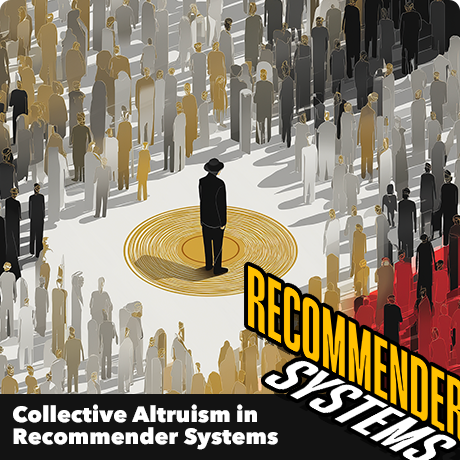
Collective Altruism in Recommender Systems
Ekaterina (Kat) Fedorova from MIT EECS joins us to discuss strategic learning in recommender systems—what happens when users collectively coordinate to game recommendation algorithms. Kat's research reveals surprising findings: algorithmic "protest movements" can paradoxically help platforms by providing clearer preference signals, and the challenge of distinguishing coordinated behavior from bot
Niche vs Mainstream
Anas Buhayh discusses multi-stakeholder fairness in recommender systems and the S'mores framework—a simulation allowing users to choose between mainstream and niche algorithms. His research shows specialized recommenders improve utility for niche users while raising questions about filter bubbles and data privacy.

Healthy Friction in Job Recommender Systems
In this episode, host Kyle Polich speaks with Roan Schellingerhout, a fourth-year PhD student at Maastricht University, about explainable multi-stakeholder recommender systems for job recruitment. Roan discusses his research on creating AI-powered job matching systems that balance the needs of multiple stakeholders—job seekers, recruiters, HR professionals, and companies. The conversation explores

Fairness in PCA-Based Recommenders
In this episode, we explore the fascinating world of recommender systems and algorithmic fairness with David Liu, Assistant Research Professor at Cornell University's Center for Data Science for Enterprise and Society. David shares insights from his research on how machine learning models can inadvertently create unfairness, particularly for minority and niche user groups, even without any malicio
Video Recommendations in Industry
In this episode, Kyle Polich sits down with Cory Zechmann, a content curator working in streaming television with 16 years of experience running the music blog "Silence Nogood." They explore the intersection of human curation and machine learning in content discovery, discussing the concept of "algatorial" curation—where algorithms and editorial expertise work together. Key topics include the cold
Eye Tracking in Recommender Systems
In this episode, Santiago de Leon takes us deep into the world of eye tracking and its revolutionary applications in recommender systems. As a researcher at the Kempelin Institute and Brno University, Santiago explains the mechanics of eye tracking technology—how it captures gaze data and processes it into fixations and saccades to reveal user browsing patterns. He introduces the groundbreaking Re

Cracking the Cold Start Problem
In this episode of Data Skeptic, we dive deep into the technical foundations of building modern recommender systems. Unlike traditional machine learning classification problems where you can simply apply XGBoost to tabular data, recommender systems require sophisticated hybrid approaches that combine multiple techniques. Our guest, Boya Xu, an assistant professor of marketing at Virginia Tech, wal

Designing Recommender Systems for Digital Humanities
In this episode of Data Skeptic, we explore the fascinating intersection of recommender systems and digital humanities with guest Florian Atzenhofer-Baumgartner, a PhD student at Graz University of Technology. Florian is working on Monasterium.net, Europe's largest online collection of historical charters, containing millions of medieval and early modern documents from across the continent. The co
DataRec Library for Reproducible in Recommend Systems
In this episode of Data Skeptic's Recommender Systems series, host Kyle Polich explores DataRec, a new Python library designed to bring reproducibility and standardization to recommender systems research. Guest Alberto Carlo Maria Mancino, a postdoc researcher from Politecnico di Bari, Italy, discusses the challenges of dataset management in recommendation research—from version control issues to p
Shilling Attacks on Recommender Systems
In this episode of Data Skeptic's Recommender Systems series, Kyle sits down with Aditya Chichani, a senior machine learning engineer at Walmart, to explore the darker side of recommendation algorithms. The conversation centers on shilling attacks—a form of manipulation where malicious actors create multiple fake profiles to game recommender systems, either to promote specific items or sabotage co

Music Playlist Recommendations
In this episode, Rebecca Salganik, a PhD student at the University of Rochester with a background in vocal performance and composition, discusses her research on fairness in music recommendation systems. She explores three key types of fairness—group, individual, and counterfactual—and examines how algorithms create challenges like popularity bias (favoring mainstream content) and multi-interest b
Bypassing the Popularity Bias
Sustainable Recommender Systems for Tourism
In this episode, we speak with Ashmi Banerjee, a doctoral candidate at the Technical University of Munich, about her pioneering research on AI-powered recommender systems in tourism. Ashmi illuminates how these systems can address exposure bias while promoting more sustainable tourism practices through innovative approaches to data acquisition and algorithm design. Key highlights include leveragi

Interpretable Real Estate Recommendations
In this episode of Data Skeptic's Recommender Systems series, host Kyle Polich interviews Dr. Kunal Mukherjee, a postdoctoral research associate at Virginia Tech, about the paper "Z-REx: Human-Interpretable GNN Explanations for Real Estate Recommendations" The discussion explores how the post-COVID real estate landscape has created a need for better recommendation systems that can introduce home b
Why Am I Seeing This?
In this episode of Data Skeptic, we explore the challenges of studying social media recommender systems when exposure data isn't accessible. Our guests Sabrina Guidotti, Gregor Donabauer, and Dimitri Ognibene introduce their innovative "recommender neutral user model" for inferring the influence of opaque algorithms.
Eco-aware GNN Recommenders
In this episode of Data Skeptic, we dive into eco-friendly AI with Antonio Purificato, a PhD student from Sapienza University of Rome. Antonio discusses his research on "EcoAware Graph Neural Networks for Sustainable Recommendations" and explores how we can measure and reduce the environmental impact of recommender systems without sacrificing performance.

Networks and Recommender Systems
Kyle reveals the next season's topic will be "Recommender Systems". Asaf shares insights on how network science contributes to the recommender system field.

Network of Past Guests Collaborations
Kyle and Asaf discuss a project in which we link former guests of the podcast based on their co-authorship of academic papers.
The Network Diversion Problem
In this episode, Professor Pål Grønås Drange from the University of Bergen, introduces the field of Parameterized Complexity - a powerful framework for tackling hard computational problems by focusing on specific structural aspects of the input. This framework allows researchers to solve NP-complete problems more efficiently when certain parameters, like the structure of the graph, are "well-behav
Complex Dynamic in Networks
In this episode, we learn why simply analyzing the structure of a network is not enough, and how the dynamics - the actual mechanisms of interaction between components - can drastically change how information or influence spreads. Our guest, Professor Baruch Barzel of Bar-Ilan University, is a leading researcher in network dynamics and complex systems ranging from biology to infrastructure and be

Github Network Analysis
In this episode we'll discuss how to use Github data as a network to extract insights about teamwork. Our guest, Gabriel Ramirez, manager of the notifications team at GitHub, will show how to apply network analysis to better understand and improve collaboration within his engineering team by analyzing GitHub metadata - such as pull requests, issues, and discussions - as a bipartite graph of people
Networks and Complexity
In this episode, Kyle does an overview of the intersection of graph theory and computational complexity theory. In complexity theory, we are about the runtime of an algorithm based on its input size. For many graph problems, the interesting questions we want to ask take longer and longer to answer! This episode provides the fundamental vocabulary and signposts along the path of exploring the in
Graphs for Causal AI
How to build artificial intelligence systems that understand cause and effect, moving beyond simple correlations? As we all know, correlation is not causation. "Spurious correlations" can show, for example, how rising ice cream sales might statistically link to more drownings, not because one causes the other, but due to an unobserved common cause like warm weather. Our guest, Utkarshani Jaimini,
Power Networks
Unveiling Graph Datasets
Network Manipulation
In this episode we talk with Manita Pote, a PhD student at Indiana University Bloomington, specializing in online trust and safety, with a focus on detecting coordinated manipulation campaigns on social media. Key insights include how coordinated reply attacks target influential figures like journalists and politicians, how machine learning models can detect these inauthentic campaigns using stru
The Small World Hypothesis
Kyle discusses the history and proof for the small world hypothesis.
Thinking in Networks
Kyle asks Asaf questions about the new network science course he is now teaching. The conversation delves into topics such as contact tracing, tools for analyzing networks, example use cases, and the importance of thinking in networks.

Fraud Networks
In this episode we talk with Bavo DC Campo, a data scientist and statistician, who shares his expertise on the intersection of actuarial science, fraud detection, and social network analytics. Together we will learn how to use graphs to fight against insurance fraud by uncovering hidden connections between fraudulent claims and bad actors. Key insights include how social network analytics can dete

Criminal Networks
In this episode we talk with Justin Wang Ngai Yeung, a PhD candidate at the Network Science Institute at Northeastern University in London, who explores how network science helps uncover criminal networks. Justin is also a member of the organizing committee of the satellite conference dealing with criminal networks at the network science conference in The Netherlands in June 2025. Listeners will l

Graph Bugs
In this episode today's guest is Celine Wüst, a master's student at ETH Zurich specializing in secure and reliable systems, shares her work on automated software testing for graph databases. Celine shows how fuzzing—the process of automatically generating complex queries—helps uncover hidden bugs in graph database management systems like Neo4j, FalconDB, and Apache AGE. Key insights include how st

Organizational Network Analysis
In this episode, Gabriel Petrescu, an organizational network analyst, discusses how network science can provide deep insights into organizational structures using OrgXO, a tool that maps companies as networks rather than rigid hierarchies. Listeners will learn how analyzing workplace collaboration networks can reveal hidden influencers, organizational bottlenecks, and engagement levels, offering a
Organizational Networks
Is it better to have your work team fully connected or sparsely connected? In this episode we'll try to answer this question and more with our guest Hiroki Sayama, a SUNY Distinguished Professor and director of the Center for Complex Systems at Binghamton University. Hiroki delves into the applications of network science in organizational structures and innovation dynamics by showing his recent

Networks of the Mind
A man goes into a bar… This is the beginning of a riddle that our guest, Yoed Kennet, an assistant professor at the Technion's Faculty of Data and Decision Sciences, uses to measure creativity in subjects. In our talk, Yoed speaks about how to combine cognitive science and network science to explore the complexities and decode the mysteries of the human mind. The listeners will learn how network s

LLMs and Graphs Synergy
In this episode, Garima Agrawal, a senior researcher and AI consultant, brings her years of experience in data science and artificial intelligence. Listeners will learn about the evolving role of knowledge graphs in augmenting large language models (LLMs) for domain-specific tasks and how these tools can mitigate issues like hallucination in AI systems. Key insights include how LLMs can leverage k

A Network of Networks
In this episode, Bnaya Gross, a Fulbright postdoctoral fellow at the Center for Complex Network Research at Northwestern University, explores the transformative applications of network science in fields ranging from infrastructure to medicine, by studying the interactions between networks ("a network of networks"). Listeners will learn how interdependent networks provide a framework for understand

Auditing LLMs and Twitter
Our guests, Erwan Le Merrer and Gilles Tredan, are long-time collaborators in graph theory and distributed systems. They share their expertise on applying graph-based approaches to understanding both large language model (LLM) hallucinations and shadow banning on social media platforms. In this episode, listeners will learn how graph structures and metrics can reveal patterns in algorithmic behavi

Fraud Detection with Graphs
In this episode, Šimon Mandlík, a PhD candidate at the Czech Technical University will talk with us about leveraging machine learning and graph-based techniques for cybersecurity applications. We'll learn how graphs are used to detect malicious activity in networks, such as identifying harmful domains and executable files by analyzing their relationships within vast datasets. This will include the

Optimizing Supply Chains with GNN
Thibaut Vidal, a professor at Polytechnique Montreal, specializes in leveraging advanced algorithms and machine learning to optimize supply chain operations. In this episode, listeners will learn how graph-based approaches can transform supply chains by enabling more efficient routing, districting, and decision-making in complex logistical networks. Key insights include the application of Graph Ne

The Mystery Behind Large Graphs
Our guest in this episode is David Tench, a Grace Hopper postdoctoral fellow at Lawrence Berkeley National Labs, who specializes in scalable graph algorithms and compression techniques to tackle massive datasets. In this episode, we will learn how his techniques enable real-time analysis of large datasets, such as particle tracking in physics experiments or social network analysis, by reducing st

Customizing a Graph Solution
In this episode, Dave Bechberger, principal Graph Architect at AWS and author of "Graph Databases in Action", brings deep insights into the field of graph databases and their applications. Together we delve into specific scenarios in which Graph Databases provide unique solutions, such as in the fraud industry, and learn how to optimize our DB for questions around connections, such as "How are th

Graph Transformations
In this episode, Adam Machowczyk, a PhD student at the University of Leicester, specializes in graph rewriting and its intersection with machine learning, particularly Graph Neural Networks. Adam explains how graph rewriting provides a formalized method to modify graphs using rule-based transformations, allowing for tasks like graph completion, attribute prediction, and structural evolution. Bridg

Networks for AB Testing
In this episode, the data scientist Wentao Su shares his experience in AB testing on social media platforms like LinkedIn and TikTok. We talk about how network science can enhance AB testing by accounting for complex social interactions, especially in environments where users are both viewers and content creators. These interactions might cause a "spillover effect" meaning a possible influence acr

Lessons from eGamer Networks
Alex Bisberg, a PhD candidate at the University of Southern California, specializes in network science and game analytics, with a focus on understanding social and competitive success in multiplayer online games. In this episode, listeners can expect to learn from a network perspective about players interactions and patterns of behavior. Through his research on games, Alex sheds light on how netwo

Github Collaboration Network
In this episode we discuss the GitHub Collaboration Network with Behnaz Moradi-Jamei, assistant professor at James Madison University. As a network scientist, Behnaz created and analyzed a network of about 700,000 contributors to Github's repository. The network of collaborators on GitHub was created by identifying developers (nodes) and linking them with edges based on shared contributions to t

Graphs and ML for Robotics
We are joined by Abhishek Paudel, a PhD Student at George Mason University with a research focus on robotics, machine learning, and planning under uncertainty, using graph-based methods to enhance robot behavior. He explains how graph-based approaches can model environments, capture spatial relationships, and provide a framework for integrating multiple levels of planning and decision-making.

Graphs for HPC and LLMs
We are joined by Maciej Besta, a senior researcher of sparse graph computations and large language models at the Scalable Parallel Computing Lab (SPCL). In this episode, we explore the intersection of graph theory and high-performance computing (HPC), Graph Neural Networks (GNNs) and LLMs.

Graph Databases and AI
In this episode, we sit down with Yuanyuan Tian, a principal scientist manager at Microsoft Gray Systems Lab, to discuss the evolving role of graph databases in various industries such as fraud detection in finance and insurance, security, healthcare, and supply chain optimization.

Network Analysis in Practice
Our new season "Graphs and Networks" begins here! We are joined by new co-host Asaf Shapira, a network analysis consultant and the podcaster of NETfrix – the network science podcast. Kyle and Asaf discuss ideas to cover in the season and explore Asaf's work in the field.

Animal Intelligence Final Exam
Join us for our capstone episode on the Animal Intelligence season. We recap what we loved, what we learned, and things we wish we had gotten to spend more time on. This is a great episode to see how the podcast is produced. Now that the season is ending, our current co-host, Becky, is moving to emeritus status. In this last installment we got to spend a little more time getting to know Becky and

Process Mining with LLMs
David Obembe, a recent University of Tartu graduate, discussed his Masters thesis on integrating LLMs with process mining tools. He explained how process mining uses event logs to create maps that identify inefficiencies in business processes. David shared his research on LLMs' potential to enhance process mining, including experiments evaluating their performance and future improvements using Ret

Open Animal Tracks
Our guest today is Risa Shinoda, a PhD student at Kyoto University Agricultural Systems Engineering Lab, where she applies computer vision techniques. She talked about the OpenAnimalTracks dataset and what it was used for. The dataset helps researchers predict animal footprint. She also discussed how she built a model for predicting tracks of animals. She shared the algorithms used and the accurac

Bird Distribution Modeling with Satbird
This episode features an interview with Mélisande Teng, a PhD candidate at Université de Montréal. Her research lies in the intersection of remote sensing and computer vision for biodiversity monitoring.

Ant Encounters
In this interview with author Deborah Gordon, Kyle asks questions about the mechanisms at work in an ant colony and what ants might teach us about how to build artificial intelligence. Ants are surprisingly adaptive creatures whose behavior emerges from their complex interactions. Aspects of network theory and the statistical nature of ant behavior are just some of the interesting details you'll

Computing Toolbox
This season it's become clear that computing skills are vital for working in the natural sciences. In this episode, we were fortunate to speak with Madlen Wilmes, co-author of the book "Computing Skills for Biologists: A Toolbox". We discussed the book and why it's a great resource for students and teachers. In addition to the book, Madlen shared her experience and advice on transitioning from aca

Biodiversity Monitoring
In this episode, we talked shop with Hager Radi about her biodiversity monitoring work. While biodiversity modeling may sound simple, count organisms and mark their location, there is a lot more to it than that! Incomplete and biased data can make estimations hard. There are also many species with very few observations in the wild. Using machine learning and remote sensing data, scientists can bui

Hacking the Colony
Today, Ashay Aswale and Tony Lopez shared their work on swarm robotics and what they have learned from ants. Robotic swarms must solve the same problems that eusocial insects do. What if your pheromone trail goes cold? What if you're getting bad information from a bad-actor within the swarm? Answering these questions can help tackle serious robotic challenges. For example, a swarm of robots can lo

Primate Poses
During this season we have talked with researchers working to utilize machine learning for behavioral observations. In previous episodes, you have heard about the software people like Richard use, but you haven't heard much from scientists modifying and using these tools for specific research cases. PhD student, Richard Vogg, is working with multi-camera set-ups to track lemurs and macaques solvin

Generating 3D Animals with YouDream
Generative AI can struggle to create realistic animals and 2D representations often have mistakes like extra limbs and tails. If 2D wasn't hard enough, there are researchers working on generative 3D models. 3D models present an extra challenge because there is paucity of training datasets.In this episode, PhD students Sandeep and Oindrila walked us through their work on creating 3D animals using 2

Weird Communication
Today, we sat down with Dr. Ignacio Escalante Meza to learn about opiliones and treehoppers. Opiliones, known as "daddy long legs" in the US, are understudied arachnids known for their tenacious locomotor behavior, sociality, and chemical communication. Treehoppers communicate through the stems of plants using vibrations. They can signal danger, attract mates, and communicate with their offspring.

Reducing the Impact of Ship Noise on Marine Mammals
Human shipping operations have increased significantly in the past few decades. While that means international trade and cheap goods for humans, it also means the ocean has experienced an increase in noise pollution. This has a measurable negative impact on marine mammals and other aquatic life. Could mathematics be the solution? This interview explores how optimization techniques can guide vo

Analysis of Unstructured Data
Robbie Moon from the Georgia Tech Scheller College of Business joins us to discuss the analysis of unstructured data and the application of NLP methodologies towards financial data.

iNaturalist
Have you ever participated in citizen science? Do you want to? One of the most popular platforms for crowdsourcing biodiversity data is iNaturalist. In addition to being a great science tool, the iNaturalist app can help you identify the organisms you encounter every day. We talked to Executive Director Scott Laurie about how scientists use iNaturalist. We also got to discuss what makes iNaturalis

Learn to Code
Do you code or are you interested in learning to code? Join us today and hear from three individuals that are at very different stages of their coding journeys. Becky Hansis-O'Neill (also our co-host this season) shares her experiences as a newbie who wants to learn more. Dr. Malia Gehan, a self-taught developer interested in studying plant phenotypes, explains why and how she and her colleagues l

Animal Computer Interaction
You've heard of Human Computer Interaction (HCI), now get ready for Animal Computer Interaction (ACI). Ilyena has made a career developing computer interfaces for non-human animals. She has worked with dogs, parrots, primates, and even giraffes. This is challenging because animals have a wide range of abilities and preferences. Parrots, for example, use their tongues to make selections on touchscr

Ape Gestures
Cat observes great apes in the wild and in the lab to crack the code of their gestural communication. We discussed the challenges and benefits of studying apes in the wild vs in the lab. Cat also shared how her lab identifies and studies ape gestures. It turns out that humans are pretty good at guessing what apes are trying to communicate with one another. Join us in this episode to learn more abo

Evaluating AI Abilities
In this episode, Kozzy discusses his endeavors to compare the cognitive abilities of humans, animals, and AI programs. Specifically, we discussed object permanence, the ability to understand an object still exists in space even when you can't see it. Our conversation traverses both philosophical and practical questions surrounding AI evaluation. We also learned about Animal AI 3, a gaming environm