HomePodcastsAncient Egypt: The Civilization That Built the Impossible — Fexingo History
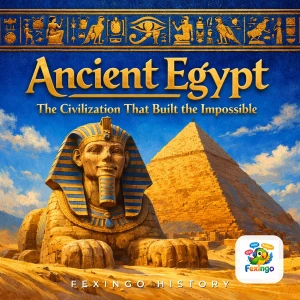
Ancient Egypt: The Civilization That Built the Impossible — Fexingo History
Fexingo128 EpisodesOct 12, 2026
Ancient Egypt was not a single, static civilization but a 3,000-year arc of empire, innovation, and collapse. From the unification of Upper and Lower Egypt under Narmer (c. 3100 BCE) to the Ptolemaic dynasty’s end with Cleopatra VII (30 BCE), this show traces every dynasty, every pharaoh, and every monument that still defies explanation. Hosts Lucas and Luna guide listeners through the Old Kingdom pyramid builders—Khufu, Khafre, and Menkaure—whose Great Pyramid of Giza remained the tallest human-made structure for nearly 4,000 years. They explore the Middle Kingdom’s literary renaissance, the New Kingdom’s imperial zenith under Hatshepsut, Thutmose III, and Ramesses II, and the Amarna Period’s religious revolution led by Akhenaten and Nefertiti. The show does not shy from controversy: how were the pyramids built? Why did the Old Kingdom collapse? Did Ramesses II really win the Battle of Kadesh? It also delves into daily life, from the role of the Nile in agriculture to the Book of the Dead’s spells for the afterlife, and the enduring mysteries of KV62—Tutankhamun’s tomb.
Episodes
The Lost Tomb of Djoser: Imhotep’s First MasterpieceOct 12, 20268:40We leave behind the towering pyramids of Giza and travel back to Saqqara, where the ground was flat and the sky was open. This episode explores the Step Pyramid of Djoser, the very first monumental stone building in human history. Built around 2630 BCE for Pharaoh Djoser, this six-tiered structure was not just a tomb but a radical experiment in engineering that changed the world forever. We focus
How Ancient Egypt Fed a Million WorkersOct 11, 20269:27We often picture the pyramids as monuments of slave labor, but the reality at Giza was far more complex and humane. In this episode, we explore the archaeological evidence from the workers' village at Heit el-Ghurab and the bakeries discovered by Mark Lehner and Zahi Hawass. We discuss how the Egyptian state organized a massive logistical network to feed tens of thousands of skilled laborers with
The Sea Peoples: Egypt’s Last Stand Against the Bronze Age CollapseOct 10, 20267:52In 1177 BCE, the Mediterranean world teetered on the brink of total collapse. While many know of the Hittites and Mycenaeans falling to invasion, few realize how closely Ancient Egypt came to joining them. This episode explores the reign of Ramesses III and the desperate defense at the Nile Delta against the mysterious coalition known as the Sea Peoples. We dive into the detailed reliefs at Medine
The Lost Army of Cambyses: Egypt's Desert MysteryOct 9, 20268:43In 525 BCE, the Persian Emperor Cambyses II launched a campaign into the Western Desert with an army estimated at 50,000 men. According to Herodotus, a massive sandstorm swallowed them whole, leaving no trace behind. But was it divine wrath or military incompetence? We explore the archaeological evidence from the Kharga Oasis and the Oases Route, examining how Egyptian border guards and Medjay uni
The Lost Army of Cambyses: Egypt's Desert MysteryOct 8, 20269:35In this episode, we explore one of ancient history’s most enduring mysteries: the disappearance of Pharaoh Cambyses II’s massive army in the Libyan Desert around 525 BCE. While Herodotus famously attributed their loss to a sudden sandstorm sent by divine wrath, modern archaeology and geology offer a different perspective on how a force of tens of thousands could vanish without a trace. We examine
The Lost City of Amarna: Akhenaten's Radical ExperimentOct 7, 20268:39In Episode 255, Lucas and Luna travel to the middle of the Eighteenth Dynasty to uncover the story of Akhetaten, the city built from scratch by Pharaoh Akhenaten. After decades of focusing on traditional religious centers like Thebes and the legacy of Amenhotep III, this episode explores the abrupt shift in power when Amenhotep IV changed his name to honor the Aten, the sun disk. We examine the ar
The Lost City of Aten: Akhenaten’s Radical New CapitalOct 6, 20266:10In Episode 254, we leave behind the traditional centers of Thebes and Memphis to explore Amarna, the short-lived capital built by Pharaoh Akhenaten around 1346 BCE. After his radical religious shift away from Amun toward the worship of the Aten, or sun disk, Akhenaten chose a virgin site on the east bank of the Nile, naming it Akhetaten, meaning Horizon of the Aten. This episode details the rapid
The First Women of Egypt: Hatshepsut and NefertitiOct 5, 20265:02While we’ve covered the political maneuvering of the New Kingdom in previous episodes, this episode focuses on the extraordinary reigns of two women who defied the gendered structures of ancient Egyptian kingship. We explore how Hatshepsut, ruling as pharaoh during the 15th century BCE, utilized the title 'per-aa' to legitimize her rule, commissioning massive monuments at Deir el-Bahari that portr
The Scorpion King: Myth, Reality, and Early UnificationOct 4, 20266:05Long before the pyramids rose or the Nile’s floods were fully tamed, a figure known as Scorpion ruled over a fragmented Egypt. Episode 252 peels back the layers of legend surrounding King Scorpion II of Dynasty Zero to examine the Narmer Palette’s hidden origins and the archaeological evidence from Tomb U at Abydos. We explore how this elusive ruler might have laid the groundwork for Narmer’s even
The Hyksos Invasion That Shattered Ancient EgyptOct 3, 20269:19Most people know the Great Pyramids, but few realize that around 1650 BCE, the Nile Valley fell to foreign invaders known as the Hyksos. This episode explores the Second Intermediate Period, a time when the central authority of the pharaohs collapsed and rulers from the Levant took control of the Delta. We trace how these outsiders, led by figures like Salitis and Apophis, didn't just conquer Egyp
The Lost Pharaoh: Akhenaten's Radical MonotheismOct 2, 20267:25In this episode, we uncover the radical religious revolution led by Amenhotep IV, who renamed himself Akhenaten and sought to replace Egypt’s polytheistic pantheon with the worship of a single sun disk, the Aten. We trace his sudden shift from traditional Amun cults to a new capital at Amarna, exploring how he dismantled centuries of theological tradition. Lucas and Luna discuss the evidence left
The Great Famine Stele: Myth vs RealityOct 1, 20266:16In Episode 249, Lucas and Luna investigate the Djoser Famine Stele from Elephantine Island. While traditionally attributed to King Djoser of the Third Dynasty, modern scholarship reveals it as a Late Ptolemaic invention designed to justify temple privileges. We explore how Imhotep, originally a vizier and architect of the Step Pyramid, was deified over centuries into a god of healing and wisdom. T
Egypt's Forgotten Plague: The Minoan EruptionSep 30, 202610:11In Episode 248, Lucas and Luna explore the catastrophic volcanic eruption of Thera around 1600 BCE and its ripple effects on Ancient Egypt. While most histories focus on the Sea Peoples or Hyksos invasions, this episode examines how a disaster in the Aegean triggered economic shifts, diplomatic crises, and religious upheaval that reached all the way to the Nile Delta. We look at the Akhenaten conn
The Great Famine Stele: Egypt’s Myth and RealitySep 29, 20268:10While the pyramids of Giza dominate popular imagination, a lesser-known monument in the Aswan Museum tells a different story. The Stela of Papyrus reveals how Pharaoh Djoser supposedly survived a seven-year famine by diverting the Nile’s flow at Elephantine. Historians have long debated whether this text reflects actual Middle Kingdom memories or New Kingdom propaganda designed to legitimize later
The Scribe's Burden: How Writing Built Ancient EgyptSep 28, 20268:41We often picture the pyramids and pharaohs when we think of ancient Egypt, but the real engine of their civilization was a quiet profession: the scribe. In this episode, we explore how literacy became the ultimate currency of power in the Nile Valley. We dive into the Satire of the Trades, a satirical text that reveals just how much society revered those who could read and write. You will hear abo
Nefertiti: The Woman Who Ruled EgyptSep 27, 20267:09In this episode of the Fexingo History podcast, Lucas and Luna explore the enigmatic life of Nefertiti, the Great Royal Wife who may have ruled as Pharaoh herself. Moving beyond her famous bust and marriage to Akhenaten, we examine the Amarna Period and the radical religious shift toward Atenism. We look at archaeological evidence from Deir el-Bahari and the tomb of Ay, alongside the controversial
The Scribe's Burden: Literacy and Power in Ancient EgyptSep 26, 20267:33While we often marvel at the monumental architecture of ancient Egypt, the true engine of its civilization was not stone, but ink. This episode explores the critical role of the scribe, or sesh, in maintaining the complex bureaucracy of the pharaohs. We examine the rigorous training at the House of Life, the practical wisdom found in texts like the Satire of the Trades, and how literacy became a g
The Hyksos: Egypt's Forgotten Chariot RevolutionSep 25, 20269:29For decades, Egyptian history was written by the victors who followed the invaders. When the Hyksos seized Avaris during the Second Intermediate Period, they didn't just occupy land; they fundamentally altered the military and cultural landscape of the Nile Valley. This episode explores how a foreign dynasty introduced the horse-drawn chariot and composite bow to Egypt, technologies that would eve
The Bronze Age Collapse: Egypt’s Last StandSep 24, 20268:24In the late thirteenth century BCE, a sudden, violent wave of upheaval swept across the Eastern Mediterranean. While most kingdoms fell to the Sea Peoples or internal revolt, the Egyptian Empire under Ramesses III managed to survive, barely. This episode explores the final great battle of the Bronze Age at the Nile Delta, where Egyptian forces faced a coalition of displaced warriors from the Aegea
The Medjay: Egypt's Elite Border GuardsSep 23, 20267:59Long before the Pharaohs ruled from Thebes, a people known as the Medjay inhabited the eastern Sahara and controlled the vital trade routes into Nubia. Originally feared warriors who were defeated by Mentuhotep II, they were eventually absorbed into the Egyptian state apparatus, evolving from enemies into the elite police force of the Middle Kingdom. This episode explores their transformation, the
The Priest Who Stole Egypt’s Greatest TreasureSep 22, 20269:49In 1820, a Greek-Egyptian antiquities dealer named Giovanni Belzoni pulled off the most audacious heist in Egyptian history by dragging a twenty-four-ton granite colossus out of the Ramesseum. This episode traces that daring expedition and places it within the broader context of ancient funerary practices, specifically the clandestine reburials in the Valley of the Queens. We explore how high prie
The Royal Tombs of the Valley of KingsSep 21, 20267:01While we’ve explored the political intrigues of the Hyksos, the naval battles of Actium, and the spy networks of the Medjay, today we descend into the earth itself. This episode examines the engineering marvels and ritual significance of the New Kingdom royal tombs in the Valley of the Kings. We trace the evolution from the simple shafts of the Eighteenth Dynasty to the elaborate, hidden corridors
The First True Peace Treaty: Egypt and the HittitesSep 20, 20268:28In 1259 BCE, after decades of border skirmishes and the chaotic stalemate at Kadesh, Egypt and the Hittite Empire faced a choice between endless war or diplomacy. This episode explores the signing of the Silver Treaty, the first recorded peace agreement in human history. We examine how Ramesses II and Muwatalli II, rivals turned allies, negotiated terms that secured their borders against common th
Narmer's Palette and the Birth of Egyptian KingshipSep 19, 20269:53We often think of ancient Egypt as a static, unchanging civilization that emerged fully formed from the desert sands. But in reality, it was forged in the fires of conflict during the late fourth millennium BCE, when rival Nomes clashed for dominance along the Nile. This episode traces the violent consolidation of power under King Narmer, whose iconic serekh and ceremonial palette reveal more than
The First Peace Treaty: Egypt and the HittitesSep 18, 20269:31While we’ve explored Egypt’s military might through the Hyksos invasions and Ramesses II’s stand at Kadesh, this episode shifts focus to what happened after the smoke cleared. We dive into the aftermath of the Battle of Kadesh in 1274 BCE, a clash that nearly destroyed both empires but instead led to history’s first recorded international peace treaty. Lucas and Luna examine the diplomatic letters
The First Spy: Egypt's Medjay and Border ControlSep 17, 20266:57Long before modern intelligence agencies existed, Ancient Egypt relied on the Medjay for border security and internal policing. Originally nomadic warriors from Nubia who became imperial police under the Middle Kingdom, these men guarded gold mines, suppressed rebellions, and served as the pharaoh’s eyes in the desert. This episode explores how a group of former enemies transformed into the backbo
Egypt's Lost Gold: The Punt Expedition That Changed TradeSep 16, 20266:37In 1493 BCE, Queen Hatshepsut launched a massive naval expedition to the Land of Punt, a mysterious region likely located in modern-day Eritrea or Somalia. This episode explores the archaeological and textual evidence behind this legendary voyage, focusing on the reliefs at Deir el-Bahari which depict exotic goods like myrrh trees, living baboons, and leopard skins. We examine how this trade missi
The Lost City of Alexandria: Unearthing HeracleionSep 15, 20266:56In this episode, we leave the banks of the Nile to dive beneath the waves of Aboukir Bay. For centuries, the ancient port city of Heracleion was considered myth or lost entirely after its sinking in the early centuries AD. But modern underwater archaeology has changed that narrative. We follow the work of Franck Goddio and his team as they uncover a civilization preserved in silt and salt. The epi
Nile Deltas and the Hyksos Chariot RevolutionSep 14, 20269:32We left off with the dramatic fall of the Hyksos, but we haven’t looked at the landscape that made their invasion possible in the first place. This episode explores the First Delta Period, focusing on the city of Avaris and its role as a cultural bridge between Egypt and the Levant. We examine how the Hyksos didn't just conquer; they integrated, introducing the horse-drawn chariot and composite bo
The Pharaoh Who Tried to Erase His StepsonSep 13, 20268:41In this episode of Ancient Egypt, Lucas and Luna explore the complex legacy of Hatshepsut, the woman who ruled as pharaoh for over two decades. While previous episodes touched on her reign, we dive deeper into the aftermath: why her successor, Thutmose III, initially honored her but later ordered the systematic destruction of her monuments. We examine the political motivations behind this erasure
The Hittite Siege of Kadesh: Ramesses II's Impossible StandSep 12, 202610:03In this episode, we leave the quiet tombs and library halls behind to stand on the dusty banks of the Orontes River in 1274 BCE. We explore the Battle of Kadesh, a clash that defined the Late Bronze Age and pitted Egypt’s Ramesses II against the Hittite Empire’s Muwatalli II. You will hear about the intelligence failure that nearly cost Ramesses his throne, the desperate counterattack by the Royal
Hatshepsut's Lost Dynasty: The Woman Who Became PharaohSep 11, 202610:54Most people know Cleopatra, but few recall Hatshepsut, the woman who ruled Egypt as a male pharaoh for over twenty years and built one of its most stunning monuments. In this episode, we uncover how she navigated the rigid gender norms of New Kingdom Egypt to claim the double crown, commissioning colossal statues in her own image while maintaining the traditional trappings of kingship. We explore
The Hyksos: Egypt’s Lost Dynasty and Chariot RevolutionSep 10, 20264:41For centuries, Herodotus and Manetho wrote of the Hyksos as foreign invaders who conquered Egypt during the Second Intermediate Period, bringing chaos and new warfare technologies. But recent archaeological work at Avaris tells a different story—one of gradual migration, cultural fusion, and technological exchange rather than sudden invasion. In this episode, we explore how these Levantine rulers
The Lost Queens of Egypt's First DynastySep 9, 20268:40While history remembers the pharaohs, the women who stood beside them in Egypt’s First Dynasty wielded power that was both sacred and political. This episode explores the lives of Queen Neith, Merneith, and Queen Meresankh, whose titles like 'Mother of the King' and 'One Who Sees Horus' reveal a complex hierarchy where royal women were central to state legitimacy. We examine the tomb at Abydos kno
The Hyksos: Egypt's Foreign Dynasty and Chariot RevolutionSep 8, 20268:51While earlier episodes touched on the Hyksos as invaders, this episode explores their profound cultural integration and military innovation during the Second Intermediate Period. We examine the Fifteenth Dynasty’s capital at Avaris, where Semitic settlers transformed Egyptian warfare with the composite bow and horse-drawn chariot. Lucas and Luna discuss how these foreign rulers adopted Egyptian ti
Egypt's Bronze Age Spies and the First International TreatiesSep 7, 20268:08While we often imagine ancient Egypt through pyramids and pharaohs, its true power lay in diplomacy and intelligence. This episode explores the complex web of international relations during the New Kingdom, focusing on the Amarna Letters found at Tell el-Amarna. We examine how Egyptian scribes decoded messages from Babylon, Mitanni, and Hatti, revealing a world of political intrigue, marriage alli
Ancient Egypt's Secret Police: The MedjaySep 6, 20266:37While we often associate ancient Egypt with pharaohs and pyramids, the true guardians of order were the Medjay. This episode traces their evolution from desert warriors to the elite police force of the New Kingdom. We explore how these Nubian scouts became the standard for law enforcement, protecting royal tombs in Deir el-Medina and patrolling the Nile Delta. Through analysis of administrative pa
Egypt's Forgotten Pharaohs: The Hyksos and the Chariot RevolutionSep 5, 20268:57Most people think of ancient Egypt as a static civilization, unchanging for millennia. But Episode 223 reveals how a foreign invasion in the Second Intermediate Period shattered that illusion. We explore the Hyksos, a Semitic-speaking group who seized power in the Nile Delta and introduced technologies that would permanently alter warfare in the ancient world. Lucas and Luna discuss the chaos of t
The Lost Library of Alexandria: Burning KnowledgeSep 4, 20266:59We step away from the desert tombs and into the marble halls of the Ptolemaic capital to explore the Library of Alexandria. For centuries, it was imagined as a single building consumed by fire, but the reality is far more complex and human. We trace the lives of scholars like Eratosthenes, who mapped the earth, and Hypatia, whose murder marked the end of an era. Through papyrus fragments and Roman
The Forgotten Scribes of Deir el-MedinaSep 3, 20268:10While the pyramids and pharaohs dominate our imagination, the true heartbeat of ancient Egypt lay in a small, walled village called Deir el-Medina. This episode explores the daily lives of the artisans who built the Valley of the Kings, focusing on the women whose literacy and economic power have largely been erased from history. We examine the ostraca fragments that reveal how these scribes manag
Cleopatra's Lost Fleet: The Naval Battle of ActiumSep 2, 20269:46We often remember Cleopatra for her beauty and her romances with Julius Caesar and Mark Antony, but her true power lay in her mastery of the Mediterranean sea lanes. In this episode, we leave the stone monuments of Giza and the desert quarries behind to sail into the chaotic final years of the Roman Republic. We explore how Egypt’s naval supremacy, built on decades of trade and diplomacy, became i
The Hyksos Invasion: Egypt's Lost DynastySep 1, 20268:42Around 1650 BCE, the Nile Valley faced an existential crisis that shattered the stability of the Middle Kingdom. This episode explores the arrival of the Hyksos, a group of Western Asian migrants who seized control of the Delta and established their capital at Avaris. We examine how they introduced the horse-drawn chariot, composite bow, and bronze weapons to Egypt, transforming warfare forever. W
The Goose that Guarded Karnak: Geese of AmunAug 31, 20267:34Long before the goose became a farmyard cliché, it was a sacred bird with a divine job description — guarding the temple of Karnak and embodying the god Amun himself. In this episode, Lucas and Luna waddle into the overlooked world of Egypt's temple geese: the priests who raised them, the labels that tracked their rations, and the sudden scandal that erupted when an official was caught pilfering a
The Nilometer: How Egypt Measured Its LifelineAug 30, 20264:59In this episode, Lucas and Luna explore the nilometer, the ancient Egyptian device used to measure the Nile's flood level. They trace its origins from simple rock markings to grand structures at Elephantine and Roda Island, and explain how these measurements determined tax rates, predicted harvests, and shaped the entire economy. The conversation also touches on the nilometer's role in religious r
The First Environmentalists: Egypt's Sacred Animal CultsAug 29, 202610:41In this episode, Lucas and Luna explore the strange and fascinating world of ancient Egypt's sacred animal cults. From the cat goddess Bastet to the crocodile god Sobek, these cults were not just about worship — they were a form of environmental stewardship. Lucas explains how temples maintained vast herds of sacred animals, how the cults influenced everything from mummification to temple economic
The Great Harris Papyrus: Egypt's Epic Legal BattleAug 28, 20268:06In this episode, Lucas and Luna delve into the Great Harris Papyrus, the largest and most detailed legal document from ancient Egypt. Discovered in a tomb near Medinet Habu, this papyrus records Pharaoh Ramesses III's massive land donations to temples, a move that consolidated priestly power and sparked a conspiracy. We examine the papyrus's creation under Ramesses IV, the famous harem conspiracy
The Rosetta Stone: How Egypt's Voices Came BackAug 27, 20264:30Before the Rosetta Stone, ancient Egypt was a world of silent monuments and unreadable script. In this episode, Lucas and Luna trace the stone's discovery in 1799, the race to decipher hieroglyphs, and the brilliant minds — Thomas Young and Jean-François Champollion — who finally cracked the code. They explore how the stone's three scripts (Greek, demotic, and hieroglyphic) provided the key, how C
The First Labor Strike in History: Deir el-Medina's WorkersAug 26, 20266:46In this episode, Lucas and Luna step away from the grand monuments to the small, dusty village of Deir el-Medina, home to the artisans who carved the royal tombs in the Valley of the Kings. They uncover the world's first recorded labor strike, a dramatic protest in 1159 BCE under Pharaoh Ramesses III, when hungry workers downed tools, marched to the mortuary temples, and demanded their grain ratio
The Lost Labyrinth of Hawara: Egypt's Greatest PuzzleAug 25, 20269:15Before the Greeks called it a wonder, a colossal mortuary temple stood beside the pyramid of Amenemhat III at Hawara, its countless halls and courtyards sprawling over six acres. Strabo saw it, Herodotus marveled at it, and then it vanished — dismantled stone by stone, its limestone stripped for Cairo's medieval buildings. In this episode, Lucas and Luna piece together what archaeology, papyri, an
The Lady of the House: Cairo's Mamluk Power BrokerAug 24, 20265:53Before the Ottomans, before the Mamluks' horse-riding sultans, there was Shajar al-Durr — a woman who seized the throne of Egypt in 1250 and held it through assassinations, crusades, and court intrigue. In this episode, Lucas and Luna explore the life of the only woman to rule Egypt in her own name since Cleopatra. We trace her rise from slave concubine to sultana, her role in the defeat of Louis
The Scorpion King's Secret: Egypt's First ScribeAug 23, 202611:06Before the pyramids, before the pharaohs, there was a moment when writing itself became power. In this episode, Lucas and Luna trace the invention of hieroglyphs back to the desert cliffs of the Eastern Desert, where a single name — Scorpion II — appears scratched into rock alongside the earliest known symbols. They explore the Narmer Palette's twin faces, the rise of the first scribal class at Ab
The Builders of the Pyramids: Lives of the Giza WorkforceAug 22, 20269:11Who really built the pyramids of Giza? Not slaves, not aliens, but a vast, well-organized workforce of Egyptian farmers, craftsmen, and laborers. In this episode, Lucas and Luna explore the lives of the pyramid builders: the seasonal conscription under Pharaoh Khufu, the workers' village of Heit el-Ghurab, the massive bakeries and breweries that fed thousands, and the medical care provided by the
The Enigma of Akhenaten: Egypt's Heretic PharaohAug 21, 20267:45In this episode, Lucas and Luna explore the reign of Akhenaten, the pharaoh who turned Egypt's religion upside down. They trace his rise as Amenhotep IV, his radical shift to worship the sun disk Aten, and his building of a new capital at Amarna. The conversation covers the suppression of Amun's priesthood, the artistic revolution that gave us the iconic Nefertiti bust, and the aftermath under Tut
The Famine Stela: Egypt's Drought and the Rise of DjoserAug 20, 20269:40When the Nile failed for seven years, Egypt faced catastrophe. This episode follows the story of Pharaoh Djoser and his adviser Imhotep as they confront a famine that threatened the very order of the Two Lands. We explore the Famine Stela, the ancient inscription that records this crisis, and what it reveals about Egyptian kingship, the priesthood of Khnum at Elephantine, and the lengths rulers wo
The Water of Osiris: How Wells Saved EgyptAug 19, 202611:19When the Nile failed, Egypt didn't just pray — it dug. In this episode, Lucas and Luna explore the ingenious wells and cisterns that kept pharaohs, priests, and ordinary people alive when the flood was weak. From the gods' own watering hole at Abydos to the great well at Buhen, they reveal how Egyptians engineered survival in a land of drought. You'll hear about the per-aa's decree to the nomarchs
The Battle of the Delta: Pharaoh's Last StandAug 18, 20268:09In the chaos of the late Bronze Age collapse, Egypt faced an existential threat: the Sea Peoples. While Ramesses III's victory at the Battle of the Delta is often celebrated as a glorious triumph, the real story is one of survival, adaptation, and the painful cost of empire. In Episode 205, Lucas and Luna unravel the mystery of the Sea Peoples—who they were, where they came from, and why they push
The Tomb Robber Trials: When Ancient Egypt Judged Its Grave ThievesAug 17, 20267:04In this episode of Ancient Egypt: The Civilization That Built the Impossible, Lucas and Luna take you into the shadowy world of the tomb robber trials of the late New Kingdom. Using the surviving papyrus records of the 'Great Tomb Robberies' — especially the Abbott Papyrus and the Amherst Papyrus — they unravel a gripping true-crime story from the reign of Ramesses IX (c. 1129–1111 BCE). You'll he
The Shadow of the Sphinx: Egypt's Lost Sky ReligionAug 16, 20268:07Lucas and Luna explore a forgotten thread in ancient Egyptian belief — the reverence for the heavens that predated the sun god Ra's dominance. From the early pyramid texts to the temple ceilings of Dendera, this episode traces how the stars, not the sun, first shaped Egypt's cosmology. They discuss the 'imperishable stars' of the northern sky, the decanal star clocks used for night hours, and the
The Scorpion King: Egypt's First ConquerorAug 15, 202615:12Before the pyramids, before the pharaohs of the First Dynasty, there was a ruler known only by a scorpion — a king who may have unified Upper Egypt and set the stage for one of history's greatest civilizations. In this episode, Lucas and Luna dig into the evidence: the macehead of Scorpion II, the ancient city of Nekhen (Hierakonpolis), and the murals at Gebel Tjauti that hint at his campaigns. Th
The Nile's Hidden Twin: Egypt's Desert Stone QuarriesAug 14, 202614:46Most Egyptology conversations stay in the Nile Valley, but the stone that built the pyramids and temples came from some of the most inhospitable places on earth. This episode ventures into the Eastern Desert to follow the ancient quarrymen who extracted granite from Aswan, sandstone from Gebel el-Silsila, and the prized golden alabaster of Hatnub. We meet the workers, the overseers, the surveyors,
The Great Pyramid's Hidden Doors: New Tech, Old SecretsAug 13, 202614:34In this 200th episode, Lucas and Luna explore the Great Pyramid of Giza through the lens of modern technology. They trace the history of exploration from the Caliph al-Ma'mun's forced tunnel in 832 CE to the discovery of the mysterious 'air shafts' by Vyse and Dixon, the 1993 robot exploration by Rudolf Gantenbrink, and the recent muon tomography that revealed a void above the Grand Gallery. The c
The Egyptian Calendar: How a River's Flood Shaped TimeAug 12, 20268:20In episode 199 of Ancient Egypt: The Civilization That Built the Impossible, Lucas and Luna dive into the origins of the ancient Egyptian calendar—a system born from the Nile's annual flood and the star Sirius. They explore the civil calendar's 365 days, the 12 months of 30 days plus five extra days, and the three seasons: Akhet, Peret, and Shemu. The conversation covers the heliacal rising of Sop
The Mummy of Ramesses II: A Pharaoh's Last JourneyAug 11, 202610:45In 1881, a cache of royal mummies was discovered at Deir el-Bahri, including the body of Ramesses II. This episode follows the mummy's journey from tomb robbery to museum display, examines the 1976 restoration in Paris (including a critical fungus infection), and recounts the 2021 'Golden Parade' through Cairo. We discuss what his mummy reveals about mummification, Egyptian kingship, and the polit
Senenmut: The Architect Who Loved a QueenAug 10, 20268:38In this episode, Lucas and Luna explore the extraordinary life of Senenmut, the commoner who became the most powerful official in Egypt during the reign of Hatshepsut. They trace his rise from humble origins to the role of steward of Amun, tutor to Princess Neferure, and overseer of the queen's grand building projects, including her mortuary temple at Deir el-Bahri. The conversation uncovers the a
The Faiyum Oasis: Egypt's Green Heart and Vanished LakeAug 9, 20267:57In this episode of Ancient Egypt: The Civilization That Built the Impossible, Lucas and Luna explore the Faiyum Oasis, a lush depression west of the Nile that became one of Egypt's most fertile and culturally rich regions. They trace its transformation from a swampy marsh into a thriving agricultural hub under the 12th Dynasty pharaohs, especially Amenemhat III, who engineered the massive irrigati
Faiyum Oasis: Egypt's Green Heart and Its Vanished LakeAug 8, 20268:41In this episode of Ancient Egypt: The Civilization That Built the Impossible, Lucas and Luna explore the lush Faiyum Oasis, a region that once rivaled the Nile in abundance. They trace its transformation from a marshy depression to a thriving agricultural powerhouse, driven by pharaohs like Amenemhat III who reshaped the landscape with massive irrigation projects. Discover the legendary Lake Moeri
The Serapeum of Saqqara: Egypt's Sacred Bull CultAug 7, 20268:46In this episode, Lucas and Luna explore the Serapeum of Saqqara, the underground burial complex dedicated to the Apis bulls, sacred animals of the god Ptah. Discover how the cult of the Apis bull became one of the most enduring and politically significant religious institutions in ancient Egypt, lasting over a millennium. The episode follows the bulls' lives in Memphis, their elaborate funerary ri
The Rosetta Stone: How Egypt's Past Was UnlockedAug 6, 20267:31In 1799, a French soldier digging near the Nile Delta unearthed a slab of black granite that would crack open three thousand years of Egyptian history. The Rosetta Stone, bearing the same decree in three scripts—hieroglyphs, Demotic, and Greek—became the key to reading a lost language. In this episode, Lucas and Luna trace the stone's journey from a fort's foundation to the British Museum, and fol
The Battle of Megiddo: Thutmose III's MasterstrokeAug 5, 20268:35In episode 192 of Ancient Egypt: The Civilization That Built the Impossible, Lucas and Luna revisit the battlefield where Thutmose III crushed a Canaanite coalition and reshaped the Near East. After covering Thutmose's reign in episode 178, they now zoom in on the day itself—May 9, 1457 BCE—when the pharaoh gambled on a narrow mountain pass at Aruna to surprise the enemy at Megiddo. They discuss t
The Memphis Toxodus: When Egypt's Old Kingdom CollapsedAug 4, 20266:54In this episode of Ancient Egypt: The Civilization That Built the Impossible, Lucas and Luna explore the First Intermediate Period—Egypt's first great collapse. They trace the reign of Pepi II, whose 94-year rule saw the Old Kingdom's power dissolve into chaos. The conversation covers the rise of nomarchs, the mysterious Toxodus I (a shadowy figure who may have seized power briefly), the famous 'A
The Great Harris Papyrus: Ramesses III's Final GiftAug 3, 20268:42Ramesses III, the last great warrior pharaoh, faced invasions, corruption, and a harem conspiracy. But his greatest legacy may be a single document: the Great Harris Papyrus, a monumental record of his reign and his gifts to the gods. This episode unpacks the papyrus's contents—its inventory of temples, lands, and people—and what it reveals about Egypt's economy, religion, and power. We also explo
Cleopatra's Egypt: The Last Pharaoh's True StoryAug 2, 20267:05In this episode, Lucas and Luna unravel the myth and reality of Cleopatra VII, the last active ruler of Ptolemaic Egypt. They explore her intelligence, political savvy, and the dramatic events that led to her downfall. From her rise to power alongside her brother Ptolemy XIII to her alliances with Julius Caesar and Mark Antony, the episode examines how Cleopatra navigated a world dominated by Rome
Ramesses II: The Battle of Kadesh Propaganda MachineAug 1, 20269:28Ramesses II is often hailed as Egypt's greatest warrior pharaoh, but the Battle of Kadesh in 1274 BCE was less a decisive victory and more a masterclass in ancient propaganda. In this episode, Lucas and Luna unpack the military reality behind the grand reliefs at Karnak and the so-called Kadesh Poem, the earliest detailed battle account we have. They explore how Ramesses transformed a near-disaste
The Amarna Letters: Ancient Egypt's Lost Diplomatic ArchiveJul 30, 20267:13In 1887, a peasant woman digging in the ruins of Akhetaten uncovered a cache of clay tablets that would transform our understanding of ancient diplomacy. These are the Amarna Letters—over 350 cuneiform tablets written in Akkadian, the lingua franca of the Bronze Age. They contain correspondence between the Egyptian court and the great powers of the era: Babylon, Assyria, Mitanni, the Hittites, and
The Land of Punt: Egypt's Mysterious Trading PartnerJul 30, 20265:37In this episode, Lucas and Luna journey to the fabled Land of Punt — a mysterious region that supplied ancient Egypt with incense, gold, and exotic goods for over a millennium. They trace the earliest known expeditions under Sahure and Mentuhotep III, then focus on the grandest of them all: Queen Hatshepsut's five-ship fleet to Punt, immortalized in reliefs at her Deir el-Bahri temple. Along the w
Akhenaten's Heresy: Egypt's Revolutionary PharaohJul 29, 20269:54In this episode, Lucas and Luna explore the radical reign of Akhenaten, the pharaoh who abandoned Egypt's traditional gods to worship the sun disk Aten. Learn how Amenhotep IV transformed into Akhenaten, built a new capital at Akhetaten (modern Amarna), and unleashed an artistic and religious revolution that shook the foundations of Egyptian society. Discover the role of Queen Nefertiti, the myste
Amenhotep III: Egypt's Golden Age of Peace and ProsperityJul 29, 20266:02Step into the reign of Amenhotep III, the ninth pharaoh of the 18th Dynasty and ruler of what many call Egypt's golden age. This episode explores his rise to power, his monumental building projects—including the Colossi of Memnon (two 60-foot statues at his mortuary temple in Kom el-Hettan) and the sprawling Malkata palace complex—and his revolutionary diplomatic policy that brought unprecedented
The Pyramid Texts: Egypt's Oldest Sacred WritingsJul 28, 20268:27In this episode of Ancient Egypt: The Civilization That Built the Impossible, Lucas and Luna explore the Pyramid Texts—the world's oldest known religious writings, inscribed on the walls of Fifth and Sixth Dynasty pyramids at Saqqara. Discover how the texts were first found in the pyramid of King Unas (c. 2375–2345 BCE), their purpose as a guide for the pharaoh's afterlife, and the shocking conten
Deir el-Medina: The Ancient Village of Egypt's Tomb BuildersJul 28, 20264:39This episode takes you behind the royal tombs of the Valley of the Kings to the village of Deir el-Medina, home to the skilled workmen who cut and decorated the pharaohs' eternal homes. We walk through their cramped houses, examine their pay records on broken pottery, and follow the world's first recorded labor strike — when the tomb builders of Ramesses III downed tools for back wages. Meet the f
The Hyksos: The Canaanite Kings Who Conquered EgyptJul 27, 20266:56Before the New Kingdom pharaohs built an empire, Egypt was ruled by foreigners: the Hyksos. These Canaanite kings from the Levant controlled the Nile Delta for over a century, introducing chariots, composite bows, and bronze weaponry that transformed Egyptian warfare. This episode explores their mysterious origins at Avaris (Tell el-Dab'a), the debate over invasion versus gradual migration, and th