HomePodcastsThe Khmer Empire's Sudden Collapse Explained — Fexingo History
The Khmer Empire's Sudden Collapse Explained — Fexingo History
Fexingo132 EpisodesOct 10, 2026
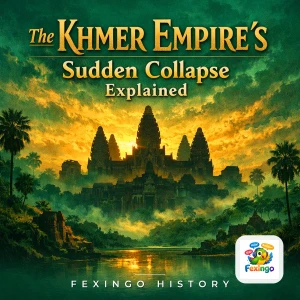
Built around the enigmatic ruins of Angkor Wat, the Khmer Empire once dominated Southeast Asia, but its sudden collapse in the 15th century remains one of history's great puzzles. Lucas and Luna guide listeners through the empire's rise under Jayavarman II, its golden age under Suryavarman II, and the gradual unraveling that followed. They examine the religious shift from Hinduism to Theravada Buddhism, the massive water management system that sustained Angkor, and the environmental stresses—droughts, floods, deforestation—that may have triggered its downfall. The show delves into the sacking by Ayutthaya in 1431, the abandonment of the capital, and the migration south to Phnom Penh. It also explores modern debates: was the collapse sudden or a slow decline? How did climate change and infrastructure failure intersect with foreign invasions? And what can the Khmer Empire's fate teach us about resilience and vulnerability in our own era of environmental change?
Episodes
The Secret War of Angkor: Chaktomuk's FallOct 10, 202610:45While previous episodes explored climate collapse and engineering failures, this episode examines the decisive political fracture that sealed Angkor’s fate. We trace the final reign of King Ponhea Yat and the strategic decision to abandon the ancient capital for Chaktomuk, or the 'Four Faces' river junction in Phnom Penh. Lucas and Luna discuss the geopolitical pressure from the rising Ayutthaya K
The Khmer Elite's Quiet Flight from AngkorOct 9, 202611:04We often picture the fall of Angkor as a dramatic military conquest or a sudden environmental catastrophe, but recent scholarship suggests a quieter, more deliberate unraveling. This episode explores the political and economic incentives that led the Khmer elite to abandon the capital city in the late fourteenth century. We examine how the shift from the Hindu-Buddhist cult of the devaraja to Ther
The Last King of Angkor's ExileOct 8, 20268:04In 1431, after decades of siege by Ayutthaya, the Khmer capital of Yasodharapura was finally abandoned. This episode explores the final days of King Ponhea Yat and the strategic decision to move the royal court south to Phnom Penh. We examine the military pressures from the Siamese kingdom, the shifting trade routes along the Mekong, and how this relocation marked not just an end, but a transforma
Angkor's Forgotten Diplomatic WarsOct 7, 20267:07We often imagine the fall of Angkor as a sudden silence, but for decades before the capital moved to Phnom Penh, it was a slow unraveling woven through court politics and foreign alliances. This episode shifts focus from climate and engineering to the human machinery of empire: the role of royal consorts and the delicate, deadly diplomacy between Kambuja and its neighbors. We trace how King Ponhea
The Rice That Starved Angkor: Climate and Crop FailureOct 6, 20266:46While previous episodes have explored the hydraulic engineering of the barays and the political shifts toward Theravada Buddhism, this episode investigates a more fundamental failure: the agricultural system itself. We examine how the Khmer Empire’s reliance on a single rice variety, Hom Mali, combined with severe drought cycles detected in lake sediment cores, led to widespread famine. Lucas trac
The Khmer Empire's Sudden Collapse ExplainedOct 5, 20265:07We explore the complex web of factors that led to the abandonment of Angkor in the late 14th and early 15th centuries. While previous episodes have covered the engineering failures of the barays, the shift from Mahayana to Theravada Buddhism, and the military pressures from Ayutthaya, this episode focuses on the critical role of diplomatic realignment and internal legitimacy crises. We examine how
Angkor's Silent Fall: The Monastic Schism That Broke Khmer PowerOct 4, 20265:53For decades, historians pointed to drought and war as the reasons Angkor fell. But a deeper fracture was happening inside the kingdom’s spiritual heart. This episode explores the intense rivalry between Mahayana Buddhist monasteries and the rising Theravada sangha in the late thirteenth century. We look at how King Indravarman III’s attempt to balance both traditions failed, leading to a bureaucra
The Great Khmer Migration: Why Angkor FellOct 3, 20268:45For centuries, the stone temples of Angkor stood as a testament to the power of the Khmer Empire, but by the early seventeenth century, the capital had been quietly abandoned. This episode moves beyond the popular narratives of drought and war to explore the human reality of the Great Migration. We examine the life of King Ponhea Yat and his decisive move from Yasodharapura to Phnom Penh in 1431,
Why Angkor’s Elite Abandoned the CityOct 2, 20267:36For centuries, historians debated whether climate change or war destroyed Angkor. But a closer look at the archaeological record suggests a different answer: the elite simply left. In this episode, we explore how the Khmer aristocracy gradually shifted their residence from the stone jungle of Yasodharapura to the riverine capital of Phnom Penh. We examine the political maneuvering of King Ponhea Y
The Khmer Empire's Sudden Collapse ExplainedOct 1, 20269:00For centuries, the grandeur of Angkor stood as a testament to human engineering and divine kingship, but by the mid-15th century, the capital was abandoned. This episode explores the final decades of the Khmer Empire’s heartland, focusing on the decisive move from Yasodharapura to Phnom Penh under King Ponhea Yat. We examine how the shifting dynamics of the Chao Phraya river system, the rise of Ay
Angkor's Trade Collapse and the Rise of AyutthayaSep 30, 20267:33For decades, historians have debated whether Angkor fell to drought, war, or religious shift. But there is another layer to the story: the empire’s economic backbone was quietly rotting from the inside out. In this episode, we look at how the Khmer Empire’s control over regional trade routes unraveled in the late fourteenth century. We explore the rise of Ayutthaya as a rival commercial power and
Angkor's Climate Crisis: The Drought That Broke the EmpireSep 29, 20267:09While previous episodes have explored the political intrigues, military sieges, and bureaucratic silences that marked Angkor’s decline, this episode shifts focus to the invisible force that ultimately made survival impossible: climate. Between 1360 and 1430 CE, Southeast Asia experienced some of the most severe droughts in its recorded history. We examine how the Khmer Empire’s massive hydraulic i
Angkor’s Rice Revolution and the Hidden CrisisSep 28, 20267:19While previous episodes have focused on military sieges, religious shifts, and water engineering failures at Angkor, this episode uncovers a quieter but equally devastating factor: the agricultural strain of over-expansion. We explore how the Khmer Empire’s reliance on wet-rice cultivation, supported by an intricate network of canals and reservoirs, became its undoing when climate patterns shifted
Angkor's Forgotten Spice Trade: The Khmer Silk RoadSep 27, 20268:02While most histories focus on the hydraulic engineering or military sieges that defined Angkor, this episode explores a different kind of infrastructure: the overland trade routes that connected the Khmer heartland to the broader Asian economy. We look at how King Jayavarman VII’s conquests opened new corridors for spices, textiles, and ideas, transforming Cambodia from a regional religious center
The Khmer Monastic Schism That Fractured AngkorSep 26, 20265:37While water management and Siamese sieges get the blame for Angkor’s decline, a quieter crisis was tearing the empire apart from within: the great schism between Mahayana and Theravada Buddhism. In this episode, we trace how King Jayavarman VII’s massive patronage of monasteries created a parallel power structure that rivaled the crown itself. When his successors tried to shift allegiance to Thera
The Khmer Bells That Outlasted an EmpireSep 25, 20268:17While historians have long debated whether the Khmer Empire fell to warfare, drought, or bureaucratic decay, a quieter artifact survived the jungle reclaiming Angkor: bronze. In this episode, we explore the lost-wax casting techniques that produced thousands of ritual bells across Southeast Asia during the height of the Khmer state. We trace how these small objects, often overlooked in favor of ma
Angkor's Forgotten War: The Khmer-Vietnamese Border ConflictSep 24, 20266:59While historians often point to climate shifts and the rise of Ayutthaya as the causes for Angkor's decline, a different kind of pressure was mounting from the east. This episode explores the forgotten border wars between the Khmer Empire and the rising Vietnamese state of Dai Viet in the late 14th and early 15th centuries. We examine how these constant low-intensity conflicts drained Khmer resour
The Khmer Monks Who Saved AngkorSep 23, 20266:26We often picture the fall of the Khmer Empire as a military defeat or an environmental disaster, but there was another force at work: the Sangha. This episode explores how Theravada Buddhist monks became the new power brokers in late 14th-century Cambodia. As kings lost their divine status through the crumbling devaraja cult, it was the monks who preserved literacy, managed land grants, and held t
Angkor's Water Crisis: The Engineering CollapseSep 22, 20267:01While previous episodes have explored the political shifts toward Theravada Buddhism and the military pressures from Ayutthaya, this episode turns to the physical infrastructure that made Angkor possible. We examine how the Khmer Empire’s massive hydraulic network—the barays and canals—became a liability rather than an asset during the late 14th and 15th centuries. Using recent LiDAR surveys and h
The Monsoon That Drowned AngkorSep 21, 20266:54For centuries, the Khmer Empire thrived on a sophisticated hydraulic network that tamed the Tonle Sap River’s dramatic seasonal swings. But by the late fifteenth century, this engineered paradise began to fail. Recent LiDAR surveys and sediment core analysis suggest the collapse wasn't just about war or political shift, but a catastrophic failure of water management triggered by extreme climate vo
The Last King of Angkor and the End of an EraSep 20, 20268:03In this episode, we explore the final chapter of the Khmer Empire through the lens of its last significant monarch, Ponhea Yat. After decades of ecological strain, shifting trade routes, and the relentless pressure from the rising Siamese kingdom of Ayutthaya, the heartland of Cambodia became untenable. We examine why Ponhea Yat made the radical decision to abandon Angkor Thom in 1431, not just as
How Khmer Bells Saved Angkor from SilenceSep 19, 20269:35When the great stone temples of Angkor fell into disuse, a different kind of monument survived: the bronze bells. This episode explores the 'Khmer Bell' tradition, where massive cast-iron and bronze bells were hung in temple courtyards and forest shrines long after the royal court moved to Phnom Penh. We trace the metallurgical ingenuity required to create these acoustic guardians, the role of loc
Angkor's Lost Bureaucracy and the Copper Plate CrisisSep 18, 20266:18We trace the quiet unraveling of the Khmer Empire not through sieges or earthquakes, but through its administrative silence. As the capital shifted south to Phnom Penh and then Udong, the massive stone inscriptions and copper-plate grants that once defined royal authority vanished. We explore how the loss of this paper trail—the copper-plate grants and Sanskrit records—signaled a deeper collapse o
The Siege of Longvek: Khmer Empire's Final StandSep 17, 20267:02While Angkor’s abandonment is often attributed to environmental shifts or the Ayutthaya sack of 1431, the true end of the Khmer imperial dream happened further south in Longvek. This episode explores the rise of this new capital, its reputation as a wealthy trading hub, and its catastrophic fall to Siamese forces in 1594. We examine how King Satha tried to modernize his military with Portuguese fi
The Day Angkor’s Water Stopped ComingSep 16, 20268:28For centuries, the Khmer Empire thrived on a sophisticated hydraulic network that tamed the Tonle Sap River. But by the late fourteenth century, something went wrong with the water itself. In this episode, we explore the environmental tipping point that silenced Angkor’s barays and canals. We look at how changing monsoon patterns and sediment buildup choked the city’s lifeblood, forcing a politica
The Secret Life of Angkor's Stone GuardiansSep 15, 20266:37We often imagine the fall of the Khmer Empire as a sudden political rupture, but the story lies in the stones themselves. This episode shifts focus from kings and treaties to the anonymous artisans who carved the bas-reliefs at Angkor Thom and the Bayon temple. We explore how these carvers, known locally as *kru*, maintained intricate guild traditions that outlasted the state bureaucracy. By exami
The Last Stone of Angkor: A King's Final DecreeSep 14, 20266:11We often talk about the collapse of Angkor in terms of climate, warfare, or trade, but we rarely look at the very last administrative breath of the empire. This episode focuses on Indravarman III, the Khmer king who ruled during the twilight years of the 14th century, right before the major sack by Ayutthaya in 1431. We examine a specific copper-plate grant from his reign that reveals a desperate
The Day the Kings Stopped Building AngkorSep 13, 20268:43While earlier episodes explored the hydraulic failures, climate shifts, and military sieges that strained the Khmer Empire, this episode examines the critical cultural turning point in the late fourteenth century. We focus on King Ponhea Yat, who made the decisive move to abandon the ancestral capital of Yasodharapura for Phnom Penh. This wasn't just a retreat; it was a fundamental shift in state
The Khmer Bureaucracy's Silent FallSep 12, 20266:37We trace the collapse of Angkor not through war or famine, but through the quiet disappearance of its administrative heartbeat. For centuries, the Khmer Empire ran on copper-plate grants and Sanskrit inscriptions that recorded land rights, tax exemptions, and royal decrees. But by the late fourteenth century, this paper trail went silent. We explore how the shift from Hindu-Buddhist statecraft to
The Khmer Bureaucracy: How Angkor’s Paper Trail Fell SilentSep 11, 20268:31We often blame the fall of Angkor on climate shifts or Siamese sieges, but there is a quieter, more structural explanation rooted in the empire’s own administrative machinery. This episode explores the intricate web of copper-plate grants and land records that sustained the Khmer state for centuries. We examine how the devaraja cult relied on a vast network of scribes and priests to legitimize roy
The Silent Fall of Angkor: Beyond the Siamese SiegeSep 10, 20267:18While popular history often blames the 1431 Ayutthaya sack for ending the Khmer Empire, this episode explores why the city was already hollowed out long before the first siege engine arrived. We examine the administrative paralysis of Indravarman III and the spiritual shift from the devaraja cult to Theravada Buddhism that eroded the centralized labor system. Lucas and Luna discuss how the loss of
Angkor's Military Collapse: The Siamese Siege of 1431Sep 9, 20269:32We often hear about Angkor’s fall as a slow fade caused by climate change or ecological mismanagement, but the final blow was delivered by sword and siege. This episode examines the devastating sack of Angkor Thom in 1431 by the Ayutthaya Kingdom under King Borommatrailokkanat. We explore how the Khmer military’s reliance on elephant warfare failed against Siamese innovations, how the breakdown of
The Khmer Empire's Sudden Collapse ExplainedSep 8, 20268:09For over six centuries, the Khmer Empire stood as Southeast Asia’s dominant power, its capital at Angkor a sprawling marvel of hydraulic engineering and spiritual devotion. But by the early fifteenth century, the city was largely abandoned, its grand temples reclaimed by jungle roots. Previous episodes have explored the climate shifts, water management failures, and Ayutthayan invasions that contr
The Khmer Empire's Sudden Collapse ExplainedSep 7, 20265:34While climate models and Ayutthaya’s military pressure explain much of Angkor’s decline, Episode 228 explores a critical internal fracture: the religious revolution that hollowed out the empire’s administrative core. We trace how the shift from the Hindu-Buddhist devaraja cult to Theravada Buddhism didn’t just change prayers—it dismantled the labor system that fed millions. Lucas and Luna examine
Angkor's Forgotten Trade Routes and Economic CollapseSep 6, 20268:27While climate change and warfare have dominated the narrative of Angkor’s decline, this episode explores a quieter, more insidious factor: the collapse of long-distance trade networks. Lucas and Luna trace how the Khmer Empire’s wealth was not just built on rice and temples, but on its position as a hub in the maritime silk road. They examine the role of the port city of Udong, the shifting allian
The Khmer Empire's Diplomatic Failure and Lost AlliesSep 5, 20269:09For centuries, the Khmer Empire dominated Southeast Asia through a complex web of alliances, trade routes, and religious diplomacy. But by the late 13th century, that network began to fracture. This episode explores how the rise of Ayutthaya in Siam and the shifting loyalties of neighboring polities like Champa and Lan Na stripped Angkor of its strategic buffer zones. We examine the critical role
Angkor's Hidden Laborers: The Workers Behind the EmpireSep 4, 20268:31We often imagine the fall of Angkor through the lens of kings, climate data, or siege warfare, but we rarely ask about the people who actually built and maintained this massive urban center. In this episode, we shift our focus from the elite to the workforce—the farmers, artisans, and laborers whose lives were dictated by the state's insatiable demand for stone and rice. We explore the concept of
Angkor's Diplomatic Failure: Why the Khmer Lost Their AlliesSep 3, 20268:36While climate and water management often dominate discussions of Angkor's decline, this episode explores a critical political failure that historians have increasingly recognized as decisive. By the late fourteenth century, the Khmer Empire under King Ramathibodi I of Ayutthaya was not just a military rival but a diplomatic predator that systematically dismantled Angkor’s network of tributary stat
Angkor's Silent Exodus: Why the City Abandoned ItselfSep 2, 20266:39For over eight centuries, Angkor served as the beating heart of the Khmer Empire, a sprawling urban complex fed by an intricate network of canals and reservoirs. But by the mid-fifteenth century, the capital was not sacked into ruin by foreign armies, nor did it fall to a single catastrophic plague or drought. Instead, historians like Michael Vickery have argued that the city simply stopped workin
The Siege of Angkor: Ayutthaya's Brutal Sack in 1431Sep 1, 20265:45While previous episodes explored the environmental and economic strains on the Khmer Empire, this episode examines the violent final chapter: the siege and sack of Angkor by the Siamese kingdom of Ayutthaya. We trace the rise of King Ramathibodi I and his successors, who shifted power from the Mekong basin to the Chao Phraya river. The narrative focuses on the military campaigns of the early 15th
The Day Angkor's Water Stopped ComingAug 31, 20266:55In this episode, Lucas and Luna examine the final decades of the Khmer Empire through the lens of Angkor's most vital resource: water. They uncover how a series of monsoon failures, combined with over-engineered canals and a failing baray system, turned the empire's greatest strength into its fatal weakness. Drawing on tree-ring data from Brendan Buckley and the Greater Angkor Project's LiDAR surv
Angkor's Lasting Shadow: The Khmer DiasporaAug 30, 202612:04When Angkor fell in 1431, the city wasn't simply abandoned—it was transformed. In this episode, Lucas and Luna trace the final chapters of the Khmer Empire through the eyes of its people, from the sacking by Ayutthaya to the quiet exodus south to Phnom Penh. They explore how Theravada Buddhism replaced the old Hindu devaraja cult, how the capital shifted with the Mekong's changing course, and what
The Sailendra Kings Who Ruled AngkorAug 29, 202610:08Before the great Khmer kings like Suryavarman II and Jayavarman VII, Angkor was briefly ruled by a foreign dynasty — the Sailendras of Java. In this episode, Lucas and Luna explore how a Javanese Buddhist empire came to dominate the Khmer heartland in the 9th century, the shadowy figure of Jayavarman II who founded Angkor, and the violent power struggles that followed his death. We trace the Saile
Angkor's Lost Rubies: The Gem Trade That Built an EmpireAug 28, 20267:38Before the barays silted and the monsoon failed, Angkor's wealth flowed not from rice alone, but from the red dirt of the Phnom Kulen hills. In this episode, Lucas and Luna dig into the quieter engine of Khmer power: the gemstone trade. They trace the journey of a single ruby from the Kulen mines to the markets of Java, Persia, and China, and follow the caravans that hauled them down the Mekong, p
Angkor's Green Desert: The Collapse of Its ForestsAug 27, 20269:19In this episode of Fexingo History, Lucas and Luna explore a surprising factor in Angkor's decline: the empire's forests. While earlier episodes focused on water management and climate, this conversation digs into the role of deforestation in the Khmer civilization's unraveling. Drawing on studies by Dan Penny and the Greater Angkor Project, they discuss how massive temple construction, iron smelt
Angkor's Vanishing Rice Fields: The Climate FactorAug 26, 20267:53In this episode of Fexingo History, Lucas and Luna examine the role of climate change in the fall of the Khmer Empire. They discuss how the monsoon patterns that sustained Angkor's complex irrigation system began to fail in the 14th century, leading to drought and floods that disrupted rice production. The conversation covers the evidence from tree ring studies by Brendan Buckley, the impact on th
Angkor's Churning Sea: A Temple Carving DecodedAug 25, 20268:08In this episode, Lucas and Luna turn to one of Angkor's most enigmatic works of art: the Churning of the Sea of Milk, a gigantic bas-relief at Angkor Wat that portrays a Hindu creation myth. The conversation unpacks the story of the devas and asuras churning the cosmic ocean with the serpent Vasuki, the mountain Mandara as a pivot, and Vishnu's turtle avatar Kurma. They explore why the Khmer kings
The Poisoned City: Saltwater and Angkor's FallAug 24, 20266:28In this episode, Lucas and Luna look at a less-known factor in Angkor's collapse: saltwater intrusion. As the great barays silted up and sea levels shifted, salt began to contaminate the Tonle Sap floodplain, poisoning the rice fields and forcing the Khmer to adjust their water management. Drawing on recent sediment core studies, they examine how the city's engineers struggled to keep fresh water
The Poisoned Rice Fields: Food Security and Angkor's FallAug 23, 20266:15In this episode, Lucas and Luna explore a fresh angle on the Khmer Empire's collapse: the silent crisis of food security. How did elaborate water management, soil degradation, and a shift to double-cropping rice set the stage for disaster? We follow the story of Yasovarman II, whose reign saw not just external threats but a growing fragility in the empire's very fields. We uncover evidence from th
Angkor's Climate Collapse: Monsoon Failures and the Khmer ExodusAug 22, 20266:52In this episode, Lucas and Luna explore how climate change—specifically weakened monsoon rains—contributed to the slow unraveling of the Khmer Empire. Drawing on tree-ring data from the Greater Angkor Project and the work of paleoclimatologist Brendan Buckley, they trace how decades of drought, followed by intense flooding, destabilized Angkor's intricate water management system. The conversation
The Leper King's Terrace: A Sculpture MysteryAug 21, 20268:45In this episode of Fexingo History, Lucas and Luna uncover the story behind Angkor's most enigmatic monument: the Terrace of the Leper King. Built in the late 12th century under Jayavarman VII, this sandstone platform is famous for its intricate carvings and the mysterious statue that gave it its name. The figure, now identified as Yama, the god of the dead, sits in a pose that has puzzled scholar
Angkor's Last King: The Silence After the FallAug 20, 202612:39When the last Sanskrit inscription was carved at Angkor in the early 1300s, the city didn't vanish overnight — it slowly emptied. This episode follows the final century of the Khmer capital, from the rise of Theravada Buddhism under Indravarman III to the erosion of the devaraja cult and the growing pressure from Ayutthaya. We piece together what life was like in those fading decades — the influx
The Poisoned Well: Angkor's Water and the Khmer CollapseAug 19, 20267:43In this episode of Fexingo History, Lucas and Luna turn to the lifeblood of Angkor: its water. Beyond the famous barays and canals, they explore the city's intricate water management system, from the East Baray to the West, and the engineering marvels that sustained a million people. But they also uncover the darker side of this hydrology — the contamination, the siltation, and the political strif
Angkor's Final Decades: The City That Outlived Its KingsAug 18, 20267:48In the decades after Jayavarman VII's death, the Khmer Empire didn't just fade—it restructured. This episode traces the late 13th and 14th centuries, when Angkor's kings abandoned the old devaraja cult, embraced Theravada Buddhism from Sri Lanka, and watched their ceremonial waterworks decay. We follow the reign of Indravarman III, the last great builder, and the rise of Ayutthaya under Ramathibod
Angkor's Last King: Jayavarman IX and the Final YearsAug 17, 20267:21In this episode, we trace the twilight of the Khmer Empire through the reign of its final monarch, Jayavarman IX. Facing the rise of Ayutthaya under Ramathibodi I, the erosion of the devaraja cult, and the shift to Theravada Buddhism, Jayavarman IX ruled over a splintering state. We revisit the last Khmer inscription, K. 1051, and consider how Angkor's wooden palaces and crumbling barays reflected
Angkor's Bronze Age: The Lost Metallurgy of Phnom BoreiAug 16, 20269:08In the centuries before Angkor Wat rose from the jungle, the Mekong Delta was already a crucible of innovation. This episode turns to the archaeological record of Phnom Borei, a walled city that flourished between the 2nd century BCE and the 5th century CE, to uncover the bronze-casting traditions that laid the groundwork for Khmer civilization. We explore the discovery of crucibles, molds, and fu
The Leper King: Angkor's Strangest StatueAug 15, 20268:42On the last day of Angkor, a statue sat on a terrace in the royal square. The Khmer called it the Leper King, but its skin was smooth. In this episode, Lucas and Luna untangle the mystery of the statue that gave the Terrace of the Leper King its name — and what it tells us about the empire's final century. They trace its possible connection to Jayavarman VII's son, Prince Indravarman, who was said
Angkor's Copper: The Metal That Shaped a CivilizationAug 14, 20268:36In this episode of Fexingo History, Lucas and Luna explore the overlooked role of copper in the Khmer Empire. While iron from Phnom Dek gets the glory, copper was the backbone of Angkor's sacred and everyday life — from the massive bronze statues of Jayavarman VII to the gilded temple roofs that dazzled Chinese envoy Zhou Daguan. We trace the copper trade routes that linked Angkor to the Lao highl
The Water War: Angkor's Canals and the Rise of AyutthayaAug 13, 20268:50In this episode, Lucas and Luna dig into a fresh angle on Angkor's collapse: the quiet but relentless competition over water infrastructure. While earlier episodes focused on megadrought, trade shifts, and disease, here we trace how the Khmer hydraulic network — the barays and canals that irrigated the rice fields and supported the capital's population — became a strategic vulnerability. We follow
The Woman Who Saved Angkor's SoulAug 12, 20268:01When Angkor's kings vanished and its temples surrendered to the jungle, one name survived in the memory of Cambodia's people: Indradevi. This episode tells the story of the scholar-queen who outlived her husband, Jayavarman VII, and became the last great voice of the Khmer Empire. We trace her journey from a royal tutor in the 12th century to the keeper of Angkor's Buddhist heart, through a period
The Temple of Preah Vihear: A Border, a Cliff, a GodAug 11, 202610:32Perched on a 525-meter cliff in the Dangrek Mountains, Preah Vihear is one of the Khmer Empire's most spectacular and least-understood monuments. Built over 200 years by seven kings, its axis runs north-south, not east-west like Angkor Wat, and its alignment was dictated by the sacred mountain Phnom Kulen. In this episode, Lucas and Luna explore the temple's architectural genius, its role in the d
Angkor's Water Crisis: The Great Baray CollapseAug 10, 20265:58In this special 200th episode, Lucas and Luna dig into one of the most overlooked factors in the fall of Angkor: the catastrophic failure of its water management system. You'll hear about the massive baray, or reservoirs, that once sustained the city, the engineering flaws that made them vulnerable, and the evidence scientists have uncovered about the final decades. Discover how the West Baray sil
The Last Khmer King: Jayavarman IX and the End of AngkorAug 9, 20269:12In this episode, Lucas and Luna explore the shadowy final years of the Khmer Empire, focusing on Jayavarman IX, the last king of Angkor, who ruled in the mid-14th century during a period of dynastic chaos, external pressure, and environmental strain. They discuss his brief reign, the collapse of the devaraja cult, the rise of Theravada Buddhism as a popular religion that undermined the god-king's
The Great Stupa of Angkor: Buddhism's Architectural AscentAug 8, 20269:45In this episode, Lucas and Luna explore how Buddhism reshaped the religious architecture of the Khmer Empire, culminating in the great stupas that replaced the towering temple-mountains of the Hindu era. They trace the transition from the devaraja cult and the construction of Angkor Wat to the rise of Theravada Buddhism under kings like Jayavarman VII and Indravarman III. The discussion highlights
The Iron Masters of Angkor: Phnom Dek and the Khmer MilitaryAug 7, 20266:02In this episode of Fexingo History, Lucas and Luna explore the crucial but often overlooked role of iron in the Khmer Empire's rise and fall. They journey to Phnom Dek, the 'Iron Mountain', where the Kuoy people practiced ancient bloomery smelting, producing the weapons that built Angkor's power. From the massive armies of Jayavarman VII to the erosion and deforestation that followed, they uncover
The Iron Harvest: Cambodia's Living MetalAug 6, 20267:26In the aftermath of Angkor's fall, a small group of Kuoy people in the Cambodian highlands carried on an ancient tradition: smelting iron the way their ancestors did for a thousand years. This episode looks at the iron harvest — the seasonal collection of laterite ore from the Phnom Dek range — and how it fed the Khmer Empire's endless demand for weapons, tools, and temple hardware. We examine the
Angkor's Army: The Khmer Military That Fought a Hundred WarsAug 5, 20269:01Long before Angkor fell to Ayutthaya in 1431, the Khmer Empire built one of Southeast Asia's most formidable military machines. In this episode, Lucas and Luna explore how the Khmer army fought on elephants, in river fleets, and across mountain passes. They talk about Jayavarman VII's campaigns against Champa, the use of war elephants and composite bows, and the logistics of feeding a massive army
Angkor's Canals: The Ghost Infrastructure of a Sunken CityAug 4, 202610:06Long after the last Khmer king left Angkor for Phnom Penh, the great city's stone temples stood abandoned, but its canals and reservoirs kept working. In this episode, Lucas and Luna follow the water through Angkor after its fall—how the baray, the moats, and the massive hydraulic network held the city together for centuries, and how the jungle slowly took it back. They examine the engineering tha
The Hidden Role of the Tonle Sap in Angkor's FallAug 3, 20266:14In this episode, Lucas and Luna dive into the surprising role of the Tonle Sap—the great lake that nourished Angkor—in the empire's final centuries. They explore how the lake's seasonal flood pulse, vital for rice farming and fish, became a liability as climate shifts and deforestation altered its behavior. Drawing on sediment cores and tree-ring data, they discuss how the megadrought of the 14th–
Angkor's Poisoned Trees: The Toxic Forest That Killed Khmer KingsAug 2, 20267:52Long before Angkor's canals silted up and its temples fell silent, something was already poisoning the empire's heart. In this episode, Lucas and Luna dig into the strange, little-known story of the Krabei River valley—a lush grove of lueang trees whose sap, when it drips into the water, turns lethal. They trace how the Khmer kings, from Indravarman III to Jayavarman VIII, unknowingly built their
Angkor's Wooden Palaces: The Architecture That VanishedAug 1, 20269:51When Zhou Daguan arrived at Angkor in 1296, he described a city of gold towers and vast stone temples. But the everyday palaces, the royal residences, the houses of the nobility — those were built of wood, and they've rotted away almost without a trace. In this episode, Lucas and Luna explore the lost wooden architecture of the Khmer Empire: how the elite lived in timber compounds that have left o
The Last Khmer Inscription What Angkor's Final Words RevealJul 31, 20266:24The Khmer Empire left behind thousands of carved stone inscriptions detailing everything from temple dedications to royal geneology. But then, in the mid-14th century, the words stopped. In this episode, Lucas and Luna examine the last known inscription from Angkor — a 1327 stele from the reign of Jayavarman IX at the temple of Preah Khan. They explore what this final text says about the empire's
Why Angkor Fell The Real Story Behind the Khmer CollapseJul 30, 20266:36The Khmer Empire didn't vanish overnight. This episode digs into the century-long decline that preceded the Siamese sack of 1431, weaving together environmental stress, economic shifts, and religious change. We follow the silt-clogged canals, the fading god-king cult, the rise of Theravada Buddhism, and the pragmatic move by King Ponhea Yat to a new capital at Phnom Penh. Drawing on recent tree-ri
Angkor's Hidden Enemy: The Disease That Helped Topple an EmpireJul 30, 20268:21This episode explores a lesser-known factor in the Khmer Empire's collapse: disease. We dive into how the elaborate water management system—the barays and canals—created ideal breeding grounds for mosquitoes, spreading malaria and dengue among the population. Recent research from the Greater Angkor Project suggests that chronic disease, combined with drought and political instability, may have sil
The Tai Migration That Reshaped Southeast AsiaJul 29, 20267:11In this episode of Fexingo History, Lucas and Luna explore how the gradual migration of Tai-speaking peoples from the north into the heartlands of the Khmer Empire fundamentally altered the political and cultural landscape of mainland Southeast Asia. We trace the rise of powerful Tai chiefdoms like Sukhothai under King Ram Khamhaeng and Lanna under King Mangrai, examine how their adoption of Thera
The Trade Route Shift That Doomed AngkorJul 29, 20264:21The fall of Angkor is usually blamed on Ayutthaya's siege or climate change, but a quieter shift in global trade may have sealed the empire's fate. In this episode, Lucas and Luna explore how the rise of maritime commerce in the 14th and 15th centuries—driven by Ming China's naval expeditions and Ayutthaya's control of the Chao Phraya delta—bypassed the inland Khmer capital. They discuss the Tonle
When Kublai Khan Came for Angkor: The Mongol Tribute That Changed an EmpireJul 28, 20266:29In the late 13th century, the Mongol Empire under Kublai Khan turned its attention to Southeast Asia. After devastating campaigns in Champa and Đại Việt, the Mongols demanded submission from the Khmer Empire. This episode explores King Jayavarman VIII's calculated decision to send tribute to the Great Khan, avoiding invasion but at a profound cost. We examine the diplomatic mission led by his son
Borommaracha II: The Ayutthaya King Who Destroyed AngkorJul 28, 20266:08In 1431, the Khmer Empire's centuries-old capital fell to a foreign army. But who led that conquest? This episode zooms in on Borommaracha II, the Ayutthayan king whose campaign against Angkor is often reduced to a footnote. We explore the political landscape of 15th-century mainland Southeast Asia—the rise of Ayutthaya under the Uthong dynasty, the strategic use of Mon and Lao mercenaries, and th
The Megadrought That Broke Angkor: Climate and CollapseJul 27, 20264:24Lucas and Luna explore the role of severe droughts in the decline of the Khmer Empire. Drawing on tree-ring data from Vietnam and sediment cores from Cambodia, they discuss how a series of megadroughts in the 14th and 15th centuries stressed Angkor's sophisticated water management system, contributing to the city's eventual abandonment. The conversation covers the work of researchers like Brendan
Angkor's Last King: Ponhea Yat and the Birth of Phnom PenhJul 27, 20265:42When Angkor fell to Ayutthaya in 1431, the Khmer court didn't simply vanish. Under King Ponhea Yat, they moved the capital south to a site that would become Phnom Penh. This episode follows the abandonment of the old capital through the legend of Lady Penh—a widow who discovered a Buddha statue in a tree—and the strategic shift from Angkor's inland baray system to the riverine trade network at the