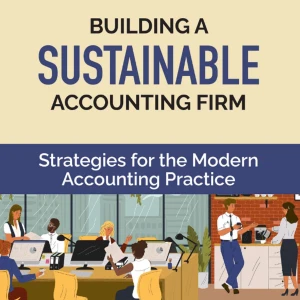
Building a Sustainable Accounting Firm
Blake Oliver, CPA 23 episodes Oct 26, 2026
Building a Sustainable Accounting Firm is an audiobook-style podcast by Blake Oliver, CPA, about moving accounting practices beyond transactional work and into a relationship-driven, transformation-focused model. It explores how bold individuals can reshape the profession from the inside, rather than waiting for top-down reform. The show profiles pioneers testing new business models that challenge the status quo and offers a roadmap for firms seeking lasting change. It is aimed at accounting professionals who want to reimagine what their firms and careers can become.
Episodes
Foreword
In this foreword, pricing expert Ronald J. Baker argues that the fee-for-service model has pulled accounting away from its purpose. Drawing on concierge medicine, he calls on firms to build lasting, transformational client relationships instead of selling transactions. Subscribe to Earmark here: https://www.earmark.app/subscriptionFind all the CPE courses here: Earmark Channel - Building
Introduction: Why I Wrote This Book
Blake Oliver, CPA, explains why he left a mid-size accounting firm frustrated by the billable hour, and what he learned at a software startup about SaaS metrics like recurring revenue, churn, and customer lifetime value. He argues that hourly billing punishes efficiency and will break down as AI speeds up accounting work. He makes the case that subscription pricing and productized service
My Personal Story
Blake Oliver traces his unconventional path from cello performance major to CPA, sharing how a demanding music teacher taught him that focused, deliberate practice beats sheer hours, a lesson he applies to accounting’s billable-hour culture. He describes building a 12-person remote bookkeeping firm on fixed monthly fees, selling it to a CPA firm, and moving into tech, where SaaS metrics s
Section 1.1: Changing the Revenue Model for Accounting Firms
Drawing on his conversation with pricing expert Ron Baker, Blake explains why accounting firms should move past hourly billing and even value pricing to a subscription model that prices the client relationship rather than the scope of work. He compares the idea to concierge medicine and Design Pickle’s unlimited design service, and also covers niching, client portfolios, and charging a pe
Section 1.2: How Modern Accounting Firms Set Prices
Blake walks through how to move an existing practice to subscription pricing: pick the services that fit, segment clients, and build three simple pricing tiers. CPA Logan Graf shares how he designs his packages, gets most clients to pay 100% upfront, and raised prices by over 50% for underpriced clients while losing only a handful. Want CPE credit for this episode?Subscribe to Earmark he
Section 1.3: Systematize Your Marketing
In this chapter, Blake profiles two CPAs who built thriving niche firms through generous, systematized content marketing. Sandra York, the Fit Money Coach, used free advice on Instagram to land nearly 100 health and fitness clients without spending anything on ads. Brandon Hall, the Real Estate CPA, combines a podcast, a 20,000-member Facebook group, and online courses to draw around 400
Section 2.1: Motivating People and Aligning Compensation with Billing
Blake tackles the accounting profession’s staffing crisis, arguing that firms moving to fixed-fee or subscription billing need to stop paying staff based on billable hours. Using Summit CPA Group as an example, he shows how a book-of-business compensation model and fully remote work let people choose how much they work, which keeps working parents and career-level professionals engaged in
Section 2.2: What It’s Like to Work at a Virtual CFO Firm
Virtual CFOs Hannah Hood and Joey Kinney describe what working at Summit CPA Group is like: forward-looking forecasting with a varied mix of clients, flexible and fully remote schedules, and a firm willing to hire them part-time. Blake also looks at why traditional firms resist this model, citing untrained managers, sunk costs in office space, and a habit of measuring hours instead of res
Section 2.3: Franchise Model: Alternative to the Partnership Model
Blake reviews some alternatives to the grueling partner track through Dark Horse CPAs, where CEO Chase Birky’s accelerator program turns managers into principals with their own $200,000 books of business. Principals earn 40–50% of their book’s revenue plus stock options, and the firm’s C-corp structure lets it share equity down to staff and buy back vested shares, offering real earning po
Section 2.4: How to Incentivize People Beyond Hours
Blake discusses some ways to reward accountants for results rather than hours, starting with Summit CPA Group’s model, which pays a national-average base salary plus variable pay tied to the book of business each person manages. BDO USA CEO Wayne Berson then explains how the firm’s employee stock ownership plan (ESOP) gives every employee a growing ownership stake, cuts turnover, and offe
Section 2.5: Give Employees Flexibility About How Much, Where and When to Work
Eric Fraint, founder of Your Part-Time Controller, LLC (YPTC), explains how his firm grew from a solo practice into a Top-100 firm of about 400 people serving nonprofits as outsourced controllers and CFOs. He describes how COVID pushed YPTC from mostly on-site work to remote work that now reaches clients in over 40 states. He also makes the case, unusual in this audiobook, for keeping hou
Section 2.6: Offshoring
Argel Sabillo, CPA, Founder of DTLA CPA, a firm serving startups, shares what he learned building a 15-person offshore team in the Philippines. He explains why he made the offshore staff client-facing so U.S. review wouldn’t hold up the work, how he hires for retention, and why he lets his team work local hours. He also argues that the savings from offshoring should go back into training
Section 2.7: Managing Remote Teams
In this chapter, Blake explores how to manage a fully remote accounting team, starting with Summit CPA Group’s team-based approach to serving each client. Scott Orn, former COO of Kruze Consulting, explains how remote hiring lets his firm recruit great accountants from anywhere, why he hires for emotional intelligence and comfort with technology, and how a culture of trust, collaboration,
Section 3.1: Building and Upgrading Your Tech Stack
Blake Oliver explains how to build a lean, scalable tech stack for a subscription-based firm, starting with the point that documented processes have to come before any software. He covers workflow and proposal tools, standardizing on one general ledger, and choosing banking, bill pay, and payroll apps, and he argues that fewer apps, simple integrations, and a COO who owns your processes a
Section 3.2: How Niching Simplifies Operations
Blake Oliver argues that niching simplifies everything from pricing to operations, using firms built around a single client type. Michael Allen, CPA, explains how a standard chart of accounts for Keller Williams real estate agents let him automate about 98% of transaction coding and profitably serve nearly 100 clients at $199 a month. Brittany Brown of LedgerGurus shares how e-commerce sa
Section 3.3: New Client Onboarding
Korey Cournoyer, formerly of GrowthLab Financial, explains how to automate new client onboarding the right way: map your current process first, mark the manual steps and pain points, and only then choose tools. He compares Zapier, Make, and Process Street, and shows how smooth, well-prepared onboarding sets the tone for the whole client relationship and frees firm owners to focus on highe
Section 3.4: Quality Control and Quality Management
John Rea, founder and CEO of Scrutinize, and Rachel Fisch, Co-founder of Nooma, explain why quality management is key to growing an accounting firm without letting standards slip. They cover how to define realistic, written quality standards, how to review exceptions instead of every transaction, and how cutting rework (which can eat up 30% of a team’s time) frees up capacity. Blake Olive
Section 3.5: Marketing as CapEx vs. Operating Expense
Blake argues that subscription-based accounting firms should view marketing as an investment in future cash flow, the way SaaS companies do, rather than as a routine operating expense. He walks through calculating customer acquisition cost and lifetime value, and suggests splitting the P&L into recurring and non-recurring expenses so firms can see their true profitability and stop und
Section 4.1: Building Services and Systems So You Can Have a Life
Blake shares how a failed music career led him to accounting and to a firm built around work-life balance. He explains how to find and document your firm’s repetitive tasks so you can automate, delegate, or offshore them. He also covers which practice management features actually matter, how to get documents from clients more easily, and why time saved and client experience are better mea
Section 4.2: Measuring Capacity: Bigger Isn’t Necessarily Better
Keila Hill-Trawick, CPA, founder of Little Fish Accounting, explains why she chose to build a deliberately small firm instead of chasing growth for its own sake. She describes dropping back-office services and stand-alone tax work in favor of fewer, higher-paying, year-round clients. She also covers how clear job descriptions, an organizational chart, and outsourcing IT, HR, and legal let
Section 4.3: How to Maximize the Value of Your Firm
M&A advisor Charles Bedard explains why subscription-based, tech-enabled firms can sell for 1.5 to 2 times revenue while traditional hourly firms often get a fraction of that, and why they attract far more buyers, including private equity. He covers the valuation metrics buyers use, such as EBITDA multiples, the “rule of 40,” and revenue per employee. He also urges owners to plan thei
Section 4.4: Selling Your Firm
Michael Ly, Founder of Reconciled, and Brandon Poe of Poe Group Advisors share what owners need to know before selling a firm, from timing the sale before burnout sets in to preparing years ahead. They explain how recurring fixed-fee billing, a firm that doesn’t depend on the owner, strong cash flow, and low churn can push valuations well above one times revenue. They also cover deal term
Conclusion
Blake closes by reflecting on his path from classical musician to CPA and encouraging accountants to build firms around recurring revenue, standardized processes, and client experience instead of the billable hour. Want CPE credit for selected episodes of Building a Sustainable Accounting Firm?Subscribe to Earmark here: https://www.earmark.app/subscriptionFind all the CPE courses here: Ea
Recommended
The Joe Rogan Experience
TED Talks Daily

SLOW ENGLISH PODCAST (A1-A2) With Subtitles | Daily Videos | English With Us Podcast

Stand In The Circle
English with Olivia | Slow Conversations & Vocabulary
Talk About Talk - Executive & Leadership Communication Skills

Learn English B1 with Daily News | English Listening Practice

Learn English A2 with Daily News | Simple English Listening Practice

Bad Friends

Learn 50 English Phrases While You Sleep | Everyday English Phrases & Vocabulary

Dateline NBC

True Crime Classics
