The History of English Podcast
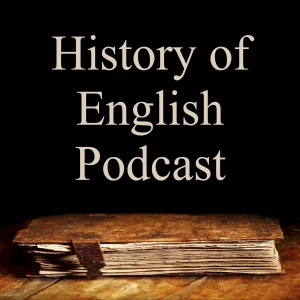
The History of English Podcast is a spoken history of the English language, tracing its evolution from its origins to the present day. Host Kevin Stroud explores the linguistic, historical, and cultural forces that have shaped English, covering topics like Old English, the Norman Conquest, and the Great Vowel Shift. The podcast is aimed at language enthusiasts and history buffs alike.
Episodes
Episode 191: A Vision of the Future
As the English Civil War raged in the 1640s, English grammarians wrote about several developments in the language, including a new sound appearing in the word “vision” and new ways of describing future actions and events. The military conflict was also shaping the language by contributing new terms to the lexicon. And a new sense of “self” was emerging, which had far-reachi
Episode 190: Union, Division and Unusual U
During the decade of the 1640s, England was divided by Civil War. At the same time, the sound of letter of U was also experiencing its own division, ultimately resulting in two distinct ‘long’ sounds and two distinct ‘short’ sounds. In this episode, we explore those developments and examine how the English Civil War shaped the English language.
TRANSCRIPT: EPISODE 190
Episode 189: Stressed Out
As we conclude our look at the 1630s, we explore the events leading to Civil War in England and the expansion of the English colonies along the eastern coast of North America. We also examine the evolution of syllable stress in English and the variation in stress patterns in Modern English.
TRANSCRIPT: EPISODE 189
Episode 188: Old England and New England
In this episode, we explore the first large-scale migration of English settlers to North America in the early 1600s. The settlers arrived in the newly established Massachusetts Bay Colony. We explore the events that led to this migration, and we also explore the linguistic connections between New England and East Anglia in eastern England.
TRANSCRIPT: EPISODE 188
Episode 187: Islands and Sea
In this episode, we explore the influence of seafaring on the English language in the early 1600s. We also look at events in the latter half of the 1620s, which included the first permanent English settlements in the Caribbean. This period saw the arrival of Charles I as the new king of England and Scotland, so we also examine his early reign and his repeated conflicts with Parliament.
TRANSCRIPT:
Episode 186: A Dutch Treat
In this episode, we explore two important developments in North America. First, we examine the legendary story of the Pilgrims’ arrival in New England in 1620 and the establishment of the Plymouth Colony. Secondly, we examine the creation of the Dutch settlement in modern-day New York and New Jersey, and we explore how Dutch influenced early American English. We also examine several importan
Episode 185: Spelling Says a Lot (Part 2)
In the second part of our look at the sound of English in the early 1600s, we continue to explore the letters of the alphabet and the sounds that each letter represents. We explore the letters K through Z and examine how the sounds represented by those letters have evolved over the Modern English period.
TRANSCRIPT: EPISODE 185
Episode 184: Spelling Says a Lot (Part 1)
Over the course of the 1500s, English spelling started to become standardized, but the pronunciation of the language continued to change. By the early 1600s, English scholars noticed that spellings no longer reflected the way words were pronounced, and they recommended phonetic reforms. In this episode, we examine how English spelling reformers described the pronunciation of English in the early 1
Episode 183: The Fabric of Our Lives
In the early 1600s, cotton fabrics made in India were in high demand throughout Asia and Africa. When the English and Dutch arrived in India and Japan, they realized how popular the fabric was, and they soon began to ship it back to northern Europe. In this episode, we explore how the ‘cotton craze’ of the 1600s shaped the modern world, and shaped the English language. We also examine
Episode 182: World of Confusion
In the early 1600s, English began to spread around the world as speakers searched for new trading partners and new places to settle. Through that process, English become an international language, but as English speakers encountered people and languages in distant places, they sometimes became confused. That confusion and uncertainty shaped the English language during this period. In this episode,
Episode 181: Heaven and Earth
The invention of the telescope in the early 1600s laid the foundation for the scientific revolution, but it also disrupted the traditional view of the universe and led to a conflict with the Catholic Church. Meanwhile, the Anglican Church completed a translation of the Bible that became known as the King James or Authorized version. In this episode, we look at how these simultaneous developments c
Episode 180: English on the Move
In the first decade of the 1600s, English speakers were on the move as they established the first permanent English settlement in North America. They also began a steady a migration to northern Ireland after an event known to history as the Flight of the Earls. As these English speakers relocated to regions outside of Britian, they took their regional accents and dialects with them. In this episod
Episode 179: Defining Moments
In the early 1600s, several landmark events shaped the history of England and determined how and where the English language would be spoken in the centuries that followed. The period from 1602-1605 saw the end of the Elizabethan era, the unification of the crowns of England and Scotland, the authorization of the King James Version of the Bible, the Gunpowder Plot, and the first English description
Episode 178: Much Ado About Hamlet
In the first couple of years of the 1600s, several new Shakespeare plays appeared. Much Ado About Nothing and As You Like It were recorded in the Stationer’s Register, and a third play called The Tragedy of Hamlet, Prince of Denmark was likely performed on the stage for the first time. In this episode, we’ll look at those plays and examine how they influenced the English language. We a
Episode 177: Dressed for Success
In this episode, we look at clothing and fashion in the Elizabethan era, and we examine the connection between clothing, custom and language. We also examine Shakespeare’s plays about the lives of Julius Caesar and Henry V of England. Along the way, we also explore how Elizabethan clothing conventions influenced the structure and presentation of those plays. Works discussed in this episode i
Episode 176: All the World’s a Playhouse
Theaters were an important part of cultural life in Elizabethan England, and they contributed many words to the English language. Those words joined thousands of other words that were pouring into English from around the world. In this episode, we look at how distant cultures were contributing to the growth of English and how Shakespeare’s acting company built a world-famous theater in the l
Episode 175: The English of Romeo and Juliet
Romeo and Juliet is one of William Shakespeare’s most popular plays and one of the most popular plays ever written. In this episode, we examine the language of the play to see how it reflects the English of Elizabethan England, and we identify evidence of emerging pronunciations that would become common over the following centuries.
TRANSCRIPT: EPISODE 175
Episode 174: Speak and Spell
English spelling largely reflects the state of the language in the late 1500s. In this episode, we look at one of the first English spelling books, and we explore several plays by William Shakespeare to examine the way he rhymed words. We also explore the way modern spellings reflect the pronunciation of words during the Elizabethan period. Works discussed in this episode include:King John –
Episode 173: Fooling Around
In this episode, we look at the development of English comedy in the early modern era. We examine some of William Shakespeare’s early comedies, and we also distinguish Shakespearean comedy from other types of comedic performances which had been popular for centuries. We also look to Italy to see how developments in literature and drama there had an influence on the theater of Elizabethan England.
Episode 172: Succession
In this episode, we explore the concept of a successful succession. During the early 1590s, France was divided by a bitter conflict over the succession of Henry of Navarre to the French throne. Meanwhile, William Shakespeare wrote a couple of plays that appear to make reference to the events in France. He also composed other plays that dealt with the theme of succession. And his plays also indicat
Episode 171: Shakespeare’s English (featuring Ben Crystal)
In this episode, we turn our attention to the wordcraft of William Shakespeare. Today, many people have mixed opinions about his plays and poems. They know that he is widely regarded as the greatest English writer of all time, but they struggle with his language. This time, we explore what makes Shakespeare’s use of the English language so unique and why it is so challenging for modern speakers. B
Episode 170: Printers, Plague and Poets
In this episode, we examine the connection between poetry and plague in the early 1590s. An outbreak of the recurring sickness contributed to Shakespeare’s early career as a poet, and that poetry likely included his many sonnets. We also examine how an old acquaintance from Shakespeare’s hometown emerged as one of the leading printers in London and how his print shop influenced the development of
Episode 169: Shakespeare Documented
William Shakespeare is widely considered to be the most important writer in the history of the English language, but relatively little is known about his personal life. The desire to know more about the ‘Bard of Avon’ has led to much speculation and conjecture over the centuries. In this episode, we try to separate fact from fiction as we look at the surviving documentation to determin
Episode 168: Witches, Demons and Fairies
In this episode, we explore the Elizabethan fascination with witchcraft and mysterious creatures like fairies and demons. Those subjects feature prominently in the literature of the period, and they reveal a lot about the world view of the people who lived in England in the late 1500s. Among the texts analyzed in this episode are Reginald Scot’s ‘Discoverie of Witchcraft,’ Christ
Episode 167: The Rhythm of English
All languages have their own rhythm and cadence, and English is no exception. That rhythm has actually shaped the language over time. It contributed to the structure of English poetry, and during the Elizabethan period, it shaped the way drama was composed. In this episode, we look at the beginning of Modern English drama through the patterns of sound in ordinary speech.
Links to Videos in Episode
Bonus Episode: Rise and Fall of the Classic Movie Accent
In this episode from the Patreon archives, we examine the accent used by actors and actresses in very old movies. We look at the origin of that accent and examine why it was adopted by the film industry in the first few decades of sound in motion pictures.
Episode 166: The Arte of Warre
In 1588, the Spanish Armada set sail for England in an attempt to depose Elizabeth I and replace her with a Spanish princess. In this episode, we examine how the English victory secured the status of English within the Church of England and ensured the spread of English as part of the nascent British Empire. We also explore how Spanish and Italian loanwords shaped the lexicon of modern warfare.
Episode 165: Glamorous Grammar
William Bullokar composed the first formal grammar of the English language in 1586. Prior to that point, the concept of grammar had been largely restricted to Latin. Bullokar’s work extended the concept to English, but it did so by employing the Latin grammatical framework. This approach was followed by subsequent grammarians, and it has shaped the way scholars think about English grammar to
Episode 164: Somewhere in the Middle
Throughout her long reign, Queen Elizabeth I was faced with many difficult decisions, and she often chose a middle path when she could. In this episode, we explore the middle paths taken during her reign, and the consequences of those decisions. In the New World, Elizabeth decided to let Walter Raleigh establish an English colony along the Mid-Atlantic coast of North America – between Florid
Episode 163: An Elementary Education
By the second half of the Elizabethan period, the perception of English had changed significantly in England. It was increasingly perceived as a sophisticated language capable of matching the refinement of other European languages. One of the language’s most vocal advocates was a schoolmaster named Richard Mulcaster. His ‘Elementarie’ argued for the standardization of English sp
Episode 162: The Pirate Queen
In the 1570s, Francis Drake plundered Spanish ships throughout the New World with the private permission of Elizabeth I. His actions marked the first direct challenge to Spanish naval supremacy in the region, and also marked the beginning the English embrace of empire. In this episode, we explore those developments and examine the impact they had on the English language. We also examine the first
Episode 161: Y U and I Have a Problem
In this episode, we explore the complicated history of the letters Y, U and I, and we examine how they gave birth to the letters W, V and J. We also look at the Gothic script of the Middle Ages which influenced how those letters were used in English spelling.
TRANSCRIPT: EPISODE 161
Episode 160: Approximant-ly English
In this episode, we explore the sounds represented by the letters L and R. Linguists refer to these sounds as ‘approximants,’ and they are some of the most challenging sounds in the English language. They are consonants with vowel-like qualities. Over time, they have shown a tendency to disappear and reappear, and even switch places in words. They also have a history of altering the vo
Episode 159: Elizabethan Voices
In 1569, an English scholar named John Hart published a manuscript called ‘An Orthographie.’ The text argued for a phonetic spelling system, and it provided one of the earliest detailed descriptions of the sounds of English. In this episode, we explore the difference between voiced and voiceless consonants, and we examine how changes in voicing shaped the English language. We also exam
Episode 158: Planting Seeds
In the mid-1500s, England attempted to expand its influence in Ireland by establishing plantations there. This same process would soon be applied to North America. In this episode, we explore those early attempts at Irish colonization and England’s first encounters with the region of Florida. We also examine the connection between these events and efforts during this period to make English s
Episode 157: Highlands, Lowlands and Netherlands
During the first decade of the reign of Elizabeth I, Protestants in Scotland and the Netherlands rebelled against the Catholic authorities who controlled those countries. Those rebellions were supported by England, and eventually Scotland and the Netherlands joined England as Protestant countries. In this episode, we’ll explore how those developments shaped the languages in all three regions
Episode 156: Beggars, Cheats and Thieves
In the 1500s, England saw a significant rise in the number of beggars and vagabonds. Those who couldn’t survive by begging often turned to thievery, gambling and fraud. By the mid-1500s, books and pamphlets were being published that highlighted the language and scams of the criminal subculture of England. In this episode, we explore the criminal slang and jargon of Tudor England, and we exam
Episode 155: Back to Basics
In the 1553, Mary Tudor became the first queen to rule England as the head of the government. She promptly turned back the clock on the religious reforms that had taken place over the prior few years. Meanwhile, scholars of English were also trying to turn back the clock. They wanted to return the language to its roots and eliminate the so-called ‘inkhorn’ terms which were so common at
Episode 154: English Equality
By the mid-1500s, scholars were becoming more confident in the ability of English to express sophisticated ideas and concepts associated with classical learning. Writers began to use English beside Latin and Greek in many scholarly works during this period. English also replaced Latin in the regular services of the Church of England. Some people embraced these changes, but others vehemently oppose
Episode 153: Zombie Letters
In early Modern English, writers and printers began to revise the spelling of many English words to reflect their etymological origins. Old letters were revived from the dead to reflect sounds that had disappeared over time in those words. This fad reached its height in the mid-1500s, and it wreaked havoc on Modern English spelling and pronunciation. In this episode, we explore that phenomenon and
Episode 152: As the Saying Goes
John Heywood was a playwright and poet who made two important contributions to the history of English. He was a key figure in the emergence of modern English drama which led directly to William Shakespeare at the end of the century. He was also a proverb collector who assembled most of the common proverbs in English into a popular poem that serves as an important resource for modern historians of
Episode 151: Sick to Death
During the reign of Henry VIII, medical books and herbals proved to be some of the most popular publications in England. The people of England wanted medical books that they could read in the own language. The largely unregulated medical marketplace meant that people often had to find a way to treat diseases on their own. In this episode, we explore the nature and terminology of disease in early T
Episode 150: A Capital Offense
In the 1530s, Henry VIII declared himself to be the ‘Supreme Head’ of the Church of England, and he demanded absolute loyalty from his subjects. Those who crossed him risked the loss of their heads. Meanwhile, the modern punctuation system started to emerge with the introduction of the comma and other punctuation marks. In this episode, we look at the intersection of ‘capitalR
Episode 149: Breaking Up Is Hard To Do
In the years following Martin Luther’s protest against the Catholic Church, small fractures soon turned into a major rift. The Protestant Reformation led to the break-up of the Western Church. Meanwhile in England, the marriage of Henry VIII and Catherine of Aragon was also coming to an end. Those two events came together in the 1520s to set the stage for the permanent break between the Chu
Episode 148: A Marital Union
In the early 1500s, a series of marriages between European royal families re-shaped the face of Europe and brought together separate regions under the leadership of a single ruler.  This led to creation of modern Spain and the formation of a massive European empire ruled by the Habsburg family.  It also secured the position of the Tudors in England, and laid the foundation for the union
Episode 147: A Rude and Rusty Language
The European Renaissance provided a transition to the early modern era by looking back to the culture of classical Greece and Rome. It led to a renewed interest in ancient Greek and Latin and a new world view known as humanism. But scholars in England doubted the ability of English to handle the new learning associated with this cultural movement. They felt that English was ‘rude’ and
Episode 146: A Brand New World
In 1492, Columbus sailed the ocean blue. The voyage marked the beginning of the European discovery of the Americas. Columbus encountered natives in the Caribbean who spoke a Native American dialect called Arawakan. As the Europeans encountered the native culture of the region, several Arawakan words passed into Spanish and then into English. In this episode, we look at what happened when these sep
Episode 145: A Sea Change for Europe
The period of European exploration and discovery began in the 1400s as part of an effort to find new trading routes to Africa and Asia. In this episode, we look at how European sailors and merchants began to think of the ocean as an international highway rather than a barrier to travel. We also examine the naval accounts of Henry VII’s ships to reveal a variety of words recorded for the firs
Episode 144: A Murder of Crows and Princes
In the second half of the 1400s, there is written evidence of word play and new word formations within English. These new terms included words for the sounds made by animals and collective nouns for various groups of animals and people. This was also a period when the Plantagenet era came to an end, and the first Tudor monarch seized the throne. In this episode, we examine those linguistic and h
Bonus Episode: Chaucer’s Purse and the Great Vowel Shift
In this bonus episode of the regular podcast, we explore the effects of the Great Vowel Shift on the pronunciation of English by reading Geoffrey Chaucer’s last known poem in Middle English, early Modern English and contemporary English.
Episode 143: The Great Vowel Shift (Part 3)
In this final episode about the sound changes associated with the Great Vowel Shift, we explore the vowel shifts that took place in the back of the mouth. We also explore how these changes impacted the way words are spelled in Modern English.
TRANSCRIPT: EPISODE 143
Episode 142: The Great Vowel Shift (Part 2)
In this second part of our look at the Great Vowel Shift, we explore the movement of the vowel sounds located in the bottom front part of the mouth. We also examine how these sounds were traditionally spelled and how the merger of those sounds produced many homonyms within Modern English.
TRANSCRIPT: EPISODE 142
Episode 141: The Great Vowel Shift (Part 1)
The term ‘Great Vowel Shift’ was coined in the early 1900s by the Danish linguist Otto Jespersen to describe a systematic change in the long vowel sounds of English. The changes help to mark the transition from Middle English to Modern English. In this episode, we explore the specific changes that took place in the upper front part of the mouth. We also examine the impact of those chan
Episode 140: You Say ‘To-may-to’
Vowel sounds are a key feature of every language, but the actual vowel sounds vary from one language to another. The English language contains about twenty vowel sounds, some of which are pure vowels and some of which are a combination of vowel sounds called diphthongs. In this episode, we explore the pure vowel sounds used in Modern English, and we examine how slight changes in the vowel sounds c
Episode 139: The Business of Printing
William Caxton introduced the mass production of books to England in the 1470s. He was also the first person to print books in the English language via the printing press. Caxton’s publications reveal the priorities and concerns of a businessman, not those of a linguist or scholar. In this episode, we explore Caxton’s contribution to the history of English, and we examine the impact of
Episode 138: Family Matters
In the 1400s, rising literacy rates and access to cheap paper combined to produce the first collections of personal letters in the English language. One of the earliest letter collections was maintained by the Paston family of Norfolk. Their letters reflect the struggles of an upstart family against the traditional landed nobility, and they provide an important perspective on the family dispute th
Episode 137: A Rose By Any Other Name
The rose is one of the most beloved flowers in western Europe, and it has a long association with English royalty. In this episode, we explore the history of English gardens and the use of the rose as a symbol of various branches of the royal family. We also examine the oldest guide to gardening composed in the English language and the origins of the conflict that became known as the ‘Wars
Episode 136: The Real Robin Hood
The legend of Robin Hood has its origins in the murky history of England after the Norman Conquest, but the first written examples of Robin Hood ballads don’t appear until the mid-1400s. In this episode, we examine the earliest references to the legend, and we explore the oldest surviving ballads that tell the story of the legendary outlaw. We also look at evidence of the Great Vowel Shift i
Bonus Episode: Stay at Home Edition
In this bonus ‘stay at home’ episode, we explore several words and phrases that appeared for the first time in the first half of the 15th century, including “turnpike,” “to curry favor,” “budget,” “average,” “peculiar,” “hogwash,” and others.
Episode 135: A House of Cards
In the early 1400s, playing cards made their first appearance in England. Those cards provide evidence of an early form of printing, but it would take another generation for Johannes Gutenberg to invent the printing press. In this episode we explore the history of playing cards and the printing press, and we also look at the end of the Hundred Years’ War. We also examine how these events co
Episode 134: A Lancastrian Standard
In the early 1400s, England welcomed a new king, a new ruling family, and a new role for the English language in the administration of government. In this episode, we explore the rise of the House of Lancaster and the emergence of a standard form of written English for the first time since the Norman Conquest.
TRANSCRIPT: EPISODE 134
Episode 133: Breaking Bread With Companions
In this episode, we explore words associated with mealtime in the Middle Ages. We also examine the important role of bread in medieval meals and impact of bread-related terms on the English language. Finally, we look at the important role of table manners as outlined in an early English etiquette guide called the Boke of Curtasye.
TRANSCRIPT: EPISODE 133
Episode 132: Food for Thought
In the midst of the English literary revival of the late 1300s, the household chefs of Richard II compiled the first cookbook in the English language. In the episode, we examine the cookbook known as ‘The Forme of Cury,’ and we explore the nature of food and cooking in medieval England. We also look at how the culinary arts shaped the English language.
TRANSCRIPT: EPISODE 132
Episode 131: Sir Gawain and the Green Knight
Sir Gawain and the Green Knight is one of the most popular English poems of the Middle Ages. In this episode, we explore the language and story of the poem. We also examine how the poem reflects certain changes that were taking place within the English language in the late 1300s.
TRANSCRIPT: EPISODE 131
Episode 130: Dialect Dialogues
Geoffrey Chaucer was one of the first English writers to compose dialogue in regional dialects to reflect the way characters spoke in the different parts of England. In this episode, we explore the dialogue of Chaucer’s northern students in the Reeve’s Tale, and we also examine the Second Shepherd’s Play from the north of England which reflects a similar approach to regional dial
Episode 129: Chaucer’s Vulgar Tongue [EXPLICIT LANGUAGE]
Geoffrey Chaucer was one of the few poets of the Middle Ages to explore the vulgar side of English and the connection between the common people and their language. The Miller’s Tale exemplifies this style. In this episode, we explore the history of swearing and obscenities, and we examine Chaucer’s use of bawdy language in the Miller’s Tale.
TRANSCRIPT: EPISODE 129
Bonus Episode: The Life of Guy – An Interview with Allan Metcalf
In this bonus episode, Kevin interviews Allan Metcalf about his new book, “The Life of Guy: Guy Fawkes, the Gunpowder Plot, and the Unlikely History of an Indispensable Word.”
Episode 128: The Canterbury Tellers
The Canterbury Tales is a collection of stories told by pilgrims during their trek to Canterbury Cathedral. The pilgrims represent a cross-section of English society in the late 1300s, and Geoffrey Chaucer paints a vivid picture of each one. He also modifies his language to fit the social class of each character. In this episode, we explore the descriptions of the various pilgrims in the General P
Episode 127: The Road to Canterbury
In the mid-1380s, Geoffrey Chaucer gave up his London job and residence and moved to Kent along the pilgrimage route to Canterbury. This move inspired the creation of the Canterbury Tales which remains the most well-known work of Middle English literature. In this episode, we explore the background of the poem and the circumstances which led Chaucer to abandon London in favor of Kent. We also exa
Episode 126: A New Turn of Phrase
During the Middle English period, English grammar and syntax underwent significant changes. Old inflectional endings continued to erode, and new phrases were introduced in their place. The writings of Geoffrey Chaucer reflect these changes, so we examine Chaucer’s House of Fame and Troilus and Criseyde for evidence of the newly emerging grammar and syntax.
TRANSCRIPT: EPISODE 126
Episode 125: The First English Bible
Many people are familiar with the King James Bible, but over two centuries earlier, an Oxford theologian named John Wycliffe produced the first Bible composed in the English language. Together with a group of close associates, he produced a Bible that was read throughout England. In this episode, we explore the events leading to this translation, and we also examine how the Wycliffe Bible impacted
Episode 124: Piers Plowman and the Peasant Revolt
The 14th century poem called Piers Plowman has intrigued and perplexed readers for over six centuries. In the 14th century, it was embraced by peasants who used it as inspiration in their struggle against the upper classes of England. That struggle culminated in a major peasant uprising in the early 1380s. In this episode, we explore the connections between Piers Plowman and the Peasant Revolt.
T
Episode 123: A Material Change
In the 1300s, the scribes of England began a gradual shift from the use of animal hides like parchment to a new material made from plant fibers. That new writing material was paper. In this episode, we explore the history of paper, and we examine the fundamental connection between texts and textiles.
TRANSCRIPT: EPISODE 123
Episode 122: The Name of the Game
In 1363, the king of England tried to ban all sports other than archery in order to ensure English supremacy with the longbow. The ban had little effect, however, as the people of England continued to play ball games and board games. In this episode, we explore how terms associated with games and sports shaped the English language, and we also examine the gaming references in Geoffrey Chaucer̵
Episode 121: English Ascent
In the years immediately following the Black Death, a labor shortage in the countryside led to the rise of yeomen and other rural laborers. The rise of these English-speaking classes led to corresponding rise in the prestige of English. The ascendency of English culminated with the Statute of Pleading which made English the official language of the government for the first time since the Norman C
Episode 120: The End of the World
In the mid-1300s, most of Europe was devastated by a massive plague known today as the Black Death. The disease killed about one-third of the population of England, and an even higher percentage of clerics and teachers who were trained in Latin and French. These disruptions permitted a younger generation who only spoke English to fill those positions. As a result, English replaced French in the gr
Episode 119: The Road to War
The Hundred Years War is one of the most well-known conflicts of the Middle Ages. The long, extended war introduced new weapons and new types of warfare, and it marked a transition from the traditional feudal state to the modern nation-state. The war also contributed to a rise in nationalism which led many Englishmen to regard the French language as the language of the enemy. The war was one of
Bonus Episode: Regarding English (Sound Education Conference Talk)
In November of 2018, I gave a talk at the Harvard Divinity School as part of the Sound Education Conference. The talk was an overview of the history of English called “Regarding English.” The final version of the speech was edited for time, so I have recorded the original version of the speech with the parts that were left out. Enjoy!
Transcript
Episode 118: Trade Names
Like much of western Europe, England experienced a significant growth in population during the two centuries after the Norman Conquest. By the 1300s, the percentage of the English population who lived in urban areas had doubled. As towns and cities grew, jobs became more specialized. The rise of specialized occupations led many workers to adopt their occupation as a surname. In this episode, we
Episode 117: What’s In a Name?
The origin of modern naming conventions can be traced to the period immediately following the Norman Conquest. Prior to the Conquest, almost all people in England had a single Anglo-Saxon name. After 1066, parents gave their children names borrowed from French and from the Bible. People also started to acquire second names based on their landholdings, place of origin, parent’s name, or som