Tumble Science Podcast for Kids
Tumble Science Podcast for Kids is a family-friendly science podcast that explores stories of scientific discovery. Hosted by science journalist Lindsay Patterson and teacher Marshall Escamilla, it aims to make science accessible and engaging for children and their families. The podcast has received a Common Sense Selection award and offers educational content on its website.
Episodes

The Hugging Robot
What makes a good hug? That’s what Ryder wants to know. Enter HuggieBot - a robot that helped discover the 11 “ingredients” of a meaningful embrace. We’ll learn why HuggieBot’s creator, Dr. Alexis Block, decided to build a hugging robot, and what a robot can tell us about why hugs matter so much to humans.
Watch videos of HuggieBot in action and read the full episode transcript on our blog.
Vo

Mailbag: What Happens When Galaxies Crash?
In this mailbag episode, astronomer Karen Masters joins Marshall and Lindsay to answer a listener's question: what happens when Andromeda crashes into the Milky Way? Plus, we're launching a brand-new segment: The Kid Quiz!
Find Tumble Cards on Yoto here.
To get an invite to the next Tumble meetup, as well as receive birthday shout outs and ad free versions of the show, go to patreon.com/tumblep

Why Does Earth Have a Magnetic Field?
How did Earth get its magnetic field? And why does it move around? Our listeners have questions about one of Earth’s most mysterious forces. To find out, we go on an archeological expedition in the Middle East, with pioneering paleomagnetist Lisa Tauxe. Lisa has spent decades “hunting” the magnetic field through time, to understand what ancient artifacts can tell us about how the magnetic field ha

Mailbag: Do Space Wormholes Exist?
In this mailbag episode, Marshall and Lindsay tackle two listener questions — whether space wormholes are real, and what a fly wing and a carrot could possibly have in common under a microscope. Plus, listener reviews and comments from China!
To get an invite to the next Tumble meetup, as well as receive birthday shout outs and ad free versions of the show, go to patreon.com/tumblepodcast and sup

Why Do T. Rexes Have Small Arms?
Why did T. Rex have such tiny arms? That’s what our listener Nora wants to know. We’re going to find out why the biggest, most powerful predator to ever walk the Earth did it with a teeny tiny set of arms.
Scientists have been coming up with answers for this question for decades — but science is never settled. Paleontologist Elizabeth Steell has walked into the debate with a stunning theory invol
Mailbag: Why Does the Left Brain Control the Right Side of Your Body? Are Dinosaurs Reptiles or Birds?
In this final mailbag episode of Summer 2026, Marshall and Lindsay address two listener questions, and learn about a surprising twist of evolution. Plus, listener reviews and comments!
To get an invite to the next Tumble meetup, as well as receive birthday shout outs and ad free versions of the show, go to patreon.com/tumblepodcast and support us!
For Tumble t-shirts, visit our store on Dashery
Tumble Science Podcast for Kids Season 12 Starts September 11!
Why do T. Rexes have tiny arms? Can dogs actually talk? Do we remember dreams or nightmares more?
Season 12 of Tumble Science Podcast for Kids drops September 11th — and we're bringing kids' wildest science questions to REAL scientists for the REAL stories behind discovery (plus the jokes and sound design you know we can't resist).
Almost 200 episodes in, and we're just getting started. 🚀
🎧 Wan
The Science of Your Favorite Foods [ENCORE]
This is a rebroadcast of a favorite episode of Tumble from season 6.
What’s your favorite food? Why does it taste so good? It turns out, what we think is tasty isn’t just a matter of opinion. It’s science! Ecologist and science writer Rob Dunn takes us on a journey back in time, before kitchens, cooking, and even farming! We find out how our ancestors’ tastes shaped our own cravings - and how ou
Mailbag: How Do Stem Cells Decide What to Become? What's Morse Code?
In this special summer mailbag episode, Marshall and Lindsay help answer three kid questions:
How do stem cells decide what to become?
How do chameleons change color? and...
What is Morse code?
This special episode features answers from Jessica Whited, Michel Milinkovich, and Mick Sullivan, from The Past and the Curious! As well as a roundup of listener reviews, and more!
For mo
The Secret to Cheetah's Super Speed [Encore]
How do cheetahs get their super speed? We talk to a cheetah scientist to find out why a spotted cat is the fastest animal on Earth. Cheetahs are literally built for speed! Anne Hilborn spent months scoping out cheetahs on the hunt in the grasslands of the Serengeti. We’ll discover how cheetahs’ incredible speed is linked to their survival - and what they do when being fast isn’t enough.
On our s
The Plastic Pollution Patrol [ENCORE]
This is a rebroadcast of one of our favorite episodes from last season, and one that is particularly timely for the summer!
What if you found out that there was a tiny, nearly invisible type of plastic pollution that’s found nearly everywhere… but you’d never heard of it! That’s what happened to environmental scientist Jace Tunnell several years ago, and he’s been on a great nurdle hunt ever sin
Mailbag: What would happen if the Moon disappeared? How big is the universe, really? Are there atoms in a black hole?
What would happen if the Moon disappeared? How big is the universe, really? And what happens to atoms inside a black hole? Marshall and Lindsay get the answers to some cosmic questions in this special mailbag episode!
If you want to have your comment or review read on our show, leave one! Write a review on Apple Podcasts or comment on Spotify.
Join on Patreon to help us continue to
How Were Dinosaur Tracks Made?
This is a rebroadcast of one of our favorite episodes from season 10!
Ever wondered how dinosaurs left their footprints behind millions of years ago? We embark on a prehistoric adventure with renowned paleontologist Paul Olsen! Discover the secrets behind dinosaur tracks and how these ancient prints can tell us incredible stories about the lives of dinosaurs. From the science of fossilization to
Mailbag: Could a Peacock and Platypus Be Friends? Why does the ground keep spinning? Do magnets work in space?
You asked, we answered! In this mailbag episode, we're tackling three big kid questions: why does the ground keep spinning after you stop? Do magnets work in space? And could a peacock and a platypus ever be BFFs? We get answers from real experts, as well as reading your reviews and comments!
Also, the Joke-ha-thon is coming up on June 3rd! Go here to donate and pick your champion, and also win
Pluto and the Planetary Pandemonium - Encore
This is a rebroadcast of one of our favorite episodes from the past!
It’s a scientific controversy of planetary proportions! Is Pluto a planet, or not? You decide, after we present two sides of an epic astronomy argument. Back in 2006, the International Astronomer’s Union voted on a definition of the word “planet” that excluded Pluto and other newly dubbed “dwarf planets” from planethood status.
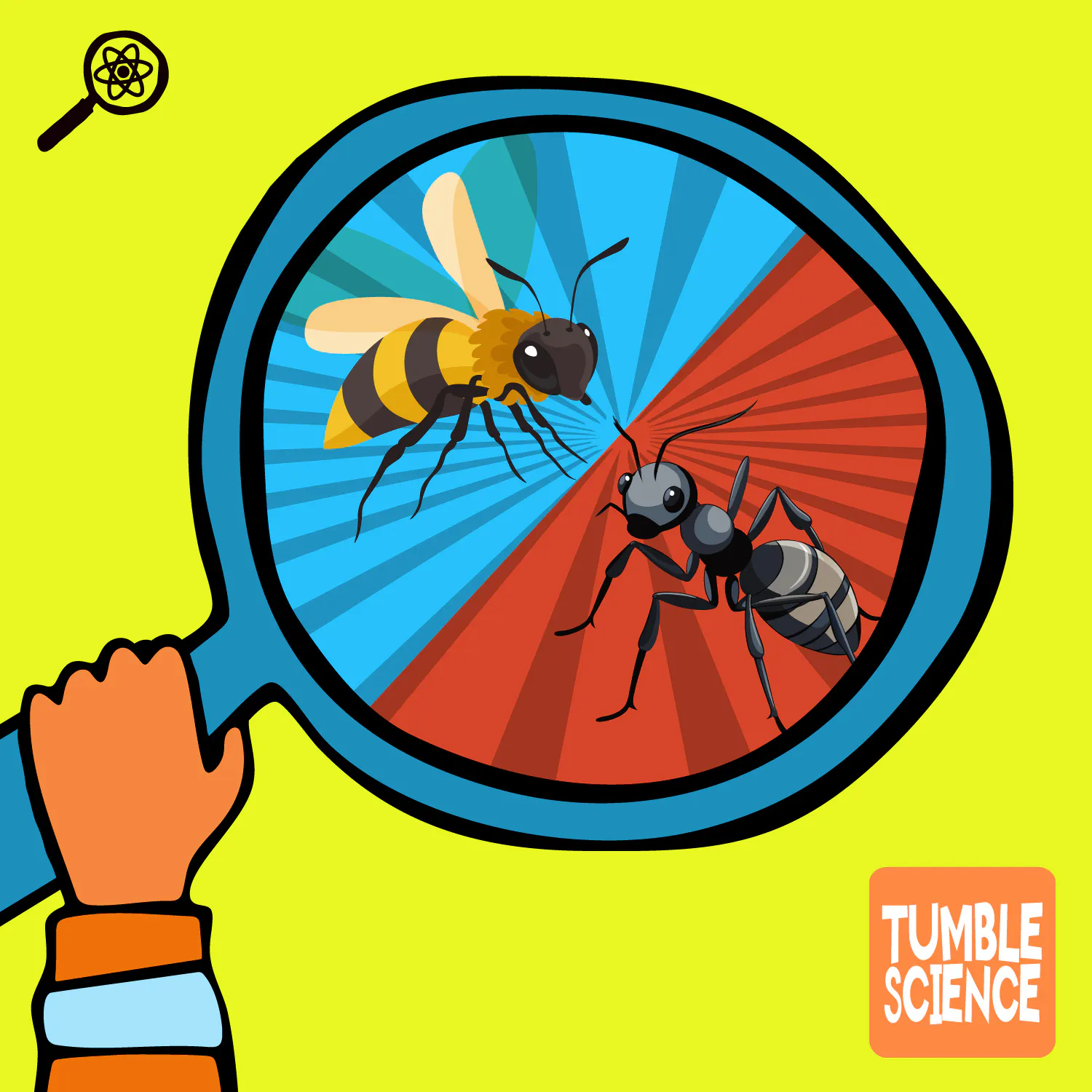
Who Works Harder: Ants or Bees?
Both ants and bees work hard. So which one works harder? That’s what our listener Hadi wants to know! So we’re pitting insect against insect in a battle of industriousness. Ants or bees: Who will win?! Tune in as we attempt to crown the Hardest Working Insect!
To help, we’ve recruited Dr. Sammy Ramsey, an entomologist, National Geographic Explorer, and host and producer of the Disney+ documentary
Mailbag: Are Animals Ticklish? + New Song!
A special “tickle attack” Mailbag edition of Tumble! We’re tackling your questions about whether animals can be tickled, and why we laugh when we’re tickled. David Leavens, a professor of psychology, helps us break down the not-so-silly science of tickling. Plus, a brand NEW SONG from Marshall based on a listener request!
Want to be on a future mailbag episode? With an adult, leave a review

Do Trees Think?
Do trees think? That’s what our listener Alden wants to know. He has an idea that scientists might study mushroom roots to find out if trees are sending messages. Is that true? And if so, what do trees have to say?!We travel deep into the forest with a young soil scientist named Natalia Mondi from the Mother Tree Project, to find out how and why trees communicate through the ecosystem. Along the w

What's Dark Matter?
What is dark matter? Why do scientists think it exists? How are they searching for it, and why are they doing it in an underground lab?! Join us on the search for dark matter with Alvaro Chavarria, a physicist running a dark matter detector underneath a mountain in the French Alps. We’ll take you inside the lab to visit the detector, and find out why everything we think we know about dark matter…

Who Invented the Peanut Butter & Jelly Sandwich? (with The Past and the Curious)
Who invented the peanut butter and jelly sandwich? And how did it become one of the most famous lunches in America?
In this episode, a question from listener Leila sends us on a trip through history to find out how peanut butter, jelly, and sliced bread came together to make the classic PB&J. Along the way, we learn about the first written recipe for the sandwich in 1901, how peanut butter went f

Can Axolotls Teach Us to Grow New Hands?
Why do humans usually have five fingers on each hand? And what if one day, we could grow a new finger if we lost one?
In this episode, a question from six-year-old listener Ayla sends us on a journey from tiny developing embryos to one of the most amazing animals on Earth: the axolotl.
We talk with Dr. Jessica Whited, a Harvard-based biologist who studies how axolotls regrow their limbs - and w

Do Animals Have Friends?
In this episode, we talk to two scientists who study animal friendships, in different animals, and in different ways. We’ll hear from Karen Bales, who studies titi monkeys (AKA “fuzzy little guys”) and Annaliese Beery, who studies voles (AKA “the cutest rodents”). Get ready to discover how animal friends play and cuddle - and what they can teach us about our own friendships.
This episode was pro
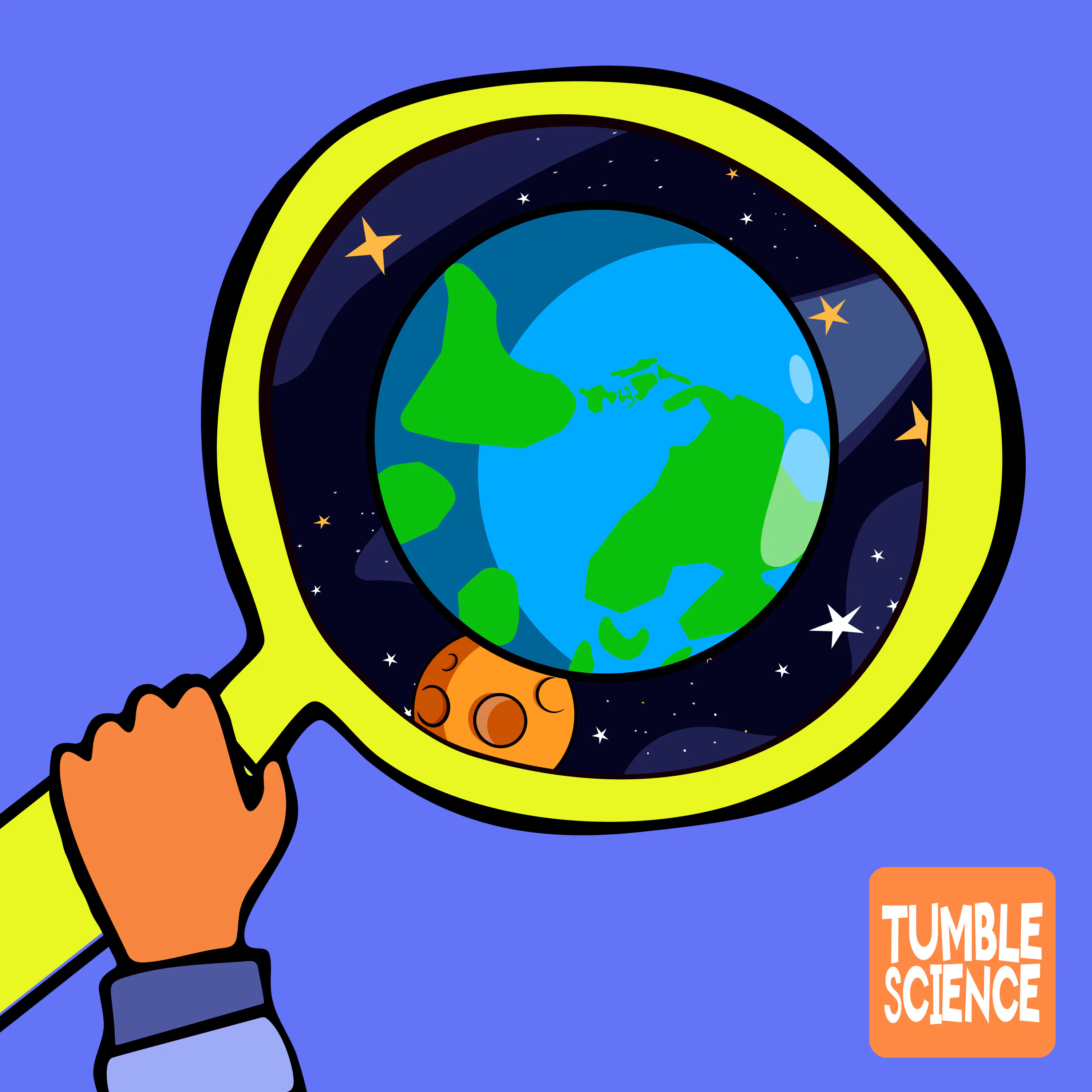
How Did Earth Begin?
How did Earth get created? What did our planet begin as? Why does our world exist? What started our planet? These questions take us back billions of years to learn how Earth formed in the very beginning - and then, we’ll look to a group of mysterious asteroids that might reveal how Earth became the planet it is today.
With planetary scientist Bill Bottke, we’ll hear the incredible story of Earth
The Science of Fungi
This is a rebroadcast of one of our favorite episodes from season 9!
Do fungi breathe? That’s what listener Alice wants to know - and we’ll find out in our punniest episode yet! We visit the Fungarium - the largest and oldest collection of fungi in the world with curator Lee Davies, who describes himself as a “librarian” of mushrooms. We’ll explore how fungi live and die, and why there’s so many
The Science of Whiskers
This is a re-broadcast of a favorite episode from 2019. We actually won our first AAAS Kavli Award for this episode, along with The Cave of the Underground Astronauts. Check it out!
Why do seals have whiskers? Listener Karah’s question dives into the wonderful world of whisker science. Robyn Grant, a self-described “whisker biologist” shares her discoveries of how whiskers work, from training a
Mailbag: Why is English so weird? Do all cats hate getting wet? Who made PB&J a combo?
We’re wrapping up 2025 with a final Mailbag episode, featuring some of our longest-running Patrons! Did you know, when you sign up to support Tumble on Patreon, you’ll get a personalized message from Marshall? And if you’ve been supporting us for years, we might just call you up to chat! We’ll meet our mysterious patron, MiloSloth and his family, and learn why they love to support the show.
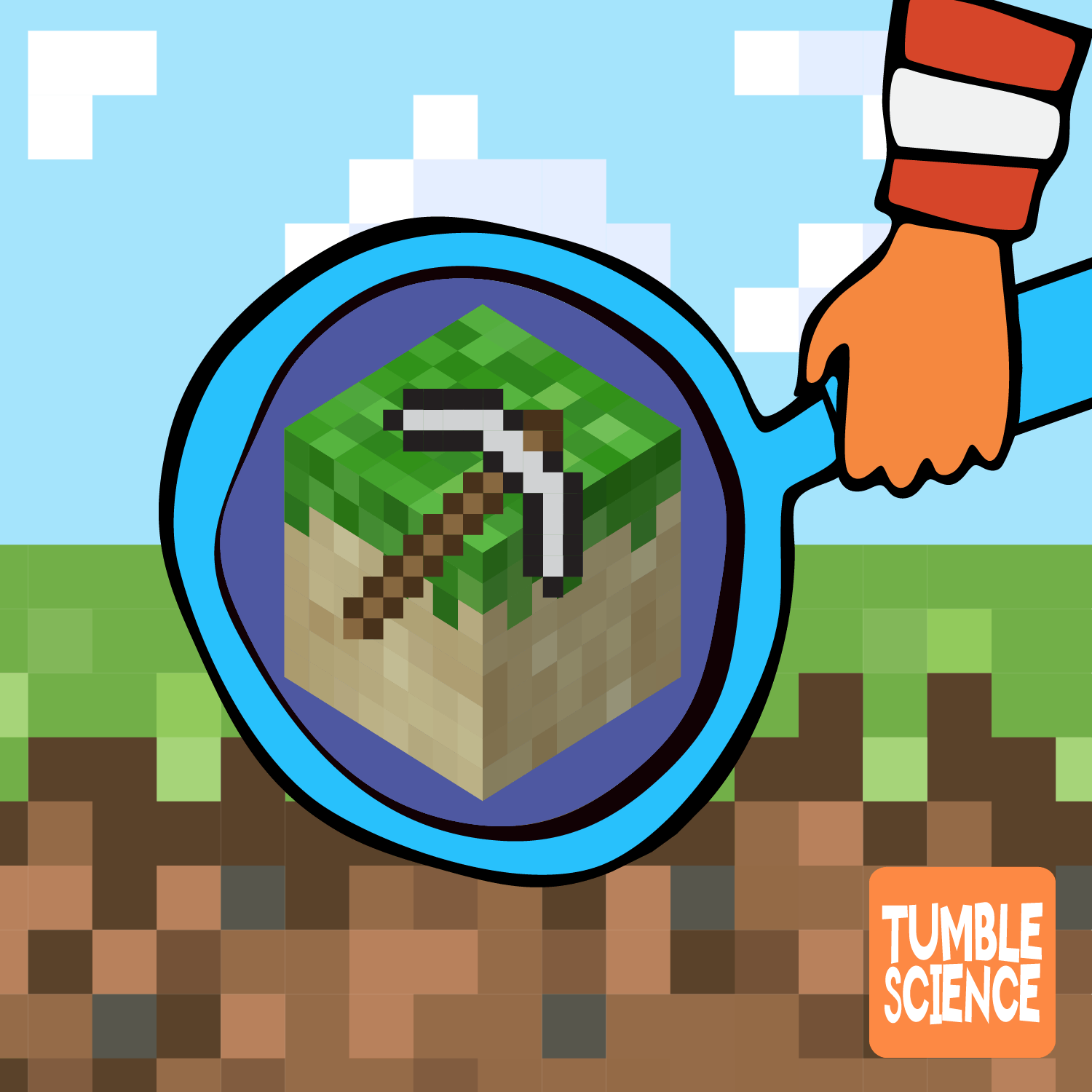
The Minecraft Experiment
How do people learn — and how can a video game help us find out? In this episode, we meet cognitive scientist Charley Wu, who built the ultimate science “mod” in Minecraft! Journey into a video game world of science to discover how and why Charley used one of the world’s most popular games to follow his curiosity about how humans learn. Featuring a “braintrust” of kid Minecraft experts to explain
The Science of Snot
Why do we have snot? Do animals get stuffy noses, too? We delve into the world of thick secretions with the help of Dani Rabiaotti, zoologist and author of “Believe it or Snot: The Definitive Field Guide to Earth’s Slimy Creatures.” You’ll find out why we make so much mucus, and meet the slimiest animals on the planet. Plus, you’ll discover why scientists study slime, even though it’s super gross.
What Sounds Do Fish Make?
What sounds do fish make? 🐟🎶 We know that cows say moo, and sheep say baa, but what do fish say? Come explore “Under the Sea” to discover the chorus of fish noises with help from fish ecologist Audrey Looby. We’ll find out how fish can be sneaky, loud, and even “slimy, grumpy cuties” (Audrey’s words) who go boop boop - and what they can tell us about life underwater. 🌊
You can learn more about A
Are Ghosts Real?
Are ghosts real… or not? That’s what Lily wants to know. To find out, we talk to a real-life Ghostbuster and science historian Efram Sera-Shriar, who takes us on a journey back in time to when the world’s most famous scientists became ghost investigators: Sitting in on séances, inventing ghost-hunting devices, and exposing the tricks of “spirit photography.” Did you know, Thomas Edison made plans
The Dino Butt Fossil
Did dinosaurs sniff each other’s butts like dogs? That’s what listener Ernie wants to know! We’ll dig up the surprising dino discovery that leads to our answer with the help of one of the world’s foremost animal butt experts, Dr. Diane Kelly!
You can learn more about Diane, and find a transcript of this episode on the blog on our website, sciencepodcastforkids.com.
Support us on Patreon! You’
Mailbag: How do asteroids form? Why don't we feel dizzy as Earth spins? Would we know if we were in a black hole?
This is our final Mailbag episode before all-new stories of science discovery arrive on Friday, October 17. Lindsay and Marshall share behind-the-scenes updates on what’s coming up in Season 11 — plus a special challenge to guess the topics of our first three episodes!
Then, astrophysicist Dr. Hakeem Oluseyi (host of NOVA’s Particles of Thought and judge on Netflix’s Baking Impossible) joins us t
The Wild Axolotl - And Tumble en Español is Coming Back!
We have a big announcement: Tumble en Español is returning on September 25th!
This is a rebroadcast of an episode of Tumble from last season. If you can't wait to hear the Spanish-language version, just go subscribe to Tumble en Español wherever you get your podcasts.
Why are there so many axolotls in fishtanks, and so few in the wild? That’s what Maximiliano wants to know. You may have found a
Tumble Newsflash: Yoto Cards, Audiobook, & Your Plant Questions!
There’s so much happening in the world of Tumble, and we’re excited to share it all with you! Plus we answer questions about plants with the help of plant biologist Carina Baskett.
Tumble Yoto Cards
A brand-new pack of 3 cards with Tumble episodes on our most popular themes - Animals, Bugs, and Gross Science - for the Yoto audio player!
Get it 20% off during Yoto’s Back to School sale
Mailbag: What state of matter is fire? What's the science of asking good questions?
Is fire a liquid, a solid, or is it even matter at all? And what is the science of asking good questions? Lindsay and Marshall dig into the Tumble mailbag to answer listener questions with the help of Tumble's science advisors, and respond to reviews! Somehow, the whole "cats are evil" thing just refuses to die.
We want to hear from you! Send us YOUR science questions, and let us know what you t
How Big is the Universe?
This is a summer rebroadcast of an episode of Tumble from a few years ago.
How big is the universe? And how do we know? It's a question that puzzled astronomers for centuries. They had no way to measure distance in space - until Henrietta Leavitt showed them how. Henrietta Leavitt was a "computer" in the 19th century, before there were computers, and she made an incredible discovery that would h
Mailbag: Why are four leaf clovers rare? Can one side of our brain fall asleep? Why do fish have different colors? How big is infinity?
Do you know why four leaf clovers are so rare? Or if just one side of our brain can fall asleep? Why do fish have different colors, and how big is infinity? Lindsay & Marshall dig into the Tumble mailbag to answer listener questions with the help of Tumble’s science advisors, and respond to reviews! (Yes, we’ll talk about cats.)
We want to hear from you! Send us YOUR science questions, and
Summer Episode: Science Songs and Games!
Listen to our brand new album of science songs, and play some games along with us as we celebrate the release of our album: Science Songs Vol. 1! It’s a special summer episode that will get you singing along and testing your knowledge of everything from capybaras to planets!
Here’s where you can listen to the full album:
Spotify: Listen on Spotify
Apple Music: Listen on Apple Music
The Volcanic Eruption Adventure
Would you fly to the top of a volcano that’s about to erupt at any moment? Volcanologist Helena Buurman did, and survived to tell the tale! In 2008, Helena was monitoring Mount Redoubt in Alaska, when the ground beneath the volcano began to shake. What follows is a tale of volcanic adventure, involving earthquakes, helicopters, and a massive eruption!
Tumble is on our summer break right now, work

The Plastic Pollution Patrol
What if you found out that there was a tiny, nearly invisible type of plastic pollution that’s found nearly everywhere… but you’d never heard of it! That’s what happened to environmental scientist Jace Tunnell several years ago, and he’s been on a great nurdle hunt ever since! This episode on fighting plastic waste comes with a special bonus: the opportunity to enroll in a “Nurdle Patrol” and lead
Did Dinosaurs Burp?
To support the Tumble Joke-ha-thon and win awesome prizes, go here!
“Did dinosaurs burp?” Tune into our Season 9 premiere to find out the answer to this stinky question. We’ll hear about dino gasses from returning guest Jessica Whiteside and their potential ecological impact from David Wilkinson. Our dive into dinosaur digestion will lead us to a smelly look at gas in Earth’s past!
Listen to ou
Tumble Sonic Saturday May 10th! Featuring the Science of Ocean Sounds
🎉 We’re getting ready for our biggest live event ever — Sonic Saturday! It’s a day of science, sound, and storytelling in Brooklyn, NY on May 10, and we’re celebrating by rebroadcasting one of the episodes that inspired it all: The Science of Ocean Sounds. 🌊🔊
Come join us (and special guest Dan Saks from Noodle Loaf!) for two interactive shows, hands-on science, and live demos from amazing STEM e

Why Is It Calm in the Eye of a Hurricane?
Why is the center of a raging storm so… calm? Tumble listener Lydia wants to know what’s really going on in the eye of a hurricane. To find out, we’re flying into the storm — literally — with meteorologist Shirley Murillo! Shirley is a real-life “hurricane hunter” who flies in a specially equipped airplane to collect data from inside the hurricane itself! Discover how hurricanes form, and what kee

Was There Ever Nothing?
Was there ever nothing in the universe? What is nothing? That’s what listener Aviva wants to know. We turned to particle physicist Dr. Jessica Esquivel to find out! She takes us on a mind-bending journey to ask what existed before the universe began, and how a quantum dance party might have started the Big Bang! This story about subatomic particles, giant magnets, and quantum physics is something

What If Trees Didn't Exist?
Have you ever wondered what life on Earth would be like without trees? In this episode of Tumble Science Podcast for Kids, we’re exploring that big question with the help of two curious listeners, Rowan and Neesha!
Join Lindsay and Marshall as they talk to plant ecophysiologist Angelica Patterson to uncover the essential role trees play in our world. From providing oxygen to supporting animals an

How To Be An Inventor
What does it take to become an inventor? To find out, we spoke with an inventor named Josh Miele about one of his greatest inventions: tactile maps! Tactile maps use braille technology to help blind people explore their neighborhoods with their fingers first. But how does Josh create brand-new inventions? Tune in to find out how inventors bring new ideas to life, and stick around to find out wheth

Why Do Animals Play?
Why do some animals play - and some don’t? That’s what Meredith wants to know. In this special collaboration with Outside/In, we investigate how and why animals - and people! - of all shapes and sizes play. Play scientists Junyi Chu and Jackson Ham help us ask the important questions like: Can you tell an octopus to play? And what can rats teach us about why taking turns is important? It turns out

Why are Capybaras So Big?
Why do capybaras have such big teeth? Adrian had to know! To get to the bottom of this, we spoke to a biologist named Santiago Herrera Alvarez. Capybaras are Internet sensations, and Santiago can't get enough of them! Santiago's questions were even bigger than capybara teeth: how did capybaras, a relative of rodents like mice and rats, get to be so enormous? Tune in for a capybara rodeo, and stick

How Does Vision Work?
How does vision work? That’s what Junie wants to know. And is it possible to create vision for people who don’t see? We’ll dive into the mysteries of how we see with Lucas Nadolskis, a scientist who became blind when he was five. Lucas is studying how vision works in the brain to understand if it’s possible to see without using your eyes! Intrigued? Listen in to find out more of the mysteries behi

The Wild Axolotl
Why are there so many axolotls in fishtanks, and so few in the wild? That’s what Maximiliano wants to know. You may have found axolotls in the lush caves of Minecraft, but in real life, they live in the lakes and canals of Xochimilco, near Mexico City. But the species is slowly disappearing from its native habitat. Axolotl veterinarian Horacio Mena takes us on a journey to Xochimilco to find out w
The Polar Bear Adventure
Happy New Year! This is a rebroadcast of “Polar Bear Adventure” from Season 8!
Join us on an Arctic adventure as we head out onto the sea ice with a polar bear scientist! Andrew Derocher shares exciting stories of flying in helicopters, getting bit by a polar bear cub, and discovering how polar bears are surviving in a warming world.
Andrew explains what happens when polar bears move into human
The Great Seal Count
Happy holidays! This is a rebroadcast of our chilly Season 7 episode, The Great Seal Count.
How do you count the cutest seals on the planet? With the help from thousands of people around the world! Conservation scientist Leo Salas explains the story behind the first-ever global count of Weddell seals in Antarctica. Plus, you’ll find out what counting seals shares with searching for ancient tombs!
Was T. Rex Smart?
This is a rebroadcast of one of our favorite episodes from Season 8!
When did smartness begin? We’ll find out how a neuroscientist blends up brains, and cracks the case of the Tyrannosaurus Rex smarts! Suzana Herculano-Houzel helps us answer listener Penny’s question by explaining how “smartness” might not mean what you think - and how all animals have shown off their intelligence over time.
Liste
The Swift Quake
This is a re-airing of our award-winning episode The Swift Quake! This episode won the AAAS Kavli Silver Medal Award for excellence in Children's Science News, as well as a Signal Award for kid's podcasts. Give it a listen!
How do you think a stadium full of Taylor Swift fans would shake the earth? Tumble enters the Swiftiverse with Jackie Caplan-Auerbach, the scientist who discovered the “Swift Q

How Does it Feel to Be in Space?
What does it feel like to be in space? That’s what Elijah wants to know. So we’re taking off on a zero-gravity flight to find out! Guest reporter Jason Strother shares the story of Sheri Wells-Jensen, a blind scientist who is paving the way for people with disabilities to go to space.
This material is based upon work supported by the National Science Foundation under Grant Number # 2148711 - Eng

Are Cats Evil?
Are cats evil? Are they hatching a plot to take over the world? Or are they just misunderstood? Scientist and cat expert Mikel Maria Delgado will tell us how the domestication of cats and dogs changed the way we think of our pets today, and she’ll explain how scientists of all ages can study cat preferences (or purr-fur-ences). Plus, she’ll share some tips on cat do’s and don’ts, so we can learn h

The Secret of the Monkeyflower
How do species evolve? Find out in the shocking conclusion of our Monkeyflower mystery series! Plant biologist David Lowry has been tracking down clues to solve the question of why plants look different - and the yellow monkeyflower is more than a suspect. Now, it’s time to take his detective skills up a notch, and use the science of DNA. A twisted discovery will flip the case - and lead to a new

The Monkeyflower Mystery
Why do plants grow in different places? How do they adapt to different environments? And what makes them different species? Those are the questions that drove biologist David Lowry to begin a 20 year study of a shape-shifting plant called the yellow monkeyflower. It begins with a road trip, and ends up questioning everything you think you know about the definition of species. Get ready for a wild,

How Were Dinosaur Tracks Made?
Ever wondered how dinosaurs left their footprints behind millions of years ago? We embark on a prehistoric adventure with renowned paleontologist Paul Olsen! Discover the secrets behind dinosaur tracks and how these ancient prints can tell us incredible stories about the lives of dinosaurs. From the science of fossilization to what these footprints reveal about dinosaur behavior and habitats, Paul

The Poopologist
What do you call a scientist who studies poop? A poopologist! We’re exploring the stinky science of “poopology” at the zoo, to discover what poop can tell us about animal behavior! Poopologist Laurel Wescott, at the Oregon Zoo, will take us on a journey to find how chemicals found in animal poop can help zoo animals stay healthy. Plus, she’ll clue us in on the “cutest” and most surprising poops, a
What Do Dogs Think?
“Do dogs think and feel the way we do?” We all know dogs can’t talk. That’s why scientists have to come up with creative ways of asking our canine companions what’s going on in their minds. We’ll find out why dog cognition scientist Zachary Silver put on a play for dogs - which inspired us to create Tumble’s very first dog radio theater production! Just call us “The Tumble Dog Players.” It will al
Do Bugs Have Elbows?
This is a rebroadcast of one of our favorite episodes from the past. Do bugs have elbows? That’s what Clare wants to know. Her question starts a debate between Team Bug Arms and Elbows, and Team Bug Legs and Knees! Choose a side, and come on the trail of a bug bod mystery with superstar entomologist and dragonfly specialist Jessica Ware. Turns out, dragonflies are a lot weirder (and ancient!) than
Hearing the Stars
This is a rebroadcast of one of our favorite episodes from Season 8! This was voted on by our patrons on Patreon--if you want to help us pick our next AND FINAL REBROADCAST OF THE SUMMER--just go to patreon.com/tumblepodcast and vote. You don't have to be a supporter to vote, but we'd appreciate it if you were!
Can we hear and touch the stars, if we can’t see them? Yuma Decaux is trying to put the
The Science of Bubbles
This is an encore episode, picked by our Patreon supporters. If you want to go vote for our next encore, just go to patreon.com/tumblepodcast to go vote! You don't have to be a patreon supporter to vote, but it does help!
Why do bubbles pop, and why do bubbles have shadows? We’re in double bubble trouble with two listener questions. Luckily, Dr. Bubbles is here to save the day! We’ll find out how
The Science of Candyland
Happy Halloween! We’re headed to Candy Land, a sugary laboratory where mathematicians found a mysterious candy dagger appear - over and over again. So gather up your candy box, and let’s discover out why mathematicians are studying candy to understand the real-life landscapes around us. Mathematician Leif Ristroph shares how he stumbled into making sweet experiments.
Want to learn more about the
The Kid Scientists' Galapagos Adventure
This is an encore of one of our favorite episodes from Season 5! If you'd like to help us choose our next episode, go to our Patreon and VOTE! You don't have to pledge to support us in order to vote, but if you do we'd appreciate it a ton!
What’s it like to be a kid doing experiments in one of the most famous science places in the world? Oscar and Mae Johnson were nine and twelve when they travele
The Cave of the Underground Astronauts
This is a summer encore episode of one of our favorite episodes from Season 4 of Tumble!
Do you love fossils, adventure, and spending time in small spaces? If so, you could become an underground astronaut! Marina Elliot, Becca Peixotto, and Kenni Molopyane found this unusual job description through a Facebook ad, and landed deep inside a cave that few people can access. The team of archeologists t

Can We Time Travel?
Is it possible to build a time machine? Can we time travel someday? That’s what Tumble listener Willa wants to know. Clifford Johnson, a theoretical physicist and film consultant, says that there’s real science behind the time travel - and he’ll tell us what it takes to do it.
To learn more about time travel, go visit our blog at sciencepodcastforkids.com, where you can find all sorts of awesome r

Will An Asteroid Hit Earth?
How do scientists find out if an asteroid might hit our planet? And what do they do if it’s on a collision course with Earth? We’ll meet a planetary defender - an astronomer who uses radar telescopes to defend our planet from space rocks! Edgard Rivera Valentín grew up in Puerto Rico, next to Arecibo, the world’s most powerful radar telescope. Hear the story of how Edgard became a scientist superh
Why Do Cicadas Live Underground for So Long?
How did cicadas evolve to go underground for so long? Why do cicadas spend so much of their lives underground? That’s what listeners Gus and Zachary want to know. This spring, up to a TRILLION cicadas will emerge across 16 states in the U.S., in an event that hasn’t happened since 1803. Cicada scientist Chris Simon helps us dig into the surprising science of cicadas - and figure out how they’re ch
The Alien Bacteria Abduction
Scientists stage an alien abduction to learn how bacteria avoid antibiotics, in this fact-meets-fiction episode! Meet our alien bacteria invaders (fiction) and our real life scientist, Caroline Blassick (fact) as they face off in a battle of microbial life and death. We’ll find out how Caroline implants mind-control devices in bacteria to improve human health, in bioengineer Mary Dunlop’s lab.
Our
Can We See Black Holes?
Why can’t we see black holes? Can we see black holes with a telescope? That’s what Tumble listener James wants to know. We explore the science of supermassive black holes and gravitational waves, with the help of astronomer Maura McLaughlin. Find out how the LIGO telescope is aiding in the search for supermassive black holes on an intergalactic collision course!
ANNOUNCEMENT: Tumble en Español, t
The Songs of Spiders
What does a spider web sound like? Join us as we weave a web of connections between science and music - and learn some truly mind-blowing facts about spiders! MIT scientist and musician Markus Buehler shares his journey into the spiderverse, turning spider silk into instruments and making materials from nature.
Watch Markus’ spider music videos on the blog on our website, sciencepodcastforkids.c
A Kid's Guide to the Total Eclipse
On April 8, 2024, a total solar eclipse is coming to the United States! Join us for Tumble’s Eclipse Spectacular with games, music, and a thrilling audio experience to learn what it’s like to be on the path of totality. Eclipse expert Vivian White guides us and our listeners through the mysteries of this rare astronomical event. You’ll be singing our new song, “Total Eclipse of the Sun” with your
The Case of the Molecular Detective
When human health is on the line, it’s a case for a molecular detective! Meet Mona Minkara, a scientist who studies molecular clues to solve big crimes inside the body. She’s tracking down the criminals who creep into our bodies to make us sick. Find out how Mona uses her powers of observation to solve mysteries just like her hero, Sherlock Holmes.
Support Tumble on Patreon to join Lindsay and Ma
The Swift Quake
How do you think a stadium full of Taylor Swift fans would shake the earth? Tumble enters the Swiftiverse with Jackie Caplan-Auerbach, the scientist who discovered the “Swift Quake” - a type of earthquake created by fans at Taylor Swift concerts. Find out who really “shakes it off” - when it comes to music and seismic energy.
Hear the other "sounds" of Jackie's earthquake and volcano research o
How Did Humans Create Language?
What are the origins of human language? That’s what Elliana wants to know. Linguist Robert Englebretson joins us for a time travel adventure to unravel the mysteries of a question that has stumped scientists for centuries.
Learn more about the study of language with Robert Englebretson on the bonus interview episode on our Patreon, at patreon.com/tumblepodcast.
Check out free resources for thi
Tumble's 150th Episode Quiz Show!
It’s Tumble’s 150th episode! 🥳 To celebrate, we had a Quiz Show with four of our biggest fans. Hear our Patrons Zoe, Kai, Eleanor and Avery compete in Tumble trivia with questions from episodes across all nine seasons of our podcast!
You can play along at home, too! Click here or visit our blog at sciencepodcastforkids.com to find an online quiz form that you can fill out as you listen. There wil
![Do Dreams Have Meaning? [ENCORE]](https://megaphone.imgix.net/podcasts/2a0c644a-d505-11ee-be8c-178e11dcfa93/image/71242eea3fa79fa6f6d24249280e23b8.jpg?ixlib=rails-4.3.1&max-w=3000&max-h=3000&fit=crop&auto=format,compress)
Do Dreams Have Meaning? [ENCORE]
Happy Holidays! If you would like to help support Tumble and get a last-minute holiday gift, consider becoming a Patreon member! Pledge your support on Patreon.com/tumblepodcast to get access to ad-free episodes, bonus interview extras, and your very own shoutout!
Before we go away on break, we’re sharing one of our favorite episodes: “Do Dreams Have Meaning?”. Join neuroscientist Sidarta Ribeiro
![Do Aliens Exist? [ENCORE]](https://megaphone.imgix.net/podcasts/2a8e1d5a-d505-11ee-be8c-f7af1d44c306/image/08c8270f5d4a966007a913373c946e9a.jpg?ixlib=rails-4.3.1&max-w=3000&max-h=3000&fit=crop&auto=format,compress)
Do Aliens Exist? [ENCORE]
Our 150th episode is coming up! To celebrate, we’re doing a quiz show with trivia from all 9 seasons of Tumble! Get entered to be on the show: Sign up now to become a Tumble Patreon on patreon.com/tumblepodcast, and tell us why you would make a great contestant! (Microphone licking not required.)
How likely is it that we’ll find intelligent alien life on other planets? Are there extraterrestri
Recommended

Learn English A2 with Daily News | Simple English Listening Practice

پلی لیست | PlayList
Conspiracy Files with Paige Carter
Bad Friends

Learn 50 English Phrases While You Sleep | Everyday English Phrases & Vocabulary
This Past Weekend w/ Theo Von
Dateline NBC

Back to the 80s Radio
Crime Stories with Nancy Grace

Bible Tea

این نقطه
TED Business
