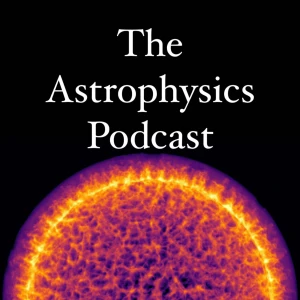
The Astrophysics Podcast
Once a month, Purdue University's Professor Paul Duffell discusses astronomy and astrophysics with experts from around the world. Duffell and guests cover topics such as supernovae, galaxies, planets, black holes, and the nature of space and time. The podcast is supported by the National Science Foundation and produced in Lafayette, Indiana.
Episodes
Dr. Chris Irwin -- Prepare to be Shocked!
Shockwaves are a familiar phenomenon here on Earth. In astrophysics, they play a role in some of the most powerful events in the universe, from exploding stars to gamma ray bursts. Shockwaves can transform enormous amounts of energy and carry information about events that are otherwise impossible to observe directly. Dr. Chris Irwin studies how these shocks form and evolve, and how we can use t
Dr. Ranadeep Dastidar -- Astrophysics at the Speed of Light
The Theory of Relativity was discovered by Einstein over a century ago, and it tells us how time and space are distorted when moving close to the speed of light. We mere earthlings don't get the opportunity to move that fast, but there are some phenomena in astrophysics that move very fast; more than 99.9999% of the speed of light. Ranadeep Dastidar is a computational modeler who writes code to
Dr. Abigail Polin -- Astrophysics Q & A #3
Abigail Polin is back, and we are doing another astrophysics Q&A! This time, our questions come from a class of third graders in Indiana. You'll be surprised at how some of the simplest questions can lead us down a very complex path!
Dr. Jeff Gerber -- Let's Talk Stars
This episode we get back to the objects that inspired the whole field of astrophysics -- stars. Those little points of light that first inspired us as children are incredible physics laboratories that we can still use today to learn about plasma physics, turbulence, and nuclear reactions. Dr. Jeff Gerber tells us why he made his career out of studying how stars work, and how much we still have t
Dr. Charles Law -- All the Molecules in Protoplanetary Disks
Just how much do we know about how the planets formed? How much of this can we learn from getting images of young solar systems? Why does it help to look at the disk using radio waves instead of optical wavelengths? Dr. Charles Law discusses these questions and more as we talk about radio astronomy and the birth of the solar system.
Dr. Daniel Polin -- The Biggest Digital Camera in the World
The Vera Rubin Observatory has just started taking its first data this month. We have a special guest (Dr. Daniel Polin) who helped in the construction of the camera for Rubin. This digital camera was a major feat due to the very large amount of data contained in each exposure, requiring clever techniques for reading and transmitting data quickly. Let's find out what it takes to build the bigge
Dr. Gurtina Besla -- Dark Matter in the Milky Way
Most of the mass in the universe is invisible. We call it "Dark Matter", and the only reason we know it's there is because we can see how it gravitationally interacts with regular matter. For example, in our own galaxy, Dark Matter comprises most of the mass, in a large spherical "halo" that binds the smaller spiral of gas and stars that we can see. As all our stars orbit the Milky Way, they are p
Dr. Abigail Polin -- Astrophysics Q & A #2
What's the deal with black holes?
Dr. Kaitlin Kratter -- Building a Solar System on the Computer
How did our solar system form? More generally, how does any solar system form? We get some of our answers to these questions by looking at newly-forming planetary systems in the first million years of their lives. But getting a complete picture also requires a lot of theoretical work, understanding each stage of solar system formation, which often entails big computational models of the early s
Dr. Tim Cunningham -- White Dwarfs Sometimes Eat Planets
A white dwarf star is the compact, dense remnant of a once-thriving solar system. Long after the original star has died and turned into a white dwarf, it can still interact with its solar system. We can even see white dwarfs eating up the rocky debris that once made up their solar system, and apparently making sense of all of this requires a detailed understanding of how convection works in thes
Dr. Merel van 't Hoff -- The Birth of the Planets
How did the planets form? What was going on in the first few brief million years of our solar system? And how did it impact what we see in our solar system today? Dr. Merel van 't Hoff takes us on a journey through astrochemistry to understand the planetary wombs that house solar systems in their prenatal years.
Dr. Wen-Fai Fong -- The Neutron Star Mash
What kinds of things do neutron stars do? They can smash into each other, producing bright flashes of radiation and strong ripples in spacetime that can be detected across the universe! Or, a neutron star can just be sitting there, and its magnetic field might suddenly shift and produce a dramatic burst of radio waves! But mainly, neutron stars are super-dense and super-complicated, giving us a
Dr. Daniel D'Orazio -- The Black Hole Shuffle
Just how big can black holes get? Well, they can get super-massive! That is, millions to billions of times as massive as the sun. How do we know this? We've detected these supermassive black holes at the centers of galaxies in a number of ways, and Dr. Daniel D'Orazio has been leading the way in figuring out new ways we can detect more, especially if it's not one but two black holes orbiting o
Dr. Abigail Polin -- Astrophysics Q & A
In this week's episode, Dr. Abigail Polin joins us to answer your questions from the internet, on a variety of topics tangentially related to astrophysics! Questions range from the basic and fundamental to the obscure and weird. Answers are totally unprepared and rambling. Our guests this week are Dr. Abigail Polin, PLUS an extra-special mystery guest!
Dr. Andrea Derdzinski -- How do we see black holes?
A black hole is so dense, its gravitational field prevents anything from escaping, including light. You would think that would make them the "blackest" things in the universe; how in the world do we know they are there? Dr. Andrea Derdzinski tells us about how we detect black holes, either due to the gravitational waves they produce, or due to their interaction with material orbiting around them
Dr. Jared Goldberg -- Does Betelgeuse have a Betelbuddy?
Up in Orion's shoulder sits Betelgeuse, a supergiant star near the end of its life. The surface of Betelgeuse has been roiling and pulsing for centuries, as long as humans have recorded its modulated luminosity. Dr. Jared Goldberg is a postdoctoral research fellow at the Center for Computational Astrophysics in the Flatiron Institute in New York City. Dr. Golberg has been developing computer model
Dr. Yvette Cendes -- Black Holes on the Radio
What happens when a black hole eats up a star? Apparently a lot of things happen, and if you wait around awhile and look in the radio, even more things happen! Dr. Yvette Cendes tells us what it's like to be a radio astronomer and about her latest research into tidal disruption events (TDE's), when a black hole shreds up a star and eats it, producing a dramatic light show across the electromagne
Dr. Maxim Lyutikov -- How do you make a Fast Radio Burst?
Some things happen out in the universe that are too powerful to make in a lab. Other phenomena are so coherent and well-ordered, we can't figure out how they can be made without a lab! Fast radio bursts are an incomprehensible combination of both; they are extremely powerful, highly coherent, and very rapid bursts of radio emission. Dr. Maxim Lyutikov spends a lot of his time pondering how thes
Dr. Lindsey Kwok -- The Forensic Science of Supernovae
How do we know so much about supernovae, when all we see is this little point of light getting brighter and then dimmer over time? Given this minimal data, we can often say what type of star exploded, and even some details about how the explosion took place. Supernova astronomers are a lot like forensic scientists dusting for fingerprints and getting DNA samples at the scene of a crime. But instea
Dr. Paul Duffell -- The Universe on a Computer (with host Dr. Abigail Polin)
How big a computer do you need to simulate a supernova? Or a planet being formed? Or a black hole swallowing gas? Many astrophysicists spend their time developing computational models to simulate these systems and learn how they evolve. We discuss these computer simulations with Purdue Professor Dr. Paul Duffell. In this first episode of season 2, Dr. Abigail Polin takes over as host.
Dr. Brenna Mockler -- When Black Holes Get Hungry
What do black holes like to eat? Sometimes a steady diet of interstellar gas just isn't enough and a black hole needs to snack on a whole star. No judgment, we all get that way sometimes. But it can lead to some extremely energetic outflows, visible from across the universe. Dr. Brenna Mockler tells us all about these events, called "Tidal Disruption Events", and what we can learn from observi
Dr. Dan Milisavljevic -- Into the Time Domain
Our universe isn't just a static, unchanging backdrop. It is constantly changing in time and we now have the technology to image it over and over again to explore all those changes. This is called Time Domain Astronomy, and Danny Milisavljevic is an expert in this field. He spends a lot of his time on the forensic science of exploding stars, to gain clues about the underlying processes that cau
Dr. Katelyn Breivik -- How Binary Stars Evolve
What would our solar system be like if we had two suns? Actually, this situation could be more common than you might think, as most stars are in binary systems. If a star is in a binary pair, how does that affect its life and death? Dr. Katelyn Breivik of Carnegie Mellon University tells us all about these systems and what scientists and other curious minds can learn from them.
Dr. Kyoungsoo Lee -- Our Galactic Neighborhood
What's the biggest thing in the universe, besides the universe itself? Well, stars live in galaxies, and galaxies live in large collections called galaxy clusters. Astronomers can study these titanic clusters of galaxies to learn about how they grow and merge with each other to assemble the universe we live in today. Dr. Kyoung-Soo Lee takes us on a journey to the largest scales in the cosmos.
Dr. Jason Wang -- Taking a Photo of an Exoplanet
For centuries, all that we have known about planets was confined to our own solar system, and its occasionally-changing number of planets (eight as of now). But in the past several decades, astronomers have developed increasingly sophisticated techniques for detecting planets outside our solar system, orbiting distant stars many light-years away. Dr. Jason Wang is an innovator who has developed
Dr. Rosalba Perna -- The Neighborhood of a Supermassive Black Hole
Planets orbit stars, and moons orbit planets, so what orbits a supermassive black hole? Possibly a whole lot of stuff, including a gaseous disk, thousands of stars and more "normal size" black holes! Dr. Rosalba Perna tells us about all the crazy things that could be orbiting around the supermassive black holes that we detect at the center of active galaxies.
Dr. Soham Mandal -- What Happens to Supernovae After they Explode?
When a star explodes, it's not finished having an impact on its surroundings. For the next thousand years or so, we can still see it as a supernova remnant, when the explosion has expanded to large enough scales that we can actually resolve an image of the explosion with modern telescopes like JWST, and it's even possible to do a forensic analysis to learn more about the cause of death. We will
Dr. Yuan Li -- Our Turbulent Universe
What is turbulence? You've probably experienced it before on a plane (or perhaps on a river) but you might not know precisely what it is. But turbulence is all around us, and in particular we find it on some of the largest scales in the universe. Professor Yuan Li talks about turbulence and also a little unrelated bit about Mira, an unusual star with a tail!
Dr. Ashley Villar -- Big Data in Astrophysics
Astronomers deal with huge datasets, and they are about to get even bigger with the construction of the Vera Rubin Observatory. When you can detect a million supernovae per year, how do we make sense of this data and decide which ones are the "most interesting" to study? Professor Ashley Villar at the Center for Astrophysics | Harvard & Smithsonian has made her career out of developing machi
Dr. Frank Timmes -- Pulsing White Dwarfs, Neutrinos, and the Infrastructure of Research
What are neutrinos and where do they come from? How do we know what's going on in the interior of a star when we can only see the surface? How does a paper get accepted into a scientific journal? We discuss these questions and more with Frank Timmes, professor at Arizona State University and Associate Editor-in-Chief of a number of scientific journals run by the American Astronomical Society.
Dr. Erica Nelson -- Watching the First Galaxies Form
How did the galaxies form and how can we learn about them? Professor Erica Nelson of the University of Colorado, Boulder tells us how we use the James Webb Space Telescope (JWST) to look back in time and learn about the initial formation of structure in the universe.
Dr. Abigail Polin -- A New Type of Supernova
How do stars explode? It turns out there's more than one way, and Professor Abigail Polin has discovered a totally new way that stars can end their lives. We talk with Professor Polin about how that works and how scientists look at a supernova to figure out what caused the explosion.
Recommended

Talk About Talk - Executive & Leadership Communication Skills

English with Olivia | Slow Conversations & Vocabulary
Stand In The Circle

SLOW ENGLISH PODCAST (A1-A2) With Subtitles | Daily Videos | English With Us Podcast

Learn English A2 with Daily News | Simple English Listening Practice

پلی لیست | PlayList
Conspiracy Files with Paige Carter

Bad Friends

Learn 50 English Phrases While You Sleep | Everyday English Phrases & Vocabulary
This Past Weekend w/ Theo Von
Dateline NBC

Back to the 80s Radio
