
The Jim Rutt Show
The Jim Rutt Show features crisp conversations with critical thinkers at the leading edge of science, technology, politics, and social systems. Each episode delves into complex topics with experts and innovators, exploring the frontiers of human knowledge and societal change. The show aims to provide deep insights into emerging ideas and trends shaping our world.
Episodes
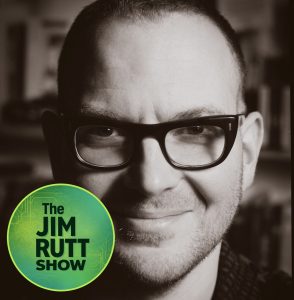
EP 346 Cory Doctorow on Why the Internet Got Worse and What to Do About It
Jim talked with Cory Doctorow—prolific sci-fi and nonfiction author, journalist, activist, EFF special adviser, and author of Enshittification: Why Everything Suddenly Got Worse and What to Do About It—about how structural forces degraded the internet, and what citizens (not consumers) can actually do about it.
They discussed:
The origin of "enshittification"—Cory's January 2023 blog post, its
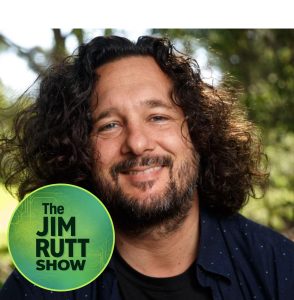
EP 345 Worldviews: Tyson Yunkaporta on Ceremony, Skepticism, and Seeing in 3D
Jim talks with Tyson Yunkaporta—indigenous Australian scholar and author of Sand Talk, one of Jim's top ten favorite books—about his metaphysics and worldview, the ecology of sex and creation, and how to wear rationalist and traditional knowledge frameworks simultaneously.
They discuss:
Jim's editorial endorsement of Sand Talk—"one of the top 10 best books I have ever read"
Tyson's trilogy o

EP 344 Lisa Buckingham on Hiring for the AI Era
Jim talks with Lisa Buckingham—a veteran HR leader at Vialto Partners, US Soccer, Lincoln Financial, and Thomson—about how the LLM era is reshaping hiring and job architecture, and how companies and workers can roll with the changes.
They discuss:
Jim and Lisa's shared history in natural language processing labs thirty years ago—and the contrast with today, where "everybody can be an AI expert
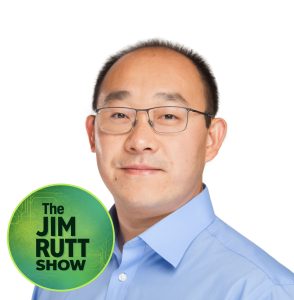
EP 343 Worldviews: Peter Wang on the Metaphysics of Quality, Sucker’s Bets, and Ofness
Jim talks with Peter Wang—chief AI officer, cofounder and CEO of Anaconda, board member of the Center for Humane Technology, and founder of the Austin STEM Center—about Robert Pirsig's metaphysics of quality, how modernity encourages defection, and a secular conception of the sacred.
They discuss:
Peter's self-description as "the music in a violin that can kind of hear itself"
The "Peter
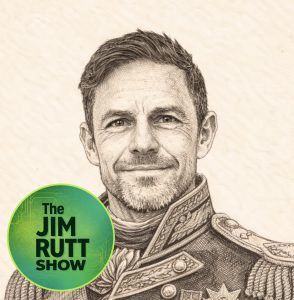
EP 342 Worldviews: Jordan Hall on Reality as Relationship and Why the Dead Are Still With Us
Jim talks with recurring guest and deep systems thinker Jordan Hall about the scaffolding of his worldview. They discuss the waking-up scenario as a window into consciousness and personal identity, Jordan's phenomenology of waking and the "latent potential of all possible memory," the soul as the binding of finite and infinite, Jim's counter-framing of consciousness as a fusion of perception, inte
EP 341 Worldviews: Bonnitta Roy on Post-Formal Actors, Stage Theory, and the Character Void in Leadership
Jim talks with Bonnitta Roy, interdisciplinary thinker and founder of the Pop-Up School and the Divinity School, about her worldview, the deep foundations of her work, and an upcoming conference in Cambridge.
They discuss the phenomenology of waking up and recomposing, life as a stream of participation, being nested in place through horses, pigeons, bees, and gardens, covariant motions as her pro
EP 340 Worldviews: Liv Boeree on Poker, Moloch, and the Art of Finding Win-Wins
Jim talks with Liv Boeree—science communicator, former professional poker player, and host of the Win-Win Podcast—about consciousness, egregores, multipolar traps, and the ethics of factory farming.
They discuss the nature of personal identity across sleep, the teleportation machine thought experiment, consciousness as a self-aware story-threading entity, the "attention as cursor of consciousness
EP 339 John Krakauer on Why Neuroscience Needs Behavior
Jim talks with John Krakauer—professor of neurology and neuroscience, director of the Center for Study of Motor Learning and Brain Repair at Johns Hopkins, and external faculty at SFI—about his 2017 paper "Neuroscience Needs Behavior: Correcting a Reductionist Bias."
They discuss defining behavior as ecologically valid goal-directed action within an animal's umwelt, behavioral decomposition being

EP 338 Jeff Giesea on Dionysian Futurism, Reading Great Books in the AI Era, and Rebalancing Generational Power
Jim talks with Jeff Giesea, entrepreneur, writer, and founder of the Boyd Institute, about his essay "Dionysian Futurism" and the broader question of what's missing from our visions of the future. They discuss Nietzsche's Apollo/Dionysus framework from The Birth of Tragedy, the critique that techno-optimist futures are lifeless and sterile, Jim's extension of that critique to Game B and adjacent s
EP 337 Worldviews: Philip Rosedale on Emergent Worlds, Localism, and What Building Second Life Taught Him About Humanity
Jim talks with Philip Rosedale, founder and CEO of Linden Lab and creator of the game Second Life, about the nature of self, society, and the design of virtual worlds. They discuss the phenomenology of waking up and coalescing into a self, the polycrisis and whether to work on AI or on software that helps people get along better, Philip's role-based sense of identity, his messianic feeling during
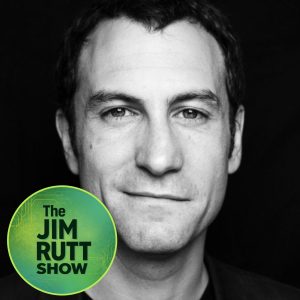
EP 336 Rufus Pollock on the Wisdom Gap and the Second Renaissance
Jim talks with Rufus Pollock—entrepreneur, activist, Zen practitioner, founder of Life Itself and the Open Knowledge Foundation, and author of Open Revolution—about the metacrisis, the wisdom gap, and what a Second Renaissance might look like. They discuss Jim's own early belief that accessible information would produce a renaissance of democracy, the realization that "open knowledge does not make
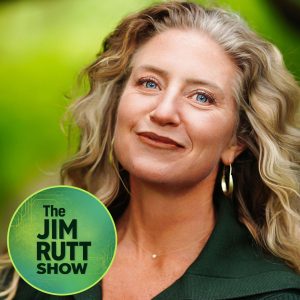
EP 335 Worldviews: Samantha Sweetwater
Jim talks with Samantha Sweetwater about her book True Human: Reimagining Ourselves at the End of Our World and the question of what it means to be human at this moment in planetary history. They discuss her verb-based rather than noun-based self-identity, Lisa Feldman Barrett's construction theory as a framework for understanding the entanglement of body, brain, mind, and relationship as the fabr
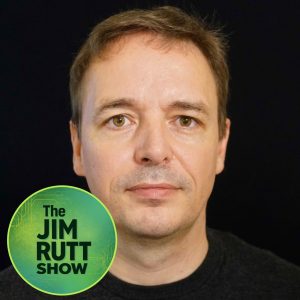
EP 334 Worldviews: Joscha Bach
Jim talks with cognitive scientist and AI researcher Joscha Bach about the computational and representational foundations of consciousness, mind, and reality. They discuss the phenomenology of waking up and coalescing into a self, language as a representational architecture and natural language as "a genre of music," the brain as a game engine constructing a simulated world, the "feeling of realne
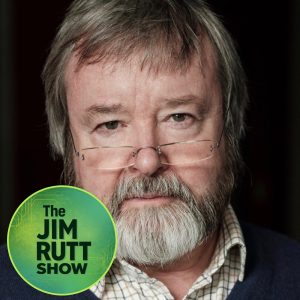
EP 333 Worldviews: Iain McGilchrist
In this Worldviews episode, Jim talks with Iain McGilchrist about consciousness, matter, and the nature of reality. They discuss consciousness as the basis of everything we know, matter as a phase of consciousness that provides resistance and persistence, pan-experientialism and the belief that everything in the cosmos experiences in some form, the whirlpool metaphor for individual consciousness w
EP 332 Worldviews: Jim Rutt
In a special edition of the new Worldviews series, Brendan Graham Dempsey asks Jim about his life and worldview using a faith development interview. They discuss Jim's life chapters from growing up through becoming a complexity guy and GameB advocate, his age 11 epiphany that religion is bullshit after researching world religions at the library, the formative influence of his wife and parents who

EP 331 Worldviews: Michael Shermer
Jim talks with Michael Shermer about his worldview and his new book, Truth: What It Is, How to Find It, and Why It Still Matters. They discuss Michael's self-identification as a monist and realist who believes in a physical objective world, the concept of fallibilism, intersubjective verification of the interobjective, reliance on authorities and institutions, the battle between the book of author
EP 330 Worldviews: Ben Goertzel
Jim talks with Ben Goertzel about his worldview. They discuss Ben's morning experience of consciousness crystallizing from ambient awareness, his identification as a panpsychic, the concept of pattern being more fundamental than stuff, Charles Peirce's ontology of first/second/third, the idea of uryphysics as a broader notion of physics beyond metaphysics, parapsychology and psi phenomena includin
EP 329 Worldviews: David Krakauer
In the inaugural episode of a new series, Jim talks with David Krakauer about his intellectual formation and worldview. They discuss what woke up as David this morning, his commitments to chance and pattern seeking, his epiphany about the idea of the idea at age 12 or 13, his perverse attraction to the arcane and difficult, evolution as integral to intelligence, the risk-averse character of schola
EP 328 Brendan Graham Dempsey Interviews Jim Rutt on Minimum Viable Metaphysics
In this flipped episode, Brendan Graham Dempsey interviews Jim about the ideas in his recent Substack essays "A Minimum Viable Metaphysics" and "What I Mean by 'Metaphysics'." They discuss metaphysics as assumptions for learning and reasoning, the difference between deduction, induction, & abduction, Jim's belief that there are no paradoxes in the real world, the reality principle, the asymmetry p
EP 327 Nate Soares on Why Superhuman AI Would Kill Us All
Jim talks with Nate Soares about the ideas in his and Eliezer Yudkowsky's book If Anybody Builds It, Everyone Dies: Why Superhuman AI Would Kill Us All. They discuss the book's claim that mitigating existential AI risk should be a top global priority, the idea that LLMs are grown, the opacity of deep learning networks, the Golden Gate activation vector, whether our understanding of deep learning n
EP 326 Alex Ebert on New Age, Manifestation, and Collective Hallucination
Jim talks with Alex Ebert about the ideas in his Substack essay "New Age and the Religion of Self: The Anatomy of a Rebellion Against Reality." They discuss the meanings of New Age and religion, the New Thought movement, the law of attraction, manifesting, Trump's artifacts of manifestation, the unmooring from concrete artifacts, individual and collective hallucinations, intersubjective verificati

EP 325 Joe Edelman on Full-Stack AI Alignment
Jim talks with Joe Edelman about the ideas in the Meaning Alignment Institute's recent paper "Full Stack Alignment: Co-Aligning AI and Institutions with Thick Models of Value." They discuss pluralism as a core principle in designing social systems, the informational basis for alignment, how preferential models fail to capture what people truly care about, the limitations of markets and voting as p
EP 324 John Preston on 40 Flushes to Grow Your Business
Jim talks with John Preston about his book 40 Flushes to Grow Your Business: The World's #2 Business Series, which is designed to be read during bathroom breaks. They discuss breaking free from being a one-person show, hiring self-guided employees, the importance of business owner support networks, clarity on business goals & personal objectives, the five-gear growth machine business metrics model
EP 323 Pablos Holman on Deep Tech
Jim talks with Pablos Holman about the ideas in his new book Deep Future: Creating Technology That Matters. They discuss deep tech versus shallow tech, computational modeling and simulation for real-world problems, the hacker mindset, the role of inventors, nuclear power and renewable energy solutions, population growth, development challenges, space-based solar power, the likelihood of fusion pow
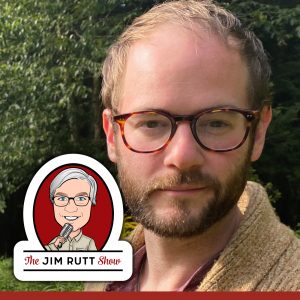
EP 322 Brendan Graham Dempsey on Psyche and Symbolic Learning
Jim talks with Brendan Graham Dempsey about the ideas in his book Psyche and Symbolic Learning, volume 2 in his Evolution of Meaning series. We discussed hierarchical complexity, stage theories of development, constructivism & realism, dynamic skill theory, the Lectical Scale, ego development & consciousness, meaning systems & worldviews, cross-cultural developmental patterns, statistical distribu
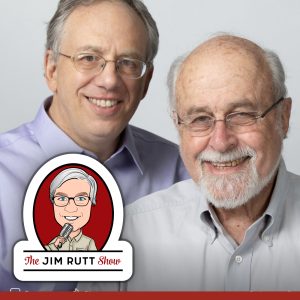
EP 321 James Fadiman and Jordan Gruber on Microdosing Psychedelics
Jim talks with James Fadiman and Jordan Gruber about the findings in their recent book Microdosing for Health, Healing, and Enhanced Performance. They discuss the definition of microdosing, "subthreshold" vs "subperceptual," typical doses, current usage statistics & demographics, its legal status & classification history, LSD, psilocybin, why cannabis isn't suitable for microdosing, mechanisms of
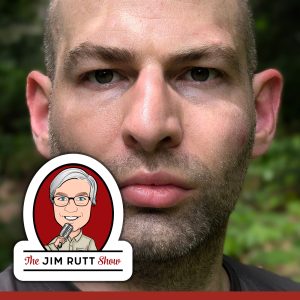
EP 320 David Shapiro on Mastering AI Tools for Research
Jim talks with David Shapiro about how to use AI language models as research and writing tools. They discuss post-labor economics, the evolution of AI tools from GPT-2 through GPT-4, using AI as a learning companion vs. relying on it completely, David's AI tool stack, exploring new domains, using NotebookLM for document management & searching, AI writing and editing techniques, critique and perspe
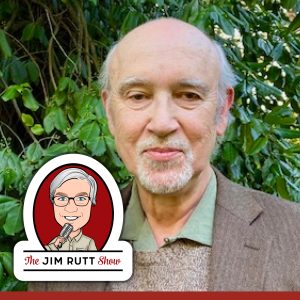
EP 319 Lawrence Cahoone on Emergence and Natural Order
Jim talks with Lawrence Cahoone about his book The Orders of Nature and his systematic approach to naturalist philosophy. They discuss fallibilist & local metaphysics, objective relativism, the rejection of simples, Jim's materialism which grants emergence first-class existence, Wimsatt's notion of emergence & nonaggregativity, downward causation & pruning rules, natural complexes, Aristotle's fou
EP 318 Adam B. Levine on Thinking on Demand
Jim talks with Adam B. Levine about humanity's rapidly changing relationship with AI and "thinking on demand." They discuss the GPT-5 release & pricing, open-source AI models, the three-dimensional framework of AI advancement (models & hardware & agent frameworks), the evolution of vibe coding, development tools, agent-based development, AI implementation strategies with humans in the loop, the Mi
EP 317 David Shapiro on Post-Labor Economics
Jim talks with David Shapiro about his six-part series on "post-labor economics." They discuss historical economic transitions, the logic of labor substitution, automation & AI's impacts on employment, the four basic human economic offerings (strength, dexterity, cognition & empathy), labor as a societal pillar, the pyramid of prosperity (universal basic services, collectively owned public & priv
EP 316 Ken Stanley on the AI Representation Problem
Jim talks with Ken Stanley about the Fractured Entanglement Representation hypothesis in deep learning neural networks. They discuss open-endedness in AI systems & evolution, the Picbreeder experiment & its significance, the objective paradox of finding things by not looking for them, comparisons between Picbreeder & SGD networks, visual differences in internal representations, weight sweep experi
EP 315 Ed Latimore on Hard Lessons from the Hurt Business
Jim talks with Ed Latimore about his new book Hard Lessons from the Hurt Business: Boxing and the Art of Life. They discuss Ed's chess playing & street hustling, size differences in modern heavyweight boxing, growing up in Pittsburgh's Hill District, childhood trauma & violence, relationships with his single mother & absent father, middle school & gifted programs, the cocaine prank incident, his h
EP 314 Zak Stein and Marc Gafni on the Nature of Everything
Jim talks with Zak Stein and Marc Gafni about consciousness, attention, and value as fundamental aspects of reality. They explore continuity & discontinuity in evolution, phenomenology & naturalism, emergence, value theory, selection theory, mathematics as both discovered & created, pre-life organic chemistry, sexual selection & evolutionary dynamics, attraction/allurement across different emergen
EP 313 Chris Colin on Why Customer Service Sucks
Jim talks with Chris Colin about his recent Atlantic article "That Dropped Call with Customer Service? It Was on Purpose." They discuss customer service hell & Chris's personal story with Ford, the concept of sludge, intentional friction in customer service systems, call center operations & tactics, high-quality customer service approaches, the impact of short-term CEO tenures on service quality,
EP 312 Lee Cronin on Automating Chemistry
Jim talks with Lee Cronin about Chemify, his startup that aims to automate chemistry through "chemifarms" that turn code into molecules. They discuss the development of the ChemChi programming language & its evolution to Turing completeness, quantum vs classical chemistry computation, open source tools & academic access, robotics & automation in chemistry, catalyst discovery & optimization, integr
EP 311 Nicholas Humphrey on the Invention of Consciousness
Jim talks with Nicholas Humphrey about the ideas in his 2023 book Sentience: The Invention of Consciousness. They discuss the distinction between sentience & consciousness, access consciousness vs phenomenal consciousness, terminology in consciousness studies, ring-fencing theories, Nicholas's early experiments with phosphenes, the discovery of blindsight in monkeys, his relationship with Helen th
EP 310 Samo Burja on Anduril’s Plan to Modernize the US Military
Jim talks with Samo Burja about his report on the defense startup Anduril's plan to modernize the U.S. military. They discuss "live players vs. dead players," AI adoption & cognitive tools, Anduril's background & naming origin, military technology modernization, software-defined conflicts, autonomous & software-enabled weapons, sensor deployment & data collection, the Lattice software platform, ha
EP 309 Richard David Hames on the Final Performance of Western Civilization?
Jim talks with Richard David Hames, picking up from the ideas in his recent Facebook essay about the decline of Western civilization. They discuss the retreat from truth in politics & institutions, postmodernism's impact on rationality, China's governance model, the failure of democratic institutions, wealth inequality & social stratification, the liberation of women as our era's defining achievem
EP 308 David Chapman on Rethinking Nobility
Jim talks with David Chapman about rethinking nobility for the modern age through his recent "nobility tetralogy" of essays. They discuss character & virtue as "risible" concepts, noblesse oblige & elite education, nobility as intention vs status, "The Battle of Maldon" poem & its lessons, postmodernism & postmodernity, the failure of elite universities, effective altruism & Sam Bankman-Fried, Elo
EP 307 Thomas Schindler on Heliogenic Civilization
Jim talks with Thomas Schindler about heliogenic civilization as a vision for a regenerative future. They discuss the current multipolar trap shitshow of global civilization, M3 money supply & GDP growth requirements, the doubling of energy demand, exit to planet as an alternative to traditional business exits, biomimicry & biological approaches to manufacturing, solar energy as a fusion reactor,
EP 306 Anders Indset on The Singularity Paradox
Jim talks with Anders Indset about his book The Singularity Paradox: Bridging the Gap Between Humanity and AI, co-authored with Florian Neutkart. They discuss the "final narcissistic injury of humankind," Freud's three historical narcissistic injuries, machine consciousness vs human consciousness, the "undead" state, human cognitive limitations, game theory dynamics & multipolar traps, Artificial
EP 305 J. Doyne Farmer on Complexity Economics
Jim talks with J. Doyne Farmer about his book Making Sense of Chaos: A Better Economics for a Better World. They discuss deterministic chaos & strange attractors, how chaos makes time possible, bounded rationality, economic equilibrium & Nash equilibrium, traditional economics' failures, standard economic theory basics, "as if" vs "as is" approaches, heterogeneity in economic systems, agent-based
EP 304 Samuel Arbesman on The Magic of Code
Jim talks with Samuel Arbesman about the ideas in his book The Magic of Code: How Digital Language Created and Connects Our World—and Shapes Our Future. They discuss Sam's motivation for writing the book, the wondering vs. utilitarian stances toward computing, early personal computing experiences, scale in programming, AI as a "hinge of history" moment, the democratization of code through AI tools

EP 303 Mark Stahlman on Pope Leo XIV and the Catholic Church’s Missionary Turn
Jim talks with Mark Stahlman about the new Pope Leo XIV and the Catholic Church's evolving role in a digital age. They discuss Trump as an avatar of the digital paradigm shift, the significance of Leo XIV's name choice, Francis as a thug, Francis's background as chemical engineer and bouncer, Synodality & Church decentralization, the exterior vs interior personas of Pope Francis, Leo XIII's 1891 e

EP 302 Daniel Mezick on Games and Governance
Jim talks with Daniel Mezick on the theme of games and their relationship to governance. They discuss Jane McGonigal's four properties of games, the nature of authority, position-based vs role-based authority, formal vs. informal authority structures, finite & infinite games, mutable games, the paradox of self-amendment, the U.S. Constitution as a game, progress tracking in governance systems, rol
EP 301 Zak Stein on K-12 Education in the AI Era
Jim talks with Zak Stein about the psychological & developmental risks of AI in K-12 education. They discuss education vs schooling, technology's role in human-to-human interaction, GPS & skill atrophy, prosthetic vs enhancement technologies, multipolar traps in AI, cognitive diminishment & skill development, teacherly authority, attention as a constrained resource, attention as a service, parasoc
EP 300 Daniel Rodriguez on AI-Assisted Software Development
Jim talks with Daniel Rodriguez about the state of AI software development and its implementation in industry. They discuss Daniel's background at Microsoft & Anaconda, transformer-based technologies, software engineering as hard vs soft science, vibe coding, barriers to entry in software engineering, cognitive styles needed for programming, Daniel's history with LLMs, unit testing & test-driven d
EP 299 Ryan Blosser on Permaculture for Food and Friendship
Jim talks with Ryan Blosser about the ideas in his book Mulberries in the Rain: Growing Permaculture Plants for Food and Friendship, co-authored with Trevor Piersol. They discuss the motivation behind writing a permaculture book, the human sector in permaculture design, financial challenges of permaculture farming, 8 forms of capital, food forest design principles, plant guild functions & relation
EP 298 Adam Lake on Rebooting American Democracy
Jim talks with Adam Lake about Reboot America, a project aimed at reforming American democracy. They discuss existential threats facing humanity, the two-party corporate duopoly, a Princeton study on policy preferences, first-past-the-post voting problems, campaign finance issues, social media's role in polarization, wealth & income inequality, Bernie Sanders's Fight Oligarchy tour, the Democratic
EP 297 Sara Walker on the Physics of Life’s Emergence
Jim talks with Sara Walker about the ideas in her new book Life as No One Knows It: The Physics of Life's Emergence. They discuss Sara's path from theoretical physics to astrobiology, the biggest scientific questions, philosophy of science & theory development, historical approaches to origin of life research, Schrödinger's negative entropy concept, Prigogine's dissipative systems, information as

EP 296 Ashley Hodgson on Economic Mythology and System Change
Jim talks with Ashley Hodgson about her YouTube series "The New Enlightenment" and its heterodox perspectives on economics and social systems. They discuss Iain McGilchrist's influence & his book "The Matter with Things," economic mythology & its role in upholding the current system, the Bernays era of programmed consumerism, GDP growth myths, destructive growth value, problems with GDP, resource
EP 295 John Robb on How a Networked Organization Blitzed D.C.
Jim talks with John Robb about the ideas in his recent essay "Blitzing DC," about how a networked organization took over Washington. They discuss the early roots of network warfare in Iraq, McLuhan-esque societal rewiring, open source dynamics & plausible promise, the Arab Spring & Occupy movements, empathy triggers, Trump's 2016 campaign as a hybrid swarm, The_Donald as a meme amplifier, the Blue
EP 294 Timothy Clancy on an AI Cold War
Jim talks with Timothy Clancy about wicked mess problems & the potential for a new Cold War centered on AI. They discuss the evolution from chat-based to reasoning AI, military applications, social & systemic complexity in national security, the scaling hypothesis, China vs US competition, DeepSeek R1 model implications, export controls on GPU chips, Taiwan's strategic importance, multipolar trap
EP 293 Brendan Graham Dempsey on Cosmic Teleology and Emergence Vectors
Jim talks with Brendan Graham Dempsey, picking up on a disagreement they had on Facebook about the teleology of the universe. They discuss Aristotle's influence on the topic, Terrence Deacon's work on naturalizing teleology, the distinction between purpose & goal-directed behavior, cosmic teleology, Telhard de Chardin's "Omega Point," Whitehead's relational teleology, Ilya Prigogine's dissipative
EP 292 Emil Ejner Friis on Building a Listening Society
Jim talks with Emil Ejner Friis about political metamodernism and what comes after postmodernism. They discuss the "woke vacuum" & its failure to include common folks, psychosocial problems vs material challenges in Western countries, Jim's pushback on postmodernism, Trump as the first postmodern president, personal vs institutional change, emotional states & leadership, late-stage financialized c
EP 291 Jeff Sebo on Who Matters, What Matters, and Why
Jim talks with Jeff Sebo about the ideas in his book The Moral Circle: Who Matters, What Matters, and Why. They discuss the concept of the moral circle, harming cats vs harming cars, the case study of Happy the elephant, Descartes' view of animals, phenomenal consciousness, Thomas Nagel's bat argument, the Google engineer who claimed LaMDA was conscious, the substrate dependence of consciousness,
EP 290 Mark Stahlman on Trump as the Avatar of the Digital Paradigm Shift
Jim talks with Mark Stahlman about Trump as an avatar of the current digital transformation. They discuss the GameB movement & complexity theory, predictions made to the Pentagon's Office of Net Assessment, security through development as alternative to war, the three spheres (East, West, Digital), China's approach to digital vs. the Western approach, Catholic social teaching principles, neo-feuda
EP 289 Adam B. Levine on AI-Powered Programming for Non-Developers
Jim talks with Adam B. Levine about AI programming aids for non-techies and the future of Bitcoin. They discuss Adam's background as a "technical non-technical" person, the evolution from manual LLM prompting to using IDEs, Windsurf as an AI-first IDE, Claude 3.7's thinking mode, productivity improvements with AI coding tools, different platforms like Cursor and Cline, the "pure idea space" vs tec

EP 288 BJ Campbell on Cops, Belief, and Chainsaw-Faced Robot Dogs
Jim talks with BJ Campbell about the ideas in his Substack essay "On Cops, Belief, and Chainsaw Faced Robot Dogs." They discuss forms of social control, absolute police states vs. belief states, the role of belief vs. actual enforcement in maintaining order, the noble lie concept & Plato's original formulation, the 2020 crime spike & "defund the police" movement, the history of police forces & alt
EP 287 Jonathan Rauch on the Epistemic Crisis
Jim talks with Jonathan Rauch about the ideas in his book The Constitution of Knowledge: A Defense of Truth. They discuss the epistemic crisis, Plato's Theaetetus, Trump & propaganda techniques, the Constitution of Knowledge as a framework for epistemics, the "marketplace of ideas" metaphor, the reality-based community, the personal-institutional spiral, the social funnel of knowledge, social medi
EP 286 Bob Levy on the Use and Abuse of Presidential Power
Jim talks with Bob Levy about presidential powers, their history, and their potential for abuse. They discuss the nature of the presidential pardon, recent controversial pardons by Trump & Biden, proposed reforms, 3 main purposes of the pardon, court blocks on executive actions, the firing of federal employees, the Impoundment Control Act, immigration & deportation under Trump, presidential power
EP 285 Josh Bernoff on AI, Writing, and Thinking
Jim talks with Josh Bernoff, author of Writing Without Bullshit, about the impact of AI on writing education and professional writing. They discuss Josh's background and career, Stephen Lane's recent op-ed arguing that AI should take over writing mechanics, problems with AI-generated writing, the role of writing in thinking, ChatGPT's "deep research," Jim's ScriptHelper project, the decline in mat
EP 284 Jordan Hall on AI, the Commons, and the Church
Jim talks with Jordan Hall about the relationship between humanity and advanced AI. They discuss the false dichotomy of state vs market control of AI, the commons & the church as organizing principles, community vs society, why alignment with humanity is by definition impossible, the role of symbols & organizing principles in communities, how Moloch & Mammon shape AI development, hyper-concentrati

EP 283 Brian Chau on the Trump Administration and AI
Jim talks with Brian Chau about what the new administration could mean for AI development. They discuss recent actions by the Tump administration including repealing Biden's executive order & the Stargate infrastructure project, Biden's impact on AI, the formation of the Alliance for the Future, regulatory bureaucracy, state patchwork laws, censorship, the Gemini controversy & DEI in AI, safety re
EP 282 Tyson Yunkaporta on Indigenous Law, Lore, and Learning
Jim talks with Tyson Yunkaporta about the ideas in his new book Right Story, Wrong Story: Adventures in Indigenous Thinking. They discuss a symbolic emu visitor on Jim's farm, Aboriginal collective pronouns, Sand Talk's impact, wrong canoes, lore vs law, how Aboriginal law adapted to invasion, ritualized violence & rule-governed fighting, Aboriginal knowledge systems & peer review, signals & spiri
EP 281 Jeff Hawkins and Viviane Clay on the Thousand Brains Theory
Jim talks with Jeff Hawkins and Viviane Clay about the Thousand Brains Project and Jeff's book A Thousand Brains: A New Theory of Intelligence. They discuss Mountcastle's theory of the neocortex's universal algorithm, cortical columns & their structure, learning modules in AI sensory systems, reprogramming of the neocortex, the 6 layers of cortex, mini-columns & macro-columns, the visual cascade,

EP 280 Rob Henderson on Luxury Beliefs
Jim talks with Rob Henderson about his book Troubled: A Memoir of Foster Care, Family, and Social Class and the concept of luxury beliefs. They discuss Rob's journey from foster care to Yale and Cambridge, Jim's background, the decline in two-parent families from 1960 to 2005, changing forms of elite hypocrisy, intra-elite competition, corporate adoption of woke beliefs, enforcement of ideological
EP 279 Samuel Scarpino on H5N1 (Bird Flu) and Pandemic Risk
Jim talks with epidemiology expert Samuel Scarpino about the recent spread of H5N1 in dairy cows and its implications for public health. They discuss the historical context of H5N1, fatality rates, modeling the spread, network effects in disease transmission, current surveillance efforts, H5N1 transmission mechanisms, challenges of human respiratory transmission, lessons learned & mislearned from

EP 278 Peter Wang on AI, Copyright, and the Future of Intelligence
Jim has a wide-ranging conversation with recurring guest Peter Wang on AI copyright frameworks and the rapidly changing tech landscape. They discuss "the Chattening" (ChatGPT's release in November 2022) & its impact, parallels between current AI & the invention of science, humans as narrow-band sensors, cybernetics & control systems, the unbearable slowness of being, the Platonic Representation Hy

EP 277 Kristian Rönn on Darwinian Traps and How to Escape Them
Jim talks with Kristian Rönn, co-founder of the carbon accounting tech company Normative, about his book The Darwinian Trap: The Hidden Evolutionary Forces That Explain Our World (and Threaten Our Future). They discuss Darwinian traps & demons, the parable of Picher, Oklahoma, the "cost of doing business" mentality, beauty filter arms races, perverse incentives in science, Goodhart's law, how natu
EP 276 Carolyn Dicey Jennings on Attention and Mental Control
Jim talks with philosopher and cognitive scientist Carolyn Dicey Jennings about her book Attention and Mental Control. They discuss mental control vs self-control, the ping pong metaphor, prioritization vs single-threaded focus, voluntary vs automatic attention, perceptual processing & conscious attention, 3 forms of interest, meditation & mind wandering, hyperfocus as a superpower, ADHD & neurodi
EP 275 Rachel Winkler on Mass Deportation
Jim talks with lawyer and former DHS policy person Rachel Winkler about Trump's promise to carry out a large-scale deportation operation. They discuss estimates of undocumented immigrants in the U.S., mixed-status households & the aging undocumented population, the legal standing of an undocumented immigrant, types of undocumented immigrants, the process for pending deportation orders, potential p
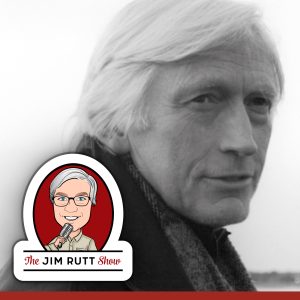
EP 274 Richard Overy on Why War?
Jim talks with historian Richard Overy about his new book Why War? They discuss historians' shyness in thinking about the nature of war, a correspondence between Einstein & Freud, the meaning of the term, the "pacified past," the interplay between warfare & cooperation, recent ethological studies of chimpanzees, conformity, 4 major types of anthropological evidence, the status of warriors over tim

EP 273 Gregg Henriques on the Unified Theory of Knowledge
Jim talks with Gregg Henriques about his new book UTOK: The Unified Theory of Knowledge. They discuss the problem the book addresses, 3 vectors of knowing, the metacrisis, avoiding despair & techno-optimism, the enlightenment gap, the iQuad coin, the UTOK garden frame, a descriptive metaphysics for science, behavior & mind, endo-naturalism, 3 kinds of mindedness, webs of justification, the periodi

EP 272 Loribeth Ford Jarrell on Bespoke Education
Jim talks with Loribeth Ford Jarrell, the director of Sumplicity Math, a mathematics enrichment program for children. They discuss working with the neural characteristics & firing patterns of individual children, education going modular, the microschool movement vs supplementary education, tutorial services, individual assessment, 10 vector dials, Jim's education in proving the teacher wrong, iden
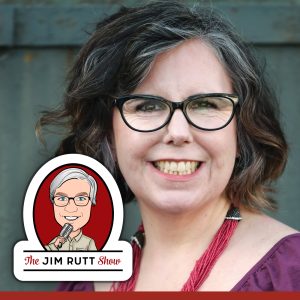
EP 271 Lorraine Besser on the Art of the Interesting
Jim talks with Lorraine Besser about the ideas in her book The Art of the Interesting: What We Miss in the Pursuit of the Good Life and How to Cultivate It. They discuss the turning point in Lorraine's life that inspired the book, the meaning of the good life, pleasure vs eudaimonia, Stoicism & Epicureanism, unstructured cognitive engagement, the interesting, Seinfeld's relationship to happiness,

EP 270 Nancy Jacobson on No Labels and the 2024 Election
Jim talks with Nancy Jacobson, the founder and CEO of the No Labels political organization, in the last of four conversations featuring non-partisan thinkers on the upcoming US presidential election. They discuss No Labels's mission, the Problem Solvers Caucus, the common sense platform, the quality of No Labels volunteers, the power of party leaders, issues with the current parties, Nancy's vote
EP 269 Alex Ebert on the War on Genius
Jim talks with Alex Ebert about his recent essay "Suboptimal Revolution: In Defense of Inefficiencies." They discuss what optimization does, genius vs democracy, negating the spatiotemporal experience of becoming a master, the decision-by-committee problem, intrinsic vs extrinsic motivation, dimensional collapse, the app Shazam, what happened to movies, preferred energetic states & the feat of pro
EP 268 Brendan Graham Dempsey on the Evolution of Meaning
Jim talks with Brendan Graham Dempsey about the ideas in his new book, A Universal Learning Process: The Evolution of Meaning. They discuss Jim's love for the book, the thinking behind the title, future books in the series, why Brendan avoided the word "religion," the nature of meaning, dissipative systems, Shannon information vs semantic information, relations vs static objects, meaning as adapti
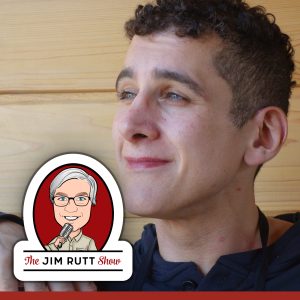
EP 267 Richard Hanania on the Presidential Election and More
Jim talks with Richard Hanania in the third of four interviews with heterodox political thinkers on the upcoming US presidential election. They discuss the danger of "heterodox orthodoxy," Trump's election denial, disagreeing with the Democrats on policy, Jim's critiques of both parties, religion's impact on policy, Republicans as the party of low human capital, the idea of Trump derangement syndr
Recommended

Learn English A2 with Daily News | Simple English Listening Practice

پلی لیست | PlayList

Conspiracy Files with Paige Carter

Bad Friends

Learn 50 English Phrases While You Sleep | Everyday English Phrases & Vocabulary
This Past Weekend w/ Theo Von

Dateline NBC

Back to the 80s Radio

Crime Stories with Nancy Grace

Bible Tea

این نقطه
TED Business
