HomePodcastsStalin: The Dictator Who Reshaped the 20th Century — Fexingo History
Stalin: The Dictator Who Reshaped the 20th Century — Fexingo History
Fexingo96 EpisodesOct 13, 2026
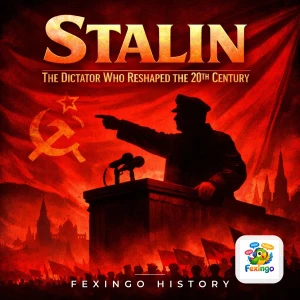
Joseph Stalin ruled the Soviet Union for nearly three decades, transforming a shattered empire into a global superpower through industrialization, terror, and total war. Lucas and Luna guide listeners through the arc of Stalin's life — from his Georgian boyhood and bank-robbing revolutionary years to the purges of the 1930s, the Great Patriotic War, and the post-war consolidation of the Eastern Bloc. They explore the human cost of forced collectivization, the Gulag archipelago, and the cult of personality that elevated a mustachioed dictator to near-divine status. Key episodes cover the 1924 power struggle with Trotsky, the Ukrainian Holodomor of 1932–33, the Moscow show trials, the Nazi-Soviet Pact, the Battle of Stalingrad, the Yalta and Potsdam conferences, and the final paranoid years marked by the Leningrad Affair and the Doctors' Plot. The show also grapples with historiographical debates: Was Stalin a strategic genius or a paranoid butcher? Did his methods modernize Russia or cripple its soul? What do declassified archives from the former Soviet Union reveal about his inner circle?
Episodes
Stalin's Secret Language: The Code That Defeated HitlerOct 13, 20266:37While we often discuss Stalin’s purges and his atomic ambitions, this episode explores a quieter, more lethal weapon: cryptography. In the winter of 1941, as German forces approached Moscow, the Soviet Union faced an existential crisis in its communications. We follow the story of Colonel Lev Shein and the Red Army’s signals intelligence division, which broke the German Enigma machine’s settings l
Stalin's Hidden War: The Soviet Atomic ProgramOct 11, 20268:30While the world knows Stalin for his purges and collectivization, his most enduring legacy may be the bomb. This episode explores the clandestine race to develop nuclear weapons in the late 1940s, a project driven by paranoia and intelligence as much as science. We follow the journey of physicist Igor Kurchatov, the man tasked with replicating Western technology under impossible conditions. Throug
Stalin's Atomic Ambition: The Soviet Nuclear RaceOct 10, 20268:45While the previous episodes have explored Stalin’s grip on food, culture, and internal purges, this episode turns to his most consequential gamble: the race for the atomic bomb. We examine how intelligence from Richard Sorge’s Tokyo ring alerted Moscow to American progress, prompting Stalin to greenlight Project No. 1. We follow physicist Igor Kurchatov as he is thrust into leadership of a despera
Stalin's Cultural Purge: The Battle for Soviet ArtOct 9, 20266:46While we have spent considerable time exploring the mechanics of terror, the archives of Lubyanka reveal a different kind of battlefield: the one waged against culture itself. In this episode, Lucas and Luna examine Stalin’s campaign to standardize Soviet aesthetics through Socialist Realism. We look at how artists like Sergei Eisenstein were forced to conform to state mandates, and how the regime
Stalin's Secret Police: The NKVD's Daily RoutineOct 8, 20268:46We’ve heard about the purges and the battles, but what did the apparatus of terror actually look like on a Tuesday morning? In this episode, we step inside the Lubyanka building in Moscow during the height of the Great Terror, around 1937 and 1938. We explore the daily life of the NKVD — the People's Commissariat for Internal Affairs — focusing not just on Stalin’s orders, but on the bureaucratic
Stalin's Puppet: The Tragic Rise and Fall of KhrushchevOct 7, 202610:59While previous episodes have explored Stalin’s purges, the atomic program, and the Leningrad Affair, Episode 257 shifts focus to the man who would eventually dismantle Stalin’s legacy from within. We trace Nikita Khrushchev’s perilous ascent from a modest Ukrainian background to the inner sanctum of Moscow power. This episode details his early career in Kyiv, his survival through the Great Purge b
Stalin's Ghost Army: The Soviet Deception at KurskOct 6, 20267:22In this episode of the Fexingo History podcast, we peel back the layers of Operation Citadel and reveal the staggering scale of Soviet deception at the Battle of Kursk. While historians often focus on the tank clashes, we explore how Marshal Georgy Zhukov and General Aleksandr Vasilevsky constructed a phantom army to fool Adolf Hitler and Field Marshal Erich von Manstein. We discuss the creation o
Stalin's Puppet: The Tragic Rise and Fall of KhrushchevOct 5, 202610:04Before he became the face of the Thaw, Nikita Khrushchev was Joseph Stalin’s most loyal enforcer in Ukraine. This episode traces Khrushchev’s brutal tenure as First Secretary of the Ukrainian Communist Party from 1938 to 1947, where he oversaw the implementation of Stalin’s terror, purged local party officials, and enforced grain requisitions that exacerbated the aftermath of the Holodomor. We exp
Stalin's Secret War: The Battle for Soviet Food SecurityOct 4, 20268:00In this episode, Lucas and Luna explore the brutal mechanics of Stalin’s food security policies during the early 1930s. We examine how the state weaponized hunger to crush the peasantry and force collectivization. The conversation focuses on the role of Anastas Mikoyan in designing the rationing system and the devastating impact of grain requisitioning on Ukraine and Kazakhstan. Listeners will lea
Stalin's Atomic Ambition and the Soviet Nuclear ProgramOct 3, 20268:33While previous episodes have explored Stalin’s purges of generals, his control over food supplies, and the terror wielded by the NKVD, this episode shifts focus to his most consequential gamble: the race for nuclear supremacy. In August 1945, just as World War II was ending, Stalin received intelligence from his spy Richard Sorge that the United States was developing a weapon of unimaginable power
Stalin's Lost Library: The Secret Archive of the Soviet EliteOct 2, 202610:14While the GULAG and the NKVD have dominated our recent coverage of Stalin’s terror, there was another instrument of control that operated in silence: the spetskhran. In this episode, we explore the secret archives of the Soviet elite, where forbidden books were burned not just for their content, but for their existence. We follow the story of Nikolai Voznesensky and Alexei Kuznetsov, two Leningrad
Stalin's Architect of Terror: Lavrentiy BeriaOct 1, 20264:40While previous episodes have explored the Great Purge and the Leningrad Affair, this episode turns its gaze to the man who wielded the NKVD’s hammer with surgical precision: Lavrentiy Beria. We trace his rise from a Georgian revolutionary to the head of Soviet security, detailing how he orchestrated Order No. 00447 and managed the GULAG system. The conversation examines his complex relationship wi
Stalin's Secret War: The Battle for Soviet Food SecuritySep 30, 20266:35In this episode of the Fexingo History podcast, we explore the human cost of Stalin’s industrialization through the lens of Soviet food security. While previous episodes touched on the Great Purge and the Doctor's Plot, we focus on the everyday struggle for survival during the early 1930s. Lucas and Luna discuss the role of Narkomprod in managing the country's dwindling supplies and the introducti
Stalin's Secret War: The Battle for Soviet Food SecuritySep 29, 20269:04We often hear about Stalin’s industrial might or his purges, but the true foundation of his power was control over the plate. This episode explores the prodovolstvennaya sistema—the Soviet rationing system—and how it functioned as a weapon of statecraft rather than mere emergency relief. We dive into the role of Anastas Mikoyan, the man who managed the Narkomprod (People's Commissariat for Food) a
Stalin's Hidden War: The Battle for Soviet Food SecuritySep 28, 20267:37We left off with the brutal mechanics of the Great Purge and the tightening grip on political dissent, but there was another front in Stalin’s war that determined the survival of the regime: food. In this episode, we turn our attention to the Narkomprod, the People's Commissariat for Food, and the man who held the keys to the nation’s pantry, Anastas Mikoyan. While the NKVD hunted enemies within t
Stalin's Lost Library: The Secret Archive of the Soviet EliteSep 27, 20269:00While we’ve covered Stalin’s purges and his wartime strategies, few episodes have explored the physical architecture of his power: the spetskhran. In this episode, Lucas and Luna peel back the layers of the Soviet Union’s most restricted libraries, where books were treated as weapons rather than knowledge. We examine how Nikolai Voznesensky, a brilliant economist and head of Gosplan, navigated the
Stalin's Last Betrayal: The Leningrad Affair ExplainedSep 26, 20269:30In this episode, we uncover the chilling final chapter of Stalin’s paranoia: the Leningrad Affair. While previous episodes touched on the purges of generals and doctors, few have explored how Stalin systematically dismantled his own party’s strongest regional power base in 1949–1950. We follow the rise and fall of Nikolai Voznesensky, the brilliant economist who managed Soviet recovery, and Alexei
Stalin's Silent Purge: The Leningrad Affair ExplainedSep 25, 20268:00While the Great Terror of 1937 is well known, the Leningrad Affair of 1949–1950 remains a shadowy chapter in Stalin’s final years. This episode explores how Lavrentiy Beria orchestrated a campaign against Leningrad’s party elite, led by Nikolai Voznesensky and Alexei Kuznetsov, to eliminate potential rivals after World War II. We examine the specific charges of treason and localism, the role of th
Stalin's Lost Library: The Secret Archive of the Soviet EliteSep 24, 20267:53While we have explored Stalin’s purges, his architects, and his generals, few episodes have examined the physical spaces where power was actually exercised. In this episode, we uncover the secret world of the Kremlin’s closed libraries and the 'spetskhran' or special storage facilities that held the USSR’s most dangerous books. We look at how figures like Nikolai Voznesensky accessed forbidden tex
Stalin's Iron Rice Bowl: The Soviet Ration SystemSep 23, 202613:37While the Great Terror and the Night Witches dominate Stalin’s narrative, a quieter, more pervasive control mechanism was the state rationing system known as the prodovolstvennaya sistema. This episode explores how the allocation of food determined social hierarchy in Soviet cities during the late 1920s and early 1930s. We examine the role of the People’s Commissariat for Food Supplies (Narkomprod
Stalin's Lost General: Zhukov and the Siege of LeningradSep 22, 202612:07We often remember Georgy Zhukov as the victor of Berlin, but his most harrowing test came at the frozen gates of Leningrad in late 1941. While previous episodes touched on the siege, this conversation zooms in on the specific logistical nightmare that nearly broke the Red Army before it could even form a coherent defense. We explore how Zhukov arrived in a city already crumbling under starvation a
Stalin's Last Betrayal: The Night Witches' FateSep 21, 20269:07After the war, the Soviet Union’s most decorated female pilots were stripped of their ranks and sent back to civilian life while their male counterparts rose through the military hierarchy. This episode explores the quiet erasure of the 588th Night Bomber Aviation Regiment following Victory in Europe. We follow Yekaterina Budanova, Tamara Kazarinova, and Mariya Smirnova as they navigate a state th
Stalin's Secret Diet: The Doctor Who Fed a DictatorSep 20, 202611:07For decades, the narrative of Joseph Stalin’s final years focused on paranoia and purges, but the mechanism of his daily existence was quietly controlled by one man: Dr. Kogan. This episode explores the complex, terrifying relationship between the Soviet leader and his personal physician, who managed everything from Stalin’s diet to his medication during the late 1940s and early 1950s. We examine
Stalin's Lost General: Zhukov and the Siege of LeningradSep 19, 20268:31This episode explores the tense, often overlooked relationship between Joseph Stalin and Georgy Zhukov during the early stages of Operation Barbarossa. While Zhukov is celebrated for his later victories at Moscow and Stalingrad, his initial command in the north was marked by brutal orders and near-execution for perceived failure. We examine the strategic dilemma facing the Red Army in 1941, the de
Stalin's Iron Fist: The Great Purge of the Red ArmySep 18, 20267:45In 1937 and 1938, Joseph Stalin turned his paranoia inward, targeting the very men tasked with defending the Soviet Union. This episode explores the catastrophic military purges that decimated the Red Army’s leadership before World War II. We examine the trial of Marshal Mikhail Tukhachevsky, the 'Case of the Trotskyist Anti-Soviet Military Organization,' and the chilling order signed by Stalin hi
Stalin's Post-War Paranoia and the Anti-Cosmopolitan PurgeSep 17, 20268:22Following the victory in 1945, Joseph Stalin turned his gaze inward, initiating a new campaign of repression known as the anti-cosmopolitan purge. This episode explores how the Soviet leader weaponized accusations of 'rootless cosmopolitanism' to target Jewish intellectuals, scientists, and artists who had gained international recognition during the war. We examine the case of Solomon Lozovsky, th
Stalin's Secret Police: The Rise of Yezhov and the Great TerrorSep 16, 20269:41This episode examines the terrifying mechanics of the Great Terror, focusing on Nikolai Yezhov’s appointment as head of the NKVD in 1938. We explore how Order No. 00447 transformed state security from a political tool into an industrial slaughterhouse, with quotas for executions and imprisonments sent down to local chapters across the Soviet Union. Lucas and Luna discuss the specific role of Mikha
Stalin's Final Purge: The Doctor's PlotSep 15, 20265:47In early 1953, months before Stalin's death, a bizarre and terrifying conspiracy theory took hold in the Soviet Union. The Doctor's Plot accused a group of Kremlin physicians—most of them Jewish—of plotting to assassinate top Soviet leaders using medical negligence. This episode explores how state security orchestrated this antisemitic scare, linking it to broader fears of Zionist influence and in
Stalin's Lost General: Zhukov and the Siege of LeningradSep 14, 202612:00While previous episodes have touched on Georgy Zhukov’s role in the broader war, this episode zooms in on the specific, harrowing mechanics of his command during the Siege of Leningrad. We explore how Stalin, a man deeply suspicious of military autonomy, allowed Zhukov unprecedented control over the city’s defense in late 1941. Lucas walks us through the brutal logistical reality of holding a star
Stalin's 1936 Constitution: The Paradox of RightsSep 13, 20266:36In 1936, Stalin unveiled a new Soviet Constitution that promised sweeping civil liberties, including universal suffrage and freedom of speech. But beneath the progressive language lay a chilling reality designed to consolidate totalitarian control. This episode explores the drafting process led by Nikolai Bukharin and Andrei Vyshinsky, examining how Article 125 granted rights on paper while simult
Stalin's Last Stand: The Doctor's PlotSep 12, 20267:47In this episode of the Fexingo History podcast, we turn our attention to the final, chilling chapter of Joseph Stalin’s rule: the Doctor’s Plot of early 1953. While previous episodes have explored the Great Terror and the purges of the 1930s, this narrative focuses on a new kind of paranoia that targeted not soldiers or writers, but the medical elite in Moscow. We examine how Lavrentiy Beria orche
Stalin's Secret War: The Night Witches of WWIISep 11, 20267:28In this episode, we step away from the Kremlin’s inner circles and into the freezing skies over the Eastern Front. We explore the story of the 588th Night Bomber Aviation Regiment, a unit composed entirely of women pilots who flew obsolete Polikarpov Po-2 biplanes against the German war machine. Led by Marina Raskova, these young women became known as Nachthexen, or Night Witches, to the terrified
Stalin's 1936 Constitution: A Paradox of RightsSep 10, 20268:48In 1936, Joseph Stalin unveiled the Stalinskaya Konstitutsiya, a document that promised universal suffrage, freedom of speech, and inviolable personal rights. Yet, as Lucas and Luna explore, this 'most democratic' constitution was drafted during the height of the Great Terror, when millions were being purged. The episode examines the political maneuvering behind Article 125, which theoretically gu
Stalin's Secret War: The Night Witches of WWIISep 9, 202610:20This episode explores the 588th Night Bomber Aviation Regiment, a Soviet all-female unit that terrorized German forces during World War II. We follow Marina Raskova, the pilot who convinced Stalin to create these regiments, and meet the women like Yekaterina Budanova, Tamara Kazarinova, and Mariya Smirnova who flew Polikarpov Po-2 biplanes on dangerous night missions. You will learn how they used
Stalin's Shadow Army: The Night Wolves and Soviet EspionageSep 8, 202611:22In this episode of the Fexingo History podcast, we explore a lesser-known chapter of Joseph Stalin’s reign: the creation and operation of the NKVD’s special purpose night bombing regiment, officially designated as the 588th Night Bomber Aviation Regiment. While most listeners know about the Great Terror or the Gulag system, far fewer are aware of how Stalin weaponized gender and folklore to create
Stalin's Lost General: Zhukov and the Siege of LeningradSep 7, 20269:40While earlier episodes explored Stalin’s internal purges and the machinery of terror, this episode turns to the battlefield where Georgy Zhukov forged his reputation under the most brutal conditions imaginable. We trace Zhukov’s appointment in September 1941 as German forces encircled Leningrad, cutting off food and fuel supplies that would lead to over a million civilian deaths from starvation an
Stalin's Secret Language: The Rise of Jargon in the USSRSep 6, 20268:02This episode explores how Joseph Stalin and his inner circle weaponized language to consolidate power during the late 1920s and 1930s. We examine the creation of Soviet jargon, or yazyk, which served as both a filter for loyalty and a tool for bureaucratic obfuscation. Lucas and Luna discuss how terms like 'enemies of the people' and 'wreckers' stripped victims of their humanity before arrest. The
Stalin's Lost General: Zhukov and the Siege of LeningradSep 5, 20268:15We often think of Stalin as the sole architect of Soviet military strategy, but his reliance on flawed generals and reluctant heroes defines much of the Great Patriotic War. This episode explores the tense relationship between Iosif Stalin and Georgy Zhukov during the early months of Operation Barbarossa. We look at how Zhukov was dismissed from command in 1941 after a disastrous retreat near Mosc
Stalin's Lost Architect: The Man Who Designed His DachaSep 4, 20269:12While we have explored the brutality of the Great Terror and the grandiosity of Socialist Realism, this episode uncovers a quieter, more intimate side of Stalin’s reign through the life of Alexey Dushkin. We follow the architectural journey of the Kuntsevo dacha, the secret compound where Stalin spent his final years, away from the public eye of the Kremlin. Dushkin was not just a builder but a su
Stalin's Secret Police: The Rise of Yezhov and the Great TerrorSep 3, 202610:14In this episode, we explore the terrifying machinery of state control under Joseph Stalin through the lens of Nikolai Yezhov, the head of the NKVD who oversaw the Great Purge of 1937-1938. While previous episodes have touched on the 1934 murder of Sergei Kirov as the spark, here we examine the industrial scale of the repression that followed. We look at how Yezhov transformed the secret police fro
Stalin's Lost Love: The Woman Who Shaped His Early LifeSep 2, 20267:33Before he was the iron-willed dictator of the Soviet Union, Iosif Dzhugashvili was a brooding seminarian in Tiflis with a turbulent personal life. This episode explores the profound and often overlooked influence of his first wife, Ekaterina Svanidze, whose death from typhus in 1907 marked a pivotal turning point in Stalin’s psychological development. We examine their courtship in the Georgian cap
Stalin's Last Years: The Doctor's Plot and Soviet AntisemitismSep 1, 202610:28This episode explores the final, chilling chapter of Stalin’s rule: the Doctor’s Plot of 1952–1953. After decades of purges targeting party elites, intellectuals, and peasants, Stalin turned his gaze toward the medical establishment in Moscow. We trace how a fabricated conspiracy theory—alleging that Jewish doctors were plotting to assassinate Soviet leaders—ignited state-sponsored antisemitism an
Stalin's 1930s Kremlin: Inside the Dictator's Inner SanctumAug 31, 202610:05In this episode, Lucas and Luna step inside the Kremlin walls during Stalin's reign—the offices, the corridors, the rituals that shaped Soviet power. They explore the Kremlin's transformation into a fortress of paranoia, the daily routines of Stalin's inner circle, the secret passages and the special telephone network, and the deadly etiquette of meetings with the Vozhd. From the 1937 purge of Kre
Stalin's Secret Police Chief: The Rise of Nikolai YezhovAug 30, 20267:20In the late 1930s, Nikolai Yezhov rose from obscurity to become Stalin's most feared enforcer, heading the NKVD during the Great Terror. This episode traces his swift ascent, his role in orchestrating mass arrests and executions, and his sudden fall from grace in 1938. We explore the infamous 'Yezhovshchina' — the era of purges named after him — and the sinister 'Yezhov's bathtub' of forged confes
Stalin's Engineers: The Men Who Built the White Sea CanalAug 29, 20266:19In 1931, Stalin ordered the construction of a 227-kilometer canal connecting the Baltic and White Seas. Built by over 100,000 Gulag prisoners in just 20 months, the Belomorkanal was a brutal experiment in 'reforging' convicts into Soviet citizens. This episode follows the canal's chief engineer, Sergei Zhuk, and his team of 'enemies of the people' who were promised freedom in exchange for their la
Stalin's 1936 Soviet Constitution: The Paradox of RightsAug 28, 20268:08In 1936, Joseph Stalin unveiled a new Soviet constitution that guaranteed freedom of speech, press, and assembly, and even granted universal suffrage. Western observers called it a sham, but for many Soviets, it felt like a genuine step toward a better future. In this episode, Lucas and Luna explore the drafting process, the role of Nikolai Bukharin, the famous article 125, and the stark contrast
Stalin's 1930s Dacha: The Dictator's Hidden WorldAug 27, 20267:32In this episode, Lucas and Luna step inside Stalin's private world—the dacha at Kuntsevo, where the dictator spent his last two decades. From the paranoid security rituals to the personal touches like his beloved billiards table, we explore how Stalin's living spaces reflected his psychology and power. We discuss the architecture of fear that surrounded him, his nocturnal working hours, and the st
Stalin's 1937 Pushkin Jubilee: The Poet as Soviet IconAug 26, 20269:14In 1937, the Soviet Union marked the centenary of Alexander Pushkin's death with a frenzy of commemorations. But behind the statues, the new operas, and the mass-produced volumes, Stalin's regime was reshaping the poet's legacy to serve its own ends. This episode unpacks the jubilee's political machinery: how the state hijacked Pushkin's image, the role of the newly formed Pushkin Commission, the
Stalin's 1931 Tsaritsyn: The Battle That Forged a DictatorAug 25, 20268:38Before Stalin ruled the Soviet Union, he fought in the shadow of the Civil War. In 1918, the city of Tsaritsyn — later renamed Stalingrad, later still Volgograd — became a crucible. This episode follows Stalin's first major military command, where he defied orders, clashed with military experts, and built a personal power base that would outlast the war. We explore the siege, the supply lines, the
Stalin's 1938 Plan to Flood Moscow with ArtAug 24, 20269:12In 1938, Joseph Stalin approved a grandiose project to transform Moscow into a 'model communist city', crowned by the towering Palace of the Soviets. This episode dives into the unrealized dream—the colossal statue of Lenin, the architects Boris Iofan and Vladimir Shchuko, the demolition of the Cathedral of Christ the Saviour, and the wartime steel that was scrapped for tanks. We explore how the p
Stalin's 1934 Writers' Congress: Socialist Realism's Iron GripAug 23, 20265:33In 1934, Stalin convened the First Soviet Writers' Congress, a moment when the state formalized its control over literature and culture. This episode explores how the doctrine of Socialist Realism was enshrined, why Andrei Zhdanov gave the keynote speech, and how writers like Maxim Gorky and Boris Pasternak navigated the new orthodoxy. We look at the congress's resolutions, the creation of the Uni
Stalin's 1935 Youth: The Komsomol's Iron GripAug 22, 20268:07In this episode of Fexingo History, Lucas and Luna examine the Komsomol, the Soviet youth organization that both inspired and entrapped millions of young people under Stalin. They trace its rise from the early 1920s to its role in the 1930s, focusing on the 1935 Congress that solidified its power. The conversation explores how the Komsomol enforced ideology, promoted shock work and Stakhanovism, a
Stalin's 1934 Kirov Murder: The Spark of TerrorAug 21, 20268:18In December 1934, a single gunshot in Leningrad changed the course of Soviet history. Sergei Kirov, the popular Leningrad party boss and potential rival to Stalin, was assassinated under mysterious circumstances. Stalin seized on the killing to launch a wave of repression that would culminate in the Great Terror. This episode unravels the murky evidence: was Kirov's murderer, Leonid Nikolaev, a lo
Stalin's 1937 Census: The Numbers That DisappearedAug 20, 20267:10In 1937, the Soviet Union conducted its first full census since 1926. The results were so alarming to Stalin that he had the census takers arrested and the results suppressed. This episode digs into the story of that census: how the questionnaires asked about religion and language, how the count revealed a population far smaller than the regime claimed, and how the 1939 census was rigged to produc
Stalin's 1936 Constitution: The Most Democratic in the World?Aug 19, 20269:04In 1936, Joseph Stalin unveiled a new Soviet constitution that guaranteed civil liberties and democratic rights — yet it coincided with the Great Terror's deadliest years. How did a document celebrated as 'the most democratic in the world' become a tool of repression? Join Lucas and Luna as they explore the making of the Stalin Constitution, from the public 'national discussion' that drew millions
Stalin's Platonov: The Writer Who Outlived the PurgeAug 18, 20268:45In 1938, as Stalin's terror peaked, a reclusive writer named Andrei Platonov finished a novel that would not be published for half a century. 'Chevengur' — a hallucinatory tale of a provincial Communist paradise — was deemed 'counter-revolutionary' and suppressed. Yet Platonov survived, writing children's stories, working as a janitor, and producing prose that dissected Soviet reality from within.
Stalin's 1938 Antarctic Expeditions: Scientific Ambition in the ColdAug 17, 20267:12In this episode, Lucas and Luna dive into a little-known chapter of Soviet history: the 1938 expeditions to the Antarctic. While Stalin's purges and industrialization dominate the narrative, his regime also funded scientific ventures that pushed the boundaries of polar exploration. The episode focuses on the voyage of the icebreaker Ob and the team led by Mikhail Somov, who braved the Southern Oce
Stalin's 1932 Famine: The Holodomor's Hidden TollAug 16, 20269:55In this episode of Fexingo History, Lucas and Luna delve into the devastating famine that struck Soviet Ukraine in 1932-33, a catastrophe known as the Holodomor. They explore the intersection of forced collectivization, brutal grain requisitions, and a government that denied its own people's suffering. From the kulak deportations to the 'Black Boards' listing non-compliant villages, from the harro
Stalin's 1941 Speech: The Soviet Rallying CryAug 15, 202611:41In the dark days of July 1941, with German forces deep inside Soviet territory, Joseph Stalin broke his silence and addressed the nation on the radio. That speech, 'Brothers and sisters,' marked a turning point in the Great Patriotic War, reframing the conflict as a people's war for survival. This episode explores the context of that broadcast: the catastrophic defeats, the panic in Moscow, and St
Stalin's 1945 Victory Parade: The Red Square SpectacleAug 14, 20268:55In this episode, Lucas and Luna explore the Victory Parade of June 24, 1945, when Stalin orchestrated a grand spectacle on Red Square to cement his role as the architect of Soviet victory in World War II. They discuss the parade's planning, the dramatic moment when Marshal Georgy Zhukov rode a white horse, the symbolic tossing of captured Nazi banners at Lenin's Mausoleum, and the infamous 'rain o
Stalin's 1948 Berlin Blockade: The Cold War's First CrisisAug 13, 202610:52In June 1948, Stalin cut off all land and water routes to West Berlin, trapping two million civilians in a city deep inside the Soviet occupation zone. The Western Allies answered not with tanks, but with cargo planes. Over the next eleven months, the Berlin Airlift delivered more than 2.3 million tons of food, coal, and medicine, flying through Soviet harassment and winter fog. This episode unpac
Stalin's 1939 Pact: The Nazi-Soviet AllianceAug 12, 202610:20In this episode, Lucas and Luna explore the Molotov-Ribbentrop Pact of August 1939 — the non-aggression treaty that shocked the world and paved the way for World War II. They discuss the secret protocol that divided Eastern Europe into spheres of influence, the dramatic negotiations in Moscow, the roles of Vyacheslav Molotov and Joachim von Ribbentrop, and how Stalin's diplomacy aimed to buy time
Stalin's 1949 Blast: The First Soviet Atomic BombAug 11, 20266:48In 1949, the Soviet Union detonated its first atomic bomb, code-named RDS-1, at the Semipalatinsk test site in Kazakhstan. This episode of Fexingo History explores how Stalin, driven by paranoia and the escalating Cold War, pushed his scientists to break the American nuclear monopoly. We follow the harrowing journey of Igor Kurchatov, the charismatic physicist who led the Soviet project, and the c
Stalin's 1939 Harvest: The Grain That Fed the War MachineAug 10, 20267:30In 1939, as Europe braced for war, Stalin's Soviet Union faced a quiet catastrophe: a catastrophic grain harvest that threatened to starve the Red Army and the cities. This episode follows the brutal procurement campaign ordered by Stalin and Lavrentiy Beria, the NKVD's role in squeezing every last kernel from the collective farms, and the human cost in Ukraine and the North Caucasus. We meet the
Stalin's 1947 Anti-Cosmopolitanism CampaignAug 9, 20268:21In this episode, Lucas and Luna dig into Stalin's 1947 anti-cosmopolitanism campaign—a cultural purge that targeted Jewish intellectuals, writers, and scientists in the Soviet Union. They explore the origins of the campaign in postwar Soviet nationalism, the role of Andrei Zhdanov in shaping cultural policy, and the devastating show trials of Jewish Anti-Fascist Committee members. Along the way, t
Stalin's Secret Police: The NKVD's Dark MachineryAug 8, 20265:25In Episode 197, Lucas and Luna delve into the NKVD, the vast and terrifying security apparatus that was the engine of Stalin's terror. From its origins in the Cheka to its evolution under Genrikh Yagoda, Nikolai Yezhov, and Lavrentiy Beria, the NKVD executed, imprisoned, and deported millions. Explore the Great Terror's mechanics—the troikas, the quotas, the show trials—and the human cost etched i
Stalin's Great Terror: The 1937 Purge of the Red ArmyAug 7, 20268:48In 1937, Joseph Stalin turned on his own military, launching a purge that would decimate the Red Army's officer corps on the eve of World War II. This episode examines the show trials, secret executions, and the destruction of Marshal Mikhail Tukhachevsky, an architect of Soviet military theory. Lucas and Luna explore how the NKVD's fabricated conspiracies, the Rykov-Bukharin trial, and the arrest
Stalin's 1944 Polish Uprising: The Soviet SilenceAug 6, 202617:50When Warsaw rose against its Nazi occupiers in August 1944, the Red Army halted across the Vistula and watched. This episode reconstructs the brutal 63 days of the Warsaw Uprising through the eyes of its leaders—Tadeusz Bór-Komorowski, Antoni Chruściel—and the Soviet calculus that left the city to burn. We examine Stalin's refusal to aid the Home Army, the stalled Red Army offensive that stopped a
Stalin's 1944 Bombing of Helsinki: The Soviet Air RaidsAug 5, 20266:07In February 1944, as the Red Army pushed toward the Baltic, Stalin ordered massive Soviet air raids on Helsinki. Three nights of bombing, over two thousand sorties, and a city that refused to break. But the real story is stranger: the Finns had cracked Soviet codes, and they knew exactly when the bombs would fall. Helsinki's defenses, led by Colonel Pekka Jokipii, used a novel system of searchligh
Stalin's 1935 Metro: Palaces for the PeopleAug 4, 202610:24In 1935, Stalin opened the Moscow Metro, a subterranean marvel designed to showcase Soviet might. This episode digs into the brutal construction, the lavish stations, and the propaganda triumph. From the Metrostroi workers who toiled in dangerous conditions to the opulent Mayakovskaya and Komsomolskaya stations, we explore how the Metro became a symbol of socialist modernity. We also uncover the d
Stalin's 1935 Metro: Underground Palaces of the ProletariatAug 3, 20266:06In 1935, Joseph Stalin opened the Moscow Metro, a project that was as much about propaganda as it was about transportation. This episode of Stalin: The Dictator Who Reshaped the 20th Century dives into the frantic construction, the dazzling stations like Mayakovskaya and Komsomolskaya, and the forced labor of prisoners and enthusiastic Komsomol volunteers. We trace how the metro became a symbol of
Stalin's 1933 Gulag: The White Sea Canal and the Cult of Forced LaborAug 2, 20268:21In 1933, Joseph Stalin unveiled the White Sea–Baltic Canal as a triumph of socialist construction, but behind the propaganda lay a colossal human tragedy. This episode of Fexingo History looks beyond the official narrative to explore how the canal became the first major project of the Gulag system, setting a pattern for forced labor that would persist for decades. Hosts Lucas and Luna examine the
Stalin's 1948 Doctors' Plot: The Antisemitic PurgeAug 1, 20267:13In 1948, as the Cold War tightened, Stalin engineered a secret campaign against Jewish doctors in the Kremlin — the so-called Doctors' Plot. This episode unpacks the arrest of Dr. Miron Vovsi and Dr. Yakov Etinger, the fabricated charges of poisoning Soviet leaders, and the role of Lydia Timashuk, the Kremlin doctor who became a state heroine overnight. We trace the affair's roots in Stalin's para
Stalin's Spanish Gambit: The Civil War That Shaped Soviet PowerJul 30, 20268:09In 1936, a military uprising in Spain drew Stalin into a proxy war that tested his doctrine of 'socialism in one country.' This episode follows the Soviet intervention—the secret arms shipments, NKVD operatives, and political manipulation that turned the Spanish Republic into a battlefield for Stalin's paranoia. We explore the Battle of Jarama, the International Brigades, the Moscow-directed purge
Stalin's 1949 Leningrad Affair Purge of a GenerationJul 30, 20265:55In this episode, Lucas and Luna explore the Leningrad Affair, a post-war purge that targeted a generation of Soviet leaders including Alexei Kuznetsov and Nikolai Voznesensky. They discuss Stalin's paranoia following Andrei Zhdanov's death, the secret trial in 1950, and the execution of key party officials. The episode examines how this purge reshaped the Soviet leadership and set the stage for Kh
Stalin's Winter War: The Soviet Debacle That Exposed Red Army WeaknessJul 29, 20266:50In November 1939, Joseph Stalin launched an invasion of Finland, expecting a swift and decisive victory. Instead, the Red Army stumbled into one of the most humiliating campaigns in Soviet history, as outnumbered Finnish forces under Marshal Carl Gustaf Emil Mannerheim exploited harsh winter conditions and guerrilla tactics. This episode examines the diplomatic ultimatums that preceded the war, th
Stalin vs Tito: The 1948 Split That Broke the Soviet BlocJul 29, 20267:46In 1948, Joseph Stalin faced an unprecedented challenge from within the communist world: Josip Broz Tito, the partisan leader who had liberated Yugoslavia without Soviet help. This episode dives into the escalating conflict between Moscow and Belgrade — the secret diplomatic letters, the economic blockade, and the dramatic expulsion of Yugoslavia from the Cominform (Communist Information Bureau).
Stalin's 1907 Tiflis Bank Robbery: The Heist That Funded the BolsheviksJul 28, 20267:29Before he became the dictator of the Soviet Union, Joseph Stalin—then known as Koba—orchestrated one of the most audacious bank robberies in history. In June 1907, in the bustling Caucasian city of Tiflis (modern Tbilisi), a gang of Bolsheviks, led by a young Stalin, ambushed a state bank carriage, using bombs and guns to seize a fortune in rubles. This episode of the Fexingo History podcast unpac
Stalin and the 1944 Warsaw Uprising: The Betrayal That Reshaped PolandJul 28, 20266:10In August 1944, as the Soviet Red Army reached the outskirts of Warsaw, the Polish Home Army launched the Warsaw Uprising, hoping to liberate their capital before Stalin's forces arrived. But Stalin had other plans. He halted his troops, denied air support, and refused to let Allied supply planes land on Soviet airfields, allowing the Germans to crush the rebellion over 63 days. Over 200,000 Poles
Stalin's Lost Son: The Tragedy of Yakov DzhugashviliJul 27, 20265:06In this episode, we explore the heartbreaking story of Yakov Dzhugashvili, Joseph Stalin's eldest son, from his strained relationship with his father to his capture by German forces in 1941. We delve into the propaganda war around his imprisonment, Stalin's cold refusal to negotiate an exchange, and Yakov's mysterious death at Sachsenhausen in 1943. Through his personal tragedy, we glimpse the rut