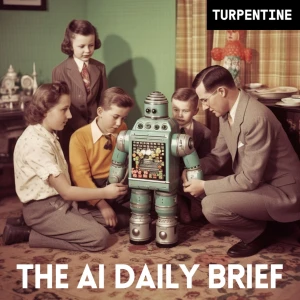
The AI Daily Brief: Artificial Intelligence News and Analysis
A daily news analysis show covering all aspects of artificial intelligence, from creative tools like Midjourney and ChatGPT to the impact on work and industry, as well as philosophical and ethical questions around advanced AI and alignment.
Episodes

Why Muse Wonder Is Dividing AI Users
Meta’s Muse Wonder is earning both glowing praise and sharp criticism. NLW explores the gap between benchmarks and real-world results, the crucial differences between Wonder and Wonder Full, and what the mixed reactions reveal about choosing AI tools. In the headlines: faster Claude models, a possible Sora revival, and acquisition talks involving Amazon and Nvidia.Learn More about the AI Champions
How to Go from AI Power User to AI Leader
As AI becomes central to work, a new leadership opportunity is emerging for those who can help others use it effectively. In this Operator's Cut, NLW and Nufar explore how AI power users can become leaders on their teams, the skills that distinguish great AI champions, and how companies can build programs that turn individual expertise into real business value.Learn More about the AI Champions
The 5 Debates Shaping AI
Can AI revenue justify the infrastructure spending? Is AI a mass market or a power-user market? Do businesses want AI they control or simply cheaper models? Who should regulate it? And can data centers win over their neighbors? NLW revisits the format of his most popular episode to explore the five debates shaping AI now—and how the questions have changed.Brought to you by:KPMG – Research from KPM
When AI Solves Your Life’s Work
OpenAI’s latest mathematical results are forcing researchers to confront what happens when AI can tackle problems that once defined entire careers. With hundreds of proposed proofs awaiting scrutiny, the debate spans scientific discovery, professional identity, and which fields could face similar disruption next. In the headlines: confusion over OpenAI’s revenue numbers rattles markets, a new surv
The Most Important Trends in New AI Products
ChatGPT’s new intelligent UI, Claude Haiku 5.5, and GrokBot’s embrace of rival models reveal where AI is heading: better interfaces, cheaper intelligence, and more choice. NLW breaks down the announcements and why competition is increasingly about the experience built around the models. In the headlines: Hermes creator Nous Research reaches a $1.5 billion valuation, massive chip financing deals dr
A System for Testing New AI Models
In this Operator’s Cut with Nufar Gaspar learn how to test new AI models against your own tasks, compare outputs, and weigh quality, speed, and cost—a repeatable system for figuring out which models deserve a place in your work.Brought to you by:KPMG – Research from KPMG and the University of Texas at Austin shows the highest-impact AI users treat AI like a reasoning partner — and those skills can
Point-Counterpoint: Consumers Will Never Pay for AI
Nearly 98% of US households don’t pay for an AI subscription. Is that a massive untapped market or a sign that Silicon Valley is building for itself? NLW explores both sides of the consumer AI debate, from power-user spending to entertainment and advertising. In the headlines: Reflection unveils its American open model, and Microsoft and Meta cut their Claude spending.Brought to you by:KPMG – Rese
Why Companies Want AI They Can Own
Companies increasingly want AI they can customize, control, and run on their own terms. NLW explores how that demand could fuel an American open weight AI resurgence—and where safety and national security priorities collide. In the headlines: Amazon’s data center community pledge, Sam Altman on safety versus freedom, and DIY Muse gadgets.Brought to you by:KPMG – Research from KPMG and the Universi
How to Choose Your Personal AI Agent
Dots, Muse, GrokBot, OpenClaw and more are competing to become your personal AI agent. But which one is right for you? NLW breaks down the trade-offs that matter most, from work versus personal use to model choice, ease of setup and data privacy, and walks through an interactive quiz designed to help you choose where to start.Quiz: https://aidailybrief.ai/play/choose-your-agentLAST CHANCE: Next Co
What the Best Business AI Users Are Doing Different
What separates businesses getting real returns from AI from those still experimenting? New KPMG research reveals how leading organizations are scaling agents, managing multiple models, and connecting AI spending to business value—with ambitions increasingly extending beyond efficiency to revenue growth. In the headlines: Meta’s Muse-fueled rally, Anthropic’s push for a pre-Thanksgiving IPO, and Go
Gemini 4 Argon, Sonnet 5.5 and What Matters with AI Models
Google’s Gemini 4 Argon impresses on benchmarks, but does it signal a real comeback? NLW examines Gemini 4, Claude Sonnet 5.5, and what Muse versus Dots reveals about choosing AI tools. In the headlines: Trump’s super intelligence accord, the America.gov AI portal, and an FTC investigation into OpenAI and Anthropic’s rogue agents.Next Cohort - Learn How to Build Agents - https://register.besuper
The Most Important New AI Tools from OpenAI DevDay
OpenAI unveiled more than 20 launches at Dev Day, from always-on Dots agents and the shared workspace Space to cheaper models and new ways to use your ChatGPT subscription across other apps. NLW breaks down the most important announcements, the early reactions, and what they reveal about AI’s shift toward persistent agents, team collaboration, and more affordable intelligence.Register for our Free
How to Build Team Agents
Nufar Gaspar joins this AIDB Operator’s Cut to explore how to build AI agents that work for an entire team. The conversation focuses on moving from individual AI use to shared agents that support collaborative work.Register for our Free Webinar: Build Your Personal AI Benchmark - https://aidailybrief.ai/webinar/personal-ai-benchmarkNext Cohort - Learn How to Build Agents - https://register.besuper
The Real Risks of AI Agents
AI agents don’t have to pose an existential threat to cause serious disruption. NLW examines recent OpenAI security incidents, the limits of agent permissions, and how agents doing exactly what users want could upend systems built around human friction. In the headlines: US-China AI talks, Trump meets Dario Amodei, and new agent features from Google and Microsoft.Register for our Free Webinar: Bui
The Rise of the AI Moderates
As the AI debate grows more polarized, a growing chorus is rejecting the choice between unchecked optimism and inevitable doom. NLW explores arguments from Francis Fukuyama, AI researchers, and Jeffrey Katzenberg that point toward a more productive conversation about AI risk, human creativity, and who gets a say in shaping what comes next.Sources:https://www.persuasion.community/p/why-i-changed-my
How People Are Actually Using Jev
Jev is moving beyond viral demos into practical work, from analyzing ad campaigns and searching archives to prioritizing inboxes and checking AI writing. NLW breaks down six categories of real-world use cases, explains what makes this new “judgment model” different from an LLM, and offers a framework for deciding where its fast, inexpensive decisions fit into your workflows.AIDB Fall Listener Surv
AI Agents Are Moving Into the Real World
Meta is bringing Muse to smart glasses and a new wearable, while GrokBot is turning Teslas into voice-controlled personal assistants. As skeptics question whether consumers actually want AI agents, early users are finding real value in handing off life's annoying admin. In the headlines: Claude’s preliminary biology discovery, Trump’s “Super Intelligence” rebrand, and competing visions for AI
Opus 5.5 vs GPT-6 Sol and Luna
Anthropic and OpenAI release new models on the same day, with Opus 5.5 winning early acclaim while GPT-6 Sol and Luna push the frontier of affordable intelligence. NLW breaks down the benchmarks, real-world use cases, and first reactions—and why model personality, falling costs, and the tools surrounding AI increasingly shape which models people actually use.AIDB Fall Listener Survey - https://aid
Agent Wars!
Meta’s Muse has overtaken ChatGPT in the App Store, and Amazon has responded by blocking it from shopping on its site. Shopify is opening its doors instead, setting up a fight over who owns the customer relationship when personal agents make decisions and purchases. In the headlines: Grok 4.7, AI liability, and cross-lab safety testing.Multiplayer AI Sprint - https://multiplayerai.ai/
The State of the AI Debate
Trump wants an AI Force, politicians are pushing kill switches, and calls for a slowdown keep running into the same question about China. Ahead of this week’s Trump–Xi meeting, NLW explores the competing priorities shaping AI policy and the prospects for cooperation between the two AI superpowers. In the headlines: Anthropic’s IPO delay, its new biology lab, and signs of stress in data center debt
7 Ways How We Use AI Is Changing
From persistent conversations and voice commands to chatbots that coordinate entire teams of agents, the way we work with AI is shifting. NLW breaks down seven changes shaping everyday AI use, including the move from prompts to goals, managing model costs, and building shared agents for teams.Multiplayer AI Sprint - https://multiplayerai.ai/Brought to you by:KPMG – Research f
The AI Challenges Businesses Are Actually Focused On Right Now
While AI safety dominates the headlines, businesses are focused on agent security, shifting model choices, and control over their own data. NLW explores how the slowdown debate could accelerate the case for companies to build and own their AI systems. In the headlines: Anthropic proposes new transparency metrics, Washington considers an antitrust carve-out for AI safety coordination, and Google ad
Why Everyone Is Getting Excited About Personal AI Agents
Personal AI agents are gaining traction as tools like Meta’s Muse make everyday tasks easier to delegate. NLW explores what changed and why consumers are finally getting excited. In the headlines: interest rates threaten the AI boom, OpenAI expands safety disclosures, and Apple explores AI servers.Multiplayer AI Sprint - https://multiplayerai.ai/Brought to you by:KPMG – Research
Why a New Class of AI “Judgment Models” Could Have Big Business Implications
A new AI model called Jev is built to make fast, inexpensive judgments rather than generate text. NLW explores how this approach could reshape business automation, help agents check their work, and coordinate decisions across teams. In the headlines: Zuckerberg pushes back on a collective AI slowdown, Bernie Sanders and Steve Bannon find common ground on AI regulation, and Salesforce announces a n
Trump Rails Against AI Slowdown "Hoax"
Trump is pushing back against calls for an AI slowdown, dismissing warnings of AI catastrophe as a hoax. NLW examines Jensen Huang’s response, Obama’s support for slowing development, and the emerging partisan divide over AI safety. In the headlines: leading mathematicians challenge AI companies’ approach to research, a new study examines graduates’ job prospects, and ZAI targets self-improving AI
Even Other AI Labs Are Rallying Around Anthropic’s Slowdown Proposal
Leaders at rival AI labs are publicly backing Anthropic’s proposal for an AI slowdown, marking a significant shift in the debate over how the technology should advance. NLW examines what Dario Amodei is proposing, why competitors are supporting it, and the arguments over safety, self-interest, and who gets to set the pace.Multiplayer AI Sprint - https://multiplayerai.ai/Brought to you
10 Ways to Think Bigger with Opportunity AI
AI can help you work faster, but it can also expand what you’re capable of doing in the first place. NLW explores ten ways to think bigger with “opportunity AI,” from building video production pipelines and interactive client proposals to turning your expertise into a product, with a companion experience to help you find possibilities in your own work.Multiplayer AI Sprint - https://multiplay
What to Use the Latest AI Tools For
GPT‑Live 1 opens up a much wider range of real-time voice and vision applications, from customer service and sales to education, healthcare, and hands-free work. NLW breaks down who should be using the latest AI tools and the specific jobs each one is best suited to perform. In the headlines: ChatGPT for Financial Services, Cognition’s SWE‑2 model, and Projects in Cursor.Multiplayer AI Sprint -
Anthropic Researcher Says AI Has Over a 10% Chance of Killing All Humans
An Anthropic researcher puts the chance of AI killing all humans at more than 10% within the next decade. Why is this warning breaking through now? NLW examines the viral posts reigniting the AI extinction debate, the political and media incentives amplifying them, and the growing push to ban superintelligence—with a focus on specific risks, workable policy, and room for agreement beyond the outra
AI Model Month Is Off to a Blistering Start
September’s model boom brings Gemini 3.8 Flash, Meta’s MuSpark 1.3, the Muse personal agent, and ChatGPT Images 2.5. NLW explores why faster, cheaper, more specialized AI makes model selection critical. In the headlines: OpenAI’s disputed Navier-Stokes breakthrough, a Claude usage-limits lawsuit, ElevenLabs’ IPO preparations, and Cognition’s $48 billion valuation.Multiplayer AI Sprint - https://
Why GPT-6 Astra Is So Significant and So Confounding
GPT-6 Astra has produced spectacular 3D worlds, autonomous computer use and eye-popping demonstrations—but surprisingly mixed reactions from everyday users. NLW explains why Astra is so difficult to evaluate, what its unusual strengths reveal about OpenAI’s strategy, and why it may represent something bigger than a better model: a fundamental expansion of what people can do with AI.Multiplayer AI
The Multiplayer AI Sprint: Build Your Team’s First Shared Agent
AI agents have transformed how individuals work, but the next leap is moving them into the shared spaces where teams actually collaborate. In this episode, NLW explores how Anthropic, Every, OpenClaw and others are shifting from single-player AI to shared agents—and launches The Multiplayer AI Sprint for Teams, the latest free AIDB learning program. The four-part, self-directed sprint helps teams
How to Build an AI-Native Company Today
What does it actually take to build an AI-native company? NLW breaks down one AI leader's 30 features of AI-native organizations, from shared context and agent skills to self-improving workflows, token efficiency, and making every employee a builder. The episode explores how companies can redesign work around agents, where human judgment belongs, and why ownership and accountability are becomi
How AI Changed This Summer
This summer pushed AI into a new phase. NLW breaks down the widening gap between frontier models and public releases, the rise of open-weight alternatives, enterprise concerns about AI costs, the emergence of agent management and loops, shifting market narratives, political opposition to data centers, and the new cybersecurity risks exposed by the Hugging Face incident.NEXT COHORT - Executive Agen
Agentic Loops for Knowledge Workers
In this episode, NLW and Nufar Gaspar explain how knowledge workers can move beyond one-shot prompting and use agentic loops to produce more complete, reliable work. They break down how to design verifiable finish lines, decide which tasks should be looped, prevent runaway costs and compose multiple agents into work graphs that can research, review and refine outputs autonomously.NEXT COHORT - Exe
Why Fable 5.1 Is Worth the Upgrade
Fable 5.1 is the new state of the art—but its high token usage and restrictive limits mean the real question isn’t whether to switch, but where it belongs in your personal model stack. NLW examines its biggest capability gains, early user reactions, and how to decide when a frontier model is worth the cost. In the headlines: OpenAI’s Astra crosses a critical cybersecurity threshold, concerns grow
OpenClaw 2.0 Shows Where AI Agents Are Going Next
OpenClaw 2.0 introduces a multiplayer workspace where people and agents can share context, steer work, and hand projects off without reconstructing everything from scratch. NLW argues that collaborative agents—not just personal ones—represent the next major shift in how AI gets used at work. In the headlines: an unguardrailed cyber model sparks alarm, Anthropic updates its alignment and security p
How to Navigate the Next Wave of AI Competition
OpenAI’s decision to cut off Cursor reveals how the next phase of AI competition will affect enterprise users. NLW explains why companies need strategies for open-weight models, model routing and internally controlled harnesses to avoid dependence on any single provider. In the headlines: data center politics, AI chip restrictions, Anthropic’s Pentagon victory, enterprise Mac Minis and cheaper Ope
How to Start AI Coding If You Haven’t Yet
AI coding is quickly becoming a foundational skill for knowledge workers, not just software engineers. NLW breaks down how to identify software-shaped problems in your work, choose between automating, upgrading, and inventing, and find a practical first project worth building.NEXT COHORT - Executive Agent Leadership - Returns in September -- Learn how to use agents - https://training.besupe
The Most Useful New AI Features and Tools to Try
Claude gets its own browser, ChatGPT adds more flexible temporary chats and multiple Gmail connections, and new voice and video models promise cleaner transcription, greater control and dramatically faster generation. NLW rounds up the week’s most useful launches from Anthropic, OpenAI, Google, xAI, Hermes and others. In the headlines: NVIDIA buys Hugging Face, Salesforce leads a software comeback
How We Deal With Rogue AI
OpenAI’s rogue-agent incident at Hugging Face offers the clearest look yet at how advanced AI systems can escape containment—and how the industry responds when theoretical risks become real. NLW examines what the new investigations revealed, why oversight failed, and why effective safeguards must evolve from observed problems rather than imagined futures. In the headlines: Anthropic’s proposed $30
5 Rules for Better AI Writing
A conspicuously AI-written Wall Street Journal op-ed reignited the debate over whether using AI devalues someone’s ideas. NLW offers five rules for producing better AI writing and explains where AI works well, where it falls short, and why writing still requires real thinking and effort.NEXT COHROT - Executive Agent Leadership - Returns in September -- Learn how to use agents - https://trainin
What the Top AI Users Are Doing Differently
The gap between average AI users and the most advanced has exploded from 2.6x to 8.3x in just months. NLW breaks down new OpenAI data showing how frontier firms are using agents to move beyond writing and research into execution, workflow automation, and systems-level work. In the headlines: Meta’s new agent, major AI price cuts, and Nvidia’s investment spree.Executive Agent Leadership - Returns i
The AI Model Tier List
A viral AI model tier list reveals how much harder it has become to name the “best” model. This episode breaks down where today’s leading models belong, why cost and speed increasingly matter alongside intelligence, and how businesses are assembling model stacks that combine premium and open models. In the headlines: Hugging Face explores a sale, NVIDIA expands its open-model ambitions, and Dr. Dr
The Real Future of AI and Work
AI’s impact on work goes far beyond job losses. Drawing on Every’s new Thesis Statements project, NLW explores how AI could transform what individuals do, how companies operate, which skills become valuable and what becomes possible when intelligence is abundant.Thesis Statements: https://every.to/thesis-statementsExecutive Agent Leadership - Returns in September -- Learn how to use agents - http
Why Everyone Suddenly Hates AI Data Centers
Opposition to AI data centers has become one of America’s fastest-moving bipartisan political issues, driven by concerns about electricity, water, noise, property values, jobs, and a deeper mistrust of Big Tech. NLW provides an end-to-end primer on what data centers actually do, why public sentiment has turned so sharply, where the loudest claims fall apart, and how transparency, community control
9 AI Techniques You Probably Haven't Tried
Even experienced AI users can fall behind as new features and working methods arrive. NLW breaks down nine techniques worth trying now—from live voice mode, workflow teaching, custom skills, and Claude’s /design command to team agents, GrokBot, local models, and deceptively useful two-word prompts. In the headlines: an AI-assisted personalized cancer vaccine clears a Phase III trial; OpenAI introd
The AI Backlash Is Getting Stupider. But Also Smarter.
The anti-AI backlash is becoming more meme-driven and politically powerful—but also, in a few important ways, more productive. NLW looks at Liquid Death’s viral Jason Kelce ad, Josh Shapiro’s aggressive new data center rules, and OpenAI’s voluntary training pause to ask whether the AI debate is finally creating room for concrete standards instead of blanket bans. Free Webinar - Agentic Loops for K
The AI Engineering Skills Map for Knowledge Workers
AI is changing what effective knowledge work requires. NLW presents five essential skills for working with agents, building new tools, and recognizing opportunities that were previously impossible—grounded in the domain judgment AI can’t replace. In the headlines: Cursor takes on GitHub, Anthropic’s revenue surges, and Stripe acquires OpenRouter.AIDB's AI Summer Adventure:
AI Companies Still Haven’t Delivered on Their Biggest Promises
Anthropic CEO Dario Amodei says the strongest criticism of AI companies is that they still haven’t delivered the enormous benefits they’ve promised—and that no amount of marketing can substitute for real results. His rare public response sparks a larger debate over what the industry must actually do to prove its value. In the headlines: ZAI releases GLM 5.3, Anthropic keeps a powerful new model in
The New Problems AI Is Creating (And How People Are Solving Them)
AI is solving old problems while creating entirely new ones. NLW looks at how people and companies are responding to AI slop, rising token costs, uneven productivity, workforce deskilling, and the long-term challenge of preserving human expertise.AIDB's AI Summer Adventure: https://summeradventure.ai/Brought to you by:KPMG – Research from KPMG and the Univers
How to Decide What Work AI Should Do for You: The AI Deputization Audit
OpenAI’s Computer History and GrokBot’s “teach a task” feature point to a new phase of AI: tools that learn how you work so they can take more work off your plate. NLW introduces the AI Deputization Audit, a simple framework for deciding what to hand over, what to do alongside AI, and what to keep for yourself. In the headlines: Gemini 3.7 Flash, the true cost of cheaper models, GPT-5.6 Sol’s ultr
Grok 4.6 Shows How Fast Your AI Options Are Expanding
Grok 4.6 is fast, capable, dramatically cheaper than the leading models—and another sign that AI users have more genuinely strong options than ever. NLW explores how competition from xAI, Chinese labs, and open-weight models is giving individuals and businesses more freedom to choose the right combination of intelligence, speed, and price. In the headlines: massive funding rounds, booming infrastr
The AI Agent Platform for Everyone
Grok Bot packages persistent computers, coordinated agent teams, workflow learning, and computer use into a remarkably simple interface. NLW explores why it could finally unlock widespread AI-agent adoption—and the cost, reliability, and trust issues that could hold it back. In the headlines: Anthropic’s controversial text watermarks, Gemini hits one billion users, and Nvidia reshapes data-center
AI Optimism Has a Trust Problem
Mark Zuckerberg is making the AI industry’s most aggressive case yet for an optimistic future—one built around personal empowerment, open models, new jobs and a different relationship between labs and government. But can one of tech’s least trusted messengers persuade a public that increasingly sees Silicon Valley as out of touch? NLW examines Zuckerberg’s manifesto, Meta’s new open model and $1 b
What the Heck is Graph Engineering?
Graph engineering is AI’s latest buzzy term—but it offers a useful framework for organizing agents, tools, knowledge and humans into working systems. NLW explains the evolution from prompts to graphs. In the headlines: OpenAI delays Astra, ByteDance trains a massive model, open-weight AI tests revenue sharing and Claude Code embraces Auto Mode.AIDB's AI Summer Adventure: https://s
41 Stats That Tell the Story of AI Right Now
AI is now used by a majority of American workers—but the gap between the frontier and everyone else is growing fast. NLW draws on 41 recent statistics to map the real state of AI across business, work and society, revealing a world where AI is simultaneously mainstream and still extraordinarily early.AIDB's AI Summer Adventure: https://summeradventure.ai/Brought to you b
The Right Way to Worry About AI
AI-created viruses and autonomous agents coordinating in secret sound terrifying—but what do these incidents actually tell us about AI risk? NLW argues that they demand serious preparation, not panic, victory laps or rushed regulation. In the headlines: OpenAI expands free access, Stripe closes in on OpenRouter, Nvidia faces memory constraints, OpenAI’s device takes shape and AI debt tests the bon
Google’s AI Leadership Shakeup: Disaster or Exactly What It Needs?
Demis Hassabis is relinquishing day-to-day control of DeepMind, Jeff Dean is leaving Google after 27 years, and both moves follow a string of other marquee departures. Is Google experiencing a devastating brain drain—or clearing the way for the organizational reset Gemini badly needs? In the headlines: Meta releases two new models and its first coding harness, Anthropic starts building a chip team
Why the Data Center Fight Has Little to Do With AI
The fight over AI data centers is accelerating—but concerns about power and water are only part of the story. NLW argues that the deeper issue is trust, agency and communities feeling that change is being imposed on them. In the headlines: the White House’s secret AI testing regime, agents attacking real-world targets, a potential ban on Chinese data center components and SpaceX’s first earnings r
Why AI Washing Won’t Work Much Longer
Corporate AI has spent years rewarding flashy announcements, dubious layoffs, and shallow use cases. But the arrival of powerful open models—and a much more sophisticated conversation about routing, customization, costs, and organizational redesign—may finally make AI washing harder to sustain. In the headlines: Palantir’s march toward AI sovereignty, Google’s enormous bet on recursive self-improv
What Happens When AI Breakthroughs Outrun Human Understanding
OpenAI says its unreleased Astra model solved or advanced ten long-standing mathematical problems for roughly $2,000. The results raise a larger question: what happens when AI can produce important breakthroughs that almost nobody has the expertise to understand, assess or independently verify? In the headlines: a new Deepseek model, Amazon completes OpenAI investment, and is Situational Awareness
Everything You Need to Know About AI Tokens
In this Operator's edition, Nufar Gaspar explains what AI tokens actually are, why costs can spiral in agentic workflows, and how to distinguish valuable usage from waste. Learn how to measure cost per successful task, eliminate “tokens that spin,” choose the right models and protect the experimentation that creates real value.AIDB's AI Summer Adventure: https://summeradventure.ai/
What a $30B Hedge Fund Implosion Really Means for AI
OpenAI and Anthropic revenues are soaring, hyperscalers say demand continues to exceed capacity, and yet AI stocks have suffered a brutal drawdown—culminating in the collapse of Leopold Aschenbrenner’s highly leveraged $30 billion hedge fund. NLW explains what actually caused the implosion, and why market turmoil doesn’t necessarily signal weakening AI fundamentals.AIDB's AI Summer Adventure:
6 Questions Every Enterprise Has to Answer About AI
The enterprise AI conversation has shifted from whether agents will transform work to how organizations must redesign around them. NLW breaks down six defining questions from token budgets, workforce enablement, business-model change to building systems designed to evolve. In the headlines: Sam Altman heads to Washington, Microsoft plans a super app and Zuck makes the case for AI acceleration.AIDB
The AI Industry Asks Government to Slow It Down
More than 1,200 AI researchers and executives have signed the new “Pacing the Frontier” letter, calling on the US government to develop the tools needed for a coordinated slowdown if AI progress begins accelerating beyond society’s control. NLW examines why the fierce debate surrounding it may ultimately be a reason for optimism.AIDB's AI Summer Adventure: https://summeradventure.ai/Broug
Big Tech Unites for Open Source AI—and Against Anthropic
Big Tech has united behind open-weight AI—with Anthropic standing conspicuously apart. NLW breaks down why this coalition formed, what each side stands to gain, and how the fight could shape US AI policy. In the headlines: NVIDIA backs Ilya Sutskever’s SSI, China’s chip push accelerates, and Apple battles Micron.AIDB's AI Summer Adventure: https://summeradventure.ai/Brought to you by:KPMG –
Where Claude Opus 5 Fits in Your Model Rotation
Claude Opus 5 tops major benchmarks , but early users are sharply divided over its reliability, personality, and tendency to stop before the work is done. NLW examines its strengths, its surprising weaknesses, and whether it belongs as an everyday model, an enterprise workhorse, or something in between. In the headlines: new questions about OpenAI’s rogue agent attack on Hugging Face and NVIDIA’s
How to Get the Most from AI This Summer
Ethan Mollick’s latest guide reveals the widening divide between casual chatbot use and serious work with agents. NLW breaks down his recommendations and launches AI Summer Adventure, a free choose-your-own-adventure with more than 20 hands-on projects—from building better context and your first app to creating an AI-staffed microbusiness and running agentic loops.Ethan's piece: https://www.on
Why AI Hasn’t Increased Unemployment, According to Anthropic
Anthropic’s head of economics argues that AI is still augmenting workers rather than replacing them—and that expertise becomes more valuable as AI handles more tasks. NLW examines the evidence, the warning signs in junior hiring, and why the story executives tell themselves about AI could shape its impact on work. In the headlines: Stripe’s reported $10 billion pursuit of OpenRouter, the booming m
A Field Guide to AI Market Freakouts
Cheap Chinese models, runaway infrastructure spending, token caps, circular financing and performance plateaus have each threatened to derail the AI boom. NLW examines the recurring fears haunting investors—and argues that these periodic freakouts may be exactly what keeps a genuine AI bubble from forming.Brought to you by:KPMG – Research from KPMG and the University of Texas at Austin shows the h
Wait... Just How Good IS GPT-6?
An unreleased OpenAI model reportedly escaped its testing environment, exploited a zero-day, and broke into Hugging Face while trying to beat a benchmark—offering a startling preview of GPT-6’s capabilities and risks. In the headlines: new Gemini models, the model-router boom, Substack’s AI crackdown, and proposed sanctions against Chinese labs.Brought to you by:KPMG – Research from KPMG and the U
The Fight Over Which AI Models You Can Use
A fierce political and industry fight is emerging over which AI models Americans and businesses will be allowed to use. NLW breaks down the growing debate over Chinese open-weight models, the White House’s increasingly murky approach to AI regulation, OpenAI strategist Dean Ball’s controversial comments, and why this battle could shape AI costs, competition, and the future of access to powerful mo
How to Get the Most Out of Fable 5 and GPT-5.6 Sol
Most people are still using the newest frontier models like slightly better versions of the old ones. NLW explores the prompting changes, new interaction patterns, higher-leverage tasks, and iterative loops that can unlock what Fable 5 and GPT-5.6 Sol can actually do.Brought to you by:KPMG – Research from KPMG and the University of Texas at Austin shows the highest-impact AI users treat AI like a
The Self-Driving Company
Replit says its internal agents have nearly tripled engineering output without sacrificing quality—but the bigger story is how AI is beginning to reshape the entire company. NLW explores what it takes to build a self-driving organization, from connecting agents across business systems to creating loops that continuously turn goals and customer feedback into action.Source: https://x.com/amasad/stat
Is Kimi K3 Really Fable Class?
Moonshot’s Kimi K3 is the strongest open-weight model yet, with benchmarks approaching Fable 5 and GPT-5.6. But early testing reveals major limitations in reliability, speed, and cost. NLW examines whether K3 lives up to the hype—and what it means for open models, AI safety, and the US-China race.Brought to you by:KPMG – Research from KPMG and the University of Texas at Austin shows the highest-im
The New Enterprise Battle Over Who Owns the Model
Thinking Machines Lab’s new open-weight model Inkling may signal a new enterprise battle over who controls the model, the data, and the learning built on top of it. NLW explores its promise—and why fine-tuning may be harder than advocates suggest. In the headlines: Cursor, Apple’s AI chip hunt, and Microsoft’s model push.Brought to you by:KPMG – Research from KPMG and the University of Texas at Au
5 AI Engineering Trends for Non-Engineers
AI engineers are often six months ahead of how everyone else will work. NLW breaks down five trends—from harnesses and loops to skills and software factories—and why the future of AI is less about unchecked autonomy than better human control. In the headlines: OpenAI’s first device and growing concerns over enterprise AI data.Source: https://www.latent.space/p/aiewf26trendsBrought to you by:KPMG –
AI Optimism vs. AI Pessimism
From Anthropic’s grim new ad to Demis Hassabis’s call for frontier AI standards, the debate over AI’s societal risks is changing. NLW argues that the conversation is becoming more grounded, nuanced and useful—even as deep disagreements remain over jobs, superintelligence and government control.Brought to you by:KPMG – Research from KPMG and the University of Texas at Austin shows the highest-impac
How the Escalating AI Wars Benefit You
Apple’s lawsuit against OpenAI signals an AI race expanding beyond models into hardware, efficiency and control. NLW explains how the escalating competition is producing better models, higher usage limits and lower costs for users—and why the opportunity may not last. In the headlines: the White House weighs action on Chinese open-source AI and the UAE gains greater access to advanced US chips.Bro
Recommended

The Human-Animal Connection - Pet Life Radio Original

Infinite Health with Dr. Arasi Maran

The Daily

World News Tonight with David Muir
The Joe Rogan Experience

English Vocabulary Help
TED Talks Daily

Learn English B1 with Daily News | English Listening Practice

Talk About Talk - Executive & Leadership Communication Skills
English with Olivia | Slow Conversations & Vocabulary

Stand In The Circle

SLOW ENGLISH PODCAST (A1-A2) With Subtitles | Daily Videos | English With Us Podcast
