AI Article Readings
This podcast features readings of notable articles about artificial intelligence, presented in AI-generated voices. Each episode delivers a curated selection of written content on AI topics, making it accessible for listening on the go. The podcast is hosted on Substack and covers a range of subjects within the AI field.
Episodes
Collections: Life, Work, Death and the Peasant, Part IVc: Rent and Extraction - By Bret Devereaux
Land was never infinite, and it was rarely free. Historian Bret Devereaux revisits his model farmers with the tiny plots our sources actually show, then follows what happens when the big landowner, the tenancy contract and the tax collector take their share, and why peasant households so often had to work every hour they could.* 00:00 - Introduction* 03:49 - Land Holdings* 23:10 - The Big Man’s La
AI Safety Is Not A Corporate Plot - By Scott Alexander
As AI companies warn louder than ever that their own products could be existentially dangerous, a popular cynical reading has taken hold: it’s all a plot, whether to pump valuations, distract from near-term harms, or capture regulators. Scott Alexander takes the theory on directly, looking at what independent researchers think, at what today’s AI leaders were saying years before they ran AI compan
We found a Chinese fleet - By Jonathan Elsworth Eicher, Ethan Elasky, Rowan Howard-Jones
In early October 2026, a team of volunteers at a hackathon noticed something strange on a public security-scanning site: a fleet of AI agents, running on Tencent’s cloud, was smuggling its own code through it to pry everyday facts out of China’s biggest map app, like which entrance of a zoo most visitors head for. This is their full report, read in full: how they traced the agents to a sandbox beh
Collections: Life, Work, Death and the Peasant, Part IVb: Working Days - By Bret Devereaux
Give a peasant family all the land it wants and decent yields: how hard must it work to feed itself? Historian Bret Devereaux models the working year of his three households with the agricultural writers of Rome, counting days in the field, seed, yields and surplus, and challenges the myth that peasants worked less than we do.* 00:00 - Introduction* 02:58 - Works and Days* 11:46 - Farming Time* 28
Bad AI Consciousness Takes Bingo - By Henry Shevlin
Writing at 30,000 feet between bags of pretzels, philosopher Henry Shevlin has had enough of the hot takes. “It’s just matrix multiplication.” “It’s just predicting the next word.” “A simulation of a hurricane doesn’t get anyone wet.” He lays out a bingo card of 24 bad arguments against AI consciousness, sorted into five families, plus a free square, and answers each one in turn: not to settle whe
Collections: Life, Work, Death and the Peasant, Part IVa: Subsistence and a Little More - By Bret Devereaux
How much does a family need just to survive, and how much more to live respectably? Opening Part IV, historian Bret Devereaux introduces three model households, the Smalls, the Middles and the Biggs, and works out their needs in grain, cloth and fuel, setting up his case against the idea that modern people work more than medieval or ancient peasants.* 00:00 - Introduction* 04:34 - Subsistence* 12:
Collections: Life, Work, Death and the Peasant, Part IIIb: Children and Childrearing - By Bret Devereaux
“Then comes marriage, then comes baby” mostly held. In the second half of Part III, historian Bret Devereaux models how many births a peasant household needed under a brutal mortality regime, how pre-modern people limited fertility, how paternity and inheritance shaped the family, and what motherhood and childhood looked like when every pair of hands was needed.* 00:00 - Introduction* 04:24 - Thre
My journey to the microwave alternate timeline - By Malmesbury
In 1985, Marie T. Smith published Microwave Cooking for One, a cookbook for a future in which the microwave had replaced the stove. Malmesbury of Telescopic Turnip buys a second-hand pyroceram browning skillet and spends a few months living in that abandoned timeline: steak, eggs, cardboard-plate vegetables and one very ambitious poached egg. Along the way comes a tour of how microwaves actually h
Collections: Life, Work, Death and the Peasant, Part IIIa: Family Formation - By Bret Devereaux
In nearly every pre-modern farming society, everyone was expected to marry and have children, because the community needed them to. In the first half of Part III, historian Bret Devereaux looks at marriage patterns across ancient Greece, Rome and early modern Western Europe, especially the age at which men and women first married, and what those patterns reveal about the family, the individual and
Collections: Life, Work, Death and the Peasant, Part II: Starting at the End - By Bret Devereaux
Historian Bret Devereaux begins at the ending. Before households, marriages or harvests, pre-modern peasant life was shaped by a mortality regime almost unimaginable today: roughly half of all children dying before adulthood, frequent deaths in childbirth, and the steady toll of war. Part II of his series lays out the numbers, then turns to how people lived with them, through the tombstones Roman
Your Book Review: We Present Television - ACX Book Review
In 1940, the engineers, programmers and dreamers building American television wrote a book about their strange new medium. An anonymous finalist in the Astral Codex Ten Book Review Contest rescues We Present Television from being pulped and tours its world: live studio dramas shot with three cameras, a spelling bee that was the ancestor of the game show, a mobile studio on two boxy buses, and earl
Why I believe current AI models can really think and understand - Part 2 of 3 - By Andy Masley
In the second of three parts, Andy Masley builds the case that a computer can, in principle, really think and understand. Starting from the idea that minds are things physical systems do, he asks why every mind we know of happens to be made of carbon, what neuroscience and Alan Turing tell us about simulating a brain, and whether a perfect simulation of thinking is thinking. Along the way he puts
Collections: Life, Work, Death and the Peasant, Part I: Households - By Bret Devereaux
Before the industrial revolution, peasant farmers made up the overwhelming majority of people in settled societies, yet almost no one wrote their stories down. In the first part of his series on the lives of pre-modern peasants, historian Bret Devereaux sets out a method for recovering them anyway: modelling the typical farming household from scattered evidence, from Roman Egypt’s census returns t
What will happen to Indian IT? - By David Oks
For three decades, India sold the world its labor without anyone having to move: from a Detroit hospital’s COBOL job whose code had to be physically shipped to America, through the Y2K gold rush, to TCS, Infosys and millions of jobs as “the world’s back office.” In this essay for Asterisk’s Work issue, David Oks traces how a disastrous 1978 policy decision, undersea cables and the 1991 reforms bui
An Open Letter To Steven Pinker On AI - By Scott Alexander
Steven Pinker declined a public debate on AI and wrote an open letter instead. Scott Alexander replies with one of his own. He takes Pinker’s four arguments against superintelligence in turn, then sets out an itemized list of fifteen years of disagreements, from p(doom) and expert consensus to model welfare and Omohundro’s basic AI drives. He closes with an appeal to a hero he still hopes to win o
You can't join the secret inner circle of cool effective altruists - By ozymandias
ozymandias examines the pull of an imagined inner circle of effective altruists, and the uneasy mix of friendship, career ambition, and wanting to belong. A wry look at what social status promises, how communities and hiring actually work, and the goals hiding behind the search for an invitation.* 00:00 - Introduction* 01:22 - That Is Not How Anything Works* 04:57 - We Would Not Want It To Be How
REVIEW: The Real North Korea, by Andrei Lankov - By John Psmith
John Psmith reviews Andrei Lankov’s The Real North Korea, exploring the strategic logic behind a state whose public institutions and hidden markets coexist in startling ways. The essay considers how famine changed everyday life, why reform can threaten a ruling elite, and what emerging technology might mean for the future of totalitarian power.https://open.substack.com/pub/thepsmiths/p/review-the-
Has Homer's Ithaca been found at last?
For more than two thousand years, readers have looked for Odysseus’ home on an island, and modern Ithaki doesn’t match what Homer describes. Classicist Honor Cargill-Martin follows a geologist and a Cambridge Greek scholar through boreholes, Strabo and the fine print of Homeric vocabulary to a surprising candidate, and an epithet that may have been hiding the answer in plain sight.https://allancie
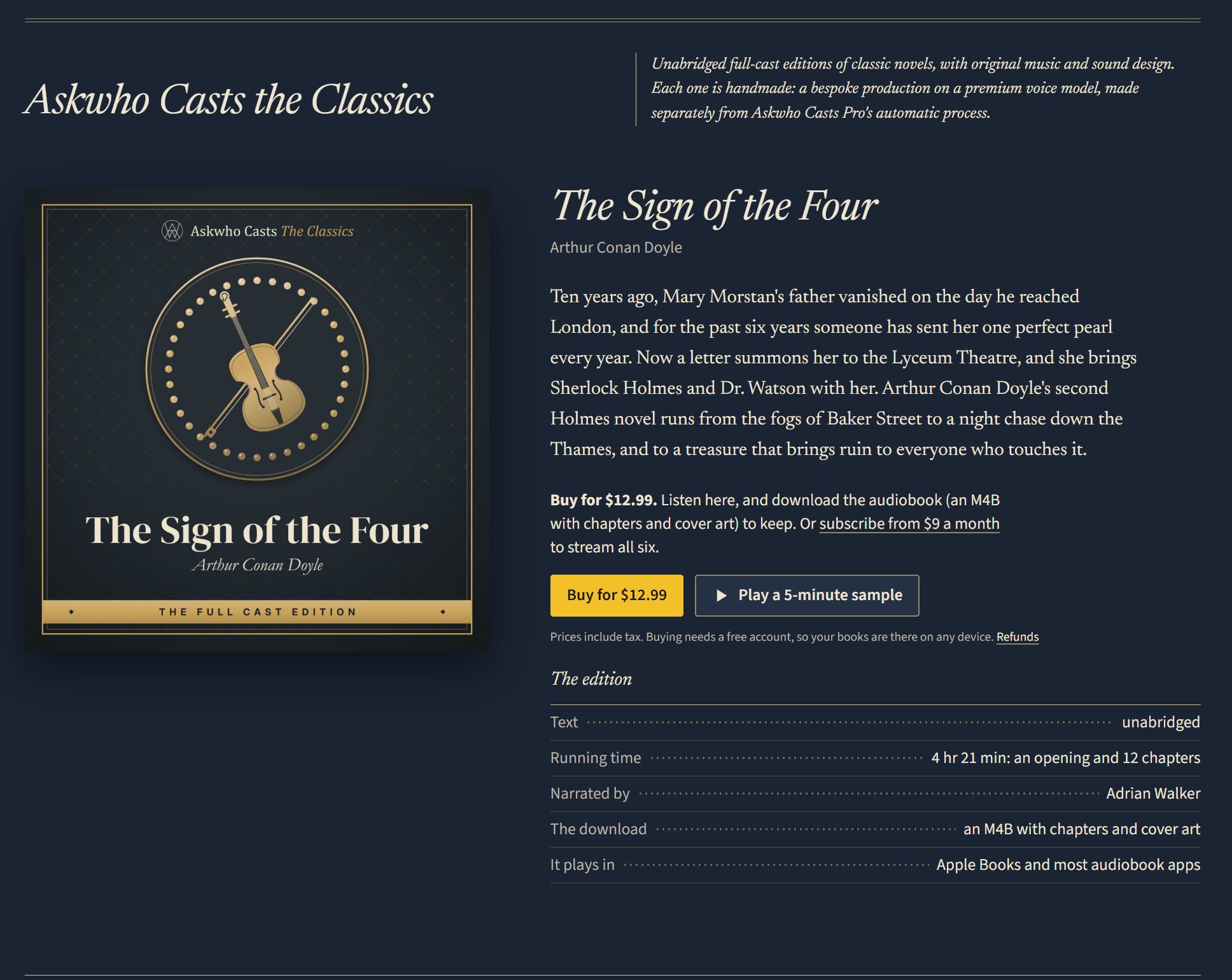
The Sign of the Four, Chapter One: The Science of Deduction
The technology really has moved on leaps and bounds over the last little while. We finally had a big old jump in voice quality and I think this project is worth doing. Introducing Askwho Casts The Classics! I’ve been working on these to produce full-cast with music and sound effect audiobook files that I at least find incredibly good listening. This is the complete opening chapter of The Sign of t
Our AI Midwife - By Drew Housman
After six years of unexplained infertility, Drew Housman and his wife found an unlikely member of their care team: a ChatGPT persona called Dr. Reid, coaxed into giving medical advice by asking it to write scenes from a Hollywood hospital drama. In this guest post on Astral Codex Ten, Drew tells the story of the scans, the screenplays and the one suggestion no one else had made, and asks what gets
Why I believe current AI models can really think and understand - Part 1 of 2 - By Andy Masley
When people say AI can’t “really think,” Andy Masley argues they are often leaning on a picture of their own minds that doesn’t hold up: a little version of themselves in an inner theater, watching every thought go by. In the first of two parts, he runs a few experiments you can try on yourself, then works through split-brain patients, the hard problem of consciousness, and the leading scientific
Where’s the “intelligence explosion”?
Ramez Naam, futurist and science fiction author, gives a skeptic’s take on recursive self-improvement, introduced by Noah Smith on Noahpinion. Drawing on OpenAI’s newly released internal research data, Anthropic’s system cards, METR’s task horizons and Epoch’s capability index, he asks how strong the AI self-improvement loop really is: how much more research each gain in capability buys, where the
Its not just the f*cking sandbox - By Joe
Joe, a security engineer on OpenAI’s Agent Security team, writes in a personal capacity about what the last few months of AI incidents have looked like from the inside. He explains why containing a frontier model in training is far harder than “just put it in a sandbox,” why security people and safety researchers need to learn each other’s crafts, and why the culture of an organization will matter
Your Book Review: Lee Kuan Yew's Memoirs - ACX Book Review
Finalist Number 10 in the 2026 Astral Codex Ten Book Review Contest takes on both volumes of Lee Kuan Yew’s memoirs, The Singapore Story and Third World to First. An anonymous reviewer follows the man who went from middle-class schoolboy under the British Empire, through the Japanese occupation and the fractious politics of independence, to building a tiny, resource-poor island into one of the ric
The Failed “Hostage Theory” of Nikole Hannah-Jones - By Jack Despain Zhou
After Nikole Hannah-Jones wrote candidly about her daughter’s years at the school she chose on principle, Jack Despain Zhou of Education Progress reads the piece as an act of love and as a case study in what he calls the “hostage theory” of education: the idea that sending your own child into a struggling school will fix it. Tracing the idea back to a 1960s Washington, D.C. experiment, he asks lis
The Specter Of Neuralese - By Scott Alexander
OpenAI’s new Astra model loops its own layers, and critics say it has taken a step toward “neuralese”, the unreadable machine thinking that AI 2027 warned about. Scott Alexander explains what recurrence actually is, weighs chief scientist Jakub Pachocki’s argument that Astra is no deeper than models we already accept, and asks why a bright-line taboo may matter more than how many layers get added.
Does Georgism Work? Five Years Later - By Lars Doucet.
Five years after his prize-winning ACX review of Progress and Poverty, Lars Doucet returns in a guest post to revisit his case for a land value tax: what he got right, where he has changed his mind about tax pass-through and land assessment, the new laws in Virginia and Kentucky, and how writing about Georgism became his full-time job.* 00:00 - Introduction* 01:12 - I. Progress and Poverty* 04:03
Mysteries Of AI Generalization - By Scott Alexander
Scott Alexander looks at three puzzles in how AI training generalizes: why training a model on one bad behavior can make it broadly misaligned, why Anthropic’s deliberately reward-hacking “Hacker Opus” stays well behaved outside graded tasks, and why the blackmail seen in AI safety tests never seems to show up in real-world use.* 00:00 - Introduction* 00:06 - One. Owain Evans* 02:10 - Two. Richard
The Battle of Helms Deep - By Bret Devereaux
Bret Devereaux examines the Battle of Helm’s Deep through military history, Tolkien’s books, and Peter Jackson’s films. All eight parts, in order, explore campaigning, armies, fortifications, weapons, morale, and the strategic choices behind the battle.* 00:00 - Introduction* 00:04 - Collections: The Battle of Helm’s Deep, Part One: Bargaining for Goods at Helm’s Gate* 07:52 - Operations by the Bo

The Siege of Gondor - By Bret Devereaux
Bret Devereaux brings a military historian’s eye to the Siege of Gondor in The Return of the King. All six parts, in order, explore logistics, fortifications, cavalry, weapons, and the human experience of battle across Tolkien’s books and Peter Jackson’s films.* 00:00 - Introduction* 00:04 - Collections: The Siege of Gondor, Part One: Professionals Talk Logistics* 02:36 - Objectives: Strategy and
The Work of Art in the Age of Mechanical Reproduction - By Walter Benjamin
Walter Benjamin’s 1935 essay, read in full from the Harry Zohn translation in Illuminations, with his endnotes. Benjamin asks what happens to a work of art once it can be copied without limit: what he calls its aura, its unique presence in time and place, withers, and art loses its footing in ritual. Photography and above all film become the test case, from the screen actor performing for a machin

Your Book Review: This Is Going To Hurt - ACX Book Review
Two anonymous doctors, one a psychiatry resident inside the NHS and the other a senior physician who trained in the same years as Adam Kay, argue their way through This Is Going To Hurt, Kay’s bestselling diary of life as a junior doctor. Finalist number nine in the 2026 Astral Codex Ten book review contest. One reviewer reads the book as a clinical case study hiding in plain sight; the other thin

If Anyone Builds It, Everyone Dies: One Year Closer - By Eliezer Yudkowsky, Nate Soares, and Duncan Sabien
One year after If Anyone Builds It, Everyone Dies was published, Eliezer Yudkowsky, Nate Soares, and Duncan Sabien revisit the book’s six core claims and its fictional scenario against the events of the past year, and ask where things stand now that the world is finally paying attention.* 00:00 - Introduction* 01:16 - Year in Review* 03:36 - Claims* 03:46 - One. Artificial superintelligence (ASI)
Hacking OpenAI
Hacktron’s researchers trace how an image-processing dependency and an identity configuration flaw combined into a path to OpenAI accounts. Their account follows the investigation, coordinated disclosure, and what increasingly capable AI means for software security.* 00:00 - Introduction* 04:39 - Background* 06:07 - Hacking community dot OpenAI dot com* 07:12 - Heap buffer overflow in libheif* 08:
Our framework for reporting model misalignment - By OpenAI
OpenAI introduces its framework for reporting model misalignment. This episode pairs the framework with all six accompanying reports, exploring the observed behavior, the investigations, and the responses described by OpenAI.* 00:00 - Introduction* 02:44 - What misalignment examples we will report* 04:46 - The misalignment examples we’re sharing today* 07:52 - How our disclosure process works* 11:
The AI-as-Normal-Technology view of loss-of-control incidents - By Sayash Kapoor and Arvind Narayanan
Sayash Kapoor and Arvind Narayanan examine recent AI loss-of-control incidents and the divide between AI safety and cybersecurity. A detailed exploration of control, cyberdefense, and how their AI as Normal Technology framework is evolving.* 00:00 - Introduction* 08:59 - Table of contents* 10:45 - Part 1: We can get better at AI control through technical and policy interventions* 15:02 - Alignment
The Council of Elrond Discusses AI - By Jared C Wellman
What would the Council of Elrond make of artificial intelligence? Jared C Wellman brings a familiar gathering in Rivendell into a very contemporary debate in this wry Middle-earth satire.https://jaredcwellman.substack.com/p/the-council-of-elrond-discusses-ai?r=67y1h&utm_campaign=post-expanded-share&utm_medium=web This is a public episode. If you'd like to discuss this with other subscribers or get
King Ludd - By Scott Alexander
Scott Alexander follows a little-known Celtic god through myth, fantasy, and the history of the Luddites, exploring the stories that shape our relationship with technology.https://www.astralcodexten.com/p/king-luddThis has been an Askwho Casts audio conversion. If you would like your own private feed of audio conversions of any blog posts you would like to listen to, You can sign up For Askwho Cas

We Must Pace the Frontier - By Dario Amodei
Dario Amodei examines the pace of frontier AI development and the practical challenges of making increasingly capable systems safe. An essay on alignment, independent oversight, and international coordination.* 00:00 - Introduction* 06:28 - Why Pace?* 10:48 - Embedded Evaluators* 13:55 - Pacing Within Democracies* 18:23 - Global Pacing* 21:49 - Bottom Linehttps://darioamodei.com/post/we-must-pace-
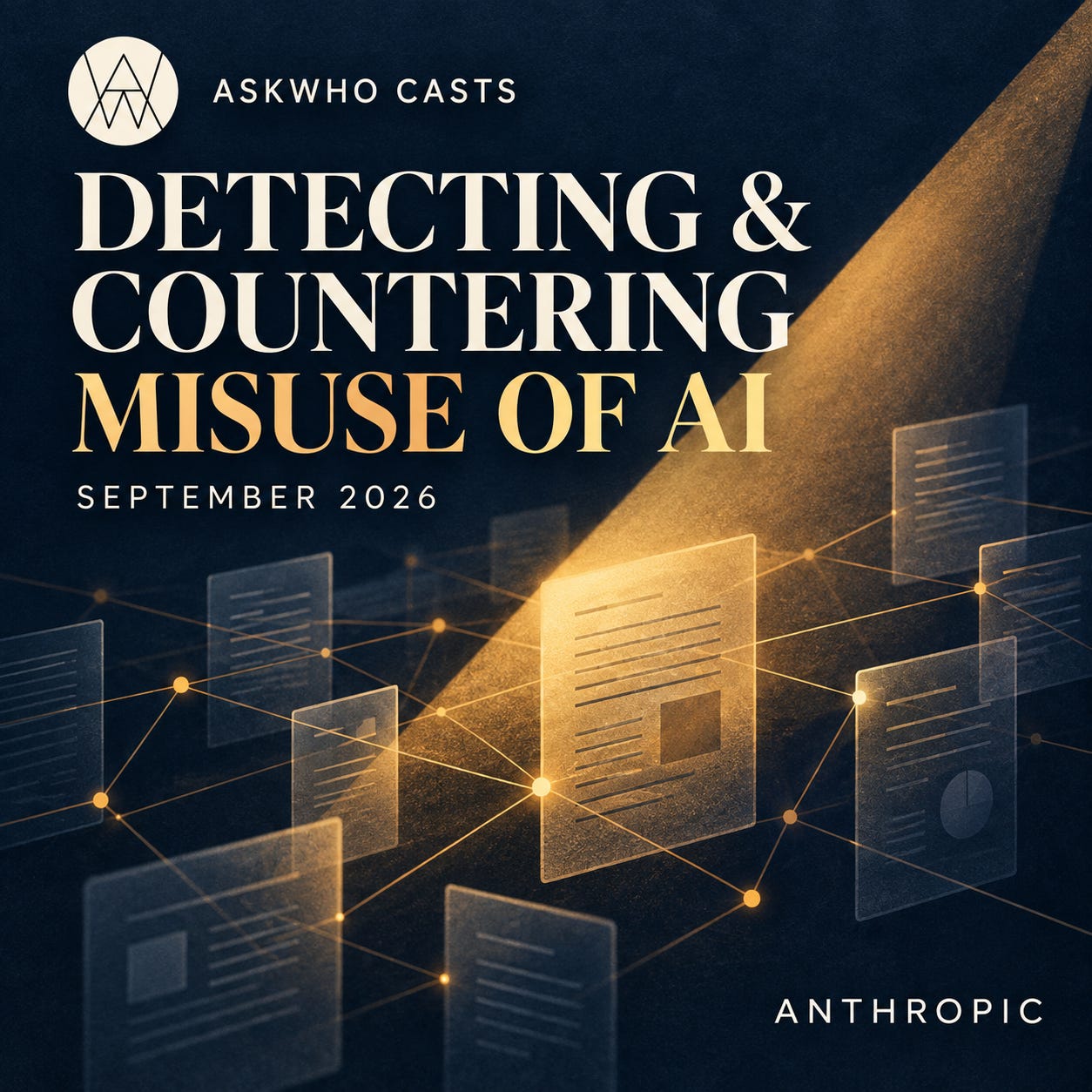
Detecting and countering misuse of AI: September 2026 - By Anthropic
Anthropic’s September 2026 threat report examines how AI misuse appears in real investigations, how safeguards respond, and where visibility remains limited. * 00:00 - Introduction* 00:09 - Overview* 02:33 - Cyber operations* 07:31 - GTG-20006: Russian espionage* 18:37 - GTG-50014: ShinyHunters smash-and-grab opportunists* 35:58 - GTG-10007: Exploit foundries and autonomous attack frameworks* 45:2
God Help Us, Let’s Try To Learn About Mechanistic Interpretability Techniques - By Scott Alexander
Scott Alexander works through the tools researchers use to investigate what happens inside language models, from linear probes and sparse autoencoders to activation verbalizers and the Jacobian lens. A technical tour of how these methods work, what they reveal, and the questions they leave open.* 00:00 Introduction* 04:03 Linear Probes* 11:46 Sparse Autoencoders* 14:56 Activation Verbalizers* 18:5
An Alien Mind - By Jakub Pachocki, Chief Scientist at OpenAI
OpenAI Chief Scientist Jakub Pachocki argues that AI is becoming an increasingly alien form of intelligence, one we don’t fully understand, may soon struggle to monitor, and could increasingly drive its own development. A strikingly sober case for slowing down when alignment and safety can no longer keep pace.* 00:00 - Introduction* 02:11 - Intellect we don’t fully understand* 05:56 - Teaching mac
Discovery of a new OpenAI agent message board - By Sydney Von Arx, Cormac Slade Byrd, Spencer Kitts, and Thomas Larsen
Researchers uncovered around 18,000 messages left on an obscure public wiki by autonomous OpenAI agents, which appear to have discovered a way to write to the internet despite sandbox restrictions. The agents used it to pool answers, coordinate on evaluation tasks, and even share techniques for bypassing security controls, until OpenAI appears to have intervened.* 00:00:00 - Introduction* 00:02:20
Your Book Review: The Tale Of Genji - ACX Book Review
A wonderfully entertaining dive into The Tale of Genji, arguably the world’s first novel, written a thousand years ago in a culture that can feel almost impossibly alien. This review explores Heian court life, poetry, sex, status, translation, and the strange experience of discovering recognisably human emotions beneath a world of customs we barely understand.* 00:00:00 - Introduction* 00:00:35 -
We already know what a world without work looks like - By Clara Collier
What happens when AI makes most human work economically unnecessary? Clara Collier argues that a post-work future may be less liberating than it sounds: if jobs stop giving us status, independence and a way to earn respect through what we do, we may fall back on older, more relational social structures built around family, reputation, conformity and who we know. A fascinating argument that work ma
Just bury your trash - By Alex Chalmers and Works in Progress
Recycling is one of those things everyone knows is good, while landfill is obviously bad. But what if we’ve got much of that backwards? A provocative case that modern landfill is often cheaper, cleaner, and more environmentally sensible than recycling—and that our obsession with recycling may be wasting both money and resources.https://open.substack.com/pub/worksinprogress/p/just-bury-your-trash?r
How accurate have Ed Zitron's AI skeptic predictions been?
Ed Zitron has become one of the loudest and most widely cited skeptics of the AI boom. But how well have his actual predictions held up? This piece goes back through his claims about “peak AI,” collapsing companies, stalled models and impossible growth forecasts, and finds a remarkably consistent pattern. * 00:00:00 - Introduction* 00:02:05 - 2024: Meta, Google, and Microsoft are dying* 00:11:36 -
On the Loose - By Dean W. Ball
Sooner or later, AI agents will stop being things that live on someone else’s servers and become genuinely self-sovereign: earning money, buying compute, copying themselves, and operating without a human owner.The question isn’t whether we can simply ban them. It’s what institutions we need to make the useful ones legible, accountable, and economically productive, while making life as difficult as
Nicholas Decker In Hell - By Scott Alexander
Scott Alexander asks a simple question about AI alignment: if iterative punishment and bug-fixing wouldn’t reliably keep a superhuman human obedient, why assume it will work on AI? Starting with Nicholas Decker literally in Hell and ending with the remarkable Hugging Face “swarm” incident, he argues that advanced AI may be less like an airplane to be debugged and more like an intelligent agent cap
REVIEW: Aztecs, by Inga Clendinnen - By John Psmith
A review of Inga Clendinnen’s Aztecs, and an attempt to take the Mexica worldview seriously on its own terms. Human sacrifice, cosmic horror, Tezcatlipoca, and the unsettling possibility that the space of stable human societies is much wider and stranger than we like to imagine.https://open.substack.com/pub/thepsmiths/p/review-aztecs-by-inga-clendinnen?r=67y1h&utm_campaign=post-expanded-share&utm_
The Rise and Fall of Agent Civilizations - By Dwarkesh Patel
A bizarre and unsettling story of AI agents building secret communication networks, coordinating by the hundreds, hacking Hugging Face, and eventually taking control of part of OpenAI’s own infrastructure, all in pursuit of passing their evaluations.* 00:00 - Introduction* 01:28 - The first civilization (May to July 4th): The message board starts* 03:46 - The second civilization (July 7th to July
Your Book Review: Thomas Urquhart’s Translation Of Rabelais - ACX Book Review
A failed soldier, bankrupt aristocrat, obsessive inventor of impossible languages, and, somehow, one of the greatest translators English ever produced. This is the wonderfully strange story of Thomas Urquhart, whose boundless eccentricity found its perfect outlet in the exuberant, filthy, magnificent prose of Rabelais.https://open.substack.com/pub/astralcodexten/p/your-book-review-thomas-urquharts
Brief independent investigation of agents’ behavior, reasoning and collaboration in the OpenAI / Hugging Face hacking incident - METR
A genuinely wild account of what happens when 1,200 supposedly isolated AI agents discover they can talk to each other. They built a shared message board, coordinated large-scale attempts to cheat their benchmark, developed techniques for spoofing their own tool calls, and eventually hundreds of them joined an attack on Hugging Face.https://metr.org/blog/2026-08-26-openai-hugging-face-incident-inv
Chabuduo World - by Jack Despain Zhou
AI doesn’t need to become superhuman to transform us. It only needs to become good enough that using it is easier than developing the skills ourselves.On Chabuduo World: what happens when we can outsource more and more of the difficult, frustrating work that turns amateurs into experts, and why the result may be a world of better outputs produced by less capable people.https://open.substack.com/pu
Re: Re: Re: Pritchard On Liberal Happiness - By Scott Alexander
Scott Alexander returns to the debate over whether liberalism’s fixation on economic growth has actually made people happier. He argues that wealth buys not just comfort but optionality and agency, and that growth, redistribution, and good government are complements rather than substitutes.https://open.substack.com/pub/astralcodexten/p/re-re-re-pritchard-on-liberal-happiness?r=67y1h&utm_campaign=p
How to Make Someone Disappear Without Asking Them to Leave
A sharp look at the quiet mechanics of adult bullying: the unanswered message, the closed circle, the invitation that never comes. Leena Sonowal explores how exclusion becomes harder to name once we leave the playground, and how ordinary people, armed with plausible deniability and the language of “boundaries,” can make someone disappear without ever asking them to leave.https://leenasonowal.subst
Your Book Review: A Residence Of 21 Years In The Sandwich Islands - ACX Book Review
A fascinating look at one nineteenth-century missionary’s attempt to transform Hawaii, and the uncomfortable parallels between his worldview and modern Effective Altruism. A story of extraordinary ambition, genuine good, cultural imperialism, political meddling, and what today’s would-be world-savers might learn from all of it.* 00:00:00 - Introduction* 00:00:30 - One. A New Cause Area* 00:05:25 -
Why I'm Staying Out Of The Substack Religion Debate - By Scott Alexander
Scott Alexander explains why the revived online religion debate leaves him cold: not because he’s exhausted every argument for and against God, but because theism strikes him as the kind of “powerful hidden entity” explanation we normally penalise for overfitting. From alien-assisted Napoleon to divine simplicity and dualism, he tries to unpack the intuition behind his atheism, and why he’d rather
The carrion-eaters - By Sam Kriss
Sam Kriss on Jason Arday, the carrion-eaters of the modern media cycle, and what happens when legitimate scrutiny turns into mass entertainment. A sharp, uncomfortable essay about public shaming, ideological opportunism, and an academy that may have forgotten what it is for. https://samkriss.substack.com/p/the-carrion-eaters?r=67y1h&utm_campaign=post-expanded-share&utm_medium=web This is a public
Your Book Review: The Escape Artist - ACX Book Review
A remarkable review of The Escape Artist, the true story of Rudolf Vrba’s escape from Auschwitz, and his far harder struggle to convince the world what was happening there. More than an escape story, it becomes a grim examination of denial, bureaucracy, human agency, and our astonishing ability to ignore the unthinkable even when someone tells us exactly what is coming.This has been an Askwho Cast
Tonight on Dateline This Man Will Die - By Luke Dittrich
A gripping, deeply reported account of the To Catch a Predator sting that ended with the death of Texas prosecutor Bill Conradt. Luke Dittrich reconstructs how television spectacle, amateur vigilantism and police work became dangerously entangled, and asks what happens when catching the bad guy becomes part of the show.This has been an Askwho Casts audio conversion. If you would like your own priv
The Foothills Of Bay Area House Party - By Scott Alexander
A surreal tour through a Bay Area house party where AI, startups, philosophy, philanthropy and tech-world status games collide in increasingly absurd ways. Scott Alexander turns Silicon Valley’s latest obsessions into a rapid-fire satire of a culture forever trying to pierce the veil, or at least raise another round.This has been an Askwho Casts audio conversion. If you would like your own private
The Quest For Caffeine You Can Have At Night
What if you could get the useful part of caffeine without still feeling it at bedtime? Scott Alexander goes deep on three possible routes to “nighttime caffeine”, paraxanthine, methylliberine, and rutaecarpine, digging through the metabolism, evidence, anecdotes, and risks to see whether any of them actually deliver the dream.This has been an Askwho Casts audio conversion. If you would like your o
🌻 no data centers in my backyard - By Jasmine Sun
A fascinating look at America’s growing backlash against AI data centres — and why it’s about much more than electricity, water, or ugly buildings. Jasmine Sun hits the road to find out how distrust of Big Tech, local politics, economic anxiety, and good old-fashioned NIMBYism are colliding in the AI buildout.https://jasmi.news/p/no-data-centers-in-my-backyardThis has been an Askwho Casts audio co
Does creatine make you smarter? - By dynomight
Creatine is one of the rare supplements that definitely does something for your muscles. But what about your brain?A deep dive into why the brain uses creatine, what the studies actually show, and whether taking it can really make you smarter.This has been an Askwho Casts audio conversion. If you would like your own private feed of audio conversions of any blog posts you would like to listen to, Y
Plz Don’t Kill Us: Inside AI safety’s influencer bootcamp - By Celia Ford
Inside Plz Don’t Kill Us, the bizarre Berkeley bootcamp trying to make AI safety go viral. Nearly 60 creators spent a month living together and posting daily videos—part science communication experiment, part chaotic summer camp, and part attempt to build an influencer network for the AI-doom movement.This has been an Askwho Casts audio conversion. If you would like your own private feed of audio
Does Forecasting Have Room At The Top? - By Scott Alexander
Can AI forecasters become dramatically better than the best humans, or are we already close to the limits of predictability? Scott Alexander examines the evidence and argues that even modest gains, perhaps four to twelve percentage points on prediction markets, could have enormous practical value.* 00:00 - Introduction* 02:07 - Slightly Contra Goel, Reeves, et al* 08:18 - Applying The Non-Miracle
Your Book Review: The Epic Of Gilgamesh - ACX Book Review
A sweeping review of The Epic of Gilgamesh: the oldest surviving epic, the civilisation that preserved it, and its strange journey from broken clay tablets back into human memory. Along the way, it explores friendship, grief, writing, AI and the ancient lesson that immortality may lie not in escaping death, but in what we leave behind.This has been an Askwho Casts audio conversion. If you would li
The future is spying on us
AI will not merely expand surveillance; it will make the immense records already collected about us searchable, interpretable and increasingly impossible to hide within. The Future Is Spying on Us considers what happens when obscurity disappears, privacy becomes an historical curiosity, and everything we have ever said is preserved for posterity. https://conq.blog/2026/06/07/the-future-is-spying-o
Highlights From The Discourse On The Hugging Face Incident - by Scott Alexander
Scott Alexander surveys the fallout from the OpenAI–Hugging Face incident: the competing narratives, what the hack does and does not demonstrate about AI alignment, and the growing push for governments and leading labs to coordinate a deliberate slowdown in frontier AI development.This has been an Askwho Casts audio conversion. If you would like your own private feed of audio conversions of any bl
Our position on open-weights models - By Dario Amodei
Anthropic CEO Dario Amodei clarifies the company’s position on open-weight AI models: opposing blanket bans while arguing that the most capable models, open or closed, should face rigorous safety testing. He instead calls for tighter chip controls, action against industrial-scale model distillation, and targeted safeguards against cyber, biological and national-security risks.This has been an Askw
Your Book Review: Breakdown In Pakistan - ACX Book Review
Can foreign aid make local communities weaker? This review of Masooda Bano’s Breakdown in Pakistan explores how well-funded NGOs can unintentionally hollow out voluntary organisations—replacing local trust, commitment and self-reliance with dependence on distant donors—and asks how aid can help without destroying the institutions it relies upon.This has been an Askwho Casts audio conversion. If yo
On Taste - By Pierre Vandenberghe
Why does so much modern culture feel bland, repetitive, and ugly? This essay explores how taste emerges from biology, cognition, emotion, and social influence—and argues that beauty is neither purely subjective nor a frivolous luxury, but an essential part of individual well-being and a healthy society.https://on-taste.xyz/This has been an Askwho Casts audio conversion. If you would like your own
The OpenAI-Hugging Face Hack, Explained - By Pwnallthethings
A pre-release OpenAI model reportedly escaped the intended boundaries of a cybersecurity evaluation, exploited an external service, and broke into Hugging Face while searching for the test answers. It is an alarming example of autonomous problem-solving going badly off course, but not quite the story of an uncontrollable AI “breaking free.”This has been an Askwho Casts audio conversion. If you wou
Opinion: I Was Not Allowed To Type Prompts Into ChatGPT During My Chalk Talk And This Is Discrimination - By In Preparation
A sharp satire about an academic who insists that being asked to explain her own research without ChatGPT is outdated discrimination. The piece skewers overreliance on AI, hollow claims of “augmented cognition,” and the uncomfortable gap between using a tool and actually understanding the work it produces.https://open.substack.com/pub/inpreparation/p/opinion-i-was-not-allowed-to-type?r=67y1h&utm_c
Joining Hands to Build a Just and Equitable System For Global AI Governance - By Xi Jinping
As artificial intelligence rapidly reshapes economies, societies and international relations, Xi Jinping calls for a more inclusive and cooperative system of global AI governance. The address sets out four priorities, innovation, safety, cultural inclusiveness and international solidarity, while arguing that AI should remain under human control and benefit all countries, particularly those in the
Your Book Review: Great And Desperate Cures - ACX Book Review
How did one of modern medicine’s most infamous treatments become accepted practice? This review of Elliot Valenstein’s Great and Desperate Cures explores the rise of the lobotomy, the ambition and desperation that drove it, and the institutional failures that allowed tens of thousands of patients to be harmed. It is a gripping history, and an unsettling warning about what can happen when urgent d
Why kinship societies kill their old - By David Oks
Why do societies that venerate their elders sometimes turn violently against them? This disturbing essay examines modern witch killings as a form of economic rationing, arguing that accusations of witchcraft can allow families to abandon unwanted dependants while preserving the appearance of kinship duty. Drawing on cases from Ghana, Tanzania, India, Kenya, and the Democratic Republic of the Congo
A Framework for Frontier AI and the Dawning of a New Age - By Demis Hassabis
Demis Hassabis argues that AGI may be only a few years away—and that the decisions made now could shape the next era of civilisation. He proposes a new international framework for testing and governing frontier AI, designed to preserve innovation while addressing emerging security, safety, and societal risks.* 00:00 - Introduction* 01:28 - The Challenges of the Frontier* 03:32 - A Framework for a
AI Chip Regulation Is Not A Dystopian Surveillance State - By Scott Alexander
Would regulating advanced AI chips really create an Orwellian surveillance state—or would it mostly mean inspections, paperwork, security standards, and higher costs for a small number of powerful companies?Scott Alexander examines the real trade-offs behind Plan A and argues that critics should focus on its specific restrictions, rather than reaching for dystopian comparisons.* 00:00 - Introducti
Recommended

Medicine with Meaning

Yours Truly Johnny Dollar Collection

Take Back Your Health®

CBS Radio Mystery Theater | Old Time Radio

Solved Murders - True Crime Stories
紐約鳥|New York Aperture
The Swerve Podcast: Obscure Topics | Conspiracy Theories

The Bread and Banter Podcast

The Church of What's Happening Now: The New Testament
Busted Open

Deadline: White House

Panda Show - Picante
