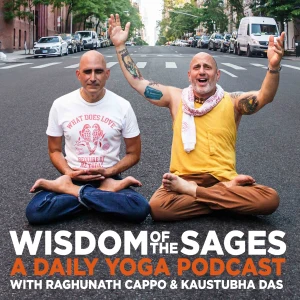
Wisdom of the Sages
Truths about life from the timeless wisdom of the Bhakti-yoga tradition - fun, relevant, and deep. Learn about dharma, yoga, bhakti, and how it relates to all the basic questions of life. This show is about how to live your best life, let go of the external distractions, and uncover the spiritual happiness that lies within the heart as the true nature of the soul. Raghunath and Kaustubha's connection goes back to their teens in the New York Hardcore Punk Scene of the early 80s, through serving together as Bhakti-yogi monks in the 90's, to sharing their experiences in the world of yoga in the 21st century.
Episodes

1832: Adapting Ancient Wisdom Without Losing It / Q&A Vol. 302
How does an ancient wisdom tradition survive for thousands of years? It needs teachers who hand it down unchanged, and yet each generation has to hear it in a new way. In this episode Raghunath and Kaustubha take questions live on the final day of the Wisdom of the Sages retreat and explore that tension: what a true teacher must preserve, and what they're free to adapt to time, place, and circumst

1831: Living Bhakti Among People Who Don't Share It / Q&A Vol. 301
There's a sticky note in Ashley's refrigerator that reads "meat section." She's the only devotee in her home, and between a loving family that doesn't share her path and a day with too few hours, her spiritual practice has started to come with a side of guilt. In this episode Raghunath and Kaustubha take questions live from the Wisdom of the Sages Autumn Retreat, exploring how to walk a spiritual

1830: Bhakti Doesn't Grow in a Hard Heart / Q&A Vol. 300
Someone on the street asks you for money, and you're fairly sure where it will go, and it's not good. Can walking past be compassion, or is it quietly hardening your heart? Raghunath and Kaustubha take live questions at the Wisdom of the Sages retreat at Supersoul Farm: whether saying no can ever be an act of love, what to do when the charity work you've done for years no longer sits right with yo

1829: A Field Guide to Your Inner Demons | Bhaktivinoda Thakur Decodes Krishna's Pastimes
In the 19th century, British colonial scholars dismissed the pastimes of Krishna as primitive and immoral, and a generation of educated Indians began to believe them. The brilliant bhakti theologian Bhaktivinoda Thakur answered with a book called the Krishna-samhita. His response: look closer. Raghunath and Kaustubha explore how the stories of Krishna can be read as the soul's path to restoring it

1828: We Never Learned the Power of Our Thoughts | You Become What You Think About
Be good. Behave. Behave yourself. Growing up, most of us heard plenty about our actions and almost nothing about the thoughts that produce them. In this episode Raghunath and Kaustubha begin with Earl Nightingale's 1956 claim that history's great thinkers agree on one point: we become what we think about. They trace that idea to the Bhagavad Gita and the practice of mantra meditation, then turn to

1827: The Emptiness of Peace and the Fullness of Love | Meditation Beyond Stillness
Most of us long for a quiet mind. But what fills it once the noise is gone? On a solo bike ride across upstate New York, Raghunath finds that solitude alone doesn't bring peace. Left to itself, the mind drifts to its default setting. Raghunath and Kaustubha explore why the path of bhakti points beyond stillness to something fuller. Amid the violence of Krishna's wrestling match in Mathura, the wom

1826: Why the Comment Thread Is Killing Your Soul | Speaking Truth to Power
When something is wrong and we say nothing, our own inner light begins to fade. But speaking up only heals when it comes from a place of love. Raghunath and Kaustubha draw on an old Quaker insight: love endures and overcomes, while hatred destroys, starting with the one who carries it. Online comment threads can drag out our lower nature and cloud our spiritual clarity, and posting is cheap. The m

1825: Our Labels Are Warping Our Vision | The Many Ways We Respond to Krishna
I'm a man. I'm a woman. I'm American. I'm this, I'm that. Every label we carry colors how we see the world, ourselves and God. Yoga starts from a bold premise: our perception is clouded, and it can be cleared. Bhakti goes further still. As the lens clears, a love unique to each of us awakens. Raghunath and Kaustubha explore that teaching through Krishna's entrance into Kamsa's wrestling arena, whe

1824: You're Not in Control | The Placebo Illusion and the Bhakti Reality
Our sense of security is based on illusion — confirmed by both modern science and the sages of the Bhakti Yoga tradition. A landmark psychiatric study reveals something startling about what actually determines whether we panic or stay calm. The Vedic sages were ahead of the curve, and put it plainly: we are living in two illusions — false terror and false security. The material energy is infinitel

1823: Life Is Sacred and Life Is Everywhere | The Earth Personified in Krishna's Pastimes
In the form of a beautiful teenager God enters a new city, meets a hunchback girl in the street, transforms her body and enters a romance with her. On the surface it sounds bizarre. But read with the right eyes, it is rich in ecological and theological depth. The girl is an expansion of Mother Earth herself, bent low under the burden of wicked rulers. Krishna straightens her out, indicates the val

1822: Grace in Your Face | Human Nature's Resistance to Unconditional Love
Are we all like wounded animals caught in a fence, biting the hand of the person trying to help? Is spiritual grace something exceptionally rare — and most of us the unfortunate ones who never win the lotto? Or is grace all around us, and we just need to put down what's in our arms to receive it? Raghunath and Kaustubha explore that alongside Krishna's entrance into Mathurā — where two encounters

1821: Krishna Doesn't Need Your Zucchini Bread | But He Wants Your Love
The Bhagavad-gītā sings of Krishna as the Absolute Truth — complete in himself, independent and lacking nothing. He doesn't need anything we can offer him. And yet — he wants our love. Raghunath and Kaustubha explore that paradox through the narration of Krishna's entrance into Mathurā — and what two very different encounters reveal about the one thing that actually matters in our relationship wit

1820: They Took Him Into Their Hearts Through Their Eyes | Krishna Enters Mathurā
When Krishna and Balarāma entered Mathurā, the women climbed to the rooftops and showered them with flowers. They took him into their hearts through their eyes — embraced him, the embodiment of all ecstasy — and their bodily hair stood on end. And in that way, unlimited distress disappeared from their lives. That is the experience that the path of bhakti leads to. In this episode Raghunath and Kau

1819: Daring to Fly Higher | Jonathan Livingston Seagull and the Ascent to Bhakti
In the 1970s the book Jonathan Livingston Seagull became a bestseller. A parable about a gull who refuses to follow the flock and discovers that his true nature is limitless. It serves as an insightful description of the spiritual path. The masses mistake worldly objects for sources of happiness — and spend their lives chasing what can never deliver. And some brave few dare to fly higher, brushing

1818: Why Nothing in This World Satisfies Us
Voltaire — the greatest writer of the French Enlightenment wrote that there is a dim flame burning in every heart — an intuition that somewhere there is a home, a happiness that is real and lasting. We spend our lives chasing it in bodies, children, homes, wealth, relationships. And it never quite delivers. In this episode Raghunath and Kaustubha explore that intuition, what covers that dim light

1817: All Rivers Flow to the Sea | Beyond Exclusivism and Hyper-Inclusivism
Westerners who take interest in Eastern Spirituality may be reacting to elements of exclusivism found in Western religion (we're right and everyone else is wrong). The swing to the East may carry all the way to Hyper-Inclusivism (everybody's right). In this episode Raghunath and Kaustubha explore what it means to hold a vision of truth that is both inclusive enough to appreciate truth wherever it

1816: Krishna, Vishnu and the Mystery of the Avatars
Most Vedic literature speaks from a perspective within this universe. But some reveal that this universe is just a tiny bubble among countless others — and invite us to view our place in existence from outside. Depending on which angle we look from, either Vishnu or Krishna will appear to be the origin of the Avatars. Raghunath and Kaustubha explore that question alongside Akrūra's extraordinary v

1815: Watch Until the Dust Settles | Krishna's Love Never Leaves Vrindavan
It is said that Krishna never takes one step out of Vrindavan. But it appears that he does leave, and breaks the hearts of the Gopis. In this episode Raghunath and Kaustubha explore that image the idea of how it is true that he never left, what A holy place is, how anywhere can become one, and the six lessons a bhakti-yogi can learn from dogs. Srimad Bhagavatam 10.39.32-39 ***********************

1814: We Crash | God's Opulences and Our Limitations
What happens when an individual soul thinks the gifts they have are their own? Why do we see so many celebrities struggle, even though they have achieved so much success? Raghunath and Kaustubha explore the source of all opulences — beauty, strength, wealth, fame, knowledge, renunciation — and how when we receive even a touch of them we tend to think they are ours. And then the truth arrives. Cras

1813: The Philosopher vs the Mystic | Understanding the Passion of the Gopīs
To the philosopher, the weeping of Krishna's lovers looks like ordinary suffering. To the mystics it's the culmination of the highest knowledge. Evelyn Underhill — first woman to lecture in theology at Oxford — said the mystic speaks the disconcerting language of first-hand experience, something only really understood by another who has felt it. Raghunath and Kaustubha explore what it means to mov

1812: The Love Sewed in Every Stitch | Dolly Parton and the Bhagavad Gīta
It's not the coat of many colors that mattered. It was the love her momma sewed into every stitch. Dolly Parton understood something the Bhagavad Gīta states plainly: offer me a leaf, a flower, a little water — but offered with love, that moves me. It's not the grandness of the offering. It's what's inside it. Raghunath and Kaustubha explore that truth alongside Akrūra in the home of Krishna — fed

1811: Proust's Madeleine and Krishna's Footprints | The Power of the Senses to Transport You
A taste, a smell, a place, a song — something dormant rises suddenly from the depths. The Vedic tradition calls this Udīpana — stimuli that transport you. But where? Raghunath and Kaustubha explore that question through Proust's famous Madeleine moment and Akrūra finding Krishna's footprints in the cowherd pasture — the footprints whose pure dust the rulers of the planets hold on their crowns. Thi

1810: Beneath Every Fear Is the Fear of Death
Anxiety, OCD, eating disorders, panic disorder, depression – beneath the specific symptoms of almost every mental health condition there is a fear of death at the root. This is the conclusion of a landmark study that synthesized 129 studies across 38 countries and 58 years of research. "Death touches a nerve. Quietly, constantly. It shapes how we live, how we suffer, and how we heal." The person w

1809: The Fish in the Water Is Thirsty | Kabir and the Departure of Gus
"I laugh when I hear that the fish in the water is thirsty. You don't grasp the fact that what is most alive of all is inside your own house, and you walk from one holy city to the next with a confused look." Kabir — the fifteenth century Indian mystic poet claimed simultaneously by Hindus, Muslims and Sikhs — saw it clearly. We are made of God's energy, sustained by God's energy at every moment.

1808: Everything on Earth Has a Purpose | Mourning Dove's Dharma
"Everything on the earth has a purpose. Every disease, an herb to cure it. And every person, a mission." Morning Dove — the first Native American women to publish a novel — called this the Indian theory of existence. In this episode Raghunath and Kaustubha explore that alongside Bhakti's idea of Dharma and its different levels - temporary and eternal. We all have to embrace different temporary rol

1807: We're All Kings for a Moment | King Canute and the Force of Time
Commonly people speak of time as measurements – days, months, years, etc. Philosophers speak of time as the force that moves — and ultimately crushes — what we measure. The Viking King of England, Canute, said: "Let all men know how empty and worthless is the power of kings." Our beauty, our influence, our position — it comes and it goes by the force of time. In this episode Raghunath and Kaustubh

1806: Low Self-Esteem and a Big Ego | Mike Tyson and the Keśī Demon
Low self-esteem and a big ego are two sides of the same coin. Mike Tyson saw it— there was "Iron Mike," the undefeatable persona built for the ring. And then there was the real confused person underneath. The ego can get you to your destination, but it's going to collapse. The teaching of bhakti goes deeper: play your role — boxer, mother, teacher, father — play it as well as it can be played. But

1805: The Humility and Heroism of Accepting Your Fate
Mariano Rivera — the greatest closer in baseball history — was willing to teach his rivals exactly how to throw his most devastating pitch. He knew that, regardless of their strength or skill, unblessed they were blessed by God to throw they wouldn't be able to. The Stoics understood it. They called it "amor fati" — love of fate. There are things within our control and things outside our control.

1804: The Love Is Gone | Gandhi on Warped Religion
People use religion it to feel superior, or to protect their position. The name and rituals remain. But the love is gone. "What passes as Christianity is a negation of the Sermon on the Mount." Gandhi wasn't rejecting Jesus — he was rejecting what had been done in his name. Something starts with a genuine God experience, rooted in love. Over time it gets warped — In this episode Raghunath and Kaus

1803: Everything Is Nothing | George Harrison and the Krishna Mantra
You need people who have everything to show you that everything is nothing. George Harrison had wealth, fame, mansions, cars — everything material desire could want. And he said just sitting down and chanting the Hare Krishna mantra gives more happiness than all of it. "The response that comes from chanting is bliss — a much higher taste than any happiness found in the material world." Raghunath a

1802: No One Truly Knows Me | The Loneliness Epidemic and Bhakti Vedānta
The majority of Americans say no one truly knows them. Research shows that warm, real connection correlates directly with physical health and peace of mind. We are relational beings by nature. The question is whether we've found the right object of love. Raghunath and Kaustubha explore that question alongside the Yugala Gīta — where Bhakti Vedānta paints a picture of spiritual relations in perfect

1801: The World Responds to Krishna's Beauty
Many spiritual traditions lack a personal conception of the Divine. Other's do, but offer little description of what that means. The Bhakti tradition's Srimad Bhagavatam goes further — painting an incredibly detailed picture of the Absolute Truth, and doing it through poetic exchanges of love. In this episode Raghunath and Kaustubha enter Canto Ten, Chapter Thirty-Five — the Yugala Gīta. Pairs of

1800: I'm Coming Out!
Episode 1800. To celebrate, Raghunath and Kaustubha open the floor to the Wisdom of the Sages community — sharing the stories of the moment they told family, friends and spouses: I'm a Hare Krishna. Funny, vulnerable, beautiful and deeply human. Happy 1800, everybody. ******************************************************************** LOVE THE PODCAST? WE ARE COMMUNITY SUPPORTED AND WOULD LOVE F

1799: Give Me a God That Sings and Dances | Was Nietzsche Looking for Krishna?
"I would believe only in a God who knows how to dance." Nietzsche didn't reject God — he rejected a God who was solemn, heavy and joyless. What he wanted was a God with joy in him. He had no idea that on the other side of the world, thousands of years before he was born, that God had already been described. Raghunath and Kaustubha explore George Harrison's idea that everybody is looking for Krishn

1798: Beauty: Blessing or Curse? | Dostoevsky and the Heart of Man
Studies show that beautiful people earn more, get hired faster, and receive lighter sentences in court. Beauty is power. But Dostoevsky saw the danger: "God and the devil are fighting there, and the battlefield is the heart of man." Beauty pulls in two directions — one kind inflates the ego and drags the consciousness down without you noticing, another makes you want to be better, kinder, more ali

1797: The Diametric Opposite of Lust | The Rāsa Līlā Completes
How does meditating on Krishna's romantic pastimes conquer lust? Not through repression — through a higher meditation. In classical yoga, the very first demand is to root out every vestige of erotic thought. With the meditators on Krishna, the romantic mood became the queen of all meditation. The gopīs' love is the diametric opposite of lust — being entirely selfless. Meditating on something so pu

1796: Prabhupāda Made New York a Holy Place | ISKCON at 60
Sixty years ago Śrīla Prabhupāda arrived in New York City — not by accident, but by design. He understood that what happens in New York radiates out to the world. In this special episode Raghunath and Kaustubha are joined by Aditya Devi Dasi from the Brooklyn Temple to talk about the ISKCON 60th anniversary weekend — a full three days of festivities in the city where it all began. The Wisdom of th

1795: The Absurdity of Imitation on the Spiritual Path
When we first find the spiritual path, we imitate. It's natural. We put on the costume before we've done the inner work. We adopt the style before we've absorbed the substance. We copy what we see in the saints and the sages — the dress, the language, the mood. But it's been said: "No man was ever great by imitation. Almost all absurdity of conduct arises from the imitation of those whom we cannot

1794: Jñāna & Bhakti: Both Bring Detachment, One Does It Beautifully
"Love separates all things from the soul." Meister Eckhart — fourteenth century Christian mystic, so radical the Pope investigated him for heresy — arrived at the same place as the Bhakti Vedāntins. Both jñāna and bhakti dissolve material attachment. Jñāna does it through relentless intellectual negation. Bhakti does it through love. And love, as the Rāsa Dance shows, does it beautifully. In this

1793: The Highest Transcendence Through Passionate Love | The Rāsa Dance Begins
A first reading of the Rāsa Līlā might suggest the gopīs' love is selfish, irresponsible, even unethical. But looking closer one can find the highest transcendence attained not through grinding austerity but through love so real and complete that everything else simply fell away. In this episode Raghunath and Kaustubha arrive at Canto Ten, Chapter Thirty-Three — the Rāsa Dance itself. Krishna expa

1792: How Do You Know What Krishna Wants Next? / Q&A Vol. 299
Live from the Wisdom of the Sages annual Tuscany retreat, three questions that go to the heart of the practice. How do we deepen intimacy in bhakti without imitating it? How do you reconcile respect and resentment toward a teacher who gave you bhakti but also caused real harm? And how do we recognize what Krishna wants from us as our next step? ****************************************************

1791: Parents, Teenagers, Codependency and Mercy / Q&A Vol. 298
Q&A Live from the Wisdom of the Sages annual Tuscany retreat. How does a bhakti practitioner maintain boundaries with a parent whose behavior has been harmful — without abandoning dharma or their own wellbeing? How do you help teenage daughters navigate comparison and self-worth in the age of social media? And how do we balance codependency with the aspect of mercy — in the context of the guru/dis

1790: How Do You Know You're Advancing? / Q&A Vol. 297
Live from the Wisdom of the Sages annual Tuscany retreat, Raghunath and Kaustubha take questions from their live audience. Four questions: When Krishna takes something away — is it punishment or love? How do you know if you're actually making progress on the path of bhakti? How do you stay Krishna conscious in a kirtan scene that rarely chants the Mahā-mantra? And how do we process the apparent re

1789: The Debt Krishna Cannot Repay | Arthur Ashe and the Signature of Real Love
That is the signature of real love — not what you get out of it, but how impossible it feels to ever pay it back. Arthur Ashe, dying, wrote to his young daughter: "You gave me so much happiness I can never repay you." He raised her. By any accounting, she owes him. And yet the giver feels the debt. In this episode Raghunath and Kaustubha arrive at Krishna's confession to the gopīs: the Supreme Per

1788: The Gopīs' Love | The Complete, Concentrated Form of Yogic Awareness
The yogī sits for years, disciplining the mind, trying to bring scattered awareness to a single point of focus. In this episode Raghunath and Kaustubha trace how Śukadeva repeatedly frames the gopīs' intimate love against the highest reference points of contemplative life. Not to dignify their love by comparison to meditation, but to show the reverse: what the yogī seeks through discipline, the go

1787: What Are You Exchanging Your Life For? | Thoreau and the Gopī Gīta
Henry David Thoreau wrote, "The price of anything is the amount of life you exchange for it." With every choice, we're trading the moments of our life for something. The Vedic tradition asks: what is it actually worth – material prosperity? Liberation? Bhakti Vedanta points higher — divine love, connection with the very origin of your existence. In this episode Raghunath and Kaustubha explore the

1786: Our Love and Prayers for the People of Venezuela
This episode begins with a sober heart. A dear member of the Wisdom of the Sages community was caught in the middle of the earthquake that struck Caracas — calling from the nineteenth floor of her building as it shook, then silence, then a single word: evacuating. In a city already crushed by corruption, inflation and instability, thousands are now without safe shelter, food or water. Raghunath an

1785: Direction Will Come to You | Phil Jackson and the Heart of Bhakti
Phil Jackson won eleven championship rings — the most of any coach in NBA history. His secret wasn't more effort. It was less noise. "If you have a clear mind and an open heart, you won't have to search for direction. Direction will come to you." In this episode Raghunath and Kaustubha explore that insight alongside one of the most beautiful verses in the bhakti tradition: pure love for Krishna is

1784: "If Creation Is Play of Brahman, Why all the Suffering?" | Bhakti-Vedānta and Līlā
If creation is God's play, why do we suffer? It's one of the oldest questions in philosophy — and the Srimad Bhagavatam answers it through the Rāsa Līlā. A full cup doesn't drink. It overflows. Krishna doesn't enjoy with the gopīs the way we pursue romance — trying to fill something missing. He's imparting what's already overflowing. We're different. When we try to enjoy others, we're trying to en

1783: Keeping the Bhakti Romance Alive / Q&A Vol. 296
How do you keep bhakti fresh, sweet and progressive for the rest of your life — fueled by genuine love rather than institutional guilt or a rigid checklist? In this special Q&A episode recorded live in Torgau, Germany with the Shelter crew, Raghunath and Kaustubha tackle that question alongside two others that go just as deep. What remains of our relationship with Krishna when everything we identi

1782: Nothing Can Remain Hidden | Da Vinci, Manu and Radharani
The wheels of justice grind slow, but fine. The truth eventually rises to the top. "Truth at last cannot be hidden. Nothing is hidden under the sun." Leonardo da Vinci wrote those words in his notebooks. Thousands of years earlier, Manu arrived at exactly the same place — the sky witnesses, the earth witnesses, the waters witness, and the God within the heart witnesses. There is an anxiety that co

1781: The Hunger for Beauty | A Signal from the Soul
Every beautiful thing we encounter is a signal pointing somewhere. Our hunger for beauty isn't random — it can be read as a signal. In this episode Raghunath and Kaustubha explore where that signal leads — through the Srimad Bhagavatam's Rāsa Līlā, where the gopīs of Vrindavan lose themselves so completely in love for Krishna that they begin acting out his pastimes, declaring to one another: I am

1780: Bhakti's Sacred Longing | In Separation, the Beloved Is Found Everywhere
How can longing be ecstasy? How can absence be the deepest form of presence? This is one of the great mysteries of love — and bhakti yoga illuminates it. When Ram banished Sita, it looked like abandonment. When Krishna disappeared from the Rāsa Dance, it looked like cruelty. But a saint follower of Rama revealed the secret to Radhanath Swami: love driven inward by separation reaches special depths

1779: Divine Madness | The Samādhi of the Gopīs
What looks like madness from the outside is the whole goal of yoga from the inside. Jacopone da Todi — Crazy Jim from Todi — found that every door of the senses leads straight to God. The gopīs of Vrindavan, wandering through the forest after Krishna disappears from the Rāsa Dance, singing his name, asking the trees if they've seen him, declaring to one another: I am Krishna — they found the same

1778: No Monopoly on God | Exclusivism and the God Who Withdraws
The moment you think your group owns God is the moment He begins to slip away.understood this. When Bill Wilson, founder of AA and a devout Christian, wrote the program that would help millions get sober, he kept it simple: we have no monopoly on God. We merely have an approach that worked for us. In this episode Raghunath and Kaustubha bring that insight into conversation to it's esoteric pinnacl

1777: Nothing Compares 2 U | The Gopīs' Message of Surrender
William James — the father of American psychology — spent years studying mystical and religious experiences across every tradition. What he found surprised him. When a person is seized by something bigger than themselves, suffering loses its sting, death loses its victory, and everything is swallowed up in a higher denomination. Nothing compares. The gopīs of Vrindavan knew this. Raghunath and Kau

1776: Authority Descends from the Author | The Gopīs Reveal the Highest Dharma
The Vedic tradition lays out dharma with remarkable precision — the duties of a wife, a husband, a parent, a child, a citizen. The gopīs of Vrindavan take it deeper. In this episode Raghunath and Kaustubha explore the idea that authority is derived from the author of all existence. All the dharmas of this world, all the figures of authority in our lives, gain their legitimacy from the supreme sour

1775: When Krishna Closes One Door He Opens Another / Q&A Vol. 295
Sometimes the thing that feels like a loss turns out to be the setup for something far better. In this special retreat Q&A from Super Soul Farm, Raghunath and Kaustubha share stories of how previous chapters in their own lives ended before the birth of the podcast. Both stories point to the same truth: when Krishna closes one door, he opens another. The episode also tackles one of the deepest ques

1774: What is a Pure Devotee? / Q&A Vol. 294
Recorded live at the Wisdom of the Sages retreat at SuperSoul Farm, this Q&A episode opens with a question that sits at the heart of bhakti — what does it actually mean to be a pure devotee? From there, Raghunath and Kaustubha move through honest questions from the room: how to begin worshiping Tulsi Devi and the deities at home, how a bhakta thinks about hunting and the stewardship of animals, an

1773: Let Your FOMO Be for the Divine | Saint Augustine and the Gopīs
There is a restlessness in the human heart that nothing in this world can satisfy. Saint Augustine called it the clue to our true nature — we were made for God, and until we find that, the searching never stops. Every object has its dharma, its purpose. The sages of the Bhakti yoga tradition say the dharma of the soul is divine love. It's what we're made for. In this episode Raghunath and Kaustubh

1772: Everyone Worships Something | Free Will and the Object of Our Affection
Everyone worships something. The rock star, the ideology, the bottle of wine, the beautiful person across the room. Dostoevsky identified it as an incessant, painful longing: so long as man remains free, he strives for nothing so persistently as to find someone worthy of complete surrender. We have free will — and where we invest our affection becomes our most important choice. In this episode Rag

1771: The Weakness of Willpower & The Power of Attention
Willpower is fundamentally the wrong tool for inner transformation. French philosopher and mystic Simone Weil argued that attention — not discipline or force of will — is the true engine of inner change. Raghunath and Kaustubha bring this insight into conversation with the Gopīs of Vṛndāvana, whose loving meditation on Kṛṣṇa accomplished what no effort of will could. The Bhagavad-gītā's method of

1770: The Mind of the Buddha, The Mind of the Gopī
Buddhism and Bhaktivedanta share a lot of common ground. Both embrace the same radical insight — that the mind is the architect of our experience, and that what we feed it determines the life we live. But in this episode Raghunath and Kaustubha explore where Bhakti takes it one step further. Buddhism negates the names and forms of matter, freeing the mind from attachment, pointing toward liberatio

1769: Answer the Call of the Heart | The Bhaktivedanta Path of Renunciation
Life is kind of empty if there is not something so meaningful and beautiful that we feel a calling to give everything out of love. We spend our lives looking for that higher cause — or feeling empty if we haven't found it. The total giving of the self is what Thomas Merton calls a blind spiritual instinct. And when you actually follow it, people may think you've gone crazy. Raghunath and Kaustubha

1768: From Beauty to Absolute Beauty | Plato, Krishna and the Rāsa Dance
Most people think of God simply as a witness or facilitator of their own romantic affairs. The Bhaktivedanta tradition reveals that the conjugal love experienced by human beings is a mere reflection of a spiritual reality in which the same love exists in an absolute, pristine state. So we don't need to turn away from beauty and love in this world. We just need to see the source and origin behind i
1767: Entering the Rāsa Dance with the Eye of Love
Every love story ever told — the Song of Solomon, Layla and Majnun, the Bollywood heroine running toward her true love — is a shadow of this. The desire for intimacy with the divine is the deepest longing in the human heart. And after six and a half years of reading through the Srimad Bhagavatam, Raghunath and Kaustubha have arrived at its most sacred passage — the Rāsa Līlā. The essence of the es
1766: When the Ego Steps Back | The Existential Sense of Being Blessed
"The gift of gratitude. In order to feel it, your ego has to take a backseat." A shift that happens when the ego stops driving. In this episode Raghunath and Kaustubha explore how gratitude isn't just an etiquette — it's a marker of spiritual depth and the default setting of the self. When the false ego dissolves, the rising of gratitude appears as a natural effect of the soul understanding itself
1765: Robert De Niro, Vedanta and the Art of Being Chill
"Just be calm. When things are going well, be calm. Don't think you're on top of the world. Everybody is dispensable." The Bhagavad-gita calls it samathvam. Robert De Niro calls it being chill. Evenness of mind, steady in both the highs and the lows. Fame, wealth, prestige — they come and they go. And when that truth settles not just as a concept but as a genuine inner recognition, something shift
1764: Speaking Truth to Power with Love
On the appearance day of the fascinating Avatar Narasimha — the ferocious half-man, half-lion form of Krishna — Raghunath and Kaustubha explore the life and teachings of his most celebrated devotee, Sri Prahlad, the child saint who spoke truth to power without apology, yet never bore animosity toward the person trying to destroy him. His core teaching, drawn from the Srimad Bhagavatam, is more rel
1763: Let Go But Don't Give Up | Bhakti, Business and the Art of Surrender
After twenty years of living in an ashram, Divya Alter opened a restaurant — and her spiritual practice tested new ways and taken to a whole new level. Divya — Ayurvedic chef, Sanskrit scholar, and founder of New York City's beloved Divya's Kitchen — discovered that separating her spiritual life from her business life created nothing but internal war. The moment she saw the restaurant as her devot
1762: No Pride Allowed | Muhammad Ali on the Hereafter
"If you've got one ounce of pride, you can't enter the hereafter." From the man who called himself the greatest, that statement lands differently. Ali understood something that took a lifetime to learn — that the gifts we're given are on loan, not owned. The strength, the beauty, the wit, the fame. None of it is ours. And the moment we claim it as ours, we cut ourselves off from the very source it
1761: Dethroning the Ego | The Existential Apology
An apology can be the turning point on a spiritual path. Through apology the ego is gently dethroned. And strangely, we feel not smaller — but freer. That insight sits at the heart of this episode, where Raghunath shares an excerpt from his upcoming book, The Six Pillars of Bhakti, on why apologizing is one of the non-negotiables of spiritual life. The longer we delay, the more the ego rewrites th

1760: Our Challenges Are Here to Reform Us
What's standing between us and our genuine happiness isn't our circumstances, it's our false pride. Bhakti Yoga has a radical insight into this — and that the difficult moments of our lives, the humiliations, the losses, the things that knock us off our pedestal, are not punishments. They are invitations to let go of the false sense of self that was blocking us from what we actually want. In this

1759: Human Potential and The Fire of Knowledge
A thousand grams of iron is worth about $100. Make it into sewing needles and it's worth $70,000. Turn it into precision laser components and it's worth $15 million. Same iron. Completely different value. The question this episode keeps returning to is simple and urgent: what are you going to make of this rare human life? Your raw material isn't the whole story. It never was. Raghunath and Kaustub

1758: The Joy of Being an Instrument | Bhakti and Creative Flow
The best thing you ever created — you probably didn't create it. Bob Dylan said he could never write a song like Blowin' in the Wind again. Marvin Gaye told Smokey Robinson that What's Going On wasn't his — it came through him. Every great artist eventually arrives at the same humbling, liberating realization: the music doesn't come from you. It comes through you. The Bhagavad Gita names this dire

1757: Staycation | Marcus Aurelius, Bhagavad-gita and the Peace Within
You can pack your bags, book the flight, and still bring every anxious thought with you. Emperor Marcus Aurelius writes in his Meditations that escaping to the country, the beach, or the mountains is idiotic. The peace you're looking for is already available, anytime, by going within. The Bhagavad Gita's fifth chapter speaks of how the self-realized person enjoys unlimited happiness not because th

1756: A Divine Light Struggling Inside This Flesh Machine
Underneath every arrogant person is a frightened one. That's the insight Desmond Tutu — Nobel Peace Prize winner and moral architect of post-apartheid South Africa — pointed us toward: arrogance doesn't come from too much self-love. It comes from too little self-knowledge. It's the mask we wear when we can't bear to feel small. And the pendulum swings — from "I am the greatest" to "I am worthless"

1755: Krishna Doesn't Punish. He Liberates.
False pride might be the one thing standing between you and genuine happiness. We protect it, defend it, build our identity around it — and all the while it's quietly keeping us from the love, the freedom, and the ecstasy we're actually looking for. In the Govardhan Lila of the Srimad Bhagavatam, an ancient Sanskrit text on consciousness and devotion, Krishna shuts down the worship of Indra — not

1754: You're Not Unlucky. You're Unexamined. | Karma and Carl Jung
The unexamined stuff in us — today — is shaping our external experiences tomorrow. We might think of karma like a cosmic scorekeeper out there keeping tabs on us. Like the universe is going to get us back eventually. But Carl Jung saw something more insightful: your inner life doesn't stay inner. Whatever you haven't faced, whatever you haven't worked through — it leaks out and becomes your circum

1753: A Better Metric for Loving God
You can check every box of religious life and still be miles from God. The real spiritual metric is simpler — and much harder. Raghunath and Kaustubha open with a passage from Fyodor Dostoevsky's The Brothers Karamazov — the dying words of the monk Father Zosima: love everything, love everyone, even in their sin, and you will perceive the divine mystery in all things. It's a vision shared across t
Recommended

McKinsey on Consumer and Retail

megahired.com

Hard Knocks Podcast

Effective Weight Loss for Moms | High protein, Strength Training, Lose Weight, Meal Planning, Fat Loss, Healthy Habits

The Human-Animal Connection - Pet Life Radio Original

Infinite Health with Dr. Arasi Maran

The Daily

World News Tonight with David Muir

The Joe Rogan Experience

English Vocabulary Help

TED Talks Daily

Learn English B1 with Daily News | English Listening Practice
