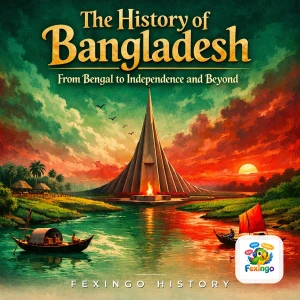
The History of Bangladesh: From Bengal to Independence and Beyond — Fexingo History
This podcast traces the full history of Bangladesh, from the ancient Buddhist kingdom of Samatata to the Mughal province of Bengal, through the Partition of 1947, the Language Movement, and the Liberation War. Hosts Lucas and Luna explore the rise of the Pala Empire, the Bengal Famine of 1943, the poetry of Kazi Nazrul Islam, and the leadership of Sheikh Mujibur Rahman. The show examines how rivers like the Padma, Meghna, and Jamuna shape the economy and identity, and what the National Martyrs' Monument at Savar commemorates. It is a story of language, culture, climate, and resilience, covering everything from ancient terracotta temples to modern garment factories.
Episodes

The Ilyas Shahi Dynasty: Bengal's Golden Age of Trade
Long before the British arrived or the Mughals conquered, Bengal was a sovereign powerhouse under the Ilyas Shahi dynasty. This episode explores the reign of Shamsuddin Ilyas Shah and his successors, who transformed Sonargaon into a bustling hub of international commerce. We look at how the Adina Mosque in Pandua stood as a testament to their architectural ambition, and how they maintained diploma
Bengal's Lost Kingdom: The Ilyas Shahi Dynasty
Before the British arrived and before the Mughals conquered, Bengal was its own powerful empire under the Ilyas Shahi dynasty. In this episode, we explore the rise of Shamsuddin Ilyas Shah in the late fourteenth century, who unified the fractured sultanates of Eastern India. We visit Pandua, the capital where the Adina Mosque still stands as a testament to Bengali architectural independence, and e
The Silent War: Erasing Bengali Identity
This episode explores the cultural erasure campaigns that preceded and accompanied the 1971 Liberation War, focusing on how linguistic and historical identity were systematically targeted by West Pakistani authorities. We examine the role of Kazi Nazrul Islam as a counter-symbol to state-sponsored Urdu nationalism, the significance of Ekushey February in shaping political consciousness, and the br
The Great Delta: Rivers That Built Bangladesh
Long before the modern borders of Bangladesh were drawn, the land itself was being forged by the relentless power of the Padma, Jamuna, and Meghna rivers. In this episode, we explore how the shifting channels of these great waterways shaped not just the geography of the Bengal delta, but its politics, economy, and identity. We look at the ancient port city of Sonargaon, which thrived on trade rout
The Rise of Ilyas Shahi: Bengal’s First Independent Sultanate
We trace the emergence of Shamsuddin Ilyas Shah and the Ilyas Shahi dynasty, which established the first truly independent Bengali sultanate in the late fourteenth century. Moving beyond the shadow of Delhi, this episode explores how Ilyas Shah unified the region from Sonargaon to Pandua, merging Turkic military traditions with local Hindu-Buddhist administrative structures. We examine the constru
Bangladesh's Forgotten King: The Rise of Shamsuddin Ilyas Shah
While we have covered the ancient cities of Wari-Bateswar and the modern struggles of the Liberation War, Episode 255 travels back to the fourteenth century to explore the Bengal Sultanate under Shamsuddin Ilyas Shah. This episode details how he unified the fractured regions of Bengal into a single, powerful kingdom, establishing Dhaka as a strategic hub long before it became the capital of indepe
Wari-Bateswar: Bengal's Lost Ancient City
We uncover Wari-Bateswar, the archaeological site in Narayanganj that is rewriting the history of South Asia. Long dismissed as mere ruins, recent excavations reveal a fortified city dating back to the 3rd century BCE, contemporary with the Mauryan Empire. We explore how this urban center challenged the assumption that early Indian cities were confined to the Gangetic plain, highlighting its role
Wari-Bateswar: Unearthing Bengal's Lost Ancient City
Before the Bengal Sultanate or the Mughal Empire, there was Wari-Bateswar, a sprawling urban center dating back to the fourth century BCE. This episode explores the archaeological discovery of this ancient city in the Brahmaputra valley, challenging our understanding of early state formation in South Asia. We examine the findings of Dr. Rony Habib and his team, who uncovered massive walls, copper
The Silent Architects of Bangladesh's Economy
While the Liberation War of 1971 is remembered for its military heroism and linguistic struggle, the economic foundations of the new nation were laid in silence by a group of technocrats who refused to abandon their posts during Operation Searchlight. This episode explores the critical, often overlooked role of Dr. Manzurul Islam and the civil service officials who preserved the administrative mac
The Great Delta: How Rivers Forged Bangladesh
While previous episodes have explored the political struggles and military conflicts that defined Bangladesh, this episode turns its gaze to the physical foundation of the nation itself. We trace the geological and historical impact of the Bengal Delta, focusing on the shifting courses of the Ganges, Brahmaputra, and Meghna rivers. Lucas walks us through the formation of the Sundarbans mangrove fo
The Silent War: Erasing Bengali Identity
We return to the roots of Bangladesh’s independence, focusing on the linguistic and cultural battle that began long before the first shot was fired in 1971. While previous episodes covered the military operations and the genocide, this episode explores the Language Movement of 1952, when students like Salam, Barkat, Jabbar, and Rafiq stood up against the imposition of Urdu as the sole state langua
Bangladesh's Forgotten Monsoon: The 1988 Floods and Recovery
While the world often focuses on Bangladesh’s political milestones and its 1971 liberation, the nation’s relationship with water is a story of constant negotiation rather than occasional crisis. In this episode, we turn our attention to the catastrophic floods of August 1988, a disaster that reshaped national policy and exposed the fragility of life in the delta. Lucas guides us through the week-l
The Silent Architects of Bangladesh's Economy
While the world remembers the bloodshed of the 1971 Liberation War, it often overlooks the quiet, desperate ingenuity that kept the new nation alive in its first months. This episode explores the role of the 'Shadow Cabinet' and the civil servants who refused to leave their posts when Dhaka fell. We focus on figures like Dr. Manzurul Islam and the intricate web of smuggling networks that brought m
The 1974 Constitution and Bangladesh's Secular Struggle
In this episode, we examine the complex journey of Bangladesh’s first constitution in 1974. While the Liberation War was fought on principles of secularism, the new nation’s political landscape shifted rapidly under Sheikh Mujibur Rahman and the Awami League. We explore how the Four Principles of State Policy attempted to balance Islamic identity with Bengali nationalism, and why the inclusion of
The Language War That Built Bangladesh
In 1952, the streets of Dhaka became a battleground not for territory, but for words. This episode explores the Bengali Language Movement, a pivotal moment when students in East Pakistan risked their lives to defend the right to speak their mother tongue against the imposition of Urdu as the sole national language. We trace the events of February 21st, 1952, focusing on the student activists, the
The Bangladesh Liberation War: How a New Nation Forged Its Identity
This episode explores the immediate aftermath of the 1971 liberation war, focusing on the fragile state of the newly independent Bangladesh. We discuss the challenges faced by Sheikh Mujibur Rahman upon his return from Pakistani captivity and the complex political landscape involving the Awami League and emerging opposition groups. The conversation highlights the struggle to rebuild infrastructure
The 1971 Refugee Crisis: Bangladesh's Silent War
While Operation Searchlight and the Mukti Bahini have been covered extensively, this episode shifts focus to the human catastrophe that defined the birth of Bangladesh. In March 1971, as Pakistani military forces tightened their grip on Dhaka and East Pakistan, an estimated ten million Bengalis fled across the border into India. We explore the sheer logistical nightmare of this exodus, tracing the
The Silent War: Erasing Bengali Identity
We trace the systematic campaign by West Pakistan to suppress Bengali culture, language, and political autonomy in the years leading up to 1971. This episode explores the linguistic violence of the One Unit policy, the banning of Kazi Nazrul Islam’s poetry, and the economic exploitation that turned East Pakistan into a cash-cow for the west. We examine how Sheikh Mujibur Rahman’s Six Points became
The Bangladesh Genocide: Operation Searchlight
This episode examines the night of March 25, 1971, when the Pakistani military launched Operation Searchlight to crush Bengali nationalism. We trace the immediate aftermath in Dhaka’s university halls and the brutal suppression that ignited the Muktijuddho liberation war. Lucas and Luna discuss the specific targets of the crackdown, including students, intellectuals, and secular leaders like Sheik
Bangladesh's Forgotten War: The Silent Struggle of the Jatiya Razzak Force
While the 1971 Liberation War is well-documented, the internal betrayal by local collaborators remains a complex shadow in Bangladesh's history. This episode explores the formation and actions of the Jatiya Razzak Force, a paramilitary group aligned with West Pakistan during the Muktijuddho. We examine how political opportunism turned neighbor against neighbor, focusing on key figures like Abdul M
The Man Who Stood Alone Against the Junta
On December 16, 1971, the Pakistani military surrendered to a joint command of Indian forces and the Bengali guerrilla fighters known as the Mukti Bahini. But while history remembers the generals and the politicians, there is one figure who stood apart from the victory parade: Major Ziaur Rahman. In this episode, we explore the complex legacy of the man who declared independence on radio in 1971,
Bangladesh's Forgotten Tsunami and the Delta's Edge
In this episode of The History of Bangladesh, we travel back to the monsoon-soaked streets of Calcutta and the shifting banks of the Ganges in October 1737. While earlier episodes covered the Great Famine of 1770 and the later British Raj, we focus on a moment when the natural world violently asserted its dominance over colonial ambition. We explore how a massive cyclone and tsunami devastated Hug
The 1974 Constitution: Secularism in a Muslim Nation
After winning independence in 1971, Bangladesh faced an immediate existential crisis: how to define its national identity in the constitution. While the Awami League and secular forces pushed for a state grounded in socialism, nationalism, democracy, and secularism, powerful political opponents like Jamaat-e-Islami argued that religion must be central to the new republic. This episode explores the
The Battle of Boyra: Bangladesh's First Military Victory
While we’ve covered the 1971 war’s brutal end and the political roots of independence, this episode dives into a moment often overlooked: the first military engagement of the Muktijuddho. In October 1971, just weeks before the formal declaration of war, Pakistani forces launched Operation Searchlight across East Pakistan. But amidst the chaos, a small contingent of Mukti Bahini fighters, led by Ma
The Sufi Saints of Bengal: Islam’s Quiet Roots
While previous episodes have detailed the political fractures, linguistic struggles, and military conflicts that defined East Bengal, this episode explores the cultural soil from which Bengali identity grew. We trace the arrival of Islamic mysticism in the fourteenth century, focusing on figures like Shah Jalal, who settled in Sylhet, and Hazrat Shah Daniyal, whose legacy shaped the spiritual land
The Chittagong Armoury Raid: India's First Strike
On Easter Sunday, April 18, 1930, a group of young Bengali revolutionaries launched a daring raid on the Chittagong armoury in eastern India. Led by Surya Sen, known as Masterda, these men sought to seize weapons and spark a nationwide uprising against British rule. This episode explores the meticulous planning, the initial success, and the brutal aftermath of the Chittagong uprising. We examine h
The Bengal Delta's Forgotten Tsunami of 1737
In this episode, we explore the catastrophic Great Bengal Flood of 1737, a disaster that reshaped the geography and politics of the subcontinent. We trace how rising waters from the Ganges and Brahmaputra rivers devastated Calcutta and surrounding villages under the Nawabship of Alivardi Khan. The narrative examines the immediate humanitarian crisis, the collapse of trade in key ports like Hughli,
The Bengal Sultanate's Golden Age and Trade
Long before the 1971 war or the British Raj, Bengal was a wealthy independent sultanate that rivaled Europe in silk production and shipbuilding. In this episode, we travel back to the 14th and 15th centuries to explore the Hussain Shahi dynasty, focusing on the city of Gaur as a cosmopolitan hub of Islamic learning and commerce. We examine how Bengal’s unique geography—fed by the Padma, Jamuna, an
The Palaiologoi: Bengal's Forgotten Byzantine Roots
While most histories of Bengal focus on the Mughal emperors, the British Raj, or the 1971 liberation war, there is a quieter, deeper thread that connects this delta to the Mediterranean. This episode explores the ancient maritime and cultural links between the Bengal Sultanate and the Byzantine Empire, specifically through the lens of the Palaiologos dynasty. We trace how Byzantine gold solidi cir
The Sundarbans: Tigers, Thugs, and the Bengal Delta's Edge
Beyond the political upheavals of Partition and Independence lies a landscape that shaped Bengal’s identity long before the first Company official arrived. In this episode, we travel into the heart of the Sundarbans, the world’s largest mangrove forest, where the Ganges and Brahmaputra meet the Bay of Bengal. We explore how this tangled, tidal wilderness was not just a barrier but a frontier of my
The Silent War: How Pakistan Tried to Erase Bengali Identity
In this episode, we explore the deep cultural and political fractures that existed between East and West Pakistan long before the 1971 war. While previous episodes covered the Language Movement and economic disparities, here we focus on the systematic efforts by the Pakistani state to impose Urdu and suppress Bengali culture as a tool of national integration. We examine the role of Governor Genera
The Battle of Plassey's Shadow: Bengal's Jute Boom
While we often look to Plassey in 1757 as the moment Britain seized control, the real economic engine that would define Bengal for centuries was already taking root. In this episode, we trace the rise of the jute industry, known locally as 'pat' and 'nara', from a humble riverbank crop to the backbone of East Bengal’s economy. We explore how Dundee mill owners in Scotland fell in love with the sti
The 1905 Partition of Bengal and the Swadeshi Movement
In this episode, we explore the 1905 Partition of Bengal, a pivotal moment in South Asian history that reshaped political identities and sparked the Swadeshi movement. We examine how Lord Curzon’s administrative decision to divide the province along religious lines ignited mass protests, boycotts of British goods, and a surge in nationalist sentiment. Lucas and Luna discuss key figures like Bal Ga
Bengal's Forgotten Rivers: The Ganges and the Rise of Dhaka
While earlier episodes covered the political fractures of Partition and the brutal struggle for independence in 1971, this episode turns to the geographical heart of Bengal itself. We explore how the shifting course of the mighty rivers—the Padma, the Jamuna, and the Meghna—shaped the economy, culture, and eventual rise of Dhaka as a capital. Lucas guides us through the geological instability that
The Great Drought of 1770: Bengal's Forgotten Famine
While the 1943 famine often dominates historical memory, the Great Famine of 1770 was a catastrophe that killed roughly one-third of Bengal’s population. This episode explores how the British East India Company, having just taken over the Diwani rights in 1765, prioritized revenue collection over survival during a catastrophic drought and pestilence. We examine the role of Warren Hastings as Gover
The Bengal Renaissance: Tagore, Vivekananda, and Cultural Awakening
We explore the late nineteenth and early twentieth centuries in Calcutta, when a wave of intellectual and artistic revival transformed Bengal into a global cultural hub. We examine how figures like Rabindranath Tagore and Swami Vivekananda redefined Indian identity through literature, philosophy, and education, challenging colonial narratives while laying the groundwork for modern Bengali consciou
The 1974 Constitution: Building a Secular Bangladesh
After the brutal independence war of 1971, Bangladesh faced an existential question: what kind of state would rise from the ashes? While previous episodes covered the violence of Operation Searchlight and the refugee crisis, this episode explores the constitutional drafting process that defined the new nation. We dive into the intense debates in the Constituent Assembly between Sheikh Mujibur Rahm
The Battle of Khushab: Pakistan's First Victory
In Episode 223, we travel back to October 1965 to explore the Battle of Khushab, a pivotal but often overlooked engagement in the Indo-Pakistani War. While much attention is given to the tank battles of Asal Uttar or the air war over Delhi, this episode examines how the Pakistani Army’s 4th Mountain Division, led by Major General Abdul Hamid Khan, successfully halted the Indian advance into West P
The Green Revolution: Bangladesh's Rice Miracle
While the world remembers the 1971 war and the language movement, a quieter revolution transformed Bangladesh from a basket case into a food self-sufficient nation. This episode explores the agricultural science and political will behind the Green Revolution in the Ganges Delta. We follow how Norman Borlaug’s high-yield varieties were adapted to local conditions by scientists like M.S. Swaminathan
The 1952 Language Movement: Killing for Bengali
In 1947, the partition of India created Pakistan, a nation split geographically into West and East by over a thousand miles of Indian territory. While the two wings shared Islam as a unifying religious bond, they were divided by language, culture, and economic disparity. The West Pakistani elite imposed Urdu as the sole state language, dismissing Bengali as merely a regional dialect. This decision
Jute and the Making of East Bengal's Economy
In this episode, Lucas and Luna look at jute, the golden fiber that shaped East Bengal's economy and politics for over a century. From the 19th-century boom when Dundee jute barons tried to control the trade, to the 1941 collapse when the Japanese cut off exports, jute was the lever that made East Pakistan the world's largest producer. They explore how the crop's dependence on the monsoon delta in
The 1966 Six Points: Sheikh Mujib's Blueprint for Autonomy
In this episode of The History of Bangladesh, Lucas and Luna revisit a pivotal document that set Bangladesh on the road to independence: the Six Points, presented by Sheikh Mujibur Rahman in February 1966 at a conference in Lahore. The Six Points demanded a federal Pakistan with maximum autonomy for East Bengal, including control over foreign exchange, a separate militia, and fiscal independence.
The 1971 Surrender at Dacca: A City's Last Day
In this episode, Lucas and Luna explore the final day of the 1971 Bangladesh Liberation War, focusing on the surrender ceremony at the Ramna Race Course in Dacca. They trace the events leading up to December 16, 1971, from the Indian military intervention and the joint command of Mitro Bahini to the desperate last-minute negotiations involving Lieutenant General A.A.K. Niazi and Jagjit Singh Auror
The 1971 Killing of Intellectuals: Al-Badr's Final Atrocity
In the final weeks of Bangladesh's Liberation War, as Pakistani forces collapsed, a shadowy militia turned on the country's brightest minds. This episode reconstructs the December 1971 abduction and murder of professors, doctors, and writers in Dhaka — the systematic campaign that came to be known as the killing of intellectuals. We follow the Al-Badr death squads, their ties to Jamaat-e-Islami, a
The 1954 United Front Election: A People's Victory
In 1954, East Bengal went to the polls and delivered a stunning rebuke to the Muslim League, the party that had led the Pakistan movement. The United Front, a coalition of the Awami Muslim League, Krishak Praja Party, and others, won a landslide victory, exposing deep regional grievances. This episode unpacks the election's aftermath: the short-lived ministry of Sher-e-Bangla A.K. Fazlul Huq, the
The 1971 Crackdown on Intellectuals: Al-Badr and Black Night in Dhaka
In the final weeks of the Bangladesh Liberation War, as Pakistani forces retreated, a shadowy militia called Al-Badr systematically abducted and executed hundreds of professors, doctors, journalists, and writers in Dhaka. This episode traces the rise of this collaborationist force, its ties to the Pakistani army and Islamist politics, and the fateful night of December 14, 1971, when the city's int
The 1958 Coup: Pakistan's First Military Takeover in Bengal
In October 1958, Pakistan's army chief Ayub Khan staged the country's first military coup, dissolving the Constituent Assembly and declaring martial law. For East Bengal, the coup was not just a distant political event — it marked the end of the fragile democratic experiment that had begun with the 1954 United Front election and the Language Movement. This episode looks at how Ayub's seizure of po
The 1971 Fall of Dacca: A City Surrenders, a Nation Is Born
In this episode, Lucas and Luna revisit the final days of the Bangladesh Liberation War, focusing on the fall of Dacca in December 1971. They trace the Indian Army's 'Operation Cactus Lily' as it converged on the city, the desperate last stand of Pakistani forces under General A. A. K. Niazi, and the moment of surrender at the Ramna Race Course on December 16. The conversation explores the role of
The 1797 Maratha Raid on Hooghly and the Birth of a Frontier
In 1797, a Maratha cavalry force under the command of Benoît de Boigne's former officer, General Perron, crossed the river and sacked the thriving European trading post of Hooghly, just upstream from Calcutta. The raid exposed the fragility of British power in Bengal and forced the East India Company to confront the limits of its authority. This episode of The History of Bangladesh follows the lit
The 1783 Famine: How Bengal's Harvest Failed Under Company Rule
In 1783, Bengal faced a famine that killed millions, yet it is barely remembered today. This episode looks at the causes and consequences of that forgotten catastrophe. We explore how the East India Company's revenue demands, a failed monsoon, and the pressures of the Permanent Settlement combined to create a perfect storm of hunger. We follow the paths of rice from the fields to the granaries, an
The 1772 Revenue Experiment: Warren Hastings and the Ijaradari System
In 1772, Warren Hastings, the East India Company's first governor-general, inherited a Bengal in chaos. The Company had won at Plassey and Buxar, but the revenue system was a patchwork of corrupt Naib Dewans and warring zamindars. Hastings, fresh from the Madras presidency, saw a solution: bypass the zamindars entirely and auction the right to collect taxes to the highest bidder through a system c
The 1757 Plassey Plot: How a Traitor Won Bengal
In June 1757, a small British force defeated the Nawab of Bengal's army at Plassey — but the battle was decided long before the first shot. This episode unpacks the conspiracy that changed South Asia: Robert Clive's secret pact with Mir Jafar, the betrayal of the Nawab's generals, and the monsoon rain that made it all possible. We trace Siraj-ud-Daulah's rise, his clash with the East India Company
The 1971 Refugee Crisis: Twelve Million Across the Border
In 1971, as war raged in East Pakistan, the largest refugee exodus in modern history unfolded: some twelve million people crossed into India, fleeing violence, famine, and genocide. This episode follows the human tide through the border posts of West Bengal, Tripura, and Assam, the makeshift camps that became cities, and the Indian government's struggle to feed and shelter them. We examine the pol
The 1947 Partition: How a Province Was Split in 48 Days
In 1947, Cyril Radcliffe, a British lawyer who had never set foot in India, was given just 48 days to draw a line that would divide Bengal and create two new nations. This episode traces the bewildering speed and human cost of that partition. We follow the Boundary Commission's chaotic process, the impossible choices faced by Bengali families, and the lasting scars that still shape the region toda
The 1943 Bengal Famine: War, Rice, and Silence
When famine struck Bengal in 1943, it wasn't just a lack of rice — it was a political and military failure. In this episode, Lucas and Luna trace the collapse from the fall of Burma to the Great Calcutta Killing, exploring how grain requisitioning, cyclone damage, and colonial denial turned scarcity into catastrophe. They examine the role of Viceroy Linlithgow, the 'denial policy' against a possib
The 1974 Famine: When Bangladesh's Independence Faced Hunger
In this episode, Lucas and Luna explore the 1974 famine that struck newly independent Bangladesh, a catastrophe that killed over a million people. They trace its roots in the Liberation War's devastation, the 1973 oil crisis and global food shortages, and the devastating floods of 1974. Crucially, they challenge the myth that famine meant absolute food scarcity—grain was available, but the poor co
The 1947 Partition Riots in Noakhali: Gandhi's Peace March
Before the Radcliffe Line split Bengal in 1947, communal violence erupted in the district of Noakhali. This episode follows Mahatma Gandhi's remarkable peace mission to the region, where he walked from village to village, relying on nonviolence amid rising chaos. We explore the origins of the riots, the role of Hindu-Muslim relations in rural Bengal, and the legacy of one man's attempt to heal a d
The 1681 Battle of Hughli: Pirates, Mughals, and the Birth of Calcutta
In 1681, a French pirate named William Kidd was not yet born, but the waters of the Bay of Bengal were already thick with European privateers. This episode tells the story of the Battle of Hughli, a clash in 1686 between the English East India Company and the Mughal Empire that would change the course of South Asian history. We explore how a string of English forts and trading posts along the Hugl
The 1857 Revolt in Bengal: How the Sepoy Mutiny Shaped Dhaka
When the Sepoy Mutiny erupted in 1857, Bengal was more than a bystander. In this episode, Lucas and Luna explore how the revolt reached Dhaka, the roles of the 73rd Native Infantry and the flamboyant Raja Ram Mohan Roy's distant legacy, and how the British response redefined the province. They trace the conspiracy that linked the Mughal court to the sepoys, the dramatic trial of the 'Wahhabi' prea
The Bengal Renaissance: Iswar Chandra Vidyasagar and Widow Remarriage
In 1856, Bengal outlawed the burning of widows on their husbands' funeral pyres — a practice known as sati. But the law alone didn't change minds. This episode tells the story of Iswar Chandra Vidyasagar, the scholar-reformer who fought for the Hindu Widow Remarriage Act, using ancient texts to prove that widows could remarry. We trace his campaign from Sanskrit scholarship to the first celebrated
The 1970 Election That Led to Bangladesh's Independence
In December 1970, Pakistan held its first general elections. The result shocked the military junta: Sheikh Mujibur Rahman's Awami League won a landslide, securing a mandate for autonomy that the regime in West Pakistan refused to accept. This episode traces the campaign, the results, and the aftermath — the negotiations that failed, the military crackdown that followed, and how a democratic vote b
The 1950 East Bengal Land Reform: Redistributing a Province
In the chaotic aftermath of Partition, East Bengal's new government tried something audacious: dismantling the zamindari system that had shaped rural life for centuries. This episode traces the origins of the East Bengal State Acquisition and Tenancy Act of 1950 — the feudal landlords, the peasant uprisings, the political maneuvering in Dhaka, and the law's lasting impact on land ownership in what
The 1970 Cyclone: Bhola's Political Shockwave
In November 1970, the deadliest tropical cyclone ever recorded slammed into the low-lying coast of East Pakistan. The Bhola cyclone killed an estimated 300,000 to 500,000 people in a single night — but its aftermath toppled a military regime. We explore how the Pakistani government's feeble, humiliating response to the disaster radicalized Bengalis, fueled Sheikh Mujibur Rahman's landslide victory
The Rivers That Made Bangladesh: Delta, Identity, and Nationhood
In this episode, Lucas and Luna explore how the rivers of Bengal—the Padma, Meghna, Jamuna, and Brahmaputra—shaped the land, people, and history of Bangladesh. From the ancient settlements of Wari-Bateshwar to the Mughal-era delta management, to the 1971 Liberation War where river crossings were as strategic as any battle, they trace the deep connection between water and nation. They discuss the B
The Sundarbans: How a Mangrove Forest Shaped History
In this episode, Lucas and Luna explore the Sundarbans — the vast mangrove forest spanning the Ganges-Brahmaputra delta — and how it has shaped the history of Bengal and Bangladesh. From the fearsome Royal Bengal tiger to the legendary dacoits who once terrorized the waterways, the Sundarbans has been a refuge for outlaws, a source of myth, and a crucial ecological buffer. Lucas traces the region'
The Great Hedge of Bengal: A Wall of Thorns That Split a Province
In this episode, Lucas and Luna explore the bizarre and little-known story of the Great Hedge of Bengal — a 2,500-mile living wall of thorny plants and trees that the British colonial government built in the 19th century to enforce a salt tax. Running from the Himalayas to the Bay of Bengal, the hedge was patrolled by a network of customs officers and informants, and it physically divided the prov
The 1971 Genocide: Operation Searchlight's Campaign
In this episode, Lucas and Luna confront one of the darkest chapters in South Asian history: Operation Searchlight, the Pakistani military's brutal campaign to suppress Bengali nationalism in March 1971. They trace the night of March 25, when General Tikka Khan and Yahya Khan unleashed a coordinated assault on Dhaka University, the police lines, and the Hindu neighborhoods of Old Dhaka. Through ey
The 1971 Surrender at Dhaka: How a War Ended an Empire
In this episode of The History of Bangladesh, Lucas and Luna examine the final days of the 1971 Bangladesh Liberation War, focusing on the dramatic surrender of Pakistani forces at the Ramna Race Course in Dhaka on December 16, 1971. They discuss the Indian army's rapid advance, the role of General Jagjit Singh Aurora and Lieutenant General A. A. K. Niazi, the Mukti Bahini's guerrilla campaign, an
The Bengal Presidency: How a Colonial Province Shaped Two Nations
In this episode of Fexingo History, Lucas and Luna delve into the origins and evolution of the Bengal Presidency, the administrative colossus that once stretched from the Sundarbans to the Himalayas. They explore how this British colonial construct, established after the Battle of Plassey in 1757, became the economic and political heart of British India. The conversation traces its expansion under
The Great Hedge of Bengal: A Wall of Thorns That Split a Province
In the late 1800s, the British government of India built something extraordinary: a 2,500-mile-long hedge of thorny plants and ditches, stretching across the subcontinent, designed to stop salt smuggling and tax evasion. This episode of The History of Bangladesh follows the forgotten history of the Great Hedge — how it rose from the British Raj's customs wars, how it snaked through the Bengal delt
The 1947 Radcliffe Line: How Bengal Was Split in 48 Days
In August 1947, Cyril Radcliffe, a London lawyer who had never set foot in India, was given five weeks to draw a line that would decide the fate of 400 million people. In this episode, Lucas and Luna explore how the Radcliffe Commission carved Bengal in two — separating villages, families, and rivers without ever visiting the province. They trace the impossible timetable, the pressure from Nehru a
The Sena Dynasty: Hindu Kings Who Shaped Medieval Bengal
This episode explores the Sena dynasty, the Hindu rulers who succeeded the Palas in Bengal and forged a distinct cultural and religious identity before the Muslim conquest. We discuss Ballala Sena's consolidation of power and his legal work Danasagara, Lakshmana Sena's patronage of literature including Jayadeva's Gita Govinda, and the dynasty's sudden end with Bakhtiyar Khalji's invasion of Nabadw
The Bengal Sultanate: A Golden Age of Syncretism and Culture
In this episode of The History of Bangladesh, Lucas and Luna explore the vibrant Bengal Sultanate, focusing on the Husain Shahi dynasty (1494-1538). They discuss the rise of the Sultanate after the Delhi Sultanate's decline, the conquest of Gaur, and the remarkable religious tolerance of Sultan Alauddin Husain Shah. Discover how he patronised the translation of Hindu epics into Bengali—like Kritti
The Pala Empire: Bengal's Buddhist Golden Age
Step into the world of the Pala Empire, the Buddhist dynasty that turned Bengal into a center of learning and art from the 8th to 12th centuries. Hosts Lucas and Luna explore the remarkable founding by Gopala, the first ruler elected by a council of chiefs; the patronage of Dharmapala, who built the great monastery of Vikramashila; and the conquests of Devapala, which rivaled the Gupta empire. The
Battle of Plassey: How Bengal Fell to the East India Company
In June 1757, a small grove of mango trees near the village of Plassey became the site of a battle that would reshape the Indian subcontinent. This episode unpacks the conspiracy between the British East India Company and the disgruntled general Mir Jafar, the ambiguous 'Black Hole of Calcutta' incident, and the decisive betrayal that handed Bengal's vast wealth to a trading company. We explore ho
The 1954 United Front Election: East Bengal's Democratic Revolution
In 1954, East Bengal held a provincial election that would reshape the political landscape of South Asia. The Muslim League, which had led Pakistan to independence, was routed by a coalition of parties united under the Jukta Front, or United Front. Led by the veteran statesman A. K. Fazlul Huq, the peasant leader Maulana Abdul Hamid Khan Bhashani, and the urban intellectual Huseyn Shaheed Suhrawar
The 1905 Partition of Bengal: Curzon's Divide That Forged a Nation
In 1905, Lord Curzon split Bengal in two, creating East Bengal and Assam with Dhaka as its capital. What was sold as administrative efficiency was a calculated 'divide and rule' move that backfired spectacularly. Lucas and Luna explore the partition's genesis, the Swadeshi boycott that swept the region, the birth of political terrorism, and the surprising role of Dhaka's Nawab. They also look at h
The Bengal Famine of 1943: Man-Made Catastrophe That Shaped a Nation
In 1943, East Bengal was devastated by a famine that killed an estimated three million people. In this episode, Lucas and Luna explore the complex causes—wartime policies, Churchill's decisions, the cyclone, and colonial neglect—and how this tragedy fueled Bengali nationalism and demands for autonomy. They discuss the Amartya Sen thesis, the role of Viceroy Linlithgow, and the famine's long shadow
The 1975 Coup: Sheikh Mujib's Assassination and Bangladesh's Darkest Hour
In August 1975, Bangladesh's founding father Sheikh Mujibur Rahman was assassinated in a military coup that plunged the young nation into chaos. This episode explores the events of August 15, 1975, when disgruntled army officers stormed Mujib's home in Dhanmondi, killing him, his wife, and three of his sons. We trace the roots of the coup in Mujib's post-independence rule, the famine of 1974, and
The Bhawal Sannyasi Affair: A Prince Returns from the Dead in British Bengal
In 1921, a sannyasi appeared in northern Bengal claiming to be Kumar Ramendra Narayan Roy, the second son of the Bhawal zamindar who had been cremated twelve years earlier. His mother-in-law initially identified him as an imposter, but his wife, Bibhabati Devi, first denied him, then changed her mind—setting off one of colonial India's most sensational legal battles. The case dragged through the C
Recommended

World News Tonight with David Muir

English Vocabulary Help

The Joe Rogan Experience

TED Talks Daily

Learn English B1 with Daily News | English Listening Practice

Talk About Talk - Executive & Leadership Communication Skills

English with Olivia | Slow Conversations & Vocabulary

Stand In The Circle

SLOW ENGLISH PODCAST (A1-A2) With Subtitles | Daily Videos | English With Us Podcast

Learn English A2 with Daily News | Simple English Listening Practice

پلی لیست | PlayList

Conspiracy Files with Paige Carter
