HomePodcastsQin Shi Huang: China's First Emperor and His Terracotta Army — Fexingo History
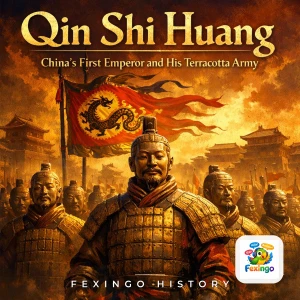
Qin Shi Huang: China's First Emperor and His Terracotta Army — Fexingo History
Fexingo126 EpisodesOct 13, 2026
Qin Shi Huang, the visionary ruler who ended centuries of Warring States conflict and unified China in 221 BCE, remains one of history's most enigmatic and controversial figures. This show explores the First Emperor's relentless drive to consolidate power: standardizing script, currency, and weights; linking defensive walls into the Great Wall; and imposing a Legalist philosophy that demanded absolute obedience. But his greatest obsession was immortality—a quest that produced the legendary Terracotta Army, thousands of life-sized clay soldiers guarding his mausoleum near Xi'an. Lucas and Luna dissect the archaeological revelations from the tomb complex, still largely unexcavated, and debate the emperor's brutal methods: book burnings, scholar burials, and conscripted labor that built monumental projects. They also trace the short-lived Qin dynasty's collapse after his death and its enduring legacy—how a single ruler's ambition shaped Chinese imperial ideology for two millennia.
Episodes
Qin's Iron Age Cybernetics and the First AIOct 13, 20268:09In this episode, Lucas and Luna explore the mind-bending concept that Qin Shi Huang’s tomb wasn't just a burial site, but a proto-cybernetic system designed to preserve the Emperor's consciousness. They examine the historical records from Sima Qian’s Shiji describing mercury rivers and mechanical archers, contrasting these legendary accounts with modern archaeological findings of bronze automata a
Qin's Iron Age Cybernetics and the First AIOct 10, 20267:33In Episode 261, Lucas and Luna explore the startling technological sophistication of Qin Shi Huang’s mausoleum, focusing on the bronze chariots, mechanical archers, and mercury rivers that reveal a civilization obsessed with automata. Moving beyond the famous Terracotta Army discussed in previous episodes, this conversation examines how Qin engineers used clockwork, pulleys, and gravity to create
Qin Shi Huang and the Ghosts of HandanOct 9, 20268:03In this episode, we turn away from the terracotta warriors and surveillance state to examine the brutal siege of Handan in 259 BCE. This was not just a military campaign; it was a moment where Qin’s future emperor, Ying Zheng, was born into chaos as a hostage in the enemy capital of Zhao. We explore how his childhood trauma shaped his ruthless Legalist philosophy and his later obsession with absol
Qin's Great Wall: The Human Cost of UnityOct 8, 20268:20We leave behind the terracotta warriors and the surveillance state to look at the physical barrier that defines China today. In this episode, Lucas and Luna explore the construction of the Qin Great Wall, not as a single monument, but as a desperate, fragmented series of fortifications built by conscripted laborers under Legalist mandates. We examine the strategic logic behind connecting existing
Qin Dynasty's Forgotten Women: Concubines, Politics, and PowerOct 7, 20268:55We often picture Qin Shi Huang as a solitary figure of absolute power, surrounded by eunuchs and ministers like Li Si and Zhao Gao. But behind the stone walls of the Xianyang palace and the sprawling Mount Li tomb complex lay a hidden world of women whose lives were shaped by imperial decree yet held unexpected agency. In this episode, we step away from the terracotta warriors and legalist codes t
Qin Shi Huang's Immortality ObsessionOct 6, 20268:26We often think of Qin Shi Huang as the unifier who standardized weights and measures, but his final years were consumed by a different obsession: escaping death itself. In this episode, Lucas and Luna explore how the First Emperor’s fear of mortality drove him to fund expeditions to the mythical islands of Penglai and Yingzhou, searching for the elusive elixir of life. We look at the role of the f
The Qin Dynasty's Secret Police and the Birth of SurveillanceOct 5, 20269:50In this episode, we explore the intricate machinery of control that held the Qin Empire together after unification. We look beyond the Terracotta Army to the Jianshiyu, or censors, who monitored officials for even minor infractions. Lucas details how the baojia system turned neighbors into informants, creating a society where privacy was nonexistent. Luna asks about the personal toll on those unde
Qin Dynasty's Road Network and Postal SystemOct 4, 20269:44In this episode, we move away from the terracotta warriors and the underground tomb to look at the Qin Empire’s most enduring infrastructure: its roads and postal relay system. Lucas and Luna explore how Ying Zheng, after unifying China in 221 BCE, ordered the construction of a massive network of paved highways radiating from Xianyang. We discuss the standardized axle width, which forced carts ont
Qin Shi Huang's Last Stand: The Deathbed CoupOct 3, 20268:39In the summer of 210 BCE, while Emperor Qin Shi Huang toured the eastern provinces to find immortality, a secret power struggle unfolded in his imperial carriage. As the First Emperor lay dying from mercury poisoning and exhaustion, two key figures—Cheng Jiao and Zhao Gao—manipulated the flow of information to control the succession. This episode explores the dramatic final hours of Ying Zheng’s l
The Lost Queens of Qin: Ying Zheng’s Hidden WivesOct 2, 20267:11History often remembers the First Emperor for his armies, his walls, and his tombs, but it frequently forgets the women who stood beside him. This episode explores the lives of Ying Zheng’s consorts, particularly those from the conquered states of Zhao and Chu. We examine how marriage alliances served as political tools in the late Warring States period, examining the fate of Princess Huayang of C
Qin Shi Huang's Forbidden City and Royal TombsOct 1, 20268:52We explore the architectural grandeur of Qin Shi Huang’s empire, focusing on the Yinqing Palace complex and the strategic placement of his mausoleum at Mount Li. This episode details how the First Emperor used urban planning to project power, moving beyond the Terracotta Army to examine the physical structures that defined Qin rule. We discuss the ling qu canal’s role in logistics, the standardiza
Qin's First Emperor and the Search for ImmortalitySep 30, 20269:35We left off last time looking at the terracotta warriors and the legalist structures that bound the empire together. But there is another side to Ying Zheng, the man who became Qin Shi Huang: the desperate, obsessive search for eternal life. This episode explores his patronage of the fangshi, or 'masters of forms,' alchemists who promised him the elixir of immortality. We look at how this quest sh
Qin's Military Logistics: Supply Lines and the Siege of HandanSep 29, 20266:56While previous episodes have explored the terracotta warriors, legalist philosophy, and the mysteries of the First Emperor’s tomb, this episode shifts focus to the logistical backbone of the Qin military machine. We examine how Ying Zheng sustained a massive army during the grueling ten-year campaign against Zhao, specifically the siege of Handan in 257 BCE. Lucas and Luna discuss the critical rol
Qin Shi Huang's Secret Police and the Birth of SurveillanceSep 28, 20268:52We explore the mechanics of Qin Shi Huang's surveillance state, moving beyond the well-known terracotta warriors to the human machinery of control. Lucas and Luna discuss the role of the Jianshiyu, the imperial censors who monitored both officials and the emperor himself. We look at the Shuihudi bamboo slips from the Liye archive, which reveal a bureaucratic system where every movement was recorde
The Qin Crossbow: Engine of Chinese UnificationSep 27, 20268:05While the Terracotta Army dominates popular imagination, the true instrument of Qin Shi Huang’s unification was not stone or soldier, but the mass-produced crossbow. This episode explores how the Qin state industrialized warfare through standardization and bureaucratic precision. We trace the development of the bronze trigger mechanism, known as the nuji, and examine the Shuihudi bamboo slips that
Qin Shi Huang's Secret Police and the First Surveillance StateSep 26, 20267:18Episode 247 explores the machinery of control behind Qin Shi Huang’s unification of China, moving beyond the famous Terracotta Army to examine the legalistic framework that bound the empire together. We look at the Jianshiyu, the imperial censors who monitored officials for corruption and disloyalty, and how their power was enforced through the baojia system of mutual surveillance among citizens.
The Qin Dynasty's Secret Police and Surveillance StateSep 25, 20268:54While we often remember Qin Shi Huang for his Terracotta Army or his quest for immortality, the true engine of his empire was a sophisticated surveillance apparatus that reached into every household. This episode explores the Jianshiyu, the Imperial Censors who acted as the emperor’s eyes and ears, and the intricate web of mutual responsibility that bound commoners together. We look at the Shuihud
Qin Shi Huang's Legalist Terror and the Burning of BooksSep 24, 20268:50We explore the ruthless machinery of Qin Shi Huang’s rule through the lens of Legalism, moving beyond the Terracotta Army to examine how order was enforced. Lucas and Luna discuss the philosophy of Han Feizi, the implementation of strict laws in Xianyang, and the infamous burning of books in 213 BCE. We look at the Shuihudi bamboo slips that reveal the reality of daily legal administration, contra
Qin's Crossbow: The Engine of UnificationSep 23, 20269:13We often think of Qin Shi Huang as the builder of walls and tombs, but his true military revolution happened in the workshop. In this episode, we explore how the Qin state standardized the crossbow—a complex, mass-producible weapon that dismantled the aristocratic monopoly on warfare. We look at the archaeological evidence from the terracotta pits, specifically the bronze trigger mechanisms found
Qin Shi Huang's Terracotta Army: The Real Cost of PerfectionSep 22, 20267:47We often hear about the sheer scale of the Terracotta Army, but we rarely examine the bureaucratic machinery that forced artisans to create over 8,000 unique faces under threat of death. In this episode, we dive into the Shuihudi bamboo slips from Liye to uncover the terrifying precision of Qin manufacturing standards. Lucas and Luna explore how the empire used strict quality control, traceability
Qin Shi Huang's Terracotta Army: The CraftsmenSep 21, 20266:55For anyone coming with us through these conversations — about East Asia and the birth of imperial China — we have spent many episodes discussing the grand architecture, the legalist policies, and the mysterious tomb of Qin Shi Huang. But today, we are shifting our focus from the Emperor to the people who built his eternal guard. We explore the Shuihudi bamboo slips, which reveal a brutal system of
The Hidden Cost of Qin's Terracotta ArmySep 20, 20268:32We often marvel at the scale of the Terracotta Army, but we rarely stop to consider the human machinery that built it. This episode moves beyond the warriors themselves to examine the Shuihudi bamboo slips from Liye, which reveal the brutal administrative reality behind the tomb. Lucas and Luna discuss how the Qin legalist system tracked every artisan’s life down to the minute, turning human being
The Qin Standard: How One Emperor Built Modern ChinaSep 19, 20267:19We often think of the Terracotta Army as a tomb guardian, but these figures were built on a radical administrative experiment that reshaped East Asia. In this episode, we explore how Qin Shi Huang didn't just conquer warring states; he standardized the very tools of governance. We dive into the 'Qin Standard' — the uniform axle widths, coinage, and script that allowed an empire to function without
Qin Shi Huang's Legalist Logic and the Weight of OrderSep 18, 20268:30While previous episodes have explored the terracotta warriors, the mercury rivers, and the quest for immortality, this conversation shifts focus to the intellectual engine that made such monumental projects possible: Legalism. We examine how Han Feizi’s philosophy transformed the Qin state from a peripheral warlord into a centralized empire through strict standardization and harsh punishment. Luca
The First Emperor's Final Secret: Mercury RiversSep 17, 20266:16For years, historians debated whether Qin Shi Huang’s tomb contained rivers of flowing mercury as described in the Shiji by Sima Qian. In this episode, we explore the modern geological survey that finally answered this question. We look at the soil samples taken from Mount Li and the high levels of mercury found in the upper layers of the tomb mound. Lucas and Luna discuss how this physical eviden
Qin Shi Huang's Terracotta Army: Artisans and IdentitySep 16, 20269:36We step away from the roads, the bronze bulls, and the alchemical quests to look directly at the faces of the Terracotta Army. For centuries, these figures were viewed as mere tools of imperial propaganda or mass-produced military assets, but recent archaeological work reveals a different story. We explore how over eight thousand individual soldiers were crafted by specific workshops in Guanzhong,
The Ghost City of Xianyang and Qin's Urban PlanningSep 15, 20268:36In this episode, Lucas and Luna peel back the layers of Qin Shi Huang’s urban ambition, moving beyond the Terracotta Army to explore the massive, ruined capital of Xianyang. They examine how the First Emperor physically reshaped the landscape by tearing down aristocratic estates to build his palaces and relocating twelve bronze colossi from conquered states. The conversation delves into the strate
Qin Shi Huang's Tomb: The Underground EmpireSep 14, 20269:11While the Terracotta Army has become synonymous with Qin Shi Huang, the emperor’s actual burial mound remains one of history’s most tantalizing mysteries. This episode moves beyond the warriors on display to explore the subterranean palace described in Sima Qian’s Shiji. We examine the archaeological evidence from Mount Li, including the staggering discovery of mercury rivers that mirror the empir
Qin Shi Huang's Mercury Rivers and Alchemical DreamsSep 13, 20267:45In this episode of the Fexingo History podcast, Lucas and Luna explore the mysterious mercury rivers that Sima Qian described within Qin Shi Huang’s mausoleum. While previous episodes covered the Terracotta Army and standardized weights, we dive into the First Emperor’s desperate quest for immortality through alchemy. We examine the fangshi, or alchemists, who promised elixirs of life, and how the
The Qin Empire's Silent LaborersSep 12, 20267:53While the Terracotta Army and the First Emperor’s quest for immortality dominate historical memory, the true engine of the Qin dynasty was its conscripted labor force. This episode explores the wu le gong ming system, a brutal but efficient method of mobilizing millions of peasants to build roads, canals, and tombs. We examine the legal framework that turned citizens into state property, the stagg
Qin Shi Huang's Forbidden City: The Royal TombsSep 11, 20266:32For decades, the terracotta warriors have defined Qin Shi Huang’s legacy, but they are merely the outer guard of a far more complex subterranean world. In this episode, Lucas and Luna step past the clay soldiers to explore the inner sanctum of Mount Li—the First Emperor’s actual mausoleum. We examine the archaeological evidence for the mercury rivers Sima Qian described, the bronze automata that g
Qin's First Emperor and the Mystery of the Mercury RiversSep 10, 20266:48We have explored the Terracotta Army, the standardized carts, and the fatal voyages for immortality, but there is one element of Qin Shi Huang’s mausoleum that remains shrouded in both scientific mystery and historical legend: the mercury rivers. For centuries, Sima Qian wrote that the emperor’s underground palace featured flowing rivers of quicksilver to represent the Yangtze and Yellow Seas. Ske
The Hidden Cost of Qin's First EmperorSep 9, 20268:39While the Terracotta Army and standardized weights dominate the narrative of Qin Shi Huang’s reign, we rarely discuss the human machinery that built them. In this episode, Lucas and Luna explore the conscription system of the Qin Empire, focusing on the laborers who carved Mount Li into a tomb and the soldiers who died defending it. We examine the legal codes from the Shuihudi bamboo slips, reveal
Qin's Lost Artisans: The Craftsmen Behind the Terracotta ArmySep 8, 20266:30While we have explored the political machinations of Li Si, the military strategies of Meng Tian, and the imperial obsession with immortality, Episode 229 shifts the lens to the anonymous hands that physically constructed the First Emperor’s eternal army. We investigate the social status of these artisans, many of whom were conscripted laborers or convicts rather than celebrated artists. Through a
Qin Shi Huang's Terracotta Army: The Artisans Who Built ImmortalitySep 7, 20268:10We often hear about the First Emperor’s ambition, but rarely meet the hands that executed it. In this episode, we look past the myths of magic and mercury to examine the actual workshop system behind the Terracotta Army. We trace the lineage of the artisans—many conscripted from conquered states like Qi and Chu—and explore how their individual styles survived the empire’s strict standardization. T
Qin Shi Huang's Failed Quest for ImmortalitySep 6, 202611:17For decades, we have explored the machinery of Qin Shi Huang’s empire: the standardized writing, the vast road networks, the terrifying precision of his legalist bureaucracy, and the haunting grandeur of the Terracotta Army. But there is a darker, more personal thread running through the First Emperor’s reign, one that historians often overshadow with his political achievements. This episode shift
The Qin Standard: How One Empire Built Modern ChinaSep 5, 20267:41In this episode of the Fexingo History podcast, Lucas and Luna explore how Qin Shi Huang unified not just land, but the very fabric of daily life across ancient China. After episodes covering the Terracotta Army and standardized writing, we look at the tangible infrastructure that held the empire together: the Chi Dao highway system, the strict axle-width regulations, and the postal relay stations
Qin Shi Huang's Silk Road: The First Empire's Trade NetworkSep 4, 20268:45While most histories focus on the Great Wall as a barrier, this episode explores Qin Shi Huang’s ambitious infrastructure projects that actually opened channels for exchange. We trace the Chi Dao and Zhi Dao highways, examining how standardized axle widths and relay stations created the first true logistical network in East Asia. Lucas and Luna discuss the Lingqu Canal’s engineering marvel that li
Qin Shi Huang's Silk Road: The First Empire's Trade NetworkSep 3, 202610:42We often think of the Silk Road as a Han Dynasty invention, but its roots dig deep into the Qin unification. In this episode, we explore how Qin Shi Huang’s brutal standardization of weights, measures, and axle widths actually laid the logistical groundwork for long-distance trade across East Asia. We’ll look at the Chi Dao highway system, the strategic placement of relay stations, and the movemen
Qin Shi Huang's Road to Immortality and the FangshiSep 2, 20267:55This episode explores the dangerous obsession of Qin Shi Huang with eternal life, focusing on the fangshi or 'energy seekers' who promised him immortality. We examine the historical reality behind the legend of Xu Fu’s voyage to find the elixir of life, the emperor’s growing paranoia, and the tragic fate of those who failed to deliver. Through the lens of the Shiji by Sima Qian, we uncover how thi
Qin Shi Huang's Last Voyage and the Death of an EmpireSep 1, 20268:59In Episode 222, we leave behind the terracotta warriors and standardized weights to follow Qin Shi Huang on his final, fatal journey in 210 BCE. We explore the political vacuum created by the Emperor’s sudden death on the road near Shaqiu, the desperate conspiracy between Zhao Gao and Li Si to alter the succession, and the tragic fate of Crown Prince Fusu. This episode details how a single lie abo
Qin Shi Huang's Bronze Mausoleum: The Lost Craft of Qin ArtisansAug 31, 20267:18In this episode, Lucas and Luna explore the bronze artistry of the Qin imperial workshops — the casters who made the First Emperor's ritual vessels, the standardized weapons of the Terracotta Army, and the experimental bronze birds that once stood in the great hall at Xianyang. They discuss what the archaeological record reveals about Qin foundry techniques, the role of state-controlled artisans i
The First Emperor's Road Trip: Qin Shi Huang on TourAug 30, 202611:18In this episode, we follow Qin Shi Huang on his five great tours across the newly unified empire. From the sacred mountain Tai Shan to the shores of the Yellow Sea, the First Emperor traveled thousands of kilometers, setting up stelae, performing ceremonies, and projecting his power. Historian Lucas walks us through the logistics of these imperial processions—the smooth roads built for them, the r
Qin Shi Huang's Standardized Cart: Wheels, Roads, and EmpireAug 29, 20268:12In 221 BCE, Qin Shi Huang unified China and, among his many sweeping reforms, standardized the axle width of every cart in his new empire. This episode of Fexingo History unpacks the surprisingly practical world of Qin logistics: how a simple measurement—the six-chi axle—kept the massive empire moving. Lucas and Luna trace the story from the conquest of the six states to the building of the Chi Da
The First Emperor's Road to the Sea: The Chi DaoAug 28, 20267:31In this episode, Lucas and Luna trace the First Emperor's ambition beyond the palace walls to the Chi Dao, the network of imperial roads that bound the Qin empire together. Built in 220 BCE by General Meng Tian's engineers, these highways stretched from Xianyang to the Yellow Sea, straight as a bowstring, wide enough for nine chariots to ride abreast. We follow the emperor's fifth and final inspec
Qin Shi Huang's Bronze Bull: The Empire's Sacred AnimalAug 27, 20266:45In this episode of Fexingo History, Lucas and Luna delve into a lesser-known facet of Qin Shi Huang's reign: the bronze bull, a symbol of imperial power and agricultural might. They explore how the First Emperor, known for standardizing everything from weights to writing, also sought to control nature itself. The conversation traces the bronze bull from its mythical origins in the 'Classic of Moun
Qin Shi Huang's Standardized Bronze WeaponsAug 26, 20267:31Before the First Emperor unified China, bronze weapons varied wildly across the warring states. This episode examines how Qin Shi Huang's standardization of weapon production—from the halberd to the crossbow—created a military machine that conquered all rivals. We look at the archaeological evidence from the Terracotta Army pits: the precise bronze alloys, the standardized lengths and weights, the
The First Emperor's Secret Shipyards: Qin's River FleetAug 25, 20267:18In this episode, Lucas and Luna dive into the forgotten naval side of Qin Shi Huang's empire — the river fleets that carried troops, grain, and even the emperor himself along China's great waterways. Before the Terracotta Army stood guard, Qin's shipyards at places like Bashu and the Yangtze River basin were hammering out vessels that helped unify the realm. We explore the Song of the Oarsmen, a r
Qin Shi Huang's Iron Age: Metallurgy and the Rise of EmpireAug 24, 20267:51In this episode, Lucas and Luna explore the technological backbone of the Qin unification: iron. From the state-sponsored iron monopolies to the mass-produced weapons that armed Qin's armies, they uncover how metallurgy shaped the first empire. They discuss the role of iron in agriculture, the standardization of tools, and the controversial debate over whether Qin's iron industry was truly advance
The Weight of a Single Scribe: Qin Shi Huang's Lost OfficialsAug 23, 20267:36In this episode, Lucas and Luna turn from the First Emperor's monuments and armies to the fragile human machinery that kept the Qin Empire breathing: the local scribes and officials. Through the Shuihudi and Liye bamboo slips, we meet real people like Xi, a local legal clerk in pre-unification Chu, and trace how Qin's standardized script—the small seal style—traveled from palace edicts to the hand
The Last Qin Prince: Ziying and the Fall of XianyangAug 22, 20269:20In this episode, Lucas and Luna explore the brief and tragic reign of Ziying, the last ruler of the Qin dynasty. They uncover how a child of the imperial family survived the court intrigues of Zhao Gao and Hu Hai, only to face the advancing armies of Liu Bang and Xiang Yu. The conversation weaves through the brutal politics of the Qin court, the dramatic death of Zhao Gao, and the burning of Xiany
The First Emperor's Forgotten Princes and the Fall of QinAug 21, 20265:16In Episode 211, Lucas and Luna step away from the Terracotta Army and mercury rivers to follow the fate of Qin Shi Huang's other children — the princes and princesses left behind in the shadow of the First Emperor's obsession with immortality. Drawing on Sima Qian's Shiji, they piece together what we know about the imperial family: the sons who served as provincial governors, the daughters married
The First Emperor's Bronze Birds and the Music of HeavenAug 20, 20267:38In 210 BCE, Qin Shi Huang's empire was young, but his obsession with immortality was already old. This episode follows the First Emperor's final years through the lens of his bronze birds—cranes, geese, and swans cast for his underground palace. Why birds? Because in Han dynasty cosmology, birds were messengers between earth and heaven, and their songs were the music of paradise. Lucas and Luna ex
Qin Shi Huang's Bureaucrats: The Scribes Who Ran an EmpireAug 19, 20269:59From dusty bamboo slips to the corridors of Xianyang palace, this episode looks at the men and women who actually kept the Qin empire running: the clerks, scribes, and low-level functionaries who turned Legalist theory into daily reality. We explore their training, their long hours, their pay—denominated in grain and coins—and the occasional perks and dangers of the job. We meet a real clerk named
The Cangjiepian: How Qin Shi Huang Standardized Chinese WritingAug 18, 20266:52In this episode, Lucas and Luna explore the Cangjiepian, the official textbook commissioned by Qin Shi Huang to standardize Chinese script across the newly unified empire. They discuss the historical context of the Qin unification, the role of Li Si and other ministers in creating the Small Seal script, and the content and structure of the Cangjiepian itself. The conversation highlights the import
Qin Shi Huang's Ghost Army: The Spirit Soldiers of XianyangAug 17, 20268:14In this episode, Lucas and Luna explore the First Emperor's obsession with the afterlife and the terracotta army's deeper purpose. They discuss the discovery at Lintong, the thousands of clay warriors in Pit 1, and the theories about why they were built — not just as tomb guardians, but as a ghost army meant to serve Qin Shi Huang in the next world. They examine the inscriptions left by the crafts
The First Emperor's Great Wall: Myth, Reality, and LegacyAug 16, 20266:36In this episode, Lucas and Luna explore the Great Wall of China, separating legend from history. They discuss the Qin dynasty's unification of warring states' walls, the massive labor force involved, the role of General Meng Tian, and the wall's actual purpose—not just defense, but also border control and symbol of imperial power. They examine archaeological evidence from sites like the Qin Great
The First Emperor's Palace: A City of Towers and SecretsAug 15, 20267:49In this episode of Fexingo History, Lucas and Luna step beyond the tomb and the terracotta army to explore the vanished splendor of Xianyang, the First Emperor's capital. From the opulent Xianyang Palace with its hundred palaces and bronze-crowned towers, to the ambitious Epang Palace that was never finished, they uncover the engineering wonders and political ambitions that made Xianyang the nexus
The Forgotten Heir: Fu Su and the War of the Two SonsAug 14, 20265:49In this episode of the Fexingo History podcast, Lucas and Luna explore the tragic fate of Fu Su, the eldest son of Qin Shi Huang, whose exile and forced suicide paved the way for the empire's collapse. They discuss the political struggles at the Qin court, the roles of Li Si and Zhao Gao, and the mysterious death of the First Emperor. The episode examines the famous forged edict, the execution of
Qin Shi Huang's Ghost Army: The Spirit Soldiers of XianyangAug 13, 20264:12In this episode of Fexingo History, Lucas and Luna explore a lesser-known facet of Qin Shi Huang's obsession with the afterlife: the Ghost Army of Xianyang. While the Terracotta Army guards his tomb, historical records and archaeological hints point to a parallel project—life-sized clay soldiers placed in temples and palaces, believed to protect the emperor in both this world and the next. Drawing
Qin Shi Huang's Secret Police: The Unseen Masters of the Qin EmpireAug 12, 20268:57In this episode of Fexingo History, Lucas and Luna explore the shadowy world of the First Emperor's intelligence network. Discover how Qin Shi Huang secured his empire through a vast system of informants, secret agents, and surveillance, long before the terracotta army was even conceived. From the legalist philosophy of Li Si to the practical workings of the Qin bureaucracy, we trace how the state
The First Emperor's Mercury Rivers and the Quest for ImmortalityAug 11, 20268:14Lucas and Luna explore the First Emperor's obsession with immortality and the technological marvels of his tomb, including the mercury rivers described by Sima Qian. They discuss the fangshi (masters of esoterica) who tempted Qin Shi Huang with elixirs, the alchemical experiments that produced cinnabar and gold, and the recent scientific tests that may have detected mercury in the mausoleum mound.
The First Emperor's Physicians and the Search for ImmortalityAug 10, 202610:07In this special 200th episode of Fexingo History, Lucas and Luna step away from the battlefield and the construction site to look at the First Emperor's most intimate obsession: his own body. How did Qin Shi Huang, the man who unified China, try to stave off death? We follow the physicians and alchemists who served him — from the legendary Xu Fu, who sailed east with thousands of boys and girls, t
The First Emperor's Missing Tomb: Mercury Rivers and a Cosmic PalaceAug 9, 20268:48Two thousand years after Qin Shi Huang built his vast mausoleum near Mount Li, the main burial chamber remains unopened. In this episode, Lucas and Luna piece together what we actually know about the First Emperor's underground palace — from Sima Qian's second-century account of rivers of mercury and a ceiling studded with pearls, to the scientific surveys that detected unnaturally high mercury le
The First Emperor's Bronze Birds: Art, Myth, and the AfterlifeAug 8, 20269:06In this episode, Lucas and Luna explore the First Emperor's obsession with the afterlife through his bronze bird sculptures—cranes, geese, and swans found in his mausoleum complex. They discuss how these delicate artworks contrast with the famous terracotta army, what they reveal about Qin Shi Huang's beliefs in immortality, and how Sima Qian's Shiji describes the underground palace with its mercu
The First Emperor's Last Conversation: A Bronze Bird and a Silent QuestionAug 7, 20268:29In this episode, Lucas and Luna explore a lesser-known artifact from the tomb complex of China's first emperor, Qin Shi Huang: a bronze crane standing on a turtle, discovered in a pit near his mausoleum at Lintong. The crane, once part of a now-lost flock, raises questions about how the emperor imagined his afterlife — not as a frozen army, but as a living world. They trace how Sima Qian's Shiji d
The Terracotta Army's Unfinished RanksAug 6, 20269:24In 1974, farmers digging a well near Lintong stumbled on a clay head, then a full army frozen beneath the soil. Qin Shi Huang's mausoleum complex, built by hundreds of thousands of workers over decades, holds over 8,000 soldiers, each with a unique face. But beneath the spectacle lies a deep contradiction: the pits were left unfinished. Some corridors lack warriors, others hold dismembered figures
Qin Shi Huang's Secret Police: Investigating the First Emperor's Spy NetworkAug 5, 20266:26Long before the terracotta army stood guard, Qin Shi Huang built a quieter weapon: a network of informants and secret police that reached into every corner of his empire. In this episode, Lucas and Luna dig into the shadowy side of the First Emperor's rule—how the Qin state used surveillance, denunciation, and legal terror to keep control. Through the Shuihudi bamboo slips and Sima Qian's Shiji, t
The First Emperor's Roads: Building an Empire's SpineAug 4, 20267:36When Qin Shi Huang unified China in 221 BCE, he didn't just build walls and palaces. He built the empire's central nervous system: a network of imperial highways designed to move armies, grain, and orders across 3,000 miles of conquered territory. In this episode, Lucas and Luna explore the roads that held the Qin state together — and ultimately helped tear it apart. They trace the famous Chidao (
The First Emperor's Engineers: Measuring an EmpireAug 3, 20267:02In this episode, Lucas and Luna explore how Qin Shi Huang's regime standardized measurement across a newly unified China. They trace the story of the bronze weight inscribed by Chancellor Li Si in 221 BCE, the legal codes from the Shuihudi tomb that enforced uniformity, and the practical challenges of building roads, canals, and the Great Wall with standardized units. The conversation also peels b
Qin Shi Huang's Bronze Chariots and the Art of the ImpossibleAug 2, 20266:42In 1980, a pit half a mile from the Terracotta Army yielded something even more astonishing: two bronze chariots, each weighing over a ton, buried for two thousand years and assembled from thousands of cast pieces, some smaller than a fingernail. Lucas and Luna uncover the story of these 'treasure cars' — their discovery by a drilling crew, the painstaking reconstruction that took eight years, and
The Terracotta Army's Hidden Workshop: Craftsmen of the MausoleumAug 1, 20268:29In this episode of Fexingo History, Lucas and Luna dive into the human side of the Terracotta Army. Beyond the famous warriors lies a story of state-run workshops, mass production, and anonymous craftsmen. The clay figures were built in assembly-line fashion, with modular parts and a workshop system that stamped every soldier with its maker's identity. Who were these people? What can their marks t
Love and Poison: The First Emperor's Mother and the Lao Ai RebellionJul 30, 20265:52In 238 BCE, the young King of Qin faced a coup that threatened his throne—not from a rival state, but from his own bedchamber. The conspirator was Lao Ai, a supposed eunuch who had been the lover of the king's mother, Queen Dowager Zhao. This episode unravels the scandalous affair, the political scheming of Chancellor Lü Buwei, and the brutal crackdown that followed. Drawing on Sima Qian's Records
The Shuihudi Bamboo Slips: Law and Life Under the First EmperorJul 30, 20267:24In 1975, archaeologists in Yunmeng, Hubei, uncovered a modest tomb holding over 1,100 bamboo slips—the legal archives and personal diary of a local Qin official named Xi. These texts offer an unprecedented, ground-level view of law, administration, and daily life under Qin Shi Huang's centralized empire. From agricultural regulations to case records of theft and murder, the Shuihudi slips reveal a
Qin Shi Huang's Immortal Quest: Xu Fu and the FangshiJul 29, 20266:12In this episode, Lucas and Luna delve into Qin Shi Huang's obsessive pursuit of immortality, focusing on the mysterious fangshi (masters of esoteric arts) and the legendary voyage of Xu Fu. They explore the ancient Chinese belief in the Isles of the Immortals—Penglai, Fangzhang, and Yingzhou—and how the emperor funded massive expeditions to find the elixir of life. Drawing from Sima Qian's Shiji,
The Daze Uprising: How Peasants Toppled the First Emperor's DynastyJul 29, 20266:00In this episode, Lucas and Luna explore the Daze Uprising of 209 BCE, the peasant rebellion that sparked the fall of the Qin dynasty just three years after the First Emperor's death. They discuss the oppressive corvée labor system under Qin Shi Huang and his successors, the personal story of Chen Sheng and Wu Guang — two conscripts forced into impossible circumstances — and how a simple decision t
Li Si and the Small Seal Script: Writing the First EmpireJul 28, 20269:33When Qin Shi Huang conquered the warring states, he inherited a chaos not just of armies but of words — six different writing systems, weights, measures, even axle widths. His prime minister Li Si, a Legalist hardliner, masterminded a cultural revolution that would reshape China for two millennia: the imposition of the Small Seal script (xiaozhuan) as the empire's single standard. This episode wal
The Armory of the First Emperor: Weapons of the Terracotta ArmyJul 28, 20269:09In this episode, Lucas and Luna delve into the remarkable weapons discovered alongside the Terracotta Army—bronze swords with a mysterious chromium coating that prevented rust for over two thousand years, intricate crossbow trigger mechanisms that were standardized across the empire, and the sheer logistical effort behind arming over seven thousand life-sized warriors. They explore how these artif
The Epang Palace and Qin Shi Huang's Burning DreamJul 27, 20265:07Long before the Terracotta Army, Qin Shi Huang envisioned a palace so vast it would dominate the landscape of his new empire. The Epang Palace (阿房宫), begun in 212 BCE, was meant to be the architectural embodiment of universal rule. This episode explores its construction, the staggering mobilization of hundreds of thousands of laborers, the raw materials shipped from across China, and the emperor's
The Burning of Books: Qin Shi Huang's War on HistoryJul 27, 20265:59In 213 BCE, Qin Shi Huang's chancellor Li Si enacted a sweeping ban on private historical records and philosophical texts, ordering their destruction across the empire. The following year, over 460 scholars and alchemists were executed—buried alive in pits near Xianyang. This episode dives into the motivations behind the infamous 'fenshu kengru' (burning of books and burying of scholars), the prac