HomePodcastsThe Story of Uzbekistan: Silk Road Kingdoms and Soviet Legacy — Fexingo History
The Story of Uzbekistan: Silk Road Kingdoms and Soviet Legacy — Fexingo History
Fexingo123 EpisodesOct 12, 2026
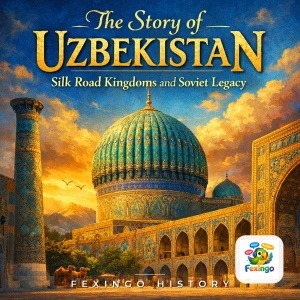
In this series, Lucas and Luna journey through the layered history of Uzbekistan, a land where Silk Road caravans once traversed the Kyzylkum Desert and where the blue-tiled domes of Registan Square still echo the glory of the Timurid Empire. From the Sogdian merchants who thrived under Achaemenid and then Hellenistic rule, to the Arab conquests that brought Islam and the Samanid Renaissance, each episode traces the rise and fall of kingdoms that shaped Central Asian identity. The show delves into the rule of Amir Timur (Tamerlane) in Samarkand, the shaybanid Uzbek khanates, and the brutal Russian imperial expansion in the 19th century. It then tackles the Soviet era: the cotton monoculture that drained the Aral Sea, the jadid reformist movement, and the legacy of Stalin's purges. Post-independence, the hosts explore the authoritarian nation-building under Islam Karimov, the revival of Silk Road tourism, and simmering tensions in the Fergana Valley.
Episodes
Bukhara's Jewish Quarter and the Silk Road LegacyOct 12, 20268:53This episode explores the enduring presence of the Bukharan Jews in Central Asia, a community that thrived along the Silk Road for over two millennia. We trace their origins from ancient Judea to the oasis cities of Transoxiana, examining how they maintained distinct religious and cultural practices while integrating into the complex tapestry of Islamic society. Lucas and Luna discuss the historic
The Khans Who Built a Modern NationOct 11, 20267:02While the Registan’s blue tiles and the Aral Sea’s crisis dominate our earlier episodes, this conversation turns to the quiet architects of modern Uzbek identity: Abdurauf Fitrat and Mahmudkhoja Behbudiy. We explore how these early twentieth-century intellectuals, known as the Usul-i Jadid reformers, navigated the collapse of the Khanate of Bukhara and the rise of Soviet power. From their educatio
Uzbekistan's Ancient Water Wars and CanalsOct 10, 20266:21While previous episodes explored the Timurid Renaissance, Sogdian trade networks, and the Soviet cotton crisis, this episode turns back the clock to uncover the ancient hydraulic engineering that built Central Asia’s first cities. We examine the Karez irrigation systems of Bukhara and the massive Qanat networks that sustained life in the arid Karakum Desert for millennia. Lucas walks through how t
Tajikistan: The Mountain Kingdom of PamirOct 9, 20268:03While our previous episodes traced the Silk Road through the flat steppes and oasis cities of Uzbekistan, this episode shifts focus to the rugged, high-altitude world of its neighbor to the east: Tajikistan. We explore how the formidable Pamir Mountains created a distinct cultural and political identity that resisted both Mongol conquests and Soviet centralization. Lucas and Luna discuss the Ismai
The Great Game: Central Asian Spies and Secret MapsOct 8, 202610:23This episode explores the clandestine world of intelligence gathering in nineteenth-century Central Asia, focusing on the rivalry between the British and Russian empires. We examine how figures like Mirza Abdul Ghafour operated as double agents, navigating the treacherous politics of the Khanate of Bukhara and the Emirate of Khiva. The conversation details the role of Sogdian networks in modern es
Uzbekistan's Forgotten Sufi ShrinesOct 7, 20265:50This episode explores the spiritual architecture of Central Asia, focusing on the Naqshbandi order and its founder, Khodja Ahrar in fifteenth-century Bukhara. We examine how his khanaka complexes served as centers for social welfare and political influence, challenging the traditional view of Sufism as purely mystical. Through the lens of Abd al-Naqshband’s teachings and the legacy of the Yasawi t
Uzbekistan's Silk Road Spy NetworkOct 6, 20266:40While the Great Game is often remembered for British and Russian generals, the real intelligence war in Central Asia was fought by local intermediaries. This episode explores how Sogdian descendants, Persian-speaking merchants, and even Muslim clerics served as essential translators, guides, and informants for imperial powers. We look at specific figures like Mirza Abdul Ghafour, a Bukharan schola
The Great Game: British and Russian Espionage in Central AsiaOct 5, 20269:35While the Timurids built domes and the Soviets carved borders, another invisible war was being fought across the steppes of Central Asia during the nineteenth century. This episode explores The Great Game, a period of intense geopolitical rivalry between the British Empire and the Russian Empire for dominance in the region. We trace how British agents like Alexander Burnes infiltrated Bukhara to a
The Silk Road’s First Global BankersOct 4, 20265:09Long before the banks of London or Amsterdam, a merchant network spanning from Samarkand to Chang’an operated on letters of credit and joint ventures. This episode explores the Sogdian economy, focusing on the Patikar system and the archaeological evidence found in Panjikent and Dunhuang. We examine how these Central Asian traders managed risk across empires, maintained diplomatic ties with the Ta
Uzbekistan's Cotton Curse and the Aral SeaOct 3, 20268:53We explore how Soviet economic planning turned Uzbekistan into a mono-crop empire, draining the Aral Sea and leaving behind toxic dust storms. This episode details the political maneuvering of Nikolai Baibakov and the tragic environmental cost of 'white gold'. We trace the journey from the Karakum Canal to the salt-covered shores of the drying sea, examining the human and ecological price paid for
The Sufi Networks That Bound Central AsiaOct 2, 20267:08Long before Soviet borders sliced through Central Asia, a spiritual infrastructure held the region together. This episode explores the Naqshbandi order and its founder, Khodja Ahrar, whose influence stretched from Samarkand to Beijing. We examine how this network of shrines, or khanaka, facilitated trade and diplomacy across the Silk Road, often bypassing political rulers. By looking at the life o
The Lost Sufi Shrines of UzbekistanOct 1, 202611:45Before the Soviet borders divided Central Asia, and long before the Timurid empires rose to power, the spiritual landscape of modern-day Uzbekistan was shaped by the wandering dervishes and Sufi masters who built its most sacred sites. In this episode, we explore the hidden history of the Naqshbandi and Yasawi orders, focusing on the enigmatic figure of Khodja Ahrar and the architectural legacy of
The Soviet Cotton Trap and the Aral Sea's VanishingSep 30, 20265:09We trace how Moscow’s central planning turned Uzbekistan into a mono-crop empire, forcing the Amu Darya and Syr Darya rivers to feed cotton fields instead of the Aral Sea. Through the eyes of agronomists and local officials, we explore the political pressure behind the White Gold boom, the ecological collapse that followed, and the human cost of feeding the Soviet textile industry. This episode mo
Uzbekistan's Cotton Empire and the Aral Sea CrisisSep 29, 20266:50This episode moves beyond the ancient Silk Road caravans and Soviet political purges to examine a different kind of empire: the industrial agricultural machine built in Uzbekistan during the mid-twentieth century. We trace how Moscow’s directive to turn the arid steppes into a cotton monoculture transformed the region’s ecology, economy, and social fabric. Lucas walks through the engineering of th
Nawab of Bukhara: The Last Khans and Soviet DelimitationSep 28, 20266:38We trace the final days of Sayyid Mir Muhammad Alim Khan, the last Emir of Bukhara, as he navigates the collapse of his dynasty against the rising tide of Bolshevik power. This episode explores the human cost of national delimitation in 1924, when Moscow redrew Central Asia’s borders, fracturing ancient cities like Samarkand and Bukhara between new republics. We examine how the Jadid intellectuals
The Silk Road's First Bankers: Sogdian NetworksSep 27, 20267:02Long before the Timurids built their blue-domed masterpieces in Samarkand, a different kind of empire rose from the dust of Central Asia. This episode explores the Sogdian merchants who didn't just trade goods but created the world's first transcontinental banking system. We look at how letters found in the Afrosiab ruins and the Dunhuang caves reveal a network that stretched from Chang'an to Cons
Uzbekistan: The White Gold Wars of the KarakumSep 26, 20268:00Episode 243 shifts focus from the political and architectural history of Uzbekistan to its environmental and economic transformation under Soviet rule. We explore the massive engineering project known as the Karakum Canal, initiated in 1954, which diverted water from the Amu Darya river across the desert to irrigate cotton fields in Turkmenistan and Uzbekistan. This 'White Gold' strategy had devas
Sogdian Merchants and the Silk Road's First Global EconomySep 25, 20267:26Before the rise of empires or the spread of major religions, a network of merchant-princes from Samarkand, Bukhara, and Panjikent built the first truly global economy. This episode explores how Sogdian traders operated across three thousand miles, from Chang'an to Constantinople, using their unique script and language as diplomatic tools. We look at the archaeological treasures found in the Astana
Sogdian Merchants and the Silk Road's First Global EconomySep 24, 20268:48Long before the Soviet era reshaped Central Asia, a network of Sogdian merchant princes built an economic empire stretching from Chang'an to Constantinople. This episode explores how these Iranian-speaking traders didn't just move goods, but created the first true transcontinental communication system, using their language as the lingua franca of the steppe. We examine the archaeological treasures
Silk Road's Hidden Language: The Sogdian ScriptSep 23, 20268:55Before the Arabic script unified Central Asia, a different language ruled the trade routes. This episode explores the Sogdians, the merchant-princes of Samarkand who invented a writing system that would echo across Eurasia. We trace how their commercial shorthand became the foundation for Mongolian, Uyghur, and Manchu scripts, carrying on through the Qing Dynasty to modern calligraphy. Lucas and L
Uzbekistan: The Timurid Renaissance and Islamic ScienceSep 22, 20269:02While previous episodes have focused on the Soviet era, the cotton disasters, and the political turmoil of the 20th century, Episode 239 travels back nearly six centuries to the golden age of Samarkand. We explore the reign of Ulugh Beg, the grandson of Timur, who transformed the Registan from a royal square into one of the world’s greatest centers of astronomical and mathematical learning. You wi
The Blue Tiled Heart of SamarkandSep 21, 20267:33Before the Soviet borders, the cotton disasters, and the purges of the Jadid intellectuals, Samarkand was the beating heart of the Timurid Renaissance. This episode explores how Ulugh Beg transformed his capital into a global center of astronomy and mathematics, building the Gur-e Amir and the Ulugh Beg Madrasa. We trace the lineage from Timur’s violent conquests to his grandson’s scholarly pursui
Tashkent Earthquake: Soviet Rebuilding and Urban IdentitySep 20, 20269:39On February 6, 1966, a magnitude 5.1 earthquake leveled Tashkent, the capital of the Uzbek SSR. While the disaster killed nearly 30,000 people, it became one of the most ambitious urban planning experiments in Soviet history. Moscow dispatched architects from across the USSR to rebuild the city from scratch, resulting in a unique architectural hybrid that blended modernist concrete with traditiona
Nawabs of Bukhara: The Last KhansSep 19, 202611:35In this episode, we explore the final chapter of independent Central Asian sovereignty before the Soviet Union redrew the map. We focus on the Emirate of Bukhara under its last ruler, Sayyid Mir Muhammad Alim Khan, and his brother Sayyid Abdullah. While earlier episodes covered the Basmachi revolt and the Red Terror, we zoom in on the political maneuvering of the late 1910s, where these rulers tri
The 1924 Border Wars That Shaped Central AsiaSep 18, 202610:46In 1924, the Soviet Union redrew the map of Central Asia overnight, dissolving the Emirate of Bukhara and the Khiva Khanate to create modern national borders. This episode explores the 'national delimitation' policy that divided historic regions among Uzbek, Tajik, Turkmen, and Kyrgyz territories. We examine how Moscow’s decision to separate Samarkand and Bukhara from the Tajik heartland sparked t
The Soviet Border Wars That Divided Central AsiaSep 17, 20266:53In this episode, we trace the complex and often brutal process of national delimitation in 1924 that created the modern borders of Uzbekistan, Tajikistan, Turkmenistan, and Kyrgyzstan. We explore how Moscow’s decision to carve up the region was not just administrative but deeply ideological, aimed at preventing a unified Muslim identity from threatening Soviet control. We examine the role of figur
Registan’s Blue Tiles: Timurid Architecture and PowerSep 16, 20268:36After decades of covering the political upheavals, Soviet purges, and ecological disasters of Uzbekistan, this episode turns to the stone and tile that define its skyline. We explore the Registan in Samarkand not just as a tourist landmark, but as a calculated statement of imperial legitimacy under Ulugh Beg and Muhammad Temur. Lucas walks us through the engineering marvels behind the blue-tile do
Soviet Uzbekistan's Sovietization: The Red Terror in BukharaSep 15, 20269:17In this episode of The Story of Uzbekistan, we turn the lens away from the ancient Silk Road and into the violent birth pangs of modern Central Asia. We explore the collapse of the Emirate of Bukhara in 1920 and the subsequent rise of the Basmachi movement, a complex anti-Soviet insurgency that defied simple categorization as merely religious or feudal. Lucas walks us through the role of Faizullah
The Red Terror in Central AsiaSep 14, 20267:28In the wake of the Soviet conquest of the Khanates, a fierce ideological war erupted within Central Asia’s intellectual class. This episode explores the Jadid movement, a reformist wave seeking to modernize education and preserve culture through new methods like usul-i jadid. We follow the tragic arc of Abdurauf Fitrat and Mahmudkhoja Behbudiy, brilliant writers who initially welcomed the Bolshevi
The Soviet Border Wars That Divided Central AsiaSep 13, 20266:32In 1924, the Bolsheviks redrew the map of Central Asia, carving out the Uzbek and Turkmen SSRs from the crumbling Bukhara and Khiva Khanates. But this administrative division was not merely bureaucratic; it was a calculated strategy to fracture ancient nomadic identities and prevent a unified Islamic resistance against Moscow. We explore how the creation of artificial borders split ethnic groups l
Tashkent's Fire and the Soviet RebirthSep 12, 202610:11While previous episodes explored the ancient Silk Road cities of Samarkand and Bukhara, this episode focuses on Tashkent, a city that had to be rebuilt from ashes. We trace its transformation from a modest caravan stop into a major urban center, culminating in the devastating 1966 earthquake that leveled much of the historic district. The narrative then shifts to the ambitious post-disaster recons
The Silk Road's Forgotten Women: Spies and SovereignsSep 11, 20266:48While we’ve explored the empires, battles, and architectural marvels of Central Asia in previous episodes, this episode shines a light on the women who operated in the shadows of power. We trace the legacy of Turdakun Isanova, the first female party secretary in the Soviet Union, and her complex relationship with Stalin’s purges. We also journey back to the Mongol era to examine how figures like K
The Soviet Border Wars That Divided Central AsiaSep 10, 20269:51While earlier episodes explored the cotton disasters and purges of Soviet Uzbekistan, this episode uncovers the administrative violence that redrew the map of Central Asia. We trace how Stalin’s division of the region into distinct republics in the 1920s fractured centuries-old trade networks and sowed ethnic tensions that persist today. The narrative follows the creation of the Karakalpak Autonom
The Khan's Last Stand: The Fall of Khiva and Soviet PowerSep 9, 202611:26In this episode, we trace the violent collapse of the Khivan Khanate in 1920 and the immediate establishment of the Khorezm People's Soviet Republic. Lucas and Luna explore how Mikhail Frunze’s Red Army swept through the Kyzylkum Desert to end the rule of Muhammad Rahim Khan II, a ruler who had already lost control to internal Jadid reformers and external Russian pressure. We examine the specific
The Khan’s Last Stand: The Fall of Khiva and Soviet PowerSep 8, 202610:10We trace the violent end of the Khanate of Khiva in February 1920, when Red Army troops under Mikhail Frunze breached the ancient walls of Ichan Kala. This episode explores how the collapse of Muhammad Rahim Khan II’s rule created a power vacuum that Stalin’s regime exploited to redraw Central Asia’s borders. We examine the role of the Jadid reformers who initially hoped for independence but were
The Silk Road’s Lost Library: Samarkand’s Paper RevolutionSep 7, 20269:09Before the printing press reached Europe, a Chinese prisoner in Samarkand changed the world’s information landscape forever. In this episode of The Story of Uzbekistan, we trace the journey of papermaking from the Battle of Talas in 751 CE to the bustling workshops of the Samanid Empire. We meet Ziyad ibn Salih, the Abbasid governor who recognized the value of this new technology, and explore how
The Soviet Border Wars That Divided Central AsiaSep 6, 202610:27Before the fall of the USSR, the borders of Uzbekistan were drawn not by ancient tradition but by Moscow’s political calculus. In this episode, we explore the 1924 National Delimitation, a massive administrative reshuffle that carved modern Uzbekistan from the emirates of Bukhara and Khiva, while assigning key territories like Samarkand and Tashkent to the new republic. We examine how Stalin’s adv
Soviet Uzbekistan's Cotton Disaster and the Aral SeaSep 5, 20266:54In 1960s Soviet Central Asia, a plan to turn deserts into white gold seemed like triumph. But the relentless demand for cotton by Moscow came at an ecological price no one anticipated. As engineers diverted the Amu Darya and Syr Darya rivers into massive irrigation canals, the land grew salt-crusted and barren. The water that fed these fields was stolen from the inland sea they called Aral, causin
Soviet Uzbekistan's Red Desert: Cotton and Ecological CollapseSep 4, 202610:11While previous episodes traced the ancient Silk Road trade routes and the violent Russian conquests of the 19th century, this episode turns to a different kind of empire: the Soviet plan to turn Central Asia into a single-crop monoculture. We follow the story of 'White Gold'—cotton—and how the directive to make the USSR self-sufficient in cotton led to the catastrophic drying of the Aral Sea. Luca
The Red Terror in Bukhara: Soviet Purges of Jadid IntellectualsSep 3, 20268:50In 1923, the Soviet Union turned its sights on the very intellectuals it had helped rise to power. This episode explores the tragic arc of the Uzbek Jadids—reformers like Abdurauf Fitrat and Mahmudkhoja Behbudiy who sought to modernize Central Asia through education and literature, only to become primary targets of Stalin’s Great Purge. We trace their journey from reformist leaders in Bukhara to p
The Basmachi Revolt: Central Asia's Anti-Soviet WarSep 2, 20269:24While Russia’s military conquest of Central Asia is well-documented, the decades-long resistance that followed is often overlooked. This episode explores the Basmachi movement, a complex and brutal insurgency that raged from 1916 to the late 1920s. We look at how local leaders like Enver Pasha and Faizullah Khojaev navigated the collapse of empires, and why this rebellion was so much more than jus
The Soviet Erasure of Central Asian HistorySep 1, 202610:32This episode explores how the Soviet Union systematically rewrote the history of Uzbekistan and its neighbors, turning vibrant Silk Road empires into mere preludes to communism. We examine the purges of Jadid intellectuals like Abdurauf Fitrat and Mahmudkhoja Behbudiy, who were executed for 'nationalist deviations' after briefly modernizing their culture. The narrative covers the destruction of hi
The Khan's Library: Books That Survived the MongolsAug 31, 20265:52In this episode, Lucas and Luna explore how Central Asia's libraries and book culture survived the Mongol invasions and shaped the region's intellectual life. They follow the story of the Samanid library in Bukhara, where Avicenna read Aristotle, and the Khwarezmian capital of Gurganj, where the scholar al-Biruni worked before the Mongols destroyed it in 1221. They discuss the fate of the great li
The Khan's Messenger: How Postal Riders Held Central Asia TogetherAug 30, 20265:42Before the telegraph, before the railroad, Central Asia's vast distances were crossed on horseback by riders who carried more than just letters—they carried the very authority of empires. In this episode, Lucas and Luna trace the evolution of the postal system from the Sogdian trading networks of the ancient Silk Road to the lightning-fast yam system of the Mongol Empire, and finally to the Russia
The Khan's Goldsmith: Jewelry and Power in Central AsiaAug 29, 20268:47In this episode of The Story of Uzbekistan, Lucas and Luna explore the overlooked art of goldsmithing in Central Asia. From the Sogdian craftsmen of Panjakent to the Timurid workshops of Samarkand and the Bukharan Jewish jewelers of the 19th century, they trace how gold objects were more than decoration — they were currency, status, and diplomatic tools. The conversation covers the discovery of th
The Silk Road's Lost Rivers: How Central Asia's Water Shaped EmpiresAug 28, 20268:07In this episode of The Story of Uzbekistan, Lucas and Luna trace the hidden water systems that made the Silk Road possible. From the ancient Sogdian cities of Panjakent and Varakhsha to the canals of Bukhara and the qanat networks of Samarkand, they explore how Central Asia's rivers—the Zarafshan, the Amu Darya, the Syr Darya—sustained empires and shaped cultures. The conversation moves from the e
The Silk Road's Secret Bazaars: Fergana's Trade NetworksAug 27, 20267:59In this episode of The Story of Uzbekistan, Lucas and Luna explore the Fergana Valley's hidden role as the Silk Road's economic engine. From the ancient Sogdian merchants who dominated transcontinental trade to the bustling bazaars of Kokand and Andijan, we trace how this fertile valley became a crossroads of commodities, ideas, and cultures. Discover the legendary 'horses of Fergana' that inspire
The Silk Road's Hidden Currency: Cotton and Central AsiaAug 26, 20269:24Before cotton became synonymous with Soviet-era ecological disaster, Central Asia's cotton was a luxury fiber traded along the Silk Road, prized in China and Persia. This episode traces the plant's journey from ancient fields to the factories of the Russian Empire, revealing how cotton shaped regional power, labor, and identity. We follow the crop through the Arab agricultural revolution, the Timu
The Khan's Gardener: Timur's Melons and Silk Road AgricultureAug 25, 20265:57In this episode, Lucas and Luna dig into the unexpected story of Central Asia's agricultural golden age under Amir Timur. While the Registan's tiles and Timur's conquests dominate the history books, his empire also fed itself on legendary melons, apricots, and grapes — and the irrigation systems that made it possible. From the ancient qanat networks to the scientific treatises of al-Biruni and Ibn
The Blue Mosque of Samarkand: A Tile's Hidden HistoryAug 24, 20267:48In this episode, Lucas and Luna uncover the story behind Samarkand's magnificent blue-tiled domes, focusing on the Registan's hidden architectural details and the craftsmen who built them. They explore how the Timurid dynasty used tilework as a political statement, the technical mastery of the glazed bricks, and the symbolic meanings of the colors. Along the way, they discuss the role of Persian a
The Silk Road's Paper Revolution: How Samarkand Became a HubAug 23, 20269:37In this episode of The Story of Uzbekistan, we trace the journey of papermaking from China to the Islamic world, focusing on the pivotal Battle of Talas in 751 CE and the subsequent establishment of a paper mill in Samarkand. We explore how Sogdian merchants, Abbasid patronage, and the expertise of Chinese prisoners transformed Samarkand into a papermaking powerhouse, influencing the spread of kno
Tamerlane's Legacy: The Timurid Renaissance in SamarkandAug 22, 20269:16In this episode, Lucas and Luna explore the Timurid Renaissance, the extraordinary cultural flowering that followed Amir Timur's conquests and reached its peak under his grandson, Ulugh Beg. They discuss the founding of Samarkand as a capital of art and science, the construction of the Registan and the Gur-e-Amir mausoleum, the astronomical work at Ulugh Beg's observatory, and the scholarly achiev
The Silk Road's Forgotten Queens: Women of Power in Central AsiaAug 21, 20269:05In this episode of Fexingo History, Lucas and Luna uncover the overlooked stories of Central Asia's formidable women rulers—from the Sogdian queen Nana to the Timurid princess Gawhar Shad, whose architectural legacy still graces Herat. They explore the steppe tradition of female regents, the rise of the Qarakhanid queen Terken Khatun (who briefly ruled a vast empire), and the surprising political
The Uzbek Jadids: Reform, Resistance, and Soviet ErasureAug 20, 20268:33In this episode, Lucas and Luna explore the Uzbek Jadids, the reformist intellectuals of early 20th-century Central Asia who sought to modernize Muslim society through education, printing, and political activism. They trace the movement's roots in the Crimean Tatar Ismail Gasprinski's usul-i jadid method, its spread to Tashkent and Samarkand, and the rise of figures like Mahmudkhoja Behbudiy, Muna
The Siege of Khiva: Russia's Bloody Entry to the City of MinaretsAug 19, 20269:10In 1873, the Russian Empire turned its sights on the last great independent khanate of Central Asia: Khiva. The campaign, led by General Konstantin von Kaufman, would bring the formidable city of minarets and madrasas under tsarist control after a series of brutal battles and a fever-ridden march across the Kyzylkum Desert. This episode follows the siege itself, from the Russians' dramatic stormin
The Last Emir of Bukhara: Exile and Soviet ErasureAug 18, 20268:39In this episode of The Story of Uzbekistan, Lucas and Luna explore the dramatic final years of the Bukharan Emirate through the life of its last ruler, Said Mir Muhammad Alim Khan. From his reforms as crown prince to his opulent reign, his alliance with the Jadids, and his ultimate flight to Afghanistan after the Red Army's invasion in 1920, Alim Khan's story is a lens on Central Asia's transforma
The Siege of Samarkand 1868: Russia's Central Asian Turning PointAug 17, 20267:41In 1868, Russian forces under General Konstantin von Kaufman seized Samarkand, only to face a desperate counter-siege by local rebels led by Jurabek. This episode of The Story of Uzbekistan explores the brutal fall of the city, the pivotal battle at Chupan Ata, and the aftermath that reshaped Central Asia. We examine the Russian conquest, the roles of Emir Muzaffar and the Bukharan army, and the s
The Siege of Samarkand: 1868's Turning Point in Central AsiaAug 16, 20268:53In 1868, the Russian Empire's advance into Central Asia reached its most dramatic moment: the siege of Samarkand. This episode follows the fall of the ancient city to General Konstantin von Kaufman and the desperate, week-long defense by a small Russian garrison against a popular uprising, led by the enigmatic Jurabek. We explore the broader context of the Bukharan Emirate's collapse, the role of
The Siege of Jizzakh: Russia's Brutal Conquest of Central AsiaAug 15, 20267:44In 1866, General Dmitry Romanovsky's Russian army marched on the fortress of Jizzakh, a key stronghold on the road from Samarkand to Tashkent. The siege lasted just three days, but its aftermath — the massacre of thousands of defenders and civilians — sent shockwaves through the khanates of Central Asia. This episode recounts the brutal campaign that broke the back of Bukharan resistance, the desp
The Silk Road's Golden Age and Its Lasting EchoAug 14, 20269:10In this special 200th episode, Lucas and Luna explore the golden age of the Silk Road in Central Asia, from the Sogdians and their trading networks to the Islamic renaissance under the Samanids and the scientific flourishing under Ulugh Beg. They discuss the fall of the Samanids to the Karakhanids, the Mongol conquest of Bukhara, the Timurid Renaissance in Samarkand, and the city's transformation
Bukhara's Jewish Quarter: Silk Road Tolerance and Soviet ExodusAug 13, 20269:06Long before the Soviet tanks rolled in, Bukhara was home to one of Central Asia's oldest and most distinctive Jewish communities. This episode traces the Bukharan Jews from their ancient roots along the Silk Road to their near-total emigration in the late 20th century. We explore how they flourished under Muslim rulers who protected them as 'People of the Book,' how they became indispensable as tr
The Timur's Elephant: War Machines of Samarkand's ConquerorAug 12, 20264:45In this episode of The Story of Uzbekistan, Lucas and Luna explore the forgotten role of war elephants in the campaigns of Amir Timur. From the Battle of Delhi in 1398, where Timur faced a massive elephant corps, to his own adoption of these armored giants in subsequent campaigns, this episode uncovers how the Central Asian conqueror adapted to and deployed these formidable machines. We trace the
The Aral Sea's Ghost Ships: A Century of Cotton and CatastropheAug 11, 20265:36In this episode, Lucas and Luna trace the Aral Sea's transformation from a thriving inland sea to a desert graveyard. They explore the ancient waterways that fed it, the Soviet cotton boom that drained it, and the engineering projects that tried — and failed — to save it. Along the way, they meet the fishermen of Muynak, the scientists who watched the waterline recede, and the architects of the Ar
The Registan: Samarkand's Blue Dome of PowerAug 10, 20267:35In this episode of The Story of Uzbekistan, Lucas and Luna explore the Registan, the majestic public square in Samarkand that has been the heart of Central Asian power for centuries. From its origins as a Timurid thoroughfare to its reconstruction under the Shaybanids and the later Jandarid rulers, the Registan's three madrasas — Ulugh Beg, Sher-Dor, and Tilya-Kori — tell a story of scholarship, r
The Katta Langar Quran: Bukhara's Blood-Stained Holy RelicAug 9, 20267:12In this episode, Lucas and Luna explore the legend and history of the Katta Langar Quran, the giant manuscript kept in Bukhara's Kokand Museum. They discuss its possible origins under the third caliph Uthman, its journey to Samarkand after the Russian conquest, and Soviet-era repatriation to Tashkent. The episode separates historical evidence from hagiography, considers the manuscript's role in Is
The Great Game's Grand Finale: Russia Takes TashkentAug 8, 20269:08In 1865, a Russian general named Mikhail Chernyaev did the unthinkable: he stormed Tashkent, the wealthiest city in Central Asia, with a force of just 1,500 men against 30,000 defenders. This episode tells the story of that astonishing victory and how it set off a chain reaction that would swallow the entire region into the Russian Empire. We explore the diplomatic maneuvering between Russia and B
The Silk Road's Paper Revolution: How Samarkand Became a Papermaking HubAug 7, 20267:56Long before Gutenberg, Central Asia was at the center of a papermaking revolution. In this episode, we trace how the technology of paper — invented in China, refined by the Arabs, and mass-produced in Samarkand — transformed the region into a literary powerhouse. We explore the legend of the Battle of Talas (751 CE), where captured Chinese artisans supposedly brought papermaking to the Islamic wor
The Khan's Library: Bukhara's Lost Books and the Fate of KnowledgeAug 6, 20268:18In this episode of The Story of Uzbekistan, Lucas and Luna explore the fate of Bukhara's legendary libraries, from the Samanid-era collection that drew scholars across the Islamic world to the catastrophic destruction under the Mongols and the later dispersals under the Russian Empire and Soviet rule. They trace the role of libraries as centers of learning, the scholars who guarded them, and the b
The Khan's Engineer: Mirza Abdul Azim's Canals of BukharaAug 5, 20268:49Before the Soviets drained the Aral Sea, another water story shaped Uzbekistan. This episode follows Mirza Abdul Azim, the 16th-century engineer who built Bukhara's great irrigation canals under Abdullah Khan II. We trace how his qanats and channels turned the Zeravshan River into a lifeline, feeding the city's cotton fields and making the Shaybanid Khanate a regional power. Along the way, we unco
The Aral Sea Disaster: How the Soviet Cotton Boom Drained a SeaAug 4, 20267:35In episode 190 of The Story of Uzbekistan, Lucas and Luna trace the rise and catastrophic fall of the Aral Sea. Once the world's fourth-largest lake, it became a symbol of ecological ruin after Soviet irrigation projects diverted its feeding rivers to grow cotton. The episode follows the sea's history from ancient Khwarezmian settlements to the 1960s decision to expand the 'White Gold' monoculture
Khiva's Ichan Kala: A Living Museum of the Silk RoadAug 3, 20269:07In this episode, Lucas and Luna step inside the mud-brick walls of Khiva's Ichan Kala, one of Central Asia's best-preserved walled cities and a UNESCO World Heritage site. They explore its origins as a caravan stop on the Silk Road, its transformation under the Khwarezmshahs and later the Khanate of Khiva, and the architectural wonders that survive today — from the towering Islam Khodja Minaret to
Bukhara's Ark: Fortress of Power Through the AgesAug 2, 20263:45In this episode, Lucas and Luna explore the Ark of Bukhara, the ancient fortress that served as the seat of power for the Emirate of Bukhara and witnessed the rise and fall of empires. From its legendary founding by the Siyavush to its role as a Soviet-era prison, the Ark embodies Central Asia's turbulent history. They discuss the Ark's architectural evolution, its significance during the Samanid
Yusuf Khas Hajib and the Wisdom of the Qutadghu BiligAug 1, 20268:00In this episode of The Story of Uzbekistan, Lucas and Luna step away from the battlefield to explore the quiet power of a single book: the Qutadghu Bilig, written by Yusuf Khas Hajib in 1069 in Kashgar. As the Karakhanid Empire consolidated its rule over Transoxiana, this poem of wisdom for princes became a cornerstone of Islamic Central Asian culture. Lucas explains how Yusuf Khas Hajib—poet, adv
The Khanate of Kokand: Rise and Fall of Central Asia's Last Great KhanateJul 30, 20265:01This episode explores the Khanate of Kokand, one of Central Asia's most powerful and culturally vibrant states before its absorption into the Russian Empire. Starting from its founding in 1709 by the Ming dynasty of Uzbeks, we trace Kokand's rise under Alim Khan, its golden age under Umar Khan and the poetess Nodira, and its tragic fall during the reign of Khudayar Khan. We cover the architectural
Abdalrauf Fitrat: The Jadid Intellectual Who Shaped Modern UzbekistanJul 30, 20266:30In this episode, Lucas and Luna explore the life and legacy of Abdalrauf Fitrat, the brilliant Jadid reformer, writer, and politician who fought for a modern Uzbekistan. From his early education in Bukhara and Istanbul to his visionary play 'The Indian Traveler' and his role in the Young Bukharan movement, Fitrat embodied the struggle between tradition and reform. After the Bolshevik revolution, h
The Three Alphabets of Uzbekistan: Arabic, Cyrillic, LatinJul 29, 20266:15The Uzbek language has been written in three different scripts over the past century: Arabic, Latin, and Cyrillic. Each shift reflected a political upheaval — the Jadid reform movement's modernizing impulse, Stalin's drive to Russify Central Asia, and post-Soviet nation-building. In this episode, Lucas and Luna trace the alphabet reforms from the 1920s Latinization campaign, spearheaded by figures
Termez: Uzbekistan's Ancient Buddhist Monasteries on the Silk RoadJul 29, 20266:12Long before Islam arrived in Central Asia, the city of Termez on the Amu Darya was a thriving center of Buddhism under the Kushan Empire. In this episode, Lucas and Luna explore the ruins of Kara Tepe and Fayaz Tepe—monasteries carved into the desert hills, adorned with stupas and murals. They uncover the story of how Kushan rulers like Kanishka spread the Dharma along the Silk Road, how the Arab
Soviet National Delimitation: Drawing the Borders of UzbekistanJul 28, 20265:28Before 1924, there was no country called Uzbekistan. The map of Central Asia was a patchwork of khanates, emirates, and tribal lands. Then, in a few years, Soviet planners redrew the boundaries, carving out the Uzbek Soviet Socialist Republic from the ruins of the Turkestan ASSR, the Bukharan People's Republic, and the Khorezm People's Republic. This episode explores how Moscow's national delimita
The Trans-Caspian Railway: Russia's Iron Road to Central AsiaJul 28, 20267:32In this episode, Lucas and Luna explore the construction and impact of the Trans-Caspian Railway, the Russian Empire's ambitious railroad built between 1879 and 1888 that connected the Caspian Sea to Samarkand and Tashkent. They discuss the engineering challenges faced by General Mikhail Annenkov, the railway's role in the Russian conquest and colonization of Central Asia, its effect on the cotton
Ulugh Beg: The Astronomer King of SamarkandJul 27, 20266:07Ulugh Beg, grandson of Timur, was a ruler and a scientist. In 15th-century Samarkand, he built an observatory that pushed astronomy further than any other in the Islamic world. His star catalogue, the Zij-i Sultani, was the most precise for centuries. But his passion for science alienated his court and his son Abd al-Latif, leading to a tragic end. Lucas and Luna explore the man, his work, and his