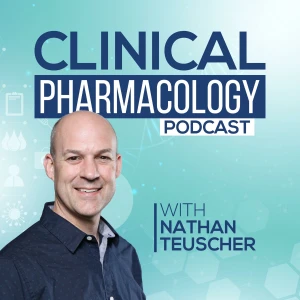
Clinical Pharmacology Podcast with Nathan Teuscher
This podcast discusses clinical pharmacology and pharmacometrics topics from the perspective of drug development scientists. The host shares his expertise and knowledge about designing and conducting clinical pharmacology studies and discusses how to analyze the data using the most effective approaches. He draws from his experience of over 20 years working in drug development organizations and consultancies.
Episodes

Exposure-Response modeling
Today’s episode is about exposure response modeling. What is ER analysis? When is it used? How do you do it? And what tools can be used for ER modeling?Links discussed in the show:ICH M15 Guideline You can connect with me on LinkedIn and send me a message Send me a message Sign up for my newsletter Copyright Teuscher Solutions LLCAll Rights Reserved
Renal and Hepatic Impairment (Ep. 59)
Today’s episode is a discussion of renal and hepatic impairment. I review the biology of the kidney and liver and how we analyze pharmacokinetic data to assess their impact on drug exposure. Links discussed in the show:You can connect with me on LinkedIn and send me a message Send me a message Sign up for my newsletter Copyright Teuscher Solutions LLCAll Rights Reserved
Beyond Small Molecules—Allometric Scaling for Biologics and Engineered mAbs (Ep. 58)
Today’s episode is about allometric scaling with therapeutic antibodies. I discuss differences from small molecules, how to handle antibodies with engineered Fc regions (e.g. YTE or LS), and using allometry to extrapolate from adults to pediatrics for these antibodies. Links discussed in the show:Haray and Tachibana’s article on allometric exponents for monoclonal antibodies Exponents for standard
Bioequivalence Testing: The Stats Behind Generic Drug Approvals (Ep. 57)
In this episode I discuss bioequivalence testing and how it was developed to support generic drug approvals, but is now a mainstream tool for all of drug development. I discuss the basics of what bioequivalence means, how the studies are designed, and then how to perform the statistical analysis. I end with some examples of how this can be used for both generic drug and innovator drugs to support
Examining Volume of Distribution (Ep. 56)
In this episode we’re going to define Volume of Distribution, look at the different types of Volume of Distribution parameters, talk about how we actually calculate it, examine what drives its value, and—most importantly—discuss why it matters for the decisions we make every day in drug development. Links discussed in the show:Volume of Distribution Volume of Distribution in Drug Design You can co
Talking about data science with Mike Stackhouse (Ep. 55)
This episode is an interview with Michael Stackhouse, the Chief Innovation Officer at Atorus Research. We discussed a variety of topics such as modern data science tools, why regulatory agencies want to get rid of SAS transport files in favor of Dataset JSON file formats, and how AI is being used in data programming and data science. Links discussed in the show:Connect with Mike on LinkedIn Learn
Using Accelerator Mass Spectrometry in Clinical Pharmacology
This episode is an interview with Dr. Wouter Vaes, the Chief Science Officer of Peregrion. We discuss how accelerator mass spectrometry is being used in early clinical development for drug metabolism and pharmacokinetics. We discuss using this technology to support development of oncology agents, determining absolute bioavailability without IV toxicology work, and more. Links discussed in the show
Using AI tools for regulatory intelligence (Ep. 53)
This episode is an interview with Aruna Dhontabhaktuni, Founder and CEO of RegKey, a regulatory intelligence platform that uses AI. The discussion touches on how companies can leverage large language model AI tools to accelerate regulatory strategy work.Links discussed in the show:You can contact Aruna by email: arunad@regkey.aiVisit the RegKey website Connect with Aruna on LinkedIn You can connec
When to use model-informed drug development (Ep. 52)
This episode is a collection of my thoughts on model-informed drug development and where different modeling modalities fit into the development schedule. These are just my opinions and each development program is different.Links discussed in the show:You can connect with me on LinkedIn and send me a message Send me a message Sign up for my newsletter Copyright Teuscher Solutions LLCAll Rights Res
QSP Modeling with Ahmed Elmokadem (Ep. 51)
In this episode I chat with Ahmed Elmokadem about QSP modeling. Ahmed, from Metrum Research Group, is an expert consultant in QSP modeling and how it can be used to provide a framework to connect mechanistic understanding with clinical pharmacology and decision-making.Links discussed in the show:Connect with Ahmed on LinkedIn on on his websiteAhmed’s book: Numbers that Dazzled the World You can co
CDISC datasets and ACoP 2025 (Ep. 50)
In this episode I discuss dataset-JSON, a new proposed data standard for CDISC files and explain some of the CDISC files I use in my clinical pharmacology work. I end with some brief thoughts about the ACoP 2025 meeting in Denver in October 2025.Links discussed in the show:CDISC dataset-JSON CDISC files I use You can connect with me on LinkedIn and send me a message Send me a message Sign up for
Statistics in Pharmacokinetics (Ep. 49)
In this episode I discuss review statistics that are commonly used in pharmacokinetics and pharmacometrics work. I reviewed the basic theory of the normal distribution and then discussed various individual statistics that we use in PK work. I concluded with some examples of which statistics I use in my work. Links discussed in the show:Link to message about harmonic mean You can connect with me on
Clinical Trial Simulations (Ep. 48)
In this episode I discuss clinical trial simulations. I review concepts of trial simulation including different variability terms and when to use them. I also share my thoughts on 3 different applications used in clinical trial simulation. Links discussed in the show:Trial Simulator Software page Simulx Software page You can connect with me on LinkedIn and send me a message Send me a message Sign
Using R Shiny for Clinical Pharmacology (Ep. 47)
In this episode I discuss R Shiny and how it can be used for building clinical pharmacology tools. I provide an overview of the technology, suggest a few example use cases, and then walk through a specific practical example of predicting AUC and Cmax for future doses from observed data. I end with a discussion of the benefits and challenges of using R Shiny for clinical pharmacology tools. Links d
What is useful about noncompartmental analysis? (Ep. 46)
In this episode I discuss noncompartmental analysis. I categorize PK parameters calculated by NCA methods as either Important, Useful, or Questionable. I also share my thoughts on how to report PK parameters calculated using NCA methods in nonclinical and clinical reports. I want to hear your thoughts about this episode. Do you agree or disagree with my categorization of PK parameters? Why? Use th
How to select a base PK model (Ep. 45)
In this episode I review the process I follow for fitting a base pharmacokinetic (PK) model. I talk from the perspective of an individual PK model, but include some differences associated with population PK models. I go over exploratory data analysis, getting initial estimates, and how to choose between different base models.Links discussed in the show:AIC and BICYou can connect with me on LinkedI
Different estimation methods used in modeling (Ep. 44)
In this episode I discuss different algorithms used for pharmacometrics modeling. I describe difference between maximum likelihood and expectation maximization methods. I review the FO and FOCEI maximum likelihood algorithms. I then review SAEM, IMP, and QRPEM expectation maximization algorithms that are available. I conclude with an brief explanation of the difference between parameter estimation
What is consulting life like? (Ep. 43)
In this episode I discuss my experience as an independent consultant in the clinical pharmacology and pharmacometrics space. I talk about how I got from high school to become a consultant. I touched on the many different activities I do as an independent consultant. I shared a bit about how I handle compensation with clients and how I pay myself. And I ended with some brief comments about getting
Population PK modeling with nlmixr (Ep. 42)
In this episode I discuss using nlmixr for population PK modeling in R. I give an overview of the software package, describe the installation process, and walk through a simple example. Overall, nlmixr is a nice package that can be used for most modeling activities you encounter. It eliminates the need for a license since it is open-source. There are some challenges associated with using R for mod
Sample size calculations (Ep. 41)
In this episode I discuss power calculations using the R package PowerTOST. I gave an introduction to power calculations and the statistical premise. I reviewed bioequivalence study designs that are commonly used for generic drug development, food effect evaluation, and drug-drug interaction studies.
Links discussed in the show:
PowerTOST R package
PowerTOST instructions (scroll down to the
Collaboration with BioTalk Unzipped (Ep. 40)
In this episode I share a couple short clips from my conversation with Chad Briscoe and Greg Austin from BioTalk Unzipped (www.biotalkunzipped.com). We chat about a variety of topics including artificial intelligence and challenges with cell therapy development. You can hear the entire conversation on the BioTalk Unizipped podcast or YouTube channel in January. For now, enjoy these clips from the
Toxicokinetics (Ep. 39)
In this episode I discuss toxicokinetic analysis. This is the analysis of exposure data to support animal toxicology studies. I review the purpose of toxicology studies and how exposure metrics are used. Then I discuss different blood sampling schemes, and how to calculate exposure parameters for both full profiles and mean profiles.
Links discussed in the show:
You can connect with me on Linked
Steady State (Ep. 38)
This episode is a discussion of steady state pharmacokinetics. Steady state occurs when the amount of drug input is equivalent to the amount of drug elimination in a dosing interval. I discuss some key PK parameters at steady state and how to use them. I also discuss different methods of confirming that you have reached steady state.
Links discussed in the show:
You can connect with me on Linke
Dose Proportionality (Ep. 37)
In this episode I talk about dose proportionality, which is a surrogate for determining if we have linear clearance across a range of dose levels. I discuss 3 different methods that people use to determine dose proportionality along with a recommendation to use the power model method.
Links discussed in the show:
Power model method
You can connect with me on LinkedIn and send me a message
Covariate Search Methods (Ep. 36)
This episode is a discussion of covariate search methods. I give definitions of covariates and predictors, and then I describe 3 different covariate search methods. For each method I describe the pros and cons associated with each one, including bias and time limitations.
Links discussed in the show:
Evaluation of the Boruta method for covariate selection
You can connect with me on LinkedIn
Stimulatory Indirect Response PK-PD Models (Ep. 35)
In this episode I describe stimulatory indirect response PK-PD models. I describe how they work, how to set up the dataset for NONMEM, and how to code the model in NONMEM. This is the last of 4 episodes on different PK-PD models.
Links discussed in the show:
Indirect response PK-PD model equations
Example NONMEM code for stimulatory indirect response PK-PD model
You can connect with me on
Inhibitory Indirect Response PK-PD Models (Ep. 34)
In this episode I describe inhibitory indirect response PK-PD models. I describe how they work, how to set up the dataset for NONMEM, and how to code the model in NONMEM. This is the third of 4 episodes on different PK-PD models.
Links discussed in the show:
Indirect response PK-PD model equations
Example NONMEM code for inhibitory indirect response PK-PD model
You can connect with me
Effect compartment PK-PD models (Ep. 33)
In this episode I describe effect compartment PK-PD models. I describe how they work, a method of creating exploratory plots, how to set up the dataset for NONMEM, and how to code the model in NONMEM. This is the 2nd of 4 episodes on different PK-PD models.
Links discussed in the show:
Example NONMEM code for effect compartment model
You can connect with me on LinkedIn and send me a message
Direct effect PKPD models (Ep. 32)
In this episode I describe direct effect PK-PD models. I describe how they work, a method of creating exploratory plots to identify direct effect models, how to set up the dataset for NONMEM, and how to code the model in NONMEM. This is the first of 4 episodes on different PK-PD models.
Links discussed in the show:
Example NONMEM code for direct effect model
You can connect with me on Linked
What should you use to present PK results? (Ep. 31)
In this episode I discuss different methods of presenting pharmacokinetic and pharmacometrics results. I spoke about using PowerPoint and R Markdown derived HTML files. While I prefer HTML files in nearly all cases, I appreciate that sometimes PowerPoint format is required by some companies. I included multiple suggestions for both PowerPoint and HTML files that can help make the information prese
How important is terminal rate constant? (Ep. 30)
This episode covers the terminal elimination rate constant calculated using non-compartmental analysis techniques. I reviewed how the rate constant is used to estimate half-life and extrapolate AUC to infinity, reviewed the methods for calculating the terminal rate constant value, and some important points about sample selection. Finally, I gave my reasons that we should ultimately stop talking ab
Parellelization in modeling (Ep. 29)
This episode covered parallelization in modeling analyses. I spoke about across model parallelization and within model parallelization. I recommended some approaches for choosing how many cores to use in parallelization and also discussed different modeling computer systems you can use.
Links discussed in the show:
You can connect with me on LinkedIn and send me a message
Send me a message
Residual errors and submission packages (Ep. 28)
Today I covered 2 different topics. First, I spoke about residual error models when modeling. I discussed additive, proportional, and power models. I also reviewed combined models and when they can be helpful. Then I spoke about modeling report submission packages. I explained what I put in those packages, how they are used, and some potential changes coming in the future.
Links discussed in the
Simulations (Ep. 27)
This episode discusses simulations. I group simulations into 4 categories: (1) average response, (2) population, (3) individual, and (4) clinical trial simulations. I discuss details of each of these types of simulations and the different variability terms included in each one. I strongly recommend that we implement more clinical trial simulations in our work. This will help us design and execute
Different work environments (Ep. 26)
Today’s show is about different work environments and not scientific topics. Throughout my career I have worked in many different types of companies, and I would like to share some observations with you from those experiences. I have held positions at startup companies or small biotechnology companies, large pharmaceutical companies, contract research laboratories, consulting firms, and working fo
Biosimilar products (Ep. 25)
Today’s show discussed biosimilar development from a clinical pharmacology perspective. I describe what biosimilar products are and the necessary comparisons to the reference product. I review requirements for PK similarity, PD similarity, immunogenicity, and safety. I also touch on the idea of interchangeability between the biosimilar and reference products.
Links discussed in the show:
FDA G
Choosing an absorption model (Ep. 24)
Today’s show discussed approaches for modeling absorption profiles. I discussed the rationale behind modeling absorption and then described some common models. These included first-order absorption, zero-order absorption, transit compartments, distributed delay, Weibull, and zero/first order absorption. I also provided my recommendations on how to model absorption.
Links discussed in the show:
What is Aplos NCA? (Ep. 23)
Today’s show was an overview of Aplos Analytics and the development story for Aplos NCA. Please consider participating in the Early Access Program. Use the link below to learn more about Aplos NCA.
Links discussed in the show:
Aplos Analytics website
Aplos Analytics Contact Us Page
You can connect with me on LinkedIn and send me a message
Send me a message
Sign up for my newsletter
Big announcement and Hepatic impairment studies (Ep. 22)
Today’s show is about hepatic impairment clinical studies. I cover the rationale behind evaluating hepatic impairment, common study designs, and key factors in the analysis and interpretation of the study results. I also share a huge announcement about Aplos NCA, a cloud-based solution for calculating NCA PK parameters. Use the link below to learn more about Aplos NCA.
Links discussed in the show:
Project Optimus (Ep. 21)
Today’s episode was about Project Optimus, the FDA initiative to improve dose selection and optimization for oncology products. Julie Bullock was a guest on this episode and shared her expertise as a former oncology clinical pharmacology reviewer at the FDA and as a current consultant in the pharmaceutical industry.
Links discussed in the show:
Project Optimus FDA
List of FDA guidances and
Tackling TMDD Models (Ep. 20)
Today’s show is about TMDD or target-mediated drug disposition models. I review the scientific and physiologic basis for TMDD models, how to review data and determine if a TMDD model is needed. I review the various modeling approaches along with my recommendations for specific TMDD models. I hope this information helps you understand how to recognize TMDD behaviors and the options for modeling tha
Communication for scientists (Ep. 19)
Today’s episode is about communication for scientists. I believe that improvements in communication skills can have a greater impact on your career and work than technical skills. Michael Piperno, an expert in communication and leadership skills joins me to discuss communication challenges and solutions for clinical pharmacologists and pharmacometricians.
Links discussed in the show:
You can con
Cell Therapy and Clinical Pharmacology (Ep. 18)
Today’s episode is about cell therapies, including CAR T-cell theraphy for cancer. I give an overview of cell therapy and the challenges of clinical pharmacology in this new area of research.
Links discussed in the show:
CAR T-cell Therapy Image
You can connect with me on LinkedIn and send me a message
Send me a message
Sign up for my newsletter
Copyright Teuscher Solutions LLC
All Rights Re
Allometry in Pediatrics and First in Human Studies (Ep. 17)
Happy New Year! Today’s episode is all about allometric scaling in pharmacokinetic and pharmacodynamics. In particular, I’ll discuss how to use it for scaling from adults to pediatrics and for selection of first in human doses.
Links discussed in the show:
Boxenbaum manuscript
FDA guidance on First in Human doses
You can connect with me on LinkedIn and send me a message
Send me a me
Computer System Validation for Pharmacometrics (Ep. 16)
This is the last podcast for 2023. Thank you for listening throughout the year! In today’s episode I talk about computer system validation for pharmacometrics. I review my experience with validation in multiple companies over 20 years and discuss what auditors and FDA inspectors want to see.
Links discussed in the show:
Computer system validation guidance for medical devices
Computer syst
QSP, PBPK, PKPD, PopPK … analysis abbreviation soup! (Ep. 15)
In today’s episode I cover 4 different modeling approaches: QSP, PBPK, PopPK, and PKPD. All of these are methods for analyzing data to predict either drug concentrations, or a response variable. But each method is developed in a different way and has different assumptions and limitations.
Links discussed in the show:
You can connect with me on LinkedIn and send me a message
Send me a message
Handling BLQ samples (Ep. 13)
In today’s episode I discuss BLQ handing for both non-compartmental and modeling analysis approaches. I discuss how BLQ samples are defined, methods for analyzing them, and situations when you should use different analysis approaches.
Links discussed in the show:
FDA guidance on bioanalytical method validation
ICH M10 guidance on bioanalytical method validation
Handling data below the lim
Clinical Drug Interaction Studies (Ep. 14)
In today’s episode I covered the different types of drug interactions, followed by features of clinical drug evaluation studies recommended in the guidance. Then I will review recommendations for both stand-alone clinical drug interaction studies, as well as nested drug interaction studies. I’ll finish with recommended approaches for interpreting drug interaction study results and expressing that
PK in patients with impaired renal function (Ep. 12)
In today’s episode I discuss the evaluation of pharmacokinetics in patients with impaired renal function. I include information from both the US FDA and EMA guidance documents linked below. I discuss the determination of when a dedicated renal impairment study is needed, characteristics of the study design and how to analyze and interpret the results.
Links discussed in the show:
• FDA guidance
Model diagnostics and selection (Ep. 11)
This episode is a discussion on model evaluation and selection. I discussed diagnostic plots using predictions and residuals. I covered approaches for model selection and factors to consider. The focus of this episode is on models that predict continuous endpoints like drug concentration, biomarkers, or other continuous endpoints. Several figures are mentioned in the podcast and links to those ima
Exposure-Response FDA Guidance (Ep. 10)
This episode is a discussion of the FDA guidance “Exposure-Response Relationships”. The relationship between drug exposure and response is critical to any determination of the safety and effectiveness of a drug product. In this episode I discuss the regulatory applications of exposure-response, the exposure-response relationships over time, the design of studies to collection exposure-response inf
Finding a job in Clinical Pharmacology (Ep. 9)
This episode I talk about finding a job in Clinical Pharmacology or Pharmacometrics. I share a few thoughts from my experience followed by an interview with TJ Elder, the president of STEM Sourcing Recruiting and Staffing. TJ shares his insights and best practices on securing a new job in Clinical Pharmacology or Pharmacometrics.
Links discussed in the show:
• Connect with TJ Elder on LinkedIn
QT Prolongation Guidance ICH E14 (Ep. 8)
This episode is a discussion of the FDA and ICH guidance E14 titled “Clinical Evaluation of QT/QTc Interval Prolongation and Proarrhythmic Potential for Non-Antiarrhythmic Drugs”. I start with background on the reason for these evaluations, then move to an overview of the key evaluations needed. I then discuss in some detail the thorough QT study and the concentration QT analysis. Then I provide s
Pediatric Extrapolation (Ep. 7)
Thank you to everyone who sent me feedback on this podcast. This episode is based on a suggestion from Kushal and Parmesh. In this episode, I discuss a general clinical pharmacology pediatric extrapolation plan. I describe the basics of the plan that is commonly proposed to regulatory bodies. I discuss specific technical approaches for extrapolation of adult pharmacokinetic data to pediatric patie
Bioequivalence Guidances from FDA and EMA (Ep. 6)
Thank you to everyone who sent me feedback on this podcast. This episode is based on a suggestion from Drew. In this episode, I discuss bioequivalence studies and generic drug development. I will refer to guidance documents from both the European Medicines Agency or EMA and the US Food and Drug Administration or FDA. First, I will start with a discussion of the definition of bioequivalence or BE.
Nuances of NCA (Ep. 5)
In this episode, I discuss some nuances of non-compartmental analysis or NCA. I am going to focus on three separate parameters: Cmax, AUC, and the terminal elimination rate constant. These three are the most commonly used parameters to describe drug exposure. I’ll discuss the basic methodology for each and then discuss challenges that may arise when you are performing an analysis.
Links discussed
Population PK FDA guidance (Ep. 4)
In this episode, I discuss the 2022 FDA Guidance on Population PK analysis. This includes a discussion of the applications, methods, and submission requirements for population PK models.
Links discussed in the show:
• FDA Population PK Guidance
• You can connect with me on LinkedIn and send me a message
• Send me a message
• Sign up for my newsletter
Copyright Teuscher Solutions LLC
All Rights
Comparing NCA and PK models (Ep. 3)
In this episode, I discuss two data analysis techniques: (1) non-compartmental analysis or NCA, and (2) PK modeling. I discuss the basic premise of each method and similarities and differences between them.
Links discussed in the show:
Publication about NCA by Johan Gabrielsson and Dan Weiner
Publication about PK modeling by Hartmut Derendorf et. al.
Play Angry Birds as a fun diversion toda
Food Effect FDA Guidance (Ep 2)
In this episode, I discuss the 2022 FDA guidance on food effect studies. I discuss the timing of these studies in your development programs, various aspects of study design, and some unique exceptions to the standard food effect study.
Links discussed in the show:
• Here’s the current FDA guidance for food effect studies
• You can connect with me on LinkedIn and send me a message
• Send me a me
Podcast about clinical pharmacology (Ep 1)
In my inaugural episode, I introduce myself, describe the type of clinical pharmacology and pharmacometrics content I will share, let you know how to get in touch with me, and give the reason why I started this podcast.
Links discussed in the show:
You can connect with me on LinkedIn and send me a message
Send me a messsage
Sign up for my newsletter
Copyright Teuscher Solutions LLC
All Right
Recommended

Learn English A2 with Daily News | Simple English Listening Practice

پلی لیست | PlayList

Conspiracy Files with Paige Carter
Bad Friends

Learn 50 English Phrases While You Sleep | Everyday English Phrases & Vocabulary
This Past Weekend w/ Theo Von

Dateline NBC
Back to the 80s Radio

Crime Stories with Nancy Grace

Bible Tea

این نقطه
TED Business
