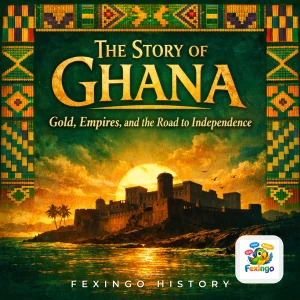
HomePodcastsThe Story of Ghana: Gold, Empires, and the Road to Independence — Fexingo History
The Story of Ghana: Gold, Empires, and the Road to Independence — Fexingo History
Fexingo178 EpisodesOct 13, 2026
From the 13th-century rise of the Mali Empire to the transatlantic slave trade and Ghana's 1957 independence under Kwame Nkrumah, this series traces the full arc of Ghanaian history. Lucas and Luna explore the gold-rich Akan kingdoms, the Ashanti Empire's military resistance against British colonialism, and the fortified castles of Elmina and Cape Coast that witnessed centuries of human trafficking. They examine the legacy of Yaa Asantewaa's war, the rise of cocoa as a global commodity, and the pan-Africanist dreams that made Ghana a beacon for liberation movements worldwide. Each episode digs into specific moments—the rule of Osei Tutu, the Golden Stool's symbolism, the 1948 Accra riots, and the coup that toppled Nkrumah—to understand how ancient empires, colonial violence, and independence struggles shaped modern Ghana.
Episodes
Kwame Nkrumah's Black Star Line and the Dream of African UnityOct 13, 20266:11While Kwame Nkrumah is remembered for political independence, his most ambitious project was economic: the Black Star Line shipping company. This episode explores how Ghana’s first president attempted to create a pan-African maritime fleet in the late 1950s, aiming to break Western monopolies on West African trade. We examine the logistical nightmares, the diplomatic tensions with British and Amer
The Man Who Freed Ghana's Gold: Kofi Abrefa BusiaOct 10, 20269:36In the wake of Kwame Nkrumah’s overthrow, Kofi Abrefa Busia emerged as a complex figure who promised democratic restoration but struggled with economic reality. This episode explores Busia’s intellectual journey from Oxford academic to Prime Minister, his conflict with Nkrumah’s legacy, and the rise of the Progress Party. We examine how his policies affected cocoa farmers, the political violence o
The Ashanti-Ulungu War: Britain's Lost BattleOct 9, 20268:04While most histories focus on the Anglo-Ashanti Wars of the 19th century, Episode 261 explores a lesser-known conflict: the brief but devastating war between the Asante Empire and British Uganda Protectorate forces in 1894. Led by the brilliant General Frederick Russell Burnham, a small contingent of British troops and local allies crossed the Gold Coast hinterland to confront the Asante army near
The Molepolole Mystery: The Kingdom That Defied Colonial RuleOct 8, 20267:30While much of Ghana’s history is framed by the coastal trade, the Ashanti wars, and Nkrumah’s independence struggle, there lies a parallel narrative in the northwest that rarely makes it into the textbooks. This episode explores the Bamum Kingdom and its complex relationship with European encroachment, focusing on King Njoya and his innovative script, Iphigwe. We also look at the broader context o
The Fante Diplomats: Navigating the Gold Coast TradeOct 7, 20269:39While empires rose and fell inland, the Fante people of the coast became the indispensable intermediaries of the Atlantic trade. This episode explores how communities like Anomabu, Winneba, and Apam turned their geographic position into political power, negotiating with Portuguese, Dutch, and British traders while maintaining complex internal governance structures. We look at the rise of the 'Fant
The Slave Roads of the Gold CoastOct 6, 202610:14This episode explores the hidden infrastructure of the transatlantic slave trade along the Gold Coast, focusing on the brutal 'Slave Roads' that connected the interior to coastal forts like Elmina and Cape Coast. We examine how local polities, including the Fante and Ashanti states, navigated the complex economics of capturing and selling prisoners of war to European traders. The narrative highlig
The Man Who Freed Ghana's Gold: Kofi Abrefa BusiaOct 5, 20266:56While Kwame Nkrumah is the face of Ghana’s independence, his political successor and rival, Kofi Abrefa Busia, holds a quieter but profound place in the nation’s story. This episode explores Busia’s intellectual journey from Achimota College to Oxford, where he studied under A.R. Radcliffe-Brown, and his return to lead the Progress Party against the Convention People’s Party. We look at his time a
Ghana's Cocoa Revolution: From Farm to Global MarketOct 4, 20269:04While earlier episodes covered the political struggles for independence and the colonial history of Elmina Castle, this episode shifts focus to the economic engine that defined modern Ghana: cocoa. We explore how Tetteh Quarshie, a single farmer from Twifo Praso in 1879, introduced Theobroma cacao to the Gold Coast, transforming a subsistence economy into a global powerhouse. Lucas and Luna trace
The Volta Dam and the Cost of Progress in GhanaOct 3, 20266:19In this episode, Lucas and Luna explore the creation of the Akosombo Dam on the Volta River, a project that defined Kwame Nkrumah’s vision for an industrialized Ghana. We examine the massive engineering feat that created Lake Volta, one of the world's largest man-made lakes, and the profound human cost paid by the Ewe and other communities displaced by the rising waters. The conversation delves in
The Great Migration: How Ghana's Cocoa Farmers Changed the WorldOct 2, 20268:01In 1900, a young man named Tetteh Quarshie smuggled cocoa pods from the Amazon to the Gold Coast. This episode explores how he and thousands of Fante farmers transformed a speculative crop into the backbone of Ghana’s economy. We trace the journey from smallholder farms in Twifo Praso to the global markets controlled by colonial companies like Cadbury and Rowntree. The story reveals how ordinary f
Ghana's Cocoa Boom: The Farmers Who Built the EconomyOct 1, 20269:18This episode explores how smallholder farmers in the Ashanti Region transformed Ghana into a global cocoa powerhouse. We look at Tetteh Quarshie, who introduced cacao to the Gold Coast in 1879, and the rapid expansion of farming by local communities like the Fante and Ashanti. The narrative covers the rise of the Cocoa Marketing Board, the economic impact on towns like Twifo Praso, and the later s
Ghana's Cocoa Boom: The Farmers Who Built the EconomySep 30, 20269:08We left off with the political battles of independence, but Ghana’s economy was being built by a different kind of revolution. In this episode, Lucas and Luna explore how smallholder farmers in the Ashanti region transformed the Gold Coast into the world’s second-largest cocoa producer. We trace the introduction of Theobroma cacao seeds by Tetteh Quarshie to the explosive growth of the cocoa belt,
Mansa Musa's Pilgrimage and the Wealth of MaliSep 29, 20269:28While earlier episodes explored Ghana’s colonial struggles and Ashanti resistance, this episode shifts focus to the magnificent empire that preceded it: Mali. We trace the pilgrimage of Mansa Musa in 1324, a journey that reshaped global economics and put West Africa on the map for Europe and the Middle East. Lucas details how Musa’s distribution of gold in Cairo caused inflation that lasted years,
The Ga People and the Origins of AccraSep 28, 20268:26Before the Gold Coast became Ghana, the coastal plains were home to the Ga people, whose capital at Accra was a hub of trade and diplomacy long before European fortifications dominated the skyline. In this episode, we explore the legendary founding of Accra by King Ayikoo, who fled the Kingdom of Notsie in present-day Togo after a brutal conflict with his brother. We examine how the Ga established
Ghana's Cocoa Boom: The Farmers Who Built the EconomySep 27, 20268:45While Kwame Nkrumah and the Big Six dominated the political stage leading up to 1957, a quiet revolution was transforming Ghana’s rural landscape through cocoa cultivation. This episode explores how smallholder farmers in the Ashanti and Western regions turned the Gold Coast into the world’s second-largest cocoa producer by the late 1940s. We follow the journey of pioneers like Ofori Atta and the
Elmina Castle: The Human Cost of the Gold CoastSep 26, 20266:26We step inside the stone walls of Elmina Castle, not as a monument, but as a machine. Before it was a museum overlooking the Atlantic, this Portuguese foundation—later seized by the Dutch and then the British—was the primary engine of the transatlantic slave trade on the West African coast. In this episode, Lucas and Luna trace the daily reality of the 'Door of No Return,' examining how European m
Kwame Nkrumah's Pan-African Vision and LegacySep 25, 20266:37While Ghana achieved independence in 1957, Kwame Nkrumah’s ambitions stretched far beyond the borders of the Gold Coast. This episode explores his bold vision for a United States of Africa, driven by the belief that political freedom was meaningless without economic unity. We delve into the formation of the All-African Peoples' Conference in Accra, the complex diplomatic negotiations with other Af
Ewe Resistance and the Battle of AgboziSep 24, 20268:56While much attention has been paid to the Ashanti wars in the interior, the coastal Ewe people mounted a fierce, coordinated resistance against German colonial forces in Togoland during the early 1900s. This episode explores the Battle of Agbozi in 1914, where Ewe warriors, led by figures like Kwami Ayittey, used traditional knowledge and terrain to challenge the superior firepower of the Schutztr
The Ashanti Uprising: Yaa Asantewaa and the Golden StoolSep 23, 20266:47In 1900, tensions in West Africa boiled over not with a traditional army, but with a woman who threatened to sit on the lap of her enemy if she had to. This episode explores the War of the Golden Stool, where Queen Mother Yaa Asantewaa united the Ashanti people against British colonial forces. We look at how Governor Frederick Hodgson’s demand for the sacred Sika Dwa Kofi sparked a fierce resistan
The Ga People and the Origins of AccraSep 22, 20268:49While much of Ghana’s history focuses on the Ashanti Empire or the coastal trade forts, the land where modern Accra stands was originally settled by the Ga people. This episode traces their migration from Notsie in present-day Togo, led by King Ayikoo, and their establishment of a thriving fishing and trading society along the Volta River estuary. We explore how the Ga adapted to the harsh coastal
The Accra Riots: Four Dead Soldiers Spark IndependenceSep 21, 20267:06On February 28, 1948, four unarmed African veterans were killed by British police in Accra, igniting a wave of unrest that shattered the illusion of colonial stability. This episode explores how the deaths of Ebenezer Ako-Adjei’s colleagues—Sampson Kodwo Daniel, Oliver Attipoe, and Henry Ocran—transformed grief into organized political resistance. We examine the role of the United Gold Coast Conve
Ghana's Black Star: Nkrumah, the Military, and the CoupsSep 20, 202610:15This episode explores the fragile early years of Ghana after independence in 1957, focusing on the complex relationship between Kwame Nkrumah and the military. While earlier episodes covered the road to freedom and the Big Six, we now look at the internal fractures that emerged. We examine the role of J. W. K. Odoi and the formation of the Republican Guard, as well as the ideological tension betwe
Ewoso: The Ashanti Oath That Bound a NationSep 19, 20267:56In this episode of The Story of Ghana, Lucas and Luna explore the spiritual and political weight of Ewoso, the sacred oath ceremony that defined loyalty in the Asante Empire. While previous episodes have covered the Golden Stool and the wars against colonial forces, few have examined the ritual mechanism that held the kingdom together long before European contact. We trace the origins of Ewoso to
Ghana's Gold Coast: The Mining Towns That Built a NationSep 18, 20269:21Before Kwame Nkrumah led the march to independence, the Gold Coast was defined by its mineral wealth. This episode explores the dramatic history of the Ashanti goldfields and the bustling mining town of Obuasi. We follow the story of the Asantehene Osei Tutu I, who consolidated control over these rich deposits in the early 18th century, and the subsequent British obsession with securing them. Thro
The Asantehene's Golden Stool and the Soul of AshantiSep 17, 20265:30We explore the spiritual and political heart of the Ashanti Empire through the legend of Sika Dwa Kofi, the Golden Stool. Unlike the physical thrones used by European monarchs, this sacred object was believed to hold the soul of the Ashanti nation itself. Our conversation traces how Komfo Anokye brought it down from the heavens during the reign of Osei Tutu, uniting the fractious Akan clans under
Ghana's First President: Kwame Nkrumah's RiseSep 16, 20266:32While earlier episodes explored the colonial resistance of the Asante Empire and the early nationalist agitation of the Big Six, this episode focuses on the man who transformed that momentum into reality: Kwame Nkrumah. We trace his journey from a teacher in rural Ghana to a student in the United States, where he immersed himself in Pan-Africanism and Marxist thought under mentors like George Padm
The Forgotten Woman Who Saved Ghana's GoldSep 15, 20269:50While Kwame Nkrumah and the Big Six dominate the narrative of Ghana’s independence, there was another powerful force shaping the nation’s destiny: Efua Sutherland. This episode explores the life of Ghana’s foremost playwright and cultural architect, whose work in the 1950s and 60s helped define a new national identity beyond political borders. We examine how she used theater to bridge ethnic divid
The Fante Confederation: Ghana's Forgotten ResistanceSep 14, 20267:14Long before Kwame Nkrumah or the Ashanti wars dominated the headlines, a coalition of coastal Fante chiefs attempted to forge an independent state in West Africa. This episode explores the Fante Confederation of 1868, a bold diplomatic experiment that sought to balance British imperial power with local sovereignty through a written constitution and a unified court system. We examine how leaders li
The Ashanti Uplift: Education and the Road to IndependenceSep 13, 20266:33While Kwame Nkrumah is often credited with Ghana’s independence, the intellectual groundwork was laid by a generation of educated elites who bridged traditional authority and modern nationalism. This episode explores the pivotal role of the Aborigines' Rights Protection Society, founded in 1897, and its key figures like J.E. Casely Hayford and John Mensah Sarpong. We examine how the Fante and Asha
The 1957 Independence Parade: Ghana's First StepsSep 12, 20266:01We trace the final, triumphant months leading up to March 6, 1957, when the Gold Coast became Ghana. Lucas and Luna explore the meticulous planning behind the independence ceremony at Christiansborg Castle, the political maneuvering that united the Big Six under Kwame Nkrumah’s Convention People’s Party, and the emotional weight of lowering the Union Jack for the last time. We examine the role of
Ghana's Independence: The Big Six and the Road to FreedomSep 11, 202610:18While Kwame Nkrumah often dominates the narrative of Ghana’s independence, the true architects were a coalition of educated elites known as the Big Six. This episode explores the United Gold Coast Convention (UGCC), founded in 1947 to demand self-governance 'as soon as possible.' We follow J.E. Casely Hayford’s early warnings about colonial exploitation, through the pivotal 1948 Accra Riots sparke
The Accra Riots: How Four Dead Soldiers Sparked IndependenceSep 10, 20269:08In the aftermath of World War II, the Gold Coast was a powder keg simmering under British rule. This episode explores the events of February 28, 1948, when four veterans were killed during a peaceful march in Accra, igniting riots that shattered colonial authority and accelerated Ghana’s path to independence. We examine the role of the United Gold Coast Convention, the arrest of the Big Six, and t
The 1948 Accra Riots and the Birth of IndependenceSep 9, 20269:03While earlier episodes explored the Ashanti wars, the Golden Stool, and Kwame Nkrumah’s rise, this episode turns to the spark that ignited the fire: the 1948 Accra Riots. We focus on the four wounded veterans—the Uncles—Nii Kwabena Bonnie III, Samuel Odoi, George Ansah, and Herbert Ofori Atta—and their fatal shooting by British officer William Waddington. This event shattered the illusion of colon
The 1874 Burnt Capital: How Kumasi Fell to the BritishSep 8, 202610:15In this episode, we trace the dramatic and devastating Anglo-Ashanti War of 1873–1874, focusing on the British expedition that culminated in the burning of Kumasi. Lucas and Luna explore the diplomatic breakdown between Governor Sir John Pope Hennessy and the Asantehene Kwaku Dua I, leading to General Garnet Wolseley’s march on the Ashanti capital. We examine the strategic failures on both sides,
Jaja of Opobo: The King Who Outsmarted the BritishSep 7, 202611:54Before Kwame Nkrumah or Yaa Asantewaa, there was Jaja of Opobo, a Igbo trader who rose from slavery to become one of West Africa’s most formidable leaders. This episode traces his extraordinary journey from a market boy in Bonny to the ruler of a thriving independent kingdom on the Niger River. We explore how he monopolized the palm oil trade, defied the Royal Niger Company, and outmaneuvered Brit
The Fante Confederation's Lost RevolutionSep 6, 20267:12While the Asante Empire dominates Ghanaian history, a sophisticated coastal alliance known as the Fante Confederation attempted to build a modern nation-state in the mid-19th century. This episode explores the political genius of Nana Mensah Bonsu and the ambitious constitution they drafted in 1868, which sought to unite the Fante people against both Asante expansion and British colonial control.
The Fante Confederation: Ghana's Forgotten ResistanceSep 5, 20269:07Before Kwame Nkrumah led the Gold Coast to independence, the Fante people organized a sophisticated political movement that challenged both British colonial authority and the Asante Empire. This episode explores the rise of the Fante Confederation in the mid-19th century, a period when coastal elites leveraged trade wealth and Western education to demand representation and protection. We examine t
Kwame Nkrumah's Pan-African Vision and the Accra ConferenceSep 4, 20268:13While earlier episodes traced the path to independence through the boycotts of 1948 and the rise of Kwame Nkrumah, this episode steps back from the domestic political maneuvering to examine the broader ideological engine that drove Ghana’s early foreign policy: Pan-Africanism. We explore how Nkrumah viewed independence not as an end goal, but as a strategic foothold for liberating the entire conti
The Man Who Built Modern Ghana: Kwame Nkrumah's VisionSep 3, 202611:15While earlier episodes covered the brutal mechanics of the slave trade at Elmina and the spiritual resistance of the Golden Stool, this episode shifts focus to the mid-twentieth century architect of independence, Dr. Kwame Nkrumah. We trace his journey from a rural teacher in Akropong to the leader who steered the Gold Coast into becoming Ghana in 1957. The conversation explores his Pan-African ph
Nana Yaa Asantewaa: The Queen Mother Who Led a WarSep 2, 20268:13We explore the life and legacy of Nana Yaa Asantewaa, the Queen Mother of Ejisu who sparked the War of the Golden Stool in 1900. After British Governor Frederick Hodgson demanded to sit on the sacred Sika Dwa Kofi, Yaa Asantewaa rallied the Ashanti people to fight for their sovereignty. This episode moves beyond the simple hero narrative to examine her political acumen, the complex internal divisi
The Asante-Fante War: Trade Rivalry and Colonial AlliancesSep 1, 202610:50While earlier episodes explored the spiritual weight of the Golden Stool and the tragic exile of Prempeh I, this episode uncovers the economic engine that fueled the Asante Empire’s rise and eventual friction with coastal powers. We dive into the fierce, decades-long rivalry between the inland Asantehene and the coastal Fante merchants, focusing on the pivotal Battle of Katamanso in 1826. Lucas an
The 1896 Exile of Prempeh I: Kumasi's King in ChainsAug 31, 20268:44In 1896, the Asantehene Prempeh I was arrested in Kumasi and marched to the coast, beginning an exile that would last decades. This episode follows that journey—from the British demand for tribute, through the arrest and the deportation to Sierra Leone and eventually the Seychelles. We look at the politics behind the exile: Governor William Maxwell's pressure, the 'protection' offer that was reall
The Cape Coast Castle Door of No ReturnAug 30, 202610:21In this episode, Lucas and Luna step inside Cape Coast Castle, the imposing whitewashed fortress on Ghana's shore that became one of the most infamous slave-holding depots in the Atlantic world. They trace its origins as a Swedish trading lodge in the 1650s, its expansion under the British Royal African Company, and its transformation into a processing center for the transatlantic slave trade. Luc
The 1900 Yaa Asantewaa War's Forgotten CommanderAug 29, 20267:57In 1900, when the British governor Frederick Hodgson demanded the Golden Stool, it wasn't just Yaa Asantewaa who answered. Behind the famous queen mother stood a network of generals, priests, and provincial leaders who turned a demand into a war. This episode focuses on one of those figures: the warrior-priest and military strategist who coordinated the siege of Kumasi Fort from the forests around
The Dutch Exit: Elmina's Last ChapterAug 28, 20266:10In 1872, the Dutch sold Elmina Castle to the British, ending centuries of European rivalry on the Gold Coast. This episode traces the negotiations, the local anger, and the fallout that reshaped Ghana's southern coast. We meet Queen Victoria's emissary, Edward Cardwell, and the Dutch governor, Jan Helenus Ferguson, whose decision to trade the fort for Sumatra triggered a local revolt. We learn how
Ghana's First Newspaper: The Voice That Shook an EmpireAug 27, 20266:12Before the radio, before the rally, there was the newspaper. In this episode, Lucas and Luna trace the rise of Ghana's first indigenous press — from the Gold Coast's earliest mimeographed sheets in the 1850s to the defiant editorials of the 1890s that dared to challenge British rule. Meet the men and women behind the ink: James Africanus Horton, the Fante doctor who wrote 'West African Countries a
The 1863 Anglo-Ashanti War: A Clash of EmpiresAug 26, 20268:14In 1863, the British and the Asante Empire clashed in a war that would reshape the Gold Coast. This episode of The Story of Ghana explores the causes, key figures, and lasting consequences of the Anglo-Ashanti War of 1863. Lucas and Luna discuss the diplomatic tensions over Elmina, the military strategies of Governor Richard Pine and Asantehene Kwaku Dua I, the devastating impact of disease, and t
The 1900 War of the Golden Stool: Yaa Asantewaa's Last StandAug 25, 20268:44In March 1900, British governor Frederick Hodgson made a fatal miscalculation: he demanded the Asante surrender the Golden Stool that embodied their very soul. The result was the last major war between the Asante Empire and the British Crown—a conflict that would see the legendary queen mother Yaa Asantewaa lead her people into battle. This episode of The Story of Ghana takes you deep into the sie
The Golden Stool's Secret: Asante Heirlooms of PowerAug 24, 20268:07In this episode of The Story of Ghana, Lucas and Luna explore the hidden treasures of the Asante kingdom — the heirlooms, regalia, and sacred objects that embody the soul of the empire. From the Odwira festival to the fufuo, the abosom, and the priestly guardianship of the Sika Dwa Kofi, discover how everyday objects became vessels of history and identity. Learn about the golden regalia melted dow
The Golden Stool's Journey: Exile, Return, and MeaningAug 23, 20267:19In this episode, Lucas and Luna trace the extraordinary travels of the Asante Golden Stool, the Sika Dwa Kofi, from its divine creation in the late 1600s to its capture, exile, and eventual return. They explore how the stool survived British attempts to seize it, its secret burial during the Yaa Asantewaa War, and the tense negotiations that led to its restitution in 1924. Along the way, they disc
Ghana's Gold Coast: The Elmina Castle Slave TradeAug 22, 20269:32In this episode, Lucas and Luna step onto the ramparts of Elmina Castle, the oldest European building south of the Sahara, and trace the human stories behind its walls. They follow the Portuguese arrival in 1471, the fort's rise as a gold and slave-trading hub, and the Dutch conquest in 1637. They meet figures like Dom João de São Jorge, the castle's first governor, and the African broker women wh
The 1826 Battle of Dodowa: Ghana's Pivotal ClashAug 21, 20268:10In this episode of 'The Story of Ghana', Lucas and Luna explore the Battle of Dodowa (Katamanso) in 1826, a decisive confrontation that reshaped the balance of power on the Gold Coast. They discuss the Asante Empire's northern expansion under Osei Yaw Akoto, the alliance of the Fante, Akwapim, and Denkyira with the British, and the crucial role of the Akwamu and Ga forces. The episode examines the
The Golden Stool's Odyssey: From Asante to the WorldAug 20, 20269:44In this episode, Lucas and Luna trace the extraordinary journey of the Sika Dwa Kofi, the Golden Stool of the Asante, from its mythical descent in the 1690s to its role as a symbol of resistance, exile, and return. They explore the stool's spiritual power, its near-capture during the War of the Golden Stool, and its clandestine burial by Prempeh I in 1896. The conversation also covers the stool's
The Golden Stool's Spiritual Power: Asante Beliefs RevealedAug 19, 20266:54In this episode, Lucas and Luna explore the spiritual dimension of the Golden Stool, the sacred object that embodied the soul of the Asante nation. They begin with the stool's divine origin story, when the priest Komfo Anokye summoned it from the sky during the reign of Osei Tutu. They discuss its role as the repository of the sunsum, or spirit, of the Asante people, and how its physical care—the
The Asante Gold Trade: How Kumasi's Golden Stool Funded an EmpireAug 18, 20264:38This episode of The Story of Ghana steps back from the wars and treaties to follow the gold itself. Before the British arrived, Asante wealth flowed from the goldfields of the Akan forest through Kumasi's bustling markets. We trace the gold from mine to stool, seeing how the Asantehene controlled the precious metal that built roads, funded armies, and paid for the empire's expansion. We look at th
Ghana's Road to Independence: The 1948 Boycott and the Ripple That Changed EverythingAug 17, 20264:33In February 1948, a boycott of European trading firms in the Gold Coast over the price of imported goods swelled into a chain of events that shook British colonial rule and set the stage for Ghana's independence. This episode picks up the story after the 1948 Accra riots: we follow the boycott from its origins in local markets, through the arrest of Nii Kwabena Bonne, the shooting of ex-servicemen
Kumasi's Golden Stool: A Symbol of ResistanceAug 16, 20267:39In this episode of Fexingo History, Lucas and Luna explore the profound cultural and political significance of the Golden Stool, or Sika Dwa Kofi, in Asante society. They trace its legendary descent from the heavens, its role as the soul of the Asante nation, and how its protection became a rallying cry against British colonialism. The conversation highlights key moments such as the 1900 War of th
The Salt Road to Kumasi: Asante Trade EmpireAug 15, 20267:58Long before the transatlantic slave trade, the Asante Empire built its wealth on salt, gold, and kola nuts, trading across West Africa's Sahel. In this episode, Lucas and Luna trace the caravan routes that connected Kumasi to the Sahara, where Berber merchants swapped Saharan salt for Akan gold. Learn about the role of the Zongo communities, the currency of cowrie shells, and how a single salt blo
The 1874 Treaty of Fomena: Ghana's Uneasy PeaceAug 14, 20268:16In 1874, after the British burned Kumasi, the Asante signed the Treaty of Fomena. But this was no ordinary peace. The treaty demanded the Asantehene pay an indemnity in gold, renounce claims to coastal states, and even surrender the Golden Stool — a demand that would never be fulfilled. Lucas and Luna explore how this treaty, far from ending conflict, set the stage for decades of tension and event
The 1947 Asante Youth Association and Ghana's IndependenceAug 13, 20266:13In 1947, a group of young Asante men met in Kumasi to found the Asante Youth Association. They were frustrated with the slow pace of change under British rule and worried that the Asante Confederacy was being sidelined in the emerging Gold Coast politics. This episode traces how that organization became a bridge between traditional Asante structures and the new mass nationalism of Kwame Nkrumah. W
The 1874 Burning of Kumasi: Britain's Scorched EarthAug 12, 20269:07In February 1874, British forces under Sir Garnet Wolseley marched into Kumasi, the Asante capital, and burned it to the ground. The destruction was meant to be a final punishment for Asante power, but it sparked a deeper transformation. This episode follows Wolseley's expedition — the roads cut through the rainforest, the standoff at Amoafo, the looting of the palace, and the burning of the town.
Ghana's Independence: The 1956 Vote and Nkrumah's DreamAug 11, 20269:48In 1956, Ghana stood on the brink of independence, but the path was far from simple. This episode looks at the 1956 Gold Coast general election, the final vote that led to independence, and the tensions between Kwame Nkrumah's Convention People's Party and the Ashanti-based National Liberation Movement. We explore the role of the Asantehene, Prempeh II, the federalism debate, and the 1956 constitu
The Fante Flag on Elmina: Ghana's Short-Lived RepublicAug 10, 20269:54In 1871, a handful of Fante chiefs signed the Mankessim Constitution and declared a short-lived republic, hoping to govern themselves under a British protectorate. This episode follows the Fante Confederation's attempt to build a state with its own flag, currency, and courts, and traces how the British responded — first with intrigue, then with suppression. We meet the Indian-born barrister James
The 1948 Accra Riots: Ghana's Bloody Road to IndependenceAug 9, 20266:31In this milestone 200th episode of The Story of Ghana, Lucas and Luna revisit a pivotal and violent chapter in the country's march to independence: the 1948 Accra riots. Spurred by wartime hardship, a canceled ex-servicemen's march, and rising nationalist fervor, the protests that erupted on February 28, 1948 left three veterans dead and set in motion a chain of events that would lead to the Couss
Bond of 1844: Ghana's Treaty Before IndependenceAug 8, 20265:58In the years before the British Crown took formal control of the Gold Coast, a small treaty was signed on the coast that would quietly shape Ghana's legal and political future. George Maclean, an eccentric governor of the merchant-run forts, had built a reputation for settling disputes through what locals called 'Palaver' — a system of arbitration that mixed English law with Fante custom. When Bri
The Asante Kings and the British Treaty That BackfiredAug 7, 20269:21In 1874, after a brutal British campaign against the Asante, the governor of the Gold Coast, Sir Garnet Wolseley, ordered the signing of the Treaty of Fomena. It was meant to cripple the Asante state. Instead, it opened a decade of chaos, drought, civil war, and a succession crisis that nearly tore the kingdom apart. In this episode, Lucas and Luna look at the treaty's terms, the rise of the warlo
The Golden Stool's Power: Ashanti Sacred Seat RevealedAug 6, 20268:27In this episode of The Story of Ghana, we peel back the layers of the Asante Golden Stool—the Sika Dwa Kofi—and its enduring role as the soul of the Asante nation. From its legendary descent from the heavens in the late 1600s, to its near-capture in 1900 and the war that followed, we trace how a wooden stool encased in gold became the ultimate symbol of unity and resistance. Along the way, we expl
The Asante Gold Stool: Between Heaven and EmpireAug 5, 20266:58Before the Golden Stool became a symbol of resistance in the Anglo-Ashanti wars, it was first a sacred object that unified the Asante nation. In this episode, Lucas and Luna explore the spiritual and political origins of the Sika Dwa Kofi, the stool that descended from the sky according to legend. They discuss how it transformed Asante kingship, the rituals that protected it, and the early attempt
The 1900 Anglo-Ashanti War: The Last Stand of the Golden StoolAug 4, 20268:38In this episode, Lucas and Luna dive into the 1900 Anglo-Ashanti War, the final armed conflict between the Ashanti Empire and the British, set against the backdrop of the Golden Stool. They explore Governor Frederick Hodgson's disastrous demand for the stool, the siege of Kumasi, the role of Queen Mothers like Yaa Asantewaa, and the war's brutal suppression. The episode unpacks how the war catalyz
Ghana's 1944 Ex-Servicemen's March: The Spark of IndependenceAug 3, 20268:17Before the 1948 Accra riots, there was the 1944 march of Ghanaian World War II veterans demanding their promised benefits. This episode explores the journey of the Gold Coast Regiment in Burma and Italy, the broken promises of British colonial administration, and how the protest of ex-servicemen at Christianborg Castle on July 6, 1944, ignited a new wave of nationalist consciousness. Lucas and Lun
Ghana's Gold Coast: The Rise of the Akwamu EmpireAug 2, 20268:11Before the Ashanti dominated the Gold Coast, another power rose from the forests: the Akwamu. In this episode, Lucas and Luna trace the Akwamu Empire from its origins in the 17th century to its peak as a military and commercial force. Discover how the Akwamu built a centralized state under a military king, or Asantehene, and wielded influence from the coast to the Volta River. Learn about their ke
The Abandoned Capital: Ghana's Lost City of ElminaAug 1, 20266:38In 1482, Portuguese navigators landed on the Gold Coast and founded São Jorge da Mina—Elmina Castle—Europe's first permanent trading post in sub-Saharan Africa. For over three centuries, this fortress was the epicenter of the transatlantic slave trade, a place where African and European histories collided. But what happened to the bustling town that grew up around it? Why was it abandoned as a cap
Yaa Asantewaa and the War of the Golden StoolJul 30, 20267:04In 1900, as the British tightened their grip on Asante after exiling King Prempeh I, they made a fatal demand: the Golden Stool, the soul of the Asante nation. A 60-year-old queen mother, Yaa Asantewaa of Ejisu, refused to yield. This episode tells the story of the War of the Golden Stool — how a woman of no formal military rank rallied a fractured kingdom, laid siege to the British fort at Kumasi
1954 Gold Coast Election: The Vote That Made Nkrumah PremierJul 30, 20265:43In 1954, the Gold Coast held its first general election under universal adult suffrage. The Convention People's Party (CPP) led by Kwame Nkrumah won 71 of 104 seats, but faced a new challenger: the National Liberation Movement (NLM), backed by the Asantehene Prempeh II, which feared Ashanti marginalization. This episode explores the campaign, the tensions between centralization and regional autono
Gold Coast at War: How World War II Shaped Ghana's IndependenceJul 29, 20266:15In this episode of The Story of Ghana, we explore a pivotal yet often overlooked chapter: the role of the Gold Coast in World War II. Over 60,000 soldiers from the colony served in the Royal West African Frontier Force, fighting in Burma, Ethiopia, and elsewhere. Lucas and Luna discuss the war's impact on the home front—cocoa price controls, labor demands, and rising nationalist sentiments—and how
Britain Restores the Asante Confederacy in 1935Jul 29, 20266:31In 1935, thirty years after crushing the Ashanti Empire, the British reversed course and officially restored the Asante Confederacy. This episode explores the surprising return of the Golden Stool, the role of Prempeh II in negotiating the restoration, and the 1935 proclamation at Kumasi that revived traditional Ashanti governance. Captain H.C. Robinson, the Chief Commissioner of Ashanti, argued t
Osei Tutu I and the Birth of the Ashanti EmpireJul 28, 20264:48In this episode of The Story of Ghana, we go back to the dawn of the Ashanti Empire. Lucas and Luna explore the life of Osei Tutu I, the exiled prince turned empire-builder, and his spiritual adviser Komfo Anokye. They recount the legendary descent of the Golden Stool from the heavens, the decisive Battle of Feyiase in 1701 that broke Denkyira's grip, and the ingenious political structure that uni
The 1863 Anglo-Ashanti War: Ghana's Forgotten ConflictJul 28, 20267:15Between the famous Battle of Katamanso in 1826 and the decisive Third Anglo-Ashanti War of 1873-74, a lesser-known conflict erupted in 1863. Asantehene Kwaku Dua I sought to reclaim Ashanti subjects who had fled to the British coastal protectorate, triggering raids on towns like Bobikuma. British Governor Richard Pine mustered a force of Fante allies and West Indian troops, but the campaign bogged
The 1896 Invasion of Asante and Prempeh I's ExileJul 27, 20265:40In 1896, British forces marched on Kumasi and captured Asantehene Prempeh I, exiling him to the Seychelles for 28 years. This episode tells the story of that bloodless conquest, Prempeh's efforts to modernize his kingdom, the failed diplomatic mission to London, and how the removal of the king set the stage for the 1900 War of the Golden Stool and the eventual colonial takeover. We explore the pol
The Battle of Katamanso 1826: How Rockets Stopped an EmpireJul 27, 20264:17In 1826, the Asante Empire faced a coalition of British-allied coastal states at Katamanso, near present-day Accra. This episode unpacks the decisive battle that combined Congreve rockets, Fante muskets, and Ga cavalry to halt Asante expansion. We follow the strategies of Asantehene Osei Yaw Akoto and British Governor James Campbell, the deadly rocket fire that broke the Asante advance, and the 18