
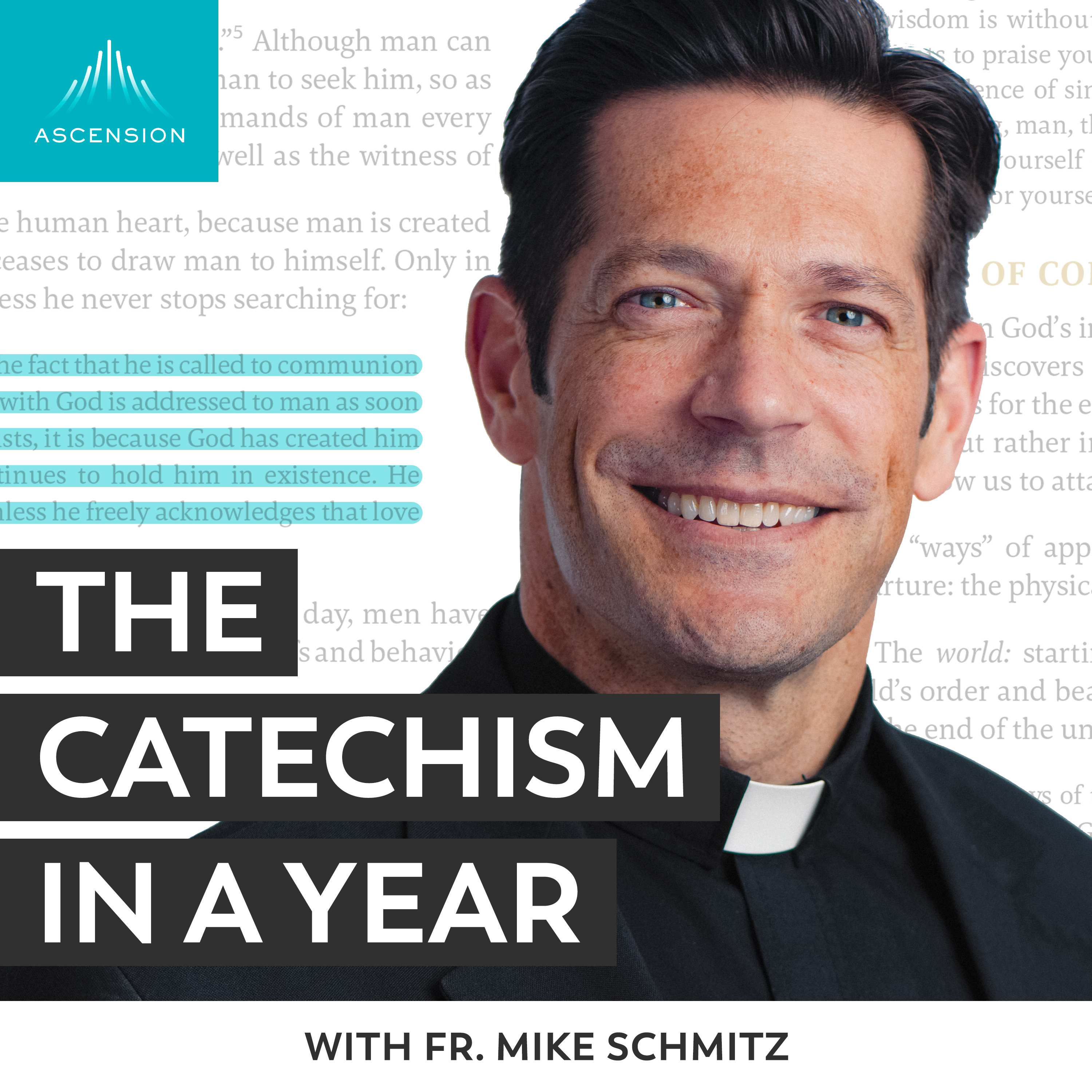
The Catechism in a Year (with Fr. Mike Schmitz)
In Ascension’s The Catechism in a Year podcast, Fr. Mike Schmitz guides you through the entire Catechism of the Catholic Church in 365 episodes, providing explanation, insight, and encouragement along the way. Unlike any other Catechism podcast, it follows a reading plan inspired by Ascension’s Foundations of Faith approach, a color-coded approach that reveals the structure of the Catechism, making it easier to read and understand. With this podcast, you’ll finally understand what it means to be Catholic and how the beliefs of the Catholic Faith come together.
Episodes
Day 287: The Gratitude of Children (2026)
Gratitude is the proper response of children toward their parents. Out of this gratitude comes respect. When we are children at home, this respect includes “true docility and obedience.” Fr. Mike emphasizes respect for parents doesn’t expire when we leave home as adults. Grown children are responsible for caring for and supporting their parents in their old age. As Fr. Mike stresses, this
Day 286: The Family and Society (2026)
The family is the foundational element of society. Fr. Mike explains how families initiate us into societal life and act as the foundation of freedom and community. Because of its indispensable importance, we learn that civil authorities are responsible for supporting and honoring the family. Familial relationships also enlighten those found in society; we see our neighbor not as an anony
Day 285: The Nature of the Family (2026)
In learning the core and fundamental definition of the family, we read today that a family is formed by a “man and a woman united in marriage, together with their children.” The Christian family is a communion of faith, hope, and love and an image of the Trinity. Fr. Mike shares how important he believes friendship and family are in spreading the Good News of the Gospel. Today’s readings
Day 284: The Fourth Commandment (2026)
The fourth commandment addresses the most universal human relationship: our relationship with our parents. Why does God command us to honor our father and our mother? Fr. Mike explains why this commandment sets the foundation for all the other commandments. He shares the 3 levels of respect and what it looks like to honor our parents despite their brokenness and imperfections. Today’s rea
Day 283: The Day of Rest (2026)
We all tend to make an idol of work. The Catechism teaches us that Sunday is a day of grace and rest from work. Fr. Mike explains what holy leisure looks like, emphasizing the importance of spending time with family, serving the poor, and taking time to meditate and pray. Resting on the Sabbath reminds us that our freedom and identity are found in the Lord. Today’s readings are Catechism
Day 282: The Sunday Obligation (2026)
Why are Catholics obligated to attend Mass every Sunday? The Catechism teaches us today about the centrality of the Sunday celebration of the Eucharist in the life of the Church. Fr. Mike emphasizes that Sunday Mass is at the heart of our worship because it is the participation in the representation of the Paschal Mystery. He invites us to honor the Sunday obligation out of love for Jesus
Day 281: Keep Holy the Lord’s Day (2026)
We begin exploring the third commandment and learn about rest and worship concerning the Lord’s Day. The Catechism points out that God models what he wants for us as he also rested on the seventh day. Fr. Mike explains the importance of prioritizing rest for ourselves because we are free and no longer enslaved people. The Catechism describes how we are to keep the Lord’s Day holy with “ou
Day 280: The Christian Name (2026)
What does it mean to bear the Christian name? The Catechism reminds us that in Baptism, we are given our Christian name, which is sacred. Our name represents the dignity of each of us and depicts how God loves us each uniquely. Fr. Mike explains that each time we make the Sign of the Cross, we call upon the Lord to bear witness to what we are about to do. Today’s readings are Catechism pa
Day 279: False Oaths (2026)
Together, with Fr. Mike, we continue our examination of the second commandment. Fr. Mike emphasizes that an oath engages the Lord’s name, and the Lord is the Lord of truth. We, therefore, have a duty as Christians to respect God’s name in matters of truth. He also emphasizes that everything we say is either in conformity to truth or in opposition to truth. Today’s readings are paragraphs
Day 278: The Second Commandment (2026)
We begin our examination of the second commandment, to not take the Lord’s name in vain. Fr. Mike emphasizes that God has revealed his sacred name to us, and it is our duty to treat that name with reverence. He also emphasizes just how easy it is for us to take the Lord’s name in vain in our day and age, and how vitally important it is for us to treat his holy name with respect. Today’s r
Day 277: Agnosticism and Graven Images (2026)
As we reach the conclusion of the section on the first commandment, we end by taking a closer look at agnosticism and graven images. Fr. Mike unpacks the different forms that agnosticism can take. He also examines the veneration of images and their relation to the first commandment. Today’s readings are Catechism paragraphs 2127-2141.
This episode has been found to be in conformity with
Day 276: Irreligion and Atheism (2026)
We continue our examination of the first commandment, unpacking irreligion and atheism. Fr. Mike highlights the different elements of irreligion, namely tempting God in words or deeds, sacrilege, and simony. He emphasizes that the sin of tempting God is easy to fall into when we are deeply troubled or afraid. Fr. Mike also spends time unpacking the many different aspects of atheism, and i
Day 275: Superstition, Idolatry, and Magic (2026)
Superstition, idolatry, divination, and magic are all things we can encounter in our daily lives, and, with Fr. Mike, we unpack how they break the first commandment. Fr. Mike reiterates that superstition represents an “excess of religion” and can affect the worship we offer to God. He points out that we can be superstitious even in our Catholic practices. He also explains that idolatry co
Day 274: Social Duty of Religion (2026)
The social duty of religion and the right to religious freedom are presented to us in the Catechism. We examine what it means to have respect for other religions and the freedom, within limits, to exercise our convictions. Fr. Mike makes it clear that it is our calling as Christians to evangelize and bring our Catholic Christianity to the public square. Today’s readings are Catechism para
Day 273: Him Only Shall You Serve (2026)
How can we serve God? The Catechism identifies ways in which we can keep the first commandment through adoration, prayer, sacrifice, and promises and vows. Fr. Mike relates these to us and identifies how we can truly worship and serve the Lord throughout our daily lives. Today’s readings are Catechism paragraphs 2095-2103.
This episode has been found to be in conformity with the Catechis
Day 272: You Shall Worship the Lord Your God (2026)
“You shall worship the Lord your God and him only shall you serve.” Taking a look at the first commandment, we see how we are called to love and worship God above all else. The Catechism also lists the ways in which we may potentially fall into sins against faith, hope, and charity. Fr. Mike elaborates on these violations and reminds us that while it may seem overwhelming, God loved us fi
Day 271: Love of God (2026)
We continue our overview of the Ten Commandments by looking at the two parts: love of God and love of neighbor. Together they form a “coherent whole,” and there is a unity between the two. While the Catechism shows us our obligation to follow the Commandments, it also reminds us that, “What God commands, he makes possible by his grace.” Fr. Mike emphasizes that even though it may be chall
Day 270: The Ten Commandments (2026)
God reveals himself and his glory through the Ten Commandments. We begin exploring the Ten Commandments as shown in the Catechism and learn about how these laws are not meant to limit us, but set us free from the slavery of sin. Fr. Mike reminds us that the Commandments are truly a gift from God and reflects his love for us. Today’s readings are the Ten Commandments and Catechism paragrap
Day 269: Our Missionary Witness (2026)
The Church’s mission of evangelization depends on the faithful witness of her members. Christian goodness and fidelity authenticate the Gospel. As Fr. Mike relates, people are attracted to admirable but everyday Christian witnesses. Through such lives of quiet holiness, the Church is built up and brought to greater fullness. This episode closes with a few summary “nuggets” about the moral
Day 268: The Precepts of the Church (2026)
God has given the Church his law as “the way of life and truth.” We, therefore, have the right to be taught and guided while maintaining a spirit of docility in love. In this, Fr. Mike reminds us that the Church is our caring mother. Her care extends into the five precepts of the Church, those laws establishing the very minimum needed to remain an active member of the Body of Christ. Thes
Day 267: The Church as Mother and Teacher (2026)
“The moral life is spiritual worship,” says the Catechism. From the Church, we receive moral guidance, with the Magisterium safeguarding and passing down authentic Christian moral teaching through the generations. This teaching reminds us who we are and how we should be, though it may sometimes deeply challenge us. In its prophetic role, Fr. Mike tells us, “the Church must both console an
Day 266: The Gift of Grace (2026)
In this summary of the Catechism’s teaching on holiness, justification, and merit, we briefly consider the work of God’s grace and mercy. His grace moves us from sin and toward him, making us his sons and daughters and bringing us into the very life of the Trinity. This gift of grace invites us to respond to his promptings and invitations freely. Finally, God offers “all the graces needed
Day 265: The Call to Holiness (2026)
Each of us is called to holiness. As Fr. Mike puts it, we’re all called to the “heights of holiness.” No matter our station in life, we’re meant for ever greater union with Christ, devoting ourselves to the love of God and neighbor. The path of holiness also entails the Cross, self-denial, and the sacrifice that ultimately leads to peace. And as Fr. Mike reminds us, even if we stumble or
Day 264: Man’s Merit (2026)
Knowing that our good actions begin and end in Christ, we recognize that man’s merit is due to God. Fr. Mike explains that charity in Christ is the source of all our merits. In this way, merit is pure grace, and we should look to the saints for examples of how to live this truth out. St. Thérèse of Lisieux puts it best when she prays to God: “In the evening of this life, I shall appear be
Day 263: Responding to Grace (2026)
God’s free initiative demands man’s free response. We continue our discussion of grace today by examining how grace and our free will interact in our lives. Fr. Mike also explains the purpose of sacramental graces and how the expression of these graces looks different across the Body of Christ. Today’s readings are Catechism paragraphs 2002-2005.
This episode has been found to be in con
Day 262: Habitual and Actual Grace (2026)
Without God’s help, we can do nothing. The Catechism delves into grace today, explaining how grace works and helps us achieve our supernatural vocation to eternal life. Fr. Mike unpacks the difference between habitual and actual grace and reminds us that God is always the initiator of all our spiritual efforts. Today’s readings are Catechism paragraphs 1996-2001.
This episode has been f
Day 261: Justification (2026)
What does it mean to be justified? The Catechism teaches us today about the grace of the Holy Spirit and its power to justify us. Fr. Mike explains how justification detaches us from sin and purifies our hearts. We learn that justification brings about a marvelous inward transformation that bears witness to God's great mercy. Today’s readings are Catechism paragraphs 1987-1995.
This epis
Day 260: Summary of the Moral Law (2026)
In today’s “Nugget Day,” Fr. Mike reviews the significant takeaways that the Catechism teaches us about the moral law. Fr. Mike highlights that God has written the moral law in the depths of every human heart. Today’s In Brief section also reminds us that the moral law is a “fatherly instruction by God,” rooted in love and oriented towards our joy, freedom, and flourishing. Today’s readin
Day 259: The New Commandment (2026)
We continue our examination of the New Law or Law of the Gospel, specifically the Golden Rule and New Commandment of Jesus. Fr. Mike emphasizes that the New Commandment requires us to love God as the center of everything we are and everything we have. He also unpacks how the New Commandment is also known as the law of love, grace, and freedom. Today’s readings are Catechism paragraphs 197
Day 258: The New Law (2026)
Together, with Fr. Mike, we examine the New Law or the Law of the Gospel. Fr. Mike emphasizes that the New Law “fulfills, refines, surpasses, and leads the Old Law to its perfection.” He also explains how the New Law of Christ that is expressed through the Sermon on the Mount is perfected by the grace of the Holy Spirit and works through charity and the Sacraments. Today’s readings are Ca
Day 257: The Old Law (2026)
We continue the section on moral law, specifically focusing on the Old Law. Fr. Mike emphasizes that the Old Law is the first stage of Revealed Law. He also unpacks how the Old Law acts as preparation for the Gospel. Today’s readings are Catechism paragraphs 1961-1964.
This episode has been found to be in conformity with the Catechism by the Institute on the Catechism, under the Subcommi
Day 256: The Natural Moral Law (2026)
Together, we begin the section on moral law, starting with natural moral law. Fr. Mike begins by emphasizing that we need both the law that guides us and God’s grace that sustains us in order to live out our call to beatitude. He also unpacks how natural moral law is written in the soul of each and every man to help him discern between good and evil. Today’s readings are Catechism paragra
Day 255: Human Solidarity (2026)
Together, with Fr. Mike, we reach the conclusion of the article on Social Justice. Fr. Mike emphasizes that although we have a right to private property, we also have a duty to meet the needs of those around us. Every human being has a right to what they need to thrive in this life. Today’s readings are Catechism paragraphs 1939-1948.
This episode has been found to be in conformity with
Day 254: Social Justice (2026)
We begin to look at social justice as outlined by the Catechism by diving into two aspects: respect for the human person and equality and differences among men. The dignity of the human person is at stake without social justice. Fr. Mike highlights that since we are all made in the image and likeness of God, we are all equal in dignity and are to love everyone including our enemies. With
Day 253: Participation in Public Life (2026)
The Catechism has shown us how the common good begins with the good of the individual. It further shows us that each individual can participate in the pursuit of the common good for all—and that this participation is not optional, but an obligation. Fr. Mike explains the nature of this obligation in quite simple terms: “see a need, fill a need.” Today’s readings are Catechism paragraphs 1
Day 252: The Common Good (2026)
The Catechism sets up a pair of definitions for us that, at first glance, appear circular, but upon close examination, reveal profound interdependence: “The good of each individual is necessarily related to the common good, which in turn can be defined only in reference to the human person.” Fr. Mike uses a fascinating thought experiment to illustrate where the common good originates: you
Day 251: Authorities in Society (2026)
The Catechism shows us that, in order for any good in society to last and flourish, legitimate authority must be instituted and respected by all. Furthermore, it is our duty as those under authority to obey those invested with authority. Fr. Mike acknowledges that most of us resist authority, but he bolsters the Catechism’s claim that legitimate authority in society is good and necessary.
Day 250: Conversion in Society (2026)
Before we can see outward changes for the good in society, there must be inward conversion in the hearts of its members, so says the Catechism. Fr. Mike highlights the fact that societies are made up of people with both body and soul—and the soul is often overlooked. Because we are broken, there is a “permanent need” for our conversion, and any society that fails to take this into account
Day 249: The Person in Society (2026)
Man is made for communion. God created man in his triune image, making us naturally social and communal beings. We learn that various societies weave us together: the family, the state, our professions, and recreational activities, among others. Fr. Mike explains how the Church promotes the principle of subsidiarity to protect the goodness of the various levels of society as each level pu
Day 248: The Spread of Sin (2026)
We close the section on human dignity and goodness by learning how sin engenders vice. Our readings today discuss the proliferation of sin and how capital sins, in particular, lead to vices that can become rooted in a person or society. Fr. Mike reminds us that while sin is a personal act, it is also possible for us to cooperate in and encourage the sins of others. This can lead to the fo
Day 247: The Weight of Sin (2026)
We can consider the variety of sins in light of their gravity or seriousness. In doing so, we see that some sins weaken charity while others destroy it. The first we call venial sins, the second mortal. Our very freedom makes possible this rejection of God. Yet, God’s mercy has no limits. God can and will forgive every sin of which we repent. Fr. Mike invites all listeners to seek this fo
Day 246: Mercy and the Mystery of Sin (2026)
Jesus reveals God’s offer of loving mercy to sinners. To accept this gift, we must identify and admit our failings. Recognizing our sins enables us to further cooperate in our redemption. Sin can be understood and categorized in several ways, but every sin wounds our nature and damages our relationships with God and neighbor. Today’s readings are Catechism paragraphs 1846-1853.
This epis
Day 245: Gifts and Fruits of the Holy Spirit (2026)
As we end our exploration of the virtues, we learn about the gifts of the Holy Spirit. These gifts perfect our virtues and increase our ability to respond to God’s guidance and inspiration. The fruits of the Holy Spirit perfect us, are signs of a life lived in the Spirit, and are “the first fruits of eternal glory,” as the Catechism tells us. Our cooperation with the Holy Spirit sustains
Day 244: The Virtue of Charity (2026)
The greatest of all the theological virtues is charity. Fr. Mike explains that charity, or love, is to love God above all things for his own sake and to love our neighbor as ourselves. This includes loving our enemies and also obeying God's commandments, two actions that are not always easy. Most importantly, today's readings remind us that true charity is not loving the Father as servant
Day 243: The Virtue of Hope (2026)
A desire for the Kingdom of heaven and eternal life is at the heart of the virtue of hope. Fr. Mike breaks down the definition of the theological virtue of hope and explains how it protects us from discouragement and selfishness. By placing our trust in Christ’s promises, we are free to love the people around us and endure all circumstances because we know that God is faithful. Today’s re
Day 242: The Virtue of Faith (2026)
The origin, motive, and object of the theological virtues are God himself. Today, we dive into the theological virtues, beginning with the virtue of Faith. Fr. Mike unpacks the meaning and purpose of the virtue of Faith and emphasizes that Faith is deeply rooted in trust in God. Lastly, Fr. Mike reminds us that Faith should be lived out along with Hope, and Love, and also professed to th
Day 241: The Cardinal Virtues (2026)
A virtuous person is someone who consistently chooses the good. Fr. Mike unpacks the four human or cardinal virtues that are essential in helping us become more like Jesus: prudence, justice, fortitude, and temperance. We learn that these four virtues make possible “ease, self-mastery, and joy in leading a morally good life.” Today’s Catechism readings are paragraphs 1803-1811.
This epis
Day 240: Erroneous Judgment of Conscience (2026)
It is possible for our moral conscience to remain in ignorance for a variety of reasons. Fr. Mike delves into the sources of errors of judgment in moral conduct and how habitual sin blinds our conscience. As we wrap up this article, Fr. Mike reminds us that a well-formed conscience sets us free and gives us the power to do what we ought. Today’s readings are Catechism paragraphs 1790-1802
Day 239: The Formation of Conscience (2026)
Together, with Fr. Mike, we unpack the formation of our conscience. Fr. Mike emphasizes that a well-formed conscience is one that is both “upright and truthful.” He also highlights the idea that a well-formed intellect is vital to having a well-formed conscience. We cannot just say something is either right or wrong, we have to understand why we think that. Today’s readings are Catechism
Day 238: Our Moral Conscience (2026)
Together, with Fr. Mike, we explore the moral conscience. Fr. Mike emphasizes that even though our intellect has been weakened by sin, we still have some sense, our conscience, that tells us that there is a right and wrong. He also emphasizes the difference between our conscience and our passions. Today's readings are Catechism paragraphs 1776-1782.
This episode has been found to be in c
Day 237: The Morality of the Passions (2026)
Together, we examine The Morality of The Passions. Fr. Mike unpacks and explores the different elements of the definition of “passions”. He emphasizes that while passions, themselves, are neither good nor bad, there still is a moral component to them. It is what we do with our passions that can either contribute to virtue or vice. Today’s readings are Catechism paragraphs 1762-1775.
This
Day 236: The Morality of Human Acts (2026)
Together, with Fr. Mike, we examine the article on the morality of human acts. Fr. Mike unpacks the three “sources” of morality: the object chosen, the end in view or the intention, and the circumstances. He emphasizes the importance of understanding the categories of right or wrong, good or evil. Today’s readings are Catechism paragraphs 1749-1761.
This episode has been found to be in c
Day 235: Human Freedom in Salvation (2026)
Together, with Fr. Mike, we examine the reality of our human freedom in the economy of salvation. Fr. Mike emphasizes that the right to freedom does not imply a right to say or do anything. Rather, it is the power to choose the “right.” He also emphasizes that the moral law actually allows us to live with freedom and joy, and that when we violate the moral law, we violate our own freedom.
Day 234: Freedom and Responsibility (2026)
The Catechism gives us an overview of what it means for humans to have freedom, as well as some of the ramifications of that freedom. It introduces us to the countercultural notion that true freedom is to choose the good—the “freedom” to choose evil is merely the abuse of freedom. Fr. Mike ensures that we understand imputability and culpability because questions about intention, ignorance
Day 233: The Beatitudes (2026)
“The Beatitudes are at the heart of Jesus’ preaching,” the Catechism tells us. Jesus’ proclamation in Chapter 5 of the Gospel of Matthew purifies our hearts, sets a standard for earthly discernment, and directs our actions towards heaven. Fr. Mike invites us to choose God’s ways and forsake our own ways. Today’s readings and paragraphs 1716-1729.
This episode has been found to be in conf
Day 232: Man Is Made in the Image of God (2026)
We enter a new chapter examining the dignity of the human person, and Article 1 shows us that we have dignity because we are made in the image and likeness of God. We preserve that dignity when we exercise virtue and charity, and we do violence to it when we commit sin and evil acts. Fr. Mike hones in on the bold statement that we as humans are “the only creature on earth that God has wil
Day 231: Our Calling (2026)
As we step into Part Three of the Catechism on How We Live, we begin with an overview of our high calling as sons and daughters of God. Truly our “first and last point of reference” will always be “Jesus Christ himself, who is ‘the way, and the Truth, and the life.’” Fr. Mike identifies for us that when most people say, “I can’t accept what the Church teaches”, it’s rarely about dogma, li
Day 230: How We Live (Part 3 Introduction with Dr. Mary Healy)
The third part of the Catechism tells us how to live—how God has revealed that we are made to act toward him, toward each other, and toward ourselves. Fr. Mike and Dr. Mary Healy dive deep into moral theology, the state of our culture, and some of the stumbling blocks readers are bound to encounter in this part of the Catechism (as well as how to overcome them).
This episode has been fou
Day 229: Christian Funerals (2026)
In this final episode of Pillar 2, we learn about the Christian funeral rite. Fr. Mike explains how the new life begun in Baptism comes to greater fulfillment as the Christian passes over from this earthly life into the fullness of the Kingdom. The Church, who has sacramentally nourished her children throughout their earthly pilgrimage, upon their death commends them to the Father and pla
Day 228: Blessings, Sacramentals and Popular Piety (2026)
Sacramentals are sacred signs that resemble the sacraments. Blessings of people, places, and objects are foremost among the various sacramentals found in the life of the Church. Among these blessings are those of exorcism, in both its simple and solemn form. Fr. Mike notes that sacramentals and the many forms of popular piety, such as the Rosary, are noble expressions of faith that prepar
Day 227: Summary of the Sacrament of Matrimony (2026)
This summary of the Catechism's teaching on the sacrament of Matrimony pulls together several beautiful themes regarding marriage and family. Fr. Mike emphasizes the family as the Domestic Church, that community where parents and children grow in charity, forgiveness, prayer, and self-giving. We're reminded that the communion of love shared by husband and wife in marriage is a sacramental
Day 226: The Supreme Gift of Marriage (2026)
“Children are the supreme gift of marriage,” says Vatican II. Marriage is directed by its very nature toward the procreation of children. Beyond this, parents are the primary educators of their children, responsible for their holistic formation. Sadly, many couples suffer from infertility. Even in their struggle, they can provide a powerful witness of love, sacrifice, and fidelity. In all
Day 225: Total Fidelity in Marriage (2026)
“Love seeks to be definitive,” the Catechism tells us in this section on marital fidelity. The faithfulness of husband and wife in the sacrament of Matrimony is a sign of God’s irrevocable covenant with humanity. This fidelity is both beautiful and challenging. Fr. Mike addresses painful separation and divorce situations and how the whole ecclesial community should respond with truthful l
Day 224: The Grace of the Sacrament of Marriage (2026)
The grace of the Sacrament of Marriage provides husbands and wives the strength to love one another with supernatural, tender, and fruitful love. Fr. Mike covers the characteristics of the marriage bond and the different roles of husbands and wives. He explains what it means to “be subject to one another out of reverence for Christ.” We also learn that indissolubility, faithfulness, and o
Day 223: Differences in Religion in Marriage (2026)
Can a Catholic marry a baptized non-Catholic or a non-baptized person? Fr. Mike breaks down the Church’s teaching on mixed marriages and disparity of cult. The Catechism teaches us that while a difference in religion “does not constitute an insurmountable obstacle for marriage,” it can often be a source of tension in marriage and present significant challenges when raising a family. Today
Day 222: Matrimonial Consent (2026)
Matrimonial consent is an indispensable element of the Sacrament of Marriage. Fr. Mike explains why it is essential for those entering marriage to express their consent freely and why in the Church’s eyes, “if consent is lacking, there is no marriage.” Fr. Mike also guides us through the Church’s teaching on annulment and clarifies why it can be complex. Today’s readings are Catechism par
Day 221: The Celebration of Marriage (2026)
What does a Catholic wedding look like? Today, we dive into the liturgical celebration of marriage and learn that the celebration must be valid, worthy, and fruitful. Additionally, we briefly cover virginity for the sake of the Kingdom and how this particular call highlights the beauty and goodness of marriage. Fr. Mike emphasizes that those called to celibacy can truly live joyful and fu
Day 220: Marriage in the New Covenant (2026)
How is the meaning of marriage different in the New Covenant? The Catechism teaches us today that Christ elevates the gift of marriage to a sacrament and restores the original order of this powerful union between man and woman. Fr. Mike explains why marriage looked different in the Old Covenant and how God was preparing his chosen people throughout time to accept Christ’s law of marriage.
Day 219: Marriage in God’s Plan (2026)
Together, with Fr. Mike, we begin the section on the sacrament of holy Matrimony. We unpack two elements of the sacrament, namely marriage in the order of creation and marriage under the regime of sin. Fr. Mike emphasizes that marriage is a partnership between man and woman that is oriented towards the good of the spouses and the procreation and education of offspring. Today’s readings ar
Day 218: Summary of Holy Orders (2026)
Together, with Fr. Mike, we reach the conclusion and “nugget day” for the section on the sacrament of Holy Orders. Fr. Mike reiterates that all three degrees of the sacrament are a longed for element of the “priestly people.” They are those called to go before God and before his people as a mediator. Fr. Mike also explains that for those who are not called to either “sacrament of service”
Day 217: The Effects of Holy Orders (2026)
Together, with Fr. Mike, we examine the effects of the sacrament of Holy Orders. Fr. Mike emphasizes that once a man is ordained a priest, he is always a priest because he receives an indelible spiritual mark. He also emphasizes that Holy Orders is a sacrament of service. The effects of the sacrament configure him in such a way that he is best able to serve the Church. Today’s readings ar
Day 216: Who Receives Holy Orders (2026)
We continue our examination of the sacrament of Holy Orders. Specifically, we explore exactly who can receive the sacrament of Holy Orders. Fr. Mike emphasizes that only a baptized man can receive the “sacred ordination”. He then unpacks exactly why the ordination of women is not possible. Today’s readings are Catechism paragraphs 1577-1580.
This episode has been found to be in conformit
Day 215: Deacons and the Diaconate (2026)
Together, with Fr. Mike, we examine the ordination of deacons and the diaconate. Fr. Mike unpacks each of the essential elements of the rite of the ordination of deacons as well as each of the tasks of the deacon. He emphasizes that only a validly ordained bishop can validly confer the sacrament of Holy Orders. Today’s readings are Catechism paragraphs 1569-1576.
This episode has been fo
Day 214: Priests and the Presbyterate (2026)
The Catechism moves on from bishops—the episcopacy—to priests in the presbyterate, who share in the bishop’s ministry “in a subordinate degree”, to be “co-workers”. Fr. Mike dives deep into the service-leadership that priests are called to. “[A priest’s] whole life must be configured and must be conformed to Jesus Christ the high priest.” Today’s readings are Catechism paragraphs 1562-156
Day 213: Bishops and the Episcopacy (2026)
There are three degrees within the sacrament of Holy Orders: the episcopacy (bishops), the presbyterate (priests), and the diaconate (deacons). The Catechism begins unpacking ordination with the bishops. Fr. Mike speaks on the special role that bishops play in the life of the Church. Today’s readings are from Catechism paragraphs 1554-1561.
This episode has been found to be in conformity
Day 212: In Persona Christi (2026)
The Catechism unpacks—by way of comparison—the “two participations in the one priesthood of Christ”: the common priesthood of all the faithful and the ministerial (or hierarchical) priesthood of the bishops and priests. Fr. Mike hones in on the ministerial priesthood as a means for Jesus to minister to his Church. His ministers act on his behalf in persona Christi Capitis: in the person o
Day 211: The One Priesthood of Christ (2026)
The priesthood of the Old Covenant among the people of Israel is fulfilled in the one priesthood of Christ. The Catechism compares the Old Testament priesthood, “powerless to bring about salvation,” with the ordained ministry in the New Covenant. Fr. Mike unpacks the reality that there is only one true priest—Jesus Christ. His “priests” on earth are humble ministers. Today’s readings are
Day 210: The Sacrament of Holy Orders (2026)
The Catechism enters Chapter Three on the “Sacraments at the Service of Communion” which include both Holy Orders and Matrimony. As it introduces the sacrament of Holy Orders, Fr. Mike reminds us that every vocation is a gift, and that—no matter what state of life we are in or have been called to—we should read this chapter with an open heart and a grateful spirit. Today’s readings are Ca
Day 209: Summary of the Anointing of the Sick (2026)
This summary of the Catechism’s teaching about the Anointing of the Sick is concise and rich. This holy anointing brings us hope and courage as we endure illness and the difficulties of old age. While we pray for healing of body and soul, this sacrament also prepares us for death. Fr. Mike ends this episode by explaining three practices of the Church that help her members prepare for deat
Day 208: Completing the Earthly Pilgrimage (2026)
The effects of the Anointing of the Sick are numerous and deeply transformative. In times of great need and temptation, this sacrament brings us strength, courage, peace, and the forgiveness of sins. Fr. Mike explains that these effects aren’t only for the individual recipient but for the whole ecclesial community. We learn that when a person approaches the threshold of death, joining thi
Recommended
CBS Radio Mystery Theater | Old Time Radio
Solved Murders - True Crime Stories
紐約鳥|New York Aperture
The Swerve Podcast: Obscure Topics | Conspiracy Theories

The Bread and Banter Podcast
The Church of What's Happening Now: The New Testament
Busted Open

Deadline: White House
Crickets Corner
History of the Earthquake and Fire in San Francisco

Fox news

K-Drama Obsessed Mamas | Beyond “Just One More Episode!”
