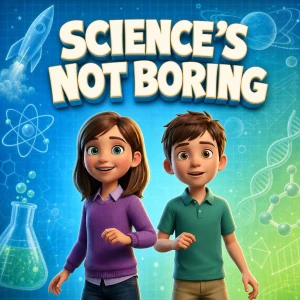
A podcast designed to make science exciting for kids aged 4-12. Fictional AI hosts Mira and Finn explore topics like volcanoes, black holes, venom, and the human body in a fun and understandable way. Each episode turns big scientific ideas into engaging stories that spark curiosity and wonder. The show aims to prove that science is not a list of facts but the story of how everything works.
Episodes

What is a Komodo dragon?
Did you know there are real-life dragons living on Earth right now? Join Mira and Finn as they track down the most incredible giant lizard on the planet—the Komodo dragon! These apex predators live on just a few rugged islands in Indonesia, but they absolutely rule their tropical habitat. Imagine a massive lizard that can grow as long as a small car, weigh over 150 pounds, and sprint as fast as a

What is animal tool use?
Did you know humans aren't the only ones who can invent and use tools? Get ready to have your mind blown by the smartest builders in the animal kingdom! In this wild episode of Science is Not Boring, Mira and Finn dive into the amazing world of animal tool use. You’ll meet adorable sea otters who keep their favorite smashing rocks hidden safely inside special armpit pockets, and clever chimpa

What is Stephenson 2-18?
Look up in the night sky! You know our Sun is incredibly massive, right? It can fit 1.3 million Earths inside it! But what if I told you there is a star so gigantic that it makes our Sun look like a tiny speck of dust? Welcome to the mind-blowing world of Stephenson 2-18, the biggest known star in the entire universe! Discovered in 1990 by astronomer Charles Bruce Stephenson using a special infrar

Who was Ernest Rutherford?
Have you ever wondered what you are really made of? Get ready for a mind-bending scientific adventure into the invisible universe! In this exciting episode of Science is Not Boring, Mira and Finn explore the totally wild discoveries of New Zealand physicist Ernest Rutherford. Imagine firing a massive heavy cannonball at a flimsy piece of tissue paper, only for it to bounce straight back and hit yo

What is a tsunami?
Have you ever wondered what creates the most powerful waves on Earth? Get ready for a splash, because today we are diving deep into the amazing science of tsunamis! Did you know that a tsunami doesn't come from wind like normal beach waves? Instead, they are triggered by massive underwater earthquakes! When the ocean floor suddenly snaps, it pushes billions of tonnes of water straight up.
Ev

What is melanin?
Have you ever wondered why your best friend has brown eyes, your cousin has bright red hair, or your grandpa's hair is turning completely grey? It all comes down to a secret paint factory hidden right inside your own body! Join Mira and Finn as they shrink down to microscopic size to discover the amazing science of melanin! You'll learn all about melanocytes, the tiny, octopus-shaped cel

What was the Tyrannosaurus Rex?
Have you ever wondered what it would be like to stand next to a real-life Tyrannosaurus Rex? In this roaring episode of Science is Not Boring, Mira and Finn travel back 66 million years to the Late Cretaceous period to uncover the secrets of the ultimate dinosaur king!
Imagine a creature as long as a school bus and as heavy as two squished elephants! You will discover how the mighty T-Rex used it

Why did feathers evolve?
Have you ever wondered why birds have feathers, or how parrots get their dazzling, bright colours? Get ready for a mind-blowing time-travel adventure that goes all the way back to the age of the dinosaurs! Join Mira and Finn as they uncover the incredible secrets of feathers. First, we learn how modern parrots are actually microscopic light-bending factories! They use special pigments called psitt

What is a microwave?
Have you ever wondered how that magic box in your kitchen heats up your food so fast? It doesn't use fire or hot air! Instead, microwaves use a super cool machine called a magnetron that shoots completely invisible waves into your food. These waves vibrate a mind-boggling 2.45 billion times every single second! When they hit the water molecules inside your favorite snacks, they make them flip

What is a stealth plane?
Have you ever wondered how to hide a giant, 65-foot airplane in the sky? Find out on this incredible episode of Science is Not Boring! Join Mira and Finn as they explore the fascinating world of physics and engineering. First, we travel back to 1935 to learn how Scottish physicist Robert Watson-Watt invented radar to bounce invisible radio waves off metal objects and track planes from miles away!

What is a plant defense?
Have you ever wondered why chopping onions makes you cry, or why hot peppers make your mouth feel like it's on fire? It turns out, plants are secretly genius chemical warriors! Because plants are stuck in the dirt and can't run away from hungry animals, they had to evolve some of the most mind-blowing defense mechanisms on Earth!
Join Mira and Finn on an action-packed botany adventure a

Why did camels grow thick fur?
Have you ever wondered why animals like camels and monkeys wear thick, fuzzy winter coats in the hottest places on Earth? It sounds completely bananas, right?! If you wore a winter coat in the blazing Sahara Desert, you would melt into a puddle! But for animals living in extreme heat, fur isn't a heater—it's an incredible superpower shield! Join Mira and Finn as they uncover the wild sci

What was the first battery?
Did you know the battery inside your favorite toy actually started with... a dead frog?! In this shockingly fun episode of Science is Not Boring, Mira and Finn travel back in time to the 1700s to uncover the wild and weird true story of how the very first battery was invented! Imagine trying to turn on a flashlight using a slimy swamp frog. That is exactly what Italian scientist Luigi Galvani acci

What are extremophiles?
Have you ever wondered if real aliens exist out in space? To find out, astrobiologists aren't just looking at the stars—they are exploring the most extreme, impossible places right here on Earth! For a long time, scientists thought all living things needed liquid water, carbon, and sunlight. But everything changed when a tiny submarine named Alvin plunged into the pitch-black depths of the Pa

What is a fruit?
Did you know that almost everything you think you know about fruits and vegetables might be wrong?! It is true! Join Mira and Finn on a wild trip to the produce aisle as they uncover the bizarre botanical secrets hiding right inside your kitchen! Discover why scientists say a tomato, a crunchy cucumber, and even a giant 2,749-pound pumpkin are actually fruits, while a carrot is just a tasty root.

What is an earthworm?
Did you know there is a squishy creature living right under your feet that has ten tiny hearts, zero bones, and absolutely no eyes? Welcome to the wild, wiggly world of the amazing earthworm! Join Mira and Finn on Science is Not Boring as they dig deep into the dirt to uncover the unbelievable secrets of nature's ultimate gardeners.
Discover how these unstoppable eating machines use invisibl

What is a big cat?
Did you know that not every large feline is actually a "big cat"? Get ready to roar into the wild world of zoology to discover what makes a big cat a true big cat! Join Mira and Finn as we track down the magnificent members of the Panthera genus: lions, tigers, jaguars, and leopards. You will learn the amazing secret behind a lion's terrifying, 114-decibel roar—it is all thanks to a

What is uranium?
Have you ever wondered what the heaviest natural element on Earth is? Get ready to dive inside the incredible, invisible world of atoms in this mind-blowing episode all about uranium! Join Mira and Finn as they uncover how a tiny piece of uranium the size of your pinky finger contains as much energy as an entire ton of coal! Discover the wild history of this super-dense metal, starting with miners

How do tadpoles turn into frogs?
Did you know a single mother frog can lay up to 20,000 squishy eggs at once? That's enough to fill a massive sports arena! Join Mira and Finn on an incredible underwater adventure to discover one of nature's most extreme shape-shifting magic tricks: how a tadpole transforms into a frog!
When baby tadpoles hatch, they don't look like frogs at all. They are little legless swimming be

What is a marsupial?
Have you ever wondered what makes animals in Australia so weird and wonderful? Get ready to explore the incredible world of marsupials! Over 50 million years ago, the continent of Australia broke off like a giant puzzle piece and drifted away into the ocean. Because these animals were trapped on a massive lifeboat, they evolved into over 250 amazing species! Join Mira and Finn as they uncover the

What was the first photograph?
Have you ever tried sitting completely still without blinking, itching, or sneezing for eight whole hours? That’s exactly what you had to do to be in the very first photograph! Join Mira and Finn on a time-traveling adventure to discover how cameras actually work! First, we’ll travel back a thousand years to ancient Egypt with a brilliant scientist named Ibn al-Haytham. He discovered the magical &

What is the colossal squid?
Are you ready to dive into the darkest, most freezing parts of the ocean? Join Mira and Finn on Science's Not Boring as they search for a real-life deep-sea monster: the colossal squid! Imagine a giant creature as long as a school bus and as heavy as a grizzly bear, swimming thousands of feet below the icy waves of Antarctica. This massive sea creature is the heaviest invertebrate on Earth! D

What is the rock cycle?
Did you know that the ground beneath your feet is actually a giant, endless recycling machine? Join Mira and Finn on an epic geological adventure to discover the secrets of the rock cycle! You might think rocks just sit there being boring and gray for millions of years, but our planet is constantly melting, squashing, and baking them into completely new shapes! Learn about igneous rocks born from

How was Earth formed?
Have you ever wondered where our home planet came from? Buckle up, space explorers, because we are traveling back four and a half billion years to witness the fiery, explosive birth of planet Earth! Before there were oceans, mountains, or even dinosaurs, Earth started as a giant, freezing cold cloud of space dust. But when an exploding star sent a shockwave through space, things got crazy! Tiny sp

How did the first plant grow?
Have you ever imagined what Earth looked like 500 million years ago? Picture this: absolutely zero green! No trees, no grass, no flowers—just endless, bare, jagged rock. If you wanted to find a plant, you had to dive underwater to find floating green algae! But how did those plants finally crawl onto the dry, scary land?
Join Mira and Finn on a prehistoric adventure to discover the greatest survi

What is a seashell?
Have you ever picked up a beautiful, swirly seashell on the beach and wondered where it came from? It wasn't just a rock shaped by the ocean waves—it was built by a squishy sea creature! Join Mira and Finn as they dive underwater to discover the amazing world of molluscs. Learn how snails, clams, and oysters use a magical organ called a mantle to literally 3D-print their very own rock-hard ar

What is a tear?
Did you know your body makes enough tears every year to fill half a bathtub? It’s true! In this episode, Mira and Finn dive into the wild, slightly slimy, and totally amazing science of tears! You might think crying is just salty water leaking from your eyeballs, but tears are actually a super-advanced biological shield. Discover the microscopic bacteria-chopping ninja enzymes hiding in your every

What is an octopus?
Have you ever wondered what it would be like to have three beating hearts, bright blue blood, and a brain that spreads into your arms? Meet the octopus, one of the wildest and smartest creatures in the entire ocean! In this episode of Science's Not Boring, Mira and Finn dive deep underwater to uncover the incredible secrets of these squishy, ancient animals. Did you know octopuses have been s

What is crude oil?
Did you know that the cars we drive, the plastic toys we play with, and even your daily toothbrush are all connected to ancient, dead sea creatures?! Join Mira and Finn as they dig deep underground to uncover the mind-blowing science of crude oil! Millions of years ago, microscopic sea plankton sank to the ocean floor. Trapped under heavy layers of mud and intense heat, they were slowly cooked int

What is an eye saccade?
Have you ever noticed what your eyes do when you read a book? You might think they slide smoothly across the page like an ice skater, but prepare to have your mind blown! Your eyes are actually bouncing, hopping, and leaping at incredible speeds! In this episode of Science is Not Boring, Mira and Finn uncover the amazing, high-speed team sport happening right inside your head.
Join the adventure

What is the Amazon Rainforest?
Are you ready for a wild adventure? Pack your bags because we are traveling deep into the Amazon Rainforest in South America! Did you know this massive jungle is so big it stretches across nine different countries and covers the space of one billion football fields? In this episode of Science's Not Boring, Mira and Finn uncover the mind-blowing secrets hiding in the rainforest canopy and rive

What is a supernova?
Have you ever wondered what happens when a giant star reaches the end of its life? Boom! It explodes in one of the most powerful and spectacular events in the entire universe—a supernova! Join Mira and Finn on Science's Not Boring as we blast off to discover the amazing secrets of exploding stars! Did you know that a single supernova can shine brighter than a hundred billion stars combined? W

Who was Dmitri Mendeleev?
Have you ever wondered what the entire universe is made of? Believe it or not, everything from the farthest exploding stars to the bugs in your backyard is made of just 118 invisible building blocks called elements! But how did scientists figure out how they all fit together?
Join Mira and Finn on Science's Not Boring as they travel back to a freezing winter in 1869 to meet a brilliant Russi

What is a Portuguese man o' war?
Did you know the longest animal in the world is not the blue whale? Get ready to explore the deep sea as we uncover a real-life sea monster that totally breaks the rules of biology! Have you ever seen a blue balloon floating on the beach with long stinging tentacles? Most people think the Portuguese man o' war is a jellyfish, but it's actually thousands of tiny cloned animals working tog

What is a Blood Moon?
Have you ever looked up at the night sky and seen a glowing, dark red moon? It looks like a giant floating campfire ember, but what exactly is a Blood Moon? Join Mira and Finn as they blast off 238,855 miles into space to solve this spectacular lunar mystery! You will discover what happens when the Sun, Earth, and Moon line up perfectly to create an enormous shadow called the umbra. But the Moon d

What is a jellyfish?
Have you ever wondered what exactly a jellyfish is made of? Get ready for a mind-blowing deep dive into the ocean! In this episode of Science is Not Boring, Mira and Finn uncover the amazing secrets of the brainless blobs that have been swimming on Earth for over 500 million years. That means they are older than the dinosaurs and even older than sharks! Did you know a jellyfish is 95 percent water

What is a brain?
Have you ever wondered what is going on inside your head? Imagine a massive, buzzing city with over a hundred trillion roads, where cars zip by at 268 miles per hour! That is exactly what your amazing brain is like! It is packed with 86 billion tiny cells called neurons that pass messages to each other at lightning speed.
Join Mira and Finn as they uncover the incredible secrets of how our minds

What is hair made of?
Did you know your hair is so incredibly strong that it could hold the weight of two fully-grown African elephants?! That is over twelve tons of elephant! In this mind-blowing episode of Science's Not Boring, Mira and Finn dive deep into the wild world of hair to discover what is really growing out of our heads.
Get ready to find out how your hair is actually made of keratin—the exact same t

What is the fastest animal on Earth?
Are you ready for the ultimate speed race in the animal kingdom? Buckle up and keep your hands inside the vehicle, because things are about to get really, really fast! When you think of the fastest animal on Earth, you probably picture the famous cheetah. While cheetahs are the undisputed speed kings of the savanna, sprinting up to 120 kilometers per hour, they are only the fastest on land!
To fi

What are wasps?
Have you ever wondered why wasps crash your summer picnics? It turns out, these buzzy bugs are actually secret superheroes of the insect world! In this episode, Mira and Finn uncover the mind-blowing truth about wasps and why we desperately need them on Earth. Did you know that wasps were making waterproof paper millions of years before humans even existed? A single queen uses her own spit and che

What is a black hole?
Have you ever wondered what a black hole actually is? Is it really a giant cosmic vacuum cleaner sucking up planets? Join Mira and Finn as they blast off into the deepest mysteries of space to find out! Discover how massive stars can crush down into something so heavy and powerful that its gravity traps absolutely everything—even light itself! Learn about the "Event Horizon," the spooky

What is DNA?
Have you ever wondered why your hair is curly, or why your eyes are a certain color? The secret is hidden inside you right now! Join Mira and Finn on Science is Not Boring as they shrink down to explore the incredible, invisible world of DNA! DNA is like a massive instruction manual for building YOU. If you took all the tiny twisting "ladders" of DNA inside your body and lined them up, t

What is a bagpipe?
Have you ever wondered how blowing into a simple tube can make loud, beautiful music? Join Mira and Finn as they uncover the wild science behind wind instruments! You'll discover how blowing air across an empty bottle sets an invisible column of air shaking to create sound waves. Did you know a tiny jet of air from a flute player's mouth can travel at 135 miles per hour—the speed of a Ca

How does the voice work?
Have you ever wondered what happens inside your body when you sing, shout, or whisper? Your voice is actually a built-in, highly complex musical instrument, and there is some amazing science behind it! Join Mira and Finn as they explore the fascinating world of human sound! Did you know that when a newborn baby cries, their tiny vocal cords are only the size of a grain of rice? Or that when a prof

What are stars?
Look up at the twinkling night sky! Did you know you actually have dead stars inside your body right now? Eww... but also totally awesome! Join Mira and Finn on an explosive space adventure to discover the wild life story of every star in the universe. We are travelling to giant space clouds called nebulas, where freezing dust is squished together by gravity until—BOOM—a brand new baby star switch

What is a scab?
Have you ever fallen off your bike and scraped your knee? Ouch! It might look messy on the outside, but underneath, your body is launching a highly advanced microscopic rescue mission! Join Mira and Finn on an amazing journey inside the human body to uncover the astonishing repair kit you carry everywhere you go.
Did you know a single drop of blood contains ten million tiny cells called platelets

What is fire?
Have you ever stared at a campfire and wondered what those glowing, dancing flames actually are? Join Mira and Finn as they uncover the blazing secrets of fire! You'll learn the secret "Fire Triangle" recipe that makes things burn and discover that flames are actually super-heated, glowing gases floating in the air. We’ll travel back in time over a million years to a place called Wo

What is extinction?
Have you ever wondered where all the woolly mammoths and dodo birds went? Once upon a time, our planet thundered with incredible creatures that are now completely gone. But what does it actually mean when an animal goes extinct? Join Mira and Finn as they uncover the wild, fascinating secrets behind why animals disappear forever! You will travel back in time to the tropical island of Mauritius to

What is an opposable thumb?
Did you know you are basically a biological puppet master?! It’s true! Wiggle your fingers right now. You might be shocked to learn that there are absolutely zero muscles in your fingers! Instead, they are controlled by long tendons connected to muscles all the way down in your forearm, just like puppet strings! Join Mira and Finn on Science is Not Boring as they explore the ultimate superpower: t

What is space made of?
Look up at the night sky. It looks like a giant, empty, pitch-black room, right? But what if I told you space isn't actually empty at all?! Join Mira and Finn on a mind-blowing journey into the deepest, darkest parts of the universe to find out what space is really made of! We usually think of space as a perfect vacuum with absolutely nothing inside, but that’s a cosmic myth! You'll disc

How do animals defend themselves?
In the wild, nobody wants to become someone else's dinner! But how do small creatures stay safe from hungry predators? Join Mira and Finn on a wild adventure to uncover the most mind-blowing and explosive animal defense mechanisms on the planet! Did you know there is a mammal covered entirely in giant fingernail-like scales? Discover the amazing Pangolin, an animal that rolls into a heavy, ra

What are feelings?
Have you ever wondered why you feel happy, sad, angry, or even scared? Feelings aren't just magic—they are a super cool mix of chemistry and electricity zooming around inside your body! Join Mira and Finn on a wild emotional rollercoaster to discover what is actually happening in your brain when you feel a feeling. Did you know you have a tiny, almond-shaped alarm system in your head called t

How does the internet work?
Have you ever wondered what happens when you send a message, watch a video, or play a game online? Do the signals just float through the air like magic? Join Mira and Finn on a mind-blowing journey to discover the secret, physical machine that connects our whole world—the internet! Get ready to be amazed because the internet isn't floating up in the sky; it is actually buried at the absolute

What is a whale?
Did you know the biggest animal to ever live on planet Earth isn't a mighty dinosaur? It is alive today and swimming in our oceans! Join Mira and Finn as they dive deep into the fascinating world of whales and dolphins. Discover the incredible Antarctic Blue Whale, a gentle giant so massive that its heart is the size of a golf cart! But wait, if whales live in the ocean, why do they have to h

What is body temperature?
Have you ever wondered why you shiver in the freezing winter snow and drip with sweat in the blazing summer sun? Your body is actually performing an incredible, invisible magic trick! Inside your brain, there is a tiny, almond-sized control center called the hypothalamus that works around the clock to keep your insides at the absolute perfect temperature.
Join Mira and Finn on Science is Not Bor

What is an animal architect?
Did you know some of the greatest builders on Earth don't use blueprints, hard hats, or power tools? They just use pure instinct! Join Mira and Finn on a wild adventure to discover the world's most amazing animal architects! First, travel to Madagascar to meet Darwin's bark spider, a tiny creature that shoots bulletproof silk over rushing rivers to build traps 82 feet wide! Next, gr

What is the speed of sound?
Have you ever wondered why you see the bright flash of a firework before you hear the massive BOOM? Or why thunder always arrives after the lightning? Join Mira and Finn on Science is Not Boring as they uncover the invisible, super-fast world of sound! When you clap your hands, you're actually pushing tiny air molecules together like a microscopic line of falling dominoes. But just how fast d

What is lightning?
Have you ever wondered what makes that giant, glowing spark in the sky during a thunderstorm? Or why a huge boom of thunder always follows it? Join Mira and Finn on an electrifying adventure to uncover the shocking truth about lightning! Did you know a single lightning bolt is only the width of your thumb, yet it packs enough energy to heat the air to 30,000 degrees Celsius? That is over five time

What is the digestive system?
Did you know your mouth makes enough spit in your lifetime to fill a whole backyard swimming pool?! Eww! Get ready for a messy, mind-blowing adventure as Mira and Finn shrink down to take a roller coaster ride inside the human body! We are following a single bite of a crunchy red apple as it travels all the way through your incredible digestive system. You will discover how powerful squeezing musc

What is Mars?
Buckle up, space explorers! Have you ever looked up at the night sky and wondered about that glowing red dot? Join Mira and Finn on an epic rocket ride to Mars to find out if humans could ever make it our second home! Mars might be our next-door neighbor in the solar system, but surviving there requires some serious superhero skills.
Did you know that Mars is basically a giant, freezing desert en

What is sound?
Have you ever wondered how your favorite song gets from a speaker all the way into your brain? It all starts with invisible sound waves flying through the air at a whopping 767 miles per hour! Join Mira and Finn on an incredible, mind-blowing journey inside the human ear to discover the amazing science of sound!
You will learn about the absolute smallest bones in your entire body—including one th

How did Mount Everest form?
Did you know the highest point on Earth used to be at the bottom of the ocean? It’s true! Join Mira and Finn on a wild science adventure to uncover the unbelievable secrets of Mount Everest! Imagine standing over five miles up in the freezing sky, looking down at the snow, and finding an ancient seashell! How did ocean creatures end up in the clouds?
Discover how the Earth's crust is like a

What is the science of flight?
Have you ever dreamed of stepping off a chair, flapping your arms, and zooming straight up into the clouds?! Why can't humans just fly like birds? Join Mira and Finn on a sky-high adventure to uncover the mind-blowing science of flight! Discover the four invisible forces of physics every flying creature must conquer to leave the ground: gravity, lift, drag, and thrust. You’ll find out why a b

What are atoms made of?
Are you ready to have your mind totally blown?! Look at your hands, the walls, and the screen you are reading this on. Everything around you is made of tiny, invisible building blocks called atoms! But what is an atom actually made of? Join Mira and Finn on a zooming, shrinking adventure into the smallest things in the entire universe! You'll discover that a single grain of sand has over fift

What is the inner ear?
Have you ever spun around super fast on a tire swing, stopped, and felt like the whole room was still twirling? Join Mira and Finn as they shrink down and travel deep into the weird, wet world inside your skull to find out why! You won't believe it, but you actually have tiny tubes of secret fluid and thousands of microscopic crystals hiding inside your ears! These amazing 'ear rocks&apo

What is climate change?
Have you ever wondered why a parked car gets so hot in the summer sun? Our whole planet is doing the exact same thing! Join Mira and Finn on Science is Not Boring as they uncover the invisible blanket wrapping around our Earth. Did you know humans pump out 37 billion tons of carbon dioxide every year? That’s as heavy as 37 billion great white sharks sent up into the sky!
Discover the amazing true

What is the sense of smell?
Did you know you actually have up to thirty-three different senses feeding your brain right now?! In this mind-blowing episode of Science is Not Boring, Mira and Finn uncover the wild secrets of the human body and how our incredible senses work together as the ultimate superhero team. Have you ever wondered why your favorite cheesy pizza tastes like boring, mushy cardboard when you have a stuffy n

What is a memory?
Have you ever wondered why you can forget where you put your shoes, but you never forget how to ride a bike? Your brain is the ultimate supercomputer! In fact, it can hold about 2.5 million gigabytes of information—that is like recording three million hours of your favorite TV shows! Join Mira and Finn on Science is Not Boring as they uncover the amazing secrets of how our memories actually work.

What are the Northern Lights?
Look up at the night sky! Have you ever seen giant, glowing ribbons of green, purple, and red light dancing in the air? Join Mira and Finn as they uncover the wild, fiery truth behind the Northern Lights, also known as the Aurora Borealis! You might think they are just pretty, glowing clouds, but they are actually caused by massive explosions on the Sun, ninety-three million miles away! Discover h

What is a skyscraper?
Have you ever wondered how super-tall buildings and massive bridges stand up without falling down? Join Mira and Finn as they uncover the invisible forces trying to knock down our cities—like sneaky gravity, fierce wind, and powerful earthquakes! Discover how clever engineers fight back using the brilliant science of shapes and materials. Did you know the strongest shape in the engineering world i

What are teeth?
Have you ever wondered what your teeth are actually made of? Hint: they are NOT bones! Your teeth are covered in a super-strong biological crystal armor called enamel, and it is officially the hardest substance in your entire body! Join Mira and Finn on an amazing journey inside your mouth and across the wild animal kingdom. You will discover why great white sharks can lose up to 35,000 teeth in t

What is chlorophyll?
Have you ever wondered why green leaves suddenly burst into bright gold, orange, and red when autumn arrives? It’s not magic—it’s amazing science! Join Mira and Finn as they uncover the secret, hidden lives of leaves. Did you know a single oak tree can have over 200,000 leaves that weigh as much as a baby grand piano? In the summer, these leaves are actually tiny, hardworking sugar factories! But

What is a computer?
Did you know that the smartphone in your hand has 19 BILLION tiny little switches inside it? It’s true! Join Mira and Finn as they shrink down to the size of a nanometer to discover how computers actually think! It turns out, beneath all your favorite 3D video games, funny videos, and cool apps, computers only do one simple thing: they flip tiny switches on and off super fast using a special math

How do muscles work?
Have you ever wondered how you can run super fast, jump incredibly high, or even just blink your eyes? It all comes down to the amazing biological superpower hidden right under your skin: your muscles! Join Mira and Finn on Science is Not Boring as they explore the incredible microscopic machinery inside your human body. Did you know you have over 600 skeletal muscles, and they can only pull, neve

What is an insect?
Have you ever wondered how many creepy crawlies share our planet? Get ready to have your mind blown, because for every single person on Earth, there are over one billion insects! Join Mira and Finn on an incredible adventure as they shrink down to explore the wild and wonderful world of bugs. You will travel deep into a South American rainforest where scientists made it literally rain bugs from th
What is a time zone?
Did you know that while you are eating delicious pancakes for breakfast, a kid on the other side of the planet in Australia is fast asleep in the pitch dark? Or that right now, even while you are sitting totally still, you are actually hurtling through space at over sixty-seven thousand miles per hour? It is true! Our massive planet Earth is like a giant, spinning spaceship! In this mind-blowing e

Why did my tooth fall out?
Have you ever wondered why your teeth keep falling out, or how you get taller every single year? Get ready for a mind-blowing journey inside the hidden construction site of the human body! Did you know you actually started out smaller than the period at the end of this sentence? It is true! Join Mira and Finn as they explore the superhero builders in your bones called osteoblasts, and find out why

What is the Sun?
Have you ever looked up at the daytime sky and wondered, what exactly is the Sun? It might look like a friendly, quiet yellow ball, but it is actually a roaring, boiling nuclear furnace! Join Mira and Finn on an explosive space adventure to the center of our solar system as they uncover the mind-blowing secrets of the closest star to Earth. Did you know you could fit over a million Earths inside i

What is animal adaptation?
Have you ever wondered how animals survive in places that would turn humans into popsicles or fry us like an egg? Join Mira and Finn on an epic science adventure as they uncover the wildest, most mind-blowing survival tricks on planet Earth! You won't believe what these incredible creatures can do to stay alive. Discover the amazing North American Wood Frog, a living ice cube that stops its h

Why do earthquakes happen?
Have you ever wondered why the ground can suddenly shake, crack, and roll like huge waves on a beach? Join Mira and Finn on an earth-shattering adventure to find out what really causes earthquakes! Did you know the ground beneath your feet is actually broken into giant puzzle pieces called tectonic plates? They are always moving, but usually only as fast as your fingernails grow!
But watch out!
Recommended
Dateline NBC

True Crime Classics

Yours Truly Johnny Dollar Collection

Suspense OTR

پلی لیست | PlayList

Crime Stories with Nancy Grace

Conspiracy Files with Paige Carter

Bible Tea
Dark Night Tales with Brian King

Fox news

CBS Radio Mystery Theater | Old Time Radio

Old Time Radio Mystery, Suspense, & Horror
