LSN: Swahili made easy® Podcast
Swahili for busy adults. The podcast provides quick, efficient, and structured lessons to help learners make fast progress. Each episode delivers bite-sized, practical Swahili, including clear explanations, useful vocabulary, and real-world phrases. Suitable for complete beginners or those brushing up their skills, it aims to get listeners speaking with confidence in just a few minutes per episode.
Episodes
“Swahili Past & Present Tenses: Can You Pass This Monster Drill?”
Can you move between the Swahili present and past tenses without second-guessing yourself? Let’s find out!This is not a sit-back-and-listen lesson. In this Monster Drill, I’ll challenge you to build and translate affirmative and negative sentences using both the present and past tenses.Give yourself time to answer before I reveal the sentence, say your answers aloud, and keep going even when you m
How to talk about past events in Swahili
If the basic Swahili verb structure still feels confusing, I recommend starting with my FREE 5-Day Ignite Your Swahili Challenge first. 🔥It gives you the foundation you’ll need before adding different Swahili tenses.👉 https://learnswahilinow.passion.io/checkout/a5dd6747-9e80-4f08-a3b0-d5b74bd7c643?utm_source=spotify&utm_medium=organic&utm_campaign=simple_swahili_past_tenseIn today’s lesson
How to use the Swahili present tense in Real life
Knowing the Swahili present tense formula is one thing. Being able to move around inside it is where things get interesting. 🇰🇪Last week, we broke down the fundamentals of the Swahili present tense. In this lesson, we take the next step: combining affirmative and negative forms with different subject prefixes so you can begin using the present tense more flexibly in real life.We’ll practice changi
How the Swahili Present tense works.
Need a stronger foundation before today's lesson? Start withmy FREE 5-Day Swahili Course HEREOr simply download the LSN: Swahili Made Easy® App from the stores. Today's lesson focuses on the Swahili Present Tense. We cover: The affirmative and negative forms, both singular and plural, and finish with guided practice drills so you can begin using the patterns with confidence.The more you sa
How to work with Swahili Causative Verb Extension
Did you enjoy today's lesson? 😊If this video helped, but you feel like you need a stronger foundation in how Swahili verbs actually work, I'd love to invite you to my FREE 5-Day Swahili Safari.In just a few minutes a day, you'll learn the building blocks of Swahili sentence structure so lessons like this one make much more sense. Rather than memorizing random grammar rules, you'll
Swahili Grammar- The Future Tense
🎉 Ready to start speaking Swahili with confidence?Did you like what you learned? If so...Join my **FREE 5-Day Swahili Safari Challenge** - and discover how just a few focused minutes each day can help you make real progress—without feeling overwhelmed.Also you can download my app LSN: Swahili Made Easy from the stores. In this lesson, you'll learn how to talk about future plans and actions us
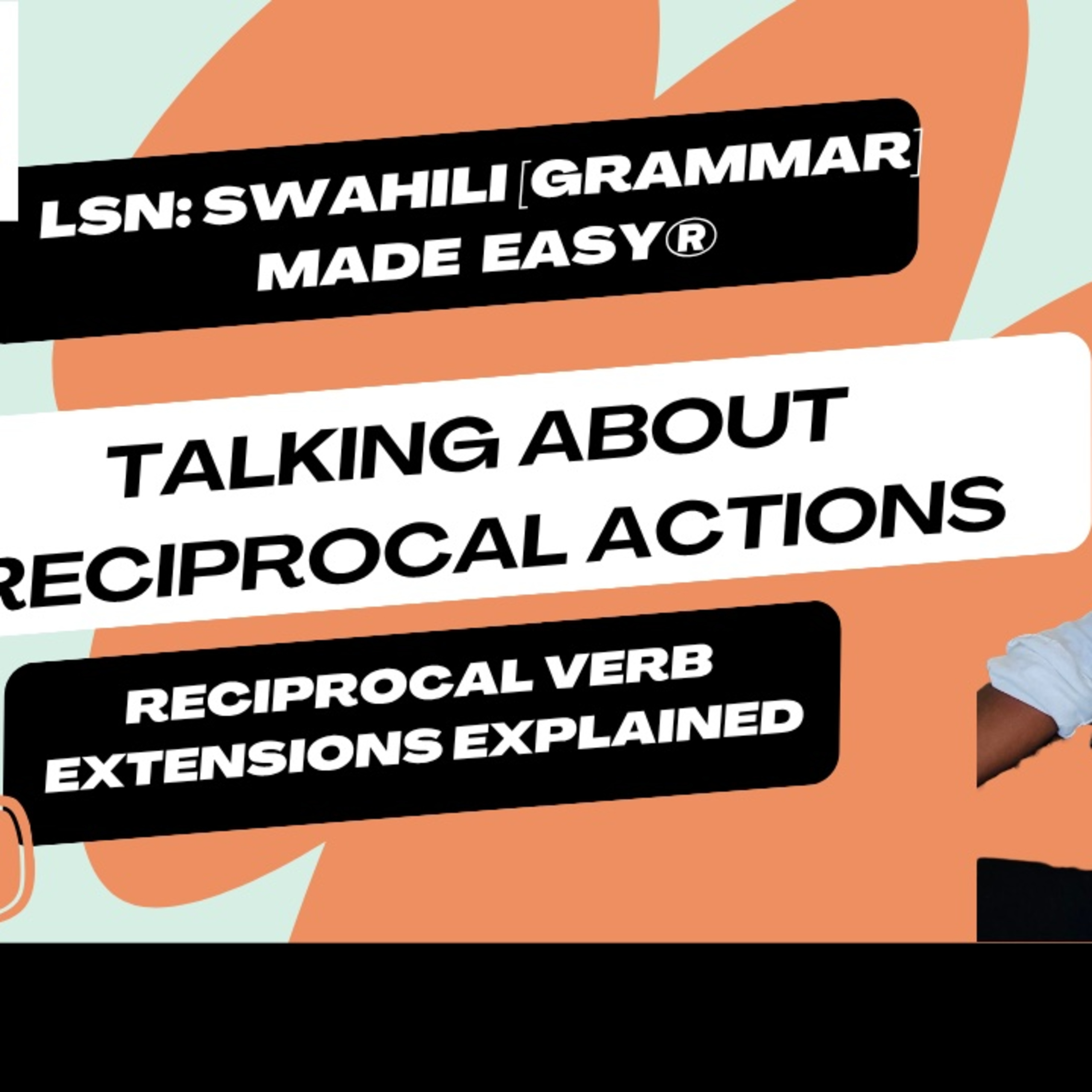
Swahili Grammar Made Easy- Reciprocal verb extensions explained.
If you are just beginning your Swahili journey and want a calm, structured way to finally start speaking with confidence, my free Swahili 5-Day Safari is the perfect place to begin. We focus on practical speaking patterns step-by-step so you are not left guessing what to learn next. Start here: Your Swahili 5-Day course🎧 In today’s lesson, we explored one of the most beautiful parts of Swahili g
How to Speak about routines in Swahili
Did you like what you watched? Try my free five day course in our LSN: Swahili Made Easy App. Download it here 🔗 Mambo vipi? You may have noticed this…You’ve been learning Swahili for a while.You understand quite a bit. But when it’s time to speak… something doesn’t quite come together.It’s not that you don’t know enough.It’s that things haven’t been fully connected yet.In this lesson, we’re worki
The Missing Piece in Your Swahili: Prepositional Verb Extensions
✨ Start here before we begin 👇🏾If you’re new to Swahili, I don’t want you trying to piece things together on your own.→ Begin with my free Ignite Your Swahili 5-Day ChallengeA simple, guided introduction to help you build a strong foundation.If you already have some experience and you’re ready to go deeper:→ Join All Access: Swahili Made EasyA complete, structured learning path to help you move be
Do not speak Swahili WITHOUT learning this tense.
🌿 Today, we’re spending a little time with the present perfect tense in Swahili.And I want you to think of this as one of those quiet turning points.Because up to now, you may have learned words… maybe even a few sentence patterns… but expressing completed actions, what you have done, what you have said, what you have experienced, that’s where things start to feel more real.So we’re not rushing th
How to say "OF" in Swahili: The small sound that makes all the difference.
The associative -a is one of the most important, and most misunderstood, structures in Swahili. When it’s unclear, possession and relationships across noun classes can feel random, even for serious learners.In this episode, I’m sharing a bonus lesson originally taught to learners who completed my Swahili Noun Class Master Course. This lesson explains what the associative -a does, why it matters, a
Why Swahili Noun Classes Aren’t Hard -You Just Haven’t Seen Them Explained This Way
If Swahili noun classes have ever made you feel confused, overwhelmed, or quietly unsure of yourself, this episode is for you. In this lesson, I walk you through the real logic behind Swahili noun classes, not as rules to memorize, but as a system you can finally understand and trust. This is the very first lesson from my Swahili Noun Classes Master Course, designed for busy, capable adult learner
Stop saying "nilisoma" when you mean "nilimsomea" 🤯
Stop saying "nilisoma" when you mean "nilimsomea" 🤯The difference? One sounds like a textbook... the other sounds like you've been speaking Swahili your whole life.Here's what most learners miss:❌ "Nilisoma" = I read (basic, flat, robotic)✅ "Nilimsomea" = I read FOR HER (personal, meaningful, natural)These 4 little endings (-ia/-ea/-lia/-lea) are the SECRET to sounding like a native speaker:• "Ali
"The directional phrases that transformed my student from tourist to confident speaker"
"🧭 Ever felt lost trying to give or follow directions in Swahili? You're not alone! In this episode, I break down the essential directional phrases that'll have you navigating conversations like a pro. These aren't just words - they're your key to sounding natural and confident when speaking Swahili. ✨ Ready to transform your Swahili speaking skills? Start with my free 5-day &
"The 2-Minute Fix That Makes Your Swahili Sound Native"
**"From sounding like a textbook to speaking like family 👨👩👧👦Today's lesson: The modifier words that separate beginners from confident speakers.'All', 'any', 'some' - these tiny words pack a HUGE punch in Swahili conversations. Get them right, and suddenly you sound like you belong.10 minutes that could transform how your Swahili mother-in-law hears you speak 💫W
🛑 STOP saying "this thing" and "that thing" in Swahili! 🛑
You know that awkward moment when you're trying to point something out in Swahili but end up doing charades instead? 😅Today's podcast breaks down the game-changing demonstratives that'll have you confidently saying:✨ "Hiki kitabu" (this book)✨ "Hizo nyumba" (those houses)✨ "Lile gari" (that car over there)No more pointing and hoping for the best! These sim
"UNLOCK THE SECRET LANGUAGE OF QUESTIONS: Master Swahili Inquisitives in Just 10 Minutes! 🔥
Ever felt lost when trying to ask questions in Swahili? Today's episode breaks down the exact formula East Africans use to ask powerful questions - the kind that build REAL connections with family, friends, and colleagues.Whether you're a traveler preparing for your next adventure, a professional working with East African communities, or reconnecting with your heritage, these inquisitive p
Want to sound more natural when you speak Swahili — without adding more vocab?
In this episode, we’re unlocking the secret weapon of fluent speakers: object infixes.They’re simple, powerful, and often overlooked.In under 10 minutes, you’ll learn:✅ What object infixes are (explained simply!)✅ Why they make your Swahili smoother and more efficient✅ The most common ones you actually need✅ Real-life examples you can use right awayWhether you're learning Swahili for work, travel,
Are You Saying It Right? How to Talk About People in Swahili Without Sounding Off Subtitle: Master the A-Wa Noun Class and Use the Right Tenses with Confidence
Let’s talk about who we’re talking about; literally.The A-Wa noun class in Swahili is used for people and animals, and it plays a huge role in how you form sentences across tenses.But here’s the part most learners miss:👉 You have to adjust your subject prefixes and your verbs based on the noun class and the tense.For example:Anafanya kazi = He/she is workingWanafanya kazi = They are workingAlifany
"Want to sound more natural when talking about your schedule in Swahili? this episode is going to help you speak about your week like a pro."
Ready to talk about your week — in Swahili?In this episode of Swahili Made Easy, we’re covering how to express your weekly routines using simple structures and key vocab like:✅ Mimi husoma kila siku — I read every day✅ Yeye huenda kazini kila Jumatatu — She goes to work every Monday✅ Tunacheza soka kila Jumamosi — We play soccer every SaturdayWe’ll break it down step-by-step so you can:✔️ Use habi
Swahili 101: The Phrases You NEED to Start Speaking
Want to speak Swahili with confidence? Start here.In this episode, we dive into the absolute basics: greetings and introductions. You’ll learn how to say hello in different situations, introduce yourself naturally (without sounding robotic), and build phrases you can actually use in real conversation.Whether you're a total beginner or brushing up on your skills—this episode gives you the foundatio
🗣️ “Cook Her… or Cook for Her? How Two Little Letters Change Everything in Swahili
Ever tried to say “I’m cooking for her” and accidentally said “I’m cooking her” in Swahili? 👀Yep. That can happen.And it all comes down to two little letters: -ia / -ea.In this episode, I’ll break down:The difference between regular verbs and prepositional verbsWhy these endings are essential for clarityEasy examples to help you speak for someone—not accidentally about someone 😅💡 Whether you’re ne
“Did you know one small change can flip your entire Swahili sentence from ‘I went’ to ‘I didn’t go’? 👀” 👉🏽 Let’s break down the past tense—the Swahili way.
How do you say “I didn’t go” in Swahili?Or “He didn’t eat?” 👀In today’s episode of Swahili Made Easy, we’re diving into the past tense—affirmative and negative.Because real fluency isn’t just about what you did… it’s also about what you didn’t do. 💬You’ll learn:✅ Simple past tense structures✅ How to flip a sentence into negation✅ Everyday examples you can actually use. 📲 BONUS: Want to practice wh
The One Prefix You Need to Talk About Someone Else in Swahili
Want to describe someone else in Swahili—like “he’s working” or “she likes coffee”?In this episode, we explore the power of the subject prefix a—a small but mighty piece of Swahili grammar that helps you talk about other people clearly and confidently.You'll learn:What a actually means in a sentenceWhen and how to use itCommon sentence patterns (and how to say them out loud!)Easy mistakes to a
How to say this/these/that/those in Swahili
In this lesson, you will learn how to use Swahili demonstratives. They are an integral part of any language. LEARN what goes into make them and go through some drills to reinforce the concept. ✅ For instance...this child-mtoto huyu... this chair...kiti hiki. Why the difference? Learn this in today's lesson. 🔥Would you like to learn simple Swahili in just 5 days? Check out my free "Ignite
The Swahili present tense: How to create and negate it
In this lesson, you will learn how to work with present tense in Swahili. You will learn what goes into making it, and how to negate it. Enjoy. To learn more you can find my comprehensive courses on the LSN: Swahili for HOAMIS (hearts on a mission app) Download Here➡️ If you are seriously learning Swahili in a non-immersive setting, (that is you do not currently live in a country that the lan
How to formulate the concept of "Any" in Swahili
In this lesson, you will learn how the concept of "Any" Works in Swahili. We will look at the first two noun classes.Want more comprehensive courses? Download my app LSN: Swahili for HOAMIs App from the stores.➡️ If you are seriously learning Swahili in a non-immersive setting, (that is you do not currently live in a country that the language is spoken) and you want to make progress, Hav
How to say "All or Whole" in Swahili
This is an introductory lesson to the -OTE module in my LSN: Swahili for HOAMIs App.-Ote denotes All or Whole.-The ending is always -Ote but the beginning changes to match the noun class-We formulate it by adding the subject prefix to the -ote suffix.Example Watoto Wote.-For nouns in the A-WA class, we only use -ote in the plural form.For inanimate objects ote can be used in both singular forms (d
How to talk about possession "one having"
In this lesson, you will learn how to work with the concept of "one having" in Swahili. It is indicated by the suffix -enye. This possesive enye will change depending on the noun class you are working with. In today's lesson we use the A-Wa noun class.Examples:The child that has a bowl is hungry- MTOTO Mwenye bakuli ana njaa.The children that have bowls are hungry- WATOTO wenye bakula wana njaa.Wa
HOW TO EXPRESS THE CONCEPT OF MANY IN SWAHILI.mp4
In today's lesson you will learn how to work with the concept of "many" in Swahili. like many other concepts, this too is impacted by the noun classes. I will show you an example of how this works with the A-Wa noun class.If you would like to learn more about noun classes and other foundational concepts, you might find my Swahili Building Blocks for Beginner's course helpful. Check it out here!➡️
MINI-LESSON 10- HOW TO SAY ANOTHER/OTHER
In this lesson, you will learn how to work with the modifier "ingine" and the A-WA noun class. Upon completion, please do the assignment below.CLICK HERETo download the LSN: SWAHILI FOR HOAMIS APP, USE THIS LINK OR GO TO ANY APP STORE➡️ If you are seriously learning Swahili in a non-immersive setting, (that is you do not currently live in a country that the language is spoken) and you wa
Mini lesson 8: Swahili Object Infixes with Noun class 3 (U)
In this lesson, you will learn how to work with the the Object infixes in the U class.➡️ If you are seriously learning Swahili in a non-immersive setting, (that is you do not currently live in a country that the language is spoken) and you want to make progress, Having ACCOUNTABILITY is a must.But how are you supposed to be consistent, when you1. Do not know what to study2. Do not have h
Mini lesson 9: Swahili Object Infixes with Noun class 4 (I)
In this video, you will learn how to work with object infixes in the I class.➡️ If you are seriously learning Swahili in a non-immersive setting, (that is you do not currently live in a country that the language is spoken) and you want to make progress, Having ACCOUNTABILITY is a must.But how are you supposed to be consistent, when you1. Do not know what to study2. Do not have hours on e
mini lesson 7: Inanimate objects as subjects, noun class 4
➡️ If you are seriously learning Swahili in a non-immersive setting, (that is you do not currently live in a country that the language is spoken) and you want to make progress, Having ACCOUNTABILITY is a must.But how are you supposed to be consistent, when you1. Do not know what to study2. Do not have hours on end to study3. Do not have a clue how to apply what you have learned4. Do not
Useful Swahili Phrases: PART 1
In this lesson, I teach you useful phrases in the Swahili language that will help you with your comprehension. The video is in drill format which encourages retention rather than just random memorization.
For Lesson notes please go ➡️ HERE➡️ If you are seriously learning Swahili in a non-immersive setting, (that is you do not currently live in a country that the language is spoken) and y
Mini Lesson 6: Swahili Subject prefixes with the 'U' class
This is the sixth video in a series that will help you build your foundation of Swahili grammar. We will learn how to work with inanimate things as object infixes to make simple Swahili sentences. In this lesson, we will work with the singular form of the U-I class.
Access lesson notes ➡️ Here.➡️ If you are seriously learning Swahili in a non-immersive setting, (that is you do not curre
3 Things you can do right now to cut your Swahili study time in Half
Have you ever said to yourself, I have no time to study...Or I need hours every day to make any significant progress in your language? Well, I've got some good news...You do not need a lot of time, in fact with just 20 mins per day you can make significant progress... But, if only you do it right...In this video, I show you 3 things you can do right away to start seeing immediate progress...➡️ If
Mini-Lesson 5: Working with Swahili object Infixes (plural)
This is the fifth lesson in a series that will help you build your foundation of Swahili grammar. We will learn how to work with personal pronouns as object infixes to make simple Swahili sentences. In this lesson, we will work with the plural form. Over the next few weeks and months, we will advance from simple forms to more complex ones.
Lesson notes HERE...➡️ If you are seriously lea
Mini-Lesson 4: Working with Swahili Object Infixes (singular)
This is the fourth lesson in a series that will help you build your foundation of Swahili grammar. We will learn how to work with personal pronouns as object infixes to make simple Swahili sentences. In this lesson, we will work with the singular form. Over the next few weeks and months, we will advance from simple forms to more complex ones.
Lesson notes ➡️ HERE➡️ If you are seriously 
MINI-LESSON 3: Working with Swahili subject prefixes (plural)
This is the third lesson in a series that will help you build your foundation of Swahili grammar. We will learn how to work with personal pronouns to make simple Swahili sentences. We will work with the plural format. Over the next few weeks and months, we will advance from simple forms to more complex ones.
Lesson notes ➡️ HERE➡️ If you are seriously learning Swahili in a non-i
Mini-Lesson 2: How to work with Subject prefixes in Swahili
This is the second lesson in a series that will help you build your foundation of Swahili grammar. We will learn how to work with personal pronouns to make simple Swahili sentences. We will work with the singular form. Over the next few weeks and months, we will advance from simple forms to more complex ones.
Lesson notes ➡️ HERE ➡️ If you are seriously learning Swahili in
MINI-LESSON 1: Introduction to the basic Swahili verb components
UPDATED! The first version of this had distracting music. I have heard you and this is an updated version. This is the first lesson in a series that will help you build your foundation of Swahili grammar. In today's lesson, we will cover the components.Over the next few weeks, we will learn the important components that make up the Swahili verb. In subsequent videos we will learn how to put these












