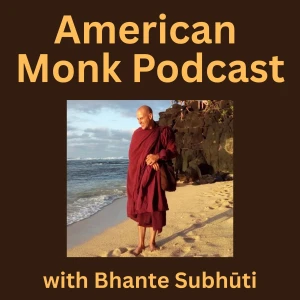
American Monk Podcast
The American Monk Podcast features Dhamma talks and personal reflections from Bhante Subhūti, a Theravāda Buddhist monk based in the United States. Episodes explore Buddhist teachings, meditation practice, and the monastic life, aimed at practitioners and anyone curious about the Buddha's path. Bhante Subhūti draws on the Pali canon and his own experience to make the teachings accessible to a Western audience. The show is a companion to his written work and online Dhamma resources at americanmonk.org.
Episodes

Rupa October 4 2026
Rupa October 4 2026 from Anattalakkhaṇa Sutta
Sept-20-Anattalakkhana_sutta_and_vibhanga
A talk on the Anattalakkhana Sutta and Vibhaṅga (Abhidhamma).
Abhidhamma Plus Jhāna
A talk on Abhidhamma and jhāna.
Buddhism And Artificial Intelligence
Buddhism and Artificial Intelligence as of 2026.
Bhavaṅga and Jhāna
Here we talk about bhavaṅga and jhāna.
Integrating Presence-interview-bhante-subhuti
Interview with Integrating Presence Podcast.
Rūpa Khanda
Here we talk about rūpa and kalāpas.
Five Khandas With The Six Sense Doors
Here we speak about the five khandas as they relate to the six sense doors.
Six Senses Part 2 and Review
Six Senses Part 2 and Review
6 Senses Part 1
6 Senses Part 1
Applying the Beautiful
Applying the Beautiful. A talk on applying the 19 beautiful cetasikas from the Abhidhamma.
Beautiful Factors
A discussion on the beautiful factors in Theravāda Buddhism.
Preparing for Meditation
The metta sutta has a lot of information about the qualities needed for successful meditation, or how to prepare for meditation whether it is loving-kindness...
Importance of Chanting
This talk is about how we should develop a habit to chant in order to escape from samsara.
Samsara Travels
About saṃsāra and how we meet people again and again.
Loving Kindness Wins
Loving-kindness wins. Story about alms in Hawai'i
5 Ways Good and Bad
Bhante Subhūti explains five ways in which phenomena, actions, or mental factors can be classified as good (kusala/wholesome) or bad (akusala/unwholesome) according to Theravāda teachings. The talk emphasizes discernment of wholesome and unwholesome states to support ethical conduct, meditation, and progress on the path.
Computer Loving-Kindness
Bhante Subhūti presents a unique explanation of mettā (loving-kindness) meditation, employing a computer analogy to illustrate how to generate and extend boundless goodwill toward oneself and all beings, making the practice more relatable for modern listeners.
What Is Killing Landscape
In Buddhism, “Killing” is defined by the technical mechanics of the mind, not by social laws. The unwholesome Kamma is complete only if five factors are present. This talk explores the deeper meaning of killing in relation to landscapes, nature, intention, and Theravāda teachings.
Protect Your Trunk
Bhante Subhūti delivers a Dhamma talk on the importance of refraining from deliberate lying (musāvāda), drawing from Majjhima Nikāya 61. The discourse uses the metaphor of an elephant protecting its trunk in battle to illustrate the Buddha's instruction to Venerable Rāhula on safeguarding truthfulness as a core aspect of sīla (morality) and the precepts.
Why Is Halloween Bad According to Theravāda Buddhism?
Bhante Subhūti explains why Halloween is considered unwholesome in Theravāda Buddhism, showing how dressing up and acting can create future kamma and influence rebirth. He also shares how the power of mettā can truly protect one from fear and spirits.
The Famous Buddhist Blessing
Bhante Subhūti explains the meaning and background of one of the most famous Buddhist blessings, often chanted after a meal offering to the Saṅgha.
Einstein and the Triple Gem
How I explain the Triple Gem to Westerners by relating it to Albert Einstein.
Mystical Purification?
Exploring the meaning of Pāṭimokkha purity in Theravāda Buddhism.
Shame Good for Meditation?
Exploring how hiri (moral shame) and ottappa (fear of wrongdoing) support meditation as beautiful mental factors.
What is Vassa (rainy season)
what is buddhist rainy season
Beautiful Mental Factors (Abhidhamma)
Explains the beautiful mental factors from the Abhidhamma, focusing on hiri (moral shame) and ottappa (fear of wrongdoing).
Does Buddhism Have a Creator?
Discusses the Buddhist perspective on whether there is a creator, explaining kamma as the driving force behind existence.
Alms in Florida
Bhante Subhūti recollects going for alms in Geneva, Florida and using mettā (loving‑kindness) as the basis for this practice.
Greetings: How Monks Greet Each Other
Explains the traditional three‑part greeting among monks: paying respect, sharing merits, and offering mutual apologies with Pāḷi phrases.
The Other Meditations (40 meditation subjects)
An overview of the 39 other meditation subjects besides in‑and‑out‑breath meditation, including kasinas, asubha, recollections, brahmavihāras and immaterial jhānas.
More on Alms and Drone Footage
Discusses the Theravada alms food collection process with video clips and references to suttas such as Itivuttaka 75 and the Culagosinga Sutta.
How to Know Qualities for Meditation
Explores the qualities needed for meditation development as listed in the first three stanzas of the Metta Sutta, showing their relevance beyond loving‑kindness practice.
About the Dhammapada
Discusses the Dhammapada and its place within Theravada Buddhism.
Myanmar Rubber Tree Alms: Giving to Give More
Tells the story behind Dhammapada verse 118 about giving and receiving, using a rubber tree alms story from Myanmar.
Money Rules and Monks
Explains the rules regarding money for Theravada monks and how these rules are observed in daily life.
About Alms in Sri Lanka (Buddhist)
A discussion of the alms‑round (piṇḍapāta) in Sri Lanka, with video footage.
A Promise for the Future
Reflects on determinations made during chanting to follow the Triple Gem, relating personal vows as a Western monk to end saṃsāra.
Interview with Bhante Subhūti (2003)
An interview with Bhante Subhūti from 2003, recorded at Pa‑Auk, discussing his experiences as a monastic.
How I Got Permission to Ordain
Bhante Subhūti recounts how he obtained his parents’ permission to ordain and the significance of parental consent in the Vinaya.