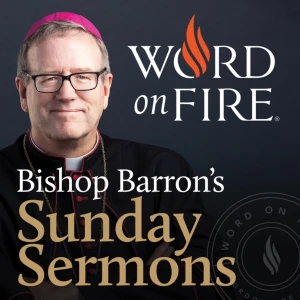
Bishop Barron’s Sunday Sermons - Catholic Preaching and Homilies
Weekly homilies from Bishop Robert Barron, produced by Word on Fire Catholic Ministries. Each episode offers a reflection on the Sunday Mass readings, providing spiritual insights and practical applications for Catholic life. The podcast aims to help listeners deepen their faith and understanding of the Gospel.
Episodes
The Invitation Has Been Offered
Friends, our Gospel today is the parable of the wedding banquet, and like all the parables, it’s kind of unsettling. What we’re meant to see is that this invitation from the king is the greatest invitation possible. God the Father is asking you, personally, to come to the marriage feast for his son. Therefore, the refusal to accept that offer is the central tragedy of the spiritual life. Will you
The Peace of Christ
Friends, in our second reading this Sunday, Paul tells the church of Philippi, “Have no anxiety at all.” It’s hard to imagine that Paul—who was shipwrecked many times, beaten within an inch of his life, threatened and harassed and persecuted and opposed, and finally arrested, dragged to Rome, and decapitated—never experienced any anxiety. So what does he mean? What he says next is the clue: “But i
The Hubris of Man, the Humility of God
Friends, our second reading, a passage from the second chapter of Paul to the Philippians, is one of the master texts in the New Testament. It’s not only ancient and poetic but also substantive; indeed, in some ways, it lays out the whole of Christianity. Adapting an early Christian hymn, Paul presents the answer to Adam’s grasp at divinity—namely, the self-emptying love of God.
Love God—Not His Benefits
Friends for this Twenty-fifth Sunday in Ordinary Time, we hear a story from Jesus that tends to bother everybody: the parable of the laborers in the vineyard. We’re meant to hear our own voices in the complaint of these workers. Dealing with God, we often think things are unfair. Why does he do what he does? I’d like to get at this with a clarification that comes out of the heart of the spiritual
You Belong to the Lord
Friends, our Gospel for this Twenty-fourth Sunday in Ordinary Time is the familiar story of Peter asking the Lord how many times he should forgive his brother: “As many as seven times?” Jesus responds, “Not seven times but seventy-seven times.” I want to get at this passage by looking at the second reading, taken from the Letter of Saint Paul to the Romans, which sheds distinctive light on it. Whe
Will the Good of the Other
Friends, for the wokeist philosophy that dominates today, empathy—feeling the feelings of the other and not harming those feelings—is treated as a supreme value. But while empathy is perfectly good and decent, the Bible teaches that love, not empathy, is the supreme value. And love does not mean, primarily, feeling the feelings of the other or not hurting those feelings; it means willing the good
A Living Sacrifice
Friends, for this Twenty-second Sunday in Ordinary Time, I want to begin with our very brief second reading from Paul to the Romans. It opens, “I urge you, brothers and sisters, by the mercies of God, to offer your bodies as a living sacrifice.” Here we see Christ’s cross and resurrection—the supreme sacrifice fulfilling all the offerings of the temple—extended to all the baptized. The Church is n
The Church Prevails
Friends, for this Twenty-first Sunday in Ordinary Time, the Church brings us once again, with Jesus and the disciples, to Caesarea Philippi, and to a famous question: “Who do you say that I am?” The main characters in this endlessly fascinating scene are Jesus and Peter, and whenever the focus is on Peter, we’re talking about ecclesiology, the study of the Church. So we learn something very import
How Not to Read the Story of the Syrophoenician Woman
Friends, for this Twentieth Sunday in Ordinary Time, we hear the story of the Syrophoenician woman. Jesus famously puts off this woman—first by ignoring her, then by dismissing her, and finally by insulting her—and she offers one of the most famous comebacks in literary history. A common reading of this story is that Jesus is cranky from a tough day of ministry, and a plucky woman from Syrophoenic
A Tiny Whispering Voice
Friends, in my evangelical work online, I often encounter people who are skeptical of religion and dismissive of its claims. I usually ask them: How do we explain the intelligibility of the world or our ability to understand it? How about objective values and our ability to recognize them? Our first reading from 1 Kings reflects, I think, a great breakthrough in Western consciousness about how we’
The Heart of Christianity
Friends, on this Eighteenth Sunday in Ordinary Time, I want to focus on the Second Reading from Saint Paul’s Letter to the Romans. The eighth chapter of Romans represents the culmination of an argument Paul’s been making, and the reading for today is the rhetorical high point of that conclusion. This is the first great theologian of the Church naming what is essential to Christianity—so we have to
What Life Is All About
Friends, we come to the Seventeenth Sunday in Ordinary Time, and we’re going to finish our reading of the thirteenth chapter of Matthew's Gospel, which deals with the parables. Jesus’s parables cut to the heart of the matter and convey the truth of the kingdom, and the two we hear today—the parable of the hidden treasure and the parable of the pearl—are really good examples. Both are about the sum
All Things Work Together for Good
Friends, we continue this weekend reading from the thirteenth chapter of Matthew's Gospel, which is dedicated to the parables of Jesus. Today I want to focus on the thought-provoking and theologically rich parable of the wheat and the weeds. A man sows good seed on his field, and while he’s asleep, an enemy sows weeds among the wheat. But the man resists the impulse to pull them up, as it might up
Let the Word of God Take Root in You
Friends, on this Fifteenth Sunday in Ordinary Time, we continue our reading of the Gospel of Matthew. In chapter 13, Jesus gives a series of seven very memorable parables, the first four having to do with the growth of the kingdom of God. The first of these, which we’re reading from today, is the parable of the sower. What do we hear? That it’s never a question of God being reticent or holding bac
Your King Shall Come to You
Friends, on this Fourteenth Sunday of Ordinary Time, our first reading is from the prophet Zechariah, who is a very important figure for the Lord Jesus. The prophet predicts the arrival of a king, meek and riding on a donkey—a king who will “proclaim peace to the nations” and extend his dominion “to the ends of the earth.” This strange text from the ancient world has been fulfilled in our hearing
Be Attached to God Alone
Friends, we’re reading this week again from the tenth chapter of Matthew’s Gospel, and Christ’s teaching here is—as always—astonishing: “Whoever loves father or mother more than me is not worthy of me,” Jesus says to his apostles, “and whoever loves son or daughter more than me is not worthy of me.” There are points of overlap with Jesus’s teachings in all the great religions of the world—but ther
Fear No One
Friends, Jesus cannot be reduced to just one ethical teacher among many. But this doesn’t mean that his teaching isn’t important or astonishing—because it is! And I want to focus this week, and next, on our Gospel readings from the tenth chapter of Matthew. As Jesus sends his disciples on mission, he gives them, and us, a wonderful instruction in the spiritual life. What we hear, as I say, is asto
Jesus Sees Something in You
Friends, on this Eleventh Sunday in Ordinary Time, the Gospel is about Jesus sending the Twelve on a mission. Whenever we hear about the Twelve, it’s the Church in seminal form. And here’s what I want to focus on: Whom does Jesus call to be his apostles? Not the best and brightest people of his time but fairly ordinary and even compromised characters. Yet Jesus sees something in every one of them—
From the Exodus to the Eucharist
Friends, we’ve come to the great Solemnity of Corpus Christi—a celebration of the Body and Blood of Christ in the Eucharist. Our first reading mentions the “manna” that fed the Israelites in the desert—a mysterious bread from heaven described in the book of Exodus. This is then correlated to the Eucharist, the bread from heaven that Jesus gives us, in our Gospel from the sixth chapter of John. I w
The Father, the Son, and the Holy Spirit
Friends, we’ve come to Trinity Sunday, one of my favorite Sundays of the year. The Trinity is not just a little puzzle for theologians; it’s the heart of the matter, in many ways. Indeed, it’s central to the way we pray: Whenever we make the sign of the cross, we’re invoking the Trinity. It matters that we come to understand this doctrine more plainly, so that we might understand the meaning of ou
Tongues of Fire
Friends, we’ve come to the great Solemnity of Pentecost, which is, along with Christmas and Easter, one of the most important feasts of the Christian year. It is the celebration par excellence of the Holy Spirit. It is also the birthday of the Church—and we are meant to see ourselves in the readings for today.
What Is the Spirit Calling You to Do?
Friends, today is the great Solemnity of the Ascension of the Lord, which is situated between Easter and Pentecost. The Ascension is when Jesus definitively moves into the higher dimension of heaven. And while we no longer have experiences like the disciples had of the risen Lord, we experience him through his Holy Spirit, who equips us to continue Christ’s work in the world.
Five Signs of the Holy Spirit
Friends, we come to the Sixth Sunday of Easter, which means we’re coming to the end of the Easter season—and coming toward the Solemnity of Pentecost. After Christmas and Easter, this great feast of the Holy Spirit is the most important of the Church year. And in our three readings for today, we see five signs—in the Church broadly speaking and in your own life—that the Spirit is present and movin
The Dwelling Place of God
Friends, on this Fifth Sunday of Easter, there’s a somewhat hidden theme that runs like a golden thread through the readings, and that theme is the temple. To understand the New Testament texts, we have to see the importance of the Jerusalem temple for ancient Israelites. It was the focal point of Jewish life—the political, cultural, and of course religious center of the country. It was seen, in a
Cut to the Heart
Friends, all during the Easter season, we read from the Acts of the Apostles, and this Sunday, we hear part of Peter’s oration on Pentecost morning. His bold proclamation is, in a way, the mother of all sermons; it is the essence of authentic Christian preaching. Peter, filled with the excitement of the Gospel, names the problem of sin, declares Jesus as Lord and Christ, and cuts his listeners to
The Pattern and Presence of Jesus
Friends, for this Third Sunday of Easter, we read once again the story of the two disciples on the road to Emmaus—a literary masterpiece, yes, but above all, a spiritual masterpiece. This story is not just about something that happened long ago; it's also about the Church now, and in all times. And it tells us who Jesus is and how to recognize him.
Both His Wounds and His Peace
Friends, peace be with you—an echo of the words of the risen Jesus in our Gospel for the Second Sunday of Easter, also called Mercy Sunday. Christ gives his disciples the gift of shalom (peace). But there’s an exceptionally important juxtaposition here: He also shows them his wounds, a sign of humanity’s own sin and dysfunction. It’s not one or the other, his peace or his wounds; it’s both. To get
The Earthquake of the Resurrection
Friends, Happy Easter! We’ve come to the high point of the Church’s liturgical year, the reason why we’re Christians at all. If Jesus didn’t rise from the dead, Christianity is a waste of time; the resurrection is the hinge point, the standing or falling point, of our faith. Taking Easter seriously is the source of our joy and our hope. Everything else is secondary to the great declaration of our
God Enters Into Our Darkness
Friends, we come now to Palm Sunday, also called “Passion Sunday” because we read, in its entirety, one of the Passion narratives from the Synoptic Gospels. This year, we hear Matthew’s version, and one of the distinctive qualities of Matthew’s account is his stress on Judas—and more precisely, on the deep regret that Judas felt over his betrayal of the Lord. We’re challenged here to contemplate t
Jesus Wept
Friends, this Lent, we’ve been journeying through some marvelous stories in John: the woman at the well two weeks ago, the man born blind last week, and now the climactic story of the raising of Lazarus. The great miracles of Jesus in John’s Gospel are referred to as “semeia” in Greek—“signs.” They’re indicators of God’s power and manner that teach us great truths about our spiritual lives. And th
The Light of the World
Friends, on this Fourth Sunday of Lent, we hear the incomparably rich story of the man born blind, which has beguiled Christians up and down the centuries. We are meant to identify with this man: All of us are born into a world that has been infected by cruelty and violence and hatred. Original sin blinds us; it takes us out of the light. But Christ declares himself “the light of the world”—the on
Thirsting for God
Friends, on this Third Sunday of Lent, we hear the story from John’s Gospel of the woman at the well—a kind of master class in evangelization. What is evangelization all about? It’s about telling starving people where to find bread; it’s about telling people dying of thirst where to find water. Every one of us sinners seeks life in this way; thus, this story, so rich in its dynamics, is a story ab
The Adventure of Salvation
Friends, on this Second Sunday of Lent, our first reading about Abraham and Matthew’s account of the Transfiguration orient us to a basic biblical principle. God has made us to go out from ourselves, to experience the splendor of reality. The more we let go of ourselves and our prerogatives—and the less we try to grasp and hang on to things—the more alive we become. Salvation, therefore, has a lot
The Serpent’s Slogans
Friends, we commence the holy and wonderful season of Lent, the time of preparation for Easter. I always think of Lent as something like spring training for baseball players, or like the end of the summer workouts for football players. It’s a time to get back to spiritual basics, to reacquaint ourselves with the elemental things in the spiritual life that we might get ourselves ordered to Christ.
Which Path Will You Choose?
Friends, this Sunday, right before the commencement of Lent, the Church is giving us something of great moment to reflect on—namely, the centrality of freedom and choice for the good at the center of the spiritual life. As Thomas More puts it in A Man for All Seasons, “God made animals for innocence and plants for their simplicity. But Man He made to serve Him wittily, in the tangle of his mind.”
Become Someone for Others
Friends, a great professor of mine at Mundelein Seminary, Dr. Richard Issel, once said, “If you want to be happy, stop worrying about being happy and get on with becoming fulfilled.” We find something similar in Jordan Peterson’s observation that “self-consciousness is equivalent to misery.” In short, we’re most unhappy when we’re turned inward, fussing about ourselves. If you want to be psycholog
Do You Want to Be Happy?
Friends, for the next several weeks, we’re going to be reading in our Gospel from the primal teaching of Jesus: the Sermon on the Mount. And we begin today with a kind of overture to it, which we call the Beatitudes. “Beatitudo” in Latin means “happiness”—the one thing we all want, no matter who we are or what our background is. Jesus, the definitive teacher, is instructing us on what will make us
Unity in Christ
Friends for this Third Sunday in Ordinary Time, our first reading from the prophet Isaiah and our Gospel from Matthew both have a section that’s a little weird. While most preachers skip over these sections to get to the better-known and understandable parts, I want to dwell, on purpose, on the strange parts—and they have to do with the lands of Zebulun and Naphtali.
The Lamb Who Takes Away the Sin of the World
Friends, we return now to Ordinary Time, and the Church asks us again to think about the baptism of the Lord, this time in light of Saint John’s distinctive account. John the Baptist sees Jesus coming toward him on the banks of the River Jordan, and the Baptist says, “Behold, the Lamb of God, who takes away the sin of the world.” You recognize that line from the Mass, when the priest holds up the
Side by Side with Sinners
Friends, we come to this wonderful feast of the baptism of the Lord. And the first thing to know is that this was a profoundly embarrassing event for the first Christians. Jesus is the son of God, the sinless Lamb of God, who takes away the sins of the world. So why is he going to John the Baptist to seek a baptism of repentance? Jesus begins his public ministry with a kind of embarrassing, humili
The Answer to Your Deepest Longing
Friends, why has the story of the Epiphany—the three wise man paying homage to the Christ child—so captivated us over the centuries? I think, in some ways, it tells the whole spiritual life: our infinite longing that will never be satisfied here below; the following of beautiful but ambiguous signs in our quest for God; and the revelation that the one we seek has all along been seeking us—and, in
Protect the Life of Christ in You
Friends, the great feast of the Holy Family follows immediately upon Christmas—a very interesting juxtaposition with a deep theological significance. The Savior came as a little baby who required the protection of a family, and from the beginning, he was opposed by forces both seen and unseen. Christmas is finally about the birth of Jesus in us—a life that might begin as something very vulnerable
Are You Willing to Surrender to God?
Friends, our readings for the fourth and final Sunday of Advent are all about maybe the central motif of the spiritual life. Our culture today is so self-oriented: It’s all about me and my choice. But that attitude is directly repugnant to the Bible; in fact, the Bible is constantly trying to move us out of that space and into a different space—namely, one of surrender to the higher purpose of God
Waiting in Action
Friends, our readings for this Third Sunday of Advent help us understand what to do while we wait for the Lord. An Advent spirituality of waiting is part of Christian life; our entire life, in a way, is waiting. We pray, “Come, Lord Jesus,” waiting for Christ to come back. But this is not just a passive stance; there is a lot to do while we wait.
The Seven Gifts of the Holy Spirit
Friends, our first reading for this Second Sunday of Advent, taken from Isaiah 11, describes the Messiah’s arrival: He “shall sprout from the stump of Jesse,” and “the spirit of the LORD shall rest upon him.” The Messiah, we hear, will come bearing seven gifts of the Holy Spirit, gifts that come to full expression in him. The Advent season is a time of longing for these gifts—watching, waiting, an
The Season of Sacred Waiting
Friends, we come to the New Year celebration of the liturgical year: the First Sunday of Advent. This is the season of sacred waiting—four weeks of looking, hoping, and watching, with a kind of joyful anticipation, for the adventus (coming) of the Savior. If you’re like me, you rather hate to wait. Yet waiting is all over the Bible, and at the heart of it is the painful process of decentering the
The Marks of Spiritual Leadership
Friends, we come to the final weekend of the liturgical year and the celebration of the Solemnity of Christ the King. Now, our country was formed in rebellion against a king, and kingship as a political reality is far removed from us. But what does kingship mean for us spiritually? In a word, everything. If you’re baptized, you’re a king, because you’re conformed to Christ, who is priest, prophet,
The Old World Has Been Shaken
Friends, we come to the Thirty-third Sunday in Ordinary Time, which means that next Sunday is the final Sunday of the liturgical year. During this time, the Church always gives us apocalyptic readings, and our Gospel today is from “the little apocalypse” in the Gospel of Luke. Apokalypsis in Greek does not mean “end of the world”; it means “unveiling”—taking away the kalyptra, the veil. This is wh
The Place of Right Praise
Friends, this Sunday we’re celebrating, with the whole Church, the dedication of the great cathedral of Rome: the Lateran Basilica. You could argue very persuasively that this see church of the pope is the most important of the four major basilicas in Rome; it is the great temple of Catholicism worldwide. This is why the readings for today are all about the temple, this place of right praise where
Why We Pray for All Souls
Friends, All Souls Day, November 2, falls on a Sunday this year, so we can really spend some time reflecting on this wonderful feast, which means so much to Catholic people. Why do we pray for the souls in purgatory? I wonder if I could begin by reflecting on why we speak of the “soul”—this higher principle breathed into us by God that survives the death of the body.
Are You Revolving Around God—Or God Around You?
Friends, for this Thirtieth Sunday of Ordinary Time, we are treated to the wonderful and deeply challenging parable of the Pharisee and the publican from Luke 18. We are meant to see in this deceptively simple story a basic and clarifying principle in the spiritual order—namely, that the ego is meant to revolve around God, not God around the ego. And this might not be immediately clear: Sometimes
The Power of Prayer
Friends, when something tragic happens and people offer their prayers, you’ll often hear now, “I've had it with thoughts and prayers. We have to act.” In some extreme cases, people of prayer are mocked, as though prayer is just something completely ineffectual that we should leave behind in favor of action. We’re the first generation in recorded human history ever to feel this way. Human beings, a
The Gospel Is Jesus Christ
Friends, in our second reading this Sunday, Paul writes to Timothy, “Remember Jesus Christ, raised from the dead, a descendant of David: such is my gospel.” The Gospel is not the ethical teachings of Jesus or the doctrinal teachings of Saint Paul; the Gospel is Jesus himself. And Christianity is not a noble spiritual path or a set of ideas; it’s a relationship to Jesus. All those other things are
Trust in God’s Plan
Friends, this Sunday, I want to talk to you once again about faith. As I’ve said before, faith is the most misunderstood word in the religious vocabulary. And both the first reading and the Gospel today shed very interesting light on the nature of faith, which is not a kind of superstition—believing in any old nonsense—but rather an attitude of humble trust in the ways of the Lord.
Love for the Poor
Friends, Pope Benedict XVI memorably told us that the Church does three essential things: It worships God, it evangelizes, and it serves the poor. This week, the first reading from the prophet Amos and the Gospel parable of the rich man and Lazarus bring that third task vividly to mind—and they are meant to bother us. Are you indifferent to the sufferings of the poor? What are you doing, concretel
The Use—and Abuse—of Power
Friends, for this Twenty-fifth Sunday of Ordinary Time, I want to focus on the first and second readings. When read together, they give us a very good sense of Catholic social teaching in regard to the question of power. The Church’s position here is a subtle one. It doesn’t demonize political and economic power; after all, God is described as all-powerful, so power can’t, in itself, be a problem.
Christ, and Him Crucified
Friends, this year, the Feast of the Exaltation of the Holy Cross falls on a Sunday, so we have the great privilege of reflecting a bit more deeply on this marvelous and, frankly, disconcerting and odd feast. The Roman cross was a horrific, terrifying symbol of tyrannical power. And yet the first Christians emerge exalting the cross of Jesus. They don’t hide it or pretend he died some other way; o
Are You Ready for Serious Discipleship?
Friends, for this Twenty-Third Sunday of Ordinary Time, we’re reading from the fourteenth chapter of Luke—and it is very serious spiritual business. A lot of us sinners are satisfied with a low-level spirituality of following the commandments. But in this extraordinary Gospel, Jesus challenges us to move into the upper levels of the spiritual life: “If anyone comes to me without hating his father
Don’t Play the Pride Game
Friends, for this Twenty-second Sunday of Ordinary Time, I want to talk to you about a very important theme—namely, pride and its antidote. I don’t know a spiritual teacher who doesn’t say that the fundamental problem we have is pride; it is the most deadly of the deadly sins. The opposite of pride is humility—and whereas the proud person is caved in around himself, the humble person leaves the bl
Does God Punish Us?
Friends, I want to focus this week on the second reading, which is from the marvelous Letter to the Hebrews. It addresses a very important and very controversial topic—namely, the divine punishment. You would be hard-pressed to say that this is not a motif in the Bible. That’s simply not the case; in fact, it’s a rather major motif. How do we make sense of this theme of divine punishment without f
Christ Came to Cast Fire Upon the Earth
Friends, the title of my ministry, Word on Fire, came from our Gospel for today. Jesus says to his disciples, “I have come to set the earth on fire, and how I wish it were already blazing!” This is not the lighting of a cozy campfire. This is closer to, if you want, Sodom and Gomorrah—to fire and brimstone. It is a dangerous and divisive fire. Christ is the light of the world, the divine luminosit
What Is Faith?
Friends, on this Nineteenth Sunday of Ordinary Time, our second reading from the Letter to the Hebrews offers us a great biblical description of faith. I stand with Paul Tillich, the Protestant theologian, who said that faith is the most misunderstood word in the religious vocabulary. Critics of religious say that faith is accepting things on the basis of no evidence; it’s believing any old nonsen
All Things Must Pass
Friends, George Harrison once sang, “All things must pass; all things must pass away.” Almost every major religious figure and philosopher the world over has intuited this great truth about our world. It’s good, and there are good things in it—a beautiful sunset, an enjoyable meal, a great conversation—but they don’t last. With that in mind, let’s turn to our readings for this Eighteenth Sunday of
Lord, Teach Us to Pray
Friends, we have the great privilege this week of reading, in our Gospel, Luke’s account of the Lord’s Prayer. This is a very sacred moment: Jesus himself—not just a spiritual guru or someone we admire, but the very Son of God—teaches us how to pray. And we become so familiar with the Our Father that we forget its spiritual power.
Are You Anxious and Worried About Many Things?
Friends, on this Sixteenth Sunday of Ordinary Time, our Gospel is the Martha and Mary story, and in my years of preaching, I’ve found that it tends to bother people a lot. With the first reading about Abraham in mind, we can better understand what this passage means—and doesn’t mean. Rather than playing one sister off the other, we should read Martha and Mary together: When we focus on the “unum n
The Natural Law
Friends, in our first reading from the book of Deuteronomy this week, Moses says to the people, “For this command that I enjoin on you today is not too mysterious and remote for you. . . . No, it is something very near to you, already in your mouths and in your hearts; you have only to carry it out.” This is a master text for what we call in the Catholic tradition “the natural law.” It means that
The Church’s Marching Orders
Friends, as we resume Ordinary Time, it’s appropriate that we’re looking at a portrait of the Church, because we’re coming back, if you want, to the ordinary work of the Church up and down the ages to the present day. Our Gospel from the tenth chapter of Luke gives us our marching orders—from going on mission together and staying rooted in prayer, to trusting in providence and supporting the work
The Church Is Built on the Rock
Friends, this year, the feast of Saints Peter and Paul falls on a Sunday, and I want to spend some time reflecting especially on Saint Peter. Around the year 64, Shimon Bar Yonah, a fisherman from Galilee, was put to death brutally in the Circus of Nero. But while the Roman Empire is long gone and the successor of Nero doesn’t exist, the empire of this fisherman, Peter the Apostle, is everywhere,
Join Your Life to Christ’s Sacrifice
Friends, every year we have Trinity Sunday followed by today’s wonderful Solemnity of Corpus Christi—two of the highest theological mysteries of our faith, the Trinity and the Eucharist, back to back. As we reflect today on the Body and Blood of Jesus, I want to explore the deep connection between temple sacrifice, the altar of the cross, and the Mass.
The Theology of the Trinity
Friends, today is Trinity Sunday—one of my favorite feast days of the year because I can put my old theologian’s cap on. Looking first at one of the greatest of the medieval theologians, Saint Bonaventure, and then at maybe the greatest figure in Western theology, Saint Augustine, I’d like to reflect with you on the dynamics of the Trinitarian life—the very matrix into which we’re inserted through
The Fruit of the Spirit
Friends, this is the great feast of Pentecost, the feast of the Holy Spirit. In the First Reading, the Spirit manifests himself as a strong driving wind, and while you can’t see the wind directly, you can see its effects. The text I want to reflect on today is not in the readings but is one of my favorites: Galatians 5:22–26, when St. Paul talks about “the fruit of the Spirit.” And it’s precisely
Seated at the Right Hand of the Father
Friends, getting the Ascension of the Lord right is very important for understanding many aspects of the Church’s life. So I want to dwell on that a little bit with you today, and I want to do so under two headings: the first I’m going to call more political, and the second more liturgical. They are both hinted at in the great statement in the Creed that we recite week after week: “He ascended int
The Holy Spirit Will Teach You Everything
Friends, we come to the Sixth Sunday of Easter, and as the Church readies us for Pentecost, the readings begin to talk about the Holy Spirit. In today’s Gospel, Jesus, speaking to his disciples the night before he dies, says, “The Advocate, the Holy Spirit, whom the Father will send in my name, will teach you everything and remind you of all that I told you.” In the beginning was the Word, and the
The Love That Jesus Commands
Friends on this Fifth Sunday of Easter, we have an extraordinary Gospel that is at the heart of the Christian thing. Jesus, at the beginning of a lengthy and incredibly rich monologue he gives the night before he dies, says to his disciples, “I give you a new commandment: love one another. As I have loved you, so you also should love one another. This is how all will know that you are my disciples
The Voice in the Depths of Your Soul
Friends, on this Fourth Sunday of Easter, we have this marvelous, short but very punchy reading from the Gospel of John: Jesus referring to himself as the good shepherd. This is a remarkably apt metaphor for how God reaches out to us—knows us personally—and how we are able to discern and follow his voice. But how do we hear the voice of the shepherd? In a lot of ways—but I wonder if the clearest w
Becoming a Disciple of Jesus
Friends, on this Third Sunday of Easter, we have the magnificent Gospel from the very end of the Gospel of John, chapter twenty-one, which is so rich theologically. We see here, on full display, what it means for us—who are all ambiguous characters—to stop resisting the cross of self-denial and love and to walk the way of the Lord.
Everything Has Changed
Friends, we enter now into the Easter season, and here is the thing I want you to know: We misunderstand Easter dramatically when we think primarily of spring festival time, the weather getting nicer, and Easter bunnies and bonnets. All of that is great; but if you don't understand Easter as a revolution—as an earthquake that has changed the entire world—you have not understood it.
Something Happened on Easter!
Friends, happy Easter! Many of you probably know that I’ve spent much of my life reading philosophers and spiritual writers—Plato, Aristotle, Confucius, Cicero, Marcus Aurelius, Anselm, Aquinas, Kant, Hegel. What all those figures have in common is a kind of calm, musing detachment as they talk about high ideas. Well, there’s all of that—and then there’s the Gospel, the “Good News.” Yes, the Gospe
The Forgiveness of Sinners
Friends, we come to Palm Sunday, which is also called Passion Sunday because we always read at Mass the Passion narrative from one of the synoptic Gospels. This year, we hear from Saint Luke, and I want to look at two elements unique to his particular version, both of which have to do with forgiveness.
The Conversion of Saint Paul
Friends, we come to the Fifth Sunday of Lent, and I want to reflect today on our second reading from the Letter of Paul to the Philippians. It is a passage of both literary genius and spiritual power, one that uses the language of conversion—of letting go of the way I understood and defined my life and turning toward an entirely new way.
Recommended

Solved Murders - True Crime Stories

紐約鳥|New York Aperture
The Swerve Podcast: Obscure Topics | Conspiracy Theories

The Bread and Banter Podcast
The Church of What's Happening Now: The New Testament
Busted Open

Deadline: White House

Crickets Corner

History of the Earthquake and Fire in San Francisco

Fox news

K-Drama Obsessed Mamas | Beyond “Just One More Episode!”

True Crime Classics
