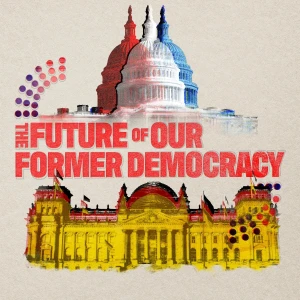
The Future of Our Former Democracy
After World War II, Germany redesigned its electoral system to prevent another faction like the Nazis from taking over the government ever again. In the new season of the award-winning podcast from More Equitable Democracy, we examine far-right movements in modern Germany and the U.S. to explore what lessons from German political history might mean for American democracy.
Episodes

From Penal Colony to Democracy Lab
How does a British penal colony become one of the world's most trusted democracies?
Ruth and Colin head back to 1788 to trace how a society of convicts and guards pioneered the secret ballot, the living wage, and the eight-hour workday, blending Washington and Westminster into a democracy all its own, built on the ethos of the "fair go." But that story is inseparable from the dispossession and ge

Vote, Surf, Sausage: A Recipe for Trust Down Under
Welcome to Season 3 of The Future of Our Former Democracy!
Colin is joined by new co-host Ruth Greenwood, director of Harvard Law School's Election Law Clinic and proud Australian expat, as the show heads Down Under. In Australia, elections are "boring, boring, boring," and voters across the political spectrum trust the results in a way Americans rarely do.
Colin and Ruth explore why.
Spec

Season 3 Trailer: The Commonwealth of Australia
Australia built its democracy on the American model, then kept revising it: the secret ballot, ranked-choice voting, proportional representation, and elections that Australians across the political spectrum actually trust. In our new season, we travel Down Under to explore how a country so similar to ours, including in its history of white supremacy and Indigenous genocide, ended up with a democra

Bonus: Who Gets To Belong? Voices from Ukraine and Syria
This bonus episode is a recording of a panel presentation from More Equitable Democracy's 2025 learning tour to Germany. The panel featured four international voices - immigrants, international students, and refugees - living in Germany today.
Special thanks to the experts featured in this episode:
- Hesham Moadamani, Office of Civic Engagement, Bard College Berlin
- Liza Nezhyva,

Bonus: Berit and Khuê: Growing Up During German Reunification
In this bonus episode, Berit, born in East Germany, and Khuê, born in West Berlin, share their respective perspectives and stories of growing up during German reunification.
Special thanks to the experts featured in this episode:
- Dr. Berit Ebert, Bard College Berlin
- Khuê Phạm, Author and journalist
Music and archival references
For more information

From the Black Forest to the Rose City: Seeding PR at Home
Throughout this season, we've heard excerpts from interviews and presentations that were part of a February 2025 learning tour organized by More Equitable Democracy. This tour brought US academics, racial justice advocates, and political reformers to Germany to see proportional representation in action during their national elections.
In our season 2 finale, some of the learning tour's participan

The "New Germans": Identity and Belonging in Modern Germany
While Germany makes a continuous effort to grapple with their past and practice remembrance of historic atrocities, there are still significant tensions today about German identity: what a German sounds like, what a German looks like, and what it means to be German.
Heather and Colin take a focused look at how identity shows up in the context of modern Germany's government. For immigrants, refuge

Alternative für Amerika: MAGA, AfD, and the Politics of Division
In Germany, as in the United States and much of Europe, there has been a rising surge of support for far-right populism and anti-democratic forces. This is exemplified in the growth of the far-right political party "Alternative for Germany" (AFD).
In this episode, Heather and Colin compare still-simmering political tensions between former East and West Germany with those between red and blue s

Project 1933: How to Dismantle a Democracy (and How to Rebuild)
In this episode, Heather and Colin walk through how Hitler and the Nazi Party executed their plan to dismantle Germany democracy and, often under-examined, how German democracy was rebuilt after World War II. Most importantly, they explore electoral system design decisions made to prevent a party like the Nazis from ever coming to power again, including the 5% threshold and the so-called "firewall

Beer Hall Demagogues: German Democracy's Rocky Start
Many people know that the Nazis came to power in 1933 under Germany's democratic system, but fewer people know how they got there in the first place. In this episode, Colin and Heather explore the economic and social conditions that led to the birth of Germany's first democracy — and why it quickly came crashing to an end.
Special thanks to the experts featured in this episode:
Bre

The Democracy Frog is Boiling
While the United States slips deeper into authoritarianism, Heather Villanueva and Colin Cole from More Equitable Democracy explore how Germany redesigned their elections after World War II to prevent another fascist takeover. As we prepare to rise to our own challenge, how can the U.S. learn from the mistakes and course-corrections of another nation that's been where we are now?
Special thanks

Season 2 Trailer: The Federal Republic of Germany
After the end of World War II, Germany adopted a new electoral system designed to prevent a faction like the Nazis from taking over government ever again. In our new season, we compare how far-right movements operate in modern-day Germany and the United States to explore hard-learned lessons from German political history and what they might mean for democracy in the U.S..

Bonus: Pádraig Ó Tuama in Conversation
In this bonus episode of 'The Future of Our Former Democracy,' we’re sharing our extended conversation with poet, theologian, and conflict mediator, Pádraig Ó Tuama.
Transcript
For more information on More Equitable Democracy’s work, please visit: https://www.equitabledemocracy.org/
For more information on Larj Media, please visit:
https://www.larjmedia.com/

Bonus: Yemi Adenuga & Hazel Chu in Conversation
This bonus episode we’re sharing a panel discussion between Councilor Hazel Chu from the Dublin City Council and former Lord Mayor of Dublin and Councilor Yemi Adenuga from the Meath County Council, and moderated by Liliana Fernandez from the National Women's Council. Both are women of color who have made significant strides in Irish politics. The discussion covers their historic campaigns, person

Bonus: A Conversation with Claire Hanna, MP for Belfast South and Mid Down
In this bonus episode, George sits down with Claire Hanna, Member of Parliament from the Social Democratic and Labour Party (SDLP) representing Belfast South and Mid Down. Claire shares insights into her journey as an activist and politician, her family's history with the SDLP, and her experiences running in different electoral systems. She delves into the complexities of Northern Ireland's politi

Bonus: The Power of Language, Poetry, and Identity: Insights from Pádraig Ó Tuama
In this bonus episode, listeners can hear the full presentation and poetry reading from Irish poet, conflict mediator, and theologian Pádraig Ó Tuama, which was excerpted throughout season 1 of The Future of Our Former Democracy. Before jumping in, Colin and George offer a quick reflection on the results of last week’s U.S. presidential election and compare the rise of far-right movements in the U

Electoral Exchange: Our Learning Tour to the Island of Ireland
This episode is a special postscript of 'The Future of Our Former Democracy,' focusing on a learning tour organized by More Equitable Democracy to the Republic of Ireland to observe elections in June 2024. Colin and George recount their experiences at the Royal Dublin Society, witnessing the tallying process, and the cultural importance of elections in Ireland. The episode features interviews with

Shared Power, Shared Future: The Slow Path to Lasting Peace
In our final episode of the season, George and Colin explore the historic and ongoing dynamics of Northern Ireland's peace process, focusing on the transformative impact of the 1998 Agreement. They discuss the establishment of new power-sharing structures and the adoption of proportional representation. More importantly, they discuss how these structural changes to Northern Ireland’s democracy lar

Bullets to Ballots - Past Lessons and Present Challenges from The Troubles
George and Colin get into The Troubles - Northern Ireland's turbulent period from the late 1960s to 1998. They discuss the social, political, and sectarian divisions that sparked the Troubles, featuring key events such as Northern Ireland’s civil rights movement, Bloody Sunday, the Abercorn bombing and the killing of three Scottish fusiliers. The narrative explores both the historical and contempo

A Tale of Three Cities – Revisiting Proportional Representation in the U.S.
George and Colin turn their attention to the US – because believe it or not, parts of the US once used proportional representation! They explore the history and impact of ranked choice voting (RCV) in New York City and its broader implications for electoral reform in the United States and Ireland. After highlighting NYC's adoption of RCV in 2021 and its positive outcomes, including a more diverse

From Rebellion to Republic: Ireland's Path to Partition
Revolution and electoral politics – our favorite! George and Colin discuss Ireland's tumultuous journey towards independence and the partition of Northern Ireland post-World War I, focusing on significant events like the Easter Rising of 1916 and the War of Independence.
With the help of experts, George and Colin discuss key historical milestones such as the 1918 General Election, which saw Si

The Past is Present: From Battles to Bonfires
Colin and George go waaaay back in time to discuss the historical roots of the tension between Ireland and England, through four historical touchpoints - the Ulster Plantations, Cromwell's Conquest, the Battle of the Boyne, and the Great Hunger. Believe it or not, the contemporary subjugation and tragedies faced by the Irish at the hands of the English reach all the way back to Henry VIII, and the

The Water We Swim In: America’s Winner-Take-All Electoral System
American Democracy sucks right now! More specifically, the United States' electoral system is outdated and needs reform to better represent its diverse population. George Cheung and Colin Cole from More Equitable Democracy probe what the U.S. can learn from Northern Ireland's adoption of proportional representation to overcome political divisions and achieve fairer representation. The episode exam

Introducing The Future of Our Former Democracy
Northern Ireland’s history and politics offer a blueprint for how the US can implement a better electoral system, especially in the wake of rising polarization and political violence. Developed in partnership with Larj Media and More Equitable Democracy.
Recommended
Solved Murders - True Crime Stories
紐約鳥|New York Aperture
The Swerve Podcast: Obscure Topics | Conspiracy Theories

The Bread and Banter Podcast
The Church of What's Happening Now: The New Testament
Busted Open

Deadline: White House

Crickets Corner

History of the Earthquake and Fire in San Francisco

Fox news

K-Drama Obsessed Mamas | Beyond “Just One More Episode!”

True Crime Classics
