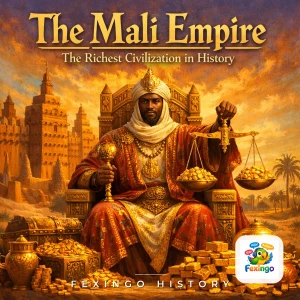
The Mali Empire: The Richest Civilization in History — Fexingo History
This podcast explores the history of the Mali Empire, one of the richest civilizations in the world. It covers the rise of Sundiata Keita, Mansa Musa's famous hajj, and the empire's gold-salt trade. The show also discusses the cultural achievements of Timbuktu and the empire's eventual decline. Hosts Lucas and Luna bring the story of this West African empire to life.
Episodes

Mali’s Royal Court: The Kora Players and Oral Tradition
We step away from the gold coins and political treaties to look at Mali’s cultural heartbeat. This episode explores the role of the jeliw, or griots, who served as the living libraries of the Keita dynasty. We examine how oral history was preserved through music, specifically the kora, a twenty-one-string harp-lute. Lucas and Luna discuss the strict protocols of court performance, the concept of n
Mansa Musa's Hajj: The Gold That Crashed Egypt
We often hear that Mansa Musa was incredibly wealthy, but the true scale of his impact is found not in Mali itself, but in Cairo during his 1324 pilgrimage. We explore how a single caravan carrying perhaps sixty tons of pure gold flooded the Egyptian market, causing inflation that took over a decade to resolve. Through the accounts of Arab historians like al-Umari and Ibn Battuta, we examine the e
Mansa Sakura's Rebellion and the Fall of Mali
We trace the dramatic rise and violent end of Mansa Sakura, the former Wangara merchant who seized the Malian throne through a daring coup against his predecessor. While previous episodes covered the golden age of Mansa Musa, this conversation explores the political fractures that followed, focusing on Sakura’s brief but transformative reign in the early fourteenth century. We examine how he attem
Mali's Lost Kings: The Mystery of Mansa Sul
While history remembers Mansa Musa as the wealthiest man in human history, his legacy was nearly erased by the silence that followed his death. This episode explores the turbulent succession crisis that fractured the Mali Empire, focusing on the enigmatic reign of Mansa Sul and the subsequent rise of his brother, Mari Djata II. We examine how internal court politics, fueled by rival factions withi
Mansa Musa's Hajj: The Gold That Crashed Egypt
We’ve covered the Kouroukan Fouga and the rise of the Wangara traders, but this episode zooms in on the single event that put Mali on the global map: Mansa Musa’s pilgrimage to Mecca in 1324. When he passed through Cairo, his generous distribution of gold didn’t just buy him friends; it flooded the market and depressed the value of the currency for over a decade. We look at the contemporary accoun
Mali's Lost Cities: Gao and the Songhai Transition
While Mansa Musa’s pilgrimage to Cairo dominates popular memory, the Mali Empire’s true strength lay in its complex urban networks and military logistics along the Niger River. This episode explores the farari river fleet and the strategic importance of cities like Gao and Djenné as administrative hubs rather than just trade stops. We examine how the Wangara merchants navigated these waterways and
Mali's Lost Cities: Gao and the Songhai Transition
While Mansa Musa’s pilgrimage to Cairo is well-known, Mali’s eastern frontier tells a different story of gradual power shifts. This episode explores the rise of Gao as a critical trade hub and the complex relationship between the Keita emperors and their Songhai vassals in the late fourteenth century. We examine how the Wangara merchants navigated political changes, how the Great Mosque of Djenné
Mansa Musa's Hajj: The Gold Crash in Cairo
In this episode, we explore the economic shockwave caused by Mansa Musa’s 1324 pilgrimage to Mecca. While earlier episodes covered his rise and the Kouroukan Fouga, here we focus on the immediate aftermath of his arrival in Cairo. We examine al-Umari’s accounts of how Musa distributed so much gold that he depressed its value in Egypt for years. Lucas walks through the mechanics of the Mamluk econo
Mansa Musa's Pilgrimage and the Cairo Gold Crash
In this episode of Fexingo History, we look past the legends of Mansa Musa’s wealth to examine the concrete economic shockwave his 1324 hajj sent through the Mamluk Sultanate. While earlier episodes covered Mali’s internal bureaucracy and the Kouroukan Fouga, here we focus on the external impact of that pilgrimage. We trace Musa’s route from Niani to Cairo, where his generous distribution of gold
Mansa Musa's Hajj and the Gold Crash
We explore the logistical miracle of Mansa Musa’s 1324 pilgrimage to Mecca, focusing not just on the spectacle but on the economic shockwave it sent through Egypt. Lucas details how the sheer volume of gold distributed in Cairo destabilized local markets for years, while Luna probes the administrative reality behind such a massive caravan. Together, we unpack the accounts from historians like al-U
Mali's Mande Constitution: The Kouroukan Fouga
While Mansa Musa’s pilgrimage to Cairo often dominates the narrative of Mali’s wealth, the empire’s true longevity rested on its legal framework. This episode explores the Kouroukan Fouga, the grand assembly that codified the Mande constitution under Sundiata Keita and his successors. We examine how this document balanced secular power with spiritual authority, regulated the sacred role of blacksm
Mansa Musa's Gold Crisis: How He Crashed the Egyptian Economy
When Mansa Musa arrived in Cairo in 1324, he didn't just bring gold—he brought an economic shockwave. This episode explores the immediate aftermath of his pilgrimage, focusing not on his piety or pageantry, but on the devastating inflation that gripped Egypt for over a decade. We examine al-Umari’s records of gold prices plummeting from 75 to under 60 mithqals and trace how this sudden liquidity r
Mali’s Hidden Tax System: How Gold Built an Empire
We often hear about Mansa Musa’s legendary hajj and the inflation he caused in Cairo, but we rarely discuss the intricate machinery that made such wealth possible. In this episode, Lucas and Luna pull back the curtain on Mali’s taxation system, focusing specifically on the Wangara merchants and the state-controlled gold fields of Bure. We explore how the Mansa didn’t just collect taxes but activel
Mali’s Mande Constitution: The Kouroukan Fouga
We often think of ancient legal codes as things carved in stone or inked on parchment, but the Mande people of the Mali Empire preserved their foundational laws through an oral tradition known as the Kouroukan Fouga. This episode explores the Gbara assembly, a massive gathering that convened shortly after Sundiata Keita established the empire to codify rights and responsibilities for all citizens.
The Great Mosque of Djenné: Earth, Faith, and Empire
While Timbuktu gets the scholarly spotlight, the Great Mosque of Djenne stands as a testament to West African engineering and community spirit. In this episode, we explore how this mud-brick masterpiece was built without blueprints or modern tools, relying instead on the collective labor of the city’s residents. We discuss the annual Crepissage festival, where thousands come together to replaster
Mali's Military Machine: The Farin and Niger River Fleet
While Mansa Musa’s gold hoard stole the spotlight in Cairo, the true engine of Mali’s expansion was its naval dominance on the Niger River. This episode explores the farari, the specialized riverine warriors who patrolled the waterways and enforced trade monopolies for the Wangara merchants. We examine how the pirouge canoes, powered by hundreds of oarsmen, served as both transport and warships, a
Mali's Gold and the Songhai Succession
We explore how Mansa Musa’s legendary wealth in 1324 didn't just buy gold dust in Cairo—it permanently altered the geopolitical landscape of West Africa by accelerating the rise of Songhai. While previous episodes covered Mali’s internal bureaucracy, the Wangara trade networks, and the mysterious reign of Mansa Sakura, this episode shifts focus outward to the empire’s eastern frontier. We examine
Mansa Sakura: The Slave Who Became King
While Mansa Musa’s pilgrimage to Cairo dominates popular memory, the rise of his predecessor, Mansa Sakura, offers a far more startling chapter in West African history. For centuries, oral tradition and the Tarikh al-Sudan chronicled how a Wangara merchant named Sakura was taken captive by Sundiata Keita, forced into servitude, yet eventually rose to become Mali’s ninth ruler. This episode explore
Mali's Water Spirits: The Cult of Mami Wata
While earlier episodes explored the political rise of the Keita dynasty and the economic power of the Wangara traders, we now turn to the spiritual foundations that held the Mali Empire together. This episode examines the role of water spirits, known in local traditions as mami wata or nyama-biri, in Mande cosmology. We look at how these entities were not merely superstitions but integral parts of
Mansa Sakura: The Slave Who Became Mali's King
Most histories remember Mansa Musa as the face of Mali’s wealth, but before his coronation sat a ruler whose rise was far more unexpected. This episode explores the life of Mansa Sakura, a Wangara merchant who began as a royal slave and eventually seized the throne from the Keita dynasty. We trace how he used his network of traders to challenge the hereditary kings, the political maneuvering that
The Silk Road of Sand: Mali's Trade Networks
While Mansa Musa’s gold has overshadowed other aspects of the empire, Mali’s true power lay in its control over trans-Saharan trade routes. This episode explores how the Wangara merchants navigated the desert, the strategic importance of salt mines at Taghaza, and the complex diplomatic relationships with Tuareg tribes. We examine the economic infrastructure that allowed Mali to become one of hist
Mali's Iron Kings: Blacksmiths and Nyama
While we often discuss the gold of Mansa Musa or the manuscripts of Timbuktu, the Mali Empire’s foundation was built on iron. This episode explores the vital role of blacksmiths, known as numu, in Mande society. We examine how the concept of nyama—a potent spiritual force associated with creation and destruction—made blacksmiths both essential to statecraft and socially marginalized. Through the l
The Great Mosque of Djenné: Earth, Faith, and Empire
While Mansa Musa’s hajj brought Mali global fame, the true heart of its spiritual life pulsed in the Sudano-Sahelian architecture of cities like Djenne. This episode explores how the Great Mosque of Djenne became more than a place of worship; it was a civic anchor, a symbol of communal labor, and a testament to the Mande worldview that blended Islamic scholarship with local tradition. Lucas and Lu
Mali's Slave Kings and the Wangara Rise
This episode explores the paradox of Mansa Sakura, a former slave who became one of Mali’s most effective rulers. While earlier episodes covered the Keita dynasty’s military conquests and Mansa Musa’s wealth, we examine how the Wangara merchant class fueled statecraft through loyalty rather than bloodline. Lucas and Luna discuss the Tarikh al-Sudan’s account of Sakura’s rise from prisoner to king,
Mali's Blacksmith Kings: The Iron That Built an Empire
While Mansa Musa’s gold dominates the history books, it was iron that actually built the Mali Empire. In this episode, we explore how the Keita dynasty’s roots as blacksmiths shaped West African statecraft. Lucas and Luna discuss Sundiata Keita’s transformation of a marginalized caste into the empire’s military backbone. We examine the technical advantages of Malian ironworking, from blast furnace
Mansa Sakura: The Slave Who Became King
In this episode, we explore the extraordinary life of Mansa Sakura, the ninth ruler of the Mali Empire and one of history’s most unlikely monarchs. Unlike his predecessor Mansa Musa or his successor Mansa Suleyman, Sakura was not born into the Keita royal lineage. Instead, he began his life as a slave, possibly a riverboat captain or a Wangara trader who lost his freedom during a raid. Through she
The Man Who Stole Mali's Throne: Mansa Sakura
For over a century, the name of Mansa Sakura was treated as an error in the historical record, a ghost story whispered by scholars who couldn't reconcile his humble origins with the grandeur of the Mali Empire. But the Tarikh al-Sudan tells a different tale, one of a Wangara trader named Sakoura who seized power during the chaos following Mansa Musa’s death. This episode uncovers the life of West
Mali’s Lost Kings: The Rise of Mansa Sakura
While Mansa Musa is rightly celebrated for his legendary pilgrimage to Mecca, the Mali Empire was built by a lineage of rulers whose stories have been largely overshadowed. This episode explores the reign of Mansa Sakura, the merchant who seized the throne and expanded Mali’s borders through diplomatic mastery rather than brute force. We examine how he consolidated power after the decline of Sundi
Mali's Bureaucracy: The Secret of Statecraft
We often hear about Mali’s gold, its war elephants, or Mansa Musa’s pilgrimage, but we rarely look at the machinery that kept such a vast empire running for centuries. This episode peels back the layers of the Jama'in, Mali’s intricate civil service and tax system. We explore how scribes, accountants, and provincial governors managed trade routes, collected tariffs, and enforced law from Niani to
Mali's Lost Cities and the Silence of Timbuktu
In this episode, Lucas and Luna explore the architectural marvels of the Mali Empire, focusing on the Great Mosque of Djenné and the urban planning of Niani. They discuss how mud-brick construction techniques created sustainable cities in the Sahel, supported by the Wangara traders and governed by the Kouroukan Fouga. The conversation delves into the role of the jeliw (griots) in preserving civic
Mansa Suleyman's Pragmatic Peace
In this episode, we shift focus from the gold-laden pilgrimage of Mansa Musa to his successor, Mansa Suleyman. While Musa’s reign is often defined by its spectacular excess and the subsequent economic shock in Cairo, Suleyman’s rule represents a different kind of power: the quiet, bureaucratic stability that held the Mali Empire together for decades. We explore how Suleyman navigated the aftermath
Mansa Suleyman and the Price of Peace in Mali
In this episode, we explore the reign of Mansa Suleyman, the brother of Mansa Musa, who inherited an empire at its peak but faced a different challenge: how to sustain it without the personal wealth that defined his predecessor. While Musa’s pilgrimage to Mecca brought global fame, it also drained the treasury and destabilized local economies through gold inflation. Suleyman adopted a pragmatic, c
The Day Mali’s Gold Collapsed: The Cairo Crisis of 1324
We often remember Mansa Musa for his legendary pilgrimage to Mecca, but we rarely examine the immediate economic catastrophe he triggered in North Africa. This episode dives into the specific mechanics of how Mali’s sudden influx of raw gold in Cairo during 1324 devalued the local currency for over a decade. We look at the accounts of Arab historians like al-Umari and Ibn Khaldun to reconstruct th
Mali's Hidden Archives: The Timbuktu Manuscripts
We often picture the Mali Empire through gold and conquest, but its true legacy lies in paper. This episode explores the vast network of libraries that flourished in Timbuktu, Djenne, and Sankore during the fourteenth and fifteenth centuries. We examine how Muslim scholars, Wangara traders, and local Mande intellectuals created thousands of manuscripts covering astronomy, medicine, law, and poetry
Mali's Lost Cities and the Silence of Timbuktu
While Mansa Musa’s hajj and the gold mines have been covered extensively, we turn to the intellectual heart of the Mali Empire: Timbuktu. This episode explores how a remote desert town became a global center for Islamic scholarship, housing thousands of manuscripts and attracting scholars from across the Muslim world. We examine the role of the Sankore Madrasa, the unique blend of Mande customary
Mali's River Fleet: How the Niger Built an Empire
While gold and salt dominated the trans-Saharan trade routes, the true lifeline of the Mali Empire was the Niger River itself. In this episode, Lucas and Luna explore how the Wangara traders and royal administrators used specialized river fleets to move goods, people, and information across West Africa. We examine the engineering of the pirouge canoes, the strategic importance of river ports like
Mali's River Fleet: How the Niger Built an Empire
While we have explored the gold mines of Bambuk and the salt slabs of Taghaza, we have not yet examined the logistical backbone that made Mali’s vast empire possible. In this episode, Lucas and Luna dive into the complex world of the Niger River fleet. We look at how the Wangara traders, Tuareg nomads, and Mande soldiers moved goods across thousands of miles of unpredictable waterways. From the se
Mansa Suleyman's Pragmatic Rule and Mali's Golden Decline
While Mansa Musa’s hajj dominates historical memory, his brother Mansa Suleyman ruled Mali for two decades with quiet pragmatism that preserved the empire’s stability. This episode explores how Suleyman reversed his predecessor’s economic overreach, stabilized the gold currency, and navigated the complex relationship between Islamic scholars and traditional Mande customs. We examine the accounts o
Mali's Shadow Wars: The Tuareg and the Salt Routes
While Mansa Musa’s gold dazzled Cairo, a quieter, more dangerous struggle for control of the Sahel was unfolding in the deep desert. This episode explores the Mali Empire’s complex relationship with the Tuareg nomads, the Takedda copper mines, and the brutal reality of the salt trade at Taghaza. We examine how Mali maintained its hegemony not just through military might, but through intricate alli
Mali's River Fleet: How the Niger Built an Empire
While we have explored Mali’s gold mines, salt caravans, and legal systems in previous episodes, the true artery of the empire was the Niger River itself. In this episode, Lucas and Luna examine how the Keita dynasty mastered the seasonal rhythms of the river to project power across vast distances. We look at the specific naval tactics used by Mansa Musa’s successors, the role of the Wangara trade
Mansa Musa's Justice: The Mande Legal Revolution
In this episode of Fexingo History, Lucas and Luna explore the legal genius behind Mali's golden age. While Mansa Musa's hajj and gold are legendary, his real legacy was a judicial system that blended Islamic law with Mande custom, creating a legal order that stabilized an empire larger than Western Europe. We trace the evolution from Sundiata's Gbara to Musa's appointment of qadis in Timbuktu, Dj
The Secret of Mali's War Elephants
In this episode of Fexingo History, Lucas and Luna explore the hidden military might of the Mali Empire: its war elephants. From the savannahs south of the Niger River to the battlefields of the Sahel, these massive animals were more than just beasts of burden—they were weapons of psychological warfare that helped Sundiata Keita and his successors forge an empire. Drawing on the Epic of Sundiata,
Mali's Salt: Taghaza and the White Gold of the Sahel
Salt. The mineral that built empires and launched caravans across the Sahara. In this episode, Lucas and Luna dig into Mali's salt trade—the mines of Taghaza, the grueling trans-Saharan routes, and the salt-for-gold exchange that made Mansa Musa's fortune possible. They trace how this humble commodity shaped urban life in Timbuktu and Djenne, and how control of salt routes became a lever of politi
The Camel Trains of Mali: Salt and Gold
In this episode, Lucas and Luna trace the salt routes that powered the Mali Empire, following the caravans from the Sahara's Taghaza mines to the market cities of Timbuktu and Djenne. They explore how salt, not gold, was the true currency of the Sahel, and how the Wangara traders kept the sources of gold a closely guarded secret. Along the way, they meet Ibn Battuta's caravan companions, the Tuare
Mansa Musa's Gold: The True Weight of Mali's Mithqals
In this episode of Fexingo History, Lucas and Luna dive into the economic mechanics behind Mali's legendary gold trade, focusing on the 'mithqal' — the standard gold coin that shaped the empire's wealth. They explore how Mansa Musa's hajj and his spending in Cairo disrupted currency values, but more importantly, they uncover the intricate systems of gold production, measurement, and exchange that
Mali's Gold Mines: The Hidden Engine of Empire
In this episode, Lucas and Luna dig into the real source of Mali's legendary wealth: the gold mines of Bambuk, Boure, and Galam. They trace how Mansa Musa's predecessors built an empire on gold, how the mines actually worked, and why the Mansa kept their locations secret. Along the way, they explore the role of the Wangara traders, the gold-salt exchange, and the reign of Mansa Musa's grandfather,
Mali's Iron Masters: Forging an Empire
In this episode of Fexingo History, Lucas and Luna explore the overlooked role of iron in the rise of the Mali Empire. While gold and salt often dominate the story, it was iron that armed Sundiata's forces and powered the agricultural surplus that sustained a vast realm. Drawing on the Epic of Sundiata, the accounts of Ibn Battuta, and archaeological evidence from the Sahel, we trace how blacksmit
Sundiata's Victory at Kirina: The Birth of Mali
In this episode, Lucas and Luna explore the legendary Battle of Kirina, where Sundiata Keita defeated the sorcerer-king Soumaoro Kante and laid the foundation for the Mali Empire. They discuss the Epic of Sundiata, the role of the jeliw in preserving history, and the political landscape of 13th-century West Africa. The conversation covers the rise of the Keita dynasty, the significance of the Gbar
Mali's Copper Trade: The Red Gold of the Sahel
In this episode of Fexingo History, Lucas and Luna dig into a lesser-known pillar of the Mali Empire's economy: copper. While gold and salt get the glory, copper from Takedda and other Saharan mines was a vital commodity, traded across West Africa and beyond. They explore how copper was mined, processed, and valued, its role in currency and ritual, and the networks that connected Mali to North Afr
Mali's Copper: The Red Gold of the Sahel
In this episode of Fexingo History, Lucas and Luna explore a less-told story of the Mali Empire: its trade in copper, the red gold of the Sahel. While gold has long captured the imagination, copper was the industrial backbone that connected Mali to the wider world. From the mines of Takedda, where Ibn Battuta witnessed copper being shaped into bars and traded for cloth, to the bustling markets of
Sundiata's Exile: The Boy Who Became a Lion
Before Mansa Musa's gold, before the Sankore madrasa, there was Sundiata Keita — a prince who was exiled as a child and returned as a warrior to defeat the Sosso king Soumaoro Kanté at the Battle of Kirina in 1235. This episode traces Sundiata's extraordinary journey: his birth into the Keita dynasty, his years of exile in Wagadu and Mema, his rise as a cavalry leader, and the fateful confrontatio
Mali's Mansa Musa: The Hajj That Shook Cairo
In 1324, Mansa Musa of Mali set out on the hajj to Mecca with a caravan so vast it reportedly included 60,000 carriers and 80 camels, each carrying 300 pounds of gold. But the pilgrimage was more than a display of wealth — it was a political statement, a diplomatic mission, and a religious journey that left a trail of gold through Cairo and Medina. This episode digs into the details of that journe
The Great Mosque of Djenne: Mud, Faith, and Mali's Builders
In this episode of Fexingo History, Lucas and Luna delve into the architectural marvel that is the Great Mosque of Djenne, one of the largest mud-brick buildings in the world and a symbol of the Mali Empire's spiritual and communal life. They explore how this monumental structure, built from banco, was not just a place of worship but a civic center, a testament to the engineering skills of the Man
The Qadi of Timbuktu: Islam and Law in Mali
In this episode of The Mali Empire: The Richest Civilization in History, Lucas and Luna explore the role of qadis — Islamic judges — in the Mali Empire, focusing on the famous qadi of Timbuktu, Al-Qadi Aqib ibn Mahmud. They discuss how the qadi's court blended sharia with Mande customary law, the importance of the Sankore Madrasa in training legal scholars, and the limits of Mansa Musa's authority
Mali's Judicial System: Mansa Musa and the Law
When Mansa Musa returned from his famous hajj, he brought back more than gold and stories — he brought architects, scholars, and a vision for law. This episode explores how Mali's judicial system actually worked under the Keita dynasty. We look at the role of the mansa as final judge, the qadis who applied Islamic law, and the older Mande customary courts that handled everything from marriage to t
The Griots of Mali: Keepers of Memory and Power
In this episode of Fexingo History, Lucas and Luna explore the vital role of the jeliw — the griots of the Mali Empire. From the legendary Balla Fasséké, who served Sundiata Keita, to the modern-day keepers of oral tradition, we uncover how these master musicians and historians preserved the empire's history, genealogies, and legal codes. Learn about the Kouroukan Fouga, the epic of Sundiata, and
The Lion of Mali: Sundiata's Gbara and the Art of Consensus
In this episode, we step back from the gold and salt trades to explore the political architecture that held the Mali Empire together: the Gbara, a great assembly of clans that balanced the mansa's power. We trace its roots to the Kouroukan Fouga, the charter Sundiata Keita proclaimed after the Battle of Kirina around 1235, and see how the Gbara functioned as a check on absolutism, giving voice to
The Sankore Madrasa: Timbuktu's Ancient University
In this episode, Lucas and Luna explore the Sankore Madrasa in Timbuktu, one of the world's oldest learning institutions and a cornerstone of the Mali Empire's intellectual golden age. They trace its origins from a 14th-century mosque foundation to its rise as a hub of Islamic scholarship under the patronage of Mansa Musa and his successors. The conversation dives into the scholars who studied and
The Mande Charter: Africa's Ancient Human Rights Declaration
In this episode of The Mali Empire, Lucas and Luna explore the Mande Charter, also known as the Kurukan Fuga Charter, a remarkable declaration of human rights from 13th-century West Africa. Discover how Sundiata Keita and the Gbara assembly crafted a code that outlawed racial discrimination, protected women's rights, and emphasized education centuries before the Enlightenment. We trace the charter
Mansa Suleyman: The Frugal Emperor Who Stabilized Mali
After Mansa Musa's legendary hajj and extravagant spending, his successor Mansa Suleyman faced a daunting challenge: restore Mali's finances and authority. In this episode, Lucas and Luna explore Suleyman's reign (c. 1341–1360), a period of consolidation after the splendor of his predecessor. They discuss Suleyman's pragmatic fiscal policies, his investment in Takedda's copper mines, his patronage
The Great Mosque of Djenne: Mud, Faith, and Mali's Builders
In this episode, Lucas and Luna explore the Great Mosque of Djenne, one of the most iconic structures in West Africa and a symbol of the Mali Empire's architectural and spiritual legacy. They trace its origins to the 13th century, when the city of Djenne became a thriving trading hub under Mansa Musa's rule, and discuss the legend of the original mosque built by King Koi Konboro on the site of his
The Kouroukan Fouga Charter: Mali's Ancient Constitution
In 1236, as Sundiata Keita consolidated his victory at the Battle of Kirina, the Mande people gathered at a site called Kouroukan Fouga. There, an assembly of nobles, farari generals, and the nyamakala castes—blacksmiths, griots, and bards—proclaimed the Kouroukan Fouga, a set of laws that would govern the Mali Empire for centuries. This episode of Fexingo History dives into the charter's 44 artic
The Mali Empire's Paper Trail: Arabic Sources and Mande Memory
In this 200th episode of Fexingo History, Lucas and Luna explore the written sources that bring the Mali Empire back to life. The discussion opens with the challenge of studying an empire whose history was largely oral, then turns to the Arabic geographers and chroniclers who recorded its deeds: Ibn Battuta's Rihla, al-Umari's Masalik al-Absar, Ibn Khaldun's Kitab al-Ibar. We follow the contradict
Mansa Musa's Huge Spending: Inflation in Cairo
When Mansa Musa passed through Cairo on his 1324 hajj, he gave away so much gold that he accidentally broke the city's economy. In this episode, Lucas and Luna unpack the real story behind the legendary inflation crisis — how much gold actually entered the market, how Cairo's goldsmiths and moneychangers reacted, and what it meant for Mansa Musa's reputation and Mali's long-term wealth. They draw
Mansa Musa's Cairo Visit: A Sultan's Protocol Breach
In 1324, Mansa Musa's pilgrimage to Mecca made him a legend across the Islamic world, but his stop in Cairo nearly sparked a diplomatic crisis. This episode unpacks the tense encounter between the Mali emperor and Sultan al-Nasir Muhammad of Egypt—two rulers with vastly different visions of power. We explore how Mansa Musa's refusal to kiss the ground or the Sultan's hand, his insistence on his ow
The Great Camel Crisis: Mali's Salt Trade Disrupted
When the trans-Saharan salt caravans ground to a halt in the mid-fourteenth century, the Mali Empire faced an economic shock that rippled from the mines of Taghaza to the markets of Timbuktu and Djenne. In this episode, Lucas and Luna explore how the empire under Mansa Suleyman navigated the crisis, examining the fragile logistics of camel caravans, the politics of the Takedda copper trade, and th
Mansa Musa's Golden Touch: The Economics of Mali's Wealth
In this episode, Lucas and Luna explore how Mansa Musa's legendary pilgrimage to Mecca in 1324 was not just a display of staggering wealth but a carefully orchestrated economic strategy that reshaped the entire Mediterranean world. They dive into the mechanics of Mali's gold monopoly, the role of the mitqal standard, and how Mansa Musa's spending spree in Cairo caused a gold inflation that took ov
The Silent Trade: Myth and Reality in Mali's Gold Markets
In episode 195, Lucas and Luna peel back the curtain on one of the Sahara's most enduring legends: the silent trade, where gold was supposedly exchanged without a word. Drawing on al-Bakri's 11th-century account and later chroniclers, they trace how this tale of mute commerce captured medieval imaginations—and how modern historians question its accuracy. The episode follows the gold's journey from
Mali Empire's Trade Taxes: The Dues That Built a Kingdom
Long before Mansa Musa's fabled pilgrimage, the Mali Empire grew rich not just from gold but from a sophisticated system of taxes and dues. In this episode, Lucas and Luna explore how the empire taxed its trade routes, from the salt caravans of Taghaza to the copper of Takedda, and how these levies funded armies, cities, and the very institutions that held the empire together. They trace the evolu
Mali's Salt: The White Gold That Powered an Empire
In this episode, Lucas and Luna dig into the salt trade that underpinned the Mali Empire's wealth. From the brutal mines of Taghaza, where salt slabs were cut by hand in a scorched landscape, to the trans-Saharan caravans that carried that salt south to Djenne and Timbuktu, salt was the silent engine of a gold economy. They follow the famous journey of Ibn Battuta through the salt towns, and exami
The Gold of Mali: Measuring Mansa Musa's Wealth
In this episode, Lucas and Luna explore the staggering wealth of Mansa Musa, the 14th-century ruler of the Mali Empire. They trace the sources of Mali's gold—the Bambuk and Bure fields—and examine the silent trade that kept their locations secret. They consider the value of Mansa Musa's gold in today's terms, the challenge of historical estimates, and the effects of his famous 1324 pilgrimage on t
Mansa Wali: The Forgotten Conqueror of the Mali Empire
Before Mansa Musa's legendary pilgrimage, another Mali ruler made the hajj and conquered Gao. This episode explores the reign of Mansa Wali (also known as Wali or Yerelinkon), the second mansa of the Mali Empire. We discuss his expansion of the empire eastward, his subjugation of the Songhai kingdom, and his diplomatic mission to the Mamluk sultan Baybars. Drawing on Ibn Khaldun and the Tarikh al-
Jeliw: Oral Historians of the Mali Empire
In this episode of the Mali Empire series, Lucas and Luna explore the vital role of the jeliw—Mande griots who preserved history, law, and genealogy through oral tradition. Unlike written chronicles, the jeliw's training lasted decades, memorizing the Epic of Sundiata, the Kouroukan Fouga constitution, and the lineages of the Keita dynasty. The episode focuses on how these artists and historians l
Sonni Ali and the Fall of Mali: The Battle for Timbuktu
In this episode, Lucas and Luna explore the final chapter of the Mali Empire's golden age: the rise of Sonni Ali, the Songhai king who conquered Timbuktu in 1468 and shattered Mali's centuries-old grip on the Niger Bend. They discuss the Battle of Tindirma, the weakening of the Keita dynasty, and the collapse of the trade networks that had made Mansa Musa legendary. Along the way, they examine the
Mansa Sakura: The Usurper Who Kept Mali's Empire Intact
Long before Mansa Musa's legendary pilgrimage, another ruler took the throne of Mali by force and led a bold campaign to reconquer rebellious provinces. Mansa Sakura, a former royal official who seized power after a succession crisis, expanded the empire's borders, secured the trans-Saharan trade routes, and became the first Malian emperor to perform the Hajj. But his reign ended in violence on th
The Last Kings of Mali: The Empire's Final Century
In this episode, Lucas and Luna trace the decline of the Mali Empire after its golden age. They explore the succession crises that followed Mansa Suleyman's death in 1360, the devastating Mossi raids of the 14th century, and the steady erosion of imperial authority. The conversation centers on the rise of the Songhai Empire under Sonni Ali, who captured Timbuktu in 1468 and Djenne in 1475, and the
Mali's Gold Mines of Bambuk and Bure
Where did the legendary gold of Mansa Musa actually come from? This episode takes us deep into the Bambuk and Bure goldfields, the hidden engine of the Mali Empire's wealth. We explore the geology of the alluvial deposits, the labor of extraction mostly by free farmers during the dry season, the silent trade rituals between Wangara merchants and local miners, and the intricate tribute system that
Mansa Musa's Pilgrimage to Mecca: The Journey That Shocked the World
In 1324, Mansa Musa, the emperor of the Mali Empire, embarked on a pilgrimage to Mecca that would become legendary. This episode traces his route from Niani across the Sahara to Cairo, where his extravagant distribution of gold caused a decade-long inflation crisis. We explore the size of his caravan—tens of thousands of people, including officials, soldiers, and slaves—and his diplomatic encounte
The Lost Capital of Niani: Unearthing Mali's Heart
Where was the heart of the Mali Empire? For centuries, the city of Niani was known only through oral epics and vague references in Arabic chronicles. In this episode, Lucas and Luna explore the archaeological quest for Mali's first capital. They discuss the 1960s excavations led by Polish archaeologist Władysław Filipowiak, which uncovered the remains of a sprawling urban center, a royal palace, a
Mansa Musa's Djinguereber Mosque: Building the Soul of Timbuktu
In this episode of The Mali Empire: The Richest Civilization in History, Lucas and Luna explore the architectural and spiritual legacy of the Djinguereber Mosque in Timbuktu. Built in the 1320s under Mansa Musa's patronage, this mudbrick marvel was designed by the Andalusian poet-architect Abu al-Hasan al-Sahili. We trace its construction using traditional Mande techniques like torons and crenella
Recommended

Crickets Corner

History of the Earthquake and Fire in San Francisco

Fox news

K-Drama Obsessed Mamas | Beyond “Just One More Episode!”

True Crime Classics

The Healer Revolution

Becoming: HER with Nikki Spoelstra

Booked, Blonde & Busy w/ Olivia Ponton

McKinsey on Consumer and Retail

megahired.com

Hard Knocks Podcast

Effective Weight Loss for Moms | High protein, Strength Training, Lose Weight, Meal Planning, Fat Loss, Healthy Habits
