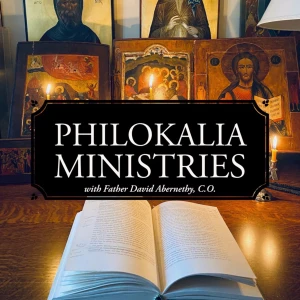
Philokalia Ministries
Philokalia Ministries is a Catholic podcast led by Father David Abernethy, a member of the Oratory of Saint Philip Neri. It focuses on the spiritual heritage of the Desert Fathers, featuring teachings on asceticism, prayer, and the Jesus Prayer. The podcast draws from ancient texts like The Ladder of Divine Ascent, the Philokalia, and writings of Saint John Cassian, as well as more recent spiritual authors. It aims to reform hearts and minds through the wisdom of early Christian monasticism.
Episodes
The Ascetical Homilies of St. Isaac the Syrian - Homily XX, Part II
There is a sentence here from St. Isaac that overturns almost everything we are inclined to think about asceticism: You suppose these things were ordained simply to oblige you to labor.
We imagine the vigil primarily as something difficult. Sleep is surrendered. The body is constrained. Psalms are prayed while the world sleeps. Nature protests and the monk remains standing before God. Looked at fr
The Evergetinos: Book Three - Chapter IX, Part IV
There is something almost frightening about the stories preserved for us in the Evergetinos. They are frightening not because they portray extraordinary wickedness, but because they reveal how quietly the heart can change.
The monk described by Palladios is not a beginner. He is a man of profound silence and prayer, one who has surrendered himself so completely to God that even the necessities of
The Ascetical Homilies of St. Isaac the Syrian - Homily XX
There are passages in St. Isaac that can sound almost impossible to modern ears. His words on vigil are among them.
“Do not imagine,” he tells us, “that among all the works of monastics there is any practice greater than night vigil.”
We hear such words and immediately think of sleep deprivation, bodily exhaustion, long hours of psalmody, standing in darkness while the rest of the world sleeps. We
The Evergetinos: Book Three - Chapter IX, Part III
There is something almost relentless about the teaching of the Fathers on watchfulness. They will not allow us to imagine that there comes a point in the spiritual life when vigilance is no longer necessary. Age does not free us from it. Knowledge does not free us from it. Years of prayer do not free us from it. Even great spiritual gifts do not free us from it.
“As long as you are in the body, do
The Ascetical Homilies of St. Isaac the Syrian - Homily XIX, Part II
There is a danger in reading passages such as this one from St. Isaac and hearing primarily a warning: Do not become negligent. Do not allow yourself to grow lax. Guard your solitude. Avoid unnecessary conversation. Do not permit the mind to become scattered.
Certainly Isaac is warning us. His language is deliberately severe because he knows how fragile the beginnings of prayer can be. A heart ne
The Evergetinos: Book Three - Chapter IX, Part II
There is a great mercy hidden within these unsettling sayings from the Evergetinos. The Desert Fathers do not speak to us about spiritual warfare in order to make us preoccupied with the devil. They speak about it so that we might become sober, humble, and utterly dependent upon Christ.
This is one of the great blessings the Desert Fathers continue to offer the Church. They expose what ordinarily
The Ascetical Homilies of St. Isaac the Syrian - Homily XVIII, Part II & XIX, Part I
There is a temptation in every generation to believe that the spiritual life consists primarily in learning new methods, acquiring hidden knowledge, or discovering techniques that promise quick access to God. St. Isaac the Syrian gently dismantles this illusion. When he speaks of the deeper forms of prayer, he deliberately refuses to satisfy our curiosity. It is a remarkable act of humility. He kn
The Evergetinos: Book Three - Chapter VIII, Part II & IX, Part I
The Fathers never speak of the spiritual life as though it were merely the acquisition of virtues or the mastery of disciplines. At its heart, it is the slow awakening of a human being who learns once again to see. The battlefield is not first the world around us but the hidden kingdom within us. It is there, in the silence of the heart, that every thought seeks entrance, every desire asks for con
The Name Above Every Name, Conference Four
The Name Above Every Name
Conference Four
Becoming Prayer
When the Name Becomes Our Life
“It is no longer I who live, but Christ who lives in me.”
— Galatians 2:20
Over these past conferences we have spoken of receiving the holy Name, guarding the heart, and learning to stand before God with a broken spirit.
All of these are necessary.
Yet none of them is the destination.
The Jesus Prayer is no
The Name Above Every Name, Conference Three
The Name Above Every Name
Conference Three
The Broken Heart and the Descent into the Heart Learning to Stand Before God
“The sacrifice acceptable to God is a broken spirit; a broken and contrite heart, O God, Thou wilt not despise.”
— Psalm 51:17
There comes a moment in every authentic spiritual life when we discover that we cannot pray as we imagined we would.
We begin with generous resolution
The Ascetical Homilies of St. Isaac the Syrian - Homily XVIII, Part I
There is a temptation to read St. Isaac’s description of the ascetic life as though he were outlining a ladder by which we ascend to God through effort. Nothing could be further from his mind. The ascetical life is not an achievement but a preparation. It removes what clouds the eyes of the heart so that grace may reveal what has always been present: the inexhaustible love of God.
Isaac begins wit
The Ascetical Homilies of St. Isaac the Syrian - Homily XVII, Part III
There is a temptation when reading the closing section of Homily 17 to see it as little more than a long list of prohibitions. Do not quarrel. Do not lie. Speak little. Avoid pride. Flee idle disputes. Endure injustice. Keep away from the powerful. Be moderate. At first glance, it can seem as though Isaac is describing a life of relentless restraint.
Yet nothing could be further from his int
The Evergetinos: Book Three - Chapter VIII, Part I
One of the striking features of the desert tradition is the extraordinary seriousness with which the Fathers speak about the conscience. Modern readers can easily mistake conscience for little more than an inner feeling, a private moral opinion, or an emotional sense of guilt. The Fathers know nothing of this reduction. For them, the conscience is something infinitely more profound. It is the hidd
The Name Above Every Name, Conference Two
The Name Above Every Name
Conference Two
Guarding the Heart with the Name
The Jesus Prayer and the Hidden Battle
“Keep your heart with all vigilance, for from it flow the springs of life.”
— Proverbs 4:23
When we begin to pray the Jesus Prayer with any measure of faithfulness, we often encounter something unexpected.
Rather than becoming peaceful, we become distracted.
Rather than discovering s
The Ascetical Homilies of St. Isaac the Syrian - Homily XVII, Part II
“One thing have I desired of the Lord, that will I seek after: that I may dwell in the house of the Lord all the days of my life.”
— Psalm 27:4
Few passages in St. Isaac the Syrian can be as easily misunderstood as this one. Read superficially, it can sound severe, even offensive to modern ears. His warnings about women, nuns, relatives, and young companions may appear to reflect suspicion toward
The Evergetinos: Book Three - Chapter V, Part II, VI, and VII, Part I
The Fathers are extraordinarily subtle here because they know that the human heart is subtle.
They refuse the comforting simplicity by which we divide the world into good people and bad people, good deeds and evil deeds, the righteous and the guilty. Not because such distinctions are meaningless, but because they do not yet reach deeply enough. Beneath the visible act lies the intention. Beneath t
The Name Above Every Name, Conference One
The Name Above Every Name Conference One
Receiving the Name
The Gift Before the Method
“At the name of Jesus every knee should bow, in heaven and on earth and under the earth.”
— Philippians 2:10
There is perhaps no prayer more beloved in the Christian East than the Jesus Prayer. “Lord Jesus Christ, Son of God, have mercy on me.”
It is spoken by monks in their cells, by hermits in the desert, b
The Ascetical Homilies of St. Isaac the Syrian - Homily XVII, Part I
This passage can easily be misunderstood as a catalogue of monastic etiquette or a list of ancient customs that no longer matter. Yet St. Isaac is doing something far deeper. As we noted earlier, he is acting first as a physician of attention before he becomes a teacher of prayer. He knows that the human heart cannot be united to God while it remains scattered among a thousand impulses. Every smal
The Evergetinos: Book Three - Chapter IV, Part II and V, Part I
The Fathers insist that the spiritual life is decided long before words are spoken or actions are taken. It is decided in the hidden conversation of the heart. Every thought arrives carrying a question: Where have I come from, and where will I lead you? Most of us are far more careful about what enters our homes than what enters our minds. Yet a single unexamined thought can become a passion, a pa
The Ascetical Homilies of St. Isaac the Syrian - Homily XVI, Part II
The Christian life is not first the struggle to become better people, but the gradual unveiling of what we have already become through Christ. We have been fashioned to be the dwelling place of the living God. Every act of repentance, every hidden prayer, every battle against the passions, every tear shed in sincerity serves this one purpose: that the heart might become a temple in which God delig
Nazareth and The Hidden Life, Session Four
Nazareth and the Hidden Life
Retreat Reflection IV
The Hidden Life and the Healing of Desire
Epigraph
“Blessed are the pure in heart, for they shall see God.” — St. Matthew 5:8
“Paradise is the love of God.” — Saint Isaac the Syrian
⸻
At the center of every human life there is desire.
Not simply desire for pleasure, though pleasure is part of it.
Not simply desire for comfort, recognition, int
Nazareth and The Hidden Life, Session Three
Nazareth and the Hidden Life
Retreat Reflection III
The Silence of Nazareth and the False Self
Epigraph
“He shall not cry, nor lift up, nor cause His voice to be heard in the street.” — Isaiah 42:2
“Go, sit in your cell, and your cell will teach you everything.” — Abba Moses the Black
⸻
One of the most frightening things about silence is that eventually it begins to tell the truth.
At first si
The Evergetinos: Book Three - Chapter III, Part II and Chapter IV, Part I
The Fathers understood something that we have almost entirely forgotten: very few souls fall suddenly. Almost every great collapse begins with something so small that it escapes notice—a hidden expectation, a wounded pride, an unspoken resentment, an interior complaint, a passing judgment, or a thought left unchallenged. What appears insignificant is often the first movement of the heart away from
The Ascetical Homilies of St. Isaac the Syrian - Homily XVI
One of the most striking characteristics of St. Isaac’s writings is that he never asks us to renounce the world because the world is evil. Rather, he continually places before us something infinitely more beautiful. He speaks so often of the sweetness of communion with God, the boldness of prayer, the radiance of divine light, and the immeasurable mercy of Christ that worldly pleasures gradually
The Evergetinos: Book Three - Chapter II, Part VIII and III, Part I
The Fathers place before us a vision of the human person that is almost unbearable in its simplicity and demands. We do not live with others because we have learned techniques of communication or conflict resolution. We can live with others only to the degree that we fear God and have begun to see all men as one.
This is why the Elder says that if we remembered how Lot was saved because he condemn
Nazareth and The Hidden Life, Session Two
Nazareth and the Hidden Life Retreat
Reflection II
Remaining in Nazareth Epigraph
“And He was subject unto them.” — St. Luke 2:51
“Acquire the spirit of peace, and thousands around you will be saved.” — Saint Seraphim of Sarov
⸻
One of the most difficult words in the spiritual life is: remain.
Modern people know how to begin things. We know how to pursue intensity.
We know how to search,
rei
Nazareth and The Hidden Life, Session One
Nazareth and the Hidden Life
Retreat Reflection I
Nazareth and the Sanctification of the Ordinary Epigraph
“And He went down with them, and came to Nazareth, and was subject unto them.”
— St. Luke 2:51
“The Lord loves the humble soul that has surrendered herself to the will of God.” — Saint Silouan the Athonite
⸻
There is something deeply unsettling about Nazareth. Not because it is dramatic,
The Ascetical Homilies of St. Isaac the Syrian - Homily XV, Part IV
There are passages in St. Isaac that seem less like theology and more like glimpses through an opened door into the Kingdom. These words are among them.
He speaks of a table around which those who fast, keep vigil, and labor in the Lord gather. Yet he is not describing merely an ascetical fellowship or a pious community of like-minded people. Something infinitely greater is taking place. The Belov
The Evergetinos: Book Three - Chapter II, Part VIII
The Fathers speak about judgment with a severity that can seem almost excessive to us. They speak of grace withdrawing, of years of tears and repentance, of visions of Christ refusing worship to one who condemned his brother. We recoil at this language because we do not see condemnation as they saw it. We think of it as a minor fault of speech, a passing irritation, a reasonable assessment of anot
The Ascetical Homilies of St. Isaac the Syrian - Homily XV, Part III
At first reading, Isaac’s words can sound severe, even shocking. He speaks of idle speech as fornication, unhealthy attachments as adultery, and certain forms of companionship as idolatry. Yet behind these warnings lies something far deeper than moral anxiety. Isaac is not obsessed with sin. He is consumed with the preservation of desire for God.
The entire homily is built upon a single conviction
The Evergetinos: Book Three - Chapter II, Part VII
The Fathers tell us again and again not to judge.
We nod our heads.
We agree.
We repeat the commandment.
And then we continue judging.
The reason is simple.
---
Text of chat during the group:
00:19:25 Fr. Charbel Abernethy: Volume III page 27 paragraph 23
00:29:20 Julie: Sometimes I feel we have to do something in actions not turn first to prayer
00:29:29 Holly Hecker: Judgement is one of the 12 f
The Ascetical Homilies of St. Isaac the Syrian - Homily XV, Part II
When we read a passage like this from St. Isaac, it is tempting to focus on the warnings. We notice his words about passions, distraction, worldliness, anger, vainglory, and talkativeness. We see the severity of his language and immediately begin examining ourselves.
Yet I do not think that is where Isaac wants us to begin.
He wants us first to behold the beauty.
Again and again throughout his wri
The Evergetinos: Book Three - Chapter II, Part VI
The Desert Fathers knew something that many of us have forgotten.
The greatest danger to the spiritual life is not always the obvious sins we can name. Often it is the secret satisfaction we feel when we discover the weakness of another.
There is something in the fallen heart that delights in comparison. The moment another stumbles, we instinctively move ourselves a little higher. We become observ
The Ascetical Homilies of St. Isaac the Syrian - Homily XV, Part I
There are moments in the writings of St. Isaac the Syrian where one realizes that what he is speaking about is not “religion” as we commonly understand it at all.
He is not concerned with external religiosity, spiritual image, theological sophistication, emotional experiences, or moral performance. He speaks instead about the transformation of the human being into a living place of divine communio
The Evergetinos: Book Three - Chapter II, Part V
There is a fierce honesty in the Desert Fathers that can unsettle us if we read them too quickly.
They never soften the reality of sin. They do not sentimentalize weakness. They do not pretend evil is harmless, nor do they collapse into the modern confusion that mercy means blindness or moral indifference. They knew too much of the violence of the passions, too much of self-deception, too much of
The Ascetical Homilies of St. Isaac the Syrian - Homily XIV
There are passages in the Fathers that do not merely instruct us. They unsettle us because they seem to speak from a place beyond ordinary language. This portion of St. Isaac the Syrian is one of them.
He begins almost defensively, and yet with extraordinary tenderness: “I shall tell you something, and do not laugh, for I speak the truth.” That opening matters. Isaac knows what he is about to desc
The Evergetinos: Book Three - Chapter II, Part IV
There is something almost incomprehensible in this passage from St. Anastasios and St. Maximos because it reveals just how surrounded we are by mercy while continuing to behave as though condemnation were wisdom.
The Fathers do not merely tell us not to judge.
They overwhelm us with reasons not to judge.
They show us a universe saturated with the patience of God, the intercession of angels, the pr
The Ascetical Homilies of St. Isaac the Syrian - Homily XII & XIII
What is striking in these homilies of St. Isaac the Syrian is not severity, though there is severity in them. Nor is it simply the exalted vision of hesychasm as the path of stillness and inner watchfulness. What pierces the heart most deeply is the tenderness hidden beneath the fierceness. Isaac speaks as one who knows the fragility of the human soul. He knows darkness. He knows instability. He k
The Evergetinos: Book Three - Chapter II, Part III
There is a fierce honesty in the fathers that modern Christians often find difficult to endure. They do not allow us the comfort of remaining spectators to the Fall. We prefer to think of Adam’s transgression as history, tragedy, doctrine, or inherited condition. But the fathers insist upon something far more painful: Adam’s sin is repeated in us daily.
Not first through sensuality.
Not first thro
The Ascetical Homilies of St. Isaac the Syrian - Homily XI, Part II
There is something striking in the way that St. Isaac the Syrian speaks about the monastic life. He does not speak of it romantically. There is no sentimentalism in him. No fascination with externals. No praise of extraordinary feats meant to astonish the imagination. What he describes is hiddenness. Poverty of spirit. Chastity. Vigilance. Tears. Silence. Freedom from worldly rumor. Perseverance i
The Evergetinos: Book Three - Chapter II, Part II
There is something in us that wants to make the spiritual life clear, manageable, and measurable.
We fast.
We give alms.
We pray.
We examine ourselves.
And quietly, almost imperceptibly, something begins to form beneath it all:
A self that stands.
A self that knows.
A self that can look at another and say, “At least I am not like that.”
The Evergetinos tears this apart without mercy.
⸻
A brother h
Pentecost Retreat - Session Four
The Fire That Remains
Life in the Spirit After the Collapse of the Religious Self
Week IV — The Heart That Bears the World
Love, Intercession, and the Hidden Life in the Spirit
⸻
Opening Invocation
O Heavenly King, Comforter, Spirit of Truth,
Who art everywhere present and fillest all things, Treasury of blessings and Giver of life,
Come and dwell in us,
Cleanse us from every impurity,
And sav
The Ascetical Homilies of St. Isaac the Syrian - Homily XI, Part I
There is something in this word from Isaac the Syrian that unsettles us a little.
Because it speaks of a beauty that is not crafted, not projected, not explained.
A beauty that simply… shines.
He does not describe a monk as someone who teaches, persuades, or convinces. He speaks of a life so permeated by grace that even the enemies of truth, simply by looking, are pierced. Not by argument. Not by
The Evergetinos: Book Three - Chapter I, Part III and II, Part I
There are sins that shock us.
And there are sins we commit while feeling righteous.
The Fathers place condemnation among the most dangerous of all, because it disguises itself as discernment, zeal, clarity, moral seriousness, concern for truth, or defense of virtue. It allows the soul to remain dark while imagining itself full of light.
The monk in Tyre publicly takes the prostitute Porphyria by t
Pentecost Retreat - Session Three
The Fire That Remains
Life in the Spirit After the Collapse of the Religious Self
Week III — When Prayer Begins to Live Itself
The Emergence of the Heart in the Life of the Spirit
⸻
Opening Invocation
O Heavenly King, Comforter, Spirit of Truth,
Who art everywhere present and fillest all things, Treasury of blessings and Giver of life,
Come and dwell in us,
Cleanse us from every impurity,
And
The Ascetical Homilies of St. Isaac the Syrian - Homily X
Many will read this homily of St. Isaac the Syrian and hear only threat. They will imagine that he is merely moralizing, merely warning, merely trying to frighten men into behaving. They will hear law where he is speaking mystery. They will hear rules where he is unveiling consecration.
Isaac is not obsessed with sin as a legal violation. He is shattered by something far deeper: that those who hav
The Evergetinos: Book Three - Chapter I, Part II
The shallow reader sees only a warning against suspicion. The deeper reader trembles, because this account unveils something far more demanding: the measure of a life so united to God that it no longer moves by ordinary instinct.
Most men protect reputation.
Most men avoid scandal.
Most men keep a safe distance from misery so that their conscience remains clean and their name untarnished.
St. Vita
Pentecost Retreat - Session Two
The Fire That Remains
Life in the Spirit After the Collapse of the Religious Self
Week II — Remaining in the Fire Without Rebuilding the Self
The Spirit as the One Who Teaches Us to Endure
⸻
Opening Invocation
O Heavenly King, Comforter, Spirit of Truth,
Who art everywhere present and fillest all things, Treasury of blessings and Giver of life,
Come and dwell in us,
Cleanse us from every impur
The Ascetical Homilies of St. Isaac the Syrian - Homily IX, Part II
There is a sobriety in the Fathers that cuts deeper than anything sentimental, yet within that severity there burns a tenderness that refuses to let the soul perish in despair.
St Isaac does not flatter us. He does not pretend that the path of virtue is smooth or that the life in Christ removes conflict. He names things as they are. Falls, compulsions, resistance, long warfare. The soul that sets
Pentecost Retreat - Session One
The Fire That Remains
Life in the Spirit After the Collapse of the Religious Self
Week I — The Fire That Reveals the False Life
Pentecost and the Beginning of the Dismantling in the Spirit
⸻
Opening Invocation
O Heavenly King, Comforter, Spirit of Truth,
Who art everywhere present and fillest all things, Treasury of blessings and Giver of life,
Come and dwell in us,
Cleanse us from every impur
The Evergetinos: Book Two - Chapter L, Part III and Book Three - Chapter I, Part I
The Fathers bring us to a place where the soul is stripped of every illusion about itself.
We imagine that we see clearly.
We imagine that we understand others.
We imagine that our words are necessary.
And they tell us plainly.
Be silent.
A brother burns with the thought that he must speak, must reveal, must correct. Yet the Elder cuts through this urgency without hesitation. Say nothing. The
The Evergetinos: Book Two - Chapter L, Part II
We want to help.
We want to fix.
We want to speak the right word at the right time and be the instrument of someone’s healing.
And hidden beneath all of it, almost always, is something far less pure.
We do not trust that God can work without us.
⸻
The Fathers cut through this illusion without mercy, but not without compassion.
A man begins to speak and sees that his heart is stirred by vainglory.
The Ascetical Homilies of St. Isaac the Syrian - Homily VIII, Part IV & IX, Part I
There is a clarity in the Fathers that we often resist because it leaves us no place to hide.
They do not flatter the human condition. They do not soften the reality of sin. They do not pretend that the spiritual life is anything other than a battle that reaches into the depths of our thoughts, our desires, our bodies, and our will. They name things as they are. We are weak. We are unstable. We ar
The Ascetical Homilies of St. Isaac the Syrian - Homily VIII, Part III
There is a humility that we speak about.
And there is a humility that is given.
The first is clean.
Understandable.
Manageable.
The second is devastating.
Saint Isaac does not speak of an idea.
He speaks of a man who has seen something in himself, not once, but repeatedly, until illusion collapses.
“A man who has reached this in truth and not in fancy…”
This is the dividing line.
Most of what we c
The Evergetinos: Book Two - Chapter XLIX, Part IV and XL, Part I
There is a form of speech that wears the mask of righteousness
and yet is born entirely of death.
The Fathers tear this mask from our face.
Mariam spoke what was true
and was struck with leprosy.
Truth did not save her.
Because truth, when mixed with accusation, becomes poison.
This is the terror.
You may be right.
You may see clearly.
You may even discern accurately the fault of another.
And stil
The Ascetical Homilies of St. Isaac the Syrian - Homily VIII, Part II
“A heart that is broken and humbled, God will not despise.”
⸻
A man begins in need.
Not in strength. Not in clarity. Not in light. He begins in the knowledge that he cannot sustain himself. That something is lacking. That without help from above he will collapse inward upon his own poverty.
So he prays.
Not once, but many times. Not with ease, but with insistence. He multiplies prayers becaus
The Evergetinos: Book Two - Chapter XLIX, Part III
You think sin begins when you speak.
The Fathers say it begins when you listen.
The serpent did not force Eve. He spoke.
She inclined her ear.
And through that small opening, death entered the world.
You fear great sins because they are visible.
But calumny is quiet.
It asks only for your attention.
A word is offered.
You do not resist.
You do not rebuke.
You do not turn away.
You listen.
The Ascetical Homilies of St. Isaac the Syrian - Homily VII, Part III and VIII, Part I
After speaking in broad and sometimes severe lines about the struggle of the spiritual life, the holy elder begins to lower his voice.
He does not abandon the path he has shown.
He reveals what makes it possible to walk it.
Not strength.
Not resolve.
Not mastery.
But hope and humility.
He speaks first of hope, not as an idea, but as a living trust in the providence of God. A man begins to see
Lenten Retreat: The Dismantling of the Religious Self, Session Four
Lenten Retreat 2026 Fourth Reflection The Man Who Has Nothing Left But God
On the Life That Appears When the Self That Lived Has Died “I live, yet not I, but Christ lives in me.”
Galatians 2:20
There comes a moment that the man cannot perceive directly, because the one who would perceive it is no longer there.
He has passed through the loss of support. He has passed through the disappearance o
The Ascetical Homilies of St. Isaac the Syrian - Homily VII, Part II
“Faith has need of labors also, and confidence in God is the good witness of the conscience born of undergoing hardship for the virtues.”
— St. Isaac the Syrian
⸻
There is a sobriety in St. Isaac’s teaching on hope that cuts through every illusion of easy religion.
He will not allow hope to become sentiment, nor will he permit it to be reduced to a desperate cry uttered only when life begins to
The Evergetinos: Book Two - Chapter XLIX, Part II
A brother said to an elder,
“Father, what is calumny?”
The elder said,
“Death.”
The brother was troubled.
“I did not strike anyone.”
The elder said,
“You struck your brother with your tongue.”
Silence fell between them.
The elder continued,
“A man may fast.
He may keep vigil.
He may pray the Psalms all night.
But if he speaks against his brother, he destroys everything.”
The brother asked,
“Even i
Lenten Retreat: The Dismantling of the Religious Self, Session Three
Third Reflection Lenten Retreat 2026 When God Begins to Take Everything
On the Delusion of Belonging to God While Still Belonging to Oneself “My God, My God, why have You forsaken Me?”
Matthew 27:46
There comes a point in the spiritual life when the man can no longer recognize himself.
Until this point, he has struggled with visible things. With sins. With distractions. With passions that move
The Ascetical Homilies of St. Isaac the Syrian - Homily VII, Part I
“Seek first the kingdom of God and His righteousness, and all these things shall be added unto you.”
Matthew 6:33
St. Isaac places hope after the first labor of virtue for a reason.
A man must first discover that his virtues cannot save him.
He fasts.
He keeps vigil.
He disciplines the body.
He restrains the passions.
He learns obedience to the commandments.
Yet even after these labors someth
The Evergetinos: Book Two - Chapter XLVIII and XLIX, Part I
“The fool hath said in his heart, There is no God.”
Psalm 13
A man stole two sheep and thought he could seal the theft with holy words.
He walked toward the monastery with perjury already formed in his mouth. He believed that if he spoke boldly enough before the relics, heaven would remain silent.
This is how sin matures. Not in ignorance, but in presumption.
He did not merely lie. He invoked God
Lenten Retreat: The Dismantling of the Religious Self, Session Two
The Dismantling of the Religious Self
Four Lenten Reflections on Delusion, Abandonment, and the Life That Remains in God
“Unless a grain of wheat falls into the earth and dies, it remains alone; but if it dies, it bears much fruit.”
John 12:24
Second Reflection The Violence We Call Righteousness
On the Ego That Survives Inside Virtue
“They being ignorant of God’s righteousness, and seeking to
Lenten Retreat: The Dismantling of the Religious Self, Session One
The Dismantling of the Religious Self
Four Lenten Reflections on Delusion, Abandonment, and the Life That Remains in God
“Unless a grain of wheat falls into the earth and dies, it remains alone; but if it dies, it bears much fruit.”
John 12:24
The fathers speak very little about religious success. They speak constantly about religious delusion.
Not because religion is false, but because the eg
The Ascetical Homilies of St. Isaac the Syrian - Homily VI, Part XI
“Death in battle for God’s sake is better than a shameful and sluggish life.”
There is always a lion for the man who does not want to begin.
Always a reason. Always a danger. Always a wiser moment to wait for. And so he remains on the road his entire life. Careful. Thoughtful. Unbloodied. Unchanged.
St. Isaac is merciless here. Much wisdom can damn a soul. Not the wisdom that fears God, but the ki
The Evergetinos: Book Two - Chapter XLVII, Part IV
As we come to the end of this hypothesis, the Fathers leave us with something painfully ordinary. They do not give us visions of heaven or heights of contemplation. They speak about the tongue. About when to speak. About when to remain silent. About lowering the eyes. About saying only what is necessary. It feels almost too simple. Yet they place it before us as a matter of life and death.
They te
The Ascetical Homilies of St. Isaac the Syrian - Homily VI, Part X
Tonight in Homily 6 Saint Isaac did not merely instruct us. He set fire before us.
In the first six homilies he has laid the foundations of the spiritual life with uncompromising clarity. No romance. No shortcuts. No sentimentality. If you have no works, do not speak of virtues. If you have not sweat in the arena of repentance, do not theorize about purity. Virtue without bodily toil he calls prem
The Evergetinos: Book Two - Chapter XLVII, Part III
The fathers did not endure silence.
They loved it.
This is the difference between a man who is forcing himself to be quiet and a man who has discovered God.
One clenches his teeth and calls it discipline.
The other falls silent because he has found Someone worth listening to.
Abba Or never lied, never cursed, never spoke unnecessarily. Not because he was following rules. Because he had seen the da
The Ascetical Homilies of St. Isaac the Syrian - Homily VI, Part IX
St. Isaac does not flatter us.
He does not tell us that the ascetic life is noble. He tells us it burns.
He does not tell us it is peaceful. He tells us it wounds.
He does not tell us it feels like fulfillment. He tells us it feels like loss.
Because what stands at the heart of the ascetic life is not discipline.
It is death.
Not the death of the body, but the death of the self that has lived for
The Ascetical Homilies of St. Isaac the Syrian - Homily VI, Part VIII
St. Isaac the Syrian is ruthless here because he is protecting us from despair on one side and fantasy on the other.
Most of us live precisely in the state he describes. We have repented. We have turned away from obvious sins. We pray. We read. We fast. And yet our prayer feels crowded. Memories intrude. Images multiply. The heart is pulled back into itself again and again. This is not a sign that
The Evergetinos: Book Two - Chapter XLVII, Part II
The Fathers do not treat speech as a social matter. They treat it as a matter of life and death.
Because speech reveals what the heart lives from.
A man may fast and remain proud. He may pray and remain full of illusion. He may withdraw outwardly and still remain inhabited by noise. But when he speaks, the truth emerges. The tongue betrays what the heart serves.
Christ says with terrifying simplic
The Evergetinos: Book Two - Chapter XLVII, Part I
We speak because we are afraid to be still.
We speak because silence exposes us.
We speak because when the mouth closes the heart begins to make noise and that noise is often unbearable.
The Fathers knew this long before psychology gave it names. They knew that speech is not neutral. It is not just communication. It is an outflow of what is ruling the inner world. Every word carries the weight of
The Ascetical Homilies of St. Isaac the Syrian - Homily VI, Part VII
Here Isaac is not giving us a technique for moral improvement. He is unveiling an icon.
Behind his austere language of toil and Scripture and withdrawal stands a single, luminous vision: the human heart being slowly remade into the dwelling place of God. Asceticism is not a set of behaviors aimed at self mastery. It is the patient clearing of space so that the Trinity may come to rest within us. E
The Evergetinos: Book Two - Chapter XLVI, Part III
The Evergetinos does not offer us inspiring stories. It offers us a blade. These elders do not behave reasonably. They do not protect their reputations. They do not appeal to due process. They do not defend themselves. They kneel. They ask forgiveness for crimes they did not commit. They accept punishment. They allow their names to be dragged through the dust. And this is exactly where modern reli
The Ascetical Homilies of St. Isaac the Syrian - Homily VI, Part VI
St. Isaac the Syrian does not allow us the comfortable fiction that we can want less than everything and still be safe. His words strip away a thousand modern compromises. To say I only wish to escape Gehenna but not to enter the Kingdom is for him a form of madness. There are not three places. There are two. To fall short of the Kingdom is already to enter the place of loss. Hell is not merely fi
The Evergetinos: Book Two - Chapter XLVI, Part II
This section of the Evergetinos exposes slander not as a minor moral failure or social misstep but as a profoundly spiritual violence. The Desert Fathers present it as a force that wounds the heart, fractures the mind, and distorts reality itself, not only for the one who is slandered but especially for the one who speaks the lie and for all who consent to it by listening.
In the lives of the two
The Ascetical Homilies of St. Isaac the Syrian - Homily VI, Part V
St. Isaac the Syrian is not offering speculation about the afterlife. He is unveiling the inner logic of existence itself, now and forever. He begins, characteristically, not with heaven, but with humility—because for him humility is not a moral ornament but the measure of reality. You do not know humility, he says, by what you think of yourself when you are alone. You know it only when your self-
The Evergetinos: Book Two - Chapter XLV, and XLVI, Part I
These texts from the Evergetinos unsettle us because they refuse to remain within the boundaries of what feels morally tidy or intellectually manageable. They do not ask us to refine our ethical reasoning. They ask us to relinquish it. Not because truth no longer matters, but because truth in Christ is no longer possessed or deployed by us. It is entered. It is suffered. It is entrusted to God.
Ab
Recommended

TED Talks Daily

Learn English B1 with Daily News | English Listening Practice

Talk About Talk - Executive & Leadership Communication Skills

English with Olivia | Slow Conversations & Vocabulary

Stand In The Circle

SLOW ENGLISH PODCAST (A1-A2) With Subtitles | Daily Videos | English With Us Podcast

Learn English A2 with Daily News | Simple English Listening Practice

پلی لیست | PlayList

Conspiracy Files with Paige Carter

Bad Friends

Learn 50 English Phrases While You Sleep | Everyday English Phrases & Vocabulary

This Past Weekend w/ Theo Von
