HomePodcastsThe Islamic Golden Age: Science, Philosophy, and Global Influence — Fexingo History
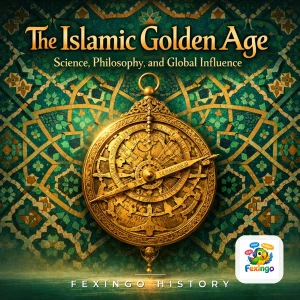
The Islamic Golden Age: Science, Philosophy, and Global Influence — Fexingo History
Fexingo98 EpisodesOct 10, 2026
From the 8th to the 13th centuries, the Abbasid Caliphate fostered an unprecedented flourishing of science, philosophy, and culture. In Baghdad's House of Wisdom, scholars like al-Khwarizmi pioneered algebra, while al-Razi advanced medicine and Ibn Sina (Avicenna) synthesized Aristotelian thought with Islamic theology. This era saw the translation and preservation of Greek classics, the development of astrolabes and observatories, and innovations in chemistry, optics, and geography. Philosophers like al-Farabi and Averroes engaged in debates over reason and revelation that echoed through medieval Europe. The show also explores the influence of the Islamic Golden Age on the Renaissance, from the transmission of Arabic numerals to the works of Dante and Thomas Aquinas.
Episodes
The Astrolabe's Hidden Geometry and Islamic InnovationOct 10, 20268:29While previous episodes have celebrated the translation movements of Baghdad and the medical breakthroughs of Avicenna, this episode turns its gaze to the instrument that made such precision possible: the astrolabe. We explore how Islamic scholars transformed a Greek navigational tool into a complex computational device capable of solving problems in astronomy, timekeeping, and even religious dire
The House of Wisdom's Final StandOct 9, 20268:57In this episode, we turn our attention away from the celebrated scientists and philosophers to explore the catastrophic destruction of Baghdad in 1258. We examine how the Mongol invasion under Hulagu Khan ended the Abbasid Caliphate and decimated the intellectual infrastructure of the Islamic Golden Age. Lucas walks us through the siege, the surrender of Caliph Al-Musta'sim, and the systematic dis
The Silk Road's Forgotten Medical NetworksOct 8, 20268:05While we often think of the Islamic Golden Age through the lens of Baghdad’s House of Wisdom or the astronomical charts of al-Biruni, a quieter revolution was taking place along the dusty caravan routes connecting Samarkand to Damascus. This episode explores how medical knowledge didn't just stay in imperial capitals but flowed outward through mobile practitioners and regional hospitals. We follow
The House of Wisdom's Hidden ArchitectsOct 7, 202610:27We often hear about the great scholars of Baghdad, but who built the infrastructure that let them work? This episode explores the quiet power of patronage in the Abbasid Caliphate. We look at how caliphs like al-Ma'mun didn't just fund translation, they created a global intellectual economy. From the salaries of Greek and Syriac translators to the political maneuvering behind Bayt al-Hikma, we unc
Al-Khwarizmi: The Father of Algebra's Global ImpactOct 6, 20267:39We often hear about the House of Wisdom or great surgeons like Al-Zahrawi, but one figure quietly reshaped how humanity calculates reality. This episode focuses on Muhammad ibn Musa al-Khwarizmi, a ninth-century scholar in Baghdad who wrote Kitab al-Jabr wa-l-Muqabala. His work didn't just solve for unknowns; it gave us the word algebra and introduced the decimal system with Indian numerals to the
Ibn al-Nafis: The Doctor Who Discovered Blood FlowOct 5, 20269:23In this episode, we turn away from the grand libraries of Baghdad and the mechanical wonders of Ismail al-Jazari to focus on a single, quiet breakthrough in Damascus. We explore the life of Ibn al-Nafis, a thirteenth-century physician whose commentary on Avicenna’s Canon contained a radical observation about the human body that contradicted two thousand years of established medical dogma. While Eu
Al-Jazari's Clockwork Genius and Medieval EngineeringOct 4, 20268:49We turn our attention from the libraries of Baghdad to the workshops of Diyarbakir to explore the life of Ismail al-Jazari, the thirteenth-century engineer whose work laid the groundwork for modern mechanical engineering. While earlier episodes covered the intellectual heights of the House of Wisdom, this episode focuses on the practical application of knowledge through his seminal text, The Book
The Astrolabe: How Muslims Mapped the Stars and TimeOct 3, 20268:54We often think of the Islamic Golden Age as a time of libraries and philosophy, but it was equally defined by the precise measurement of the heavens. This episode explores the astrolabe, that intricate brass instrument which served as the medieval world’s most powerful analog computer. We trace its evolution from the Greek models of Claudius Ptolemy to the sophisticated devices crafted in Baghdad
Al-Jazari's Ingenious Machines of the Abbasid EraOct 2, 20268:39This episode explores the mechanical genius of Ismail al-Jazari, a twelfth-century engineer whose work in the late Abbasid Caliphate laid groundwork for modern automation. We examine his landmark text, The Book of Knowledge of Ingenious Mechanical Devices, and its detailed descriptions of water-raising pumps, elephant clocks, and candle mechanisms. Lucas traces how these inventions solved practica
Tungran: The Persian Scribe Who Saved BaghdadOct 1, 20268:29In this episode, we step away from the grand libraries and famous polymaths to focus on a single, pivotal moment during the Mongol siege of Baghdad in 1258. While history remembers Hulagu Khan for his brutality and the destruction of the House of Wisdom, it often overlooks the human agency that mitigated some of the worst outcomes. We explore the story of Tungran, a high-ranking Persian civil serv
Al-Jazari and the Clockwork Genius of BaghdadSep 30, 202610:56In this episode, Lucas and Luna explore the life and mechanical inventions of Ismail al-Jazari, the eleventh-century engineer whose work defined Islamic Golden Age technology. Moving beyond the philosophical debates of the House of Wisdom, we examine how al-Jazari applied mathematics and metallurgy to create complex automata, water-raising devices, and sophisticated timekeeping instruments. We dis
Al-Biruni and the Measurement of EarthSep 29, 20268:47In this episode, we explore the extraordinary life and work of Abu Rayhan al-Biruni, a polymath from the eleventh century who changed how humanity understands its own planet. While many history listeners know Baghdad for its House of Wisdom, fewer realize that some of the most rigorous scientific breakthroughs came from the eastern fringes of the Islamic world, particularly in Ghazni and Nishapur.
Al-Idrisi's World Map: Medieval Cartography and Global TradeSep 28, 20268:17While Baghdad’s House of Wisdom translated ancient texts, another intellectual revolution was mapping the physical world. In this episode, we turn away from algebra and optics to explore the life of Muhammad al-Idrisi, a geographer who served King Roger II of Norman Sicily in the twelfth century. We examine how al-Idrisi compiled the Tabula Rogeriana, a map that synthesized Greek geography with fi
Al-Biruni's Earth: Measuring the World from GhazniSep 27, 202611:12In this episode of Fexingo History, we turn away from the bustling translation halls of Baghdad to explore the scientific achievements of Abu Rayhan al-Biruni. While many Golden Age figures worked in major urban centers, al-Birini conducted his most groundbreaking work from the frontier city of Ghazni under the service of Mahmud of Ghazni. We examine how he calculated the Earth’s circumference wit
The Great Translation Movement of BaghdadSep 26, 20267:14We often think of the Islamic Golden Age as a time of invention, but its foundation was built on words. In this episode, we explore the Great Translation Movement of the early ninth century, where scholars in Baghdad didn't just preserve ancient knowledge—they actively reconstructed it. We follow Hunayn ibn Ishaq, a Nestorian Christian physician and translator who became the master of Greek to Ara
Al-Zahrawi's Surgical Legacy in Medieval MedicineSep 25, 20267:06While we have previously touched upon the medical giants of the Islamic Golden Age, this episode zooms in on Abu al-Qasim al-Zahrawi, the towering figure from Al-Andalus whose work redefined surgery for centuries. We explore how he moved medicine away from purely theoretical frameworks toward hands-on, practical intervention, documenting procedures that were decades ahead of their time. You will h
Ibn al-Haytham and the Birth of OpticsSep 24, 20268:47While earlier episodes have explored the House of Wisdom, algebra, and surgical tools, this episode turns the lens toward a different kind of revolution: the science of light itself. We follow the life of Ibn al-Haytham, known in the West as Alhazen, who challenged centuries-old Greek theories about vision. Living in Cairo under the Fatimid Caliphate, he rejected the idea that eyes emit rays to se
Al-Jahiz: The Satire and Humor of the Islamic Golden AgeSep 23, 20268:30While we have explored the scientific rigor of Ibn al-Haytham and the medical precision of Al-Zahrawi, this episode turns to the vibrant, chaotic literary world of Baghdad through the eyes of Al-Jahiz. Born in Basra to a Zanj slave father, he rose to become the era's most celebrated prose writer and wit. We explore his masterwork, the Kitab al-Hayawan (Book of Animals), which blends zoology with s
Al-Biruni's Earth: Measuring the World from GhazniSep 22, 20269:29Episode 243 shifts focus from Baghdad’s House of Wisdom to the observatory of Mahmud of Ghazni, where the polymath Al-Biruni conducted one of history’s most rigorous scientific experiments. We explore how a Persian scholar, stranded in what is now Afghanistan, calculated the Earth’s circumference with astonishing accuracy using trigonometry and mountain angles. The episode details his method of ob
Avicenna's Canon and the Global Medical RevolutionSep 21, 20269:26While previous episodes have touched on individual medical pioneers like Al-Zahrawi and Al-Razi, this episode centers on Ibn Sina, known in the West as Avicenna. We explore his magnum opus, the Kitab al-Qanun fi al-Tibb, or The Canon of Medicine, a massive five-volume encyclopedia that standardized medical knowledge across the Islamic world and Europe for centuries. Lucas and Luna discuss how Ibn
The Silk Road's Hidden ScientistsSep 20, 20267:30We often think of the Islamic Golden Age as centered in Baghdad, but the real engine of scientific exchange was the Silk Road itself. In this episode, Lucas and Luna trace how Chinese papermaking technology traveled west after the Battle of Talas, fundamentally changing how knowledge was stored and shared across the Middle East. We explore the role of Samarkand’s paper mills, the translation movem
The House of Wisdom's Lost TreasuresSep 19, 20267:23In this episode, we explore the intellectual legacy of Baghdad’s Bayt al-Hikma during the Abbasid Caliphate. Lucas and Luna discuss how scholars like Hunayn ibn Ishaq and Thabit ibn Qurra translated Greek, Syriac, and Persian texts into Arabic, preserving works by Euclid, Ptolemy, and Galen. We examine the political climate under Caliph al-Ma'mun, the Mihna inquisition, and the vibrant scholarly c
Al-Kindi: The Arab Philosopher Who Invented CodebreakingSep 18, 20268:52Long before the Enigma machine or modern cryptography, there was Al-Kindi, a ninth-century polymath in Baghdad who wrote the definitive treatise on breaking secret codes. This episode explores how the Abbasid Empire’s demand for intelligence during political upheaval birthed frequency analysis and statistical linguistics. We follow Al-Kindi as he translates Greek logic into Arabic and applies math
The House of Wisdom: Baghdad's Lost LibrarySep 17, 20267:56We revisit the Bayt al-Hikma, but this time we look past the famous names to the machinery of translation. How did scholars like Hunayn ibn Ishaq and Thabit ibn Qurra turn Greek, Syriac, and Persian texts into Arabic with such precision? We explore the collaborative networks, the patronage of caliphs like al-Ma'mun, and the intense intellectual debates that shaped the Mihna. This episode uncovers
Al-Zahrawi: The Surgeon Who Invented Modern ToolsSep 16, 20267:58We often think of medieval medicine as a dark age of superstition, but in tenth-century Cordoba, Abu al-Qasim al-Zahrawi was performing surgeries that wouldn't be seen again for centuries. In this episode, we step into the operating theater of Kitab al-Tasrif, the massive thirty-volume encyclopedia that became the standard medical text in Europe for five hundred years. We explore how al-Zahrawi di
Al-Khwarizmi and the Algebra That Built the Modern WorldSep 15, 202611:08In this episode of The Islamic Golden Age, we turn away from the grand libraries of Baghdad to explore a quieter revolution: the birth of algebra. We focus on Muhammad ibn Musa al-Khwarizmi, the Persian mathematician whose 9th-century text, Kitab al-Jabr wa-l-Muqabala, gave us the word 'algorithm' and redefined how humanity solves problems. Lucas and Luna trace how al-Khwarizmi moved mathematics f
The House of Wisdom's Lost TreasuresSep 14, 20269:29In this episode, we explore the devastating destruction of Baghdad in 1258 and the tragic loss of the House of Wisdom's vast collection. Lucas and Luna discuss the Mongol siege led by Hulagu Khan, the burning of libraries along the Tigris River, and the stories behind the scholars who tried to save texts like Al-Khwarizmi's astronomical tables and Hunayn ibn Ishaq's medical works. We also look at
Banu Musa Brothers: The Engineers of BaghdadSep 13, 20265:17While we’ve explored the philosophical and medical giants of the Islamic Golden Age, this episode turns to the mechanical innovators who built the city’s wonders. Meet the three Banu Musa brothers—Muhammad, Ahmad, and al-Hasan—who worked under Caliph al-Ma'mun in the ninth century. We’ll examine their seminal text, the Kitab al-Hiyal (Book of Ingenious Devices), which detailed hundreds of automata
The House of Wisdom's Lost TreasuresSep 12, 20266:35We often think of the Abbasid Golden Age as a period of intellectual harmony, but Episode 233 explores the violent reality behind the scenes. Lucas and Luna examine how Caliph al-Ma'mun’s Bayt al-Hikma became a battleground for religious orthodoxy during the Mihna inquisition. They discuss Hunayn ibn Ishaq’s desperate translations under pressure, the destruction of libraries by Hulagu Khan’s Mongo
Al-Ma'mun and the House of Wisdom: Baghdad's Intellectual RevolutionSep 11, 20267:17While earlier episodes introduced the Bayt al-Hikma as a library, this episode explores how Caliph al-Ma'mun transformed it into an engine of global knowledge through state-sponsored translation. We examine the Mu'tazilite debate and the Mihna, the controversial inquisition that forced scholars to align with rationalist theology or face exile. Lucas walks us through the precise mechanics of the tr
Al-Haytham: The Father of the Scientific MethodSep 10, 20266:28While many know Al-Kindi or Al-Razi, few discuss how Ibn al-Haytham fundamentally changed how we understand light and vision. This episode explores his pivotal work Kitab al-Manazir and his rigorous experimental methods that predated the European Renaissance by centuries. We trace his life from Cairo to his controversial house arrest, where he produced some of history's most important scientific t
Al-Razi: The Chemist Who Healed the WorldSep 9, 20267:05While we’ve explored the mathematical brilliance of al-Khwarizmi and the mechanical wonders of al-Jazari, Episode 230 turns its gaze to the healing arts through Abu Bakr al-Razi. In 9th-century Baghdad, al-Razi revolutionized medicine by insisting on observation over tradition, famously distinguishing between smallpox and measles for the first time. This episode traces his journey from a young mus
Al-Jazari's Automata: The First Robots of Medieval IslamSep 8, 20269:41While we have covered the intellectual achievements of the House of Wisdom and the mathematical rigor of al-Khwarizmi, this episode turns its gaze to the mechanical arts through the life of Ismail al-Jazari. Based in Diyarbakir during the late twelfth century, al-Jazari served the Artuqid dynasty and wrote the Kitab fi Ma'rifat al-Hiyal al-Handasiyya, or Book of Knowledge of Ingenious Mechanical D
The House of Wisdom's Secret: How Paper Spread KnowledgeSep 7, 20268:04We often think of the Islamic Golden Age through its brilliant minds—al-Khwarizmi, Ibn Sina, or Al-Kindi—but we rarely discuss the material medium that allowed their ideas to survive. This episode shifts focus from the thinkers to the technology that democratized knowledge: paper. We trace the journey from the Battle of Talas in 751 CE, where captured Chinese artisans taught Abbasid scribes the ar
Al-Ghazali: The Crisis of Faith in BaghdadSep 6, 20268:01In this episode, we explore the profound intellectual crisis that gripped the Islamic world in the 11th and 12th centuries through the life of Abu Hamid al-Ghazali. Once the most celebrated philosopher and theologian in Baghdad, al-Ghazali experienced a spiritual breakdown so severe he abandoned his prestigious position at the Nizamiyya madrasa to wander as a Sufi ascetic for years. We trace his j
Al-Zahrawi: The Surgeon Who Invented Modern ToolsSep 5, 202611:15Long before the sterile operating theaters of the nineteenth century, a physician in Cordoba named Abu al-Qasim al-Zahrawi was stitching wounds with catgut and cauterizing tumors with heated irons. This episode explores his magnum opus, Kitab al-Tasrif, a thirty-volume medical encyclopedia that served as the standard surgical text in Europe for over five hundred years. We examine how he invented d
Nizami Ganjavi's Khamseh: Love and Logic in Medieval PersiaSep 4, 20268:26This episode moves beyond the scientific and administrative achievements of the Islamic Golden Age to explore its literary soul through the life and work of Nizami Ganjavi. Born around 1141 in Ganja, a city on the Silk Road, Nizami wrote his masterpiece, the Khamseh, a collection of five long narrative poems that redefined Persian literature for centuries. We examine how he blended pre-Islamic myt
Al-Idrisi's World Map: The Islamic Geographer Who Mapped the Medieval GlobeSep 3, 20269:41In Episode 224, Lucas and Luna explore the life and work of Muhammad al-Idrisi, a 12th-century geographer who created the Tabula Rogeriana for King Roger II of Sicily. While previous episodes covered Baghdad’s House of Wisdom and the translation movement, this episode shifts focus to the Mediterranean crossroads of Palermo, where Islamic, Christian, and Jewish scholars collaborated under Norman ru
Al-Jazari's Ingenious Devices and Medieval EngineeringSep 2, 20265:05We leave the translation halls of Baghdad to explore the mechanical genius of Ismail al-Jazari, whose 1206 CE masterpiece The Book of Knowing the Ingenious Mechanical Devices revolutionized engineering. While previous episodes touched on the Banu Musa and their automata, we dive deep into al-Jazari’s specific innovations: the crankshaft, the camshaft, and his famous Elephant Clock. This episode ex
The House of Wisdom: Baghdad's Lost LibrarySep 1, 20266:52We explore the Bayt al-Hikma, not just as a translation center but as the intellectual engine of the Abbasid Caliphate. Lucas and Luna discuss how Caliph al-Ma'mun transformed Baghdad into a global hub of inquiry, drawing scholars from diverse faiths to translate Greek, Persian, and Indian texts. We examine the political weight of knowledge during the Mihna, the daily life of scholars like Hunayn
The Paper Revolution: How Baghdad's Mills Changed the WorldAug 31, 20266:06In this episode, Lucas and Luna explore how papermaking transformed the Abbasid world. From the legendary Battle of Talas in 751 CE, where Chinese prisoners supposedly introduced paper to Central Asia, to the bustling paper mills of ninth-century Baghdad, they trace how this humble technology enabled an explosion of knowledge. They discuss the role of the Bayt al-Hikma, the rise of paper as a comm
The Great Library of Cordoba: Al-Hakam II's Bookish LegacyAug 30, 20266:09In tenth-century Cordoba, while Baghdad's House of Wisdom was fading, Caliph al-Hakam II built a library that rivaled—and perhaps surpassed—anything the Abbasids ever had. This episode explores how the Umayyad caliph of al-Andalus amassed a collection of over 400,000 volumes, from rare Greek manuscripts to the works of al-Khwarizmi and Ibn al-Haytham. We look at the scholars he employed to scour t
Al-Jazari's Elephant ClockAug 29, 20268:02In this episode, Lucas and Luna explore the life and inventions of Ismail al-Jazari, the 12th-century engineer whose Book of Knowledge of Ingenious Mechanical Devices described over a hundred automata and machines, including the famous Elephant Clock. They trace how al-Jazari, working for the Artuqid court in Diyarbakir, combined ancient Greek and Indian engineering traditions with Islamic craftsm
Al-Biruni: The Master Polymath of the Islamic Golden AgeAug 28, 20268:45In this episode, Lucas and Luna explore the remarkable life and work of Abu Rayhan al-Biruni, the 11th-century scholar whose insatiable curiosity spanned astronomy, mathematics, geography, and anthropology. From his groundbreaking calculations of Earth's radius to his meticulous study of Indian culture in the Kitab al-Hind, al-Biruni stands as a testament to the intellectual breadth of the Islamic
Harun al-Rashid's Baghdad: The City of PeaceAug 27, 202610:19In this episode of The Islamic Golden Age, Lucas and Luna step back from the great minds and inventions to walk the streets of the city that made it all possible: Baghdad, the City of Peace. Founded by Caliph al-Mansur in 762 on the banks of the Tigris, Baghdad was not just a political capital but a purpose-built hub for trade, learning, and power. We follow its rise from a circular fortress to a
Hunayn ibn Ishaq: The Translator Who Shaped MedicineAug 26, 20267:20In this episode, Lucas and Luna explore the life and work of Hunayn ibn Ishaq, the 9th-century Nestorian Christian physician and translator who became the most influential figure in the Great Translation Movement. From his early days in al-Hira to his rise in Baghdad's Bayt al-Hikma, Hunayn translated over a hundred Greek medical and philosophical works into Syriac and Arabic, including Galen's en
Al-Kindi: The Philosopher of the Arabs and the Birth of Arab PhilosophyAug 25, 20265:35Before Ibn Rushd and Avicenna, there was al-Kindi — the first self-identified philosopher in the Arabic tradition. In this episode, Lucas and Luna explore the life and work of Abu Yusuf Ya'qub ibn Ishaq al-Kindi, a 9th-century polymath who translated Greek thought into Arabic and tried to reconcile faith and reason. We follow his journey from Kufa to Baghdad under the early Abbasids, his role in t
Al-Khwarizmi: Algebra, Algorithms, and the House of WisdomAug 24, 20269:14In this episode, Lucas and Luna explore the life and legacy of Muhammad ibn Musa al-Khwarizmi, the Persian polymath whose work on algebra and algorithms transformed mathematics and shaped the modern world. From his role at the House of Wisdom in Baghdad to his astronomical tables and geographic corrections of Ptolemy, al-Khwarizmi's influence reached from the Islamic Golden Age to Renaissance Euro
The Sugar Revolution: How Baghdad Sweetened the WorldAug 23, 20267:05In this episode, Lucas and Luna explore how the Abbasid Empire turned sugar from a rare luxury into an industrial staple, transforming agriculture, labor, and cuisine across the medieval world. From the marshes of Khuzestan to the plantations of Sicily, they trace the spread of sugarcane, the invention of new refining techniques, and the rise of sugar as a global commodity. They discuss the role o
Fatimid Cairo's Grandeur: Al-Azhar's First CenturyAug 22, 20267:37In this episode, Lucas and Luna step into the world of the Fatimids, the Ismaili Shi'a dynasty that challenged Abbasid authority and built a rival capital. We trace the founding of al-Qahira in 969 CE by Jawhar al-Siqilli, the Sicilian-born general who led the conquest of Egypt for Caliph al-Mu'izz. We explore how the Fatimids used propaganda, spectacle, and scholarship to legitimize their rule, f
The Banu Musa: Engineering Geniuses of BaghdadAug 21, 20269:20In ninth-century Baghdad, three brothers from a modest Persian family became the most prolific engineers and mathematicians of the Abbasid Golden Age. Muhammad, Ahmad, and al-Hasan ibn Musa ibn Shakir — known collectively as the Banu Musa — turned their inheritance into a scientific powerhouse. Backed by the caliphs al-Ma'mun and al-Mutawakkil, they translated Greek texts, pioneered algebra and ge
The Astrolabe's Silent Partner: Al-Farghani's MeasureAug 20, 20269:48In this episode, Lucas and Luna explore the life and work of Ahmad ibn Muhammad ibn Kathir al-Farghani, the ninth-century astronomer whose meticulous measurements of the Earth's circumference and his text 'The Elements of Astronomy' shaped both Islamic and European science for centuries. We trace his journey from the banks of the Oxus to the caliphal court in Baghdad, where he worked alongside the
The Great Translation Movement: Baghdad's Bridge of KnowledgeAug 19, 20267:28In this episode, Lucas and Luna explore the Great Translation Movement, the engine behind the Islamic Golden Age's intellectual explosion. From the eighth-century courts of al-Mansur to the grand ambitions of al-Ma'mun, they trace how a civilization built a bridge to the ancient world. Discover the translators who rendered Greek, Syriac, and Persian works into Arabic—figures like Hunayn ibn Ishaq,
Ibn al-Haytham's Optics: Light, Lenses, and DoubtAug 18, 20269:30In this episode, Lucas and Luna explore the life and work of Ibn al-Haytham, the eleventh-century polymath whose investigations into light and vision changed the course of science. From his early career in Basra and Cairo to his famous imprisonment, we trace the roots of the scientific method in his insistence on empirical testing. His monumental Kitab al-Manazir challenged Ptolemy's theory of vis
The Market Inspector of Baghdad: Commerce, Justice, and the MuhtasibAug 17, 20268:07In this episode, Lucas and Luna step into the bustling markets of Abbasid Baghdad to meet the muhtasib — the market inspector who was part cop, part judge, part moral enforcer. Drawing on the tenth-century manual by Ibn al-Ukhuwwa, they explore how this official checked weights and measures, tested coins, prevented fraud, and even ensured that bakers didn't shortchange their customers. The convers
The Silver Dirham: Money, Trade, and the Abbasid EconomyAug 16, 20268:18In this episode of Fexingo History, Lucas and Luna explore the economic engine of the Abbasid Caliphate: the silver dirham. They trace how a standardized coinage system, rooted in Byzantine and Sasanian traditions, underpinned a vast trading network stretching from al-Andalus to China. Along the way, they meet the money-changers of Baghdad's suqs, the merchants of the Khurasan trade route, and the
Al-Sufi's Book of Fixed Stars: A Persian Astronomer's LegacyAug 15, 20268:05In this episode, we explore the life and work of Abd al-Rahman al-Sufi, the 10th-century Persian astronomer whose Book of Fixed Stars (Kitab al-Kawakeb al-Thabet) transformed how the heavens were observed and mapped. Based in Isfahan under the Buyid dynasty, al-Sufi corrected Ptolemy's star catalogue, recorded the Andromeda Galaxy as a 'little cloud', and influenced everyone from Copernicus to mod
The Astrolabe's Silent Partner: Al-Farghani's Measure of the WorldAug 14, 20267:23In this episode of Fexingo History, Lucas and Luna step away from the crowded spotlight of al-Khwarizmi and al-Battani to follow the quieter path of Ahmad ibn Muhammad ibn Kathir al-Farghani, the ninth-century astronomer whose measurements of the Earth's circumference and the diameter of the moon shaped Islamic and European science for centuries. We trace his journey from the banks of the Oxus to
Al-Ma'mun and the Mihna: Faith, Reason, and the InquisitionAug 12, 20266:07In 833, the Abbasid caliph al-Ma'mun, patron of the House of Wisdom and champion of Greek philosophy, imposed a religious inquisition on his own scholars. The Mihna tested whether theologians and judges would publicly affirm that the Quran was created, not eternal. This episode follows the rise of the Mu'tazilite doctrine, the role of chief judge Ahmad ibn Abi Du'ad, and the ordeal of Ahmad ibn Ha
Al-Jahiz and the Kitab al-Hayawan: A Ninth-Century MindAug 11, 20268:14In this episode, Lucas and Luna explore the life and work of Al-Jahiz, the ninth-century Basran polymath whose Kitab al-Hayawan (Book of Animals) blended zoology, philosophy, and social commentary. They discuss his early poverty in Basra, his move to Baghdad's intellectual circles, his role as a court writer under the Abbasids, and his groundbreaking observations on animal behavior, evolution-like
Ziryab: The Slave Who Revolutionized Andalusian CultureAug 10, 20267:36In this episode, Lucas and Luna explore the extraordinary life of Ziryab, a freed Black slave from Baghdad who transformed 9th-century Córdoba into the cultural capital of the West. From his musical innovations—adding a fifth string to the oud and founding Europe's first conservatory—to his influence on fashion, cuisine, personal hygiene, and etiquette, Ziryab's legacy permeates daily life even to
The Abbasid House of Wisdom: More Than a LibraryAug 9, 20267:29Episode 200 of Islamic Golden Age takes you inside the Bayt al-Hikma, the famed Abbasid institution that was far more than a library. In Baghdad's heyday, this center of translation and research brought together scholars of every background—Persians, Nestorians, Jews, and Arabs—to preserve and expand the world's knowledge. We trace its rise under Harun al-Rashid and al-Ma'mun, the translation move
The Rise of Paper in Abbasid BaghdadAug 8, 20266:02In this episode, Lucas and Luna trace the journey of paper from its origins in China to the heart of the Abbasid Caliphate, where it transformed scholarship, bureaucracy, and everyday life. They explore the Battle of Talas in 751, the capture of Chinese papermakers, and the establishment of the first paper mills in Baghdad, Samarkand, and beyond. The conversation highlights how paper's affordabili
Fatimid Cairo and the Rise of al-Azhar UniversityAug 7, 20267:23In 970, the Fatimid general Jawhar al-Siqilli laid the foundation stone of a new city outside the old walls of Fustat. He called it al-Qahira, 'the Victorious' — and at its heart he began a mosque that would become one of the oldest universities in the world: al-Azhar. This episode follows the Fatimid conquest of Egypt, the building of Cairo, and the creation of al-Azhar as a center of Ismaili lea
The Map That Shaped the World: al-Idrisi and Roger IIAug 6, 20267:26In this episode, we explore the remarkable meeting of minds between the Andalusian geographer Muhammad al-Idrisi and the Norman king Roger II of Sicily. Together, they created the Tabula Rogeriana, a world map so accurate that it remained the standard for centuries. We trace al-Idrisi's journey from Ceuta to Cordoba, his travels across the Mediterranean and beyond, and how Roger II, a Christian ki
Al-Biruni and the Geodesic Measurement of the EarthAug 5, 20267:35In this episode, Lucas and Luna explore the remarkable life and work of Abu Rayhan al-Biruni, the 11th-century polymath who measured the Earth's circumference with astonishing accuracy using trigonometry and a mountain in present-day Pakistan. They discuss his method, his travels with Mahmud of Ghazni, his pioneering work in geodesy, his critique of Ptolemy, his insights into Hindu philosophy and
The Golden Age of Islamic Geography: al-Idrisi and the WorldAug 4, 20266:50Before GPS and satellite maps, a 12th-century Moroccan scholar named Muhammad al-Idrisi created one of the most accurate maps of the medieval world. Commissioned by the Norman King Roger II of Sicily, al-Idrisi's world map and his book, the Kitab Rujar, synthesized centuries of Islamic geographical knowledge with European and African sources. This episode of The Islamic Golden Age follows al-Idris
The Great Library of Cordoba: Al-Hakam II and the Bookish CapitalAug 3, 20267:23In this episode, Lucas and Luna explore the golden age of the Library of Cordoba under Caliph al-Hakam II. They discuss how his passion for books turned a palace library into a center of learning that rivaled Baghdad, with manuscripts collected from across the Islamic world. The episode covers al-Hakam's patronage of scholars, the library's catalog of over 400,000 volumes, and the tragic fate of t
The Astrolabe's Golden Age: From Baghdad to the StarsAug 2, 20269:56In this episode of Fexingo History, Lucas and Luna explore the astrolabe's journey from its Hellenistic origins to its flourishing in the Islamic Golden Age. They discuss how scholars like al-Farghani and al-Battani refined the instrument, how it became a symbol of scientific inquiry from Baghdad to Cordoba, and how it enabled navigation, timekeeping, and even religious practice. The conversation
The Great Library of Cordoba: al-Hakam II and the Bookish CapitalAug 1, 20268:02In this episode, we step away from Baghdad and east to Cordoba, the dazzling capital of al-Andalus, to explore one of the greatest libraries of the medieval world. Under Caliph al-Hakam II, who ruled from 961 to 976, Cordoba's library reportedly held over 400,000 volumes—more than any library in Christendom at the time. We discuss how al-Hakam, unlike his predecessors, was a bookish ruler who pers
The Brethren of Purity: The Secret Philosophers of BasraJul 31, 20268:31In 10th-century Basra, a clandestine group of scholars known as the Ikhwan al-Safa—the Brethren of Purity—compiled a 52-epistle encyclopedia that synthesized Greek, Persian, Indian, and Islamic thought. This episode explores who they were, their eclectic blend of Neoplatonism and Hermeticism, their secretive network, and the enduring influence of their Rasail on Islamic philosophy and even the Eur
The Astrolabe: How Islamic Science Charted the CosmosJul 30, 20264:46Before GPS, before sextants, there was the astrolabe—a handheld device that could tell time, predict sunrise, and measure the stars. In this episode of The Islamic Golden Age, we trace the astrolabe's journey from Greek origins to its golden age under Abbasid astronomers like al-Farghani and al-Battani. Learn how Muslim scholars refined Ptolemy's plansiphere, added intricate star maps for prayer t
Bimaristan: The Medieval Hospitals That Transformed MedicineJul 30, 20265:15Before modern hospitals, there were bimaristans — the sophisticated medical institutions of the Islamic Golden Age. In this episode, we explore the rise of the first true hospitals in Baghdad, Cairo, and Damascus, from the pioneering bimaristan funded by Harun al-Rashid to the sprawling Mansuri Hospital in Cairo. We discuss free universal care, specialized wards for fevers, mental illnesses, and s
Ibn al-Nafis and the Discovery of Pulmonary CirculationJul 29, 20265:05In this episode of The Islamic Golden Age podcast, Lucas and Luna explore the remarkable story of Ibn al-Nafis, a 13th-century physician who discovered pulmonary circulation three centuries before William Harvey. Born near Damascus in 1213, Ibn al-Nafis studied at the Nuri Hospital and later became chief physician at Cairo's Mansuri Hospital. By performing human dissections and critically examinin
Hunayn ibn Ishaq: The Translator Who Saved Ancient KnowledgeJul 29, 20266:34Before the works of Galen and Aristotle reached medieval Europe, they passed through the hands of one remarkable man: Hunayn ibn Ishaq, a Nestorian Christian physician and translator in 9th-century Baghdad. This episode follows his journey from the town of al-Hira to the Abbasid court, where he became the chief translator at the House of Wisdom (Bayt al-Hikma). We explore his rigorous method for v
Al-Kindi: The Philosopher of the Arabs and the Birth of Islamic PhilosophyJul 28, 202610:24Before al-Farabi and Ibn Sina, there was al-Kindi. Known as the 'Philosopher of the Arabs,' Abu Yusuf Ya'qub ibn Ishaq al-Kindi was the first major philosopher in the Islamic tradition to reconcile Greek thought with Islamic theology. Born in Kufa and active in Baghdad's House of Wisdom, he translated and commented on Aristotle and Plato, while also writing original works on optics, cryptography,
Ibn al-Haytham: The Birth of the Scientific MethodJul 28, 20265:35In this episode of The Islamic Golden Age, we explore the life and work of Abu Ali al-Hasan ibn al-Haytham, known in the West as Alhazen. Born in Basra in 965 CE and later active in Cairo under the Fatimid Caliphate, Ibn al-Haytham revolutionized the study of optics with his magnum opus, the Kitab al-Manazir (Book of Optics). Challenging centuries-old theories from Ptolemy and Galen, he developed
Al-Khwarizmi: The Father of Algebra and AlgorithmJul 27, 20264:48This episode dives into the life and work of Muhammad ibn Musa al-Khwarizmi, the ninth-century Persian polymath whose contributions to mathematics, astronomy, and geography shaped the modern world. We explore his seminal book 'Al-Kitab al-Mukhtasar fi Hisab al-Jabr wa al-Muqabala', which introduced systematic algebraic methods, and his astronomical tables 'Zij al-Sindhind'. We also discuss his rol
The Round City: How Al-Mansur Built BaghdadJul 27, 20267:42In 762 CE, the Abbasid caliph al-Mansur founded Baghdad, originally named Madinat al-Salam (City of Peace). This episode explores the vision behind the round city—its innovative concentric design, the symbolic placement of gates, and the massive construction effort that transformed a village into a global hub. We discuss the site selection, the workforce of skilled artisans, and the strategic layo
The Barmakids: The Persian Viziers Who Shaped the Abbasid Golden AgeJul 26, 20265:17Before their spectacular fall, the Barmakid family dominated the Abbasid court under Harun al-Rashid, patronizing science, literature, and the translation movement. This episode traces their rise from Buddhist priests in Balkh to the most powerful officials in Baghdad, their role in nurturing the golden age, and the sudden purge in 803 that erased them. We explore the stories of Yahya al-Barmaki,