
The OLNE Relationship Podcast
The OLNE Relationship Podcast is a relationship advice show for people who want love without ownership, intimacy without control, and freedom without chaos. It explores relationships, emotional intelligence, jealousy, attachment, communication, dating, breakups, personal growth, and the deeper psychology of love. Each episode offers practical insight for building relationships rooted in honesty, self-awareness, nonconditional love, and mutual respect.
Episodes

What to Watch When You Say No (Understanding Narcissism, Ep. 7)
- Someone can feel disappointed and still respect your no.- Watch what happens to the original issue after you disagree.- Does warmth return while your answer stays the same, or only when you give in?- An apology means more when the behavior changes next time.
Betrayal Trauma: When the Person You Need Hurts You (Understanding Narcissism, Ep. 6)
- You can know someone hurt you and still need them.- Why does blaming yourself sometimes feel easier?- Staying quiet doesn't mean you don't see what's happening.- Being kind afterward isn't the same as repairing the harm.
Do They Know You, or Just Their Version of You? (Understanding Narcissism, Ep. 5)
- Being praised isn't always the same as being understood.- What happens when you want something they didn't expect?- You shouldn't have to give up an interest to prove you care.- Can their picture of you change when you do?
Grandiose vs. Vulnerable Narcissism: What’s the Difference? (Understanding Narcissism, Ep. 4)
- Someone can feel overlooked and still expect special treatment.- Shyness and insecurity aren't the same as narcissism.- Can they celebrate your good news without making it about them?- Their pain can be real without making their demands fair.
The False Self and Narcissistic Supply (Understanding Narcissism, Ep. 3)
Getting admiration isn’t the same as feeling known.-Why doesn’t yesterday’s praise always feel like enough?-A simple correction can turn into a conversation about someone’s worth.-Notice when you’re asked to praise the effort instead of discuss the problem.
How a Child Learns to Perform Instead of Be (Understanding Narcissism, Ep. 2)
--A child can get plenty of praise and still feel unseen.--What happens when affection depends on getting it right?--Looking confident doesn’t tell you how much pressure someone feels.--Can they make a mistake without losing their place in the relationship?
What Are You Calling Narcissism? (Understanding Narcissism, Ep. 1)
--When is liking attention a disorder--What about a painful reaction to criticism--What happens to boundaries--Dealing with bad behaviors
From Empathy to Co-Independence: The Full Picture (Beyond Empathy: The Path to Co-Independence, Ep. 7)
- You can understand someone and still make the wrong choice for them.- What happens when they correct the version of them in your head?- Caring helps when the other person can still choose for themselves.- Closeness works better when both people can remain themselves.
The Costs Of Caring (Beyond Empathy: The Path to Co-Independence, Ep. 6)
- They understand what matters to you. Does it change what they do?- Helping can take effort without asking you to erase yourself.- A favor can be freely given, or used to keep someone indebted.- What happens when nobody’s watching and it’s time to follow through?
Can They Let You Correct Them? (Beyond Empathy: The Path to Co-Independence, Ep. 5)
- They say they understand you. What happens when you say they got it wrong?- A question isn’t curiosity if only one answer is allowed.- Being wrong about one moment doesn’t make someone a bad partner.- Can your answer actually change what they believe about you?
When Empathy Gets The Meaning Wrong (Beyond Empathy: The Path to Co-Independence, Ep. 4)
- You feel sad with them. Do you know why they’re sad?- Why can the same feeling mean different things to two people?- What happens when your reaction becomes their explanation?- Can you be close without feeling exactly the same way?
When Your Pain Becomes About Them (Beyond Empathy: The Path to Co-Independence, Ep. 3)
- You came to them for support. Why did you end up comforting them?- Can someone care about you and still miss what you need?- What happens when their guilt takes over the conversation?- How do you get room to finish what you were saying?
Are They Seeing You or Their Version of You? (Beyond Empathy: The Path to Co-Independence, Ep. 2)
--They know what you’ll do. Do they know why?--What happens when “the strong one” needs help?--They remember your habits, but do they see what matters to you now?--Could asking one question change what you thought you knew?
The Difference Between Empathy and Care (Beyond Empathy: The Path to Co-Independence, Ep. 1)
--They know why you're upset. So why do you still feel alone?--You ask for company and get an explanation instead.--Feeling something with you isn't the same as showing up for you.--A caring response can include a real limit.
What Real Repair Looks Like Under Pressure (Cluster B Under Pressure, Ep. 7)
--What changes after the apology?--Can they hear a no?--What happens at the next disappointment?--Can you forgive and still leave?
Who Are They After The Argument? (Cluster B Under Pressure, Ep.6)
The argument ends. Why does one person still feel under pressure?An apology can be sincere and still leave the original demand in place.Feeling ashamed isn’t the same as owning what you did.Does “Can we start fresh?” leave room to talk about what happened?
Why Anger Spreads Through the Whole Relationship (Cluster B Under Pressure, Ep. 5)
-The argument may be over, but the relationship can still be reacting to it.-Anger can start shaping what both people feel safe saying.-Reassurance can calm the moment without changing the demand.-When does anger stop expressing hurt and start controlling the conversation?
When Disagreement Turns You Into the Enemy (Cluster B Under Pressure, Ep. 4)
- One disagreement can turn into a verdict on your whole character.- Splitting and black-and-white thinking overlap, but they aren’t the same thing.- How can you tell a global accusation from a specific complaint?- You can see the fuller picture and still protect yourself.
When Distance Feels Like Abandonment (Cluster B Under Pressure, Ep.3)
- They ask for space. Suddenly it feels like they’re leaving forever.- Feeling abandoned and being abandoned aren’t always the same event.- Reassurance can be loving without becoming unlimited access.- A pause is only healthy if it isn’t being used as punishment.
When Criticism Feels Like Humiliation (Cluster B Under Pressure, Ep.2)
-> You name one behavior. Suddenly you’re proving you don’t think they’re worthless.-> Feeling humiliated doesn’t always mean someone humiliated you.-> A complaint can be painful and still be fair.-> If every conversation ends in reassurance, the original harm never gets addressed.
When A Small Problem Takes Over The Relationship (Cluster B Under Pressure, Ep.1)
- You changed one plan. Now you’re defending whether you love them.- The event may be small, but the meaning can feel enormous.- Feeling rejected and being rejected aren’t the same event.- A reaction can make sense and still cross a boundary.
Fantasy That's Healthy vs. Pathological - The Final Boss (When the Fantasy Becomes Pathological, Ep.7)
- > Two people can agree and still be living inside a fantasy.-> Disagreement isn’t the problem. What happens to the truth afterward is.-> A real relationship can survive “I changed my mind.”-> Shared reality doesn’t require either person to disappear.
When Reality Breaks The Shared Fantasy (When the Fantasy Becomes Pathological, Ep. 6)
-> You can grieve a future that never became part of your life.-> A breakup and the collapse of the story aren’t always the same thing.-> Sometimes you’re not only missing them. You’re missing who you felt like with them.-> Your hope was real, even when the future wasn’t.
How The Shared Fantasy (Paracosm) Defends ITSELF (When the Fantasy Becomes Pathological, Ep.5)
-> You ask about the plan. Now you’re defending whether you love them.-> What happened to the question you originally asked?-> Being disappointed is one thing. Asking someone to take back what they noticed is another.-> Sometimes a relationship sounds united because one person has stopped speaking.
How you get recruited into the shared fantasy (pathological shared fantasy ep4)
Have you ever wondered when you became “the one who always believes”?At first, the role can feel like being deeply understood.Then you change your mind, and suddenly there’s a problem.What happens when you stop playing the part the relationship expects?Two people can believe the same story without having equal power or responsibility.
The Moment Fantasy Becomes Pathological (When a Shared Fantasy Becomes Pathological, Ep.3)
- Plans, hopes and fantasies.- The real warning sign is when no evidence can change the story.- What if success proves it, but failure somehow proves it too?- Hope adjusts when reality changes. Fantasy keeps changing the explanation.- Ask yourself: What would I actually allow to change my mind?
When Fantasy Feels Better Than Reality ep2
- What's wrong with fantasy- Feeling relief vs. the truth- Hope vs. Fantasy- What's wrong with a comforting story- Love that's reality-tested, what that looks like
Parenting On An Empty Tank (Rebuilding Your Life Without Losing Yourself, Ep. 5)
• Limited capacity is not limited love• When exhaustion becomes a moral accusation• A hard week versus parental burnout• What caregiving is actually consuming• When demands exceed available resources• The four questions for an empty tank• Why trying harder cannot create sleep• Simplifying without abandoning essential care• Why your child cannot become your support system• Support the care instead
Can they change? Desire versus support
• Desire is not capacity.• Promises versus evidence.• Insight without change.• The cost of real change.• Support versus dependence.• Capacity under stress.• Repetition reveals the pattern.• What setbacks expose.• Repair that changes behavior.• Trust follows evidence.
Why they come back | Hoovering
• Why they really come back• Return is not repair• One message, different motives• Restoring the shared fantasy• Recovering regulation or attention• Regaining access• Sincere regret versus change• What happens when access is limited• Four questions before trusting again
Do they feel remorse? (Shame v remorse)
- Why intense tears reveal emotion, but not what the emotion is centered on.- The crucial difference between "I am bad" and "I did something harmful."- How shame can pull attention away from the injured person and back toward the self.- Why fear of consequences or lost access can resemble remorse.- The moment "I cannot bear what I feel" becomes "You are the problem."- Why Vaknin gives two conflict
When You Say “No”
• When they campaign against your no | boundaries• Why a strong reaction doesn’t reveal motive• Narcissistic injury versus ordinary disappointment• When no feels like abandonment• Why visible drama doesn’t prove HPD• Goal frustration and pressure for compliance• The difference between processing and punishment• How expectations differ from commitments• Four questions that preserve reality testing•
Why They Lie & What to Do (Cluster B Patterns & Behaviors, Ep. 2)
• When falsehood protects fantasy• When fear drives deception• When lying becomes performance• When deception serves a goal• Why ordinary people lie too• What changing stories reveal• Why body language proves nothing• Four questions to assess deception• Understanding without excusing• What real repair looks like
Selfish, or Crazy? (Cluster B Patterns and Behaviors, Ep. 1)
• Why selfishness can mean different things• Behavior is not a diagnosis• Observation versus inference• What a boundary can reveal• Grandiosity versus abandonment fear• Attention versus access• Real emotion can still become coercive• Explanation does not erase accountability• Four questions for recurring behavior• Trust conduct, not labels
How To Be A 'Stable' Person (Your Personality & Identity, Ep. 6)
• Why consistency is not stability.• What holds you together when several parts of life change at once.• How one role or relationship can become responsible for your entire identity.• Why memory can connect your chapters without becoming your whole self.• How commitments turn stated values into visible behavior.• Why revising an agreement does not erase its history or effects.• What saying no reve
Opinions Of Who You Are (Your Identity & Personality, Ep. 5)
• When “I know you” stops feeling loving and starts feeling like a cage.• How someone can see something real without getting to define you.• The difference between an observation and an identity assignment.• Why rejecting someone’s interpretation doesn’t erase accountability.• When a familiar description becomes a role you’re forced to perform.• How intimacy can deepen knowledge without creating o
Does Chaos Make You Feel Alive (Your Personality & Identity, Ep. 4)
• Why calm can feel empty while crisis feels vivid• What urgency gives you besides stress• When direction gets mistaken for aliveness• Why a crisis can make you feel focused and useful• The difference between activation and genuine presence• How external drama can temporarily organize internal noise• Why intensity doesn’t automatically mean meaning• When crisis becomes your primary route to presen
When You Need Attention To Feel Alive (Your Identity & Memory, Ep. 3)
• When being needed becomes proof that you exist.• What attention supplies besides connection.• Why silence can feel like erasure.• How one relationship, role, or platform becomes load-bearing.• The difference between co-regulation and outsourced selfhood.• Why needing people isn’t the problem.• How imagined outside eyes shape your identity.• What functional concentration looks like in daily life.
Memory, Identity, and the Thread of 'You' (Memory & Personality, Ep. 2)
• Knowing, recollecting, and owning aren’t the same.• Why your past can feel like someone else’s life.• Why vividness isn’t the same as accuracy.• What photographs and songs can prompt, but never prove.• Why owning a chapter doesn’t mean approving it.• How to build a low-pressure Continuity Archive.
Are You Still You? (Your Personality, Ep. 1)
• You changed. Are you still you?• What changed, carried through, and remains yours?• Growth without escaping accountability.
When commitment becomes ownership, what to do?
When Commitment Becomes Ownership (Dating After Abuse, Ep. 6) When commitment becomes permanent access The hidden danger of relationship titles Ask instead of assume Appreciation without hidden debt Why affection is never advance consent Real agreements without ownership Freedom without emotional abandonment Repair measured through follow-through Stop overcommitting for two people Can lo
Is Your Chooser Broken? (Dating After Narcissistic Abuse, Ep. 2)
• Why strong chemistry creates panic• What attraction cannot prove• The role hiding inside chemistry• When familiar isn’t dangerous• Three questions before choosing more
When They Change, What Do You Do (Intimacy Skills, Ep.7)
• What happens when someone remembers an older version of you?• Why isn’t knowing your partner ever finished?• How can curiosity replace an outdated assumption?• What changed?• What’s still true?• What needs updating?• Why does understanding never force agreement?• Can you love someone and still be incompatible?• When should a shared agreement be renegotiated?
When They Ask For Space (Intimacy Skills, Ep. 5)
• When does space become punishment?• What makes a return point trustworthy?• How do you pause without disappearing?• How do you respect space without accepting avoidance?
When Feelings Feel Like Obligation (intimacy skills 4)
• When does a feeling become a demand?• Can validation coexist with no?• Does hurt prove harmful intent?• What are you actually being asked?• Is the feeling separate from the story?• Can you care without taking blame?• When is repair genuinely owed?• Does empathy require agreement?• Can a boundary still be loving?• What changes when a promise was broken?
Disagreements because of words (intimacy skills ep3)
• What did they mean?• Did you check?• Are you assuming?• What does “support” mean?• Did you hear rejection?• Are you fighting an inference?• Can you understand and disagree?• Does intent erase impact?• What is the real request?• Are you having the same conversation?
Stop Demanding Honesty (Intimacy Skills Ep. 2)
Why can pressure backfire? When does privacy become deception? What information do you actually need? What if they refuse to answer?
When Love Is Not Enough - Relationship Reality Testing Episode 6
How can love be real and still not build a future?- What changes when love and relationship are separated?- Why doesn't wanting something create the capacity to provide it?- Can an honest limitation still be a dealbreaker?- When is "not now" honest, and when does it become indefinite waiting?- What do receipts reveal that promises cannot?- When can improvement be real but still not create enough f
How to Be Known: The Intimacy Skills Nobody Taught You Ep.1
You Don’t Know Them Yet• Are you loving a picture?• When does curiosity become pressure?• What should you trust: words or patterns?
Relationship Reality Testing Episode 4: Evaluating Trust
• Can a promise create trust?• What does the record show?• Which agreement was broken?• Did the truth arrive in time?• What changed after the breach?• Can trust return without surveillance?• What should you do now?
Relationship Reality Testing Episode 2: Apology vs. Repair
- When is “sorry” not enough?- What does repair actually require?- Can remorse exist without change?- Does explanation replace ownership?- Who decides what makes it right?- Can trust return without forgiveness?- What proves the pattern changed?- Are amends becoming a purchase?- Can you forgive without reopening access?- Is the apology only the beginning?
Relationship Reality-Testing, Ep.1: Don't Ask If They Love You
- Is love the wrong question?- Feeling love vs. building love.- When intention hides impact.- Pattern. Impact. Repair.- Receipts over vows.- When sincere change isn’t enough.
After The Fantasy - Rebuilding You: Designing Yourself After You're Free
- Why the old you may not be the goal.- Who did you become to stay loved?- The hidden rule beneath your role.- Why values need visible actions.- Stop manifesting. Start practicing.- Role. Rule. Value. Action. Review. Repeat.
After The Fantasy: Rebuilding You - What To Do After You're Free
- what actually can be designed- the 2 traps of designing your self/personality- what do you build with freedom- how to know if you're building from goal or panic- how to build for reliability not one-time only- how to "reality-test"- How to recognize positive change
After The Fantasy: Rebuilding You, Ep. 4 - Somatic & Social Reconstruction
- Somatic & Social Reconstruction- the difference between implicit/somatic and explicit/conscious- understanding vs. body sense- hypervigilance not as a personality trait- physiological anxiety- body reconstruction- why anxiety can get worse- dissociation during crisis- overriding the nervous system- the importance of social/communal
After The Fantasy: Rebuilding You, Ep. 3 - Identity Reconstruction
- who are you after the "we"- collapse of the shared fantasy- what you lost- the kernel of the 'self'- success defined in reconstruction- the ego would prefer you suffer- genuine failure- end-running the ego
After The Fantasy: Rebuilding You, Ep. 1 - What The Grief Is About
- the hard part (the leaving part is easy)- when a narcissistic relationship ends- the voice in your head that uses you- why survivors can't trust their own minds- why "just be yourself" is the worst advice- the "survival self"- why letting it go is hard- what actually gets rebuilt
Narcissistic Healing Ep. 7: The Relational Goal For Healing Narcissism - Co-Independence
- what you are changing into- the more important question for narcissist than healing- why most people cannot reach nonconditional love- what is the willingness to love without transaction- the internal stance that make change possible- telling the truth without losing the relationship- why most therapies contract the false self- the architecture doesn't disappear - what to build instead
Healing Narcissism Ep. 6: Narcissistic Mortification - the Shattering
- shattering the false self - creating the opening- the first to mortify the narcissist- controlled shattering through cold therapy- what most narcissists usually do- the reverse regression sequence- the kidnapper metaphor- when not to do controlled mortification- how holding works
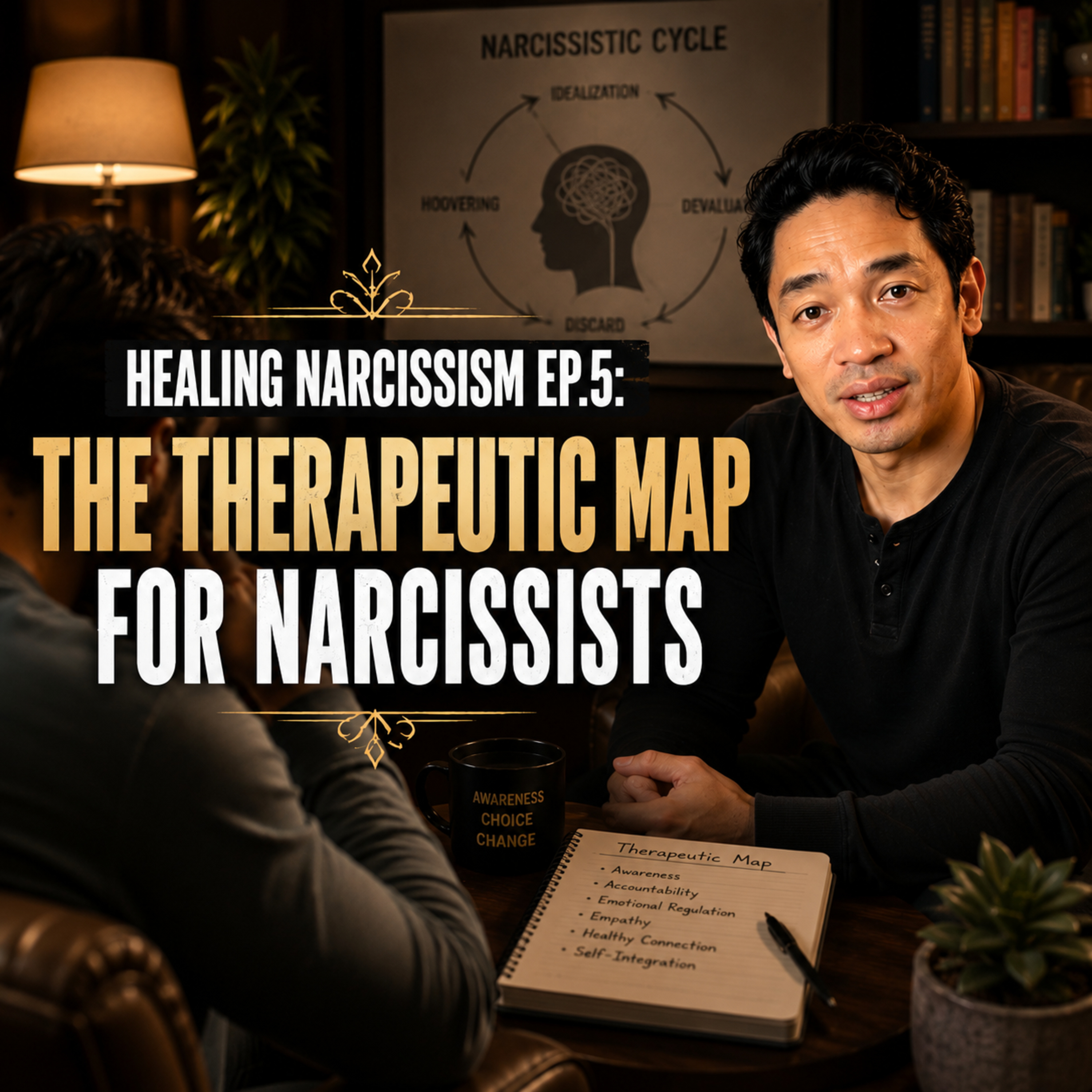
Narcissistic Healing Ep. 5: The Therapy Map
- modification vs. cure and healing in narcissism; how it works- DBT test outcomes and men's "cover borderline"- Vaknin's "cold therapy" - re-traumatization- 18 maladaptive schemas- therapies that collude with the false self- reverse splitting
Narcissistic Healing Ep.4: The Sadistic Inversion in Narcissism
- the inversion that appears as grandiosity and confidence- what the inner critic actually is- sadistic super-ego- the grandiosity gap- the defense cascade (3 parts)- why therapy is difficult
Healing Narcissism Ep. 3: False Self- The Architecture of Resistance
why dropping the mask doesn't work- the origin story, object relations and Winnicott- why the false self is impenetrable- cold therapy and co-independence- therapy vs. structure
Healing Narcissism Ep. 2: The 'Types' Of Change *IF* A Narcissist Can Change
- The question: if the narcissist can change is the wrong question- why healing and 'behavior modification' are completely different- what clinical profile is needed for "healing" - there are two- Do the inside and outside connect in Cluster B- the longitudinal BPD research - and why it's a misnomer- 3 mechanisms that keep internal and external development locked apart- the 3
Healing Narcissism Episode 1: Why They Can't See It
Healing Narcissism Episode 1: Why They Can't See It- Why the Narcissist cannot see themselves- even when they try- What the 'False Self' is- The 2 categories they sort things in- Why self-help doesn't work on narcissists- What is narcissistic mortification- How the pillar of OLNE works on narcissism- What change actually requires - beyond surface level
Can They Change? - How To Know IF They Can Without Wasting Time (Sex, Lies, & Cluster B, Ep. 6)
- 3 things that look like "change" to watch out for- cluster b personalities: how they outsource regulation- symptom reduction vs. behavioral change, the truth- covert narcissists; can they change- what to look for so you don't waste years of your life- change your question to this
Why Change, To A Narcissist, Feel Like Death (Sex, Lies & Cluster B Ep. 5)
- why stability feel like death to a narcissist- narcissist "snapshot" theory- why boundaries feel like attack- how they use sex as anxiety medication- how the false self "mummifies" the true self- why narcissists can't see your disappearance- the pathological shared fantasy

In Bed With A Narcissist, Psychopath or Histrionic (Sex, Lies & Cluster B, Ep. 4)
- how to tell the difference between histrionic, narcissist, and psychopath in bed- why they look identical- the emotional temperature test- what "I love you" means to each one- what sociosexuality means for each- three voices that live in one person- the robotic doll test- the "don't ask, don't tell" idea

Paranoia In Bed (Sex, Lies, & Cluster B, Ep. 2)
- what is paranoid ideation- two strands of paranoia- the false self enemy- twin anxieties- the persecutory object- the 5 behavioral outcomes of paranoid ideation- projective identification- narcissistic mirroring - what happens

Sex, Lies, & Cluster B (ep. 1): How To Tell Someone's Personality By How They Behave In Bed
• Why sex is a map of the whole personality• Why the paranoid partner can't stay present in bed• Three Cluster B types look identical - one is cold• Why "I love you" and "you're a prop" come from same person• The false self: the wall that kills intimacy• They use sex like a sedative• Warmth vs. emptiness -how to tell them apart
Post-Family-Abuse - After Going No-Contact (Family Dynamics of Cluster B, Ep. 8)
- why you feel worse or hollow after no-contact- a different kind of grief- identity from grievance- why an internalized abusive voice sounds like you- how to integrate the idea of "co-independence"- why the family member hoovers- what the finishing line actually is
Cluster B Family Mechanism For Control; Triangulation, Flying Monkeys, Smear Campaign, Tribunal
- narcissist conversion; flying monkeys- using triangulation for control- when you're targeted- you're put on trial by the family- how to love them and have no contact
Regression: why you turn 8 at the table - Family Dynamics of Cluster B Ep. 6
- becoming 8 years old at the dinner table- regression mechanics - developmental demotion- the inner committee - introjects- misidentification- splitting the family - good/bad parent- disidentifying vs. suppressing
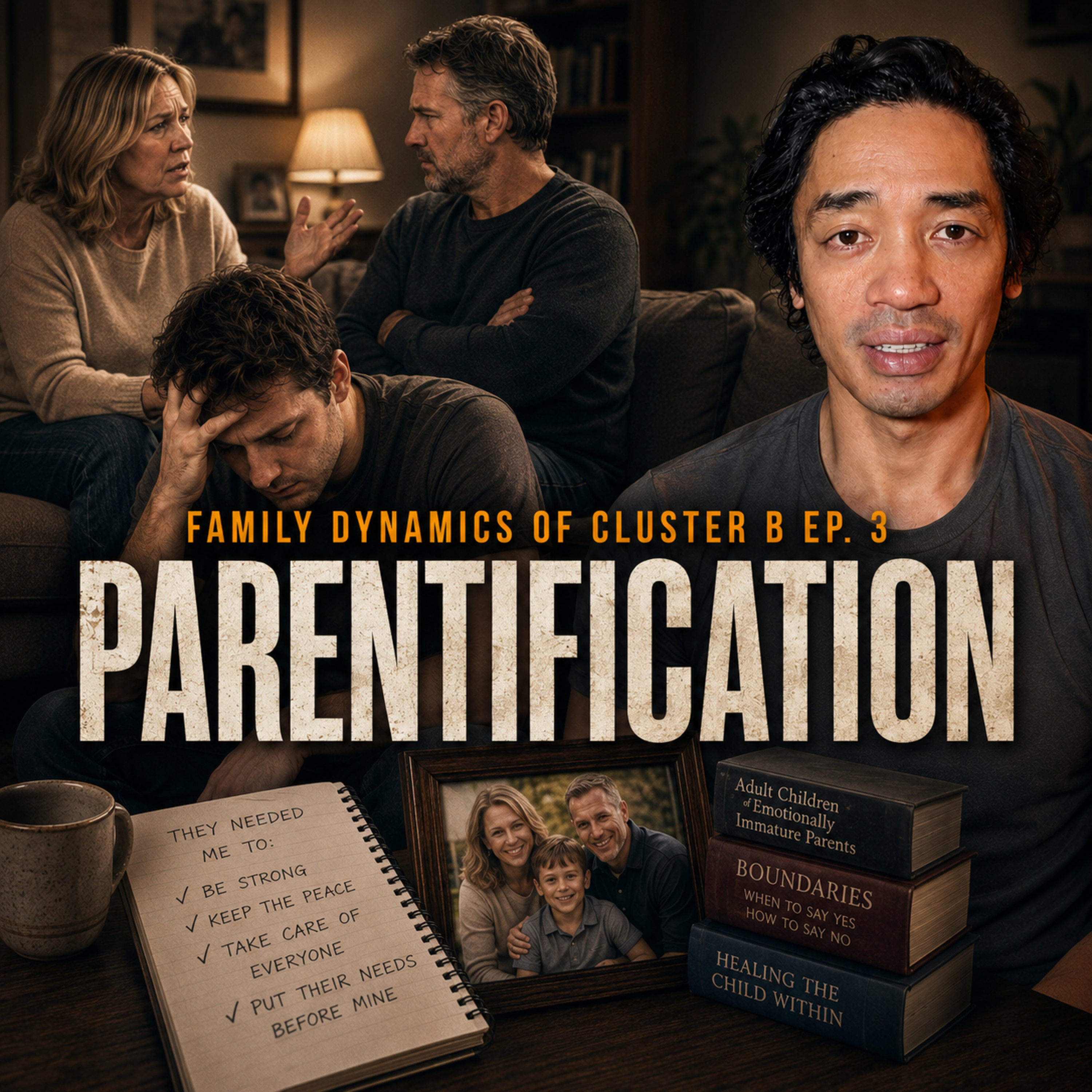
The Parentified Child: When You Became the Adult Too Soon (Family Dynamics of Cluster B Ep. 3)
- What parentification actually is (it's not what you think)- The two directions of the trap — and why both hurt- Emotional covert incest: the harm with no name- The voice inside you that says you're never enough- Why you learned to self-soothe before you ever had a reason to- What recovery actually looks like (it's not just "healing")

Family Dynamics Of Cluster B - The Scapegoat & The Golden Child
- the sibling lie- projected splitting: role theory + splitting + projection- the golden child's prison (conditional love, false self)- the scapegoat's curse + hidden edge (truth-seeking)- the toxic contract: why children comply- sibling divide as maintenance tool- when the parent dies - the liberation myth- the path through- reconciliation vs. splitting the parents

The Role You Played To Be Loved (Family Dynamics of Cluster B Ep. 1)
- the difference between your identity and the role you grew up with- how cluster b family systems turn children into personalities- why trying to fix things might feel like love - but actually survival- the "invisible child"- role theory and emergent roles explain why family labels last- the problem child dynamic- the golden child dilemma- unhealthy family dynamics
Stop Comparing Your Healing to Their Avoidance
Why avoidance can look like peace from the outside.How the scoreboard keeps your worth on trial.Why healing metabolizes reality — and avoidance relocates pain.The hidden trap of comparing your grief to their new life.How the death voice turns their happiness into a verdict.Why pain is not proof you’re behind.The difference between moving on and transferring regulation.Why the rebound doesn’t have
Why You Protested After Betrayal (Replacement wound ep. 3)
- Why betrayal can make you act unlike yourself- When protest behavior is attachment panic- Why the wound is: “I don’t know what was real.”- The crime scene inside your nervous system- How intermittent reinforcement keeps you searching- Why the replacement wound hurts so deeply- The difference between panic and behavior- How to stop living in judgment

Replacement Wound Ep. 2: The Prize of An Affair
- why the affair partner can feel like "the winner"- how to frame the betrayal- what the affair partner is participating in- how triangulation works in a disordered personality- the influence of shame- the dynamics of love vs. accountability- what to do with the triangulation

Why They Choose Someone Easier - affair rebound and self blame
- Why the “replacement” usually isn’t better - just easier.- The shared fantasy needed a new container.- How the affair partner becomes shame-management.- Why your protest was attachment panic, not weakness.- A rebound lasting doesn’t prove growth.- Why duration proves duration; not love, depth, or health.
Codependency Trap ep.7: Breaking The Pattern
- Why the codependent trap isn’t just the person- and it keeps repeating.- The difference between relief and love- why “being chosen again” can feel so addictive.- How intermittent reinforcement turns the person who hurt you into the person your nervous system craves.- Why open communication breaks the fog by making reality non-negotiable.- The hidden difference between nonconditional love and sel