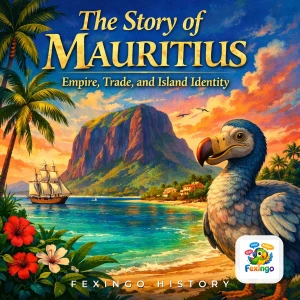
The Story of Mauritius: Empire, Trade, and Island Identity — Fexingo History
Mauritius, a small volcanic island in the Indian Ocean, became a crossroads of empire from the 16th century onward. The podcast explores the brutal colonial ambitions of the Portuguese, Dutch, French, and British, and their lasting impact on the island's landscape and people. Lucas and Luna guide listeners through the extinction of the dodo, the sugar boom, the struggle for control of the Indian Ocean, and the legacy of French governor Mahé de Labourdonnais. They also delve into the Maroon communities, the abolition of slavery, the arrival of indentured workers from India, and the birth of a unique multicultural society.
Episodes

Mauritius' Forgotten French Planters and the Sugar Boom
While earlier episodes explored the Dutch origins, the Maroon resistance at Le Morne Brabant, and the Indian Girmit labor system, this episode shifts focus to the critical French interregnum that transformed Mauritius from a neglected waystation into a thriving colonial hub. We examine how Governor Mahé de Labourdonnais rebranded the island as Île de France and laid the groundwork for its sugar ec
Mauritius' Forgotten Indian Rebellion: The Sétoucal Uprising
While we have explored the maroon wars of Le Morne and the tragic separation of Chagos, Episode 257 turns its gaze to a different kind of resistance on the sugar plantations. In January 1894, a small group of indentured laborers from India staged a violent revolt at the Sétoucal estate in Caudan Valley. Led by figures like Subramania Pillai, this uprising challenged the brutal discipline of the gi
Mauritius' Drowned Graves and the Vieux Rempart Mystery
While previous episodes have covered the brutal mechanics of slavery, the dramatic escape of maroons to Le Morne, and the tragic extinction of the dodo, Episode 256 turns our gaze to the quiet, submerged history beneath Port Louis. We explore the phenomenon of 'drowned graves'—mass burial sites from the late eighteenth century that were lost to urban expansion and rising sea levels—and the endurin
Mauritius: The Dodo, Maroons, and the Fight for Chagos
We trace three defining threads of Mauritius’ past: the tragic extinction of the dodo, the heroic resistance of the maroon slaves in Le Morne Brabant, and the complex political maneuvering behind the 1965 separation of the Chagos Archipelago. Lucas and Luna explore how the Dutch East India Company’s arrival erased a unique ecosystem, how enslaved Africans built hidden communities in volcanic crags
Mauritius' First Capital and the Dutch East India Company
While previous episodes have explored the dodo's extinction, the maroon wars at Le Morne, and the later Indian indentured labor system, this episode travels back to 1638 to examine the very first human settlement on Mauritius. We focus on the Dutch East India Company’s (VOC) attempt to establish a permanent colony under Governor Jan van Hoorn. Unlike the French later era of spice gardens or the Br
Mauritius' Secret War for Chagos
In Episode 253, Lucas and Luna explore the geopolitical maneuvering behind the 1965 separation of the Chagos Archipelago from Mauritius. While earlier episodes touched on the political figures involved, this episode digs into the specific diplomatic pressure applied by British Prime Minister Harold Macmillan and U.S. Secretary of State Dean Rusk to secure Diego Garcia for a strategic military base
Mauritius: The Secret War for Chagos
This episode explores the complex geopolitical maneuvering behind the 1965 separation of the Chagos Archipelago from Mauritius. We examine the roles of Sir Seewoosagur Ramgoolam, Harold Macmillan, and Dean Rusk in this pivotal moment. The narrative focuses on the strategic importance of Diego Garcia to the United States and the British government's insistence on maintaining military bases there. W
The 1835 Emancipation and the Girment System
After the abolition of slavery in 1835, Mauritius faced a labor crisis that reshaped its demographic and cultural landscape. This episode explores the transition from the Code Noir to the indentured labor system known as girmit. We examine the role of the sirdar, the experiences of the first Indian arrivals, and the complex legal frameworks that governed their lives. Lucas and Luna discuss how thi
Mauritius' Secret Indian Rebellion: The Sétoucal Revolt
In this episode, we explore a pivotal but often overlooked moment in Mauritian history: the 1834 rebellion of the Sétoucal indentured laborers. Long before the formal abolition of slavery in 1835, thousands of Indian workers, known as girmitiyas, arrived on Île de France under brutal conditions. We focus on the leadership of Subramania Pillai and the coordinated uprising at the Caudan Valley sugar
Mauritius' Secret Resistance: The Maroon Wars
While earlier episodes explored the botanical wars and the emancipation experiments of Mauritius, this episode uncovers the brutal reality of marronnage—the escape of enslaved people to the island’s rugged interior. We focus on Le Morne Brabant as a sanctuary and the subsequent military campaigns waged by colonial forces against these maroon communities. Through the lens of figures like François l
The Great Dodo Extinction: Captain Caillot's Final Hunt
We often think of the dodo’s extinction as a slow, accidental fading, but the final chapter was actually written in blood and gunpowder by a specific man named Captain Caillot. In this episode, we step away from the botanical gardens and sugar plantations to focus on the year 1681, when the last known population of Raphus cucullatus was wiped out in the rugged terrain of Le Morne Brabant. We explo
The Dodo's Last Stand: Extinction and Empire in Mauritius
We trace the tragic final days of the dodo, focusing on Captain Caillot’s 1681 expedition to Le Morne Brabant and the myth that these birds simply chose death over captivity. While popular culture remembers the dodo as a clumsy joke, historical accounts from sailors like François Leguat reveal a bird that was actually intelligent, curious, and deeply adapted to its island home. We examine how the
The Chagossians: Displaced from Their Home
In this episode of the Fexingo History podcast, Lucas and Luna explore the complex and painful history of the Chagos Archipelago separation in 1965. While earlier episodes covered the spice gardens and sugar plantations of Mauritius, we now turn to the strategic geopolitical maneuvering that led to the expulsion of the Chagossian people. We examine how the British government coerced Prime Minister
Mauritius' Lost Maroon Wars and Le Morne's Siege
While previous episodes have touched on the Code Noir and the general concept of marronnage, this episode dives into the specific military history of the Maroon communities in Mauritius. We explore how escaped slaves built fortified settlements in the rugged interior, particularly around Le Morne Brabant, and turned the island’s geography against colonial forces. Lucas and Luna examine the British
Mauritius 1965: The Chagos Archipelago Separation
In 1965, as Mauritius prepared for independence from Britain, a controversial decision was made to detach the Chagos Archipelago to create the British Indian Ocean Territory. This episode explores the geopolitical pressures of the Cold War, the role of UK Prime Minister Harold Macmillan and US Secretary of State Dean Rusk, and the complex negotiations that led to the separation. We examine the leg
Mauritius: The Great Escape of the Maroons
While earlier episodes explored the botanical wars and the sugar economy, this episode turns to the rugged interior of Le Morne Brabant. We examine the lives of the marrons—escaped slaves who carved out a free society in the volcanic peaks during the late eighteenth century. Through the lens of François le Noir and the legend of the final stand in 1803, we explore how geography shaped resistance.
The Great Fire of Port Louis: A Colonial Catastrophe
In this episode, we trace the devastating Great Fire of Port Louis in July 1835, a disaster that nearly wiped out Mauritius’ capital just as emancipation was taking hold. We explore how a single spark in a warehouse owned by the Franco-Mauritian merchant Jean-Baptiste de la Plaine ignited a conflagration that consumed over two hundred buildings, including the colonial courthouse and the main hospi
Mauritius’ Forgotten Labor: The Girmit System Explained
While we’ve traced the French botanical gardens and the sugar plantations, this episode turns to the human machinery that sustained them. After abolition in 1835, Mauritius faced a labor crisis that led to the introduction of indentured workers from India under the girmit system. We explore how sirdars recruited families, the brutal conditions aboard ships like the William Pitt, and the cultural r
Mauritius' Chinese Architects: Building Port Louis
While Pierre Poivre’s botanical gardens and the sugar plantations dominate the narrative of French Mauritius, a quieter force shaped the island’s urban landscape. This episode explores the arrival of Cantonese and Hakka artisans in the late eighteenth century, who were brought not as laborers but as skilled craftsmen to build Port Louis. We trace how these Chinese migrants influenced the architect
Mauritius' Secret Silk Road and Botanical Wars
While previous episodes explored the spice trade and sugar plantations, Episode 239 uncovers a lesser-known chapter: Pierre Poivre’s aggressive botanical espionage in the 1760s and 1770s. We trace how the French intendant of Île de France smuggled nutmeg and clove cuttings from the Dutch-held Banda Islands and Ceylon, defying VOC monopolies to establish Mauritius as the 'Garden of the Indian Ocean
Mauritius' Forgotten Indian Architects
This episode explores the often-overlooked contribution of Chinese and Cantonese immigrants to the urban development of Port Louis during the French colonial era. While much attention has been paid to French governors like Mahé de Labourdonnais and botanical experiments by Pierre Poivre, the physical layout of the capital was heavily influenced by artisans from Guangdong province. We examine how t
The Ghost Ships of Mauritius: The 1835 Emancipation
On February 1, 1835, the French colony of Île de France, later known as Mauritius, witnessed one of the earliest and most significant abolitions of slavery in the world. This episode explores the complex political maneuvering behind the 'Great Emigration,' where former slaveholders received substantial compensation from the British Crown while the newly freed population faced immediate economic un
Mauritius Port Louis: The Slave Market and Urban Roots
While earlier episodes explored the botanical gardens of Pierre Poivre and the rebellions at Le Morne, this episode shifts focus to the beating heart of colonial Mauritius: Port Louis. We trace the transformation of a humble fishing village into the strategic capital known as Île de France under French rule. Lucas walks us through the layout of the Place d'Armes, the rise of the Franco-Mauritian m
Mauritius' Forgotten Chinese Architects
While French colonial history dominates the narrative of Mauritius, a quiet but profound influence shaped its urban landscape: the Chinese indentured laborers who arrived in the late nineteenth century. This episode explores how these workers, primarily from Guangdong province, transformed Port Louis from a rigid military outpost into a vibrant commercial hub through their mastery of brickmaking,
Mauritius' Hidden Spice War: Pierre Poivre's Secret Garden
While previous episodes covered the brutal sugar economy and the dodo’s extinction, this episode uncovers a quieter, intellectual war fought by French botanist Pierre Poivre in the 1750s. As the Intendant of Île de France, Poivre waged a covert campaign against the Dutch VOC monopoly on nutmeg and cloves, smuggling seeds from the Banda Islands into his secret garden at Jardin de l'État. We explore
Mauritius' Cinnamon Monopoly: Pierre Poivre's Secret Garden
While previous episodes explored the brutality of slavery and the rise of sugar, this episode uncovers the quiet, botanical warfare waged by Pierre Poivre in the 1760s. As Governor of Île de France, Poivre realized that the Dutch East India Company held a stranglehold on the global spice trade through their monopoly on cinnamon from Ceylon. He launched a daring mission to smuggle cinnamon seeds ou
Mauritius 1780s: The French Botanical Revolution
In the 1780s, Mauritius (then Île de France) became the epicenter of a global botanical conspiracy orchestrated by Pierre Poivre. As Governor, Poivre didn't just grow plants; he stole spice seeds from the Dutch-controlled Spice Islands to break their monopoly and feed the French Empire. This episode explores how the Jardin de l'État in Port Louis became a hub of espionage, smuggling, and scientifi
Mauritius' Forgotten Silk Road: The French Botanical Garden
Long before Mauritius became a sugar colony or an independent nation, it served as the botanical heart of the Indian Ocean under French rule. In this episode, we explore the ambitious vision of Pierre Poivre, the intendant who transformed Île de France into a living laboratory for global agriculture. We trace his secret missions to steal seeds from the Spice Islands, the establishment of the Jardi
Mauritius 1835: The Emancipation Experiment
In this episode of The Story of Mauritius, Lucas and Luna explore the pivotal year of 1835, when slavery was officially abolished across the British Empire, including on Île de France. While earlier episodes covered the Maroon Wars and the Le Morne uprising, this conversation focuses on the complex legal and social reality of 'Emancipation.' We examine how the British colonial administration imple
Mauritius' Forgotten Spice Gardens and the French Visionary
Before sugar dominated Mauritius, it was a jewel of botanical ambition under French rule. This episode explores the visionary work of Pierre Poivre, the Governor of Île de France in the 1760s and 70s, who turned Port Louis into a global arboretum. We trace how he smuggled spice trees—nutmeg, cinnamon, cloves—from Dutch-controlled islands to break their monopoly, creating lush gardens that fed the
The Sugar Kings of Mauritius: Planters and Power
We explore the rise of the Franco-Mauritian sugar aristocracy in nineteenth-century Mauritius, focusing on the pivotal 1850s crisis when planters like Adrien d'Épinay challenged colonial authority. This episode details how the abolition of slavery in 1848 forced a brutal shift to indentured labor from India, creating a new economic hierarchy rooted in coercion rather than chattel ownership. We exa
Mauritius' Creole Resistance: Language and Identity
While earlier episodes explored the dodo's extinction, French naval strategies, and the brutal mechanics of slavery and indenture in Mauritius, this episode turns to the cultural heartbeat that survived them all: Kreol Morisien. We trace how this language emerged from the collision of French planters, enslaved Africans, Malagasy refugees, and later Indian labourers, becoming a tool of both oppress
The Spice Garden of the Indian Ocean
Before Mauritius became known for sugar and rum, it was a secret botanical laboratory for the French East India Company. In this episode, we explore how Pierre Poivre transformed Île de France into a hub for global spice trade, specifically cinnamon and nutmeg. We follow Poivre’s daring missions to Ceylon and Java, where he smuggled protected seeds across empires under the nose of the Dutch VOC. Y
Mauritius' Secret Forest: The Cinnamon Trade
While the dodo and sugar plantations dominate Mauritius’ historical narrative, there was another force that shaped the island’s ecology and economy in the eighteenth century: the cinnamon trade. This episode explores how French administrators and private traders introduced Ceylon cinnamon to Île de France, creating a lucrative but ecologically disruptive industry. We follow the journey of Pierre P
The Dodo’s Song: Unraveling Mauritius’ Myth
We all know the dodo as a symbol of extinction, but the story of Raphus cucullatus is far more complex than simple clumsiness. In this episode, Lucas and Luna dig into the primary sources from the Dutch East India Company to separate fact from the caricature created by later European writers. We explore how the bird’s actual biology—its slow metabolism and lack of predators—was misinterpreted as s
Mauritius' Forgotten French Resistance: The Maroon Wars
While earlier episodes covered the dodo’s extinction and the sugar boom, this episode explores the violent struggle of marronage—the act of enslaved people escaping to the mountains. We focus on Le Morne Brabant, where a community of freed slaves held out against British forces in 1835. Lucas details the geography of the peninsula and the leadership of figures like François the Black, while Luna a
Mauritius 1769: The French Navy’s Hidden Base
In 1769, while Europe watched the American colonies stir, Mauritius — then Île de France — quietly became the most strategic naval hub in the Indian Ocean. Under Governor Étienne de Fauconnet, the island transformed from a Dutch ruin into a bustling French arsenal, complete with shipyards, dry docks, and a population of thousands. This episode explores how the Compagnie des Indes turned this remot
The Great Emigration: How Mauritius Freed Its Slaves Early
While the rest of the British Empire waited until 1838 to fully abolish slavery, Mauritius took a radical, controversial path in 1835. This episode explores the unique emancipation process on the island, where freed slaves were offered land grants in exchange for continuing to work on plantations for several years. We look at the lives of the first free citizens, the tension between plantation own
The Le Morne Uprising: A Slave Rebellion in Mauritius
While the dodo’s extinction and the sugar boom dominate narratives of Mauritius, a quieter, more profound story unfolds at the foot of Le Morne Brabant. In August 1835, as slavery was abolished across the British Empire, hundreds of escaped slaves, known as marrons, did not simply walk into freedom—they organized a defensive stand against colonial forces. This episode explores the Le Morne Uprisin
The Vanishing Dodo: Extinction and Legacy
We left off in the late seventeenth century, when the Dutch East India Company had established a foothold on Île de France. But beyond the trade logs and governor reports lies a quieter, more profound story: the disappearance of the Raphus cucullatus, the dodo. This episode explores the specific ecological conditions that made Mauritius an evolutionary dead end for flightless birds, the role of in
Mauritius' Forgotten French Resistance: The Maroon Wars
While earlier episodes covered the dodo's extinction, the sugar boom, and the arrival of indentured laborers, Episode 218 turns to a quieter, more persistent struggle that defined Mauritius for over a century. We explore the history of marronnage—the act of enslaved people escaping into the island’s rugged interior—and how these maroons formed autonomous communities in the Black River Gorges. Thro
The 1810 Capitulation: Sugar, Slaves, and a Handover
When Britain took Mauritius from the French in 1810, the island's fate turned on a single document: the Capitulation of 1810. This episode unpacks the handover through the eyes of Governor Decaen and the British commodore, Josias Rowley, and follows the clauses that protected French language, law, and sugar plantations — while quietly leaving the institution of slavery intact. We look at how the i
The 1850s Planters' Revolt: Mauritius Sugar Crisis
In this episode of The Story of Mauritius, Lucas and Luna dive into the island's sugar-powered economy and its breaking point in the 1850s. When global sugar prices collapsed after the British removed protective tariffs, Franco-Mauritian planters faced ruin. Their response — a coordinated strike on taxes and a political campaign against Governor William Stevenson — nearly brought the colonial admi
Mauritius 1840s: The Indenture Experiment Begins
In the 1840s, as apprenticeship ended and sugar boomed, Mauritius turned to a new labor system that would reshape its society: indentured migration from India. This episode follows the first ships carrying girmitiyas to the island, the contracts they signed, the brutal work in the cane fields, and the surprising ways these migrants built communities, kept their languages, and eventually became the
The 1815 Mauritius Slave Registration: Counted by the Crown
In 1815, as the British Empire tightened its grip on Mauritius, the new colonial administration ordered a full census of every enslaved person on the island. The Slave Registration returns of 1815–1826 weren't just bureaucratic paperwork — they became a battleground between planters, abolitionists, and the enslaved themselves. This episode unpacks the registry: how it was compiled, the brutal mech
Thomas Bellingham's Mauritius: The Enigma of an Early Governor
Before Mahé de Labourdonnais turned Île de France into the jewel of the Indian Ocean, there was Thomas Bellingham — a shadowy figure who governed the French island in the 1680s, when its entire population could fit on a single ship. This episode follows the fragmentary traces of Bellingham's brief tenure: the Compagnie des Indes' first attempts at settlement, the famine of 1686, the shifting allia
Mauritius 1720s: The Island Between Empires and the Trade That Shaped It
In the 1720s, Mauritius sat at the crossroads of two rising empires—France and Britain—and a web of Indian Ocean trade that stretched from Mozambique to Surat. This episode follows the island's pivot from a failed Dutch outpost to a French prize, tracing the sugar, slaves, and spices that flowed through its ports. We meet the Compagnie des Indes officials who struggled to make the island profitabl
The 1849 Prison Mutiny: Mauritius' Forgotten Uprising
In 1849, just a decade after the abolition of slavery, the British colony of Mauritius faced a crisis that exposed the fragile boundaries between freedom and coercion. When a new governor arrived with promises of reform, the inmates of Port Louis' main prison — a motley mix of ex-slaves, indentured labourers, and political prisoners — rose up in a desperate, bloody revolt that shocked the island's
Mauritius 1810: The Island's Brief British Siege
In 1810, after years of French privateering from Île de France, the British launched a full-scale invasion. This episode follows the expedition from the staging ground in Rodrigues to the landing at Cap Malheureux, the fall of Port Louis, and the surprisingly generous terms of the Capitulation of 1810. Lucas and Luna explore how the island's strategic value, not its people, drove the handover — an
The Dodo's Last Island: Mauritius and the Great Extinction
In this episode of The Story of Mauritius, Lucas and Luna explore the island's most famous tragedy: the extinction of the dodo. They trace the bird's first encounters with Dutch sailors in 1598, its evolution in an island without predators, and the swift impact of human settlement, hunting, and introduced species. The conversation weaves through the dodo's role in colonial trade, its disappearance
Mauritius 1736: The Mapmaker's Island
In 1736, French cartographer Jean-Baptiste Marie de la Serre sailed to Île de France with a commission from Mahé de Labourdonnais to chart the island's coasts, reefs, and mountains. His resulting maps — among the most accurate of their time — would guide naval strategy, plantation expansion, and even the island's urban layout for decades. But La Serre's work was more than a technical achievement;
The 1835 Apprenticeship: Mauritius Between Freedom and Work
In 1835, slavery was abolished across the British Empire, but on Mauritius the law didn't set everyone free overnight. Instead, former slaves entered a system called 'apprenticeship' — six more years of unpaid labour under their old masters. This episode follows the island's transition from slave colony to plantation economy, tracing how apprenticeship worked on the ground, who resisted it, and ho
The Pirates' Haven: Madagascar Pirates and 1720s Mauritius
In the 1720s, the Indian Ocean was a pirate sea. From the pirate haven of Libertalia, believed once to lie off Madagascar, to the corsairs who menaced the Île de France, this episode of Fexingo History explores what happens when an island becomes a crossroads for outlaws. Lucas and Luna revisit the era when Mauritius was a French colony, barely settled, and pirates like Captain Misson and Henry Ev
Mauritius 1814: The Sugar Boom That Remade an Island
In 1814, Mauritius was a British colony with a French elite, a Creole middle class, and a growing population of enslaved Africans and Indian indentured workers. That year, the island's sugar industry exploded, transforming its economy, landscape, and society. This episode follows the rise of the sugar barons, the brutal labor that fueled the boom, and the island's first tentative steps toward a mo
The Great London Coffeehouse Boom of the 1650s
In this episode of Fexingo History, Lucas and Luna dive into the explosive rise of London's coffeehouses in the 1650s, a phenomenon that reshaped the city's social and political life. They trace the first coffeehouse opened by Pasqua Rosée in 1652, the initial backlash from tavern owners, and the attempts by Charles II to suppress these 'seditious' spaces. The conversation explores how coffeehouse
The 1868 Wreck of the Sultana and Mauritius' Indian Ocean Crossroads
In 1868, the steam clipper Sultana ran aground on a reef off Mauritius, carrying a cargo that revealed the island's hidden role in the Indian Ocean's oldest trade routes. This episode traces the ship's final voyage from Bombay to Port Louis, the passengers and goods aboard, and the colonialinvestigation that followed. We explore how the wreck exposes Mauritius as a node in a web of commerce, migra
The Sega That Survived: Music of Mauritian Resistance
In this episode, we trace the origins of the séga, the music and dance that became the heartbeat of Mauritian identity. From the ravanne drum and the maroons of Le Morne Brabant to the plantation yards of the 18th century, we explore how enslaved Africans and their descendants wove rhythm, memory, and resilience into a living art form. We meet Ti Frère, whose 20th-century séga put the island's Cre
Mauritius 1735: Mahé de Labourdonnais and the Island's Naval Turn
In 1735, a French naval officer named Bertrand-François Mahé de Labourdonnais arrived on the Île de France (now Mauritius) with a mission: turn a neglected colonial outpost into a strategic naval base. Over the next eleven years, he built Port Louis into a bustling harbor, fortified the island against British attack, and laid the foundations for the sugar economy that would define Mauritius for ce
Mauritius 1848: Abolition and the New Plantation Order
In the decade after formal emancipation, Mauritius faced a labour crisis on its sugar estates. The British had freed the enslaved, but the planters still needed workers. The answer came in a system that would reshape the island: indentured labour. This episode follows the transition from apprenticeship to full freedom in 1839, the rise of the girmitiyas from India, and the social divisions that em
The Cyclone of 1892 and Mauritius' Great Rebuilding
In April 1892, a catastrophic cyclone struck Mauritius, flattening Port Louis and devastating the island's sugar industry. This episode follows the storm's path, the immediate humanitarian crisis, and the remarkable reconstruction that followed. We meet Governor Sir Hubert Jerningham, whose leadership during the recovery reshaped the colony's infrastructure and social contracts. We explore how the
The 1803 Treaty of Amiens and Mauritius: Peace That Changed an Island
In 1803, the Treaty of Amiens briefly ended the wars between Britain and France, and for Mauritius—then called Île de France—the peace brought a strange interlude. This episode explores how the island, governed by Napoleon's ambitious prefect François-Louis Magallon, used the ceasefire to rebuild, trade, and prepare for the inevitable return of war. We follow the negotiations that nearly made the
Le Morne's Shadow: Maroons, Memory, and a Mountain's Secret
In this episode, Lucas and Luna climb into the story of Le Morne Brabant, the mountain that became a fortress of freedom for escaped slaves in 18th- and 19th-century Mauritius. They trace the maroons who fled the island's plantations, the brutal slave hunts led by men like François de Révérend, and the legend of the 1835 mass suicide at the mountain's summit—a story with a complex truth. The conve
The 1810 British Invasion of Mauritius: A Quiet Conquest
In December 1810, a British fleet sailed into Grand Port and ended nearly a century of French rule on the island Napoleon called the 'star and key' of the Indian Ocean. But the British didn't storm in with cannon fire — they landed with a promise, the Capitulation of 1810, which let the French-speaking elite keep their language, their laws, and their sugar estates. This episode unpacks how that de
The Pirates' Haven: Madagascar Pirates and 1720s Mauritius
Before the French East India Company fully claimed Île de France, the island was a pirate haunt. In this episode, Lucas and Luna explore the brief but vivid moment when Madagascar's legendary pirate republics — Libertatia, run by Captain Misson and the Italian ex-priest Caraccioli — cast their shadow over Mauritius. We trace how pirates like Robert Culliford, Henry Every, and Thomas Tew used the i
The Forgotten Slave Trade of Mauritius: 1680s–1730s
Long before the French East India Company transformed Mauritius into Île de France, the Dutch and early French settlers ran a brutal slave trade that shaped the island's demographics and economy. In this episode, Lucas and Luna trace the origins of Mauritian slavery from the first Dutch landing in 1598 to the French consolidation of the island as a slave colony. They follow the fate of the enslave
The Sega That Survived: Music of Mauritian Resistance
In 1830s Mauritius, enslaved people and indentured laborers created a music that would define an island. This episode explores the birth of séga under French colonial rule, its transformation as it traveled from plantation camps to Port Louis, and its role in resistance — from the maroons of Le Morne to the twentieth-century Creole revival. Lucas and Luna dig into the instruments, the banned dance
Mauritius 1721: The French Arrive and the Island Changes Hands
In 1721, the French East India Company took possession of the uninhabited island that the Dutch had abandoned a century earlier, renaming it Île de France. This episode follows the rocky first decade of French colonization: the early settlers who struggled with drought and disease, the introduction of coffee and sugarcane, and the arrival of enslaved people from Madagascar and East Africa who woul
Mauritius 1642: The Dutch and the Dodo's Doom
In 1642, the Dutch East India Company established the first permanent settlement on Mauritius, a tiny island that would become a crucial waypoint in the Indian Ocean trade. This episode follows the island's early colonial history, from the Dutch arrival to their abandonment in 1710, and explores how their presence—along with rats, monkeys, and pigs—sealed the fate of the dodo. We meet Willem van W
The Apollo and the Sugar Boom: Mauritius 1855
In 1855, the British clipper Apollo raced from Calcutta to Port Louis carrying a precious cargo: indentured laborers for Mauritius's booming sugar estates. But the Apollo was no ordinary ship — she was a floating experiment in speed and greed, and her voyage became a scandal that exposed the dark underbelly of the indentured system. In this episode, Lucas and Luna trace the Apollo's journey, from
The Maroon Cartographer: Mapping Freedom on 1830s Mauritius
In this episode, Lucas and Luna explore the little-known story of a maroon cartographer on 1830s Mauritius. While plantation surveys marked boundaries for sugar, an anonymous fugitive slave sketched hidden paths through the island's forests and mountains, creating a map of survival. We trace how this document—found decades later in a Port Louis archive—reveals a network of maroon communities, secr
The Dodo and the Forest: Mauritius' Lost Ecology
In this episode of The Story of Mauritius, Lucas and Luna explore the island's vanished natural world, from the dodo's last days in the 1660s to the ebony forests that funded Dutch and French ambitions. They trace how sailors, settlers, and introduced species — rats, pigs, monkeys, and deer — dismantled a unique ecosystem in just a few centuries. The conversation weaves in the story of the last do
The 1888 Port Louis Fire and the Fight for a New Mauritius
In this episode, Lucas and Luna explore the devastating fire that swept through Port Louis in 1888, a disaster that exposed the fragility of the island's colonial infrastructure and ignited a movement for urban renewal and sanitation. They delve into the causes, the heroic efforts of the fire brigades, the political fallout in the Legislative Council, and the lasting architectural legacy that resh
Mauritius 1835: The Apprenticeship That Never Worked
In 1834, Britain abolished slavery across its empire — but in Mauritius, freedom came with a catch. The 'apprenticeship' system forced former slaves to continue unpaid labour for their former masters for up to six years, ostensibly to ease the transition. Lucas and Luna unpack the hypocrisy of that system: how planters exploited loopholes, how stipendiary magistrates struggled to enforce the law,
Mauritius 1971: The Emergency That Tested a Young Democracy
In December 1971, just three years after independence, Prime Minister Sir Seewoosagur Ramgoolam declared a State of Emergency in Mauritius. The Militant Mauritian Movement (MMM), led by Paul Bérenger, had been mobilizing workers with strikes and protests, challenging the established Franco-Mauritian and Indo-Mauritian political elite. This episode explores the tensions that led to the emergency: l
The 1983 Kreol Alphabet War That Shaped Mauritius
In 1983, a quiet but fierce battle erupted in Mauritius over the very letters used to write its mother tongue. After independence, the question of how to spell Kreol Morisien became a political and cultural flashpoint. On one side: the simplified phonetic system championed by poet Dev Virahsawmy and the militant movement, aimed at universal literacy. On the other: a French-based orthography defend
Mauritius 1834: The Atlas and the Birth of Indentured Labor
On November 2, 1834, the ship Atlas docked at Port Louis carrying thirty-six men from Calcutta—the first indentured labourers to arrive in Mauritius. Just months after the abolition of slavery, the island's sugar planters faced a catastrophic labour shortage. This episode tells the story of that first voyage, the system of 'girmit' that followed, and the men who became the ancestors of the majorit
Mauritius 1793: The Jacobin Club of Port Louis
In 1793, the French Revolution reached the shores of Mauritius (then Isle de France). Revolutionary ideals clashed with colonial reality as a Jacobin club formed in Port Louis, advocating liberty and equality for white citizens while the enslaved majority remained in chains. This episode explores the tensions: the club's radicalism, a planters' conspiracy against the governor, and the discovery of
Mauritius 1868: Tse Yin and the Rise of Chinese Commerce
In 1868, a young Hakka merchant named Tse Yin arrived in Port Louis, Mauritius, joining a small but growing Chinese diaspora that would transform the island's economy. This episode traces the story of Chinese immigration to Mauritius in the 19th century, from the first free migrants in the 1820s to the establishment of a vibrant Chinatown. We explore how Chinese traders, initially peddling goods f
The 1937 Mauritius Labour Strikes: Dr. Maurice Curé's Fight for Justice
In this episode, Lucas and Luna explore the 1937 labour strikes in Mauritius, a pivotal moment in the island's history. They focus on Dr. Maurice Curé, the charismatic leader who organized sugar estate workers against oppressive conditions. The conversation covers the Great Depression's impact on sugar prices, the formation of the Labour Party in 1936, the August 1937 strikes at Union Flacq and ot
Mauritius 1968: Independence and the Birth of a Nation
On March 12, 1968, Mauritius became an independent nation, ending 158 years of British rule. This episode explores the final push for independence led by Sir Seewoosagur Ramgoolam, the tense negotiations with the Franco-Mauritian elite, and the fears of ethnic fragmentation that nearly derailed the process. We walk through the flag-raising ceremony in Port Louis, the compromises that created a fra
Recommended

Stand In The Circle

SLOW ENGLISH PODCAST (A1-A2) With Subtitles | Daily Videos | English With Us Podcast

Learn English A2 with Daily News | Simple English Listening Practice

پلی لیست | PlayList

Conspiracy Files with Paige Carter

Bad Friends

Learn 50 English Phrases While You Sleep | Everyday English Phrases & Vocabulary

This Past Weekend w/ Theo Von

Dateline NBC

Back to the 80s Radio

Crime Stories with Nancy Grace

Bible Tea
