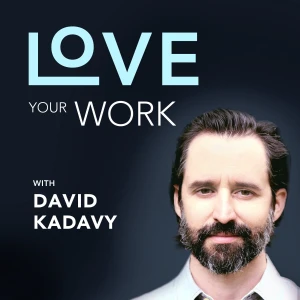
Love Your Work
Love Your Work is a podcast hosted by David Kadavy, bestselling author of books like Mind Management, Not Time Management. The show explores productivity for creative professionals, offering insights on how to manage time and energy to achieve breakthroughs. It features conversations with notable guests such as Dan Ariely, David Allen, and Seth Godin. The podcast aims to help creators make meaningful progress in their careers.
Episodes
Why the Curious Peak Late
Pre-order Finish What Matters at kdv.co/fwmpre. It debuts September 14th. This article debuted on my Maxiumum Reverie Substack. You can read the text and see the images at: https://maximumreverie.substack.com/p/why-the-curious-peak-late
[Note] Pre-order Finish What Matters at kdv.co/fwmpod
I have never had to face so many personal demons as I have writing this book. In 2017, I decided I needed to get serious about shipping creative work. So I challenged myself to send an email a day for 30 days. I wrote a draft of a book I'd call Getting Art Done. Some of you OGs might have signed up. That little draft was the seed of an idea that would keep me busy for the next decade. But now this
[NOTE] My next book: Finish What Matters Preview Edition at kdv.co/fwmpre
Hello, Love Your Work listeners, those who still have this pod in your feeds – thank you for staying subscribed! I do not have a new episode for you, per se, though I've certainly thought about making new episodes, the bandwidth hasn't been there, because I have been long and hard at work on my next book, Finish What Matters! In short, you can buy the preview edition at https://kdv.co/fwmpre, but
308. Why I Quit Podcasting
After nearly eight years of the Love Your Work podcast, I'm quitting. Here's why, and What's Next. Podcasting is a bad business This is not the immediate reason I'm quitting, but it is at the root: Podcasting is a bad business. When the indirect benefits of an activity run out, it's hard to keep doing it if it's not making money. I realized long ago podcasting is a bad business, but I kept going f
307. A.I. Can't Bake
You've probably heard that, in a blind taste test, even experts can't tell between white and red wine. Even if this were true – and it's not – it wouldn't matter. I was in Rome last month, visiting some Raphael paintings to research my next book, and stopped by the Sistine Chapel. I've spent a good amount of time studying what Michelangelo painted on that ceiling. There are lots of high-resolution
306. Summary: The Triumph of Doubt by David Michaels
We trust the food we eat, the drinks we drink, and the air we breathe are safe. That in case they're unsafe, someone is working to minimize our exposure, or at least tell us the risks. In The Triumph of Doubt, former head of OSHA David Michaels reveals how companies fight for their rights to sell harmful products, expose workers to health hazards, and pollute the environment. They do it by manufac
305. Hedgehogs and Foxes
According to philosopher Isaiah Berlin, people think in one of two different ways: They're either hedgehogs, or foxes. If you think like a hedgehog, you'll be more successful as a communicator. If you think like a fox, you'll be more accurate. Isaiah Berlin coined the hedgehog/fox dichotomy (via Archilochus) In Isaiah Berlin's 1953 essay, "The Hedgehog and the Fox," he quotes the ancient Greek
304. Too Many Ideas, Must Pick One
Many creators and aspiring creators struggle not because they don't have enough ideas, but because they have too many. Their situations, in summary, are "Too many ideas, must pick one." Embedded in this belief are assumptions that, if challenged, can help you feel as if you have just enough ideas. In my recent AMA, I got a question I'm asked about creativity, probably more than any other: How
303. Livestream/AMA: Publishing Outside Amazon, Focusing Curiosity, and Mind Management
Today I have a special episode for you. If you missed last month's AMA/Livestream, I'm delivering it right to your ears. In this AMA, I answered questions about: What's the best self-publishing platform, and how did I publish 100-Word Writing Habit, non standard-sized, outside of Amazon? Buenos Aires versus Medellín, which is better for mind management? How to pick a creative project when you ha
302. The Four Sources of Shiny Object Syndrome
Shiny object syndrome can be evidence of a problem, or it can be a normal part of the creative process. If you can identify the four sources of shiny object syndrome, you can tell the difference between being lost, or simply exploring. Three first three sources are problems The first three of the four sources of shiny object syndrome hold you back from finishing projects. They are: ambition, perfe
301. 1,500 Words on Writing a 5-Word Tweet
Writing a tweet is a microcosm of writing a book. If you think deeply and carefully about every word in a tweet, and what the tweet as a whole communicates, you can extend those skills to all your writing. In this article, I'll break down how to think about every word in a tweet, nearly tripling its performance. Step 1: The first-impression tweet The tweet we'll work on came to me like most tweets
300. The Mechanics of Media
Every message is shaped by the mechanics of media. Whether it's a tweet, a TikTok video, a news article, or a movie, the characteristics of the medium determine how it's made, how it's consumed, and whether it spreads. If you understand the mechanics of media, you can more effectively communicate in a wide variety of mediums, and protect yourself from being manipulated by media. The message is
[NOTE] Submit your questions for the upcoming AMA/Livestream! (kdv.co/ama)
Submit your questions and mark your calendars for my upcoming AMA/Livestream.
299. Why Make Predictions? (and How)
Making, recording, and evaluating predictions is a simple way to improve your thinking and decision-making. But the way to properly make and record predictions isn't obvious. In this article, I'll share some predictions I've made, what I've learned, and how you can improve your thinking by making predictions. Making predictions has grown my business Five years ago, I had been running my busines
298. Kellogg's 6-Hour Day
In the midst of the Great Depression, cereal manufacturer Kellogg's switched to a shorter, six-hour day. This continued a trend that seemed inevitable: people would work less and less. But economic policies, management strategies, and cultural attitudes changed. The story of the rise and fall of Kellogg's six-hour day is a microcosm of these changes, as well as of our attitudes about the roles of
297. Desire Paths
Desire paths are trails left on the ground, by anything that frequently travels along a route. There are subcultures fascinated by desire paths as symbols of collective wisdom, disregard for authority, or mere evidence of existence. Desire paths are also celebrated as a design technique. Desire paths in their pure form are about what you can see, but the characteristics of desire paths – which you
296. Beyond Vulnerability
The term, "vulnerability" has spread into realms where it's not an accurate description of what's going on. The case for being vulnerable often doesn't make sense. In the creative realm – and possibly in others – we should pursue something beyond vulnerability. When I wrote about vulnerability to my Love Mondays newsletter, saying some of what I'm about to say, I got a lot of pushback. In the curr
295. Summary: The Prince by Niccolò Machiavelli
The Prince is a political treatise, written by Niccolò Machiavelli, first distributed in 1513. It's infamous for its apparent advice to political leaders to lie, murder, and manipulate. It's still a fascinating read today, and is thought-provoking when considering any context where the true motives of actions may not be what they seem. Here, in my own words, is a summary of Niccoló Machiavelli's,
294. Sure Bets and Wildcards
Which would you rather have? Mild success, or wild success? Most of us would prefer wild success. But we pursue mild success. And you can't have one when you're going for the other. The struggle of an aspiring novelist A more specific version of the scenario I mentioned in episode 253: Imagine you're working at Starbucks during the day, and at night you're writing novels – not just any novels, but
293. Carrots, Sticks, and Blinders
You can't get through a project on momentum alone. But there are mechanisms you can use to tweak your motivation and make better use of what momentum you have. These motivation mechanisms aren't one-size-fits-all – you have to choose which ones work for you. Motivation requires self-mastery As I talked about on episode 291, getting through a creative project is like skateboarding through a halfpip
292. Summary: The Network: The Battle for the Airwaves and the Birth of the Communications Age, by Scott Woolley
The Network, by Scott Woolley, tells the history of wireless communications, and the stories of the characters that were a part of it. It's the first book strictly about media history that I'm summarizing and adding to my best media books list. Wireless communications start with wired communications Wireless communications today of course include cell phones, but The Network takes us from the wire
291. The Project Halfpipe
A creative project is like a halfpipe. The depth of the halfpipe from which you must ascend to finish a project is equal to the height of the optimism that prompted you to begin. But there's a way to build your project halfpipe so the project itself keeps you moving forward. The gravity of optimism pulls you into a project When you begin a project, you are optimistic. Why else would you start? You
290. Leonardo Mind, Raphael World
The world expects us to be Raphaels, but some of us are Leonardos. Don't hold your Leonardo mind to Raphael standards, because this Raphael world would be nothing without Leonardo minds. There's an inscription in the Pantheon in Rome that says, "Here lies that famous Raphael by whom Nature feared to be conquered while he lived." In other words, Raphael was such an amazing painter, Nature was suppo
289. Livestream/AMA: Book Marketing, Motivation, Language Learning, Picking a Project, and Selling Foreign Rights
Today I have a special episode for you. If you missed last month's AMA/Livestream, I'm delivering it right to your ears. In this AMA, I answered questions about: How should I start marketing my books? How can you cope with burnout that gets in the way of creative work? How can you market your books when it doesn't come naturally? How did you build your audience and how long did it take? (How can
288. Summary: Old Masters and Young Geniuses, by David W. Galenson
The book, Old Masters and Young Geniuses shows there are two types of creators: experimental, and conceptual. Experimental and conceptual creators differ in their approaches to their work, and follow two distinct career paths. Experimental creators grow to become old masters. Conceptual creators shine as young geniuses. University of Chicago economist, and author of Old Masters and Young Geniuses,
287. David Perell: Being a Hedgehog When You're a Fox, Living With the Twitter Algorithm, Learning from Tyler Cowen, and Building Mass for Leverage
Do you want to build an audience online, but have such a wide variety of interests, you don't know what to focus on? I think you'll like this interview with David Perell. David Perell (@david_perell) calls himself "The Writing Guy." He runs the cohort-based online writing school, Write of Passage (I love that name). His marketing is very specific, but he has incredibly diverse interests, and enthu
[NOTE] Ask Me Anything Livestream (kdv.co/ama)
Submit your questions and mark your calendars for my upcoming AMA/Livestream.
286. Nobody Knows Anything
In 1977, Richard Bachman published his first novel. In an unusual move for a first-time author, Bachman made his publisher promise to release his books with hardly any marketing. Bachman stacked the dice against himself Bachman's books were to skip the hardcover format and go straight to bargain-bin paperback – the kind you'd find mixed in with other nobody-authors, at a truck stop on I-80, somewh
285. Crumb Time
"Crumb time" is the little pieces of time that get lost throughout the day. Instead of giving away your crumb time to unproductive distractions, build systems that complete big projects with small actions. Today, I'll tell you how. Crumb time is everywhere throughout our days. Whenever we do something substantial with our time, little chunks of time of various sizes and shapes fall to the floor. W
284. Curiosity Management
Do you ever feel like you don't have the time and energy to learn about everything you want to know? Is it hard to stay focused on reading one book, when there's ten others you want to read? You need curiosity management. Curiosity management is the management of your thirst to know things. In a world with unlimited access to information, and finite time and energy, it's impossible to read every b
283. Fifteen Years as a Creator. (I'll Never Make It.)
Five years ago, I wrote about how - after ten years as a self-employed independent creator - I hoped to "make it." I now realize, I never will. Five years ago, I sat at my keyboard to have a serious conversation with myself. It had been ten years since I had woken up to a day with nothing scheduled, and wondered how I was going to fill it with something that both made life worth living, and also p
282. How I Put My Book on a Times Square Billboard (What Did It Cost, & Did It Work?)
I recently advertised my book on a billboard in Times Square. It was cheaper than you think, and was up for less time than you might expect. But it's still paying dividends. Times Square is a big deal (duh) Times Square is the epitome of mainstream success. The biggest brands have locations there, and any big brand you can name advertises there. 350,000 people walk through Times Square on a typica
281. E.R.A.S.E. F.E.A.R. and Finish Your Creative Projects
In fifteen years as a self-employed creator, I've learned how to finish what matters. I follow a nine-step process that makes an easy-to-remember acronym, that also describes what this process does: E.R.A.S.E. F.E.A.R. Fear is Resistance Fear is at the root of most struggles to finish creative projects. Even when you think you're merely getting interested in another project, that's often fear masq
280. Surround and Conquer (Your Biggest Dreams)
When Facebook was first expanding, they used a timeless military strategy to win their most-crucial first users. You can use this strategy to attack your toughest projects, by leveraging hidden complexity to lend devastating power to simple actions. Facebook faced tough competitors When Facebook was starting, in the mid-aughts, it was only available at colleges. It wasn't easy to win new users on
279. Summary: Industrial Society and Its Future (The Unabomber Manifesto)
Industrial Society and Its Future, is otherwise known as "The Unabomber Manifesto," written by Ted Kaczynski. Kaczynsnki is a terrorist who killed three people, and injured twenty-three others, by sending bombs through the mail, between 1978 and 1995. He used his terror campaign to exploit the negativity bias of media and pressure the Washington Post and New York Times into publishing his 35,000-
278. Summary: The Elements of Eloquence: Secrets of the Perfect Turn of Phrase
There are some invisible structures in language, and using them can be the difference between your message being forgotten or living through the ages. These are The Elements of Eloquence, which is the title of Mark Forsyth's book. I first picked this up a couple years ago, and have read it several times since then. I think it's one of the best writing books, and has dramatically improved my writin
277. Summary: Trust Me, I'm Lying – by Ryan Holiday
In Trust Me, I'm Lying, Ryan Holiday reveals the media manipulation tactics he used as Marketing Director of American Apparel, and for his PR clients. Meanwhile, he exposes the inner workings of a modern media machine in which incentives make it impossible for the version of reality depicted in the media to come close to resembling the truth. I think it's Holiday's best book, and one of the best m
276. How Matthew Walker Ruined My Sleep (& How I Fixed It)
In 2018, Matthew Walker was on a media blitz, promoting his book, Why We Sleep. I was one of the many people who picked up the book. It slowly ruined my sleep. But recently, I fixed it. No, this is not a takedown Before I go further, this is not a "takedown" of Why We Sleep, like the one that's been floating around. I've read that takedown, and I didn't find it convincing. I trust that Why We Sle
275. Finish What Matters (Forget the Rest)
One thing I hear from a lot from readers of The Heart to Start, is that many people have no problem starting new projects. They instead struggle with finishing them. I can relate. Like many creative people, I once struggled to finish projects. I always had new ideas, I left books half-read, projects half-finished. I had done lots of creative work, and had little to show for it. Now I still always
274. Summary: Balaji Srinivasan – Centralized China vs Decentralized World – The Tim Ferriss Show #547
What will the future look like? In his most recent November appearance on the Tim Ferriss Show, entrepreneur and investor Balaji Srinivasan presents a cohesive explanation of the current world, and plausible scenarios of how things will play out. I found Balaji's theories so mesmerizing, I listened to the four-and-a-half-hour podcast several times, then read and took notes on the transcript. Liste
273. Write on a Typewriter
It seems even the most devout techno-utopiasts carry around a Moleskine notebook. They appreciate the way writing longhand on paper alters their thought processes. Yet the same people think writing on a typewriter is absurd, performative, pretentious, or a deliberate troll. Over the past year, I've grown to love writing on a typewriter. I didn't write my first three books on a typewriter, but I am
272. Ode to the Unfinished
There's a reason the expression, "unfinished business" has such provocative power. Unfinished projects stack up like skeletons in our cluttered mental closets. We know if we crack open that door, we'll be reminded of our failed intentions, our foolish optimism, and our broken promises – to others and to ourselves. But unfinished business doesn't get the credit it deserves. Unfinished projects are
271. How to Be Somebody
There's something I want to talk about, but frankly, I'm a little embarrassed to do so. However, I write with my former self in mind, and my former self would want to know about this. So here I go. I want to talk about how to be somebody. What do I mean by "somebody?" To be somebody is to be known for your work. To have your name synonymous – or even better, eponymous – with your accomplishments.
270. My Cooking System
Systems save energy. Especially if the system helps you with something you do every day. This is why I have a system for cooking. When you're hungry, you make bad decisions, such as grabbing the quickest food you can find – which often happens to be unhealthy food. My cooking system ensures I never have to think about what to eat, or how to prepare it. It frees my time and my mind, so I can focus
269. Farm What You Forage
Many people think our hunter-gatherer ancestors lived short and miserable lives. In fact, that's what most anthropologists thought. Until the 1960s, when they looked more closely at how foragers got by. The way foragers "worked" can tell us a lot about the way we, as creators, work. Farming gets a lot of output with little effort No one can be exactly sure when a human first planted a seed to grow
268. The Void
There's a story I think of every time I'm in the throes of a difficult project. It's from the movie, Catch Me if You Can, about the infamous con artist, Frank Abignale, Jr. Frank's Father, Frank Senior, tells him a story: Two little mice fell in a bucket of cream. The first mouse quickly gave up and drowned. The second mouse wouldn't quit. He struggled so hard that eventually he turned that cream
267. The Finisher's Paradox
When Michelangelo was painting the Sistine Chapel ceiling, he designed and built his own scaffolding. But, it only covered half of the ceiling. So he painted the first half of the ceiling, then removed the scaffolding. When he finally got to view his work from the floor, seventy feet below, it was as if he were seeing it with new eyes. After two years work, he didn't like what he saw. Michelangelo
266. The Foundation Effect
On October 10th, 1901 – 120 years ago, almost to the day – the grandstand was full at the horse track in Grosse Pointe, Michigan. But not to see horses. There was a parade of more than 100 of these new things called automobiles, and several other events, including races of automobiles with electric engines and with steam engines. But the main event was a race of gasoline automobiles. By the time t
265. Shipping is a Skill
Leonardo da Vinci is easily the most-accomplished procrastinator who ever lived. He finished hardly any projects at all. He was great at many things, but he wasn't great at shipping. The world would have been better off if Leonardo da Vinci had treated shipping as a skill. Far be it for me to criticize anything Leonardo da Vinci did. Despite his repeated failure to ship, he lives on today as one o
264. Creative Waste
When Vincent van Gogh began his career as an artist, he had already failed at everything else. He even got fired from his own family's business in the process. Not seeing any alternative, he completely immersed himself in art. In one two-week period, he created 120 drawings. But exactly none of those drawings are famous today. What feels like waste is not waste Last week, I talked about the Iceber
263. The Iceberg Principle
1920s, London. Radclyffe Hall was pacing around her study. She wore close-cropped hair, a tweed skirt, and a man's silk smoking jacket and tie. Her partner, Uma Troubridge, sat in a nearby chair, reading the writing of Radclyffe – or "John," as she preferred to be called. But just as Uma's voice wavered a bit, John grabbed the papers from her hand, and threw them in the fire. In the 1920s, throw
262. Aim Left
It's 1997, and Tiger Woods is in a sudden death playoff, against Tom Lehman. Lehman shoots first, on a par three, and hits his ball into the water. Now Tiger's up, and this is Tiger's tournament to lose. All he has to do is hit a safe shot, far away from the hole, and far away from the water. But that's not what he does. An aggressive and dangerous play The hole is way on the left side of the gree
261. Shiny Object Syndrome
Shiny Object Syndrome is an affliction that causes you to be attracted to "shiny objects." Shiny objects can be whatever is new and trendy in your field. But oftentimes, the shiny objects are simply new ideas you have – other projects you'd rather be working on. In this form, Shiny Object Syndrome will ruin any chance you have of finishing your current project – unless you do something about it. T
260. How I Produce My Weekly Newsletter
If you want to grow an audience online, it's great to have a consistent newsletter. It keeps you in touch with your subscribers, and it gives you a place to test out small ideas you can later grow into big ideas. I've been delivering my Love Mondays newsletter every week for more than 100 weeks (and you can sign up at kdv.co). Here's how I streamline and automate the process, so I never miss a wee
259. My Nighttime Routine
You hear a lot about morning routines, but nighttime routines are every bit as important. Your parents probably had a bedtime routine for you, and if you have kids you probably have bedtime routines for them. But we need bedtime routines as adults, too. I follow a specific nighttime routine, and it helps me get to sleep faster, and wake up better-rested. Wind down, and don't try to force sleep My
258. 8 Harsh Truths About Dating (from a former professional dater)
I once was a professional dater. I was good at getting dates. I was terrible at finding a partner – which I really wanted. I went on so many dates, I made $150,000 on an online-dating-advice blog (which I recently shut down). I've now been in a relationship for several years. Here are the harsh truths I wish my single self had known. Dating is noise. There's nothing about dating that has anything
257. The Image by Daniel J. Boorstin Book Summary
Does image-based media make us think less about our principles and ideals, and more about pursuing mere appearances? Daniel J. Boorstin thought so. In his book, The Image: A Guide to Pseudo-Events in America, Boorstin breaks down why "The Graphic Revolution," has built a world where our fantasies are more real than our reality. In this book summary, I'll explain why Boorstin says, "By sharpening o
256. Use the Barbell Strategy for Success in Creativity (& Life)
The business of creative work is the business of riding randomness. If you want to write a bestselling book or launch a revolutionary company, you're going to need luck. You're navigating Extremistan, not Mediocristan, as I talked about in episode 253. How do you increase your chances of having a hit without risking everything? You do it with "The Barbell Strategy." You can use the Barbell Strateg
255. My Low-EMF Computing Setup
I recently got a message from a reader, who said, "I don't know if it's meditation or you reaching a new level professionally, but I feel like your writing is on FIRE!" I do feel my writing has improved over the last year. They're right to think the meditation I talked about on episode 246 has helped. If I had to pick one thing that has improved my writing, it's starting to use the Zettelkasten m
254. Why I Lost $4,000 on my BookBub Featured Deal (& Why I'd Do it Again)
After fourteen rejections, as I outlined on episode 247, I finally landed a BookBub Featured Deal. Once I tallied up my results, I had lost more than $4,000 running the promotion. I'll tell you why, and why I'd still do another BookBub Featured Deal in a heartbeat. My BookBub Featured Deal Results Book: The Heart to Start: Stop Procrastinating & Start Creating BookBub Category: Advice and H
253. Creative Success in Extremistan (Not Mediocristan)
If you want to succeed in anything creative – whether that's writing, art, or entrepreneurship – you're navigating unfamiliar territory. Everyone else is living in Mediocristan, but you're living in Extremistan. You need a different approach for deciding how you define success. "Extremistan" is a term introduced by Nicholas Nassim Taleb in his book, The Black Swan, which I summarized on episode 24
NOTE: Join the "True Fan" Patreon level (for a limited time, at patreon.com/kadavy)
Just a quick note here to tell you loyal listeners about a new opportunity over on Patreon. As I've said in my Patreon pleas at the end of the episodes, some money that I make feels better than other money. When I sell a book, that money feels good. When I get a sponsor for the podcast, that money feels...not as good. Other money I get that feels good is the money I get from Patreon supporters. Th
252. Amusing Ourselves to Death Book Summary
Can the way we consume information make us unable to tell truth from lies? Neil Postman thought so. In his book, Amusing Ourselves to Death, Postman says everything has been turned into entertainment: Our politics, religion, news, athletics, our commerce – even our education – have all been turned into forms of entertainment. This has weakened our ability to reason about society's important quest
NOTE: Listen to Mind Management, Not Time Management free (at kdv.co/mindaudible)
I just got word that the Mind Management, Not Time Management audiobook is now live on Audible.com. And you can listen to it free. If you are not already an Audible member, you can listen to the Mind Management, Not Time Management audiobook free, with a free trial. Just go to kdv.co/mindaudible. If you prefer another platform, check it out, Mind Management, Not Time Management is probably availa
251. Survivorship Bias's Fatal Flaw
There's an important bias to avoid: Survivorship bias. Unfortunately, people who might otherwise do something with their lives hide behind survivorship bias. Just as important as knowing when survivorship bias matters is knowing when survivorship bias does not matter. Survivorship bias has a fatal flaw. Example: Abraham Wald avoided survivorship bias to bring back more survivors In WWII the US
250. My Zettelkasten: An Author's Digital Slip-Box Method Example (Using Plain-Text Software)
As a nonfiction author, retaining what I read is my job. Through the process of writing three books, I've experimented with different ways of reading, remembering what I read, and using that knowledge to develop my own thoughts. I'll share today my note-taking system. I hope it serves as a good example of a digital "Zettelkasten" or slip box. Listen to My Zettelkasten: An Author's Digital Slip-B
249. How to Take Smart Notes Book Summary
If you're a fan of using Getting Things Done to stay on top of all the, well, things you need to get done – you'll love How to Take Smart Notes for staying on top of all the things you want to learn. I'll give you an introduction – in my own words – in this How to Take Smart Notes book summary. The note-taking system introduced in Sönke Ahrens's How to Take Smart Notes is a bit like Getting Thing
NOTE: New (free) email course. Build your writing habit at kdv.co/100
Hey, just a quick note to let you know I'm launching a new (free) email course. It's 100-Word Writing Habit, and you can sign up at kdv.co/100 I built my writing career by building a writing habit. Three books later, I still write 100 words first thing in the morning. That gets me going so – in addition to books – I can ship an email newsletter each week, and a couple 2,000-word articles on this p
248. Understanding Media (by Marshall McLuhan) Book Summary
You've heard the expression, "The medium is the message." But what does that really mean? "The medium is the message" is a term coined by Marshall McLuhan in his book, Understanding Media: Extensions of Man. More than fifty years after it was published – in 1964 – Understanding Media reads as if it's from the future. In this Understanding Media summary, I'll break down – in my own words – why "The
247. How to Land a BookBub Featured Deal
What is BookBub, and what is a BookBub Featured Deal? BookBub is a gigantic email list that sends discounted or even free books to people. BookBub curates the deals they send to their subscribers. They send them "Featured Deals." A BookBub Featured Deal is a chance to get your book in front of hundreds of thousands of readers – or even a million+ readers – interested in your genre. You'll sell hun
246. What I Learned from Naval Ravikant's Meditation Challenge of 60 Hours in 60 Days
I recently saw a tweet storm by entrepreneur/investor/philosopher Naval Ravikant. He was challenging people to meditate sixty minutes a day for sixty consecutive days. The view from the location of my 60th hour-long meditation session. Here's a quote from Naval about his meditation challenge, from The Naval Almanack: Meditation isn't hard. All you have to do is sit there and do nothing. Just si
245. The Avocado Challenge: Tell The Future
It's hard to predict the future, but you can be better at predicting the future. All you need is a few delicious avocados. Even the "experts" are bad at predicting the future Wharton professor Phillip Tetlock wanted to make the future easier to predict. So he held "forecasting tournaments," in which experts from a variety of fields made millions of predictions about global events. Tetlock foun
244. The Black Swan Book Summary (Nassim Nicholas Taleb)
If you want to write a book, don't ask, "How much money does the average book make?" In this context, "average" is meaningless. You're in the world of Black Swans. The Black Swan is a book by Nicholas Nassim Taleb, and I have found the ideas in it critical to navigating my career as an author. Here – in my own words – is my summary of The Black Swan: The Impact of the Highly Improbable. These are
243. Buy Mind Management, Not Time Management at kdv.co/mind
Today is the day! My new book, Mind Management, Not Time Management is now available everywhere! Writing this book has been a long journey. Over the past ten years, I slowly discovered the things I share in the book, and I also scrapped several drafts, before I finally got it right. I'm very excited to share with you a cohesive system for managing your energy, instead of your time – to be producti
242. Getting Thing Done Book Summary
When I first heard of Getting Things Done, I was skeptical. How could it possibly live up to the fanaticism of its cult following? But once I saw the power of the "next action," of "someday/maybes," and of organizing tasks by "context," I knew there was a good reason for the hype: "GTD" works. More than fifteen years later, GTD still helps me stay productive and in control of all of the things goi
241. Raised Floors
In the game of golf, there's an expression: "Drive for show, putt for dough." What it means is: If you want to win tournaments, practice putting. It makes sense. In a standard even-par round of golf, putts make up half of all strokes. You'll use your driver less than half the number of times you'll use your putter. There's more strokes to get rid of in the putting part of the game. "Drive for show
240. Welcome to the Creative Age
Each November, writers around the world make a commitment. They commit to writing a novel within a month. It's called NaNoWriMo – National Novel Writer's Month. Since 2013, software developers have also been making a commitment. They've committed to generating a novel within a month. It's called NaNoGenMo – National Novel Generation Month. The novels these programmers create – if you can call them
239. Week of Want
Subject: "IMMEDIATE Action Reqeusted [sic]" They misspelled "requested," which had the unintended effect of highlighting that this email was urgent. There were some documents attached to the email. They wanted me to review the documents and sign them. Then, I would get a wire of money to my bank account – from Google, Inc. I had no idea this email was coming. It was a nice surprise, since it was m
238. Shun the Unearned
In New York City, sometime around the beginning of the twentieth century, a young art student sat for a portrait. The artist who painted this portrait won a prestigious award for that portrait. The young woman who sat for the portrait suddenly became a sought-after model. She could actually earn money sitting for portraits. She needed that money. Her family was poor, and art school -- especially a
237. Complexity Creep & The Birthday Problem
Here's a brain teaser for you: Imagine we've got a room full of people. We're trying to figure if any two people in the room have the same birthday. For us to reach a fifty-percent probability that there are two people in the room with the exact same birthday, how many people need to be in the room? I told you this was a brain teaser, so suffice to say that the answer -- to how many people need to
Recommended

Hard Knocks Podcast
Effective Weight Loss for Moms | High protein, Strength Training, Lose Weight, Meal Planning, Fat Loss, Healthy Habits

The Human-Animal Connection - Pet Life Radio Original

Infinite Health with Dr. Arasi Maran

The Daily

World News Tonight with David Muir

English Vocabulary Help
The Joe Rogan Experience
TED Talks Daily

Learn English B1 with Daily News | English Listening Practice

Talk About Talk - Executive & Leadership Communication Skills
English with Olivia | Slow Conversations & Vocabulary
