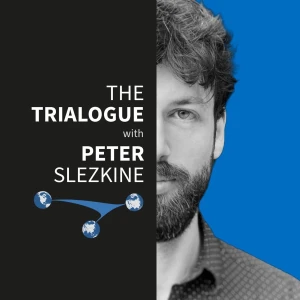
The Trialogue
Peter Slezkine, Director of the USA-Russia-China Trialogue project at the Stimson Center, hosts conversations with experts and former officials from the United States, Russia, China, and beyond. The podcast explores cold wars past and present, areas of conflict and cooperation, and alternative visions of global order. It aims to provide a new perspective on the trilateral dynamic among these three major powers, especially as bilateral communication channels break down. The show is produced by University FM and hosted by the Stimson Center.
Episodes
Branko Milanovic: The Great Global Transformation
Branko Milanovic joins the show to discuss his latest book, The Great Global Transformation: The United States, China, and the Remaking of the World Economic Order (2026). We discuss the emergence of a new elite; similarities between Trump, Putin, and Xi; and “national market liberalism” in a multipolar world.Branko Milanovic is a Research Professor at the CUNY Graduate Center and former lead econ
Mark Leonard: Europe in an Age of "Un-Order"
Mark Leonard, Co-Founder and Director of the European Council on Foreign Relations, joins Worldviews with Peter Slezkine to discuss Europe’s evolving identity, the current state of the transatlantic relationship, prospects for ending the war in Ukraine, and the future of Europe in a changing global order.Listen and subscribe on Apple Podcasts or Spotify to stay updated with the latest episodes!*Th
Fyodor Voitolovsky: Russia's Vision for Ending the War in Ukraine
Fyodor Voitolovsky, director of the Institute of World Economy and International Relations at the Russian Academy of Sciences, returns to the Trialogue to lay out Moscow's vision for ending the war in Ukraine, the security guarantees Russia wants for itself, why a UN Security Council resolution may be the only durable guarantee against renewed conflict, and how the Ukraine war has permanently resh
Arvind Gupta: India's Rise as a Digital Power
Arvind Gupta, co-founder and head of the Digital India Foundation joins the Trialogue to discuss the role of technology in electoral politics, the importance of Y2K in jumpstarting India’s digital capacity, the Indian concept of digital sovereignty, the difference between the Indian, American, Chinese, and European approaches to digital technology, and the significance of India, and Indians, to
Arne Westad: Why Today Looks Like 1914
Deck: Arne Westad, Elihu Professor of History and Global Affairs at Yale University, joins the Trialogue to discuss his new book The Coming Storm, why the world today resembles the years before World War I more than the Cold War, what roles the U.S., China, India, and Russia are playing in this dangerous drama, and whether the fires burning from Ukraine to the South China Sea can be kept from merg
Hossein Kanani Moghaddam: Iran’s Outlook
Hossein Kanani Moghaddam, leader of the Green Party of Iran and former senior IRGC commander joins the Trialogue from Tehran to discuss the Strait of Hormuz, the nuclear question, relations with Russia and China, and the prospects for a negotiated settlement with the Trump administration.
Listen and subscribe on Apple Podcasts or Spotify to stay updated with the latest episodes!
*The Trialogue Pod
Federico Petroni: Italy’s National Interests
Federico Petroni, senior analyst at Limes, Italy's leading geopolitical journal, joins the Trialogue to discuss Europe’s anger over the U.S. attack on Iran, NATO’s fraught future, Italy’s Mediterranean strategy, and its regional rivalries with France and Turkey,
Listen and subscribe on Apple Podcasts or Spotify to stay updated with the latest episodes!
*The Trialogue Podcast is hosted by the Stim
Zhao Hai: What Would China Do?
Zhao Hai, Director of the International Politics Program in the National Institute for Global Strategy at the Chinese Academy of Social Sciences, returns to the Trialogue to discuss the impact of the US-Israeli war with Iran, the state of US-China trade relations, the future of international institutions, and the prospects of stabilizing cross-strait relations, among other subjects.
Listen and sub
Mathew Burrows: Forecasting the Next World Order
Mathew Burrows, program lead of the Stimson Center's Strategic Foresight Hub, returns to the podcast for a forward-looking conversation. We discuss global demographic decline, the energy transition, the promises and limits of AI, the future of the transatlantic relationship, and China's role in a multipolar world.
Listen and subscribe on Apple Podcasts or Spotify to stay updated with the latest ep
Curt Mills: Conservative Anti-Interventionism
Curt Mills, executive director of The American Conservative magazine, joins the Trialogue to discuss the evolution of anti-interventionist thought on the American right. In this conversation we cover the origins of American empire, the extent of U.S. global commitments, the future of NATO, competition with China, and the strategic direction of U.S. foreign policy in Trump’s second term.
Listen and
Trialogue Live: The Expiration of New Start
The expiration of New Start on February 5 marks the end of over half a century of bilateral efforts to advance strategic arms control. On February 3, the Stimson Center and the Oppenheimer Project convened leading nuclear experts from the US and Russia to imagine what comes next. The American speakers were Scott Sagan (Stanford University), Rita Guenther (The National Academies), and Matthew Bunn
Fyodor Lukyanov: Russia’s Place in the World
Fyodor Lukyanov, Editor-in-Chief of Russia in Global Affairs, returns to the Trialogue at the start of an already-eventful year to take stock of Russian strategy amid dramatic U.S. intervention in Venezuela, crisis in Iran, and negotiations over the future of Ukraine.Listen and subscribe on Apple Podcasts or Spotify to stay updated with the latest episodes!*The Trialogue Podcast is hosted by the S
Zhou Bo: What China Wants
Zhou Bo, a retired senior colonel in the PLA and a senior fellow in the Center for International Security and Strategy at Tsinghua University, returns to the Trialogue to discuss China’s calculations about recent events, including the release of the U.S. National Security Strategy, tense Sino-Japanese relations, the situation in Taiwan, and negotiations to end the war in Ukraine.Listen and subscri
Kuiken and Hodges: The China Commissioners
Mike Kuiken and Josh Hodges, two commissioners on the congressionally appointed US-China Economic and Security Review Commission, join us to discuss the recommendations of the Commission’s 2025 annual report and the state of US-China relations more broadly.Listen and subscribe on Apple Podcasts or Spotify to stay updated with the latest episodes!*The Trialogue Podcast is hosted by the Stimson Cent
Glenn Diesen: Will Europe Survive?
Glenn Diesen, professor at the University of South-Eastern Norway and host of the Greater Eurasia Podcast, joins us to discuss the current state of affairs in Europe, including the West’s approach to the war in Ukraine, the future of integration on the continent, and the militarization of Scandinavia. Listen and subscribe on Apple Podcasts or Spotify to stay updated with the latest episodes!*The T
Mathew Burrows: A Life in the CIA
Mathew Burrows, program lead of the Stimson Center’s Strategic Foresight Hub, joins us to discuss his career in the CIA and the National Intelligence Council, where he was the lead author of Global Trends, a non-classified report released every four years as an aid to incoming administrations. We also discuss transformative global events of recent decades, the mechanics of predicting trends, and w
John Mearsheimer: A World Tour
John Mearsheimer, world-renowned scholar of international relations, joins us to discuss the state of play in the Middle East, East Asia, and Eastern Europe. We also examine the relationship between realism and morality, the nature of the China threat, and the origins of “offshore balancing.” Listen and subscribe on Apple Podcasts or Spotify to stay updated with the latest episodes!*The Trialogue
Leonard Benardo: Reexamining the “Open Society”
Leonard Benardo, Senior Vice President at the Open Society Foundations, joins us to discuss OSF’s emergence and evolution, defining values of open societies, and heterodox thinking for turbulent times.Listen and subscribe on Apple Podcasts or Spotify to stay updated with the latest episodes!*The Trialogue Podcast is hosted by the Stimson Center and produced by University FM.Time Stamps:01:29 – Len
Zhao Long: Beijing’s Balancing Act
Zhao Long, Deputy Director of the Institute for Global Strategic and Security Studies in Shanghai, returns to the Trialogue to discuss Beijing’s perspective on a slew of recent high-profile summits, in the context of China’s complex relations with Russia, the United States, India, and North Korea. Listen and subscribe on Apple Podcasts or Spotify to stay updated with the latest episodes!*The Trial
Samuel Moyn: Can Multipolarity Save Liberalism?
Samuel Moyn, the Chancellor Kent Professor of Law and History at Yale University, joins us to discuss the philosophical underpinnings of liberalism, its role in international relations, and the possibility of a multipolar liberal order emerging in a period of U.S. decline.Listen and subscribe on Apple Podcasts or Spotify to stay updated with the latest episodes!*The Trialogue Podcast is hosted by
Jana Kobzova: Europe’s Take on the Alaska Talks
Jana Kobzova, Director of the European Security Program at the European Council on Foreign Relations and former foreign policy adviser to the president of Slovakia, joins us to discuss the European perspective on the Trump-Putin summit in Alaska, the Washington meeting between Trump, Zelensky, and top European leaders, and the future of the war in Ukraine.Listen and subscribe on Apple Podcasts or
Dmitry Suslov: Russia’s Take on Alaska Talks
Dmitry Suslov, Deputy Director of the Center for Comprehensive European and International Studies at the Higher School of Economics in Moscow, joins us to discuss the Trump-Putin summit in Alaska and Russia’s expectations for a settlement in Ukraine.Listen and subscribe on Apple Podcasts or Spotify to stay updated with the latest episodes!*The Trialogue Podcast is hosted by the Stimson Center and
Victoria Panova: Russia and BRICS
Victoria Panova, Vice Rector of HSE and Head of Russia’s BRICS Expert Council, joins us to discuss the history of BRICS, Russia’s attitude toward the association, and the differences between BRICS and other international formats, such as the G7 and the G20.Listen and subscribe on Apple Podcasts or Spotify to stay updated with the latest episodes!*The Trialogue Podcast is hosted by the Stimson Cent
Curtis Yarvin (Part 2): The Empire of Love
Curtis Yarvin returns to discuss the logic of the “empire of love” and the possibilities of an American “perestroika.” He calls on Washington to shutter its foreign embassies, withdraw from the UN, and dissolve the transatlantic relationship.Listen and subscribe on Apple Podcasts or Spotify to stay updated with the latest episodes!*The Trialogue Podcast is hosted by the Stimson Center and produced
Xiang Lanxin: Is Trump Good for China?
Xiang Lanxin, Distinguished Fellow at the Stimson Center, joins us to discuss Trumpian “kayfabe,” the possibility of a grand bargain over Taiwan, and the US-Russia-China “grand strategic triangle,” among other subjects.Listen and subscribe on Apple Podcasts or Spotify to stay updated with the latest episodes!*The Trialogue Podcast is hosted by the Stimson Center and produced by University FM.Time
Sunjoy Joshi: The View from India
Sunjoy Joshi, Chairman of India’s Observer Research Foundation, joins us to discuss Indian philosophy, subtleties of the subcontinent, and India’s relations with the US, China, and Russia.Listen and subscribe on Apple Podcasts or Spotify to stay updated with the latest episodes!*The Trialogue Podcast is hosted by the Stimson Center and produced by University FM.Time Stamps:01:29 What is the Observ
Curtis Yarvin: The Empire of Love (Part 1)
Curtis Yarvin joins us to discuss the Anglo-American “empire of love,” the bohemian libertines of the ancien regime, Putin’s relative weakness, Xi’s advantages over Mamdani, and populism’s last chance.Listen and subscribe on Apple Podcasts or Spotify to stay updated with the latest episodes!*The Trialogue Podcast is hosted by the Stimson Center and produced by University FM.Time Stamps:00:55 Alt-r
Samuel Charap: Russia Policy in Retrospect
Samuel Charap, Distinguished Chair in Russia and Eurasia Policy at RAND, joins us to discuss US policy toward Russia since 2008, the war in Ukraine, and the prospects of a settlement.*The Trialogue Podcast is hosted by the Stimson Center and produced by University FM.Time Stamps:00:40 How did you get interested in Russia?01:59 US-Russia relations since 200811:05 EU-Russia relations15:41 The 2022 R
Maksim Suchkov: What Does Russia Want?
Maksim Suchkov, Director of the Institute of International Studies at MGIMO University in Moscow, joins us to discuss direct Russia-Ukraine talks, US-Russia relations, and Russia’s own “revolution of common sense”.*The Trialogue Podcast is hosted by the Stimson Center and produced by University FM.Time Stamps:01:08 Evaluate the Russia-Ukraine talks and the Trump-Putin phone call03:17 Why does Russ
Emma Ashford: Where do American interests end?
What is a foreign policy of restraint? Are the Anglosphere and Western Hemisphere key to American interests? Will the transatlantic alliance endure? Do Russia or China pose substantial threats to the United States? Time Stamps:01:38 What is the restraint movement in US foreign policy?06:28 Is military overextension a product of liberal internationalism?12:35 Restraint as a function of generational
Da Wei: Will the US and China Decouple or Rebalance?
Da Wei, Director of the Center for International Security and Strategy at Tsinghua University in Beijing, joins us to discuss tariffs, the prospects of a trade deal, Russia’s global role, and the coming multipolar order. Time Stamps:00:53 Was China prepared for Trump’s tariffs?02:55 Does Washington want to decouple from China or rebalance trade?08:49 Is the US improvising or following a plan?11:57
Robert Agee: An American Businessman in Moscow
Robert Agee, President of AmCham Russia, joins us to discuss American business in Russia since the 90s, who left and how after the start of the war in Ukraine, who suffered and benefited from Western sanctions, and the outlook for American (and Chinese) business in Russia going forward.Time Stamps:00:45 What is AmCham?02:29 How did you end up at Xerox in Russia in the 90s?04:58 American business i
Dynkin and Voitolovsky: Welcome to Washington
Alexander Dynkin and Feodor Voitolovsky, President and Director of the Institute of World Economy and International Relations at the Russian Academy of Sciences, join us to discuss their return to Washington, the war in Ukraine, and Sino-Russian relations, among other subjects.Time Stamps:00:59 Returning to Washington for the first time since 201903:28 Will US-Russia relations improve under Trump?
The Trialogue Live: April 8, 2025
This episode is a recording of a live event held online on April 8. Lanxin Xiang, Andrey Kortunov, and Emma Ashford joined me to discuss the state of theUS-Russia-China trilateral relationship.*The Trialogue Podcast is hosted by the Stimson Center and produced by University FM. Hosted by Simplecast, an AdsWizz company. See pcm.adswizz.com for information about our collection and use of personal da
Reinhard Krumm: How Boxed In is Berlin?
Reinhard Krumm of the Friedrich Ebert Stiftung joins us to discuss Germany’s reversal on Russia and a new American Ostpolitik.Time Stamps:00:54 What is the Friedrich Ebert Stiftung?02:00 How was Vance’s Munich speech received in Germany?06:49 What is the future of the trans-Atlantic relationship?16:45 Is Germany sovereign?21:40 Nord Stream26:17 German Ostpolitik since the 60s31:23 Maidan and the M
Christopher Caldwell: The Right since Reagan
Writer Christopher Caldwell joins us to discuss the legacy of Ronald Reagan, the rise of a “New Right,” and the fate of the West.Time Stamps:00:56 What is the New Right?12:53 Revisiting Reagan’s legacy17:24 Trump’s revolution20:43 US foreign policy since Reagan25:55 Whither the West33:43 Immigration in Europe and the US38:10 Russia and China42:16 The limits of American autarchy?*The Trialogue Podc
Zhao Long: Is Beijing Worried about US-Russia Rapprochement?
This week, our guest is Zhao Long, Deputy Director of the Institute for Global Strategic and Security Studies at the Shanghai Institute for International Studies. We discuss the prospects of the US splitting Russia from China and China peeling Europe away from the US, among other subjects.Time Stamps:00:55 Is Beijing worried about a US-Russia rapprochement?24:36 Can China profit from a transatlant
Anastasia Likhacheva: Surviving “sanctions from hell”
This week, our guest is Anastasia Likhacheva, Dean of the Faculty of World Economy and International Affairs at the Higher School of Economics in Moscow. Time Stamps:01:48 Studying sanctions since 201603:27 Nord Stream and the abrupt change in European attitudes after February 20226:22 Western companies leaving (and returning) to Russia after February 20228:52 Inability of both Western and Russian
Fyodor Lukyanov: What in the world is the “world majority”?
This week, our guest is Fyodor Lukyanov, Editor-in-Chief of Russia in Global Affairs, Professor at the Higher School of Economics, and Research Director of the Valdai Discussion Club. What is it like to sit on stage with Putin? When did relations with the West go wrong? And what in the world is the “world majority”?Time Stamps:00:53 Moderating Putin’s Q&A sessions06:24 Perestroika and the unresolv
Andrew Roth: A decade of reporting from Russia
This week, our guest is Andrew Roth, Global Affairs Correspondent at The Guardian. We discuss the twists and turns of Andrew’s ten-year career as a reporter in Moscow. Time Stamps:03:12 Arrival in Russia in 201108:04 The 2012 protests12:39 Foreign journalists in Moscow23:02 Reporting in East Ukraine in 2014-1635:25 Covering Zelensky45:30 Edward Snowden49:19 Evan Gershkovich57:27 Washington’s China
ZHOU Bo: How many military bases does Beijing need?
This week, our guest is Zhou Bo, a retired senior colonel in the PLA and a senior fellow in the Center for International Security and Strategy at Tsinghua University. We discuss China’s military presence in Africa, the Houthis, Ukraine, Taiwan, and the South China Sea.Time Stamps:00:44 Zhou Bo’s studies in England and Australia03:23 Chinese military relations with Africa07:04 The Houthis and the R
Philani Mthembu: South Africa’s attitudes toward Russia, China, and BRICS
This week, our guest is Philani Mthembu, Executive Director at the Institute for Global Dialogue in Pretoria. We discuss the South African perspective on the war in Ukraine, China, and BRICS.Time Stamps: 01:19 How many languages do you speak?01:58 What is the purpose of the Institute for Global Dialogue?03:29 What has changed since the ANC lost its majority?05:12 To what extent are relations with
Dmitry Stefanovich: Nuclear deterrence during the war in Ukraine
This week, our guest is Dmitry Stefanovich, a research fellow at the Center for International Security at the Russian Academy of Sciences. We discuss recent revisions to Russia’s nuclear doctrine, deterrence during the war in Ukraine, Russian red lines, and the evolution of Chinese nuclear policy.Time Stamps:00:01:39 Dmitry’s Odesa origins and involvement in the Sochi Olympics00:04:08 Deterrence d
Daniel Bessner: The last days of liberal empire?
This week, our guest is Daniel Bessner, Associate Professor in American Foreign Policy in the Henry M. Jackson School of International Studies at the University of Washington and non-resident fellow at the Quincy Institute for Responsible Statecraft. We discuss Trump, American empire, Washington’s Asian fixation, and the possibility of “mutual ruin of the contending classes” among other subjects.T
ZHANG Xin: How real is Russia’s pivot to China?
This week, our guest is Zhang Xin, Deputy Director of the Center for Russian Studies at East China Normal University. We discuss the history of Russia studies in the PRC, the Sino-Russian border area, and the logic of the US-China-Russia triangular relationship, among other subjects.Time Stamps:00:00:51 Grad school at UCLA and interest in Russia00:02:45 First visit to Moscow in 200500:05:04 Histor
Akram Umarov: Central Asia between Russia and China
This week, our guest is Akram Umarov, First Vice Rector at the University of World Economy and Diplomacy and Deputy Director of the Institute for Advanced International Studies in Tashkent, Uzbekistan. We discuss Central Asian politics, Uzbekistan’s attitude toward the Shanghai Cooperation Organization, and the country’s relations with Russia, China, and the USA, among other subjects.Time Stamps:0
Stephen Wertheim: Realism and restraint in US foreign policy
This week, our guest is Stephen Wertheim, Senior Fellow in the American Statecraft Program at the Carnegie Endowment for International Peace. We discuss the origins of “isolationism,” historical hypotheticals, the United States’ relative interests in the Middle East, Europe and Asia, Ukraine and Taiwan, and an “America first” policy for the Democratic party, among other subjects.Time Stamps:00:00:
Dmitry Novikov: Russia’s Eurasian reorientation
This week, our guest is Dmitry Novikov, Deputy Head of the School of International Relations at the Higher School of Economics in Moscow, Russia. We discuss the difficulties of being an Americanist in Moscow, the sources of US-Russian conflict, and Russia’s future as a “Eurasian” power, among other subjects.Time Stamps:00:00:38 What is like being an Americanist in Moscow right now?00:04:22 Russian
DA Wei: The advantages of limited decoupling
My guest today is DA Wei, Professor of International Relations and Director of the Center for International Security and Strategy at Tsinghua University. We discuss Wei’s time at CICIR and Tsinghua, his recent visits to the US and Russia, Taiwan and the South China Sea, and the potential positives of partial decoupling, among other subjects.Time Stamps:00:00:49 What is CICIR00:04:13 Tsinghua’s Cen
Charles Kupchan: Beyond isolationism and internationalism?
This week, our guest is Charles Kupchan, Professor of International Affairs at Georgetown University and Senior Fellow at the Council on Foreign Relations. We discuss Charlie’s first visits to China and the Soviet Union, naiveté and NATO expansion in the 1990s, the dangers of the current conflict with Russia and China, the possibility of a new American foreign policy paradigm, global interdependen
Alexander Pilyasov: The Russian Arctic
This week, our guest is Alexander Pilyasov, a professor of geography at Lomonosov Moscow State University and the Higher School of Economics in Moscow. We discuss the Russian Arctic, cooperation in the region with China, and growing competition with the United States. We recorded the conversation in Belgrade, following a “Trialogue” on American, Russian, and Chinese interests in the Arctic.Time St
ZHAO Hai: Trump’s trade war and the war in Ukraine
This week, our guest is ZHAO Hai, Director of the International Politics Program in the National Institute for Global Strategy at the Chinese Academy of Social Sciences (CASS). We discuss US policy toward China, Sino-Russian relations, the war in Ukraine, and China’s vision of global order.Time Stamps:00:01:00 Zhao’s family connections to the PRC Navy00:06:37 Zhao’s graduate study in Chicago00:09:
Karl Eikenberry: Recollections of a retired general
This week, our guest is Karl Eikenberry, a retired lieutenant general in the U.S. Army, whose many titles include the defense attaché at the U.S. Embassy in China, Commander of the Coalition Forces in Afghanistan, and U.S. Ambassador to Afghanistan. Because General Eikenberry has had such a long and fascinating career and often occupied key roles at important pivot points in U.S. policy, we decide
Andrey Kortunov: Four decades of Russian foreign policy
This week, our guest is Andrey Kortunov, the founding director of the Russian International Affairs Council. Time Stamps:00:01:00 Kortunov’s career before RIAC00:09:22 RIAC’s origins and evolution00:18:36 RIAC’s work on sanctions00:25:40 BRICS and other international institutions00:33:29 China-India relations00:36:06 Russia-China relations00:47:00 Russia-Western relations*The Trialogue Podcast is
XIANG Lanxin: China’s “rise” should not come as a surprise
This week, we discuss China-US-Russia relations with Xiang Lanxin, Distinguished Fellow at the Stimson Center and Professor Emeritus of International History and Politics at the Graduate Institute of International and Development Studies, Geneva.Time Stamps:00:01:17 The Xiang family’s four centuries in the Chinese military00:07:38 Lanxin’s experience during the Cultural Revolution00:18:00 Graduate
Season 1 Trailer
The Middlebury Institute of International Studies at Monterey presents the Monterey Trialogue podcast, a series that investigates the relationship among the United States, Russia, and China by engaging with experts from all three countries. At a time when even bilateral channels of communication have begun to break down, the Monterey Trialogue offers a new and necessary perspective on the defining
Recommended

پلی لیست | PlayList
Conspiracy Files with Paige Carter
Bad Friends

Learn 50 English Phrases While You Sleep | Everyday English Phrases & Vocabulary
This Past Weekend w/ Theo Von
Dateline NBC

Back to the 80s Radio
Crime Stories with Nancy Grace

Bible Tea

این نقطه
TED Business
Dark Night Tales with Brian King
