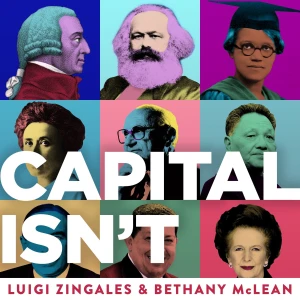
Capitalisn't
Capitalisn't investigates how capitalism is—or more often isn’t—working in our world today. Hosted by economist Luigi Zingales and business journalist Bethany McLean, the podcast explains why capitalism can go wrong and what we can do to fix it. Listeners are invited to send questions or comments by email.
Episodes
The Case That Could End Super PACs - ft. Larry Lessig
Everyone blames Citizens United for super PACs. Harvard Law professor Lawrence Lessig says they're blaming the wrong case, and he is actually taking his argument to court. The ruling that actually created super PACs, he argues, is SpeechNow.org v. FEC, a D.C. Circuit decision issued two months after Citizens United that the Supreme Court has never reviewed. In 2024, nearly 75% of the Maine’s
The Workplace Is a Dictatorship? - ft. Elizabeth Anderson
At the center of our market economy sits an institution that runs more like a dictatorship. The firm you work for writes the rules and enforces them. There is no vote, no appeal, and no constitution. The only real remedy is to leave.University of Michigan philosopher Elizabeth Anderson, author of "Private Government" and "Hijacked: How Neoliberalism Turned the Work Ethic Against Workers," argues w
Why Congress Protects Car Dealers More Than Elon Musk - ft. Eric Zwick
For every member of the Forbes 400, there are more than 4,000 private business owners worth at least $10 million. You probably have never heard of any of them.They own the beer distributorship in your town, the dental group with four offices, the HVAC trucks that passed your house this morning. A decade inside anonymized IRS data turned up three million of them, and the version of that story runni
Can Capitalism Serve the Common Good? - ft. Mariana Mazzucato
The drugs in your medicine cabinet were probably discovered on your dime, in a university lab, with NIH money. You don't hold the patent. You don't set the price. Same story with the touchscreen, the GPS and the voice assistant in your pocket.The public often helps fund breakthroughs, while private companies claim all the profits. Economist Mariana Mazzucato thinks it’s time to renegotiate. In “Th
The One Thing That Could Decide If AI Takes Your Job - Ft. Luis Garicano
AI is coming for your job; AI isn't coming for your job. Economist Luis Garicano thinks both camps are asking the wrong question.
In Messy Jobs: The Work That AI Cannot Reach, Garicano and co-authors Jin Li and Yanhui Wu argue that all knowledge work varies along a dimension of “messiness”, and that the jobs which survive won't be the ones that are hardest, but the messiest. Bethany McLean a
Can Liberalism Survive This Kind of Capitalism? - ft. Daron Acemoglu
For most of the last century liberal democracies offered a simple deal: the economy grows and, if you work hard, you get a fair shot at the rewards. According to 2024 Nobel Prize-winning economist Daron Acemoglu, that deal is broken.
Acemoglu joins Bethany McLean and Luigi Zingales to discuss his new book, What Happened to Liberal Democracy?, and why the system that delivered unprecedented freedom
How Washington Privatized The Capital Market - ft. Renée Jones
Amazon went public three years after it was founded. SpaceX stayed private for 24 years. What changed and why does it matter?
The standard story is that companies avoid an IPO because public markets carry too many government rules and too many lawyers looking to sue. Renee Jones, law professor, former SEC official, and author of the new book Untamed Unicorns: Why Startup Finance Is Broken and How
A Conservative's Attack On Neoliberalism - Ft. Chris Griswold
The Republican Party is often associated with free-market fundamentalism, deregulation, and tax cuts. But a new faction on the right is challenging that consensus.
In this episode, Bethany and Luigi sit down with Chris Griswold, the Policy Director at American Compass. Drawing on Catholic social teaching, Griswold argues that we need to stop viewing our economy as a force of nature or an end unto
Was The Constitution An Anti-Democratic Coup? - ft. Michael Klarman
Were the foundations of American governance engineered to protect the wealthy? Harvard Law professor Michael Klarman argues that the US Constitution was actually a counter-revolutionary coup to constrain democracy rather than protect it.
This episode explores how debt, taxes, and money influenced the drafting of America's founding document. And whether a wealthy elite bypassed democratic institut
Our Personal Finance Mistakes Are The Industry's Profits - ft. John Campbell & Tarun Ramadorai
Is personal finance rigged against ordinary people? Economists John Campbell and Tarun Ramadorai argue the system rewards the wealthy and financially savvy at the expense of everyone else.
Their book Fixed points to a troubling pattern: the fees you avoid by never overdrafting, or by refinancing on time, are paid for by people who don't, and they warn that the resulting resentment is fueling poli
Was Free Trade Ever Really Free? - ft. Fmr. Biden Trade Rep. Katherine Tai
Free trade was never actually free? That's the case Katherine Tai, Joe Biden's former U.S. Trade Representative, brings Bethany McLean and Luigi Zingales this week.
For decades, the economic consensus treated free trade as an engine for cheaper goods and faster growth. But, Tai argues, this system actually relies on ignored externalities, allowing multinational corporations to reap the benefits o
Why Corporations Always Win At The Supreme Court - ft. Adam Winkler
Corporations are people in the eyes of the law. But how did that happen, and why does it hand them rights you don't have?
UCLA law professor Adam Winkler, author of "We the Corporations", traces a 200-year campaign by business to win the constitutional rights of human beings. Bethany McLean and Luigi Zingales press him on what Zingales calls an incredible trick. Corporations insist they're separa
You Can't Buy Trust - ft. Wikipedia Co-Founder Jimmy Wales
How does a free, decentralized, volunteer-run encyclopedia produce something more trusted than nearly any for-profit institution?
Luigi Zingales and Bethany McLean sit down with Wikipedia co-founder Jimmy Wales to explore how the platform organizes global knowledge.
The conversation unpacks how Wikipedia governs itself without a central authority, why consensus beats voting, and what the delibera
Is Healthcare Making Capitalism Sick? - ft. Zack Cooper
Are stagnant wages the hidden price tag of a broken healthcare system? On this week's Capitalisn't, Yale health economist Zack Cooper tells Bethany McLean and Luigi Zingales that the U.S. healthcare market is failing because of structural flaws like employer-sponsored insurance, which hides true costs from consumers. He argues this opaque system has quietly become one of the leading drivers of inc
How “Muskism” Is Changing American Capitalism - ft. Quinn Slobodian
For the better part of the 20th century, the American economy relied on the steady social peace of "Fordism"—an era of mass production and consumption that helped reconcile capitalism with democracy. Today, a radical new paradigm threatens to upend that equilibrium: "Muskism".
While conventional wisdom suggests that Silicon Valley billionaires are libertarians desperate to escape government oversi
Is Capitalism Delivering For The Majority? - ft. Steve Kaplan
The US economy looks great on paper: high GDP, low unemployment, and booming markets. So why does it feel like the system is broken for so many people?
To unpack the disconnect between macroeconomic data and everyday financial anxiety, we’re joined by Chicago Booth professor Steve Kaplan. A staunch defender of the free market, Kaplan argues that despite our collective pessimism, American capitalis
Is The College Promise Broken? - ft. Noam Scheiber
For decades, Americans were promised that a college degree guaranteed a secure spot in the middle class. But instead of entering corporate management, many graduates are finding themselves trapped in low-paying service roles with crippling debt. Is this widening gap between expectations and financial realities fundamentally reshaping the modern American workforce?
New York Times reporter Noam Sche
The Real Cause Of Wage Stagnation - ft. Arin Dube
Economic models have treated the labor market like a perfectly competitive system where wages naturally align with worker value. Arin Dube, economics professor at the University of Massachusetts Amherst and author of “The Wage Standard”, challenges this long-held assumption. He argues that modern labor markets are riddled with invisible frictions that give employers outsized power over your payche
Is Everyone Getting Adam Smith Wrong? - ft. Glory Liu
Most people associate Adam Smith with free markets and “the invisible hand”. But does this conventional narrative purposefully ignore Smith’s deep suspicions about monopolies and power?
Georgetown assistant professor Glory Liu argues this narrow interpretation is actually a deliberate historical reconstruction. In her book, “Adam Smith’s America”, Liu reintroduces the famous philosopher as a the
Why Human Progress Is Not Inevitable - ft. Carl Frey
We tend to view technological advancement as an unstoppable force that naturally improves our living standards over time. From the printing press to the internet, modern society assumes that groundbreaking ideas will always find their way into the marketplace. However, beneath the surface of our rapid digital expansion, global productivity is actually facing a troubling and persistent slowdown. Ma
The Hidden Economic Dangers Of Supreme Court Overreach - ft. Steve Vladeck
For decades, Americans viewed the Supreme Court as an impartial referee standing above the political fray. However, public trust in this vital institution has recently plummeted to historic lows. Many observers blame a surge in ideological rulings that align with the party of the President who appointed each justice. If the referee is suddenly wearing a team jersey, the fundamental systems of demo
Adam Smith In The Age of The “Epstein Class” - ft. MP Jesse Norman
As we approach the 250th anniversary of Adam Smith's “Wealth of Nations" this March, his theories on competition and the invisible hand remain part of the bedrock of modern economics. But, have we undermined those theories in our economy today?
Widespread public anger suggests there is a growing belief that our current economic system is fundamentally rigged by those at the top. In many instances,
How Inequality Distorts the Law - ft. Katharina Pistor
If we want to understand why capitalism feels broken, do we need to stop looking at the economy and start looking at the legal code that underpins it?
In our system, capital is often described as money, machinery, or raw materials. But Columbia Law School professor Katharina Pistor argues that capital is actually a legal invention. An asset, whether it's a plot of land, an idea, or a promise of fu
Are Betting Apps Engineered for Addiction? - ft. Jonathan Cohen
If a sports betting app has the data to know exactly when a user is struggling financially, should it have a legal duty to cut that person off?
On this episode of Capitalisn't, we dive into the murky waters of the American sports betting explosion. We are often told that legalization simply moves an existing black market into the light, but guest Jonathan Cohen argues that the issue isn’t that we
Can We Build a Middle Class Without Factories? - ft. Dani Rodrik
Is the era of manufacturing-led growth officially over? For decades, the path to a stable middle class was paved through industrialization, but today, even manufacturing giants like China are losing millions of factory jobs to automation.
In this episode, Bethany McLean and Luigi Zingales sit down with Dani Rodrik, Ford Foundation Professor of International Political Economy at Harvard and author
Who Should The Fed Answer To? - ft. Sir Paul Tucker
Is the Federal Reserve’s independence a pillar of democracy or a convenient shield that allows elected officials to duck their responsibilities? This week on Capitalisn’t, we confront a shift in Washington after the Justice Department served subpoenas on the Fed.
Joining the conversation is Former Deputy Governor of the Bank of England, Sir Paul Tucker, who complicates the definition of central b
How To Fix The American Tax System - ft. Ray Madoff
Is the American tax code a fair engine for growth, or a "second estate" where the rich choose whether or not to pay?
We are often told that the top 1% of earners already pay 40% of all taxes, while nearly half of Americans pay nothing at all. Legal scholar Ray Madoff argues that this statistic is a deliberate "bait-and-switch" designed to confuse the public. The reality is that the truly rich oft
How Capitalism Became Global ft. Sven Beckert
Is capitalism a force of nature, or a human-made order that we have the power to shape? In this episode, Luigi and Bethany sit down with Sven Beckert, a Harvard historian and author of the new book A Global History of Capitalism, to tackle a question that seems basic but remains surprisingly difficult to answer: what exactly is capitalism?Beckert argues that capitalism is not defined simply by the
How to Stop “Ensh*ttification” Before It Kills the Internet - ft. Cory Doctorow
There’s a word that’s gained a lot of popularity in the last year: “ensh*ttification”. It refers to a trajectory many see with digital platforms: they initially offer immense value to users, only to systematically degrade that quality over time in order to extract maximum surplus for shareholders. We invited the coiner of this term, science fiction author and activist Cory Doctorow, on the podcast
Why Matthew Yglesias Is Skeptical Of Anti-Monopoly Policies
A recent proposal by Lina Khan, co-chair of Zohran Mamdani's mayoral transition team, to cap the price of beer at stadiums in New York City sparked a debate on X last month. At the center of that debate was Matthew Yglesias, editor and author of the Slow Boring newsletter, who argued that the modern antitrust movement has become "slipshod" and is ignoring basic economic trade-offs in favor of poli
Are Big Tech’s Regulators “Cowards”? ft. Tim Wu
Did you know Amazon makes $37 billion a year—more than double the revenue of all the newspapers in the world combined—from its sponsored results alone? Yes, the same, spammy, sponsored results at the top of a search that bilk shoppers with fake or low-quality items and can starve legitimate businesses of traffic and revenue.This is one of the many insights shared by our guest this week, Tim Wu, in
Why Economists Should Care About Inequality, with Branko Milanovic
Recently, Bethany and Luigi joined economist and wealth inequality expert Branko Milanovic in front of a live audience at the Aspen Ideas Festival to explore how capitalism, democracy, and income inequality interact. Together, the three discussed the pervasiveness of income inequality around the world, its connections with democracy and political stability, if the inequality that really matters is
Nobel Economist Reveals Why Economic Models Keep Failing Us, ft. Richard Thaler
Standard economic theory informs how we think about business strategy and the economy and presumes that people are selfish, have well-defined preferences, and consistently make welfare-maximizing choices. In other words, we are rational. But what if that is not the case?Nobel Prize-winning economist Richard Thaler is out with an updated edition of his bestselling 1991 book, "The Winner's Curse: Pa
What Everyone’s Getting Wrong About AI, with Arvind Narayanan
Every major technological revolution has come with a bubble: railroads, electricity, dot-com. Is it AI’s turn? With investments skyrocketing and market valuations reaching the trillions, the stakes are enormous. But are we witnessing a genuine revolution—or the early stages of a spectacular crash?Princeton professor Arvind Narayanan joins Luigi Zingales and Bethany McLean to explain why he believe
Why Capitalism Stopped Working In Japan, with Takeo Hoshi
The Japanese economy was once the envy of the world. By the 1980s, it looked set to surpass the United States in size. Real estate prices were high, the stock market was booming—the entire world was asking if Japan had found a superior model of economic growth and recovery after World War II, one grounded in industrial policy.However, the bubble burst in the early 1990s, and what followed was not
How Profit and Politics Hijacked Scientific Inquiry, with John Ioannidis
Why does a podcast about capitalism want to talk about science?Modern capitalism and science have evolved together since the Enlightenment. Advances in ship building and navigation enabled the Age of Discovery, which opened up new trade routes and markets to European merchants. The invention of the spinning jinny and cotton in the 18th century spurred textile production. The United States’ Departm
Will Privatizing The Mortgage Giants Solve The Housing Crisis?
This week, the Trump administration announced it would sell around 5% of mortgage giants and government-sponsored enterprises (GSEs) Fannie Mae and Freddie Mac. The sale would begin to reintroduce the two firms to private markets after 17 years of government conservatorship. The decision to re-privatize two of the largest mortgage firms in the world, and a prominent reason why the United States is
Trump's Great Private Equity Bailout, with Dan Rasmussen
For decades, private equity has been the darling of pension funds, university endowments, and sovereign wealth funds, promising high returns and low volatility. Now, President Donald Trump has made it possible for everyday investors to get in on the magic with his executive order, "Democratizing Access to Alternative Assets for 401(k) Investors.” The order relieves regulatory burdens that limit th
Should Chatbots Teach Our Children? With Khan Academy CEO Sal Khan
What is the right way, if there is one at all, to integrate artificial intelligence (AI) technology into our education system? For Sal Khan, CEO of one of the world’s largest nonprofit education technology platforms, the answer is to take a step back and ask: Where can AI best complement current pedagogy? If a problem can be solved by pencil and paper, should we really be using AI instead?Khan joi
Can The Dollar Be Dethroned?, with Ken Rogoff
Americans are often told that they benefit from the privilege of the dollar serving as the world's currency. A strong dollar makes imports cheaper, facilitates demand for American companies, and is tied to cheap government borrowing. But what happens when this powerful privilege weakens? What does it even mean for the dollar to be “strong” or “weak” as a medium of exchange and investment? Why shou
Revealing the Secret Architects of Capitalism, with Chris Hughes
After the 2008 financial crisis, and especially after the COVID pandemic of 2020, an increasing number of Americans are questioning the wisdom of unregulated markets and envisioning a more active role for the state. Scholars have coined a panoply of neologisms to capture this view of the political economy, including political scientist Steven Vogel’s “marketcraft.” The term indicates that the stat
How The Democrats Lost Labor And Found Capital, with David Sirota
The Democratic Party has become too focused on appeasing its billionaire donors and has failed to communicate its commitment to the working class, argues long-time political journalist David Sirota. The question moving forward, he says, is if the party can ever refocus its brand orthodoxy from prioritizing social and cultural issues to economic populism.Sirota joins Bethany and Luigi to dissect th
Why Cliff Asness Believes Markets Are Getting Dumber
Are financial markets becoming less efficient? Famous investor Cliff Asness certainly thinks so. In his paper published last year, “The Less-Efficient Market Hypothesis,” Asness argues that social media and low interest rates, among other factors, have distorted market information so that stocks have become disconnected from their true values. This distortion has directed funds toward undeserving
How Democrats Forgot To Be Normal, with Joan Williams
Back in 2016, Joan Williams, distinguished professor of law (emerita) at UC Law San Francisco, wrote an essay for the Harvard Business Review on why President Donald Trump attracted so many non-college voters. It went viral with almost four million views, becoming the most-read article in the 90-year history of the publication.Williams’ new book, Outclassed: How the Left Lost the Working Class and
Lina Khan's Vision of Capitalism
Lina Khan recently concluded her term as one of the Biden administration’s most controversial leaders. Her tenure as chair of the Federal Trade Commission raised the profile of the relatively obscure antitrust agency charged with protecting competition. Her anti-monopoly outlook and more aggressive enforcement strategies, particularly toward Big Tech market power and protecting workers, earned the
The Economics of Law Firms’ Resistance to Trump, with John Morley
The rule of law is essential to the flourishing of liberal democracy and capitalism. Yet, it is now under pressure in the United States, and corporate law firms are in the eye of the storm. Over the last few weeks, President Donald Trump has issued executive orders against several prominent law firms that represented his political adversaries and promoted diversity, equity, and inclusion (DEI) ini
Profit or Purpose? OpenAI's $300 Billion Question, with Rose Chan Loui
All too often, capitalism is identified with the for-profit sector. However, one organizational form whose importance is often overlooked is nonprofits. Roughly 4% of the American economy, including most universities and hospital systems, are nonprofit.One prominent nonprofit currently at the center of a raging debate is OpenAI, the $300 billion American artificial intelligence research organizati
Is Silicon Valley Turning Fascist?
Silicon Valley’s traditionally Democratic tech leaders are turning toward President Donald Trump, but are the reasons as straightforward as lower taxes and favorable regulations? Perhaps not, if we consider the influence of a convoluted political philosophy called the “Dark Enlightenment.” Washington and Silicon Valley power players, including Vice President JD Vance, Steve Bannon, Peter Thiel, an
Why Trump Is Deregulating In The Wrong Way, with Sam Peltzman
In President Donald Trump's recent joint address to Congress, he said, "To unshackle our economy, I have directed that for every one new regulation, ten old regulations must be eliminated." Elon Musk, whom Trump has assigned to execute this vision, has argued that it is time to get rid of all regulations, or as Musk said, “regulations, basically, should be default gone.”Joining Bethany and Luigi t
Trump’s War on Universities, with Nicholas Dirks
Skyrocketing costs of attendance, declining enrollment, the advent of artificial intelligence, campus debates about free speech, and a crackdown on diversity initiatives: Today's universities are in a pickle. Adding to this pickle are President Trump's threats and actions on slashing research funding — the financial lifeline of modern universities. Last month, the Chronicle of Higher Education hig
Did NIMBYs Kill the American Dream?, with Yoni Appelbaum
“Homeownership is the American Dream.” This saying is so ingrained in our zeitgeist that most Americans don't even pause to question it. However, according to the Black Knights Home Price Index, the average US home price increased nearly 80% from April 2015 to April 2023. Census data reveals that the median household income only increased by 4% during this period. Homeownership has thus become inc
Can AI Even Be Regulated?, with Sendhil Mullainathan
This week, Elon Musk—amidst his other duties of gutting United States federal government agencies as head of the “Department of Government Efficiency” (DOGE)—announced a hostile bid alongside a consortium of buyers to purchase control of OpenAI for $97.4 billion. OpenAI CEO Sam Altman vehemently replied that his company is not for sale.The artificial intelligence landscape is shifting rapidly. The
Why This Nobel Economist Thinks Bitcoin Is Going to Zero, with Eugene Fama
In December 2024, Bitcoin, one of the earliest cryptocurrencies and undoubtedly the most famous, hit $2 trillion in market capitalization, bigger than Tesla, Meta, and Saudi Aramco. In this episode, Nobel Prize-winning economist and Chicago Booth finance professor Eugene Fama—widely considered the “Father of Modern Finance”—predicts it will go to zero within ten years.Legendary investor Ray Dalio
Should Companies Have A Social Responsibility To Be “Great Businesses”?, with John Kay
The public often imagines corporations as self-contained actors that provide a set of goods and services to consumers. Underpinning this image have been ideas of ownership, rights to capital and intellectual property, and corporate responsibility to stakeholders including consumers, workers, and shareholders. But what if almost everything we are told about the essence of the firm is wrong? So writ
How Big Money Changed The Democratic Game, with Daniel Ziblatt
Daniel Ziblatt is an American political scientist, Eaton Professor of the Science of Government at Harvard University, and the co-author (with Steven Levitsky) of several bestselling books, including How Democracies Die and Tyranny of the Minority. Ziblatt writes from the position that what defines strong democracies is free and fair competition for power, inclusive participation, and a package of
America’s Addiction to Easy Money, with Ruchir Sharma
Are bailouts the new “trickle-down” economics? Have government debt and deficits caused capitalism’s collapse—thus ending the American Dream?Ruchir Sharma is a well-known columnist for the Financial Times, the author of bestselling books Breakout Nations and The Rise and Fall of Nations, and an investment banker who worked as Morgan Stanley’s head of emerging markets for 25 years. His new book, Wh
The Argentinian DOGE
A new U.S. Department of Government Efficiency (DOGE) is headed by Elon Musk and Vivek Ramaswamy. Its goals include administrative reductions, cost savings, regulatory cutbacks, and reducing federal spending by nearly $2 trillion. President-elect Donald Trump has called DOGE the "Manhattan Project of our time," and has indicated that DOGE will reduce regulatory burdens to firms and individuals. Bu
The Fertility Crisis: Capitalism's Next Challenge, with Sir Niall Ferguson
For years, the world worried about overpopulation and our capacity to sustain ever-increasing numbers of people. Now, the worry is underpopulation—and recent numbers are stunning. Fertility rate is the average number of children that are born to a woman over her lifetime. According to the United Nations, this number is currently 1.64 in the U.S.: If it stays this way, in three generations there wi
Visa's Hidden Tax on Americans
While Americans rely on debit transactions for the necessities of life, most are unaware of the networks that drive those transactions, nor are they aware that one company, Visa, has monopolized debit transactions, penalized industry participants that seek to use alternative debit networks, and co-opted innovators, technology companies, and financial institutions to forestall or snuff out threats
How Lobbying Led to Crony Capitalism, with Brody Mullins
As the United States elections draw near, everyone is wondering who will take control of Washington next. In this week’s Capitalisn’t episode, Pulitzer Prize-winning reporter Brody Mullins reveals how the real winner will be neither Democrats nor Republicans. Rather, it will be the lobbyists.Mullins is the co-author (along with his brother Luke, also an investigative reporter) of The Wolves of K S
Mailbag: UBI, AI, and Does Luigi Believe in "Free Time"?
You asked and we answered: Over the last year, we have solicited listeners’ questions via voicemail, email, and social media. In this episode, our producer, Matt, turns the tables on Bethany and Luigi and puts them in the hot seat to answer your burning questions in an Ask Me Anything “AMA” format.How do Bethany and Luigi actually define capitalism? Does universal basic income disincentivize work?
Harris vs. Trump: Economics Beyond The "Vibes"
Last week, United States presidential candidates Kamala Harris and Donald Trump delivered hour-long speeches outlining their economic policies for the country if they win in November. This week on a special episode of Capitalisn’t, Bethany and Luigi weigh in on the candidates’ economic proposals. What makes this discussion particularly urgent is that neither candidate is espousing a traditional Re
Can Democracy Coexist With Big Tech? with Marietje Schaake
International technology policy expert, Stanford University academic, and former European parliamentarian Marietje Schaake writes in her new book that a “Tech Coup” is happening in democratic societies and fast approaching the point of no return. Both Big Tech and smaller companies are participating in it, through the provision of spyware, microchips, facial recognition, and other technologies tha
Universities and Politics: Should They Mix? with Hanna Gray
America’s universities have powered its economy by developing an educated workforce and producing transformative technology, including the internet and vaccines. They were seen as vehicles for social mobility; when veterans returned home from World War II, the newly enacted G.I. Bill compensated millions with paid college and vocational school tuition. However, universities today are bloated and e
Raj Chetty's Surprising New Insights On How Children Succeed
Is race a more consequential determinant of social mobility than class? How and under what circumstances do Americans move up the economic ladder?For years, Harvard economist Raj Chetty has leveraged big data to answer these questions. In his recent paper, Chetty and his team show that Black millennials born to low-income parents have more quickly risen up the economic ladder than previous Black g
The End of Google As We Know It?
This week we're taking a quick summer break, but in the meantime, we wanted to re-share a special episode that is relevant in the news again. With the recent federal court ruling that Google engaged in illegal monopolization of internet searches, we thought it would be a great opportunity to share our episode with lawyer Dina Srinivasan. She's an expert in the field of competition policy and a fel
Dani Rodrik on the New Economics of Industrial Policy
Harvard professor of international political economy Dani Rodrik has long been skeptical of what he calls "hyperglobalization," or an advanced level of interconnectedness between countries and their economies. He first introduced his theory of the "globalization trilemma" in the late 1990s, which states that no country can simultaneously support democracy, national sovereignty, and global economic
The Economic Costs of a Phone-Based Childhood, with Jonathan Haidt
In one of this year's bestselling books, "The Anxious Generation: How the Great Rewiring of Childhood is Causing An Epidemic of Mental Illness," New York University social psychologist Jonathan Haidt argues that today's childhoods spent under the influence of smartphones and overprotective parenting has led to the reported explosion in cases of teenage anxiety and depression. He calls this process
Immigration in America: Data and Myths, Revisited With Leah Boustan
If democracy is a social contract, why don’t we allow everybody who is willing to sign it? Why don’t we have open borders for immigration?In their book "Streets of Gold: America's Untold Story of Immigrant Success," Princeton University’s Leah Boustan and Stanford University’s Ran Abramitzky provide insights from big data to explore how immigration shaped the United States by looking at the econom
Joseph Stiglitz's Vision of a New Progressive Capitalism
In the last 60 years, few economists have contributed more to exposing the failures of capitalism than Joseph Stiglitz. Formerly the chief economist of the World Bank and chair of the U.S. Council of Economic Advisers under President Bill Clinton, Stiglitz won the Nobel Prize in Economics in 2001 for his work showing that the possibility of having different information can lead to inefficient mark
Capitalism-Was: What Happened to the American Dream? With David Leonhardt
Is the famed American Dream still attainable for the immigrants and working class of today? What made America the land of opportunity — and if it isn't the same anymore, what happened to it?Joining co-hosts Bethany and Luigi to discuss these questions is David Leonhardt, Pulitzer Prize-winning journalist and author of "Ours Was the Shining Future." In his book, Leonhardt describes what he calls to
The Money Behind Ultra-Processed Foods, with Marion Nestle
Critics of the food industry allege that it relentlessly pursues profits at the expense of public health. They claim that food companies "ultra-process" products with salt, sugar, fats, and artificial additives, employ advanced marketing tactics to manipulate and hook consumers, and are ultimately responsible for a global epidemic of health ailments. Companies are also launching entirely new lines
The Economics of Student Protests
Over the last few weeks, university politics has captured headlines as students across the country occupy sections of their campuses and demand that their schools divest from Israel in protest of its contentious war in Gaza. Last week for Compact Magazine, Luigi and Nobel Laureate Oliver Hart stressed that one lesson from these protests is that universities need to make transparent their investmen
Is Private Credit In The Public Interest? with Jim Grant
The meteoric rise of private credit over the last decade has raised concerns among banks about unfair competition and among regulators about risks to financial stability. Historically, regulated banks have provided most of the credit that finances businesses in the United States. However, since the 2008 financial crisis, banks have restricted their credit lines in response to new regulations. In t
Ralph Nader's Capitalism
"The only true aging is the erosion of one's ideals," says Ralph Nader, the former third-party presidential candidate who just turned 90 after more than 60 years of consumer advocacy and fighting for small business in America. From influencing the transformative passage of car safety legislation to advancing numerous environmental protection and public accountability causes, Nader has fought again
The New Business Of News, with Ben Smith
Given the recent mass layoffs, acceleration of media consolidation, continued decline of local journalism, and rapid uptake of generative AI, the news industry—fundamental to institutional accountability in capitalist democracies—appears to be in deep crisis. Joining Bethany and Luigi to make the case that journalism can not only survive but thrive is Ben Smith, longtime journalist, former New Yor
Poverty in America: Terrible Scourge or a Measurement Error?
Perhaps the biggest evidence that capitalism in America doesn’t work, at least not for everyone, is growing income inequality and the persistence of poverty. But what is the current state of poverty and inequality in the United States? Why do debates still persist about whether poverty has been eradicated? What do the numbers and official statistics tell us, and should we believe them? What do per
When a Few Financial Institutions Control Everything, with John Coates
In his recent book, "The Problem of Twelve: When a Few Financial Institutions Control Everything," Harvard law professor John Coates sheds light on the secrecy, lack of public accountability, concentrated power, and the disproportionate influence of a select few institutions in our financial system.Coates joins Bethany and Luigi to dissect the potential dangers of this era of financial consolidati
Is Short Selling Dead? With Jim Chanos
The Wall Street Journal wrote that “Wall Street's best-known bear is going into hibernation" after the legendary short seller Jim Chanos announced he would close his main hedge funds late last year, in part due to diminishing interest in stock picking. Short selling, which bets on drops in asset prices, wins when companies and governments fail and has gained a predatory reputation over the years.
Manufacturing Influence, with Emily Hund
According to the latest industry statistics, the global influencer economy grew from $1.7 billion in 2016 to $21.1 billion in 2023 — and it's only expected to grow exponentially from here with advances in artificial intelligence. In 1988, Noam Chomsky and Edward S. Herman investigated how mass media sways audiences to conform to social norms without coercion, or what they called “manufacturing con
Recommended

English Vocabulary Help
TED Talks Daily

Learn English B1 with Daily News | English Listening Practice
Talk About Talk - Executive & Leadership Communication Skills
English with Olivia | Slow Conversations & Vocabulary
Stand In The Circle
SLOW ENGLISH PODCAST (A1-A2) With Subtitles | Daily Videos | English With Us Podcast

Learn English A2 with Daily News | Simple English Listening Practice

پلی لیست | PlayList
Conspiracy Files with Paige Carter
Bad Friends

Learn 50 English Phrases While You Sleep | Everyday English Phrases & Vocabulary
