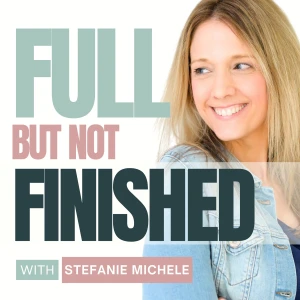
Full But Not Finished
Full But Not Finished is a podcast hosted by Stefanie Michele, a Somatic and Intuitive Eating counselor and coach. It explores the complexities of recovery from disordered eating, focusing on the psychology, nervous system patterns, and cultural conditioning that influence eating behaviors. The podcast offers somatic tools and integrative approaches to help listeners move beyond willpower and find real regulation.
Episodes
51. Why Is Dinner Harder Than Breakfast? 5 Reasons We Struggle With Night Eating
Why does dinner feel so much harder than breakfast when it comes to binge eating, overeating, or feeling out of control with food? Maybe you can eat breakfast without much thought, but by dinner you're picking at food while cooking, struggling to feel satisfied, or experiencing a level of urgency around eating that wasn't there earlier in the day. In this episode of Full But Not Finished, I explo
50. I Feel Ugly, Irritable, and Impulsive With Food: The Capacity Connection
If you've been feeling more impulsive with food, more critical of your body, or unusually impatient with everyone and everything, you may be dealing with a capacity problem. After unexpectedly stepping away from Instagram for a couple of weeks, I noticed some surprising changes: more patience with my kids, more attunement with food, less impulsivity, and more...lightness. It made me look more clos
49. When Fullness Feels Unsafe: Sexual Trauma and Binge Restrict Cycles with Becca Robinson
Therapist and binge eating recovery coach Becca Robinson joins me to talk about the ways sexual trauma changed her relationship with food, her body, and herself. For Becca, bingeing, purging, and restriction became much more intense after her assault. Fullness could feel physically overwhelming and bring her back into sensations she wanted to escape, while restriction created a sense of distance f
48. Can Hypnotherapy Help You Stop Binge Eating?
If you've ever thought, I know why I binge. I know what triggers it. I know what I'm supposed to do instead. So why am I still doing it? I wanted to talk with clinical hypnotherapist Emelia Armstrong-Crews about this. Can hypnosis be useful when talking and insight have only gotten you so far? We ended up having a much bigger conversation about how people change. Emelia talks about what it means t
47. Eckhart Tolle on Body Image: Do We Pay Too Much Attention to How We Look?
Eckhart Tolle says a dog doesn't have body image issues because a dog doesn't have an image of itself. My first reaction was basically: okay, but we're not dogs. We know what we look like. Other people see us. Our bodies exist in a world that assigns meaning to appearance. We can't just opt out of all of that. But there is something useful in what he's saying. How much of our body image distress i
46. Why Diet Talk Makes You Want to Eat More: The Rebel Response
A listener wrote in about something I know a lot of people experience in recovery: hearing someone talk about cutting sugar, seeing a weight-loss commercial, or coming across an article demonizing certain foods, and then feeling almost compelled to do the opposite. Not because you suddenly want the food more, exactly. Because something in you is saying, absolutely not. You will not take this away
45. Binge Recovery, "Healthy Eating," and a Kidney Cancer Diagnosis: Suanne's story
In this episode, I'm joined by Suanne to talk about a recovery story that began in a fairly textbook way: regular meals, consistency, and learning to stop bingeing. But stopping the binges didn't automatically resolve everything underneath them. Food choices could still be shaped by ideas about weight, volume, and what counted as "healthy." Years later, a kidney cancer diagnosis complicated those
44. The Cookie Paradox: Mental Restriction in Reverse
Still having food noise even though you've stopped dieting? Mental restriction can keep binge eating and overeating going long after you've stopped counting calories or labeling foods "good" and "bad." In this episode, I share a client story that explains mental restriction a little differently than we usually talk about it. She wasn't afraid of cookies, worried about calories, or judging herself
43. Why Travel Days and Transitions Can Trigger Binge Urges
Why does a travel day, a Sunday night, or the first day back after being away sometimes make you want to graze, overeat, or binge? Transitions can do strange things to our relationship with food, especially in the hours when one routine has ended and the next one hasn't quite begun. More free content in weekly emails Instagram too
42. I Wanted My Roommate's Diet to Fail: and other stories I was too ashamed to tell anyone.
In this episode of Full But Not Satisfied, Stefanie shares four hidden behaviors from her 25 years with disordered eating and an eating disorder — things she assumed were evidence of bad character, but were actually nervous system threat responses. From neglecting hygiene and hoping for a hospital stay, to feeling jealous of other people's diets, to stealing and lying about food, these are the pa
41. Why Listening to Your Body Is So Confusing
Why is listening to your body so confusing? You might be trying to follow your hunger and fullness cues but still have no idea whether you're feeling hunger, anxiety, habit, adrenaline, an emotion, or the pressure of paying far too much attention. In this episode, I talk through five reasons body cues can be difficult to interpret, especially after disordered eating or years of overriding them. Cu
40. Bored, Restless, and Looking for Food: Emotional Eating and the Nervous System
Why do we eat when we're bored, even when we know we aren't hungry? In this episode, I look at boredom eating through a nervous system lens and question the assumption that boredom simply means we cannot tolerate being alone with ourselves. Stillness can leave us with a mind that is anything but still, especially when the brain shifts into the default mode network and begins revisiting everything
39. GLP-1s, Body Acceptance, and the Pressure to Choose
Can you work toward body acceptance while considering a GLP-1 medication? In this unscripted collaboration, body image coaches Kristina Bruce of Unlearning Beautiful and Stefanie Michele of Full But Not Finished talk about what happens when you have spent years stepping away from dieting while the culture around you appears to be moving toward weight loss again. We discuss the pressure on both si
38. I Lost Decades to my ED and I'm Okay With That — and Is Body Image Just A First World Problem?
In this Q&A episode, I'm answering two questions about eating disorder recovery. The first is about how to make peace with the years an eating disorder took — the grief of looking back and realizing how much of life was shaped by food, body image, fear, and survival, without blaming yourself for not recovering sooner. The second question is about why body image can still matter, even when part of
37. A Different Way to Be Strong: with Guest Marcus Kain
In this episode, I'm joined by Marcus Kain Murray of Strong Not Starving for a conversation about strength training that goes beyond reps, programming, and pushing harder. We talk about what changes when training becomes something you practice instead of something you perform for approval. Marcus gets into why a workout can feel hard and still be the wrong kind of hard, how the fitness industry se
36. Can You Have Food Freedom With Food Restrictions?
More from Stef: Binge Eating to Intuitive Eating (BE2IE) Self-Study Course iamstefaniemichele.com/iamstefaniemichelecourse.com What happens when a food restriction is not coming from diet culture, but from an actual health need? In this episode of Full But Not Finished, I'm answering a listener question about giving up gluten for an autoimmune condition, feeling better physically, and then suddenl
35. Not Recovered, But Not Ashamed: a listener's story
In this episode, I'm joined by Minea for a conversation about food recovery, body image, control, and what happens when you understand the concepts but still don't feel safe enough to let go. This is not a neat success story, and that is exactly why I wanted to share it. Minea talks about growing up as a child who loved food, the moment her body began to feel like something other people could judg
34. When You Can't Stop Exercising
Last week, I talked about resistance to exercise and how movement can become safer when it is no longer tied to weight loss, punishment, or proving yourself. This week is the other side of the coin: what happens when exercise becomes compulsive and rest starts to feel threatening. Movement can be genuinely regulating. It can help us feel strong, embodied, capable, grounded, and in control. But tha
33. How to Rebuild Your Relationship with Exercise (after diet culture)
Exercise can be hard to separate from weight loss, calorie burning, food compensation, discipline, and body control. In this episode, I'm talking about how to rebuild your relationship with movement after dieting, binge eating, restriction, or years of using exercise as a way to change your body. For a lot of people, exercise does not feel neutral. It can bring up old rules, old pressure, old fear
32. Supporting a Partner Through Binge Eating Recovery (a conversation with my actual husband)
In this episode, Stef talks with her husband, Mike, about what it was like to support her through years of binge eating, restriction, body shame, and recovery. They talk about what he noticed in the early years of their relationship, what he misunderstood, what helped him understand binge eating more clearly, and why trying to "fix" it usually didn't work. They also discuss the quieter parts of
31. Hilary Duff, "Strong Not Small," and Body Diversity in Wellness
Hilary Duff's "Strong Not Small" campaign has brought up a bigger conversation about wellness culture, diet culture, fitness ideals, and the way bodies are still expected to show up. On the surface, "strong not small" sounds like progress, especially for millennial women who grew up in the early 2000s celebrity body-shaming era. We were taught to fear weight gain, compare ourselves to famous women
30. When Body Image Meets Aging: a conversation with Deb Benfield
Aging is natural, but women are rarely allowed to experience it that way. In this episode, I talk with Deb Benfield, author of Unapologetic Aging, about the pressure women face to keep defying the evidence. This conversation is really about the promise underneath anti-aging culture: that if we can stay young enough, thin enough, smooth enough, or close enough to the ideal, we might stay safe, want
29. Gentle Nutrition After Diet Culture: How To Make It Simple
Nutrition is a complicated, sometimes scary word after ED recovery or dropping out of diet culture. You may want more energy, steadier meals, better digestion, or a way of eating that supports your body more consistently. But the second nutrition enters the conversation, it can start to feel threatening. Old rules come back. The pressure to get it right comes back. Even a small thought about prote
28. Life After Dieting with Guest Allison: Food Freedom, Body Image, and Motherhood
In this episode of Full but Not Finished, I'm talking with Alison about finding food freedom as a mom after weight gain, years of dieting, and years of living in the binge/restrict cycle. The Body Image Workshop is open! Allison grew up in peak 90s diet culture, with cottage cheese, "Can't Believe It's Not Butter," and the message that gaining weight was something to fear. When her body changed in
27. 5 Real-Time Tools for a Bad Body Image Day
Bad body image day? I'm sharing five things I use in real time to interrupt the spiral, work with nervous system dysregulation, and get through a trigger without letting it take over the whole day. We talk about body neutrality, somatic tools, movement, distraction, and what to do when you're too flooded to think clearly. (This episode idea came to me as I was talking to a client on Whatsapp and w
26. Body Image and Perfectionism: Why It Never Feels Like Enough (A Conversation with Kristina Bruce)
What happens when two body image coaches start talking "off the record"? (also: Join The Body Image Workshop this May for more of this type of conversation) In this special joint episode, Stefanie Michele - a Binge Eating Recovery Coach and Kristina Bruce, a Body Peace Coach share a raw, unedited conversation that was originally happening offline. We realized the "good stuff" coming up was too imp
25. Why Am I Always Thinking About Food? (Mental Hunger vs Appetite Explained)
If you feel like you think about food more than other people, or your appetite just seems… bigger — this episode is going to matter. This episode is about appetite and mental hunger, and why both are so often misunderstood in binge eating recovery. A lot of people assume that thinking about food a lot means something is wrong. Or that if a "normal" meal doesn't satisfy them, they're doing somethin
24. Why Body Image Gets Harder on Vacation | Q&A
Why does body image get so much harder when you go away, even when you thought you were doing pretty well? You're out of your routine, around other people more, dealing with different clothes, different food, different plans, different mirrors, and less of what normally helps you feel like yourself. It makes sense that body image can get activated there.. In this Q&A episode, I'm answering listen
23. Body Image on Vacation: Triggers, Comparison, Aging, and Tools To Help
After a recent trip to the beach with friends, I found myself thinking: body image doesn't ever "finish" or resolve in a permanent way. It shifts, it resurfaces, and certain environments bring it right back to the surface. In this episode, I talk through what came up for me on this trip and why body image often intensifies on vacation. Being out of your routine, in different clothes, around other
22. The Link Between Body Image, Shame, and Feeling Your Anger
Anger is one of the most important emotions in recovery, and one of the hardest for people to let themselves feel. In this episode, I talk about why anger gets such a bad reputation, why so many of us are afraid of it, and why I think it is deeply connected to body image, shame, binge eating, restriction, and boundaries. Many people associate anger with aggression or danger. Others grew up in env
21. Intuitive Eating Q&A: Saying No, Brunch Planning, and "Food Isn't Exciting Anymore"
In this Intuitive Eating Q&A episode, we're unpacking three nuanced questions that often come up in recovery and food freedom work: ✨ How to say no to food without slipping back into restriction ✨ Whether eating lighter before a brunch or event can still be intuitive ✨ Why food can feel less exciting after recovery — and what that means Many people assume food freedom is only about permissi
20. Are Ultra-Processed Foods Bad? A Non-Diet, Intuitive Eating Perspective
Processed foods are having a cultural moment, and the way they're discussed online is so extreme that it's hard to know what to trust without feeling stressed or guilty. In this episode, I'm talking about why the fear-based language around ultra-processed foods is such a red flag, and why I don't trust conversations that rely on absolutist claims meant to scare you into compliance (or sell you som
19. I Need Help! Five Things I Needed to Help Me Recover from Decades of Food Noise and Body Image Anxiety
If you're in recovery and you keep hitting the same walls, you might need more help than you want to admit. In this episode, I'm talking about what it looked like for me to recruit support during my all-in recovery from years of binge eating + restriction, and why it can feel so loaded to say, "I can't do this by myself right now." Here's what we get into: Why needing help can feel like a charac
18. From Burnout to Wintering: When Your Nervous System Is Afraid to Slow Down
Many of us live in a nervous system state where movement, productivity, and momentum feel like safety. Slowing down doesn't feel restful — it feels threatening. And when the body starts asking for less, the mind often panics and tries to think, plan, or "fix" its way out. This episode explores what happens at the edge of capacity, when exhaustion collides with fear, and your system begins demandin
17. Perimenopause + Body Image: Can You "Prevent" Menopause Weight Gain? (Q&A)
In this Q&A episode, I answer three listener questions that sit right at the intersection of body image, recovery, hormones, and nervous system patterns—especially in midlife. First: a listener in perimenopause is struggling with body acceptance and has convinced herself she needs to lose weight now to "get ahead" of the weight gain she expects menopause will bring. We start by naming what
16. The 4 Types of Restriction That Drive Binge Eating
Restriction doesn't only mean "eating less." It can also mean living with food rules in your head, shutting down emotions you don't know how to hold, or staying stuck in a stress state without relief. Any of those experiences can create a scarcity of safety, and scarcity is one of the biggest drivers of binge eating and overeating. This episode breaks down four types of restriction: • Physical res
15. When Your Clothes Don't Fit... and You Want to Binge?
Ever feel bad about your body and go straight to food? That moment feels confusing, self-defeating, and impossible to explain to anyone who hasn't lived it. This episode is about that moment — why it happens, what's actually driving it, and why the reaction makes far more sense than you've been told. Inside this conversation, we look at the psychological and nervous-system dynamics that turn body
14. Why Restriction Feels Calming: Nervous System Dysregulation + Food Control
For years I have talked about binge eating, compulsive eating, and the binge & restrict cycle — and how chaotic and dysregulated those patterns feel in the body. But what if restriction itself is also a form of nervous system dysregulation? In this episode, I break down how food restriction shows up inside the four trauma responses — fight, flight, freeze, and fawn — using polyvagal theory, nervou
13. The January Trap: Last-Supper Eating, Gym Diet Culture, and Food Gifts [Q&A]
If you're already thinking about how to "fix" your eating in 2026, listen to this first. This Q&A episode covers three of the biggest pressure points people hit at the end of December and the start of January: Last Supper eating, diet-culture talk in fitness spaces, and the anger that can come from getting food gifts from friends in their own food dysfunction. I'm answering these questions
12. Why Am I So Nostalgic? On being a highly sensitive person
Nostalgia, body image, and high sensitivity are connected—and this episode explains why. This is for highly sensitive people who experience nostalgia as a full-body emotional event. Do you notice that when the past gets stirred, food and body stuff gets louder? Songs, places, photos, endings, and transitions don't just bring up memories, they can trigger urges to control food, reconsider our appea
11. My All-In Recovery Story: The Process That Ended My Binge Eating for Good
In this episode, I explain my all-in recovery process and how it helped me stop binge eating after decades of battling food noise. I break down what "all in" actually means in practice, why unconditional permission to eat means (and doesn't mean), and how body image work played a central role in becoming binge-free for over six and a half years. I'm sharing my personal all-in recovery process—the
10. Celebrity Weight Loss: are we allowed to say something?
Celebrity weight loss is back in the spotlight — in headlines, before-and-after photos, GLP-1 speculation, and nonstop commentary online. Alongside that has come a louder insistence that we "shouldn't talk about people's bodies" at all. But should we really keep quiet? This episode focuses on body image, diet culture, celebrity bodies, and how weight loss is discussed on social media. I talk about
A Meditation for When You Feel Full or Over-Full
In this guided meditation, I use pendulation to help you work with fullness without getting pulled into the usual fear or anxiety. You'll move between the sensation itself and calmer places in your body or environment, so your nervous system has room to settle in the here and now. This practice supports both everyday fullness and the kind of fullness that can happen after a binge. We keep the focu
8. Getting Through Thanksgiving Meal with a Steady Nervous System (and Food Regulation)
Thanksgiving can bring up a lot for people who are working on binge eating recovery, intuitive eating, or nervous-system regulation. Big meals on holidays have more stimulation, more exposure, more history, and more pressure to "be good" even though your nervous system is doing its own thing underneath. In this episode, I talk through why the holiday environment makes appetite, pacing, and fullnes
7. The Reluctant Somatic: An Accessible Guide to Nervous System Regulation
In this episode of Full But Not Finished, Stefanie breaks down somatic work in a practical, accessible way for anyone who has ever felt confused, skeptical, or resistant to it. She shares her own path toward becoming a Somatic Experiencing practitioner and how body-based work shifted patterns that mindset alone doesn't fully address -- including anxiety, depression, and long-standing food and body
6. How to Break Food Habits Without Restricting | Intuitive Eating & Nervous System Explained
Are you eating out of habit or because your body actually needs something? In this episode of Full But Not Finished, I'm breaking down one of the most common recovery questions I get: how to know when it's a true habit versus a leftover pattern from restriction or stress eating. This isn't another "habit stacking" podcast. We're talking about how nervous system coding, allostatic load, and emotion
5. My Eating Disorder Story: Binge Eating, Restriction, and Orthorexia -- and Recovery
In this episode, Stefanie Michele shares the full story of her ED — from early dieting and body image issues to decades of binging, restriction, and an obsession with healthy, clean eating. She explains how family dynamics, cultural pressure, and the physiology of restriction shaped her relationship with food, and what finally changed in her late thirties that led to recovery at forty. This episod
4. Food and Family Triggers: A Parts Work Approach
When we're back around family, something ... regressive happens. Old dynamics resurface, our nervous systems fire, and parts of us we thought we'd outgrown suddenly take the wheel. In this episode of Full But Not Finished, I explore how family gatherings activate protective parts of the psyche, and how that shows up in our relationship with food. Drawing from Parts Work (Internal Family Systems th
3. Why Upsizing Your Clothes Isn't a Failure: Body Image, Weight Gain & Self-Acceptance
Struggling with weight gain or needing to size up your clothes? In this episode of Full But Not Finished, Stefanie Michele explores the emotional and psychological side of upsizing — the moment you realize your clothes no longer fit the same, and what that stirs up in a culture obsessed with shrinking. We talk about why sizing up isn't a failure or loss of control but a reflection of healing, saf
2.The Body Keeps the Score...But With Food
Have you ever found yourself eating when you weren't hungry—but something in you needed to? This episode explores how the body remembers the trauma of restriction, overexercise, and food insecurity long after the behaviors end. We'll talk about how those old survival codes get reactivated—like feeling an urgent pull to eat after movement, or panic when food feels limited—and why this isn't a lack
1. PILOT EPISODE: Why Recovery Means Letting Go (and Beginning Again)
In this very first episode of Full But Not Finished, host Stefanie Michele (formerly of Life After Diets) shares why this new podcast exists, what's changing in her own life, and how the themes of food freedom, body image recovery, and ED healing always circle back to the larger work of self-development. From 25 years of binge-compensation cycles to going "all in" on recovery in 2019, Stefanie ref
Recommended

紐約鳥|New York Aperture
The Swerve Podcast: Obscure Topics | Conspiracy Theories

The Bread and Banter Podcast

The Church of What's Happening Now: The New Testament
Busted Open

Deadline: White House

Panda Show - Picante
Crickets Corner

History of the Earthquake and Fire in San Francisco

Fox news

K-Drama Obsessed Mamas | Beyond “Just One More Episode!”

True Crime Classics
