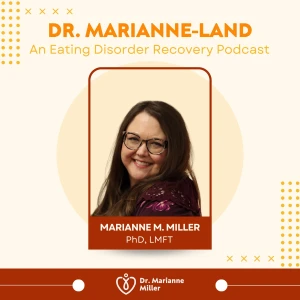
Dr. Marianne-Land: An Eating Disorder Recovery Podcast
Dr. Marianne Miller, an eating disorder therapist and binge eating coach, hosts this podcast exploring the ins and outs of eating disorder recovery. The show covers topics such as anorexia, bulimia, binge eating disorder, ARFID, and body image issues. Guests share personal stories, tips, and strategies to help listeners on their recovery journey. The podcast also addresses self-love, self-compassion, LGBTQ+ issues, anti-fat bias, and weight-neutral fitness.
Episodes
AI & Eating Disorder Recovery: When Chatbots Harm & How They Might Provide Support (With Caution)
AI chatbots can offer quick answers and a sense of support, but they can also reinforce food rules, reassurance seeking, and eating disorder behaviors. Dr. Marianne examines how AI use can complicate eating disorder recovery and where these tools might provide limited, practical support.
AI & Eating Disorder Recovery: Benefits and Risks
Learn how chatbot responses can reinforce restriction, ex
Autism, ADHD, & Eating Disorder Recovery: Building a Life That Fits Your Brain
Eating disorder recovery happens within your daily life. For autistic people and ADHDers, sensory overload, executive functioning challenges, masking, and demanding schedules can make consistent nourishment harder. Building a life that fits your brain means taking those needs seriously and creating support that makes recovery more accessible.
Dr. Marianne shares how neurodivergent-affirming eating
Misophonia: Why Chewing Sounds Feel Unbearable & How to Cope With Dr. Tom Phelan
Do chewing, crunching, or slurping sounds make you feel anxious, overwhelmed, disgusted, or desperate to leave? In this episode of Dr. Marianne-Land, Dr. Marianne welcomes clinical psychologist and author Dr. Tom to explore misophonia, sound triggers, and their impact on eating, relationships, and everyday life.
Drawing on his personal experience with misophonia and his book, Stop That Chewing, Dr
Why Certain Foods Become Binge Foods: ADHD, Autism, Bulimia, & Binge Eating Disorder
Certain foods can become closely connected to binge eating because they provide more than taste or energy. For people with ADHD or autism, these foods may offer sensory stimulation, predictability, emotional regulation, comfort, or relief after a demanding day.
Dr. Marianne explains why binge foods are not random and why removing them rarely addresses the full problem. She examines the connections
Chronic Pain Challenges With Eating Disorders: When Pain, Fatigue, & Food Collide
Chronic pain can make eating disorder recovery more complicated. Pain, fatigue, brain fog, medication side effects, nausea, limited mobility, and sensory overload can interfere with shopping, preparing food, recognizing hunger, and eating consistently.
In this solo episode of Dr. Marianne-Land, Dr. Marianne explains why these challenges reflect real barriers to nourishment, not a lack of motivatio
Eating Disorder Recovery in an Anxious World: Finding Safety With Food & Connection With Vanessa Scaringi, PhD & Kathryn Garland, LCSW
Attachment patterns can shape how we seek comfort, respond to uncertainty, and relate to food. Dr. Marianne welcomes back Vanessa Scaringi, PhD, and Kathryn Garland, LCSW, to discuss eating disorder recovery, emotional eating, and finding connection when the world feels unsafe.
The co-owners of CALM Counseling share insights from their book, Hungry for Connection: Heal Your Relationships with Food
When Your Fear of Being Fat Is About How Others Will Treat You: The Desire for Thinness As Social Safety
Fear of weight gain is not always about appearance. For many people, the desire for thinness reflects a fear of rejection, medical weight stigma, dating discrimination, family criticism, workplace bias, or losing social acceptance.
In this solo episode, Dr. Marianne examines how anti-fat bias can make thinness feel like protection. Fear of fatness is real, and people in larger bodies often receive
Autism, ADHD, & Food Struggles: Why Eating Is So Hard in Systems Not Built for You
Autism, ADHD, and other forms of neurodivergence can make eating far more complicated than simply recognizing hunger and choosing food. Sensory sensitivities, executive dysfunction, time blindness, interoception differences, demand avoidance, decision fatigue, and neurodivergent burnout can all interfere with regular nourishment.
Dr. Marianne explains the hidden work behind eating and why many com
Eating Disorder Recovery Without Food Rules: A Dietitian’s Approach With Lauren Hofstee, RD
Food rules can make eating feel like a test you have to pass. Dr. Marianne talks with registered dietitian Lauren Hofstee about eating disorder recovery, disordered eating, and building a steadier relationship with food without judgment or guilt.
WHAT YOU’LL LEARN
Lauren explains how “what I eat in a day” videos, body checks, and the thin ideal can shape food choices and body image, especially for
Can I Trust This Nutrition Advice? Eating Disorders, Food Safety, & Misinformation
Nutrition misinformation can make eating disorder recovery feel increasingly confusing. Social media warnings about sugar, carbohydrates, seed oils, processed foods, toxins, inflammation, and “clean eating” often sound scientific, even when they rely on fear, exaggeration, or missing context.
In this solo episode, Dr. Marianne discusses how nutrition myths and conflicting food advice can intensify
Have a Chronic Eating Disorder? Why Late-Diagnosed ADHD May Have Been the Issue All Along
ADHD and eating disorders often overlap in ways that treatment misses. For adults with late-diagnosed ADHD, chronic restriction, binge eating, bulimia, ARFID, food inconsistency, and repeated eating disorder relapse may reflect more than fear of food or resistance to recovery.
In this solo episode, Dr. Marianne discusses how ADHD executive dysfunction, time blindness, hyperfocus, decision paralysi
Eating Disorders in Midlife: Rebuilding Trust With Food & Your Body With Amber Caudle
Binge eating recovery requires more than changing what or how you eat. Chef, eating psychology coach, and author Amber Caudle joins Dr. Marianne to discuss her 30-year struggle with binge eating, restriction, purging, compulsive exercise, and food obsession.
Binge Eating Recovery, Food Freedom, and Self-Trust
Amber shares how she appeared successful while privately living with shame, body dissatis
ARFID & PDA: Why Eating Can Feel Like a Demand Even When No One Is Pressuring You
ARFID and PDA can make eating feel difficult even when no one is telling you what, when, or how much to eat. For autistic and neurodivergent people with Avoidant/Restrictive Food Intake Disorder (ARFID) and a PDA profile, hunger, meal schedules, food preparation, and even personal recovery goals can sometimes begin to feel like demands.
In this solo episode, Dr. Marianne explains how ARFID, autism
Tradwives, Disordered Eating, & the Thin Ideal: Why Young Women Are Being Told to Shrink Again
Tradwife culture is having a moment, but what happens when traditional femininity, purity culture, the thin ideal, and disordered eating begin to overlap?
In this SOLO episode, Dr. Marianne Miller examines the growing popularity of tradwives and renewed interest in conservative Christianity among some young women. She considers why messages about modesty, discipline, self-denial, homemaking, and b
Is Eating Disorder Recovery a Form of Neurodivergence? Diet Culture, Hunger, & Body Trust With Shira Collings, LPC
Eating disorder recovery often requires developing a relationship with food, hunger, movement, and body size that differs sharply from what society considers “normal.” In this conversation, Dr. Marianne welcomes back psychotherapist Shira Collings, LPC, to discuss a powerful question: Can eating disorder recovery become its own form of neurodivergence?
Shira describes neurodivergence as a way of t
Autism, Food Rigidity, & Eating Disorders: How Autistic Traits Can Help & Hinder Recovery
Autism and eating disorders can create a complicated relationship with food rigidity, routines, sensory needs, and predictability. For autistic people recovering from anorexia, ARFID, bulimia, or other eating disorders, repetitive eating patterns aren't always symptoms that need to be challenged. Sometimes autistic food routines and preferred foods make consistent nourishment more accessible.
In t
Why Is Eating Disorder Recovery So Scary? Understanding Fear, Safety, & Letting Go
Eating disorder recovery can feel surprisingly scary, even when you genuinely want to get better. Letting go of restriction, binge eating, purging, compulsive exercise, food rules, or body checking can trigger intense fear because eating disorder behaviors often serve functions that go far beyond food and body image.
In this solo episode, Dr. Marianne explores why recovery from anorexia, bulimia,
How to Help Your Child With an Eating Disorder: Replacing Control With Connection With Dr. Tom Wooldridge
Supporting a child or teen with an eating disorder can leave parents caught between the urgency to help them eat and the fear that increasing control will create more conflict around food.
In this episode, Dr. Marianne welcomes psychologist and psychoanalyst Dr. Tom Wooldridge to discuss how parents can help a child with an eating disorder by replacing control with connection. Drawing from his boo
Anorexia & Binge Eating: The Binge-Restrict Cycle in Long-Term Eating Disorder Recovery
Can you have anorexia and struggle with binge eating, too? If you find yourself moving between food restriction and binge eating, you may wonder whether your eating disorder has changed or whether you're somehow failing at recovery.
In this solo episode, Dr. Marianne talks about the binge-restrict cycle, why eating disorder symptoms can shift over time, and what it means when binge eating shows up
Why Do I Need to Save Food? Eating Disorders, Food Rationing, & Scarcity Fears
Food rationing and scarcity fears can show up in eating disorders in surprising ways. You might save the last few bites even though you’re still hungry, carefully make favorite foods “last,” become anxious when safe foods run low, or hesitate to eat something because you’re worried you won’t have it later.
In this solo episode, Dr. Marianne explores how food scarcity anxiety can affect people with
ADHD, Autism, & Eating Disorders: When Feeling “Too Much” Makes You Want to Be Smaller With Stacie Fanelli, LCSW
What happens when years of hearing that you talk too much turn into the belief that you are simply too much?
In this episode, Dr. Marianne welcomes back eating disorder therapist Stacie Fanelli for a conversation about hyperverbalism, ADHD, autism, and eating disorders. They discuss why some neurodivergent people process thoughts and emotions through talking, why hyperverbal communication is often
Night Eating Syndrome, ADHD, & Autism: Why Neurodivergent People Eat More at Night
Why does eating feel easier, more appealing, or more intense at night for some neurodivergent people?
In this solo episode, Dr. Marianne explores Night Eating Syndrome (NES), ADHD, autism, and neurodivergent eating patterns through a neurodivergent-affirming lens. Rather than assuming nighttime eating comes from a lack of willpower, she looks at what may be happening across the entire day.
ADHD an
Eating Disorder Recovery When You Feel Stuck: 5 Strategies for Chronic Anorexia & Bulimia
What happens when you’ve spent years working on eating disorder recovery, but anorexia or bulimia still shows up?
Long-term eating disorder recovery can feel exhausting, especially when you understand your patterns but still struggle with restriction, bingeing, purging, compulsive exercise, or persistent food and body image thoughts. Knowing why something happens doesn’t always make it easy to cha
How to Stop Binge Eating Without Dieting: ADHD, Body Image, & Food Freedom With Marcelle Rose
What if binge eating isn’t a willpower problem at all?
Dr. Marianne welcomes back nutritionist and eating disorder specialist Marcelle Rose @marcellerosenutrition, author of The Binge Freedom Method, for a conversation about binge eating recovery without dieting. Marcelle works with people experiencing binge eating, bulimia, restrictive eating, and emotional eating, and her approach looks beyond f
Why Food Feels So Regulating: Autism, ADHD, Eating Disorders, & the Nervous System
Why can eating feel so calming, stimulating, or grounding? For many autistic people, ADHDers, and people with eating disorders, food does more than satisfy hunger. Eating can provide sensory input, emotional regulation, predictability, stimulation, and nervous system support.
In this solo episode, Dr. Marianne explores food as self-regulation, co-regulation, and stimming, including why chewing, cr
Anorexia in a Larger Body: How to Talk About Your Eating Disorder When Others Don't Understand
Anorexia in a Larger Body: How to Talk About Your Eating Disorder When Others Don't Understand
Can you have anorexia in a larger body? Yes. Yet weight stigma and stereotypes about what an eating disorder "looks like" can make it difficult to feel believed, receive appropriate anorexia treatment, or talk about your experience with others.
In this solo episode, Dr. Marianne discusses anorexia in lar
Harm Reduction & The Middle Place of Eating Disorder Recovery With "Slip" Author Mallary Tenore Tarpley, MFA
How can harm reduction support eating disorder recovery when full recovery feels complicated, nonlinear, or far away?
Dr. Marianne welcomes back journalist, professor, and author Mallary Tenore Tarpley, MFA, for a conversation about eating disorder harm reduction, anorexia recovery, long-term eating disorder recovery, and the pressure to achieve full recovery. Mallary is the author of Slip: Life i
How to Manage Weight Restoration When Your Autistic Child Has Anorexia, ARFID, & a PDA Profile
How do you support weight restoration when your autistic child needs nutrition, but pressure around food makes eating even harder?
For autistic children, teens, and adolescents with a PDA profile (Pathological Demand Avoidance or Pervasive Drive for Autonomy), weight restoration for ARFID, anorexia, and other restrictive eating disorders can become especially complicated. Parents may know that the
My Eating Disorder Recovery Story Continued: Internalized Weight Bias in the Age of Ozempic
What happens to eating disorder recovery when the culture around you starts celebrating weight loss again?
In this deeply personal solo episode, Dr. Marianne continues sharing her eating disorder recovery story and talks about something that has surprised her: the return of body insecurities during the Age of Ozempic. After recovering from a decades-long history of anorexia, binge eating disorder,
Is Healthmaxxing Disordered Eating? Protein, Fitness Trackers, & Eating Disorder Recovery With Amy Ornelas, RD
When does trying to be healthy cross the line into rigid or disordered eating?
Healthmaxxing focuses on optimizing nutrition, protein, exercise, sleep, steps, and other health metrics. But for someone with an eating disorder or history of disordered eating, healthmaxxing can become another way to follow rigid rules, compulsively track behaviors, and disconnect from the body.
In this episode of Dr.
Why Lived Experience Matters in Anorexia & Bulimia Recovery for Neurodivergent People: 5 Things I've Learned as Both a Therapist & Someone in Recovery
Does it matter whether your eating disorder therapist has personally recovered from anorexia or bulimia?
In this solo episode of Dr. Marianne-Land, I explore that question from two perspectives: as an eating disorder therapist and as someone who spent about 25 years navigating anorexia, binge eating, orthorexia, bulimia, compulsive exercise, and the long road to recovery.
Lived experience does not
Is It OCD, Perfectionism, or Both? Why It Matters in Eating Disorder Recovery
Many people with eating disorders get labeled as perfectionists. Sometimes that's accurate. Sometimes it's only part of the story.
In this episode of the Dr. Marianne-Land Podcast, I explore the overlap between OCD and eating disorders, perfectionism, anxiety, autism, ADHD, and the cognitive effects of malnutrition. I explain why similar behaviors can have very different underlying causes and why
Complex Trauma Treatment for Eating Disorders: EMDR & Ketamine-Assisted Therapy With Jennifer Lancaster, LCSW
What happens when years of eating disorder treatment reduce symptoms but never fully address the trauma underneath? In this episode of the Dr. Marianne-Land Podcast, I welcome Jennifer Lancaster, LCSW, for a conversation about complex trauma treatment for eating disorders, including the role of EMDR therapy, ketamine-assisted psychotherapy (KAP), attachment trauma, nervous system healing, and sham
What to Expect From ARFID Treatment: A Neurodivergent-Affirming, Sensory-Attuned, Trauma-Informed Approach
If the idea of ARFID treatment feels just as overwhelming as ARFID itself, you're not alone. Many people avoid seeking help because they worry treatment will involve pressure, forced food exposures, or having their sensory experiences dismissed.
In this episode of Dr. Marianne-Land, Dr. Marianne Miller explains what neurodivergent-affirming ARFID treatmentactually looks like. She discusses why und
Anorexia & Bulimia Recovery: 5 Ways to Manage Eating Overwhelm in Long-Term Eating Disorders
If eating still feels overwhelming after years of living with anorexia or bulimia, you're not alone. Long-term eating disorders often make every meal feel mentally, emotionally, and physically exhausting, even when you're deeply committed to recovery. In this episode of Dr. Marianne-Land, eating disorder therapist Dr. Marianne Miller shares five practical, compassionate strategies to help reduce e
Late-Diagnosed Autism & ADHD: Why So Many Girls Get Missed With Jamie Roberts, LMFT @neurodivergenttherapist
Why do so many autistic and ADHD girls grow up believing they're simply "too much," anxious, or broken? In this episode, I sit down with licensed marriage and family therapist, author, and neurodiversity advocate Jamie Roberts @neurodivergenttherapist to talk about why autism and ADHD so often go undiagnosed in girls, how masking hides neurodivergence, and what changes when people finally receive
Why Eating Feels Impossible: Sensory Overload, Trauma, ARFID, & Food Restriction
Have you ever looked at a plate of food, known you needed to eat, and still felt like your brain and body simply couldn't do it?
Many people assume this experience reflects a lack of willpower or motivation. In reality, sensory overload, trauma, ARFID, and food restriction can all make eating feel genuinely inaccessible. When your nervous system stays in survival mode, even choosing, preparing, an
ADHD & Binge Eating: Why You Feel Like a Bottomless Pit (And Why Traditional CBT Often Fails)
Why do some people with ADHD feel like no amount of food is ever enough? Why can you finish a satisfying meal and still find yourself searching the pantry, thinking about dessert, or feeling like something is missing?
In this solo episode of Dr. Marianne-Land, I explore the often-overlooked connection between ADHD and binge eating disorder (BED). I explain why many ADHDers describe feeling like a
What If You're Not Broken? Neurodivergence, Sanism, Eating Disorders, & Radical Acceptance With Shira Collings @threadandthreshold.therapy
What happens when you stop viewing yourself through a pathology lens and start seeing your differences as part of your identity instead of evidence that something is wrong with you?
In this thought-provoking conversation, I sit down with Shira Collings, LPC, a neurodiversity-affirming, fat-affirming, LGBTQIA+ affirming, disability justice-aligned therapist, to explore neurodivergence as a social i
Is ARFID Lifelong? What We Know About Recovery, Treatment, & Hope
Have you ever wondered whether ARFID is something a person lives with forever? It's one of the most common questions people ask after an ARFID diagnosis, yet the answer is rarely as straightforward as people hope. Adults with ARFID, parents of children with ARFID, and even clinicians often want to know what recovery really looks like, whether meaningful change is possible, and how neurodivergence
Family Food Rules & Body Image Issues: How Diet Culture Gets Passed Down Through Generations
Have you ever wondered where your beliefs about food, weight, and body image actually came from?
Many people assume their eating disorder, body dissatisfaction, or disordered eating patterns developed entirely from personal experiences. In reality, family food rules, generational diet culture, and inherited beliefs about bodies often shape our relationship with food long before we recognize what's
Body Image, TikTok, & Eating Disorder Prevention With Jenny Tomei @askjenup
What happens when children struggle with body image and restrictive eating?
In this conversation, I welcome back eating disorder advocate, educator, and JenUp founder Jenny Tomei @askjenup to discuss a troubling trend she is seeing in schools across the UK. Children as young as elementary school age are making comments about each other's bodies, judging what peers eat at lunch, and absorbing diet
Night Eating Syndrome: How Restriction & Masking Fuel Nighttime Eating
Do you spend the entire day feeling in control around food, only to find yourself eating far more than expected at night? If nighttime eating leaves you feeling confused, ashamed, or convinced that you lack willpower, this episode may offer a different perspective.
Many people with Night Eating Syndrome focus on what happens after dinner without realizing that the story often begins much earlier.
When Your Eating Disorder Becomes Your Identity: Anorexia Recovery & Finding Yourself Again
What happens when anorexia no longer feels like something you struggle with and starts feeling like who you are?
Many people with long-term anorexia, so-called "atypical" anorexia, and restrictive eating disorders fear recovery for reasons that go far beyond food. They worry about losing structure, purpose, safety, achievement, or even their sense of self. In this episode, I explore the powerful c
After 14 Years of Binge Eating: What Finally Helped Me Heal (With Deb Elbaz)
Can you recover from binge eating disorder after years, or even decades, of struggling?
In this inspiring episode, I sit down with a longtime friend and recovery coach to discuss her personal binge eating recovery journey. After living in the binge eating cycle for 14 years, she found a path to lasting freedom and has been binge-free since 2002. She shares how binge eating remained hidden from eve
When an Eating Disorder Feels Lifelong: Finding Hope Beyond Full Recovery Narratives
What happens when eating disorder recovery does not look neat, linear, or complete? In this episode of the Dr. Marianne-Land podcast, Dr. Marianne Miller explores the emotional reality of living with a chronic eating disorder, including long-term anorexia, bulimia, binge eating disorder, ARFID, and restrictive eating disorders that persist for years or decades. This conversation examines the grief
When You Have a Restrictive Eating Disorder Like Anorexia or ARFID: How To Manage Nervous System Overwhelm
What happens when eating disorder recovery starts colliding with nervous system overwhelm? In this episode of the Dr. Marianne-Land podcast, Dr. Marianne Miller explores one of the most confusing parts of restrictive eating disorder recovery: learning how to tell the difference between genuine nervous system dysregulation and eating disorder avoidance disguised as self-protection.
Many people with
CONTENT CAUTION: Eating Disorders & Trauma Recovery With Debbie Saroufim: When Healing Brings Buried Pain to the Surface
If you’ve done years of eating disorder recovery work and suddenly find old trauma surfacing, you are not alone. In this deeply honest conversation, Dr. Marianne Miller and Debbie Saroufim explore the complicated overlap between eating disorders, trauma recovery, body image, nervous system responses, and healing after survival mode. They discuss why trauma can emerge later in recovery, how eating
Anorexia in Higher-Weight Bodies: Hidden Restriction, Misdiagnosis, & What Gets Missed
Why do so many people with anorexia go undiagnosed simply because of their body size? In this episode of the Dr. Marianne-Land podcast, eating disorder therapist Dr. Marianne Miller explores anorexia in higher-weight bodies, restrictive eating disorders, weight bias in healthcare, and the dangerous myths surrounding “atypical anorexia.” This conversation unpacks how restrictive eating can become n
You’re High-Functioning. You’re Still Struggling With Food: The Eating Disorders No One Sees.
You show up. You succeed. You keep functioning. Meanwhile, food, eating, body image, or restrictive behaviors may quietly consume an enormous amount of mental and emotional energy. In this episode of the Dr. Marianne-Land podcast, Dr. Marianne Miller explores the hidden reality of high-functioning eating disorders and why so many people get overlooked simply because they appear “fine” from the out
Eating Disorders in 2026: ARFID, Diet Culture, Identity, & the Pressure to Be Thin With Lisa Jimenez, LMHC
What happens when diet culture gets louder, ARFID awareness grows, social media becomes therapy language, and the pressure to be thin starts shaping everyday life again? In this episode of The Dr. Marianne-Land Podcast, I sit down with Lisa Jimenez (@lisajimeneztherapy) for a deeply honest conversation about what eating disorder therapists are actually seeing in 2026. We talk about the resurgence
OCD & Eating Disorders: Why Food Rules, Rituals, & “Not Feeling Right” Take Over
Do you feel like eating has to happen a certain way or your anxiety spirals? Do food rules, rituals, or intrusive thoughts take over your day in ways that feel exhausting but impossible to stop? In this episode of The Dr. Marianne-Land Podcast, Dr. Marianne Miller explores the complex overlap between OCD and eating disorders, including how compulsions, “just-right” feelings, anxiety, sensory sensi
Does Rejection Ruin Your Whole Day? Here's One Reason Why: RSD, ADHD, & Eating Disorders
Does one awkward interaction, unanswered text, or small piece of feedback ruin your entire day? You may not be “too sensitive.” You may be experiencing Rejection Sensitive Dysphoria (RSD), especially if you also live with ADHD or an eating disorder. In this episode, Dr. Marianne explores why rejection can feel emotionally and physically painful, why shame spirals happen so quickly, and how emotion
Late-Diagnosed Autism, ADHD, & “Neurohybridity”: Why Some People Never Fit One Label With Dr. Emma Offord @divergentlives
What happens when you relate to parts of autism, ADHD, giftedness, sensory sensitivity, masking, and trauma, but never fully fit into one diagnosis or label?
In this timely conversation, Dr. Marianne Miller sits down with neuro-affirming clinical psychologist Dr. Emma Offord to explore “neurohybridity,” a term Emma developed to describe the fluid, overlapping, and mosaic-like nature of neurodiverg
ARFID Doesn’t Have to Look Extreme to Be Real: The Overlooked Middle Ground
When Safe Foods Stop Working: ARFID Plateaus, Burnout, & What Helps on Apple & Spotify.
ARFID Explained: What It Feels Like, Why It’s Misunderstood, & What Helps on Apple & Spotify.
Why Sensory-Attuned Care Matters More Than Exposure in ARFID Treatment on Apple & Spotify.
Complexities of Treating ARFID: How a Neurodivergent-Affirming, Sensory-Attuned Approach Works on Apple &am
Autistic Adults Who Struggle to Eat: POTS, Eating Disorders & What Helps
If eating feels impossible, like your body shuts down, pushes back, or feels worse after you try, this episode explains why. For many autistic adults, eating challenges are shaped by POTS, nervous system differences, and misunderstood patterns that often get labeled as eating disorders. Here’s what’s actually happening and small steps that can help.
What POTS Is and Why It Changes Eating
POTS, or
If Everyone Is Getting Smaller, This Might Be Why: GLP-1s, Tradwives, & Eating Disorder Pressure With Anne Richardson @theeatingdisordernutritionist
It feels like everyone around you is getting smaller. This conversation will change how you understand why.
In this episode of the podcast, Dr. Marianne Miller sits down with eating disorder nutritionist Anne Richardson @theeatingdisordernutritionist to unpack what’s really driving the current push toward thinness. From GLP-1 medications like Ozempic to the rise of tradwife content to the constant
Why Eating Feels So Chaotic With ADHD: Binge Eating, Bulimia, & Executive Function Challenges
If eating feels chaotic, unpredictable, or hard to keep up with, especially with ADHD, there are real reasons for that. This episode breaks down why eating can feel all over the place, not because you are doing something wrong, but because your brain is being asked to manage a process that depends heavily on executive functioning, timing, and regulation across the entire day.
In this solo episode,
When Your Autistic Child Has ARFID & Anorexia: Signs, Misdiagnosis, & What to Do Next
If your autistic child’s eating feels more complex than anyone seems to understand, this episode may put words to what you’ve been seeing. Because when ARFID and anorexia overlap in autistic kids, the signs often get missed, misunderstood, or explained away in ways that don’t actually help. And when that happens, families can feel stuck, blamed, or pushed into approaches that increase distress ins
“Debating” Jillian Michaels: Body Positivity, Eating Disorders & What You Didn’t See on Jubilee With Edie Stark, LCSW @ediestarktherapy
You saw the clip. You saw the reactions. But you didn’t see what actually happened.
In this episode of Dr. Marianne Land, I sit down with eating disorder therapist and fat-positive advocate Edie Stark @ediestarktherapy to unpack what it was really like to be placed in a highly edited, high-pressure “debate” with Jillian Michaels. This conversation pulls back the curtain on how media formats shape
Long-Term Anorexia & Restrictive Eating: 5 Strategies That Actually Help
Long-term anorexia and restrictive eating are often missed, misunderstood, or minimized—especially when they don’t match the stereotype. Anorexia can occur in all body sizes, yet many people in larger or mid-sized bodies go undiagnosed or unsupported for years. If restriction has been part of your life for a long time, this episode offers a different path forward—one that centers harm reduction, f
What Is Mechanical Eating? Pros, Cons, & How It Can Work When Eating Feels Hard (ARFID, Binge Eating, Restriction)
If eating feels inconsistent, overwhelming, or like something you are constantly negotiating with, mechanical eating might be the tool you have heard about but are not sure how to use. In this episode, I break down what mechanical eating actually is, the pros and cons, and why it can help when eating feels hard, especially if you are navigating ARFID, binge eating, anorexia, or restrictive eating
ADHD & Bulimia: Dopamine, Impulsivity, & the Hidden Link to Binge Eating With Kirsten Book, PMHNP-BC
If you have ADHD and struggle with bulimia or binge eating, it may not be about willpower at all. It may be about dopamine, impulsivity, and a nervous system that has been trying to regulate itself the only way it knows how.
In this episode of the podcast, I sit down with psychiatric nurse practitioner Kirsten Book to unpack the often-missed connection between ADHD and eating disorders. We move be
Why You Can’t Stop Body Checking: Anxiety, Eating Disorders, Autism, & What Actually Helps
If you feel stuck in constant body checking, repeatedly scanning, measuring, or monitoring your body throughout the day, you are not alone and there is a real reason this pattern is so hard to break. Body checking is not about vanity or lack of willpower. It is a nervous system response shaped by anxiety, eating disorders, sensory processing, and a culture that teaches you to constantly evaluate y
Harm Reduction for Eating Disorders: How Lived Experience Shapes Recovery, Support, & Long-Term Healing
What if eating disorder recovery didn’t have to be all-or-nothing to be real, valid, and life-changing?
If traditional eating disorder recovery models have ever felt too rigid, too fast, or disconnected from your real life, this episode offers a different way forward. In this solo episode, I explore how harm reduction for eating disorders creates space for sustainable, real-world healing, and why
Eating Disorders in Midlife: Ageism, Body Image, & the Pressure to Stay Thin & Young With Deb Benfield, RDN @agingbodyliberation
Eating disorders in midlife are increasing, yet they are often missed, misunderstood, or dismissed as “normal” aging concerns. During midlife, many people notice a sudden intensification of food struggles, body dissatisfaction, and eating disorder symptoms such as restriction, binge eating, or food anxiety. This is not random. It is the result of a powerful intersection between ageism, diet cultur
PDA, ARFID, & Food Avoidance: Why “Just Eat” Doesn’t Work & What to Do Instead
When eating feels like a demand, everything changes. For people with a Pervasive Drive for Autonomy (PDA) profile, especially those navigating ARFID (Avoidant/Restrictive Food Intake Disorder), pressure around food can quickly backfire. What may look like refusal or lack of motivation is often a nervous system response to perceived threat. In this episode, Dr. Marianne explores why common advice l
Chronic Eating Disorders: Why Some Anorexia & Bulimia Become Long-Term
Not all eating disorders follow a short or linear recovery path. For many people, anorexia and bulimia become long-term, shifting over time rather than disappearing. In this episode, Dr. Marianne explores why eating disorders become chronic, how symptoms can wax and wane across life stages, and what this means for recovery, support, and understanding your nervous system.
This episode offers a deep
Nutrition Myths Exposed: Protein Obsession, Processed Foods, & Eating Disorder Recovery With Kathleen Meehan, RD @therdnutritionist
What happens when nutrition advice becomes loud, simplified, and everywhere you turn? In this episode, Dr. Marianne welcomes back Kathleen Meehan, RD (@therdnutritionist), an anti-diet, fat-positive dietitian, to unpack the current wave of nutrition myths shaping how people think about food, health, and eating disorder recovery. From protein obsession to processed food panic, this conversat
Why High Achievers Can Develop Anorexia & Bulimia: Perfectionism, Control, & Hidden Struggles
High achievers are often seen as disciplined, driven, and successful. But behind that external competence, many people are navigating intense internal pressure, perfectionism, and a deep disconnection from their bodies. In this episode, Dr. Marianne explores why high achievers are more vulnerable to eating disorders like anorexia and bulimia, and how these patterns are often hidden in plain sight.
What Is PCOS & Why Is It Linked to Eating Disorders? Hormones, Hunger, & Insulin Resistance Explained
If you have PCOS and feel constantly hungry, deal with strong food cravings, or struggle with binge eating, you are not imagining it. PCOS can directly affect hunger, cravings, and eating patterns through insulin resistance and hormone imbalance. In this episode, Dr. Marianne explains the real link between PCOS and eating disorders so you can understand what is happening in your body without blame
Lived Experience of ARFID in Autistics & ADHDers: Sensory Survival & Misunderstandings With Dr. Panicha McGuire, LMFT, RPT
What if what gets labeled as “picky eating” is actually a complex, sensory-based eating disorder shaped by neurodivergence, culture, and access to resources?
In this episode, I’m joined by Dr. Panicha McGuire, a licensed therapist and founder of Living Lotus Therapy, who shares her lived experience with ARFID alongside her clinical work with neurodivergent clients. Together, we explore how ARFID s
When Safe Foods Stop Working: ARFID Plateaus, Burnout, & What Helps
What does it mean when your safe foods suddenly stop working? If you live with ARFID (Avoidant Restrictive Food Intake Disorder), this experience can feel confusing, scary, and isolating. A food that felt reliable can suddenly feel impossible, leaving you wondering if your eating challenges are getting worse or if you are doing something wrong.
In this episode of Dr. Marianne-Land, Dr. Marianne ex
Why You Fear Food: Diet Culture & Food Anxiety in Eating Disorder Recovery
If eating feels stressful, overwhelming, or even scary, you are not alone. Fear of food is incredibly common, especially for people navigating eating disorder recovery or trying to unlearn years of diet culture messaging. What often gets labeled as “lack of willpower” is actually something much deeper. It is learned fear.
In this episode, Dr. Marianne explores how fear of food develops, why it fee
Autism, ADHD, & Eating Disorders: Recovery, Sensory Needs, & Late Diagnosis With Margo White, CPN @margo_wholebodynutrition
What if the eating challenges you have struggled with were never just about food? In this deeply validating and expansive conversation, Dr. Marianne sits down with Margo White, CPN, to explore the intersection of autism, ADHD, and eating disorders through a neurodivergent-affirming lens. Margo shares her lived experience of being late-identified as autistic and ADHD, and how years of unmet needs,
Restrictive Eating in Midlife: Why Eating Disorders Can Begin After 30, 40, 50
Most people still believe eating disorders only begin in adolescence or early adulthood. But restrictive eating can develop later in life, and midlife can be a particularly vulnerable time. Changes in the body, new health conditions, medications, major life transitions, and cultural pressure around aging can all shape someone’s relationship with food.
In this episode of Dr. Marianne-Land, Dr. Mari
Family Dynamics & Eating Disorders: How Early Relationships Shape Disordered Eating
Many people in eating disorder recovery eventually wonder how their early environment may have shaped their relationship with food. Questions about family dynamics and eating disorders often come up in therapy, especially when someone is trying to understand why certain patterns around food, body image, and control feel so deeply ingrained.
Eating disorders such as anorexia, bulimia, binge eating
Harm Reduction for Long-Term Eating Disorders: Peer Support, Healing, & Hope With Johanna Scoglio, M.Ed., M.B.A.
What happens when traditional recovery messaging does not fit someone’s lived reality? For many people living with long-term eating disorders, the expectation of full recovery can feel overwhelming, unrealistic, or even invalidating. In these situations, harm reduction for eating disorders offers another path forward, one that centers dignity, autonomy, safety, and compassion.
In this episode of t
Fear of Uncertainty in Eating Disorder Recovery: Why It Feels So Terrifying + 5 Practical Skills That Help
Eating disorder recovery can feel frightening for reasons that go far deeper than food, weight, or body image. One of the most powerful drivers of eating disorder behaviors is fear of uncertainty. When recovery removes rigid rules and predictable routines, the nervous system can interpret that loss of certainty as danger.
In this episode, Dr. Marianne explores how fear of uncertainty operates unde
GI Issues in Eating Disorder Recovery: Why Bloating, Constipation, & Stomach Pain Happen & How Healing Is Possible
If eating disorder recovery has made your stomach feel worse instead of better, you are not alone. Many people experience bloating, constipation, reflux, stomach pain, and fullness during recovery. These symptoms can feel frightening and discouraging, especially when they show up after you start nourishing your body more consistently.
In this solo episode, Dr. Marianne Miller, LMFT, explains why g
Recommended

این نقطه

TED Business
Dark Night Tales with Brian King
Fantasy Flex

زن بودن
Medicine with Meaning

Yours Truly Johnny Dollar Collection

Take Back Your Health®

CBS Radio Mystery Theater | Old Time Radio

Solved Murders - True Crime Stories

紐約鳥|New York Aperture
The Swerve Podcast: Obscure Topics | Conspiracy Theories
