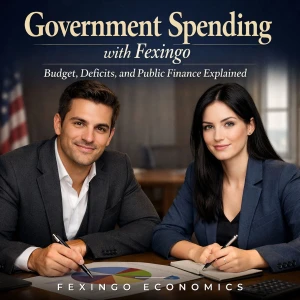
Government Spending with Fexingo: Budget, Deficits, and Public Finance Explained
Governments around the world spend trillions annually, yet the logic behind budget allocations, deficit targets, and public-debt ceilings remains opaque to most citizens. In this podcast, Lucas and Luna dissect the numbers behind national accounts, walking through real budget documents from the U.S., Germany, Japan, and emerging economies. Each episode focuses on a single government-spending concept, such as structural versus cyclical deficits, entitlement program burdens, military budget justifications, or surplus versus debt accumulation. They avoid partisan talking points and trace actual flows from tax receipts to procurement contracts to transfer payments.
Episodes

How State Pension Liabilities Shape Local Tax Policy
Every state in America carries a massive, hidden debt load through its pension funds for teachers, police, and public workers. This episode examines how unfunded liabilities force local governments to divert billions from education and infrastructure into retirement payments. We look at the specific mechanics of contribution holidays, the political pressure to underfund pensions, and why this stru
How Off-Budget Liabilities Hide Real Fiscal Risk
In this episode, we pull back the curtain on the trillions of dollars in liabilities that never make it onto the federal budget headline. Lucas and Luna break down how government-sponsored enterprises like Fannie Mae and Freddie Mac, along with massive implicit obligations in Medicare and Social Security, create a fiscal gap far wider than the official deficit suggests. We examine the mechanics of
The Trillion Dollar Ghost Cost of Government Debt
In this episode, we pull back the curtain on the single most underestimated line item in the federal budget: interest on the national debt. Lucas and Luna explore how rising rates have transformed debt service from a manageable expense into a dominant fiscal force, surpassing defense spending and threatening future investment. We break down the mechanics of Treasury securities, explain why borrowi
How Fiscal Multipliers Shape Economic Growth
In this episode of Government Spending, we look at the fiscal multiplier — the precise mechanism that determines whether every dollar the government spends actually grows the economy or just shifts money around. Lucas and Luna break down why infrastructure spending often has a higher multiplier than tax cuts, using data from the Congressional Budget Office and historical examples like the New Deal
The Real Cost of Federal Borrowing Power
We drill into the mechanics of Treasury issuance and why the federal government's borrowing strategy is reshaping daily financial markets. With interest rates hovering near multi-year highs in October 2026, the cost of servicing national debt has moved from a background metric to a headline risk. Lucas and Luna unpack how specific auction dynamics, like the heavy reliance on foreign holders versus
How Payroll Taxes Fund Social Security
We look at the mechanics of the payroll tax and its role in funding social security, examining how contributions from employees and employers shape federal revenue streams. Lucas breaks down the wage base limit and the split between old-age insurance and disability benefits, while Luna explores the long-term sustainability questions surrounding these dedicated funds. We discuss why this specific t
How Payroll Taxes Fund Social Security
Social Security and Medicare rely on dedicated payroll taxes, not general revenue. This episode breaks down the FICA tax structure, the wage base limit, and why the trust funds are facing shortfalls. Lucas and Luna explore how these specific levies shape federal spending and what happens when the funding gap widens.
#FexingoBusiness #BusinessPodcast #PublicFinance #PayrollTaxes #SocialSecurity #M
How State Budgets Dictate National Economics
We look at how state-level fiscal decisions, particularly around infrastructure and workforce development, create ripple effects across the national economy. With a focus on specific states like Texas and California, we examine how local budgeting impacts federal tax revenue and economic stability. This episode breaks down the mechanics of state spending efficiency and its role in shaping broader
The True Cost of Government Spending Efficiency
In this episode, Lucas and Luna examine the paradox of government spending efficiency. Using the GAO's recent findings on federal IT modernization, they explore how bureaucratic processes often inflate costs beyond market rates. The discussion highlights specific examples from the Department of Defense's cloud migration efforts and contrasts them with private sector procurement models. Listeners w
How Local Budgets Dictate National Economics
We peel back the layers of municipal finance to reveal how local governments, often overlooked in national headlines, wield immense power over economic stability. By examining the structural rigidities of property tax reliance and the hidden burdens of unfunded pension obligations, we uncover why a city council decision in Ohio can ripple through global bond markets. This episode moves beyond fede
The Real Cost of Federal Mandates
Lucas and Luna unpack the unfunded mandate crisis in American federalism, using the No Child Left Behind Act as a cautionary tale for modern policy. They explore how Washington pushes responsibilities onto states without providing the cash to back them up, forcing local officials into budget traps that squeeze schools, hospitals, and infrastructure. The conversation drills into the mechanics of co
The Hidden Cost of Federal Entitlement Reform
Most federal spending debates fixate on defense or discretionary programs, but the real fiscal gravity lies in entitlements like Social Security and Medicare. This episode examines how demographic shifts are turning these programs from manageable obligations into structural pressures. We look at specific policy proposals, from raising the retirement age to changing cost-of-living adjustments, and
How The Federal Reserve Funds Government Spending
We explore the mechanics of open market operations and how the central bank’s balance sheet expansion interacts with Treasury issuance. Lucas breaks down the difference between quantitative easing and direct monetization, while Luna examines the inflationary implications of holding massive debt portfolios. This episode clarifies why the Fed’s asset purchases matter for fiscal policy sustainability
The Hidden Cost of Federal Permitting Delays
We are looking at how the National Environmental Policy Act has transformed from a procedural checklist into a multi-year bottleneck for infrastructure projects. The story centers on the Los Angeles Basin oil field expansion, where environmental reviews delayed production by over a decade despite clear economic need. Lucas breaks down the shift from time-bound mandates to open-ended litigation ris
How Federal Debt Interest Reshapes The Budget
With federal debt interest payments surpassing the entire defense budget, we examine how rising rates are crowding out discretionary spending. Lucas and Luna break down the mechanics of Treasury bill auctions, the impact on state and local fiscal policy, and why this structural shift is redefining public finance in late 2026.
#FederalDebt #InterestPayments #TreasuryBills #PublicFinance #FiscalPol
How Federal Tax Credits Skew Public Spending
Most people think of government spending as checks written from the Treasury. But a massive chunk of federal outflows happens invisibly through tax expenditures. This episode breaks down how refundable tax credits, like the Child Tax Credit and the Earned Income Tax Credit, function as direct cash transfers disguised as revenue foregone. We look at the structural mechanics of these programs, why t
The Real Cost of Federal Borrowing Power
Lucas and Luna explore how the federal government’s reliance on short-term Treasury bills creates a structural vulnerability in public finance. With interest rates hovering higher than they have been in years, the cost of rolling over this debt is eating into discretionary spending power. They examine the mechanics of bill rollovers, the hidden inflationary pressure of monetizing deficits, and wha
The Trillion Dollar Mystery of Federal Accounting Errors
We dig into the Government Accountability Office's recent audit findings revealing over one trillion dollars in unaccounted federal funds. Lucas and Luna explore how broken legacy IT systems, disconnected databases, and manual reconciliation processes allow this money to vanish from sight. We look at specific cases where duplicate payments went undetected for years and examine why fixing these acc
How Tax Expenditures Hide the True Cost of Government
Lucas and Luna peel back the layers of federal accounting to examine tax expenditures — revenue forgone through deductions, credits, and exclusions that function exactly like direct spending. Focusing on the mortgage interest deduction as a primary case study, they break down why this single provision costs the Treasury roughly one hundred billion dollars annually while benefiting disproportionate
The Hidden Cost of Federal Permitting Delays
We dissect how administrative bottlenecks, not just budget lines, inflate the cost of public infrastructure. Using the specific case of the California High-Speed Rail and general permitting timelines for renewable energy projects, we explore the concept of 'time tax.' We look at data showing that delays add billions in carrying costs and inflation adjustments to federal projects, effectively creat
How Tax Expenditures Mask Real Government Spending
Most Americans think government spending is only what appears on the federal budget table. But there is a parallel ledger called tax expenditures — revenue foregone through deductions, credits, and exclusions that often exceed direct appropriations. In this episode, Lucas and Luna drill into the mortgage interest deduction, a policy that costs roughly one hundred billion dollars annually yet benef
How Federal Procurement Bloat Drives Hidden Costs
We examine the hidden tax of federal procurement complexity, focusing on how multi-layered contracting and compliance requirements inflate costs beyond the sticker price. Lucas breaks down the structural inefficiencies in government buying, while Luna explores real-world examples where simplified processes saved taxpayer money. This episode reveals why a simple office supply purchase can involve d
How Federal Grants Trap States in Budget Traps
We examine the structural rigidity of federal grant funding, focusing on how earmarked dollars from agencies like HUD and DOT create unfunded mandates for local governments. Using the specific case of municipal infrastructure maintenance, we explore why states cannot simply redirect these funds to higher-priority needs despite clear budget shortfalls. The episode breaks down the difference between
The Hidden Tax of Corporate Subsidies
Most people think about government spending as what the Treasury sends out, but a massive chunk flows back to corporations through tax breaks. We look at the Research and Development tax credit, which costs roughly twenty billion dollars annually. Lucas explains how this subsidy works in practice, why it often rewards companies for things they would have done anyway, and whether it actually drives
How Tax Credits Create Hidden Federal Spending
Most people think of federal spending as checks written from the Treasury. But a growing share of the budget flows through the tax code via refundable credits like the Child Tax Credit and the Earned Income Tax Credit. This episode explores how these tax expenditures function as invisible entitlements, distorting labor markets and creating complex eligibility traps. We look at the specific mechani
The Silent Tax Of Federal Pension Liabilities
Federal employees have some of the most generous retirement packages in the private sector, but the accounting for those promises has long been obscured. This episode drills into the Federal Employees Retirement System and how unfunded liabilities are quietly reshaping the national budget. We look at the specific numbers behind pension obligations, why they matter more than headline deficit figure
The Hidden Cost of Federal Disaster Recovery
We drill into the complex mechanics of FEMA’s disaster relief funding, focusing on the mismatch between rapid initial response and long-term recovery grants. With September 17, 2026 marking another quiet quarter in broader markets, we examine how a single hurricane can trigger billions in federal spending that often outpaces local rebuilding capacity. Lucas and Luna break down the specific adminis
How Federal Procurement Fraud Drains Taxpayer Money
Federal procurement fraud costs the government billions annually, yet most investigations focus on high-profile corporate giants. This episode shifts the lens to the small and medium-sized businesses that make up the bulk of federal contracts. We examine how overbilling, cost-plus contracting inefficiencies, and weak oversight allow minor discrepancies to snowball into massive losses. With a speci
The Trillion Dollar Problem of Federal IT Legacy Systems
Lucas and Luna examine why the federal government spends over one hundred billion dollars annually on outdated technology, focusing on the specific case of the Internal Revenue Service’s modernization efforts. They break down the structural incentives that keep legacy mainframes running despite known security risks and inefficiencies. The conversation explores how procurement rules, risk aversion,
The Hidden Tax Of Federal Contracting Complexity
Most budget debates focus on how much the government spends, but few examine the friction costs embedded in the procurement process itself. In this episode, we look at the Small Business Innovation Research program and the specific burden it places on startups trying to win federal contracts. We break down why a simple five-million-dollar grant can require twenty thousand dollars in administrative
How The US Tax Code Subsidizes Housing Through Mortgage Interest Deductions
We break down the mortgage interest deduction, a twenty-year-old policy that costs the federal treasury roughly one hundred billion dollars annually. Lucas and Luna examine how this subsidy disproportionately benefits high-income earners rather than first-time homebuyers, using data from the Joint Committee on Taxation to show who really wins. We look at the effective tax rate differences between
How Federal Payroll Costs Are Reshaping The Budget
We drill into the structural shift in federal spending: while discretionary line items face scrutiny, mandatory payroll and benefits for federal employees are quietly consuming a larger share of the budget. Lucas and Luna unpack how union contracts, healthcare inflation, and defined-benefit pensions are creating a sticky cost floor that policymakers struggle to trim. Using data from the Office of
How Federal Grants Create Budget Traps
Federal grants are often viewed as pure additions to state budgets, but they carry hidden strings that force local governments to maintain spending levels long after the money runs out. We look at why a simple highway improvement project in Ohio can lock a county into decades of maintenance costs, and how unfunded mandates create structural deficits that no mayor wants to admit. This episode break
The Hidden Cost of Federal Debt Interest
We break down why federal interest payments are now the fastest-growing line item in the US budget, surpassing defense and Medicare. With the ten-year Treasury yield hovering near recent highs and the national debt exceeding thirty-three trillion dollars, Lucas and Luna examine how compounding rates squeeze discretionary spending. We look at a specific case study of a mid-sized municipality strugg
The Hidden Cost of Federal Payroll and Benefits
Lucas and Luna break down the silent drift of federal mandated spending, focusing on how pension obligations for federal employees are quietly reshaping the budget landscape. With the federal workforce nearing historic highs and retirement benefits accruing at an accelerated rate, the long-term fiscal impact is becoming impossible to ignore. They explore why traditional deficit debates miss this c
The Trillion Dollar Shadow of Federal Debt Interest
We break down the explosive growth of net interest on the federal debt, which recently surpassed defense spending as the largest mandatory outlay. With the ten-year Treasury yield hovering near four percent and the national debt exceeding thirty-four trillion dollars, Lucas and Luna explore how compounding interest is reshaping budget priorities, crowding out domestic programs, and forcing difficu
The Hidden Cost of Federal Lease Space
We explore why the federal government continues to rent outdated office space in prime urban centers while new construction projects stall. With over thirty percent of the federal workforce operating in buildings that fail modern energy efficiency standards, we break down the fiscal inefficiency of legacy leases versus the promise of modernization. Lucas and Luna examine the specific trade-offs be
The Silent Drift of Federal Mandated Spending
Most Americans think of the federal budget as a series of conscious choices made by politicians in Washington. But the truth is far more structural. In this episode, we explore how mandatory spending programs like Social Security, Medicare, and Medicaid are growing faster than the economy itself, driven not by new legislation but by automatic triggers tied to inflation and demographics. We break d
The Real Cost of Federal Payroll and Benefits
We break down the often-overlooked expense of federal employment, specifically looking at how health insurance premiums and pension obligations drive up the true cost of every government dollar spent on salaries. Using data from the Congressional Budget Office and Bureau of Labor Statistics, we explore why the federal workforce's compensation package is significantly larger than the paycheck alone
How Paygo Rules Shape Federal Spending
We look at how the statutory budget enforcement rules force Congress to make hard trade-offs every time they propose new spending. By examining the recent infrastructure package, we see how pay-as-you-go constraints shape legislative strategy and force lawmakers to offset new commitments with existing cuts or revenue increases. This creates a unique dynamic where fiscal responsibility is baked int
How Paygo Rules Shape Federal Spending
We break down the silent architecture of federal budgeting: Pay As You Go rules. While most coverage focuses on annual appropriations, this episode examines how mandatory spending and statutory caps create a rigid fiscal environment that limits discretionary flexibility. We look at the historical impact of these rules on infrastructure and social programs, using specific legislative examples to sh
How Paygo Rules Shape Federal Spending
We examine the Congressional Budget and Impoundment Control Act of 1974, specifically the Pay-As-You-Go statute. Lucas and Luna break down how this mechanical rule forces lawmakers to offset new spending or tax cuts with savings elsewhere. We look at why deficits often balloon not because of intentional stimulus, but because of automatic revenue shortfalls during recessions. The episode traces a s
How The US Debt Ceiling Became A Recurring Crisis
We dissect the mechanics of the debt ceiling and why it has evolved from a rare procedural check into an annual political hostage situation. Using the 2023 standoff as our anchor, we explain how the Treasury Department’s extraordinary measures kept the lights on while Washington played chicken with global markets. You will learn exactly what borrowing authority means, why the statutory limit is de
How the Pentagon Overpays for Spare Parts
The U.S. Department of Defense buys millions of spare parts each year, from jet engine blades to tiny O-rings. But a 2024 Government Accountability Office report found that the Pentagon overpaid by at least $1.1 billion in a single year, often because it bypassed competitive bidding. In this episode, Lucas and Luna dig into specific examples: a $10,000 flashlight, a $7,622 coffee maker, and a $1,4
How the Federal Government Pays Twice for the Same Prescription
Every year, the federal government spends billions of dollars on prescription medications. But a little-known loophole in how those purchases are structured means it often pays twice for the same drug. In this episode, Lucas and Luna dig into the mechanics of the federal supply schedule, the role of pharmacy benefit managers, and why a simple pricing fix could save taxpayers real money. They walk
Why the Federal Government Overpays for Weather Satellites
The U.S. government's weather satellites are among the most expensive in the world, with costs running billions over initial estimates. In this episode, Lucas and Luna dig into one specific case: the Joint Polar Satellite System, a program that has seen its price tag balloon from $11 billion to over $17 billion, with launch delays stretching from 2014 to 2022. They explore how a combination of tec
Why Federal Grants Reward Overspending
In this episode of Government Spending with Fexingo, Lucas and Luna dig into a counterintuitive fiscal trap: how federal grants to states are often structured to reward overspending rather than efficiency. Using the example of Medicaid's Federal Medical Assistance Percentage (FMAP), they explain why a dollar saved by a state can mean a dollar lost in federal matching funds, and why this creates a
The Invisible Bill for Federal Flood Insurance
In this episode of Government Spending, Lucas and Luna drill into the National Flood Insurance Program (NFIP), the federal backstop that has insured American homes against rising water since 1968. With the program now over $20 billion in debt to the Treasury, they explore how subsidized premiums obscure the true cost of building in flood zones, why private insurers are stepping in, and what the la
Why the Government Overpays for Airport Security Screening
In this episode, Lucas and Luna dig into the surprising economics of airport security screening. The Transportation Security Administration, or TSA, spends over $4 billion a year on screening, yet private contractors like Covenant Aviation Security handle checkpoints at several major airports at comparable or lower cost. We look at the 2004 Screening Partnership Program, why only about two dozen a
Why the Federal Government Rents Empty Office Space
The federal government is the largest office tenant in the United States, yet it spends billions on space it doesn't use. In this episode, Lucas and Luna dig into the specific case of the U.S. General Services Administration's lease portfolio, exploring how outdated policies, fragmented agency needs, and a lack of market incentives lead to wasted taxpayer dollars. They break down the numbers behin
How Government IT Modernization Projects Drain Taxpayer Money
The federal government spends over $100 billion a year on IT, yet many systems still run on decades-old code. In this episode, Lucas and Luna dig into why modernization projects so often fail — and what the Pentagon's disastrous ERP rollout teaches us about the incentives behind these boondoggles. They trace a single $1 billion program through contracting pitfalls, shifting requirements, and the p
How Government Software Licenses Hide Millions in Waste
Every year, federal agencies spend billions on software licenses they never use — and the rules that are supposed to prevent waste actually encourage it. Lucas and Luna dig into the tangled world of government software procurement, from 'shelf-ware' to the perverse incentives in annual licensing. They explain how a single agency can buy 10,000 seats for 2,000 employees, why auditors keep flagging
How Government Pays Twice for the Same Prescription
In this episode, Lucas and Luna dig into a little-known federal accounting quirk: the government sometimes pays twice for the same prescription drug. Through a specific example involving a common cholesterol medication, they explain how agencies like the VA and Medicare negotiate different prices, and how a lack of coordination between programs leaves taxpayers covering the gap. They trace the pro
How Federal Land Sales Leave Money on the Table
Every year, the federal government sells off public land for a fraction of its true value, leaving taxpayers billions short. In this episode, Lucas and Luna dig into a specific case: the 2017 sale of the Bureau of Land Management's Las Vegas holdings, where parcels bought for under $1,000 an acre were flipped for over $100,000 an acre within months. They break down why the government's auction pro
How the USPS Mail Trucks Is a Fiscal Time Bomb
The U.S. Postal Service is often dismissed as a slow-mail punchline, but its aging delivery fleet hides a fiscal time bomb. This episode drills into the $6 billion gamble on a new mail truck contract — and why the old Grumman Long Life Vehicles, some 30 years old, are still burning through taxpayer-funded maintenance. We look at how deferred maintenance inflates costs, how the agency's financial s
The Hidden Cost of Every U.S. Tax Dollar
When the U.S. government collects a dollar in taxes, how much actually goes to the intended program? In this episode, Lucas and Luna drill into the overlooked cost of 'tax administration' — the bureaucracy of collection itself. They walk through the Internal Revenue Service's annual budget, the cost to collect one hundred dollars, and the surprising economics behind the tax gap. They explore why t
How Government Food Aid Buys Overpriced Cheese
In this episode of Government Spending with Fexingo, Lucas and Luna dig into a hidden chunk of the federal budget: the Dairy Price Support Program, which spends billions every year to buy up surplus cheese, butter, and milk powder. They trace how a Depression-era policy morphed into a modern subsidy machine, why the government ends up paying above-market prices for millions of pounds of cheese it
How Government Debt Collectors Overcharge Taxpayers
In this episode of Government Spending with Fexingo, Lucas and Luna investigate how the federal government's use of private debt collectors adds billions to the cost of collecting overdue taxes. They trace the history of these contracts, reveal how collectors pocket up to 25 percent of what they recover, and compare that to the Internal Revenue Service's own in-house collection costs. They also ex
How Government Pension Funds Hide Risk with Dreamy Forecasts
Government pension funds are sitting on trillions in liabilities, but many use optimistic return assumptions to keep contribution costs low. Lucas and Luna dig into the mechanics of discount rates, the Pension Protection Act of 2006, and how a 7 percent assumed return can distort a fund's true health. They compare state and federal plans, cite the classic example of the California Public Employees
Why the Federal Government Pays More for Medications Than Anyone Else
In this episode, Lucas and Luna dig into why the federal government, the largest buyer of prescription drugs in the US, ends up paying some of the highest prices in the world. They trace the story back to a 1990 law that barred Medicare from negotiating drug prices, and follow the twists and turns up to the Inflation Reduction Act of 2022, which finally gave Medicare that power. They break down ho
Why the Federal Government Pays Too Much for Consultants
The federal government spends billions each year on private consultants, often for work that duplicates in-house expertise. In this episode, Lucas and Luna drill into a single 2021 Defense Department audit that found 40 percent of consulting contracts lacked proper oversight, and they trace how a $15 billion consulting bill became a political flashpoint. They explain what's actually driving the sp
Why the Federal Government Pays Too Much for Office Space
In this episode of Government Spending with Fexingo, we get into a surprisingly huge slice of federal waste: the billions of dollars the government spends each year leasing and maintaining office space. Using the example of a single, little-known federal agency that once paid above-market rates for a building it barely used, we show how the General Services Administration (GSA) has been signing le
How Government Data Centers Waste Billions on Idle Servers
Federal agencies spent over $10 billion on data centers last year, yet up to 30 percent of those servers sit idle most of the time. In this episode, Lucas and Luna dig into the Data Center Optimization Initiative, the GAO's latest findings, and the specific reasons why agencies keep paying for computing power they don't use. From power-hungry cooling systems to legacy contracts that lock in waste,
How Federal Grants Fuel the Yacht Tax Shelter
This episode of Government Spending with Fexingo digs into a niche but telling corner of federal finance: how wealthy Americans use a Depression-era tax break, accelerated depreciation on yachts, to write off millions while the government promotes the industry. Lucas and Luna trace the history of the rule, the lobbying that keeps it alive, and the estimated $100 million a year it costs taxpayers.
How Government Pension Promises Outpace Taxpayer Funding
Public pension plans across the U.S. face a quiet crisis: promises made to retirees are growing faster than the money set aside to pay them. In this episode, Lucas and Luna dig into the numbers behind the $1.5 trillion gap in state and local pension funding, using Illinois as a case study. They explain what 'funded ratio' means, why optimistic investment assumptions hide the risk, and how pension
How the Federal Reserve's Balance Sheet Costs You Billions
In this episode of Government Spending with Fexingo, Lucas and Luna explore the hidden costs of the Federal Reserve's balance sheet, a topic rarely covered in public finance discussions. They break down how the central bank's quantitative easing program, which ballooned its asset holdings to nearly $9 trillion, now results in billions of dollars in annual losses as interest rates rise. The convers
Why Federal Property Sales Keep Falling Through
The federal government owns roughly 250,000 buildings, yet it sells only a handful each year, often at a loss or not at all. In this episode, Lucas and Luna dig into the surprising economics of federal property disposal: why the General Services Administration struggles to offload surplus real estate, how congressional restrictions and environmental reviews stall sales, and what the push to modern
How Government Debt Collectors Overcharge Taxpayers
In this episode of Government Spending with Fexingo, Lucas and Luna dig into a hidden cost of public finance: the federal government's reliance on private debt collectors. They explore how collectors are paid contingency fees that can total over 25 percent of what they recover, and how that creates incentives to pursue smaller debts aggressively—sometimes at the expense of fairness. The hosts trac
How Government Construction Delays Inflate Costs
Why do public infrastructure projects drag on for years and cost billions more than budgeted? This episode drills into the mechanics of delay: design changes, environmental reviews, procurement appeals, and the perverse incentives that keep projects from finishing. Lucas walks through the concrete example of California's high-speed rail and how its cost estimate ballooned from $33 billion to over
Why Government Audits Miss Trillions in Waste
The federal government loses an estimated half-trillion dollars a year to fraud, waste, and abuse—yet the audits meant to catch it are themselves a study in failure. In episode 147 of Government Spending with Fexingo, Lucas and Luna dig into the Government Accountability Office's own annual high-risk list, the 2025 update that added pandemic relief funds and the Census Bureau, and the uncomfortabl
How Government Debt Shapes Your Interest Rates
In this episode of Government Spending with Fexingo, Lucas and Luna explore how the federal government's borrowing directly influences the interest rates you pay on mortgages, car loans, and credit cards. They break down the mechanics of Treasury auctions, the role of the Federal Reserve, and the spillover effects on corporate bonds and consumer lending. Using the recent increase in federal debt a
How Federal IT Modernization Wastes Billions
The federal government spends over $90 billion a year on information technology, yet many systems still run on decades-old code. In this episode, Lucas and Luna dig into one notorious example: the Department of Defense's planned $3.8 billion cloud contract that was cancelled after years of legal battles, and the Air Force's $1.3 billion tanker maintenance system that was five years late and over b
How Government Subsidies to Big Ag Distort Food Prices
In this episode of Government Spending with Fexingo, Lucas and Luna examine the quiet ways federal agricultural subsidies shape what you pay at the grocery store. They break down the history of farm payments, from the New Deal to the modern era, and explain how crop insurance, direct payments, and price supports funnel tens of billions to a handful of commodity crops. With specific numbers and a c
How the Federal Government Spends a Billion on Advertising
The U.S. federal government spent over $1.1 billion on advertising in 2021, making it one of the largest advertisers in the country. This episode breaks down where that money goes, from military recruitment ads to public health campaigns, and examines the waste and duplication revealed by a Government Accountability Office report. Lucas and Luna discuss whether taxpayers are getting their money's
How Student Loan Subsidies Cost Taxpayers Billions
Every year, the federal government spends roughly $100 billion on student loan subsidies—more than it spends on the National Institutes of Health, the Environmental Protection Agency, and the entire K-12 budget of the Department of Education combined. In this episode, Lucas and Luna drill into the mechanics: how income-driven repayment plans, interest rate subsidies, and loan forgiveness programs
Why Government Conference Spending Is Out of Control
Federal agencies spent over $3.2 billion on conferences in a single year, according to a 2024 Government Accountability Office (GAO) report. This episode dives into specific examples, like the Department of Veterans Affairs spending $1.5 million on a single Orlando conference, and explores why approval policies are widely ignored. Lucas and Luna discuss the lack of oversight, comparisons to privat
How Government Consulting Contracts Inflate Costs
The federal government spent over fifteen billion dollars on management consulting last year—more than the EPA's entire budget. But a 2025 Government Accountability Office report found that nearly a third of these contracts produced no measurable improvement. This episode examines a specific case: a consulting engagement at the Department of Veterans Affairs that cost $250 million to 'modernize' a
How Improper Payments Cost Taxpayers Hundreds of Billions
In fiscal year 2025, the federal government made an estimated $247 billion in improper payments — money sent to the wrong people, in the wrong amounts, or for the wrong reasons. This episode unpacks the biggest source of waste in public spending: the Earned Income Tax Credit alone accounts for nearly $20 billion in overpayments each year. Lucas and Luna walk through why Medicare, Medicaid, and une
How Federal Crop Insurance Subsidies Cost Taxpayers Billions
Every year, the federal government spends over $15 billion on crop insurance subsidies—more than it spends on the National Park Service, the EPA, and several other agencies combined. In this episode, Lucas and Luna break down how the program works, why it disproportionately benefits large agribusinesses, and why reforms keep failing. They explain the 62 percent premium subsidy, the role of private
The Trillion-Dollar Interest on Government Debt
The U.S. government is projected to spend over one trillion dollars on interest payments on the national debt in fiscal year 2026, making it the fastest-growing major category of federal spending. This episode breaks down how Treasury bonds, notes, and bills work, why the average interest rate on the debt has doubled in recent years, and how refinancing older low-rate debt at higher rates will pus
Recommended

English Vocabulary Help
TED Talks Daily

Learn English B1 with Daily News | English Listening Practice

Talk About Talk - Executive & Leadership Communication Skills

English with Olivia | Slow Conversations & Vocabulary

Stand In The Circle

SLOW ENGLISH PODCAST (A1-A2) With Subtitles | Daily Videos | English With Us Podcast

Learn English A2 with Daily News | Simple English Listening Practice

پلی لیست | PlayList
Conspiracy Files with Paige Carter

Bad Friends

Learn 50 English Phrases While You Sleep | Everyday English Phrases & Vocabulary
