
Ferment Radio
Ferment Radio is a podcast series that takes you deep into the fascinating world of microbes. Through fermentation and transformation, we develop new recipes for living on a broken planet.
Episodes
No good ferment starts with a sad veggie
In this episode of Ferment Radio, we enter the world of Citizen Sandwich, a food and cultural heritage project that materialized during the past Audra Festival in Kaunas, Lithuania. Citizen sandwich was part experimental kitchen, part temporary canteen, part art project, part fermentation lab, and built around hyper-local ingredients, rescued food, and foraging.This project was brought together by
#54: Microbial or human, that is the question (with Nathalie Dubois & Adam Zaretsky)
What are we actually? Are we more microbial than human? This episode brings together two artists whose practices orbit that question from very different angles: Nathalie Dubois, a bioartist and scientist whose work often centers on microbes, and Adam Zaretsky, a bioartist mixing ecology, biotechnology, non-human relations, body performance, and gastronomy. Nathalie explores how human personality i
#53: Walk your desire path of fermentation (with Johnny Drain)
There’s a moment when it hits you. It happens after some time of gathering bits and pieces of knowledge, experiences, feelings, and observations. It might even come after asking yourself “what am I doing?” multiple times. But suddenly the pieces click and turn into a viewpoint that you want to share with others.Some people find this clarity in the form of a book. One of them is Johnny Drain, who w
#52: Come on feel the science! (with Kirsty Hendry)
More than a collection of fixed truths, science can be an ongoing narrative, one that continually reshapes how we understand bodies, identity, and life itself. In this episode, we explore how scientific ideas evolve, transform, and eventually become obsolete. This shifting nature of knowledge is at the core of our conversation with artist Kirsty Hendry. Through texts and moving images, Hendry’s pr
#51: Ferment on Earth (with Joshua Evans)
If you send a mixture of soybeans and koji mold to outer space, will it ferment as miso, even so far away from home?How do you bring it back to Earth? How will it taste like? Can we still call it miso?This is the second part of our conversation with Joshua Evans, from the Sustainable Food Innovation at the Danish Technical University’s Center for Biosustainability. We had previously talked about h

#50: View inside Insideview (with Aga Bułacik, Vaim Sarv, and Ola Zielińska)
There’s a phenomenon experienced by people who have seen the Earth from outer space. It is known as the “Overview Effect”: a new level of compassion and understanding of how fragile and interconnected life is. What could bring us closer to the Overview Effect without leaving Earth? How can we embody what is hard to grasp, relate to, and integrate into a conscious interconnectedness beyond intellec
#49: Ferment among the stars (with Joshua Evans)
When humans go to space, whether they like it or not, microbes tag along. And if microbes can live in microgravity—probably more comfortably than humans—then perhaps fermented food too.There have already been a few experiments to send fermented foods into orbit—like kimchi and wine. But there’s a difference between eating food that was fermented on Earth, and fermenting it in space. This is where
#48: Discover your microbial child (with Zsuzsa Millei)
Did you know your body is never truly sterile—even before you’re born? From semen and placenta to umbilical cord blood, your microbial journey begins early on. And it doesn’t stop there. The type of birth, nurturing, and how you explore the world as a child play a crucial role in shaping your unique microbiome. The introduction of solid foods, interactions with your environment, and social contact
#47: The World in a Pickle - To exist you have to resist (with César Iván Linares and Juan Escalona Meléndez)
In this episode of the World in a Pickle, we delve into the world of pulque—a fermented drink made of agave sap, or “aguamiel”, which has been consumed in Mexico for centuries, and is now threatened by urbanization, climate change, and crime.Our guests, César Iván Linares, an ethnobiologist specialized in traditional fermented beverages, and Juan Escalona Meléndez, a chef and scientist behind proj
#46: The World in a Pickle - The end of many worlds (with Paula Neubauer)
The Guarani-Kaiowá are the people of Mato Grosso do Sul, a Central-West region of Brazil. It translates as “Thick Forest of the South", and as the name suggests, nature has protected the Guarani-Kaiowá and their culture from colonization. Particularly, the ancient tradition of chicha making—a sacred white corn drink that can also be fermented. The Guarani-Kaiowá believe that if they stop maki
#45: The World in a Pickle - The war of the soups (with Yevhen Klopotenko)
When Russia started to claim ownership over the ever popular –and oftentimes fermented– soup known as Borscht, Ukrainian chef Yevhen Klopotenko knew he had to do something. He took up a knife, chopped up some beetroots, added a few more ingredients, and turned them into a soup. Then he traveled across Ukraine to find out where this dish comes from. If he could only confirm its origins, UNESCO coul
#44: The World in a Pickle - They Came from Beyond
Migrating birds, shipwreck survivors, extraterrestrial bodies, distant seeds washed ashore, outsiders in love, forgotten memories, and rare ingredients that become staple foods. This is Hiiumaa, an island in the Baltic Sea, 22 kilometers from mainland Estonia: a field laboratory to investigate “what is foreign”. In collaboration with plants, flavors, human voices, and insular soundscapes, we ferme
#43: Refuse, reduce, reuse, repurpose…re-imagine (with Albert Franch Sunyer)
You enter a restaurant in a historical art nouveau building, right in the center of Helsinki, Finland. You sit down and a person wearing a stylish uniform, made of discarded textiles, pours water into a glass that is made out of a used bottle. You look around and wait for your food. There’s not a single trash bin. Instead, there is a stainless steel, sci-fi-looking piece of furniture, which turns

#42: Deep, deep time (with Björn Kröger)
Two hundread years ago, the very first illustration of prehistoric times –in a scientific context– was brought to light. It was painted by British geologist and palaeontologist Henry De la Beche, who was inspired by fossils collected by Mary Anning. The artwork, known as “Duria Antiquior, a more ancient Dorset”, cuts through costal waters to depict the epic – and strangely simultaneous– battles be

#41: Making the invisible visible (with Anna Dumitriu)
Bacteria are often considered ugly and stinky; something dangerous that wants to get on us, and that we need to protect ourselves from. Fermentation is one way to overcome that prejudice and find pleasure and beauty in what many people fear, misunderstand, or even loathe. Another way is art, which can utilize microorganisms as metaphors and aesthetic experiences. But, do things need to be pretty s

#40: Show me your kitchen, and I will tell you who you are (with David Zilber)
We choose our tools, and in return, our tools shape us. Tools can be an opening to new possibilities, but also a limitation. What makes the workspace of a fermenter? What tools are there available? How do these tools influence the process?
In this episode, we sneak peek into the kitchen of David Zilber, chef, fermenter, food scientist, and author of The Noma Guide to Fermentation. Guided by David

#39: Yeast upon a time (with Johanna Rotko)
It looks like a square, monochromatic, glass slide photo, and not only because of the material it is made of, but also because it could belong to a different time. It feels as if the face that emerges from there and gazes at you must have posed for a very long time for the exposure to do its job. Only if you could stare at it uninterruptedly for days, or years, would you be able to notice that the

#38: Fermentation is witchcraft (with Paulina Gretkierewicz)
She asks the plants for permission before foraging them. She sings to her fermentation jars. She prepares funerals for her kombucha scobies. She gives names to her ferments. She observes the moon cycles. She’s a witch. But what does it mean to be a witch today?
I asked this to Paulina Gretkierewicz, a forager, a fermenter, and a witch. She transforms seasons and landscapes around Copenhagen, Denm

#37: Slimemoldesque (with Heather Barnett)
Have you ever heard of slime mold?
These organisms might not have a nervous system or even a brain, but they have impressive problem-solving abilities. Slime mold can navigate through mazes and find the most efficient routes to find food. Some researchers have already been inspired by them to design more efficient transportation networks, urban planning, and solving optimizational problems. Howeve

#36: Can ferments change the food system? (with David Zilber)
A healthy food system encourages the production and consumption of foods that support a balanced gut microbiome. It reduces food waste and gives preference to natural preservation methods. It uplifts food, not only for its nutritional value but also as cultural heritage and an expression of diversity. It is also mindful of the energy spent in order to process food.
All these characteristics of a h

#35: Creating space for other voices to be heard (with Noora Sandgren)
Garden. It invites us to sit down and watch things grow. It makes us work with gazillions of other species to make them flourish. Silent observation or site-specific, mindful labor can be a form of wondering: seeing magic in what’s common and perceiving what’s repetitive with new eyes.
This is how Noora Sandgren, a visual artist and art educator from Finland, works in her family garden. She colla

#34: Unloved unknown (with ARTIS-Micropia)
We associate these institutions with petrified displays, and long-gone worlds that are alien to our own experience: museums. Whether we like it or not, they play a crucial role in preserving heritage.
Can heritage be something alive and ever changing? It seems that yes. At least ARTIS-Micropia, a one-of-a-kind museum showing the invisible world of micro-organisms, is doing that. ARTIS-Micropia is

#33: Trust your gut and follow your microbes (with Riina Hannula)
Can we intentionally influence our nervous system through what we do? If so, could we also activate the main nerve of our parasympathetic nervous system known as vagus nerve? This is the central communication pathway between the gut and the brain, and between microbiota and our nervous system. Could we interact with our gut microbiota and our gut microbiota interact with us?
In this episode

#32: Sensing what most can’t sense (with Pia Lindman)
We communicate with the outside world based on the information we receive through our senses. But just like fingerprints, no two people have the same brain anatomy, and therefore, no two people can sense the world identically. We can’t experience how other bodies feel, but we can attempt to describe it.
Today, together with Pia Lindman, an artist and researcher working with performance art, healin

#31: We belong to microbes (with Terike Haapoja)
The notion of “animal rights”, meaning that we recognize their universal, intrinsic rights, regardless if some animals are more useful for humans or not, is being talked about more and more these days. However, we can’t fully understand the lives of animals, and as result, we can’t understand our own lives without microbes and our relationship with them. Our lives depend on them. In other words, w

#30: The poetry of antimicrobial resistance (with Iona Walker)
Through language, we not only reflect our relationship with the world but also shape it. For example, what does the conviction that we need to “exterminate all superbugs” tell us about humans? Could it be that antimicrobial resistance, which causes antibiotics to become ineffective against microbial infections, is in part driven by a human desire to separate human from nature and eradicate what is

#29: Why artists work with bacteria? (a conversation with Laura Beloff)
On Ferment Radio, we have often talked about how artists use technology and science in order to tackle the microbial world. Do you remember the episode “Play that fungi music!” with Tosca Terán? Or “Interspecies collaborations” with Mindaugas Gapševičius? Some people refer to this kind of practice as “bioart”: the happy place where experimentation and process are more important than concrete resul

#28: Macro consequences of micro processes (a conversation with Colleen C. Myles)
For centuries, fermention has had an important role in the evolution of agriculture. But the idea that fermentation can be treated as a paradigm for understanding place-based change is one steap ahead.
The 28th episode of Ferment Radio explores how land use and management is related to the production and consumption of fermented beverages —a research area Colleen C. Myles calls “fermented landsca

#27: The war on bugs (a conversation with Jessica Maccaro)
We use them all the time. Metaphors allow us to make sense of things we cannot comprehend. What metaphors do we commonly use to understand microbes? Bacteria are bugs, and we certainly are at war with them. Such a stand contributes greatly to our antagonistic relationship with microbes. But, can we revalue our relationship with microbes through metaphors? Could metaphors help us reconsider habits

#26: Recipe for controversial yogurt (with Cecilia Westbrook)
In 2015, while in grad school, Cecilia Westbrook made yogurt out of her vaginal flora, as an experimental side-project. A journalist friend of hers wrote about it, and the article got published on Vice. It immediately went viral, spawning a number of copy-cat publications that re-edited the original text but never added more content, let alone created space for dialogue or reflection.This situatio

#25: Can we make fermentation less white? (with Miin Chan)
Last year, an article titled "Lost in the Brine!” was published on the Eater. The author, Miin Chan, aka Dr Chan, says what most people don’t want to admit: while the fermented foods industry evangelizes products rooted in global, often East Asian, traditions, its most visible faces are predominantly white.As a white host of a fermentation-related podcast myself, whose guests, so far, are pre

#24: Breaking the taboo around bacteria and vaginas (with Giulia Tomasello)
Vaginal flora consists largely of Lactobacillus. This particular type of bacteria can affect everything, from developing certain diseases to fighting infections, and from getting pregnant to having a miscarriage. If the vaginal microbiome is imbalanced, there’s a risk for developing vaginosis, a type of vaginal inflammation. Some sources say that 75% of people with a vagina will experience vaginos

#23: Afro futuristic conscious cooking (with Njathi Kabui)
Food is something quite peculiar. On the one hand, it is very intimate: we put it in our mouths, it nourishes our bodies, and we share it with the people we love. On the other hand, big corporations capitalize from it, turning it into a global political product. Njathi Kabui (Chef Kabui), a Kenyan-born, US-based organic chef is committed to raising awareness around food, and therefore restoring b
#22: Microbes and other shamanic beings (with César E. Giraldo Herrera)
Missionaries and explorers who arrived in the Americas in the 17th century interpreted what they encountered through their own viewpoint and interests. In this way, local shamanism was mostly understood in reference to spirits and souls; concepts that were present at that time in medieval Europe. But what would happen if we attempted to comprehend shamanism differently?The work of César Enrique Gi

#21: Turning ocean problems into possibilities (with Mari Granström)
Did blue-green algae bloom ever make you hesitate to take a dip in the sea during a hot summer day? It is common to hear that these algae produce toxins that can be harmful for humans and animals. But, do we know why they actually bloom? What kind of ecological impact do they imply? In our conversation with Mari Granström, co-founder of Origin by Ocean, we talk about the mysteries of blue-green al
#20: Play that fungi music! (with Tosca Terán)
In this episode, we celebrate one year of Ferment Radio by listening to mushrooms. We all know what their fruiting bodies look like and how some of them taste. But we might have no idea how they sound, especially when it comes to the part of the mushroom that is invisible to our eyes. How can we listen to things we cannot see? This is one of the questions we ask Tosca Terán in this episode of Ferm

#19: Microbes, bodies, and politics (with Stefanie Fishel)
We need new words and concepts to explain the complexity of the world. Metaphors have the potential to be a productive tool to motivate social and political change. Could metaphors contribute to creating reality rather than just explain it? What about using the human body and its microbial life as a metaphor for interconnectivity and global relations? In this episode of Ferment Radio, we talk abou

#18: Spirulina for all (with Anya Muangkote)
Food production is one of the major drivers of global environmental change. Spirulina, a kind of cyanobacteria, has a big chance to benefit the environment by requiring less land and water to produce the same amount of protein and energy as livestock. You might know it as a popular superfood supplement that comes in green, blueish pills, or powder. But, aside from that, what is actually spirulina

#17: It’s alive!!! (with Adrien Rigobello)
Many fermented foods and beverages seem gross. What exactly is this feeling of disgust? Where does it come from? Is it the fear of something unfamiliar? Something that goes beyond our globally standardized ways of being, behaving, and feeling?Join us in a conversation with Adrien Rigobello, a Ph.D. researcher working with Fungal Architectures at the Royal Danish Academy and founder of thr34d5, a m

#16: The unpredictables (with Sarah Lloyd)
There’s a group of microorganisms that have been on the planet for about 600 million years. They’re unicellular, but have many nuclei; they are brainless, but can find their way through mazes that have inspired urban planners. They’re small, very hard to categorize, and they feed on bacteria. Who are they?Our guest on Ferment Radio’s 16th episode is Sarah Lloyd, a scientist who studies these fasci

#15: Waiting for time to do its job (with Andrew Gryf Paterson)
The kitchen is a space that many people might not think is worth sharing. It’s a place known for messy preparations, and not exactly perfect results. In this episode, cultural producer, educator, and independent researcher Andrew Gryf Paterson “spills his guts” and talks about his hybrid practices, which include bioart experiments, food cultures, and his everyday life. They all come together in hi

#14: There are no simple solutions for complex problems (with Aviaja Hauptmann)
Fermented meat is seen by many as something closer to a dead body than to a pickle. This kind of fermentation practices have often been subjectively represented as something dangerous, cruel, or unecological. But, is it really so? Tune into the 14th episode of Ferment Radio and join us in a conversation with Aviaja Hauptmann, a microbiologist and Greenlandic Inuit who researches microbiomes of fer

#13: How much of our survival depends on consumption? (with Zayaan Khan)
Microbes might be small, but they play a big role in the work of Zayaan Khan, an ecological artist based in Cape Town, South Africa. Tune into Ferment Radio and find out more about Zayaan’s life story through her ever changing relationship with food: from a childhood obsession with sweets to fermenting wild rosemary to produce hair conditioner, and more. As usual, the conversation is not just abo

#12: Sourdough is a snapshot of a moment (with Karl de Smedt)
This is a perfect episode to listen to when you’re baking your own bread. You’ll find answers to questions you always wanted to ask about your sourdough starter, but there was no one to ask. Did my sourdough go bad? How often should I feed it? Here, we also talk about how old sourdough starters are; who actually owns them, and why sourdough cultures are like cities. Tune in and join our conversati

#11: Gentle transformations (with Eva Bakkeslett)
Ferment Radio bid farewell to 2020 with an exciting episode about transformations inspired by micro worlds. Join us in a conversation with Eva Bakkeslett, an artist exploring social change through gentle actions and subtle mind-shifts. In this episode, Eva tells us about the time and conditions needed to create change, and shares captivating stories about culture starters and the mysterious beauty

#10: Pure, or not pure (with Stephanie Maroney)
Different ideas about food and eating can actually change our understanding of society, and have a strong influence on how we live our lives. Fermentation questions purity: it needs bacteria to grow, and in our society, bacteria are seen as something unclean. Can fermentation, which goes against separation, control, and boundary-making, help create a healthier society? Our guest Stephanie Maroney

#9: Thinking of difference, differently (with Deboleena Roy)
Neuroscience, molecular biology, feminist science and technology studies, feminist theory, postcolonial studies, and reproductive justice movements. This all comes together in the work of feminist scientist Deboleena Roy. In the 9th episode of Ferment Radio, we will ponder about change inspired by microscopic organisms. From that perspective, evolution seems to be more of a collaboration than comp

#8: Fermenting Feminism (with Lauren Fournier)
What happens when we put together fermenting and feminism? In this conversation with Lauren Fournier –a writer, curator, video artist, and filmmaker based in Toronto– we reflect on the different meanings of these powerful words. Our conversation is built around Lauren’s article “Fermenting Feminism as Methodology and Metaphor”.Fermentation is preservation, transformation, and collaboration. That i

#7: Fermenting our way out of trouble (with Maya Hey)
Fermentation keeps things from going bad! Let’s face it, microbes and humans will always be connected. But, can we actually apply this fermentation paradigm to society? In the 7th episode of Ferment Radio, we continue our conversation with Maya Hey. Together, we reflect on the impossibility of controlling something that is inseparable from us, fermentation as a feminist practice, and the cultural
#6: I wish I had superpowers to see microbes (with Maya Hey)
The 6th episode of Ferment Radio is the first part of a conversation with Maya Hey, a scholar and PhD candidate at Concordia University researching fermentation and feminist theory. From chemistry labs to culinary kitchens, organic farms, and food markets, her work is a constant search to answer questions around embodied knowledge, collective ethics, and interspecies thriving. In our conversation,
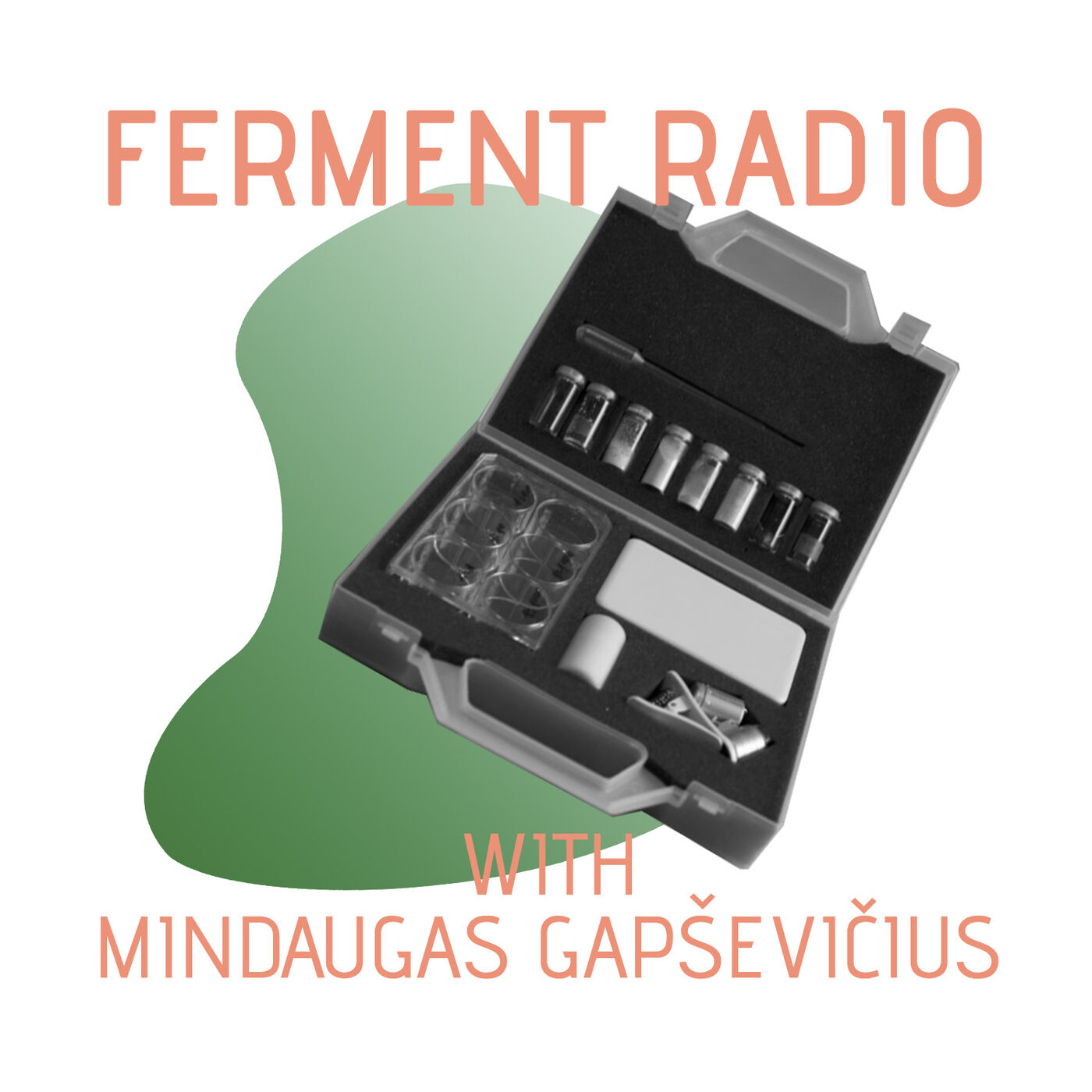
#5: Interspecies collaborations (with Mindaugas Gapševičius)
On Ferment Radio’s 5th episode, we will engage in a conversation about “collaborations with bacteria”. Together with Mindaugas Gapševičius –an artist, facilitator, and curator based in Berlin and Vilnius– we will reflect on creating the right environment for bacteria to thrive. Whether it’s a pocket-size toolkit or community-based biolaboratory, Miga is definitely a specialist in establishing col

#4: Healing the inanimate with bacteria (with Christina Stadlbauer)
Christina Stadlbauer is an artist working in the interstices between art and science. Her work pivots around life; animals, plants, and bacteria. On the 4th episode of Ferment Radio, we engage in a conversation around one of her long-term projects entitled Kin Tsugi Transformations. Kin Tsugi is a traditional Japanese technique of repairing broken ceramics with Urushi lacquer and gold or silver. T

#3: Microbial time and space travels (with Mateusz Kędzior)
On Ferment Radio’s 3d episode, we learn about microorganisms as our ancestors, time vehicles, and superheroes! Find out about this and much more in a conversation with Mateusz Kędzior, a Postdoctoral Fellow with Betül Kaçar’s research group at the University of Arizona, United States. Somewhere between sci-fi and astrobiology’s hi-tech, this team tries tries to find an answer to seemingly basic qu

#2: Microbes as social actors (with Salla Sariola)
Salla Sariola is a social scientist at the University of Helsinki, Finland. In this episode, we will talk about her research on microbes as social actors, and the implications of antimicrobial resistance, which happens, for example, when microorganisms are immune to antibiotics. Salla is also passionate about fermenting vegetables and dairy, as well as permaculture composting.

#1: Fermentation On Wheels (with Tara Whitsitt)
Tara Whitsitt is a nomadic artist and educator whose passion for growing food and teaching fermentation inspired the grassroots educational project “Fermentation on Wheels”. Tara has been driving across the USA for over 7 years, sharing starter cultures, the history and science of fermentation, as well as countless stories that she has gathered on the road. Together with millions of microbes, she

Ferment Radio (Trailer)
Recommended

پلی لیست | PlayList

Conspiracy Files with Paige Carter

Bad Friends

Learn 50 English Phrases While You Sleep | Everyday English Phrases & Vocabulary
This Past Weekend w/ Theo Von
Dateline NBC

Back to the 80s Radio

Crime Stories with Nancy Grace

Bible Tea

این نقطه
TED Business
Dark Night Tales with Brian King
