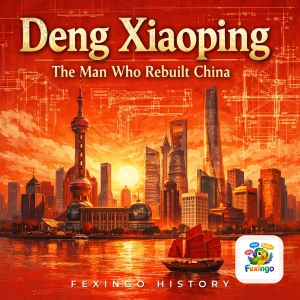
Deng Xiaoping: The Man Who Rebuilt China — Fexingo History
Deng Xiaoping: The Man Who Rebuilt China — Fexingo History is a podcast that explores the life and legacy of Deng Xiaoping, the architect of China's economic transformation. Hosts Lucas and Luna trace his journey from the Long March to his pragmatic reforms that opened China to foreign investment. They examine key events like the Tiananmen Square protests, the Southern Tour, and the creation of Special Economic Zones. The show also delves into his 'one country, two systems' policy for Hong Kong and the debates over his legacy. Each episode focuses on a specific aspect of Deng's era, from agricultural reform to state-owned enterprise restructuring.
Episodes

Deng Xiaoping's Last Stand: The 1989 Crisis and Succession
While previous episodes have traced Deng Xiaoping’s economic experiments from Shenzhen to the Gaokao reforms, this episode turns to the most perilous moment of his leadership: the spring of 1989. We explore how Deng navigated the intersection of student activism, party infighting, and international pressure without yielding on the core principle of Communist Party control. Lucas and Luna examine t
Deng Xiaoping and the Secret Battle for China's Grain
While most histories focus on Deng Xiaoping’s economic reforms or his iconic Southern Tour, this episode uncovers a quieter, more desperate struggle: the fight to feed a starving nation. We explore how Deng bypassed ideological rigidities to empower farmers in Anhui province, starting with the secret pact at Xiaogang Village in 1978. Lucas and Luna trace the journey from collective failure to hous
Deng Xiaoping's Quiet War on Illiteracy
While Deng Xiaoping is celebrated for economic reforms and special zones, his most profound legacy may be the eradication of illiteracy. In this episode, we explore the massive campaign to teach reading and writing to hundreds of millions of Chinese citizens in the late 1970s and early 1980s. Lucas and Luna discuss the specific challenges of standardizing Mandarin, the role of local teachers, and
Deng Xiaoping and the Battle for China's Grain
We often hear about Deng Xiaoping’s economic reforms and the rise of Shenzhen, but his legacy is equally rooted in solving a crisis that nearly starved the nation. In this episode, we trace the origins of the Household Responsibility System back to Xiaogang Village in 1978, where eighteen farmers secretly signed a pact to divide collective land. We explore how Wan Li, the provincial party secretar
Deng Xiaoping's Secret Nuclear Submarine Program
This episode explores the hidden history of China’s nuclear submarine program during Deng Xiaoping’s early political rehabilitation in the late 1960s. We trace how Xiao Jingguang and Admiral Zhao Renkai navigated the chaotic Cultural Revolution to build the Type 091 Han-class submarines. The conversation examines the strategic isolation of Huludao, the technological hurdles faced by the Second Art
Deng Xiaoping and the Lost Year of Soviet Friendship
In 1964, Deng Xiaoping stood on the podium in Moscow to deliver a historic speech at the anniversary of the October Revolution. It was meant to be a moment of unity between Beijing and Moscow, but instead, it became a masterclass in ideological confrontation. While Nikita Khrushchev expected loyalty or at least silence, Deng delivered a withering critique of Soviet revisionism that shocked the Kre
Deng Xiaoping's Southern Tour and the Birth of Modern China
In January 1992, at age eighty-eight, Deng Xiaoping embarked on a secret inspection tour that would redefine the People's Republic of China. This episode explores the 'Southern Tour' (Nanping Lun), where Deng bypassed ideological stalemates to champion economic reform over political purity. We trace his visits to Shenzhen, Zhuhai, Shanghai, and Wuhan, focusing on his famous dictum that development
Deng Xiaoping and the Secret Battle for China's Grain
In this episode, we move beyond the skyscrapers of Shanghai and the political maneuvers in Beijing to explore the quiet, desperate struggle that fed a nation. We examine how Deng Xiaoping’s reforms were not just economic policies but survival strategies rooted in the soil of rural China. The conversation delves into the story of Xiaogang Village and the anonymous farmers who risked their lives to
Deng Xiaoping's 1984 Shanghai Urban Blueprint
While Shenzhen became the face of China’s economic opening, Shanghai remained a quiet, industrial giant in the early 1980s, its potential largely dormant under Deng Xiaoping’s initial reforms. This episode explores the pivotal moment when Deng shifted his gaze from the Pearl River Delta to the Huangpu River, authorizing the massive redevelopment of Pudong. We examine the fierce internal debates wi
Deng Xiaoping's 1986 Hukou Crisis
In 1986, China faced an invisible crisis that threatened to derail Deng Xiaoping’s economic reforms: the rigid hukou household registration system. While Special Economic Zones were booming, millions of rural migrants flooded into cities like Shanghai without legal status, creating a shadow population that strained urban infrastructure and social stability. This episode explores the intense bureau
Deng Xiaoping and the Hidden Battle for China's Grain
While previous episodes have explored Deng Xiaoping’s architectural reforms like Shenzhen and Pudong, this episode turns to the quiet revolution in the fields. We examine the collapse of the People’s Communes and the rise of the Household Responsibility System, starting with the secret pact at Xiaogang Village in 1978. Lucas and Luna discuss how Wan Li, the Party Secretary of Anhui Province, navig
Deng Xiaoping and the Hidden Battle for China's Grain
While we often remember Deng Xiaoping for his bold economic experiments like the Special Economic Zones and the Southern Tour, a quieter, more existential crisis loomed over his leadership in the late 1970s. This episode explores the terrifying reality of China’s food shortage and how Deng’s pragmatic decision to abandon rigid collective farming saved hundreds of millions from starvation. We dive
Deng Xiaoping's Southern Tour and the Birth of Modern China
By early 1992, China’s economic reforms were stalled by ideological debate. Deng Xiaoping, then eighty-eight years old, embarked on a secret tour of southern cities including Wuhan, Changsha, Guangzhou, and finally Shenzhen. This episode details his 'Southern Tour,' where he delivered a series of speeches that dismantled fears of capitalism and reignited the market-oriented policies he had pioneer
Deng Xiaoping's Southern Tour: How He Saved China's Reforms
In early 1992, an eighty-eight-year-old Deng Xiaoping left Beijing for a surprise inspection tour of southern China. This episode traces his journey through Shenzhen, Zhuhai, and Shanghai, revealing how he used this trip to silence hardliners who wanted to reverse the economic reforms known as gaige kaifang. We explore the famous 'crossing the river by feeling the stones' philosophy in action, the
Deng Xiaoping and the 1986 Hukou Crisis
While earlier episodes explored Deng’s economic reforms in Shenzhen and his nuclear ambitions, this episode examines a quieter but equally transformative policy: the relaxation of the hukou household registration system. In the mid-1980s, Deng faced an internal crisis as rural migrants flooded coastal cities, challenging the rigid social controls established decades prior. We look at how Zhu Rongj
Deng Xiaoping's Silent Revolution in Chinese Education
While we have explored Deng Xiaoping’s military modernization, his nuclear ambitions, and the economic spark of Shenzhen, this episode turns to the quiet engine of China’s transformation: education. In 1977, amidst political uncertainty and a generation left behind by the Cultural Revolution, Deng made a decisive move that would reshape the nation’s intellectual landscape. We trace the restoration
Deng Xiaoping's Shanghai Blueprint: Pudong's Rise
We left off with the special zones in Shenzhen and the constitutional reforms of the early eighties, but by the late 1980s, a new pressure was building. Shanghai, the historic financial heart of China, was stagnating while its neighbor to the south boomed. In this episode, we explore Deng Xiaoping’s pivotal decision in 1990 to open Pudong, the desolate marshland across the Huangpu River. We look a
Deng Xiaoping and the Battle for China's Soul
In this episode, we explore the complex ideological struggle that defined Deng Xiaoping’s later years, focusing on his concept of 'Two Civilizations.' While earlier episodes covered economic reforms and military modernization, here we examine how Deng attempted to balance material wealth with spiritual integrity. We discuss the Anti-Spiritual Pollution Campaign of 1983-1984, a controversial effort
Deng Xiaoping and the Great Education Reform
While earlier episodes covered Deng’s military modernization and economic special zones, this episode explores the intellectual infrastructure of his legacy: the restoration of the Gaokao in 1977. We examine how a single decree reversed the Cultural Revolution’s anti-intellectual policies, reshaping Chinese society by reinstating meritocracy after a decade of class-based admissions. The conversati
Deng Xiaoping and the Rise of Shenzhen's Special Zone
In this episode, we step away from the high-stakes nuclear submarines and political purges that have dominated our recent discussions to focus on one of Deng Xiaoping’s most tangible legacies: the creation of the Special Economic Zone in Shenzhen. We explore how a small fishing village transformed into a global manufacturing hub under Deng’s guidance. The conversation examines the concept of 'cros
Deng Xiaoping and the Secret Art of Soft Power
While previous episodes have mapped Deng’s economic reforms, military modernization, and political maneuvers, Episode 237 explores a quieter, more subtle dimension of his legacy: the cultural diplomacy that paved the way for China’s global reintegration. In the early 1980s, as Deng initiated Gaige Kaifang, he simultaneously launched a strategic push to reintroduce Western classical music and liter
Deng Xiaoping and the Rise of Shenzhen's Special Zone
In this episode, we turn our gaze from the high politics of Zhongnanhai to the muddy fishing villages of Guangdong Province in the late 1970s. We explore how Deng Xiaoping authorized the creation of the first Special Economic Zones, starting with Shenzhen, and what that decision actually meant for ordinary Chinese citizens. We follow the trajectory of Kuang Yinglu, a pragmatic local leader who wor
Deng Xiaoping's Secret Nuclear Submarine Program
While Deng Xiaoping is widely celebrated for his economic reforms and the opening of China to global trade, a darker, more clandestine chapter of his leadership involved a desperate push to modernize the People's Liberation Army Navy. In 1980, amidst the lingering tensions of the Sino-Soviet Split and a growing awareness that China’s conventional forces were lagging behind superpowers, Deng author
Deng Xiaoping and the 1982 Constitutional Revolution
While we have explored Deng's economic experiments and military modernizations, this episode turns to his most enduring legacy: the structural overhaul of China's state. In late 1982, amidst the power struggles following Mao's death, Deng orchestrated a fundamental shift in how the Communist Party governed. We trace the drafting of the new Constitution, the controversial abolition of the life pres
Deng Xiaoping's 1984 Hong Kong Handover Strategy
In this episode, we look at the tense months leading up to the 1984 Sino-British Joint Declaration. While earlier episodes covered Deng’s economic reforms and military modernization, here we focus on the diplomatic chess game regarding Hong Kong’s future. Lucas and Luna explore how Deng navigated the complex relationship with British Prime Minister Margaret Thatcher, specifically during their famo
Deng Xiaoping and the Battle for China's Soul
While earlier episodes traced Deng’s economic reforms and military modernizations, this episode uncovers the profound ideological struggle that lay beneath them. In 1983, Deng launched the Campaign to Strike Hard Against Criminals, a massive crackdown on petty crime that reshaped public safety but also introduced severe legal overreach. We explore how this policy intersected with the simultaneous
Deng Xiaoping's Hidden Nuclear Program
While most histories focus on Deng’s economic reforms, this episode explores the parallel military modernization that secured his legacy. We trace the secret push for China’s nuclear submarine program in the late 1970s and early 1980s, a critical component of national defense often overshadowed by the opening up of Shanghai. The narrative centers on Admiral Xiao Jingguang and the engineers at Hulu
Deng Xiaoping and the Secret Deal with Japan
While history remembers Deng Xiaoping’s opening to the West, a quieter but arguably more vital pivot happened in Tokyo. In late 1978, just months before his famous visit to Washington, Deng signed the Sino-Japanese Peace and Friendship Treaty, unlocking a wave of Japanese Overseas Economic Cooperation loans that would build China’s industrial backbone. This episode explores how Zhang Jianmin navig
Deng Xiaoping's Secret Nuclear Submarine Push
While most history books focus on Deng Xiaoping’s economic reforms, this episode explores a quieter, more dangerous pivot: his 1975 decision to restart China’s nuclear submarine program. We trace how the Cultural Revolution had left the navy’s fleet aging and technologically stagnant, with surface ships unable to compete in the Cold War era of underwater deterrence. Lucas and Luna examine the poli
Deng Xiaoping and the Rise of Shenzhen's Special Zone
While earlier episodes covered Deng’s political maneuvers and educational reforms, this episode focuses on the creation of the Shenzhen Special Economic Zone in 1979. We explore how Deng used the phrase 'crossing the river by feeling the stones' to justify a radical experiment: turning a fishing village into a global manufacturing hub. The conversation details the initial resistance from conservat
Deng Xiaoping and the 1980s Cultural Cold War
While previous episodes have traced Deng Xiaoping’s economic reforms, legal overhauls, and military modernization, this episode explores a quieter but equally vital battle: the ideological reconstruction of Chinese society in the early 1980s. We focus on the Anti-Spiritual Pollution Campaign of 1983–1984, a controversial attempt to cleanse public culture of Western influences that Deng ultimately
Deng Xiaoping's 1982 Nuclear Submarine Push
While most histories of Deng Xiaoping focus on economic reforms like the Special Economic Zones or the restoration of the Gaokao, his approach to military modernization remains a critical, often overlooked pillar of China's resurgence. This episode examines the intense bureaucratic and technological battles within the Central Military Commission during the early 1980s, specifically the push to com
Deng Xiaoping and the 1980s Intellectual Awakening
While earlier episodes covered Deng’s economic experiments in Shenzhen and rural Sichuan, this episode explores the cultural and intellectual liberation that accompanied his reforms. In 1979 and 1980, Deng authorized the translation and publication of Western philosophical, literary, and scientific works that had been banned for decades. We follow the work of translators like Fu Lei and the publis
Deng Xiaoping's Hidden War: The 1986 Anti-Spiritual Pollution Campaign
In the wake of the economic reforms and student exchanges that defined Deng Xiaoping’s early tenure, a quiet but fierce ideological battle erupted within the Chinese Communist Party in 1986. This episode explores the Anti-Spiritual Pollution Campaign, a movement initiated by Deng to curb the influence of Western liberal ideas, consumerism, and what party hardliners viewed as moral decay. We trace
Deng Xiaoping and the Great Air Force Modernization
While earlier episodes covered Deng’s economic reforms and student exchanges, this episode reveals his parallel, high-stakes push to modernize the People's Liberation Army Air Force in the late 1970s. We explore how Deng, acting as Vice Chairman of the Central Military Commission, dismantled the isolationist mindset left by the Cultural Revolution to rebuild China’s aviation industry. The conversa
Deng Xiaoping's Secret War: The 1980 Sino-Soviet Border Crisis
While the world watched Deng Xiaoping open China’s economy, a different kind of tension simmered along the northern frontier. In 1980, the Soviet Union deployed over one million troops to the Sino-Soviet border, creating a nuclear standoff that threatened to derail Deng’s entire reform agenda. This episode explores the quiet diplomacy and military maneuvering that defined this period, focusing on
Deng Xiaoping's 1986 Political Reform Push
In 1986, Deng Xiaoping launched an ambitious campaign to modernize China’s political structure, not just its economy. This episode explores the internal debates within the Chinese Communist Party regarding administrative decentralization and the rule of law. We look at key figures like Hu Yaobang and Peng Zhen, who advocated for institutional reforms to prevent future chaos. However, the push face
Deng Xiaoping's 1985 Shanghai Economic Zone Pivot
While Deng Xiaoping is often credited with the coastal Special Economic Zones, his 1985 decision to open the entire Yangtze River Delta was a far more complex geopolitical gamble. This episode explores how Deng bypassed conservative resistance in Zhongnanhai to empower local leaders like Chen Yun and Zhu Rongji in transforming Shanghai from a decaying industrial hub into an export powerhouse. We e
Deng Xiaoping's 1986 Political Reform Push
While Deng Xiaoping is often remembered for economic opening, his attempt to overhaul China’s political structure in 1986 remains one of the most consequential decisions of his career. This episode explores the inner workings of the 1980s political reform movement, focusing on the tension between modernization and stability. We examine the role of Hu Yaobang as the primary architect of these chang
Deng's Secret War: The 1980 Sino-Soviet Border Crisis
While most narratives focus on Deng Xiaoping’s economic reforms, this episode uncovers the quiet, high-stakes military tension that defined his early consolidation of power. In late 1979 and throughout 1980, as China opened its doors to the West, it faced a massive Soviet military buildup along its northern border. We explore the strategic dilemma facing Deng: how to pivot toward market economics
Deng's 1980 Push to Open China's Stock Markets
In 1980, Deng Xiaoping took a gamble that challenged decades of Marxist orthodoxy: inviting foreign capital to buy into Chinese industry through joint ventures and, eventually, stock trading. This episode traces how Deng's pragmatism led to the creation of China's first stock exchanges in Shanghai and Shenzhen, the role of economist Liu Hongru, and the political tightrope walked to reconcile 'soci
Deng Xiaoping's 1980 Central Committee Pivot
In this episode, Lucas and Luna explore a rarely discussed but pivotal moment in Deng Xiaoping's reform era: his 1980 decision to restructure the Party's Central Committee and push out aging revolutionaries, clearing the way for younger, more pragmatic leaders. They unpack the tensions at the Fifth Plenary Session, the resignations of veterans like Wang Dongxing, the promotion of Hu Yaobang to Gen
Deng Xiaoping and the 1975 Nuclear Submarine Push
In 1975, as China emerged from the chaos of the Cultural Revolution, Deng Xiaoping made a decisive push to accelerate the country's first nuclear submarine program. This episode digs into the technological and political hurdles behind the 09-I (Han-class) submarine, the role of key figures like Xiao Jingguang and Zhao Renkai, and the strategic importance of the Huludao shipyard on the Bohai Sea. W
Deng Xiaoping's 1978 Decision That Restored China's Universities
In this episode, Lucas and Luna explore a pivotal yet often overlooked moment in Deng Xiaoping's reform agenda: the 1978 National Education Work Conference and the reopening of China's universities after the Cultural Revolution. They trace how Deng, alongside Zhou Rongxin and Liu Xiyao, rebuilt higher education from the ashes of the 'two estimations' — the Maoist verdict that had branded intellect
Deng Xiaoping and the 1979 Border War with Vietnam
In this episode, Lucas and Luna revisit the brief but bloody Sino-Vietnamese War of 1979, a conflict that reshaped Cold War alliances and tested Deng Xiaoping's nerve just weeks after his historic visit to Washington. They explore the Vietnamese invasion of Cambodia, the Chinese leadership's debate over retaliation, and the military campaign itself — from the lightning strikes by the People's Libe
Deng Xiaoping's 1977 Decision to Restore Gaokao
In 1977, Deng Xiaoping made a decision that reshaped China: the restoration of the gaokao, the national college entrance examination. After a decade of the Cultural Revolution, when universities were shut and admissions were based on political loyalty, Deng's move reopened the doors to higher education for millions of young people. This episode tells the story of that pivotal moment: the August sc
Deng Xiaoping's 1980 Decision That Rebuilt Shanghai
In this episode, Lucas and Luna explore Deng Xiaoping's pivotal 1980 decision to revive Shanghai, a city that had been deliberately held back during the Mao years. They trace the origins of Shanghai's industrial might, the effects of central planning that turned it into a revenue cash cow for Beijing, and the moment when Deng, alongside Chen Yun and others, chose to transform it into a hub for fin
Deng Xiaoping's 1982 Push for a Law-Based China
In 1982, Deng Xiaoping pushed through a new constitution that rewired China's legal system. This episode unpacks how the '1982 Constitution'—drafted under Peng Zhen's guidance—replaced the Mao-era charter, enshrined 'rule of law' as a goal, and created the basis for everything from criminal law reform to property rights. Lucas and Luna dig into the debates: how Deng balanced 'people's democratic d
Deng Xiaoping and the 1984 Decision to Open China's Skies
In 1984, Deng Xiaoping made a quieter but transformative move: opening China's skies. This episode follows the creation of China's first commercial airline, the birth of Beijing Capital International Airport's modern Terminal 1, and the decisions that put ordinary Chinese on planes for the first time. We trace the story of the Civil Aviation Administration of China (CAAC) splitting into six region
Deng's 1980 Push for Rural Electrification
In this episode, Lucas and Luna explore Deng Xiaoping's 1980 initiative to bring electricity to rural China, a cornerstone of the reform era. They trace the early days of rural electrification, the challenges of the 1970s, and how Deng's push for small hydropower and grid expansion transformed villages overnight. The conversation highlights the role of engineers like Li Peng, the impact on daily l
Deng Xiaoping's 1978 Decision That Opened China's Doors
In this episode, Lucas and Luna explore a pivotal moment in China's reform era: Deng Xiaoping's 1978 decision to restart student exchanges with the West. They trace the journey of the first 52 students sent to the United States, the political maneuvering in Beijing, and the cultural shock these pioneers experienced. From the initial skepticism to the transformative impact on China's modernization,
Deng Xiaoping's 1978 Sichuan Land Reform Experiment
Before Shenzhen became the symbol of China's economic miracle, a quiet revolution was underway in the countryside of Sichuan. In 1978, Deng Xiaoping and provincial party secretary Zhao Ziyang turned to rural reform, testing a system of household responsibility that would eventually reshape agriculture nationwide. This episode follows the path from the drought-stricken fields of 1978 to the secret
Deng Xiaoping's 1984 Shenzhen Gamble: The City That Rewrote China
In 1984, Deng Xiaoping made a secret visit to Shenzhen, the experimental Special Economic Zone that was either a bold leap into the future or a capitalist betrayal. This episode traces Deng's four-day tour, his cryptic silence, and the inscription that settled the debate: 'Shenzhen's development and experience prove that our policy of establishing Special Economic Zones is correct.' We follow the
Deng Xiaoping's 1978 Decision to Restart Student Exchanges
In 1978, Deng Xiaoping made a quiet but pivotal decision: send Chinese students to the West again. It was the first large-scale overseas study program since the Cultural Revolution, and it reshaped China's science, technology, and economy for decades. This episode follows the story of the 52 students who left for the US that year, the diplomats and scientists who made it happen, and the debates in
Deng Xiaoping's 1979 Special Economic Zones Gamble
In 1979, Deng Xiaoping made a bold bet that would reshape China's economy: the creation of four Special Economic Zones. This episode takes you inside that gamble—from the initial proposal by Xi Zhongxun to the fierce debates in Zhongnanhai over capitalism's creeping influence. You'll hear how Shenzhen, Zhuhai, Shantou, and Xiamen were chosen, why Deng insisted on calling them 'special' rather than
Deng and the 1984 Pearl River Delta Push
In this episode, Lucas and Luna dive into Deng Xiaoping's 1984 decision to open up the Pearl River Delta, the fertile crescent of Guangdong that became the workshop of the world. They trace the region's transformation from rice paddies to factory floors, the role of overseas Chinese capital from Hong Kong and Macau, and the 'front porch, back factory' model that fueled explosive growth. They discu
Deng Xiaoping and the 1985 Military Disarmament
In 1985, Deng Xiaoping announced a one-million-man reduction in the People's Liberation Army, a stunning reversal for a nation that had long prioritized massive ground forces. This episode explores how Deng, with the help of Yang Shangkun and Zhang Aiping, steered the PLA toward modernization, shifting focus from quantity to quality, and laying groundwork for future technological advances. We disc
Deng Xiaoping's 1983 Fearless Push Against Spiritual Pollution
In this special 200th episode of Fexingo History, Lucas and Luna take on a less-traveled chapter of Deng Xiaoping's reform era: the brief but intense 1983 campaign against 'spiritual pollution.' They trace how Deng, fresh from the success of rural reforms, turned his attention to what he called a 'slightly poisonous' cultural atmosphere—imported jeans, rock music, avant-garde art, and even Hu Yaob
Deng Xiaoping's 1975 Nuclear Submarine Push
In 1975, with China's nuclear submarine program stalled by Cultural Revolution chaos and a bitter rivalry between the Navy and the Second Artillery, Deng Xiaoping made a decisive move. This episode uncovers the story behind the 09-I Han-class submarine — the first nuclear-powered attack sub built in China — and the political maneuvering that brought it to life. We follow the engineering struggle w
Deng Xiaoping's 1980 Tibet Policy Shift
In 1980, Deng Xiaoping and Hu Yaobang visited Tibet, a region recovering from the Cultural Revolution's devastation. Their trip led to a temporary policy of leniency, the return of the Dalai Lama's summer palace to monastic use, and a brief thaw in Sino-Tibetan relations. But by 1987, the reformer's pragmatism gave way to a hardline turn, culminating in the Lhasa unrest. This episode explores the
The 1984 Decision That Gave China Its Modern Army
In 1984, Deng Xiaoping pushed through a military shake-up that reduced the People's Liberation Army by a million troops and made way for a generation of younger, better-educated officers. This episode digs into the details of that decision: the Central Military Commission meetings, the role of Yang Shangkun, the tough cases like Zhang Aiping who resisted retirement, and the ripple effects on China
Deng and the 1984 Decision That Saved China's Rivers
In 1984, with reform spreading across China's cities, a quiet revolution began on its waterways. The State Council approved the 'Regulations on River Management,' giving the Ministry of Water Resources new powers to regulate flood control, irrigation, and shipping on the Yangtze, Yellow, and other major rivers. This episode focuses on the man behind the push, Li Peng, and the fierce bureaucratic b
Deng Xiaoping and the 1984 China-US Nuclear Accord
In 1984, Deng Xiaoping and Ronald Reagan signed a civilian nuclear cooperation agreement that quietly transformed China's energy future and its place in the global order. This episode traces the diplomatic path from the 1979 normalization to the signing of the 1984 US-China Nuclear Cooperation Agreement, the hurdles of nonproliferation, the role of Zhou Peiyuan and the China Atomic Energy Authorit
Deng Xiaoping's 1979 Counterattack: The Brief War with Vietnam
In February 1979, Deng Xiaoping ordered a punishing strike against Vietnam, a Soviet ally, just months after normalizing relations with the United States. This episode unpacks the geopolitical calculus behind the brief but bloody border war: China's need to prove it would not tolerate Soviet expansion, the domestic political rationale for military action, and the unexpected economic cost that near
The Unretiring Reformer: Deng Xiaoping's 1982 Military Shake-Up
In 1982, Deng Xiaoping faced a stubborn obstacle to his reform agenda: a military leadership stacked with aging veterans of the Long March. This episode traces Deng's quiet but forceful campaign to break the PLA's resistance to change, from the early 1980s 'aging problem' to the 1985 decision to demobilize a million soldiers. We explore how Deng used a series of strategy sessions and personnel res
Deng Xiaoping and the 1978 Silk Road Revival
Before the skyscrapers of Shenzhen, before the highways and the stock markets, Deng Xiaoping made a quiet bet on an ancient network of trade routes. In this episode, Lucas and Luna trace the origins of China's Belt and Road Initiative back to a series of little-known study tours in the late 1970s, when Deng dispatched teams to Europe, Japan, and the United States to learn how the world had moved o
The 1984 Shanghai-Hong Kong Double Tax Agreement
In 1984, as Deng Xiaoping's reform was accelerating, China and Britain quietly signed a double taxation agreement that would shape the flow of capital for decades. This episode unpacks that treaty: why Shanghai, the city of capitalists, mattered, how its drafters balanced socialist rhetoric with investor logic, and what it tells us about the messy, pragmatic invention of China's tax treaty network
The 1984 Decision That Rewired China's Cities
In October 1984, the Central Committee of the Chinese Communist Party adopted the Decision on Reform of the Economic Structure, a document that quietly ended central planning in China and set the stage for the market reforms that followed. This episode traces how Deng Xiaoping, Zhao Ziyang, and a team of economists—including the unassuming Ma Hong—drafted a text that used the phrase 'socialist com
Deng Xiaoping and the 1975 Railway Rectification
In 1975, with China still reeling from the Cultural Revolution, Deng Xiaoping launched a bold campaign to restore order to the country's chaotic railway system. This episode follows Deng's appointment as First Vice Premier, his alliance with the pragmatic minister Wan Li, and the dramatic crackdown on factionalism at Xuzhou Station. We explore the 'three-point instructions' that became the rallyin
Deng Xiaoping and the 1987 Ocean Shipping Reform
In 1987, Deng Xiaoping pushed through a radical reform of China's ocean shipping industry, breaking the monopoly of the state-owned China Ocean Shipping Company (COSCO) and opening the seas to provincial and private players. This episode traces the story of the China Shipping Group, formed from the remnants of the old Shanghai Shipping Bureau, and the man at its helm, Li Xiannian-era veteran Zhang
Deng Xiaoping's 1979 Border Talks: The Quiet Diplomatic Reversal
In 1979, as China's military struck Vietnam in a punitive war, Deng Xiaoping quietly pursued a diplomatic opening that few expected: improving ties with the Soviet Union's ally, Mongolia, and subtly realigning China's northern frontier. This episode unpacks the forgotten border negotiations with Ulaanbaatar, the role of the Sino-Soviet split, and how Deng used a mix of strategic patience and quiet
Deng Xiaoping's 1984 Urban Economic Reform: The Decision That Changed China
In October 1984, the Central Committee of the Chinese Communist Party adopted the historic 'Decision on Reform of the Economic Structure', moving China's reform beyond agriculture into the cities. Lucas and Luna explore how this landmark document, championed by Deng Xiaoping, introduced the concept of a 'socialist commodity economy', gave state-owned enterprises greater autonomy, and paved the way
Deng Xiaoping's 863 Program: The Letter That Sparked China's Tech Revolution
In March 1986, four Chinese scientists wrote a letter to Deng Xiaoping warning that the United States' Strategic Defense Initiative (SDI) threatened to leave China behind in a new technological arms race. Deng responded within days, approving a massive state-led research program that would become known as the 863 Program. This episode tells the story behind that letter: the scientists — Wang Ganch
Deng Xiaoping's 1982 Retirement Reform That Ended Life Tenure
In 1982, Deng Xiaoping was 78 years old and still the paramount leader of China. But he was determined to break the Communist tradition of life-long tenure for top officials. This episode dives into the surprising 1982 retirement system reform — how Deng convinced his revolutionary comrades to step down, the creation of the Central Advisory Commission as a retirement buffer, the role of Chen Yun a
Deng Xiaoping's 1977 Gaokao Restoration: Rescuing China's Education
In 1977, Deng Xiaoping made a decision that would transform China: restoring the Gaokao, the national college entrance exam, which had been abolished during the Cultural Revolution. This episode dives into the tense political maneuvering behind that decision, the winter exam that drew 5.7 million applicants, and the profound impact on a generation of young Chinese. We explore Deng's personal convi
Deng Xiaoping's 1984 Coastal Cities Opening: Bringing Reform to China's Shores
In 1984, Deng Xiaoping catalyzed China's second wave of economic reform by opening 14 coastal cities to foreign investment and trade. Building on the success of the Special Economic Zones, this bold move extended preferential policies to cities like Shanghai, Dalian, and Qingdao, transforming them into hubs of globalization. Lucas and Luna explore the decision-making behind the coastal city openin
Deng Xiaoping's 1983 Strike Hard Campaign
In 1983, as China's economic reforms accelerated, a wave of violent crime threatened social stability. Deng Xiaoping personally authorized the 'Strike Hard' (Yanda) campaign—a nationwide crackdown that led to mass arrests, swift trials, and thousands of executions. This episode examines the origins of the campaign, its impact on public security, and the lasting tension between rapid reform and iro
Deng Xiaoping and the Birth of Shenzhen Special Economic Zone 1980
In 1980, China established its first Special Economic Zones, with Shenzhen as the flagship experiment. This episode dives into the political struggle to launch the SEZs, the role of reformist vice-minister Yuan Geng who physically paced out the border fence, and the conservative opposition led by Chen Yun who feared capitalism's return. Lucas and Luna explore how Deng Xiaoping's pragmatism turned
Deng Xiaoping's 1992 Southern Tour: Reviving China's Reform
In early 1992, after Tiananmen and years of conservative retrenchment, China's reforms were stalling. Deng Xiaoping, officially retired but still the paramount leader, embarked on a crucial journey south—the Nanxun. This episode follows Deng's train from Beijing to Wuchang, his impromptu speeches at Shenzhen's electronics factories, and his blunt warnings to party leaders. We explore his famous ap
Deng Xiaoping's 1979 US Visit: Cowboy Hat Diplomacy
In January 1979, just weeks after formal normalization of relations, Deng Xiaoping became the first Chinese leader to visit the United States since the founding of the People's Republic. Over eight days, he crisscrossed America—from the White House to a rodeo in Houston, where he donned a ten-gallon cowboy hat. Lucas and Luna dive into the diplomatic tightrope Deng walked: charming President Jimmy
Recommended
The Joe Rogan Experience

TED Talks Daily

Learn English B1 with Daily News | English Listening Practice

Talk About Talk - Executive & Leadership Communication Skills

English with Olivia | Slow Conversations & Vocabulary

Stand In The Circle

SLOW ENGLISH PODCAST (A1-A2) With Subtitles | Daily Videos | English With Us Podcast

Learn English A2 with Daily News | Simple English Listening Practice

پلی لیست | PlayList

Conspiracy Files with Paige Carter

Bad Friends

Learn 50 English Phrases While You Sleep | Everyday English Phrases & Vocabulary
