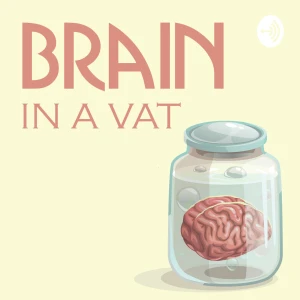
Brain in a Vat
Brain in a Vat is a podcast that explores thought experiments and features conversations with philosophers. Hosted by Dr Jason Werbeloff and Mark Oppenheimer, it delves into philosophical ideas and debates.
Episodes

Decoding Reactions: Signal and Noise in Personal Interactions | Mark Schroeder
Mark Schroeder discusses When Things Get Personal, his account of how we interpret one another and why those interpretations so often go wrong. Our interactions are filled with noise, factors that don’t reflect the person themselves, complicating what we can infer about an individual from their behavior. Schroeder dissects the complex relationship between behavior, agency, and identity, as well as
The Truth About Honesty, Lies, and Deception | Christian Miller
Christian Miller, author of The Honesty Crisis, joins to explore the nature and ethics of honesty. He examines what it means to be honest, when lying can be morally justified, and the difference between honesty and simply telling the truth. Miller considers these questions through cases involving deepfakes, delusion, infidelity, and our obligations to tell the truth.Chapters:[00:00] Introducing Ch
The Costs of Open Borders | Lionel Shriver
Lionel Shriver returns to discuss her new novel, 'A Better Life,' and the philosophical debate over immigration and open borders.Inspired by a proposed New York City program to pay residents to house migrants, the novel turns one family's home into a thought experiment about immigration and humanitarian obligations.Shriver examines the arguments for and against open borders, as well as
The Man Who Exposed Jason Arday: Cancelled at Cambridge | Nathan Cofnas
Nathan Cofnas, the academic who recently drew widespread attention for exposing plagiarism allegations against Cambridge professor Jason Arday, returns to Brain in a Vat to discuss academic freedom, institutional conformity, and his own controversial departure from Cambridge.Cofnas argues that universities create incentives for academics to conform, particularly when scholarship challenges prevail
Free Speech, Schools, and Children | Jimmy Mullen
Former Brain in a Vat producer Jimmy Mullen returns to discuss free speech in schools, exploring how educational institutions should balance student expression with their responsibility to maintain an environment conducive to learning.Drawing on constitutional law and landmark cases on student free speech, the conversation explores viewpoint neutrality, the role of political disagreement in educat
Sexual Ethics on Campus: Consent and Power | Colin McGinn
Colin McGinn joins to discuss sexual ethics on campus. Drawing on thought experiments and his own experiences in academia, McGinn argues that universities too often conflate harassment with consensual relationships while overstating the role of power imbalances. He explains why he believes current policies can undermine academic freedom, due process, and the proper limits of institutional authorit
The Philosophy of Pluribus | Spencer Case
Spencer Case returns to discuss Pluribus, one of the most philosophically ambitious science fiction series in recent years. The conversation explores whether individuality is worth preserving if giving it up would create a happier and more peaceful world, raising questions about personal identity, autonomy, and the ethics of a hive mind.Chapters:[00:00] Welcome[00:58] Pluribus Explained[03:09] The
The Time-Meaning Conundrum | Rivka Weinberg
Rivka Weinberg returns to argue that time is both the source of meaning and its greatest threat, making meaningful lives possible while also guaranteeing loss and impermanence. The conversation explores the relationship between suffering and meaning, whether ultimate meaning is attainable, and why temporary achievements may remain valuable even if nothing lasts forever.Chapters:[00:00] Introductio
Should You Need Permission to Take Medicine? | Jessica Flanigan
Do adults have a right to decide what goes into their own bodies, even when experts believe they're making a mistake?Jessica Flanigan returns to defend a radical idea: competent adults should have the freedom to access pharmaceuticals without needing permission from doctors or government regulators. Flanigan argues that the same principles underlying informed consent also support a right to se
Can Torture Be Justified? | Stephen Kershnar
We welcome back Stephen Kershnar to discuss the ethics of torture. Kershnar argues that some criminals deserve torture because severe wrongdoing can cause a person to forfeit protections against extreme punishment. He critiques the idea that there are moral constraints the state must never cross.The dialogue also examines objections to torture concerning human dignity, bodily integrity, and the da
A World Without Scarcity | Steven Kotler
What happens to human beings in a world without scarcity? If all our needs were met, would we actually be better off? Will technological progress lead to utopia or collapse?Humans are living through massive improvements in material conditions. More people have access to food, energy, and technology than ever before. Steven Kotler examines what this kind of abundance does to us. It may support a mo
Living with Adversity | David Benatar
What does it mean to live with adversity? How ought we respond to the suffering of others? How can we adapt to hardship?Adversity is a universal experience. Nearly everyone, at some point, faces physical, psychological, or social challenges, and yet suffering often goes unnoticed.David Benatar joins us to discuss these questions on the human condition, provoked by his book 'Living with Adversi
Risky Storytelling | Kevin Allison
Kevin Allison, creator of the RISK! podcast, recounts a high school prank at an all-boys Jesuit school in 1986. After a crush teased him by repeatedly spitting on him, Kevin later mailed him a sealed container of feces labeled “enjoy the cookies.” In retelling the story, Kevin considers how the prank mixes humiliation and a possible form of intimacy, situated within his experience of growing up ga
Free Speech, Hate Speech, and Mental Health | Chloe Carmichael
Clinical psychologist Chloe Carmichael, author of "Can I Say That?," examines how free expression relates to psychological well-being and social trust. Carmichael argues that suppressing disagreement drives resentment and misperception, rather than resolving conflict. She also scrutinizes the role of safe spaces, the spread of therapeutic language, and what limits on speech might be just
The Bias against Conservatism in Higher Education | Amy Wax
Amy Wax joins us to discuss the ideological landscape of higher education. Wax reflects on her conflict with the University of Pennsylvania and argues that universities have become increasingly hostile to conservative viewpoints. The conversation explores ideological bias on campus, academic freedom, and the challenges conservatives face within modern higher education.[00:00] Welcome to the Discus
The Nature of the Sexes | Tomás Bogardus (with Stephen Kershnar)
Tomás Bogardus joins to discuss his book "The Nature of the Sexes" and argues for a reproductive-functional account of biological sex. According to Bogardus, males and females are defined by the reproductive function their bodies are structured to perform: producing sperm or eggs. Even when that function is not realized and no sperm or eggs are produced, a person’s sex remains the same,
God Is Not Praiseworthy | Stephen Kershnar and Nathan Bray
Brain in a Vat is back from hiatus with a deep dive into the philosophy of religion. Stephen Kershnar and Nathan Bray join us to ask whether God can be morally responsible and whether worship makes sense if God could not have done otherwise.The discussion begins with a thought experiment about gratitude and worship. If worship expresses praise for morally responsible action, can a perfectly good G
Facial Distortions and Prosopometamorphopsia | Brad Duchaine (Rebroadcast)
In this special episode of Brain in a Vat, Brad Duchaine from the Psychological and Brain Sciences Department at Dartmouth discusses prosopometamorphopsia (PMO) – a condition where individuals see distorted faces.The episode explores various manifestations of PMO, including seeing demonic features, dragons, or entirely different faces, and distinguishes it from prosopagnosia (face blindness). It d
Should We Stay or Should We Go | Lionel Shriver (Rebroadcast)
When is death preferable to living? Are there fates worse than death? And what sort of future society should we build?Lionel Shriver discusses her latest novel, Should We Stay or Should We Go.
Parental Licensing | Connor Kianpour (Rebroadcast)
Should you be required to get a parental license from the State before you can raise your own children? Do the wishes of parents matter at all – or should we only care about the best interests of their children?
Can AI Bring Our Loved Ones Back? Inside Reflekta AI’s Digital Afterlife | Miles Spencer
In this special episode of Brain in a Vat, we step outside our usual format to interview Miles Spencer, founder of Reflekta — a company using cutting-edge AI to recreate digital reflections of loved ones who’ve passed away.Miles shares his personal journey of using Reflekta to reconnect with his late father and explains how the system blends voice recordings, photos, and written biographies to cre
Cultural Appropriation | Stephen Kershnar (Rebroadcast)
Is it permissible for members of one group to appropriate the cultural practices of another? Is there anything wrong with cultural appropriation at all, or are there benefits to cultural appropriation?
Aztec Philosophy: What the Aztecs Knew About Life | Sebastian Purcell
How did the Aztecs understand life, morality, and human purpose? What can Aztec philosophy teach us about living well? Sebastian Purcell guides us through Aztec thought, beginning with a thought experiment from Homer’s Odyssey and moving into the core ideas of Aztec wisdom. Along the way, he contrasts Aztec ethics with Western traditions and applies them to modern debates on morality, from sex and
The Assassination of Charlie Kirk
In this special episode of Brain in a Vat, Mark and Jasondiscuss the tragic assassination of political commentator, Charlie Kirk. The episode discusses Kirk's commitment to open dialogue and civil discourse, particularly on college campuses, and critique the societal implications of hisdeath.The episode delves into themes of free speech, academicfreedom, and the dangerous conflation of words a
Using AI to Fight Crime | David Boonin (Rebroadcast)
Is racial profiling always wrong, even if used by an AI to decrease crime? Should we use AI to judge criminal cases, recommend sentences for the guilty, or decide parole for prisoners?Chapters:[00:00] Introduction to AI in Crime Fighting[00:12] Thought Experiment: The Looting Scenario[06:32] Predictive Policing and AI[10:13] Debating the Ethics of AI in Law Enforcement[23:26] Affirmative Action an
Are We Free at Work? Marx on Capitalism Today | Brian Leiter
In this episode of Brain in a Vat, we’re joined by Brian Leiter, co-author (with Jamie Edwards) of a new book on Marx. We explore whether workers in contemporary capitalism are truly free—or trapped in a form of “wage slavery.” Leiter uses thought experiments to probe the limits of workplace freedom. He also examines Marx’s labor theory of value—its strengths and flaws—and shows how modern capital
The Possible Worlds of David Lewis | Barry Lam (Rebroadcast)
What are possible worlds? Could you have been born to different parents, and could an object be both completely green and completely red? Barry Lam explains how David Lewis’s views on possible worlds can help us understand everything from time travel to the nature of who we are.
Procreative Ethics | Rivka Weinberg (Rebroadcast)
Is it wrong to bring new life into the world? Is adopting a child a moral obligation? Is parenting meaningful?
Imagine There’s No Gender | Holly Lawford-Smith [with Raja Halwani] (Rebroadcast)
Would the world be better if we didn’t recognize genders?In such a world, there would be males and females, but nothing associated with what it means to be male or female other than biological facts. Men and women would be equally likely to be social leaders. And there would be no stereotypically male or female behavior.In this world, there’d be true sex equality, and, it seems, no need for trans
The Moral Lives of Spies | Cécile Fabre
What does a spy owe — to their country, their conscience, or their cause? In this episode, Cécile Fabre investigates the moral lives of Cold War operatives like Kim Philby and Oleg Gordievsky. With Fabre, we probe the strange morality of spies and the ethical paradoxes they inhabit.Is it ever right to betray your country? Can deception be a moral duty? These questions come to life through real sto
The Right to Sex | Raja Halwani (Rebroadcast)
Do we have a right to sex, and is there an obligation to sexually fulfill the disabled? Should sex work be not only legal, but obligatory?[00:00] Introduction and Guest Welcome[00:16] Exploring the Right to Sex: Thought Experiment[03:43] Negative vs. Positive Rights to Sex[09:50] State-Sponsored Sex Work and Ethical Considerations[11:52] Sexual Obligations and Imperfect Duties[23:51] Rights to Sex
Decriminalizing Sex Work | Jessica Flanigan
In this episode of Brain in a Vat, we welcome back Jessica Flanigan for a discussion on the decriminalization of sex work.Using a decriminalization framework, Flanigan examines the ethics of sex work and the role of state regulation.The conversation explores autonomy, consent, and coercion. It also addresses the stigma surrounding sex work, its possible benefits, and the impact of market dynamics
Disgust | Martha Nussbaum (Rebroadcast)
What exactly makes us feel disgusted? Is disgust for a person or group ever justified? And is disgust useful, or should we try to eliminate it?Chapters:[00:00] Introduction to Disgust and Cognitive Content[00:11] Paul Rosen's Experiments on Disgust[02:16] Disgust and Its Connection to Animality and Mortality[03:05] Projective Disgust and Social Implications[05:06] Disgust in Legal Theory and Pract
Patriotism Unpacked | Spencer Case (Rebroadcast)
What does it mean to be patriotic, or to love your country? Some argue that patriotism is virtuous because it allows us to transcend our selfish needs and act for the good of our community. But others argue that patriotism is overly narrow-minded, arbitrary and sometimes immoral.Microdigressions Podcast: https://www.youtube.com/@Micro-DigressionsChapters:[00:00] Introduction to Brain Nevada[00:27]
Is Tarot a Tool for Thought? | Georgi Gardiner
In this episode of Brain in a Vat, Georgi Gardiner returns to explore the epistemic value of tarot: its capacity to shape self-understanding, spark creative reflection, and influence major life decisions.Drawing on personal experience and philosophical analysis, Georgi examines how tarot can serve as a mirror for introspection while also raising concerns about confirmation bias and self-deception.
Living The Philosophical Life | Agnes Callard
In this episode, Brain in a Vat is joined by public philosopher and author Agnes Callard to explore the relevance of philosophy in everyday life. Drawing from her work on Socrates, Agnes makes a case for why philosophical inquiry matters, now more than ever. From the pig farmer analogy to Socratic love, this conversation is a deep dive into how philosophy is a way of life.Chapters:[00:00] Introduc
The Israel Palestine Conflict | David Benatar
Are Jews entitled to their own homeland? Is the Israeli response to the massacre of civilians perpetrated by Hamas on October 7th justified? Should there be a ceasefire? David's Article in Quillette: https://quillette.com/2023/10/21/its-not-the-occupation/ Raja Halwani wrote to us about Jason's exposition of his view at 33:06. Here is Raja's clarification:**I wanted to clarify a point
The Ideal State: An AI Debate - Plato vs Nozick
In this episode of Brain in a Vat, we examine two competing political visions through an AI debate between Plato and Robert Nozick. Plato defends rule by philosopher kings and a unified society, while Nozick argues for individual liberty and a minimal state. Following our previous episode featuring Mill and Kant, we continue investigating major philosophical divides through thought experiments lik
Organ Markets | James Stacey Taylor (Rebroadcast)
Should we be allowed to sell our organs on the open market? Would the poor be exploited under such a system? And does organ donation impose an unfair burden on the relatives of those that need a transplant?Check out FeedSpot's list of 90 best philosophy podcasts, where Brain in a Vat is ranked at 15, here: https://podcast.feedspot.com/philosophy_podcasts/
Academic Freedom in Universities | Eric Sampson and Rebecca Tuvel
Eric Sampson and Rebecca Tuvel explore the contested issue of academic freedom. They discuss the tensions that emerge when universities try to balance the promotion of diverse intellectual perspectives with concerns over potential harm to community members, as seen in controversies involving figures like philosopher Peter Singer. Drawing on debates about gender, race, and ethics, they analyze the
Children's Rights and Parenting | Connor Kianpour and Ella Coleman
Connor examines involuntary commitment, substance abuse disorders, and the ethical dilemmas surrounding parenting and children's welfare. Should children be allowed to transition genders? When is the state justified in removing children from harmful environments? And what is the role of non-parental caregivers in a child's life?Join us for this thought-provoking episode that pushes the bou
Are Conspiracy Theories Right? | Jared Millson and Ella Coleman
Jared Millson delves into the intriguing world of conspiracy theories, exploring well-known cases like Pizzagate and lesser-known but historically significant events such as the COINTELPRO. The discussion spans the definitions and philosophical debates about what constitutes a conspiracy theory, the criteria for evaluating these theories, and the psychological and sociopolitical impacts they have
Animal Liberation Now | Peter Singer (Rebroadcast)
Peter Singer delves into difficult ethical questions regarding animal rights, the morality of factory farming, and difficult human-related ethical dilemmas.Singer discusses his views as a consequentialist, examining the impact of our choices on animal suffering, the ethical considerations around organ donation from anencephalic children, and the broader implications of such decisions.What are the
End Taxes? | Jessica Flanigan
Jess Flanigan argues that personal income tax is illegitimate. But is the state ever justified in extracting money from its population to pay for public goods? Are property taxes and privatization of state functions better options? And if taxes are illegitimate, are we permitted, or even obligated, to stop paying our taxes?[00:00] Introduction and Thought Experiment[02:40] Justifying Taxes for Pub
The Problem with Democracy | Jason Brennan (Rebroadcast)
If most voters are misinformed, is democracy legitimate? What sort of voting system should we have in its place? And should some votes count more than others?[00:00] Introduction to the Problems of Democracy[00:17] Brexit: A Case Study in Misinformed Voting[05:33] Voter Behavior: Social Benefits and Signaling[18:29] The Legitimacy of Democratic Systems[30:32] The Challenge of Political Incentives[
Mass Shootings | Kurt Blankschaen
Does our common understanding of mass shootings help us to prevent them?Blankschaen argues that our common beliefs and media narratives around gun ownership, mental illness, and school policies are unhelpful in preventing future mass shootings.Can we even provide an adequate definition of mass shootings? Should we give up the concept of mass shootings altogether, and focus instead on the particula
The Problems with Virtue Ethics | Travis Timmerman
Through comparisons to consequentialism and deontological ethics, Travis dissects the core principles and critiques of virtue ethics. Along the way, we discuss moral dilemmas, the application of virtues, and the real-world implications of ethical theories. Whether you're a student of philosophy or just curious about moral reasoning, this discussion provides deep insights into the essence of vi
The End Goal of Wokeness | Nathan Cofnas
What is the underlying logic of woke ideology? Is it consistent, and can it justify the pursuit of equality of outcome, such as redistributing wealth and land?Cofnas discusses the origins and evolution of wokeism, the moral and empirical premises underlying it, and the political dynamics between conservatives and liberals.Tune in to gain a deeper understanding of the ongoing debates around equity,
Effective Altruism and Making a Difference | Jacob Bauer
How should we allocate our donations to address global issues effectively? Jacob discusses the principles guiding Effective Altruism, the importance of evidence-based charitable giving, the ethical implications of supporting local versus global causes, and the challenges of predicting long-term impacts.The episode also delves into the significant debate within the effective altruism community abou
Ultimate Meaning | Rivka Weinberg (Rebroadcast)
Is it possible for us to lead meaningful lives? Is there an ultimate point to our existence? Can we enrich our lives with the pursuit of love, knowledge and friendship? [00:00] Introduction to the Meaninglessness of Life[00:14] Tolstoy's Existential Crisis[01:39] The Appropriateness of Sadness[04:18] Everyday Meaning vs. Ultimate Meaning[06:13] The Metaphysical Argument[10:57] The Role of Acco
Affirmative Action and Medical School | Stephen Kershnar
Join us for a provocative episode on Brain in a Vat as we rejoin the infamous Stephen Kershnar, whose prior discussions have made headlines. This episode delves into affirmative action, demographic considerations in education and employment, and the ethics of statistical predictions informed by race.The discussion debates the legitimacy and consequences of using race, gender, and other demographic
Should Only Queer Actors Play Queer Roles? | Kurt Blankschaen & Travis Timmerman
Was Kit Conner obligated to reveal his queer sexual orientation to play his role as a queer character on ‘Heartstopper’? Timmerman and Blankschaen argue that straight actors can authentically portray queer characters, addressing issues of character versus performer authenticity, potential harm to marginalized actors, and the broader impact on the industry. They respond to various objections and ex
The Moral Circle: Are AI and Animals Included? | Jeff Sebo
Who should be included in our 'moral circle' when we make our moral decisions? Jeff discusses the ethical responsibilities we might have towards non-human beings, such as Neanderthals, AIs, or even figments of our imagination. The conversation critically examines issues related to animal welfare, the complexities of population ethics, and the potential future implications of artificial int
Don't Vote | Chris Freiman with Rebecca Tuvel
Chris Freiman argues that we’re justified in ignoring politics. Freiman, whose book 'Why It's Okay to Ignore Politics' delves into this controversial stance, presents thought experiments and addresses common objections. The conversation also explores effective altruism, the moral implications of individual actions, and the complexities surrounding charitable giving and political partic
Alix Spiegel on Storytelling | Alix Spiegel
In this special episode, Alix Spiegel, host and producer of ‘Invisibilia’ and journalist for ‘This American Life’, joins us to talk about storytelling.Alix discusses storytelling techniques, the philosophical and political dimensions of narrative choices, and the emotional journey of confronting climate change.[00:00] Introduction to the Guest: Elise Spiegel[00:23] The Story of Joy and Her Unique
Why It's Okay to Eat Meat - Or Is It? | Dan Shahar (Rebroadcast)
Dan Shahar defends the view that eating meat is permissible, even though meat farming is not. Is this a coherent position?
[00:00] Introduction and Thought Experiment
[00:48] The Alien Analogy
[02:20] Moral Implications and Human Relationships
[03:33] Vegetarian Perspective and Ethical Dilemmas
[08:01] Super Cow Hypothetical
[12:11] Real-World Ethical Challenges
[21:59] Voting and Social
Who was Derek Parfit? | David Edmonds (Rebroadcast)
Parfit altered the landscape of the philosophy of identity. We speak to David Edmonds about his recently released biography on this influential philosopher, and ask: what made Parfit the man he was?
[00:00] Introduction to David Edmunds
[00:25] David's Personal Connection to Derek Parfit
[01:42] Derek Parfit's Early Life and Education
[04:17] Derek Parfit's Philosophical Contributions
[08:39] The
The Philosophy of Severance | Travis Timmerman (Rebroadcast)
Ben Stiller's superb series, Severance, raises fascinating questions about the nature of personal identity. Are we minds or brains? Is it possible for two persons to inhabit the same body? And can a person survive gaps in their existence?
[00:00] Introduction to Severance
[01:24] Philosophical Questions on Personal Identity
[05:59] Real-Life Analogies and Thought Experiments
[11:26] Ethical
Anti-Semitism | Mark Oppenheimer (Rebroadcast)
What do anti-semites and ultra-orthodox Jews have in common? How did the ivy league discriminate against Jews? Is America still a safe haven for Jews? Follow Mark's work on https://markoppenheimer.substack.com/
[00:00] Introduction and Confession
[00:17] The Tree of Life Synagogue Shooting
[03:59] Historical Context of Jewish Persecution
[07:15] Understanding Antisemitism
[13:38] Antisemitism and
What Is a Woman? | Alex Byrne (Rebroadcast)
Oxford University Press refused to publish Alex Byrne's book on gender. We discuss whether women are adult human females and whether sex is the same as gender.
[00:00] Introduction and Thought Experiment
[02:38] Exploring Gender Identity
[11:22] Historical Context and Gender Roles
[19:00] Biological and Social Perspectives
[27:51] Understanding Social Identity: 'One of the Boys'
[28:17] C
Sex Work or Prostitution? | Lori Watson (Rebroadcast)
Is sex work actually work? Is prostitution always a form of exploitation? And show we legalize or decriminalize prostitution?
[00:00] Introduction and Opening Remarks
[00:14] The Moral and Legal Concerns of Prostitution
[04:11] Debating Terminology: Prostitution vs. Sex Work
[06:37] Legal Frameworks and Models of Prostitution
[11:24] The Unique Harms of Prostitution
[24:41] Sex Work as Lab
Is Monogamy Wrong? | Harry Chalmers (Rebroadcast)
Is the restriction on having additional sexual or romantic partners similar to the restriction on having additional friends? Should you allow your partner to be free to pursue other partners? And are we able to overcome the jealousy associated with non-monogamy?
[00:00] Introduction to the Debate on Monogamy
[00:11] Thought Experiment: Friendship Restrictions
[03:17] Defending Monogamy: Common Ar
The Privacy Paradox | David Boonin (Rebroadcast)
Is observing people in a public space from the privacy of your home an infringement of their rights? Can the widespread use of CCTV cameras be justified, or does it violate their privacy? And how do technological developments affect the delicate balance between safety and privacy?
[00:00] Introduction
[00:18] The Case of Mrs. A
[02:06] Privacy and Public Surveillance
[08:28] The Networking E
Benatar on Bullshit | With Rebecca Tuvel
Are there different kinds of bullshit? Do bullshitters know they are full of it? What should we do to stem the tide?
[00:00] Introduction
[00:19] David Benatar's Joke
[02:25] Defining Bullshit: Philosophical Perspectives
[04:21] Academic Bullshit and Real-World Examples
[09:34] The Ethics of Calling Out Bullshit
[23:14] The Tragedy of the Bullshit Commons
[36:06] Language, Slurs, a
Unravelling “White Privilege” | Spencer Case
Can the definition of privilege be nuanced enough to address the broad range of individual experiences and historical contexts? Does recognizing and discussing privilege lead to meaningful social change? Or does talk of privilege oversimplify complex issues?
[00:00] Introduction and Welcome
[00:14] Exploring the Privilege Walk
[04:57] Discussion on Privilege and Comparative Advantage
[17:05]
Cultural Appropriation | Stephen Kershnar
Is it permissible for members of one group to appropriate the cultural practices of another? Is there anything wrong with cultural appropriation at all, or are there benefits to cultural appropriation?
[00:00] Introduction and Thought Experiment
[00:29] Criticism and Cultural Appropriation
[02:07] Ownership of Ideas
[04:49] Intellectual Property and Cultural Rights
[12:03] Personal Offense
Determinism, Free Will, and the Meaning of Life | Stephen Maitzen
Stephen Maitzen argues that the world is deterministic. But if all of our choices are determined, how should we understand free will, the meaning of life, and regret?
Read Maitzen’s Book here:
https://www.routledge.com/Determinism-Death-and-Meaning/Maitzen/p/book/9781032134185
[00:00] Introduction to Determinism and Thought Experiment
[00:15] Clark Griswold's Christmas Lights: A Lesson in Det
Abortion: An AI Debate - Mill vs Kant
We explore the complex moral landscape of abortion through the perspectives of two philosophical giants, John Stuart Mill and Immanuel Kant, as simulated by AI.
Mill defends abortion from a utilitarian standpoint, emphasizing individual autonomy and the consequences of our actions, while Kant objects to abortion from a deontological approach, focusing on inherent human dignity and universal moral
Will Machines Rule the World? | Barry Smith
Does Searle’s Chinese Room show that AI is not intelligent or creative? Does AI learn the way humans do? And could AI ever be capable of truly creative thought?
[00:00] Introduction to the Chinese Room Argument
[03:55] The Evolution of Human Language
[05:58] ChatGPT's Capabilities and Limitations
[12:09] Human Understanding vs. AI Responses
[15:33] The Complexity of Human Desires
[20:24] The
Reimagining Democracy as Lottocracy | Alexander Guerrero (With Travis Timmerman)
'Lottocracy' is a system where political representation is determined randomly. Is this a better system than democracy?
We discuss the shortcomings of current electoral democracies, including the influence of media and special interests, and examine innovative models like deliberative democracy and specialized legislative structures.
How should we balance between expertise and random selection,
Navigating Kinky Sex: Ethics, Safety, and Risk | Georgi Gardiner
Georgi Gardiner discusses the intricate philosophy of safe sex, kink, and BDSM. She delves into the complexities of power dynamics, moral judgments, and ethical implications in kinky sex.
How should we think about risk perception and its relation to STIs, and the value of sexual liberation?
[00:00] Welcome and Introduction
[00:10] A Curious Real Life Case
[03:31] The Norms and Rules of Sexual
Comedy, Satire, and Laughing at the Uncomfortable | John Vlismas
Dive into the intersection of comedy and philosophy with South African comedian John Vlismas. We explore the power of humor as a political tool, its role in confronting societal issues, and the fine line between making people laugh and challenging their deeply held assumptions.
Vlismas shares his insights on the evolving landscape of comedy, the ethics of jokes, and the responsibility of comedian
The Value of Bad Movies | Matt Strohl (with Travis Timmerman)
Join hosts Mark Opennheimer and Travis Timmerman as they dive into the world of bad movies with Matt Strohl, author of 'Why It's Okay to Love Bad Movies.' The episode explores 'bad' films like 'Dancing It's On,' the creative triumphs of low-budget movies, and the merits of B-movies.
The conversation then shifts to the controversial film 'Cannibal Holocaust,' examining its place within the Mondo g
Refugees and Border Control | Bradley Hillier-Smith
Bradley Hillier-Smith argues that states have a duty not to harm refugees, and a duty to improve the lives of refugees. He argues that wealthier nations, therefore, have an obligation to accept and support at least some refugees.
But what is the impact of refugee policies on citizens? And just how far do our obligations go toward helping refugees?
[00:00] Introduction to Refugee Crisis
[00:11]
Exploring Alien Civilizations | Isaac Arthur
Isaac Arthur, president of the American National Space Society, discusses the nature and likelihood of alien civilizations.
What sort of alien civilizations are most likely do exist? Is 'uplifting' an alien species ethical? What level of intelligence, sociability, and language are aliens most likely to have?
And is AI a form of alien intelligence?
See Isaac Arthur’s channel here: https:
Can Animals Create Art? | Yolandi Coetser
This live episode of Brain in a Vat investigates the boundaries of animal creativity through real-life examples, thought experiments, and philosophical theories of art.
What are the cognitive capacities of animals? What is the best way of understanding the apparent ‘art’ of animals? And how should we value the lives of animals?
[00:00] Introduction to Thought Experiments
[00:17] Human vs. Animal
Population Decline and Pronatalism | Paul Morland
Paul Morland, author of 'No One Left', joins the Brain in a Vat podcast to discuss demographic changes and Pronatalism. Paul explores the idea of having more children in response to declining fertility rates, demographic momentum, and the potential societal impacts of population collapse. Paul discusses potential solutions, including state intervention, cultural changes, and technological
Love and Limerence | Georgi Gardiner
What is the difference between love, limerence, crushes and squishes? Can someone be mistaken about whether they’re in love? And is limerence harmful, or can it also have therapeutic value?
[00:00] Introduction to Love and Limerence
[00:09] Thought Experiment: Terry and Sam Seder
[01:38] Philosophical Debates on Love
[03:37] The Power of Self-Descriptions
[06:14] Exploring Limerence
[10:10]
Aliens, Social Groups, and the Golden Record | Jason Werbeloff
How would we explain our social structures to aliens? Can we define our social groups in a way that is easy to articulate and understand?
Jason Werbeloff argues that it’s extremely difficult to answer even the simplest questions about the nature of our social groups.
Does this mean we should exclude any talk of groups when describing ourselves on the Golden Record?
And should we understand our
Ayn Rand and the Ethics of Selfishness | Tara Smith
Has selfishness been misunderstood? Is there a way of defending Ayn Rand’s egoism?
Tara Smith confronts challenging questions about morality, individual rights, and the balance between personal and societal well-being.
Read Smith’s book here: https://a.co/d/5r4HfXb
[00:00] Introduction to Ayn Rand and Egoism
[00:21] Challenging Common Perceptions of Self-Interest
[02:40] Objective vs. Subject
Recommended
TED Talks Daily

Learn English B1 with Daily News | English Listening Practice
Talk About Talk - Executive & Leadership Communication Skills
English with Olivia | Slow Conversations & Vocabulary
Stand In The Circle

SLOW ENGLISH PODCAST (A1-A2) With Subtitles | Daily Videos | English With Us Podcast

Learn English A2 with Daily News | Simple English Listening Practice

پلی لیست | PlayList

Conspiracy Files with Paige Carter
Bad Friends

Learn 50 English Phrases While You Sleep | Everyday English Phrases & Vocabulary
This Past Weekend w/ Theo Von
