
How AI Is Built
Real engineers. Real deployments. Zero hype. We interview the top engineers who actually put AI in production. Learn what the best engineers have figured out through years of experience. Hosted by Nicolay Gerold, CEO of Aisbach and CTO at Proxdeal and Multiply Content.
Episodes
#056 Building Solo: How One Engineer Uses AI Agents to Ship Production Code
Nicolay here,Most AI coding conversations focus on which model to use. This one focuses on workflow - the specific commands, git strategies, and review processes that let one engineer ship production code with AI agents doing 80% of the work.Today I have the chance to talk to Kieran Klaassen, who built Cora (an AI email management tool) almost entirely solo using AI agents.His approach: treat AI a

#055 Embedding Intelligence: AI's Move to the Edge
Nicolay here,while everyone races to cloud-scale LLMs, Pete Warden is solving AI problems by going completely offline. No network connectivity required.Today I have the chance to talk to Pete Warden, CEO of Useful Sensors and author of the TinyML book.His philosophy: if you can't explain to users exactly what happens to their data, your privacy model is broken.Key Insight: The Real World Action Ga
#054 Building Frankenstein Models with Model Merging and the Future of AI
Nicolay here,most AI conversations focus on training bigger models with more compute. This one explores the counterintuitive world where averaging weights from different models creates better performance than expensive post-training.Today I have the chance to talk to Maxime Labonne, who's a researcher at Liquid AI and the architect of some of the most popular open source models on Hugging Face.He
#053 AI in the Terminal: Enhancing Coding with Warp
Nicolay here,Most AI coding tools obsess over automating everything. This conversation focuses on the rightbalance between human skill and AI assistance - where manual context beats web search every time.Today I have the chance to talk to Ben Holmes, a software engineer at Warp, where they're building theAI-first terminal.Manual context engineering trumps automated web search for getting accurate
#052 Don't Build Models, Build Systems That Build Models
Nicolay here,Today I have the chance to talk to Charles from Modal, who went from doing a PhD on neural network optimization in the 2010s - when ML engineers could build models with a soldering iron and some sticks - to architecting serverless infrastructure for AI models. Modal is about removing barriers so anyone can spin up a hundred GPUs in seconds.The critical insight that stuck with me: "Don
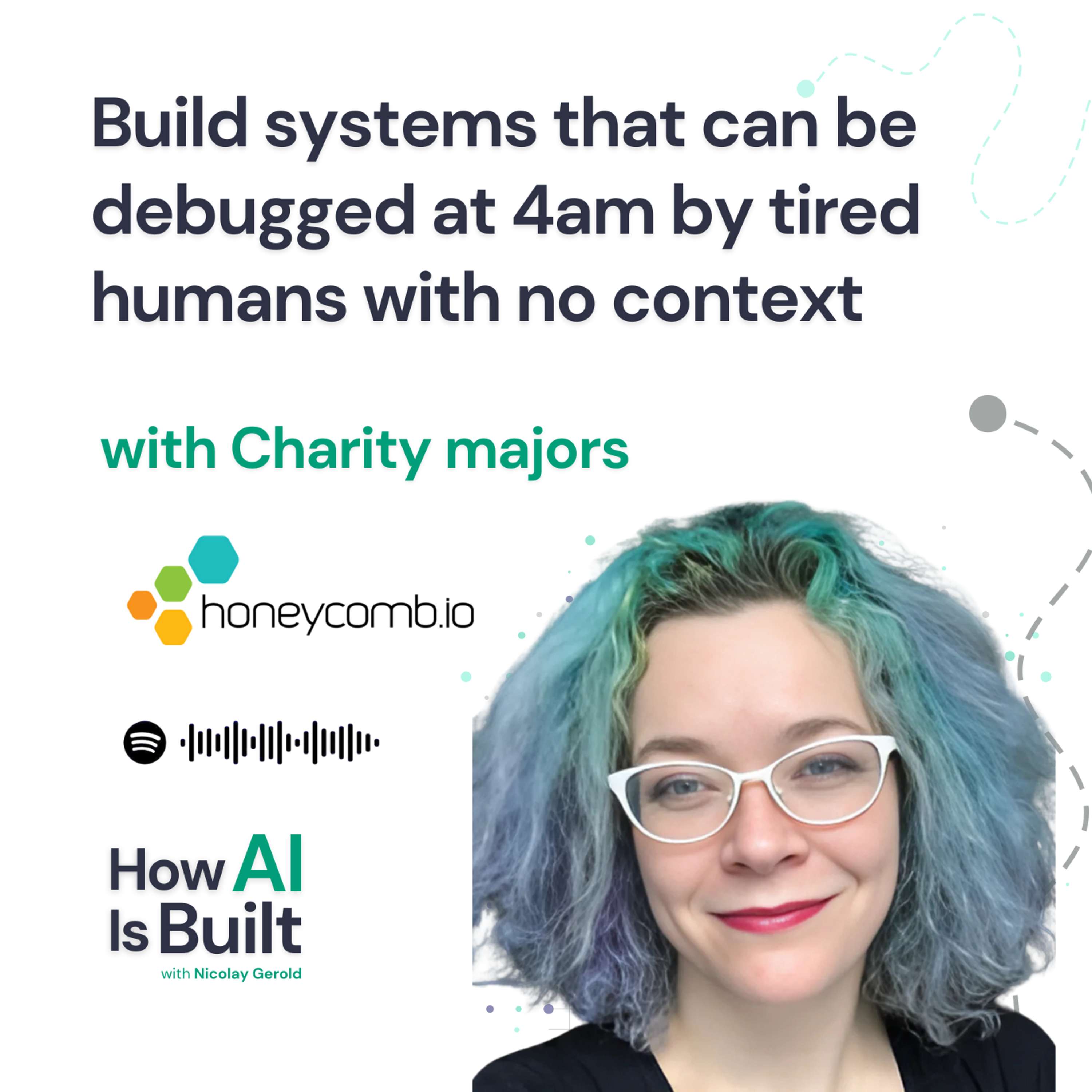
#051 Build systems that can be debugged at 4am by tired humans with no context
Nicolay here,Today I have the chance to talk to Charity Majors, CEO and co-founder of Honeycomb, who recently has been writing about the cost crisis in observability."Your source of truth is production, not your IDE - and if you can't understand your code there, you're flying blind."The key insight is architecturally simple but operationally transformative: replace your 10-20 observability tools w
#050 Bringing LLMs to Production: Delete Frameworks, Avoid Finetuning, Ship Faster
Nicolay here,Most AI developers are drowning in frameworks and hype. This conversation is about cutting through the noise and actually getting something into production.Today I have the chance to talk to Paul Iusztin, who's spent 8 years in AI - from writing CUDA kernels in C++ to building modern LLM applications. He currently writes about production AI systems and is building his own AI writing a
#050 TAKEAWAYS Bringing LLMs to Production: Delete Frameworks, Avoid Finetuning, Ship Faster
Nicolay here,Most AI developers are drowning in frameworks and hype. This conversation is about cutting through the noise and actually getting something into production.Today I have the chance to talk to Paul Iusztin, who's spent 8 years in AI - from writing CUDA kernels in C++ to building modern LLM applications. He currently writes about production AI systems and is building his own AI writing a
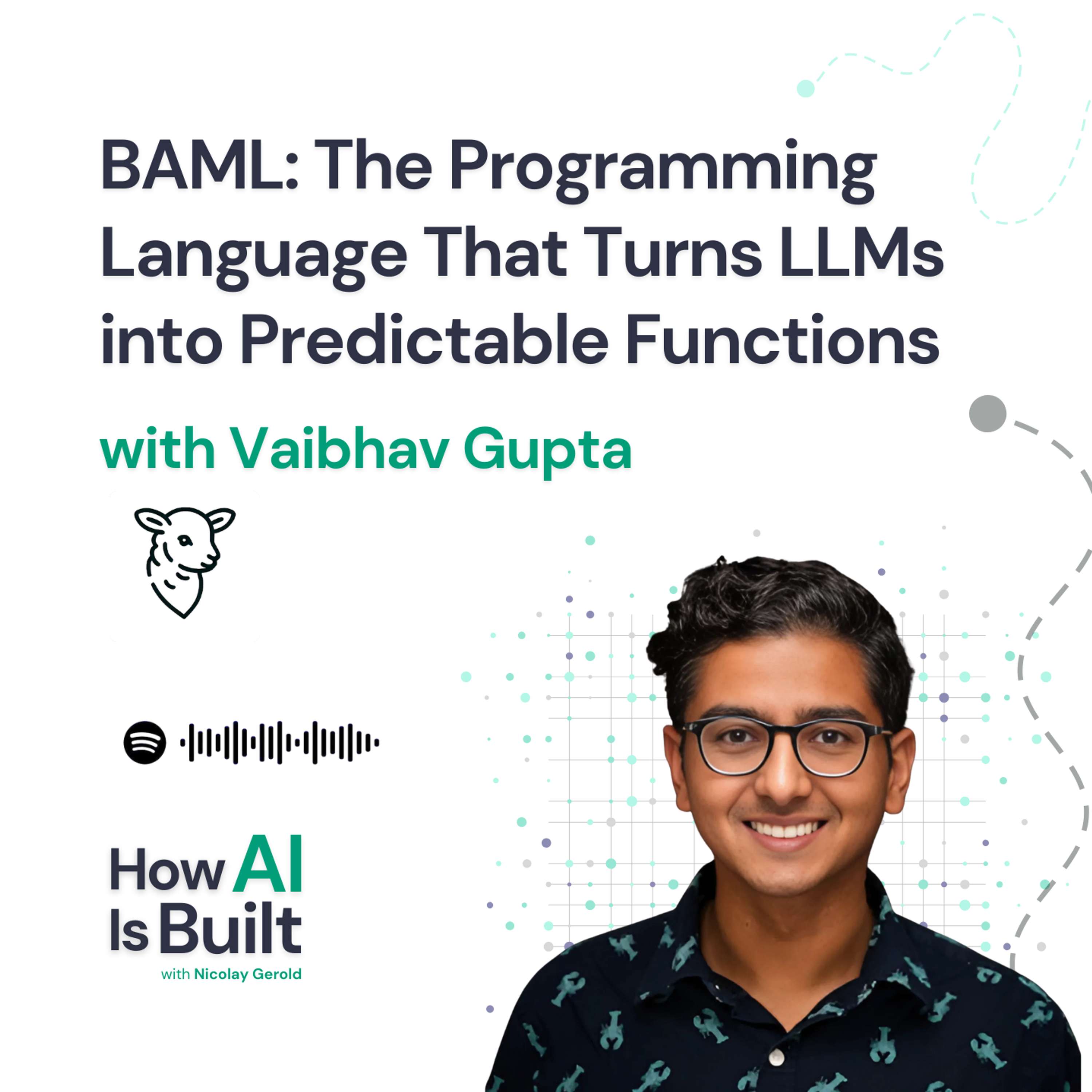
#049 BAML: The Programming Language That Turns LLMs into Predictable Functions
Nicolay here,I think by now we are done with marveling at the latest benchmark scores of the models. It doesn’t tell us much anymore that the latest generation outscores the previous by a few basis points.If you don’t know how the LLM performs on your task, you are just duct taping LLMs into your systems.If your LLM-powered app can’t survive a malformed emoji, you’re shipping liability, not softwa
#049 TAKEAWAYS BAML: The Programming Language That Turns LLMs into Predictable Functions
Nicolay here,I think by now we are done with marveling at the latest benchmark scores of the models. It doesn’t tell us much anymore that the latest generation outscores the previous by a few basis points.If you don’t know how the LLM performs on your task, you are just duct taping LLMs into your systems.If your LLM-powered app can’t survive a malformed emoji, you’re shipping liability, not softwa

#048 TAKEAWAYS Why Your AI Agents Need Permission to Act, Not Just Read
Nicolay here,most AI conversations obsess over capabilities. This one focuses on constraints - the right ones that make AI actually useful rather than just impressive demos.Today I have the chance to talk to Dexter Horthy, who recently put out a long piece called the “12-factor agents”.It’s like the 10 commandments, but for building agents.One of it is “Contact human with tool calls”: the LLM can

#048 Why Your AI Agents Need Permission to Act, Not Just Read
Nicolay here,most AI conversations obsess over capabilities. This one focuses on constraints - the right ones that make AI actually useful rather than just impressive demos.Today I have the chance to talk to Dexter Horthy, who recently put out a long piece called the “12-factor agents”.It’s like the 10 commandments, but for building agents.One of it is “Contact human with tool calls”: the LLM can
#047 Architecting Information for Search, Humans, and Artificial Intelligence
Today on How AI Is Built, Nicolay Gerold sits down with Jorge Arango, an expert in information architecture. Jorge emphasizes that aligning systems with users' mental models is more important than optimizing backend logic alone. He shares a clear framework with four practical steps:Key Points:Information architecture should bridge user mental models with system data modelsInformation's purpose is
#046 Building a Search Database From First Principles
Modern search is broken. There are too many pieces that are glued together.Vector databases for semantic searchText engines for keywordsRerankers to fix the resultsLLMs to understand queriesMetadata filters for precisionEach piece works well alone.Together, they often become a mess.When you glue these systems together, you create:Data Consistency Gaps Your vector store knows about documents your t
#045 RAG As Two Things - Prompt Engineering and Search
John Berryman moved from aerospace engineering to search, then to ML and LLMs. His path: Eventbrite search → GitHub code search → data science → GitHub Copilot. He was drawn to more math and ML throughout his career.RAG Explained"RAG is not a thing. RAG is two things." It breaks into:Search - finding relevant informationPrompt engineering - presenting that information to the modelThese should be t
#044 Graphs Aren't Just For Specialists Anymore
Kuzu is an embedded graph database that implements Cypher as a library.It can be easily integrated into various environments—from scripts and Android apps to serverless platforms.Its design supports both ephemeral, in-memory graphs (ideal for temporary computations) and large-scale persistent graphs where traditional systems struggle with performance and scalability.Key Architectural Decisions:Col
#043 Knowledge Graphs Won't Fix Bad Data
Metadata is the foundation of any enterprise knowledge graph.By organizing both technical and business metadata, organizations create a “brain” that supports advanced applications like AI-driven data assistants.The goal is to achieve economies of scale—making data reusable, traceable, and ultimately more valuable.Juan Sequeda is a leading expert in enterprise knowledge graphs and metadata manageme
#042 Temporal RAG, Embracing Time for Smarter, Reliable Knowledge Graphs
Daniel Davis is an expert on knowledge graphs. He has a background in risk assessment and complex systems—from aerospace to cybersecurity. Now he is working on “Temporal RAG” in TrustGraph.Time is a critical—but often ignored—dimension in data. Whether it’s threat intelligence, legal contracts, or API documentation, every data point has a temporal context that affects its reliability and usefulnes
#041 Context Engineering, How Knowledge Graphs Help LLMs Reason
Robert Caulk runs Emergent Methods, a research lab building news knowledge graphs. With a Ph.D. in computational mechanics, he spent 12 years creating open-source tools for machine learning and data analysis. His work on projects like Flowdapt (model serving) and FreqAI (adaptive modeling) has earned over 1,000 academic citations.His team built AskNews, which he calls "the largest news knowledge g
#040 Vector Database Quantization, Product, Binary, and Scalar
When you store vectors, each number takes up 32 bits.With 1000 numbers per vector and millions of vectors, costs explode.A simple chatbot can cost thousands per month just to store and search through vectors.The Fix: QuantizationThink of it like image compression. JPEGs look almost as good as raw photos but take up far less space. Quantization does the same for vectors.Today we are back continuing

#039 Local-First Search, How to Push Search To End-Devices
Alex Garcia is a developer focused on making vector search accessible and practical. As he puts it: "I'm a SQLite guy. I use SQLite for a lot of projects... I want an easier vector search thing that I don't have to install 10,000 dependencies to use.”Core Mantra: "Simple, Local, Scalable"Why SQLite Vec?"I didn't go along thinking, 'Oh, I want to build vector search, let me find a database for it.'
#038 AI-Powered Search, Context Is King, But Your RAG System Ignores Two-Thirds of It
Today, I (Nicolay Gerold) sit down with Trey Grainger, author of the book AI-Powered Search. We discuss the different techniques for search and recommendations and how to combine them.While RAG (Retrieval-Augmented Generation) has become a buzzword in AI, Trey argues that the current understanding of "RAG" is overly simplified – it's actually a bidirectional process he calls "GARRAG," where retrie
#037 Chunking for RAG: Stop Breaking Your Documents Into Meaningless Pieces
Today we are back continuing our series on search. We are talking to Brandon Smith, about his work for Chroma. He led one of the largest studies in the field on different chunking techniques. So today we will look at how we can unfuck our RAG systems from badly chosen chunking hyperparameters.The biggest lie in RAG is that semantic search is simple. The reality is that it's easy to build, it's eas
#036 How AI Can Start Teaching Itself - Synthetic Data Deep Dive
Most LLMs you use today already use synthetic data.It’s not a thing of the future.The large labs use a large model (e.g. gpt-4o) to generate training data for a smaller one (gpt-4o-mini).This lets you build fast, cheap models that do one thing well.This is “distillation”.But the vision for synthetic data is much bigger.Enable people to train specialized AI systems without having a lot of training
#035 A Search System That Learns As You Use It (Agentic RAG)
Modern RAG systems build on flexibility.At their core, they match each query with the best tool for the job.They know which tool fits each task. When you ask about sales numbers, they reach for SQL. When you need to company policies, they use vector search or BM25. The key is switching tools smoothly.A question about sales figures might need SQL, while a search through policy documents works bette
#034 Rethinking Search Inside Postgres, From Lexemes to BM25
Many companies use Elastic or OpenSearch and use 10% of the capacity.They have to build ETL pipelines.Get data Normalized.Worry about race conditions.All in all. At the moment, when you want to do search on top of your transactional data, you are forced to build a distributed systems.Not anymore.ParadeDB is building an open-source PostgreSQL extension to enable search within your database.Today, I
#033 RAG's Biggest Problems & How to Fix It (ft. Synthetic Data)
RAG isn't a magic fix for search problems. While it works well at first, most teams find it's not good enough for production out of the box. The key is to make it better step by step, using good testing and smart data creation.Today, we are talking to Saahil Ognawala from Jina AI to start to understand RAG.To build a good RAG system, you need three things: ways to test it, methods to create traini
#032 Improving Documentation Quality for RAG Systems
Documentation quality is the silent killer of RAG systems. A single ambiguous sentence might corrupt an entire set of responses. But the hardest part isn't fixing errors - it's finding them.Today we are talking to Max Buckley on how to find and fix these errors.Max works at Google and has built a lot of interesting experiments with LLMs on using them to improve knowledge bases for generation.We ta
#031 BM25 As The Workhorse Of Search; Vectors Are Its Visionary Cousin
Ever wondered why vector search isn't always the best path for information retrieval?Join us as we dive deep into BM25 and its unmatched efficiency in our latest podcast episode with David Tippett from GitHub.Discover how BM25 transforms search efficiency, even at GitHub's immense scale.BM25, short for Best Match 25, use term frequency (TF) and inverse document frequency (IDF) to score document-qu
#030 Vector Search at Scale, Why One Size Doesn't Fit All
Ever wondered why your vector search becomes painfully slow after scaling past a million vectors? You're not alone - even tech giants struggle with this.Charles Xie, founder of Zilliz (company behind Milvus), shares how they solved vector database scaling challenges at 100B+ vector scale:Key Insights:Multi-tier storage strategy: GPU memory (1% of data, fastest)RAM (10% of data)Local SSDObject stor
#029 Search Systems at Scale, Avoiding Local Maxima and Other Engineering Lessons
Modern search systems face a complex balancing act between performance, relevancy, and cost, requiring careful architectural decisions at each layer.While vector search generates buzz, hybrid approaches combining traditional text search with vector capabilities yield better results.The architecture typically splits into three core components:ingestion/indexing (requiring decisions between batch vs

#028 Training Multi-Modal AI, Inside the Jina CLIP Embedding Model
Today we are talking to Michael Günther, a senior machine learning scientist at Jina about his work on JINA Clip.Some key points:Uni-modal embeddings convert a single type of input (text, images, audio) into vectorsMultimodal embeddings learn a joint embedding space that can handle multiple types of input, enabling cross-modal search (e.g., searching images with text)Multimodal models can potentia
#027 Building the database for AI, Multi-modal AI, Multi-modal Storage
Imagine a world where data bottlenecks, slow data loaders, or memory issues on the VM don't hold back machine learning.Machine learning and AI success depends on the speed you can iterate. LanceDB is here to to enable fast experiments on top of terabytes of unstructured data. It is the database for AI. Dive with us into how LanceDB was built, what went into the decision to use Rust as the main imp
#026 Embedding Numbers, Categories, Locations, Images, Text, and The World
Today’s guest is Mór Kapronczay. Mór is the Head of ML at superlinked. Superlinked is a compute framework for your information retrieval and feature engineering systems, where they turn anything into embeddings.When most people think about embeddings, they think about ada, openai.You just take your text and throw it in there.But that’s too crude.OpenAI embeddings are trained on the internet.But yo
#025 Data Models to Remove Ambiguity from AI and Search
Today we have Jessica Talisman with us, who is working as an Information Architect at Adobe. She is (in my opinion) the expert on taxonomies and ontologies.That’s what you will learn today in this episode of How AI Is Built. Taxonomies, ontologies, knowledge graphs.Everyone is talking about them no-one knows how to build them.But before we look into that, what are they good for in search?Imagine a
#024 How ColPali is Changing Information Retrieval
ColPali makes us rethink how we approach document processing.ColPali revolutionizes visual document search by combining late interaction scoring with visual language models. This approach eliminates the need for extensive text extraction and preprocessing, handling messy real-world data more effectively than traditional methods.In this episode, Jo Bergum, chief scientist at Vespa, shares his insig
#023 The Power of Rerankers in Modern Search
Today, we're talking to Aamir Shakir, the founder and baker at mixedbread.ai, where he's building some of the best embedding and re-ranking models out there. We go into the world of rerankers, looking at how they can classify, deduplicate documents, prioritize LLM outputs, and delve into models like ColBERT.We discuss:The role of rerankers in retrieval pipelinesAdvantages of late interaction model
#022 The Limits of Embeddings, Out-of-Domain Data, Long Context, Finetuning (and How We're Fixing It)
Text embeddings have limitations when it comes to handling long documents and out-of-domain data.Today, we are talking to Nils Reimers. He is one of the researchers who kickstarted the field of dense embeddings, developed sentence transformers, started HuggingFace’s Neural Search team and now leads the development of search foundational models at Cohere. Tbh, he has too many accolades to count off
#021 The Problems You Will Encounter With RAG At Scale And How To Prevent (or fix) Them
Hey! Welcome back.Today we look at how we can get our RAG system ready for scale.We discuss common problems and their solutions, when you introduce more users and more requests to your system.For this we are joined by Nirant Kasliwal, the author of fastembed.Nirant shares practical insights on metadata extraction, evaluation strategies, and emerging technologies like Colipali. This episode is a mu
#020 The Evolution of Search, Finding Search Signals, GenAI Augmented Retrieval
In this episode of How AI is Built, Nicolay Gerold interviews Doug Turnbull, a search engineer at Reddit and author on “Relevant Search”. They discuss how methods and technologies, including large language models (LLMs) and semantic search, contribute to relevant search results.Key Highlights:Defining relevance is challenging and depends heavily on user intent and contextCombining multiple search
#019 Data-driven Search Optimization, Analysing Relevance
In this episode, we talk data-driven search optimizations with Charlie Hull.Charlie is a search expert from Open Source Connections. He has built Flax, one of the leading open source search companies in the UK, has written “Searching the Enterprise”, and is one of the main voices on data-driven search.We discuss strategies to improve search systems quantitatively and much more.Key Points:Relevance
#018 Query Understanding: Doing The Work Before The Query Hits The Database
Welcome back to How AI Is Built. We have got a very special episode to kick off season two. Daniel Tunkelang is a search consultant currently working with Algolia. He is a leader in the field of information retrieval, recommender systems, and AI-powered search. He worked for Canva, Algolia, Cisco, Gartner, Handshake, to pick a few. His core focus is query understanding. **Query understanding is a
Season 2 Trailer: Mastering Search
Today we are launching the season 2 of How AI Is Built.The last few weeks, we spoke to a lot of regular listeners and past guests and collected feedback. Analyzed our episode data. And we will be applying the learnings to season 2.This season will be all about search.We are trying to make it better, more actionable, and more in-depth. The goal is that at the end of this season, you have a full-fle
#017 Unlocking Value from Unstructured Data, Real-World Applications of Generative AI
In this episode of "How AI is Built," host Nicolay Gerold interviews Jonathan Yarkoni, founder of Reach Latent. Jonathan shares his expertise in extracting value from unstructured data using AI, discussing challenging projects, the impact of ChatGPT, and the future of generative AI. From weather prediction to legal tech, Jonathan provides valuable insights into the practical applications of AI acr
#016 Data Processing for AI, Integrating AI into Data Pipelines, Spark
This episode of "How AI Is Built" is all about data processing for AI. Abhishek Choudhary and Nicolay discuss Spark and alternatives to process data so it is AI-ready.Spark is a distributed system that allows for fast data processing by utilizing memory. It uses a dataframe representation "RDD" to simplify data processing.When should you use Spark to process your data for your AI Systems?→ Use Spa
#015 Building AI Agents for the Enterprise, Agent Cost Controls, Seamless UX
In this episode, Nicolay talks with Rahul Parundekar, founder of AI Hero, about the current state and future of AI agents. Drawing from over a decade of experience working on agent technology at companies like Toyota, Rahul emphasizes the importance of focusing on realistic, bounded use cases rather than chasing full autonomy.They dive into the key challenges, like effectively capturing expert wor
#014 Building Predictable Agents through Prompting, Compression, and Memory Strategies
In this conversation, Nicolay and Richmond Alake discuss various topics related to building AI agents and using MongoDB in the AI space. They cover the use of agents and multi-agents, the challenges of controlling agent behavior, and the importance of prompt compression.When you are building agents. Build them iteratively. Start with simple LLM calls before moving to multi-agent systems.Main Takea
Data Integration and Ingestion for AI & LLMs, Architecting Data Flows | changelog 3
In this episode, Kirk Marple, CEO and founder of Graphlit, shares his expertise on building efficient data integrations.
Kirk breaks down his approach using relatable concepts:
The "Two-Sided Funnel": This model streamlines data flow by converting various data sources into a standard format before distributing it.
Universal Data Streams: Kirk explains how he transforms diverse data into a singl
#013 ETL for LLMs, Integrating and Normalizing Unstructured Data
In our latest episode, we sit down with Derek Tu, Founder and CEO of Carbon, a cutting-edge ETL tool designed specifically for large language models (LLMs).Carbon is streamlining AI development by providing a platform for integrating unstructured data from various sources, enabling businesses to build innovative AI applications more efficiently while addressing data privacy and ethical concerns."I
#012 Serverless Data Orchestration, AI in the Data Stack, AI Pipelines
In this episode, Nicolay sits down with Hugo Lu, founder and CEO of Orchestra, a modern data orchestration platform. As data pipelines and analytics workflows become increasingly complex, spanning multiple teams, tools and cloud services, the need for unified orchestration and visibility has never been greater.Orchestra is a serverless data orchestration tool that aims to provide a unified control
#011 Mastering Vector Databases, Product & Binary Quantization, Multi-Vector Search
Ever wondered how AI systems handle images and videos, or how they make lightning-fast recommendations? Tune in as Nicolay chats with Zain Hassan, an expert in vector databases from Weaviate. They break down complex topics like quantization, multi-vector search, and the potential of multimodal search, making them accessible for all listeners. Zain even shares a sneak peek into the future, where ve
#010 Building Robust AI and Data Systems, Data Architecture, Data Quality, Data Storage
In this episode of "How AI is Built", data architect Anjan Banerjee provides an in-depth look at the world of data architecture and building complex AI and data systems. Anjan breaks down the basics using simple analogies, explaining how data architecture involves sorting, cleaning, and painting a picture with data, much like organizing Lego bricks to build a structure.Summary by SectionIntroducti
#009 Modern Data Infrastructure for Analytics and AI, Lakehouses, Open Source Data Stack
Jorrit Sandbrink, a data engineer specializing on open table formats, discusses the advantages of decoupling storage and compute, the importance of choosing the right table format, and strategies for optimizing your data pipelines. This episode is full of practical advice for anyone looking to build a high-performance data analytics platform.Lake house architecture: A blend of data warehouse and d
#008 Knowledge Graphs for Better RAG, Virtual Entities, Hybrid Data Models
Kirk Marple, CEO and founder of Graphlit, discusses the evolution of his company from a data cataloging tool to an platform designed for ETL (Extract, Transform, Load) and knowledge retrieval for Large Language Models (LLMs). Graphlit empowers users to build custom applications on top of its API that go beyond naive RAG.Key Points:Knowledge Graphs: Graphlet utilizes knowledge graphs as a filtering
#007 Navigating the Modern Data Stack, Choosing the Right OSS Tools, From Problem to Requirements to Architecture
From Problem to Requirements to Architecture.In this episode, Nicolay Gerold and Jon Erich Kemi Warghed discuss the landscape of data engineering, sharing insights on selecting the right tools, implementing effective data governance, and leveraging powerful concepts like software-defined assets. They discuss the challenges of keeping up with the ever-evolving tech landscape and offer practical adv
#006 Data Orchestration Tools, Choosing the right one for your needs
In this episode, Nicolay Gerold interviews John Wessel, the founder of Agreeable Data, about data orchestration. They discuss the evolution of data orchestration tools, the popularity of Apache Airflow, the crowded market of orchestration tools, and the key problem that orchestrators solve. They also explore the components of a data orchestrator, the role of AI in data orchestration, and how to ch
#005 Building Reliable LLM Applications, Production-Ready RAG, Data-Driven Evals
In this episode of "How AI is Built", we learn how to build and evaluate real-world language model applications with Shahul and Jithin, creators of Ragas. Ragas is a powerful open-source library that helps developers test, evaluate, and fine-tune Retrieval Augmented Generation (RAG) applications, streamlining their path to production readiness.Main InsightsChallenges of Open-Source Models: Open-so
Lance v2: Rethinking Columnar Storage for Faster Lookups, Nulls, and Flexible Encodings | changelog 2
In this episode of Changelog, Weston Pace dives into the latest updates to LanceDB, an open-source vector database and file format. Lance's new V2 file format redefines the traditional notion of columnar storage, allowing for more efficient handling of large multimodal datasets like images and embeddings. Weston discusses the goals driving LanceDB's development, including null value support, multi
#004 AI with Supabase, Postgres Configuration, Real-Time Processing, and more
Had a fantastic conversation with Christopher Williams, Solutions Architect at Supabase, about setting up Postgres the right way for AI. We dug deep into Supabase, exploring:Core components and how they power real-time AI solutionsOptimizing Postgres for AI workloadsThe magic of PG Vector and other key extensionsSupabase’s future and exciting new featuresHad a fantastic conversation with Christoph
#003 AI Inside Your Database, Real-Time AI, Declarative ML/AI
If you've ever wanted a simpler way to integrate AI directly into your database, SuperDuperDB might be the answer. SuperDuperDB lets you easily apply AI processes to your data while keeping everything up-to-date with real-time calculations. It works with various databases and aims to make AI development less of a headache.In this podcast, we explore:How SuperDuperDB bridges the gap between AI and
Supabase acquires OrioleDB, A New Database Engine for PostgreSQL | changelog 1
Supabase just acquired OrioleDB, a storage engine for PostgreSQL.
Oriole gets creative with MVCC! It uses an UNDO log rather than keeping multiple versions of an entire data row (tuple). This means when you update data, Oriole tracks the changes needed to "undo" the update if necessary. Think of this like the "undo" function in a text editor. Instead of keeping a full copy of the old text, it jus
#002 AI Powered Data Transformation, Combining gen & trad AI, Semantic Validation
Today’s guest is Antonio Bustamante, a serial entrepreneur who previously built Kite and Silo and is now working to fix bad data. He is building bem, the data tool to transform any data into the schema your AI and software needs.bem.ai is a data tool that focuses on transforming any data into the schema needed for AI and software. It acts as a system's interoperability layer, allowing systems that
#001 Multimodal AI, Storing 1 Billion Vectors, Building Data Infrastructure at LanceDB
Imagine a world where data bottlenecks, slow data loaders, or memory issues on the VM don't hold back machine learning.Machine learning and AI success depends on the speed you can iterate. LanceDB is here to to enable fast experiments on top of terabytes of unstructured data. It is the database for AI. Dive with us into how LanceDB was built, what went into the decision to use Rust as the main imp
Recommended
The Joe Rogan Experience

TED Talks Daily

Learn English B1 with Daily News | English Listening Practice

Talk About Talk - Executive & Leadership Communication Skills

English with Olivia | Slow Conversations & Vocabulary

Stand In The Circle

SLOW ENGLISH PODCAST (A1-A2) With Subtitles | Daily Videos | English With Us Podcast

Learn English A2 with Daily News | Simple English Listening Practice

پلی لیست | PlayList

Conspiracy Files with Paige Carter

Bad Friends

Learn 50 English Phrases While You Sleep | Everyday English Phrases & Vocabulary
