Sherlock Holmes: Trifles
This podcast explores the Sherlock Holmes stories by focusing on the small details and minutiae that often go unnoticed. Each episode answers questions that arise from the plots, clarifies muddy details, and examines period terminology. Hosted by Scott Monty and Burt Wolder, it offers a deep dive for fans of the classic detective tales.
Episodes

How Annoying
"Would that annoy you?" [STUD] Sherlock Holmes was not always the most patient of men. Then again there were others who had no capacity for tolerating delays, incompetence, or simple interruptions. There are all manners of annoyances in the Sherlock Holmes stories and all kinds of people to annoy. Let's get to work! It's just a Trifle. If you have a question for us, please email us

£1000
"A thousand pounds! Great Lord of mercy!" [BLUE] One thousand pounds sounds like a lot of money — now and in Sherlock Holmes's time. How much would £1000 in 1895 be worth today? In which stories do we find a mention of "a thousand pounds"? And what is going on around each of those sums? Answers to all of these questions and more are ahead. It's just a Trifle. If you have a question

Watson, Lomax, and the Goodly Volume
"departed to my rooms with a goodly volume under my arm" [ILLU] In this month's "Mr. Sherlock Holmes the Theorist" episode, it's a matter of a listener-suggested topic. After our Trifling Trifles look at Lomax the sub-librarian, Maxine Reneker wrote to us with an idea. In 2020, Maxine teamed up with Marsha Pollak to pen "Watson, Lomax, and the Goodly Volume: Observations on the Illustriou

A Study in Pink
"a little wisp of pink" [STUD] The Sherlock Holmes stories are filled with colors, from the stories with colors in the titles to the rich scenic details in each. What a great opportunity to explore the rainbow! We take this opportunity to explore the context of the color pink across the Canon. We even set it up like something of a quiz so you can play along in real time. Do you think y
I Met Harry Murcher
"him who has the Holland Grove beat" [STUD] Harry Murcher. There's a name from the Sherlock Holmes stories that could be the answer to a particularly dastardly quiz. In this episode, we'll get to meet Harry, courtesy of Sonia Fetherston, BSI ("The Solitary Cyclist"), whose article "I Met Harry Murcher: Getting Acquainted with Holland Grove's Elusive P.C." appeared in the Spring 2011 issue

Victims of Circumstance
"some novel and suggestive circumstance" [BRUC] We've talked about victims before — people down on their luck, women powerless to do anything, and the like. Then we thought a little more about victims of circumstance. There are a handful of clients and even side characters in the Sherlock Holmes stories who, through no intention of their own, find themselves in difficult straits. These a

Solving the Problems of the Red-Headed League
"I see that there was nothing in it, after all." [REDH] In this month's "Mr. Sherlock Holmes the Theorist" episode, we're getting aggressive: we're taking on a number of trifling things at once. Greg Darak, BSI ("The Engineer's Thumb") wondered about various troubling items in "The Red-Headed League," a story popular not only for its plot but for its many problems. Dates, practical mat

The Thames River Police
"a clear reach of the river" [SIGN] Once again, a listener has inquired about a trifling topic that we hadn't given much thought to. And as the reference only appears in one place in the Canon, we were concerned there might not be enough to cover. He wondered about the Thames River police force as mentioned in The Sign of Four. There's not much else to go on in the stories, but we found

The Spies Who Never Were
"several international spies and secret agents" [SECO] One of the wonders of "His Last Bow" is a snapshot of Britain before the Great War. We're treated to Sherlock Holmes still in top form in the last recorded case of his career, pitting him against the German spy Von Bork. Michael Pollak, BSI ("The Blue Carbuncle") won the 2010 Morley-Montgomery Award for his article "The Spies Who Never

Trifles @ 500
"I would willingly give five hundred" [REIG] Five hundred! It's astounding to think we've managed to notch 500 episodes of Trifles. But, do this weekly for nine and a half years, and the math seems to work. To celebrate our quincentennial, we took an unorthodox approach — one inspired by a scene in The Valley of Fear. Random text on a given page. The exercise was a fascinating one and

Who Was Barker?
"my friend and rival, Mr. Barker" [RETI] We occasionally get suggestions for topics, and this is one of those cases. Kaj Johansen wondered "who was Barker?" — as in "Barker, my hated rival on the Surrey shore," in "The Retired Colourman." It led us to a short article in The Baker Street Journal by William Schweickert (Vol. 43 No. 2) that takes us through Mercer, Shinwell Johnson, and L

Thorndyke on the Holmesian Method
"I've heard of your methods before now, Mr. Holmes" [NAVA] In this month's "Mr. Sherlock Holmes the Theorist" theme, we turn our attention to another detective — a contemporary of Sherlock Holmes: Dr. John Evelyn Thorndyke. The creation of R. Austin Freeman, Thorndyke appeared in 21 novels and 40 short stories published between 1907 and 1942. In Baker Street Miscellanea No. 9, Howard Bro

The Shivers
"It is not cold which makes me shiver" [SPEC] We've all had moments when we've shivered. Perhaps it's from being exposed to the cold for a while, so the entire body spasms in an effort to create heat. Or maybe it's a tingle along our spine, brought on by something that scares us. We trace the appearance of shivers and shivering in the Sherlock Holmes stories, to determine who was shiveri

Holmes Alone
"the gap of loneliness and isolation" [MAZA] Holmes and Watson go together like every great paring. To think of one of them, one must, by simple association, think of the other. It seems almost anathema to consider them alone. In his 2009 Morley-Montgomery Award-winning article "Holmes Alone: Glimpses of Post-Watson Baker Street in 'The Mazarin Stone,'" Marshall Berdan, BSI ("Henri Murger

Female Villains
"These villains have coaxed this unhappy lady to London" [LADY] Professor James Moriarty, Colonel Sebastian Moran, Dr. Grimesby Roylott — it seems as if the male villains in the Sherlock Holmes stories get all of our attention. And yet, there are a number of women who are complicit in Canonical crime — and in some cases the instigators. Who are they and where do we find them? It's just a T

Musgrave Musings
"a rough familiarity" [LAST] According to one Sherlockian scholar, there is material in "The Musgrave Ritual" that is strangely familiar. You may or may not have picked up on it before. We certainly didn't. E. Butler Richards, in Vol. 9 of Baker Street Miscellanea, wonders if Watson or Holmes was pulling the wool over our eyes in this entry from an early part of Holmes's career. Does he su

Up Against It
"Funds were wanting, however" [STUD] Not every case Sherlock Holmes took involved a crime. Often times, clients were dealing with a puzzling situation or a conundrum without a crime. And taking their cases to Sherlock Holmes was the best recourse. And a number of these cases involved clients who were in a bit of a financial jam. Interestingly these cases all appeared in fairly close succes

The Real Swedish Pathological Society
"Corresponding member of the Swedish Pathological Society" [HOUN] When James Mortimer, M.R.C.S. left behind his walking stick in The Hound of the Baskervilles, it was filled with clues — enough to lead Watson to his medical directory, which listed Mortimer as a member of the Swedish Pathological Society. In his 2008 Morley-Montgomery Award-winning article in Vol. 58, No. 4 of The Baker Str

Holmesless in Aldershot
"To my astonishment it was Sherlock Holmes" [CROO] What if we told you that Watson wasn't exactly honest with readers in "The Crooked Man"? That his telling of the tale masked that it was actually he, and not Sherlock Holmes, who solved the case. John Rabe, son of old Irregular W.T. Rabe ("Colonel Warburton's Madness") questions Watson's version of "The Crooked Man" in Vol. 76, No. 1 of The Ba

Entombment
"the business in the crypt" [SHOS] If you experience claustrophobia, this may not be the episode for you. Because it's all about being shut up in close spaces. And it's the monthly "Mr. Sherlock Holmes the Theorist" episode. Denise M. Rogers walks us through the gothic theme shared between Edgar Allan Poe and some of the Sherlock Holmes stories in her Baker Street Miscellanea article "Cryp

Watson's Embellishments
"an exaggerated view of my scientific methods" [SUSS] We consider Watson a reliable narrator. At least we hope he is. And yet there are a number of times when Sherlock Holmes accuses his Boswell of romanticizing the factual. Is Holmes simply taking issue with how Watson writes with a more emotional and imaginative framework? Or is it possible that Watson was also exaggerating to make the s

The Wicked Beginnings of a Baker Street Classic
"the hidden wickedness" [COPP] Vincent Starrett eventually became the dean of American Sherlockians, widely recognized as the foremost expert and significant collector, in part due to his publication of The Private Life of Sherlock Holmes in 1933. This month's Morley-Montgomery Award episode comes to us from Starrett expert Ray Betzner, BSI ("The Agony Column") from Vol. 57, No. 3 of The B
The Dating of "The Five Orange Pips"
"As to your dates, that is the biggest mystification of all." [CREE] If you want to know five different options for dates of a Sherlock Holmes story, all you have to do it get four chronologists together. Such is the case with "The Five Orange Pips." In the mid-1990s, Les Klinger, BSI ("The Abbey Grange") looked at evidence within the story and external to it to determine if Watson's cla

Spats
"spat out some atrocious word" [CREE] One of the curiosities of Victorian and Edwardian life that doesn't get much attention, at least in Sherlockian conversation, is that of spats. This curious piece of attire related to footwear gets a scant two mentions in all of the Sherlock Holmes stories (do you remember who is mentioned as wearing them?), but its history and evolution are even more
The Three Real Garridebs
"This little group forms the real family" [WIST] Baker Street Miscellanea is the source of this month's Mr. Sherlock Holmes the Theorist episode. Rev. Raymond Holly, in Number 50, Spring 1987, wondered who "The Real Three Garridebs" were. Or namely, one of them. He brings us into French Napeleonic territory on this journey of discovery. How does Brigadier Gerard connect with the problems o

Toast
"he arranged a number of breadcrumbs" [PRIO] Toast is a simple accompaniment of breakfast that we take for granted. We place bread in an appliance and minutes later, we have a perfect slice of toast. It wasn't quite so simple in Victorian times. How was toast cooked in Mrs. Hudson's kitchen? And in which stories do we even find toast mentioned? It's just a Trifle. If you have a questi

The Materia Medica of Sherlock Holmes
"researches which have a medico-criminal aspect" [DYIN] This month, the Morley-Montgomery Award brings us up to the year 2006, when Harold Billings pulled out some serious research originating in Edinburgh. His article "The Materia Medica of Sherlock Holmes" in Vol. 56, No. 3 of The Baker Street Journal helps us understand the sources Holmes may have used for his non-traditional education

Fingerprints
"through the courtesy of Mr. Moriarty" [FINA] As a student and practitioner of the latest forensic sciences as they pertained to the world of crime, Sherlock Holmes was on the cutting edge. He even wrote a number of monographs on topics related to crime. One might think that among them we might find "on the use of fingerprints to identify criminals." This is not the case. Why, we even had

Mr. Moriarty
"through the courtesy of Mr. Moriarty" [FINA] Each month, we look at a bit of Sherlockian scholarship that deserves to be unearthed and explored. Together, we consider the trifling matter is concerns. This month, we look at A.G. Macdonell's chapter "Mr. Moriarty" in the 1934 landmark publication Baker Street Studies, edited by H.W. Bell. And it's just a Trifle. If you have a question fo
A Study in Solecisms
"I can't stand his lordship" [MAZA] For hapless Americans, the titles used by peers in the Sherlock Holmes stories can be vexing indeed. One would think that Sherlock Holmes would be able to keep things straight. Between his devil-may-care attitude toward the upper class and Conan Doyle's own lack of breeding, Damian Thompson found a decided gap in the way certain members of the peerage are
Thaddeus Sholto (Mis)Diagnosed
"It confirms my diagnosis, as you doctors express it." [SIGN] Our latest Morley-Montgomery award episode features another dive into the medical world of Sherlock Holmes. But this time, it's about a diagnosis made by Dr. Watson. In 2004, Costa Rossakis, MD, BSI ("St. Bartholomew's Hospital"), a trained cardiologist, investigated exactly what was going on with the nervous Thaddeus Sholto. His

Shaving
"we have had a close shave" [SIGN] Holmes was always clean-shaven, Watson always had a mustache. This is the way of the world of Sherlock Holmes as we know it. But they didn't arrive at that state naturally. Like any good Victorian gentleman who eschewed whiskers, they had to shave. As did others in the Canon. We explore a bit of the history of shaving and its applications. It's just a Trifle

Dr. Watson & Mr. Wilde
"a bit of professional business between two gentlemen" [3GAR] In this month's Mr. Sherlock Holmes the theorist, we turn again to a bit of British scholarship from the 1950s. James Edward Holroyd's chapter "Dr. Watson and Mr. Wilde" in Baker Street By-Ways does an exemplary job of comparing the timelines of the great detective and the great wit, who each had a connection to a certain dinner
Revenge
"a methodical revenge" [STUD] They say revenge is a dish best served cold. But what about when it's just threatened? In this episode, we do a sweep of figures in the Sherlock Holmes stories who promised or exacted revenge. Did we catch them all? It's just a Trifle. If you have a question for us, please email us at trifles@ihearofsherlock.com. If you use your inquiry on the show, we'll
The Case of 'J'
"some strange and inexplicable horror in the background" [CARD] This Morley-Montgomery award-winning article is the only one written under a pseudonym (thus far). In "The Case of 'J': A Psychoanalytic Case Study with Particular Attention to `Marriage Neurosis', one D.K. Andrews provides a 1920s medical journal-like case study. In it, Dr. Andrews presents the background of an individual every S

Earls
"You evidently do not know the Earl" [CHAS] For modern audiences (particularly those not familiar with British aristocracy), the titles of the nobility could be a bit confusing. In the Sherlock Holmes stories, we find our fair share of dukes, barons, and lords. But what about earls? There are only a handful of earls in the Canon, so in this episode, we spend a little time investigating th
Oxford or Cambridge
"one of the brightest intellects of the University" [3STU] Of the long-running debates about the Sherlock Holmes stories (the location of Watson's wound, the true dates of "The Red-Headed League," the location of 221B Baker Street), one of the most perennial is Sherlock Holmes's university. There are cases to be made for each of the great universities, but it was Gavin Brend who made a de
Professor Moriarty
"I must really know more before I leave him." [MISS] Professor Moriarty. We know him as the arch-rival of Sherlock Holmes. In many ways, he was the original model for the supervillain. But what do we really know about him? The answer is surprisingly little. And what we do know about him comes primarily from Sherlock Holmes. Join us as we dig a little deeper (or as deep as we can) on this Na
Upon the Dating of Blood Stains
"whose interest is it that the letter should come out?" [SECO] Season 10 kicks off with another Morley-Montgomery Award winning article from The Baker Street Journal — a series we're continuing in which we look at notable pieces of Sherlockian scholarship about certain trifling issues. In Vol. 52, No. 4, Robert Schultz, BSI ("The Gloria Scott") examined "The Second Stain" for historical clues
The Chronology of the Apocrypha
"that is the biggest mystification of all" [CREE] You thought we were done with the Apocrypha of Sherlock Holmes? Silly you. As Inspector Baynes said, "I thought I had squeezed all the juice out of it, but I see there was a little over." [WIST] Now we turn to a fascinating study: dating the Apocryphya. Or at least part of it. An entry by Brett Graham Fawcett in Timelines, the newsletter of th
The Man Who Was Wanted
"evidence was wanted" [GOLD] The final installment in our series on the Apocrypha of Sherlock Holmes brings us to "The Case of the Man Who was Wanted." Its discovery and provenance seems to have been both wanted and not wanted by the Conan Doyle brothers, who discovered it thanks to a biographer of their father in the 1940s. How it came into their possession and the story behind what was onc

Sherlock Holmes and Edwin Drood
"Oh! a mystery is it?" [STUD] When Charles Dickens died in 1870, The Mystery of Edwin Drood was only six chapters into its 12-chapter run. There were no sketches or outlines of what would come next, so for a century and a half, scholars have puzzled over the solution. In 1968, Colin Prestige, BSI ("Captain Jack Croker") made a bold claim: that Sherlock Holmes could have handily solved the

Calling Cards
"He sent in his card with a message" [CROO] In our own digital age, business cards are nearly artifacts of the past. And calling cards? They're so outdated we had to create this episode. Numerous individuals in the Sherlock Holmes stories present their cards to Sherlock Holmes and Holmes presents his card to a few people as well. What's the history behind calling cards and visiting cards a
Who Wrote the American Chapters of A Study in Scarlet?
"Nine to seven." "Seven to five." [STUD] For anyone who has first experienced Sherlock Holmes through A Study in Scarlet, Chapter VIII is a shock to the system, placing us squarely in the Great Akalai Plain with John and Lucy Ferrier, and narrated by... who? Ben Vizoskie had that same question in the 2000 BSJ article "Who Wrote the American Chapters of A Study in Scarlet?" which was awarde

Angels of Darkness
"upon the track of the avenging angels" [STUD] The Apocrypha of Sherlock Holmes series continues with a three-act play that wasn't published until over a century after it was written by Arthur Conan Doyle. The story of its discovery and dating is even more interesting than the play itself, which is reminiscent of the American chapters of A Study in Scarlet and is... Well, you'll hear. It's
A Most Valuable Institution
"all the main ones in the press reports" [THOR] Sherlock Holmes knew how to use newspapers to his advantage. Time and again, we see him scanning the agony column and making clippings. He told Watson "The press is a most valuable institution if only one knows how to use it." Just how did he use it and in which cases? It's just a Trifle. If you have a question for us, please email us at
Lucky Thirteen
"thirteen in number" [HOUN] Ask the average citizen about the number thirteen, and it is likely to inspire terror, or at least some slight trepidation. Right up there with black cats and overturned saltshakers, the number thirteen has a long history associated with bad luck. But what about in the Sherlock Holmes stories? Where does the number thirteen pop up and what can we infer from it?
The Sherlock Holmes We Never Knew
"and actor and a rare one" [SIGN] The monthly feature of Morley-Montgomery Award-winning articles continues apace, when we share these top-notch pieces of Sherlockian scholarship from the pages of The Baker Street Journal. This episode is from S.E. Dahlinger's truly remarkable 1999 article "The Sherlock Holmes We Never Knew," which gives us a better understanding of William Gillette and t
The Tall Man
"I have never seen so tall a man" [SIGN] Our series on the Apocrypha of Sherlock Holmes continues on, with a slightly different entry this time. Previous examples have been fully developed stories; this is simply a story outline. How it surfaced is just as interesting as the outline itself, perhaps more. The reader/listener will be left to decide if this could have made a full-blown story

Paddington vs. Waterloo
"proceed to Waterloo" [HOUN] For those looking to travel from London west to Dartmoor (particularly those interested in stopping at Coombe Tracey), you might do well to do as Dr. Watson did and meet Sir Henry Baskerville at Paddington Station. One small thing, though: there's another station that will get you our west. And if you're another character, you might fancy that. Why? It's just a
T.S. Eliot and the Great Grimpen Mire
"so subtly influenced by it" [STUD] It is well known that T.S. Eliot lifted lines from "The Musgrave Ritual" and appropriated them for Murder in the Cathedral, as well as found inspiration for Macavity in the Napoleon of crime. In this "Mr. Sherlock Holmes the Theorist" episode, Don Hardenbrook, BSI ("Huret, the Boulevard Assassin") found a deeper meaning in Four Quartets, a collection of
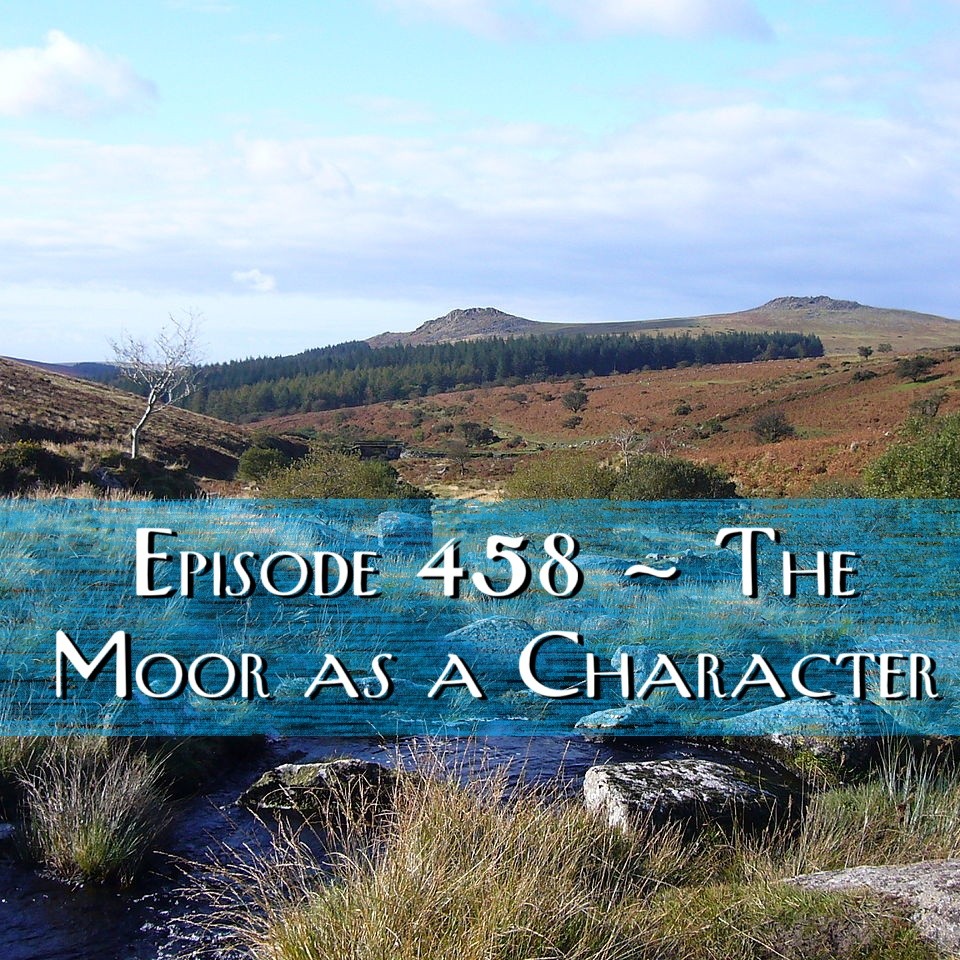
The Moor as a Character
"a huge expanse" [HOUN] Credit: Wikimedia Commons CC BY-SA 4.0 There are four main characters in The Hound of the Baskervilles: Sherlock Holmes, Dr. Watson, the hound, and the moor. [Record scratch SFX] Yes, the moor. Inspired by a clip from an old IHOSE episode, we explore why this ever-present setting looms large in the story, both when it's explicitly mentioned and when it's no
On the Chaldean Influences in Cornish
"traced in the Cornish branch of the great Celtic speech" [DEVI] The Morley-Montgomery Award series rolls on, and this time we've jumped from 1979 (the last award granted, covered in Episode 453) to 1995. Dr. Margaret Nydell turns her philological attention to the Canon. She specifically looks at Sherlock Holmes's intentions in researching the Cornish language, with its roots in Chaldean. H
The Crown Diamond
"What good are you going to get out of your diamond?" [MAZA] We're back in the theater for another Sherlock Holmes story in our series on the Apocrypha of Sherlock Holmes. It seems that Conan Doyle saw great potential in other mediums (not just the seance type, either). The Crown Diamond: An Evening With Sherlock Holmes is clearly a rehash of the short story "The Mazarin Stone." Or was tho
Lhassa & Mecca
"amused myself by visiting Lhassa...looked in at Mecca" [FINA] The Great Hiatus, as the interval between "The Final Problem" and "The Empty House" is known, has inspired a great deal of speculation and interpretation, thanks to Sherlock Holmes's brief and tantalizing account of his time away. Edgar Smith took it on in his famous essay (as referenced in Episode 334), but Don Pollock took ai
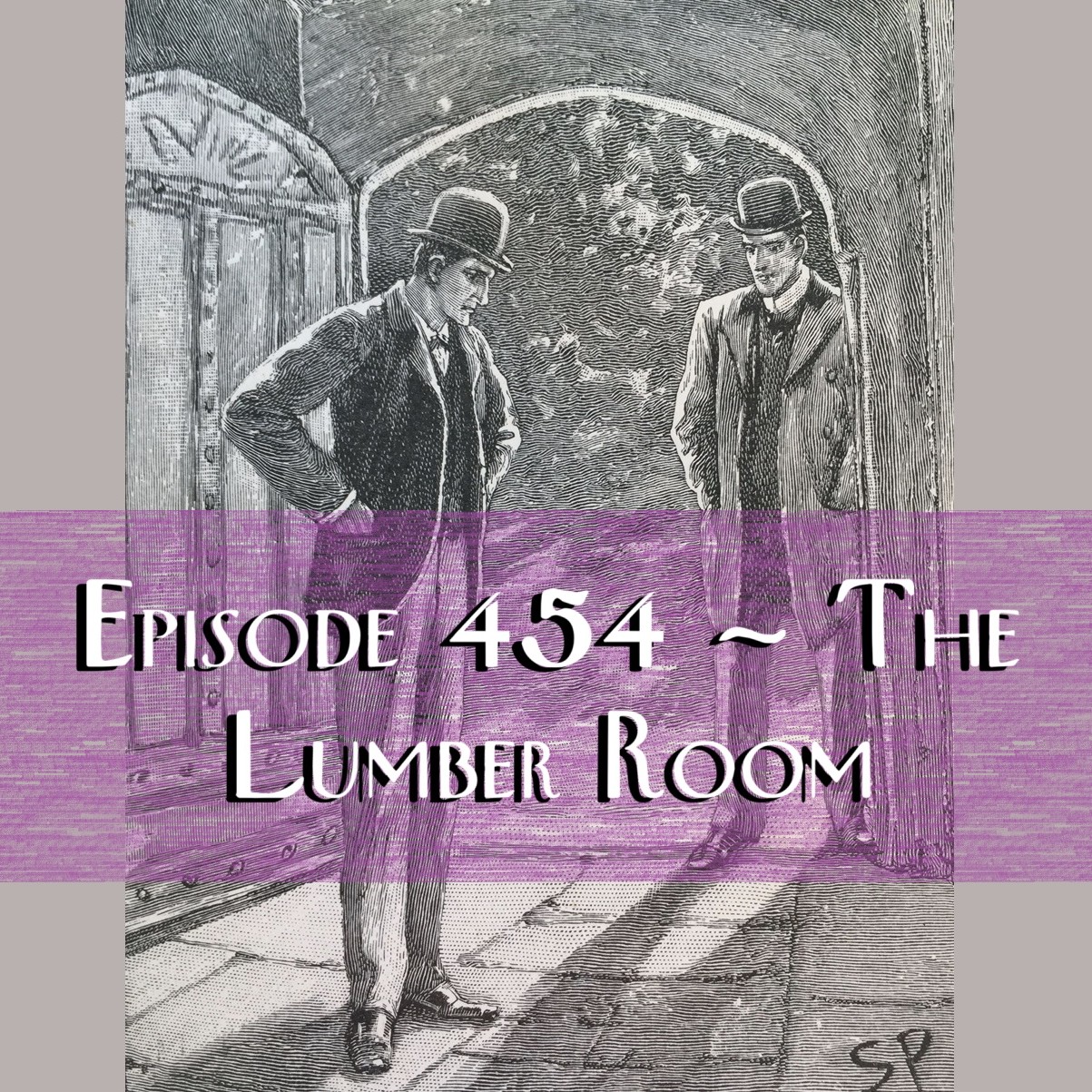
The Lumber Room
"lumbering upon its way" [DEVI] Across the Sherlock Holmes stories, we find a few mentions of what seems to be a strange and magical place in English residences: the lumber room. In old country houses and in the city at 221B Baker Street, as well as in descriptions of the mind, the lumber room is a place that deserves a little exploration. And it's just a Trifle. Thanks to Kaj for the su
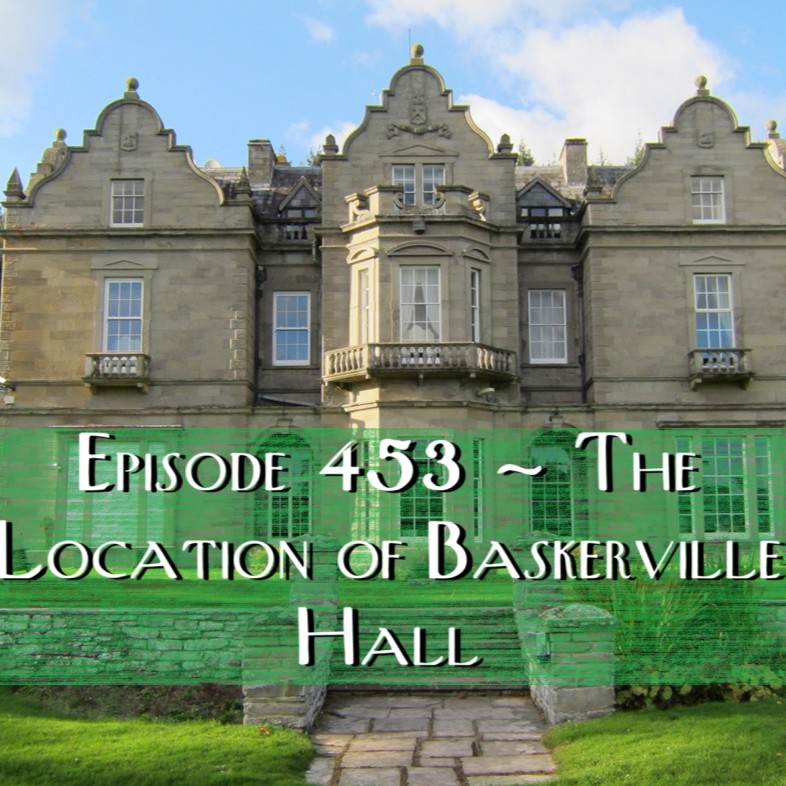
The Location of Baskerville Hall
"I was able to reach Baskerville Hall" [HOUN] There are a handful of locations in the Sherlock Holmes stories that are regularly sought out by fans. Of course 221B Baker Street is at the top of the list, along with the Reichenbach Falls. For those who venture to the west, Baskerville Hall is always a source of inspiration. But where exactly was it? Scholars have been debating that subject
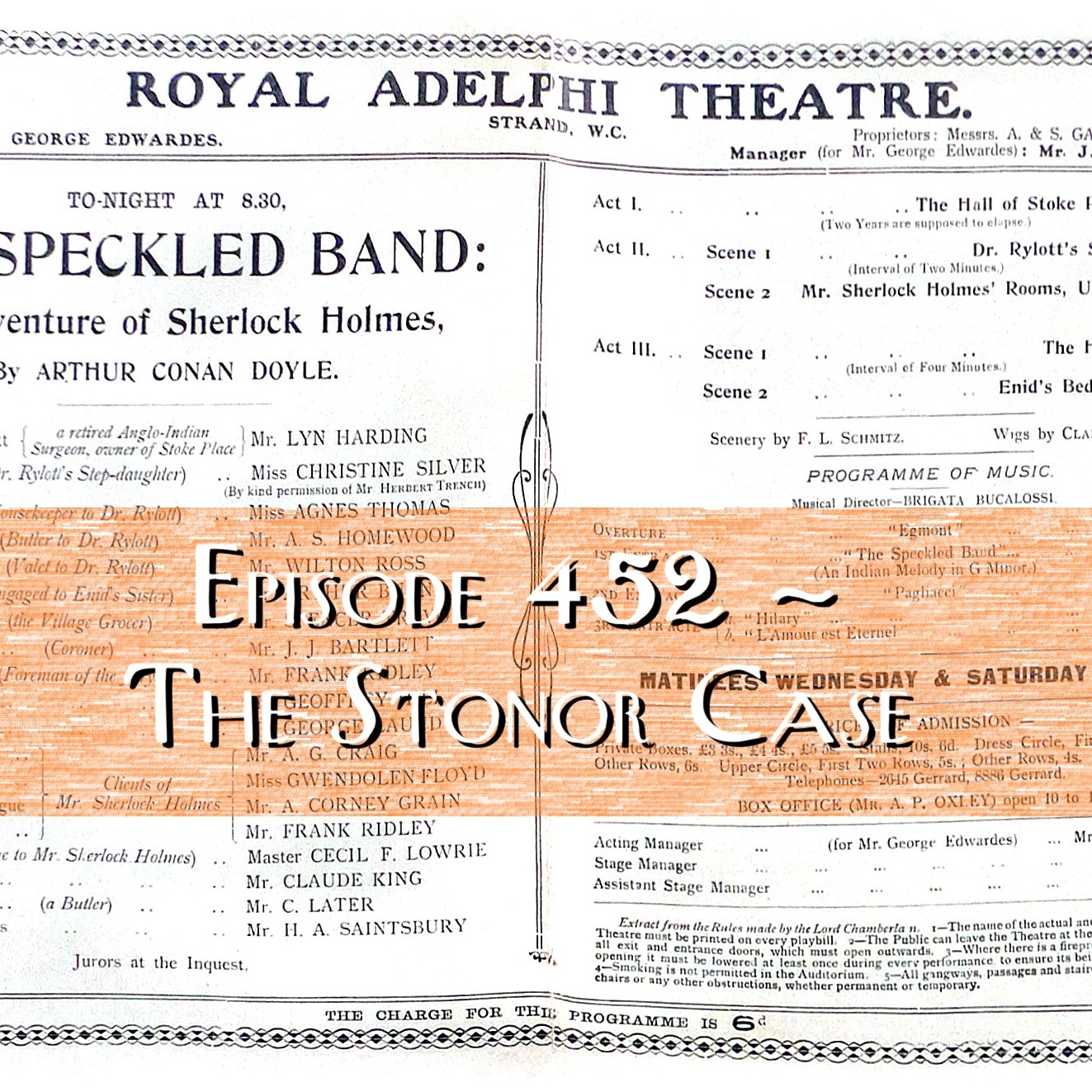
The Stonor Case
"took to the stage" [TWIS] When faced with four months of an empty theater in a six-month lease in 1910, Sir Arthur Conan Doyle did the only thing he could on a moment's notice: he turned to Sherlock Holmes. The Stonor Case (later renamed The Speckled Band) went into production and is considered part of the group of stories categorized as apocryphal. While the name was the same as the short
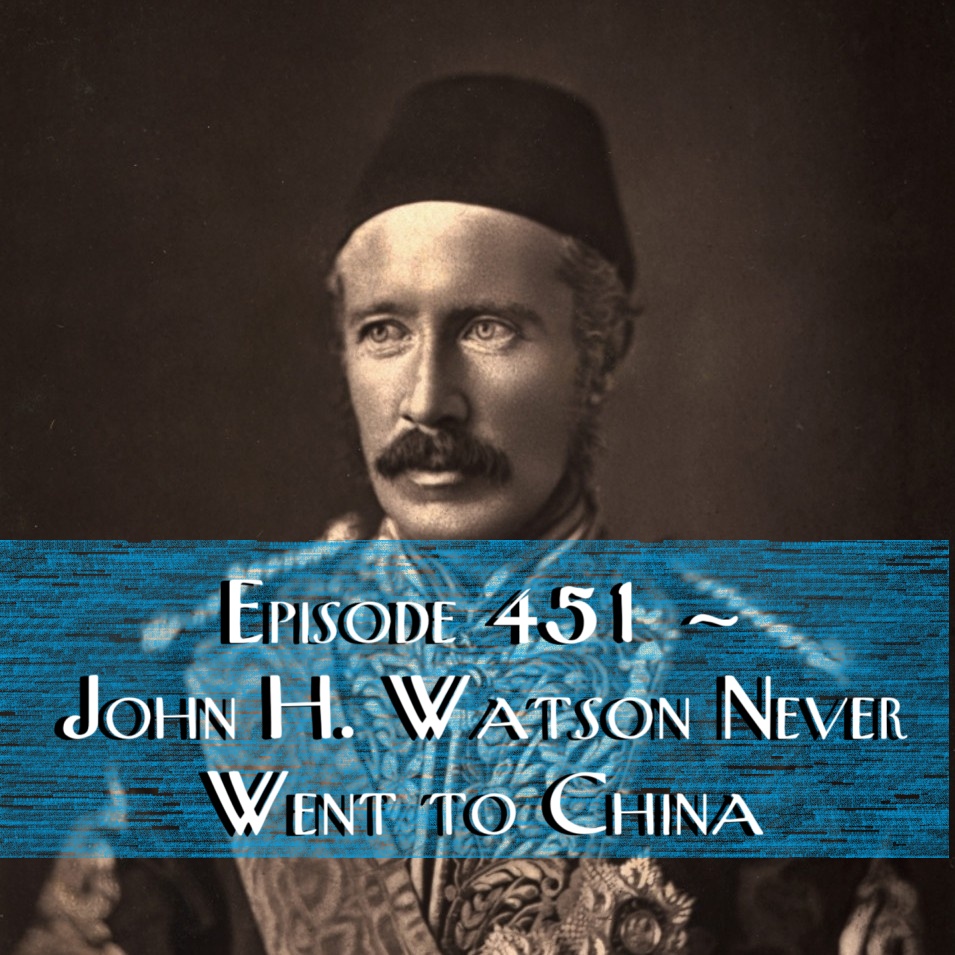
John H. Watson Never Went to China
"Well, but China?" [REDH] Our recent episode about real people who inspired characters in the Sherlock Holmes stories spills over into this episode for our monthly Mr. Sherlock Holmes the Theorist-themed episode. Jay Finley Christ wrote a piece in 1949 that wasn't widely published until 1975 (if one can call the audience of Baker Street Miscellanea wide). Prof. Christ takes on John Dickson
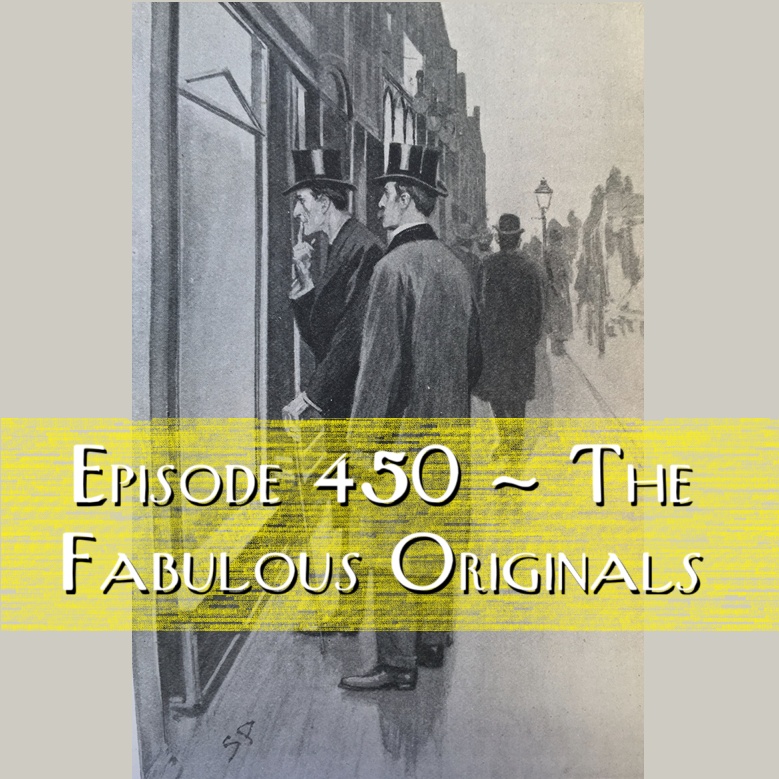
The Fabulous Originals
"There are the originals" [LAST] Sherlockians go to great pains to "play the game," meaning that Sherlock Holmes and Dr. Watson were real. If we can drop the mask for a moment, we all know they were creations of one Arthur Conan Doyle. We also know that every author is inspired by people, names, and places around them. So too was Conan Doyle when he created certain characters. Who were some
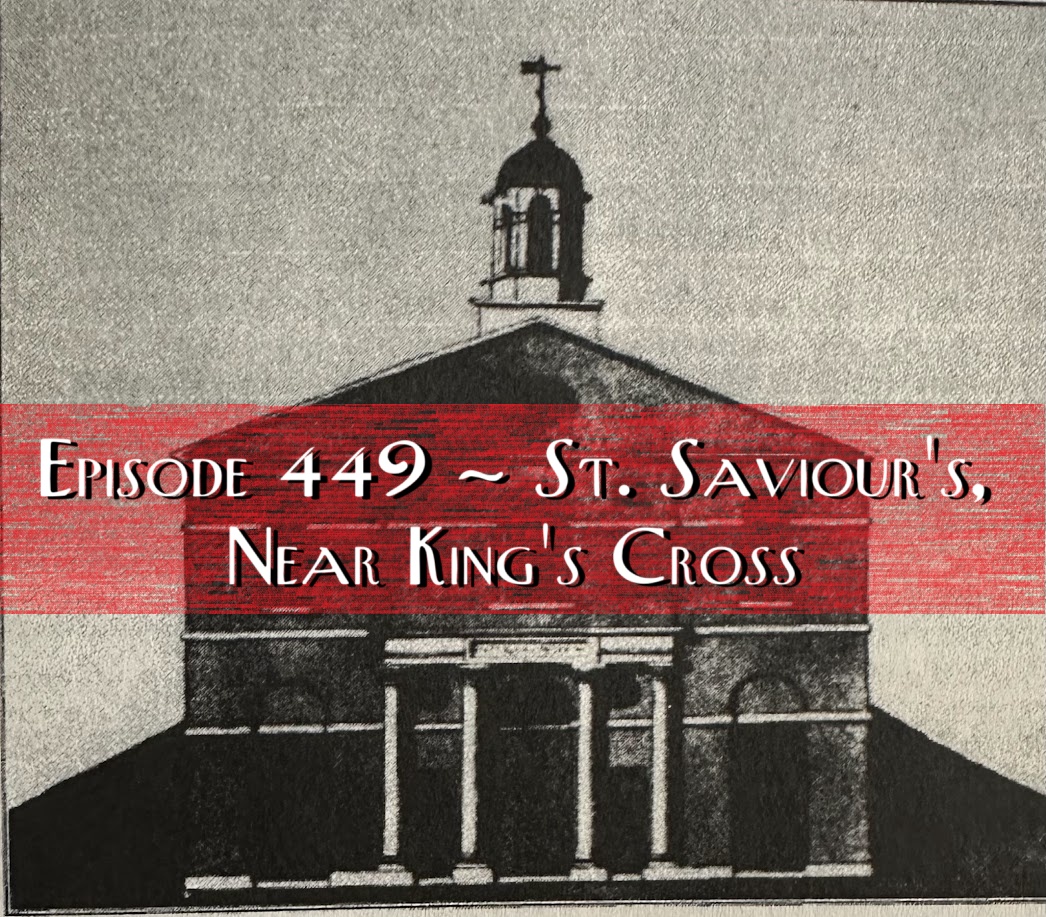
St. Saviour's, Near King's Cross
"entirely mistaken" [CHAS] The Morley-Montgomery Award-winning article we're discussing this month is by the legendary Jack Tracy, author of The Encyclopedia Sherlockiana and founder of Gaslight Publications. "St. Saviour's, Near King's Cross" appeared in Vol. 27, No. 4 of the Baker Street Journal in 1977 and looked specifically at the church where Mary Sutherland was supposed to marry Hosm
The Story of the Lost Special
"engage a special" [FINA] This marks the fourth episode in our series of The Apocrypha of Sherlock Holmes — stories by Sir Arthur Conan Doyle that are technically not part of the original Canon. "The Story of the Lost Special" was written by Conan Doyle in 1898 about a train that has vanished from the face of the earth, but doesn't explicitly include Sherlock Holmes. How does this then tie
Playing Tricks with the Law of England
"play tricks with me and I'll crush you" [ABBE] Was Sherlock Holmes too lenient with how he handled some of the criminals he defeated? There are a number whom he caught and set free, flouting the law in the process. Inspired by a recent article in The Baker Street Journal, we look at examples in a handful of stories and compare the fates of the accused in each. Did they get what they deserve
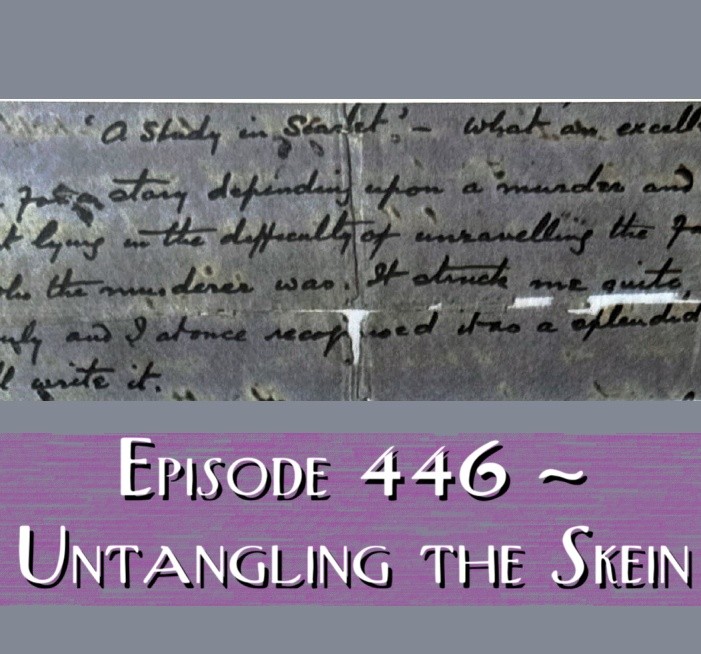
Untangling the Skein
"another thread which I have extricated out of the tangled skein" [HOUN] It has long been accepted that the original title of A Study in Scarlet was meant to be A Tangled Skein. While there is no surviving manuscript of the first Sherlock Holmes story, a single page of notes has long served as Sherlock Holmes's "birth certificate." However, Matt Hall discovered a letter in Sydney, Australia

£100
"put £100 down in front of him" [BLUE] Humans are suckers for round numbers. And 100 seems like a perfectly reasonable one to settle on. It's the first three-digit number (in Arabic numbers, that is; Romans were happy to hit a C note). When it comes to £100 in the Sherlock Holmes stories, it's a figure often associated with some sort of scam — enough to get attention and secure the trust of

John H. Watson―Word-Painter
"I had painted" [TWIS] The Morley-Montgomery Award-winning article we're discussing this month is by H.C. Potter from Vol. 26, No. 2 of The Baker Street Journal. In it, Potter looks at Watson's prosaic way of setting the scene for us. He selects excerpts from a number of stories to prove his case. Was he successful in backing up his claims? It's just a Trifle. If you have a question for us, p
How Watson Learned the Trick
"why should anyone play me such a trick?" [CARD] After a brief hiatus, we're back to the third in our series of The Apocrypha of Sherlock Holmes — stories by Sir Arthur Conan Doyle that are technically not part of the original Canon. This is the shortest of all of the Apocrypha and it was created for the British Royal Family in a special edition. "How Watson Learned the Trick" is a lovely a
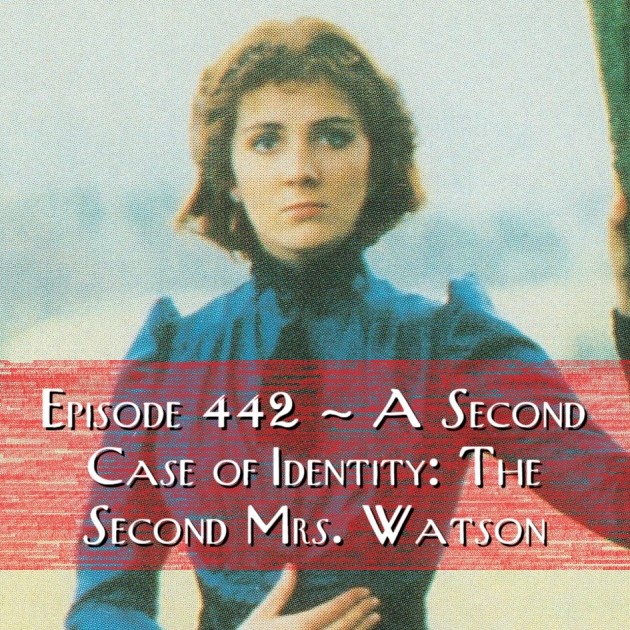
A Second Case of Identity: The Second Mrs. Watson
"Is Mrs. Watson in?" [FINA] We all know Watson had more than one wife; the number has been debated over the years. But it's his second wife that seems to be the most intriguing. In this "Mr. Sherlock Holmes the Theorist" episode, we look at David Hammer's article from Baker Street Miscellanea, No. 43. Who was the second Mrs. Watson? It's just a Trifle. If you have a question for us, pleas

About the Moor
"traces of the ancient people" [HOUN] When Watson noted a "difficult and dangerous quest" on "the forbidden moor" in The Hound of the Baskervilles. The moor played an outsized role in that story, providing the perfect setting for this gothic tale of terror, greed, and mystery. What is the moor really like? How does the Canonical version differ from reality? Listener Nelson Pigeon wrote in to

On the Hound
"What, in heaven's name, was it?" [HOUN] One of the most famous Sherlock Holmes stories, The Hound of the Baskervilles, tells a terrifying story of a dog that most certainly did something in the night-time. But what do we know about the actual canine? In a Morley-Montgomery Award-winning article in 1975, Michael L. Burton dispels myths and narrows down the likely breed. It's just a Trifle.
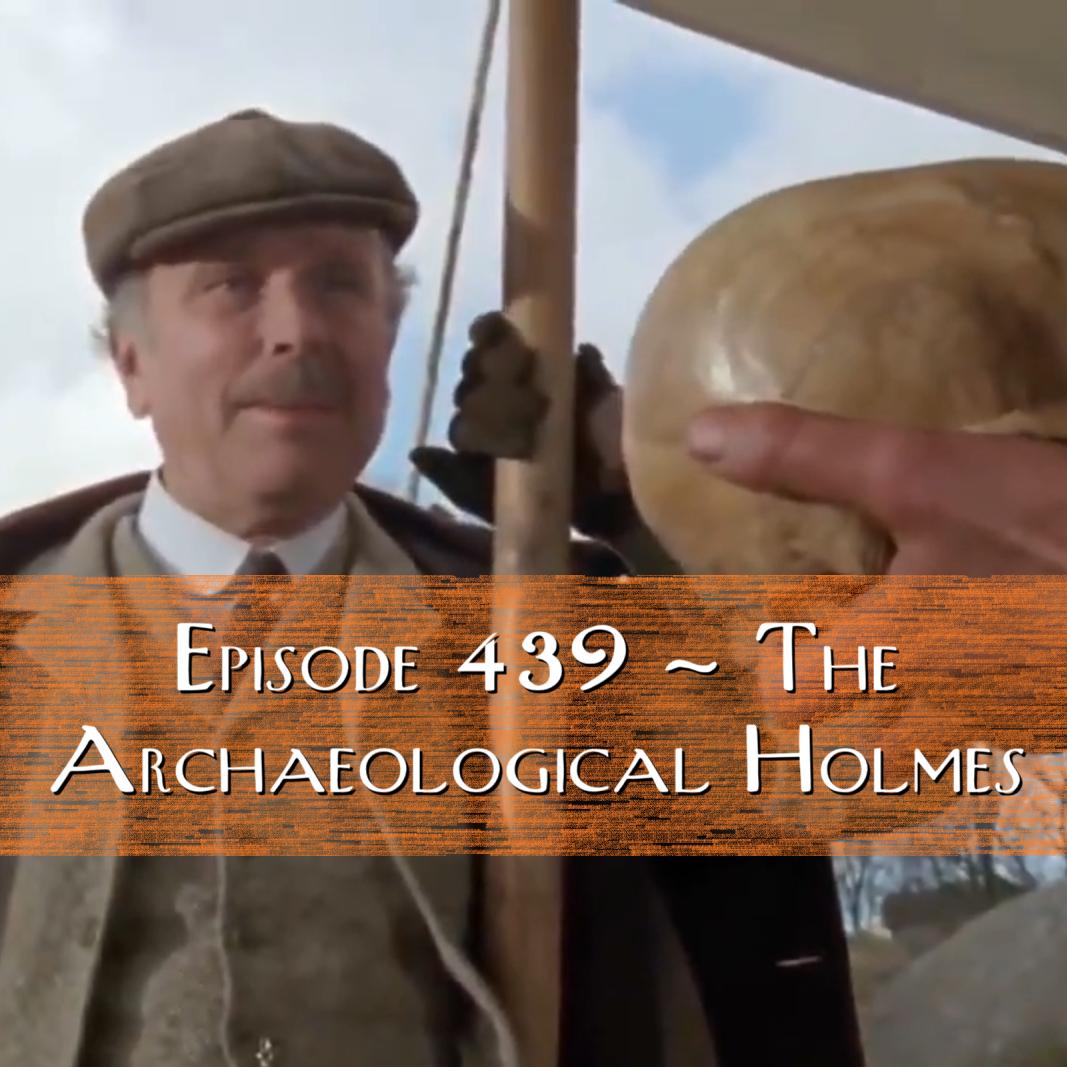
The Archaelogical Holmes
"I am a bit of an archaeologist myself" [3GAR] We find ourselves digging into a reference in "The Devil's Foot" in this episode, with the help of a pair of Sherlockian scholars. Poul and Karen Anderson explore the truth behind Sherlock Holmes's claim to be researching the origins of the ancient Cornish language. Where might the language have originated from? It's just a Trifle. We also continu
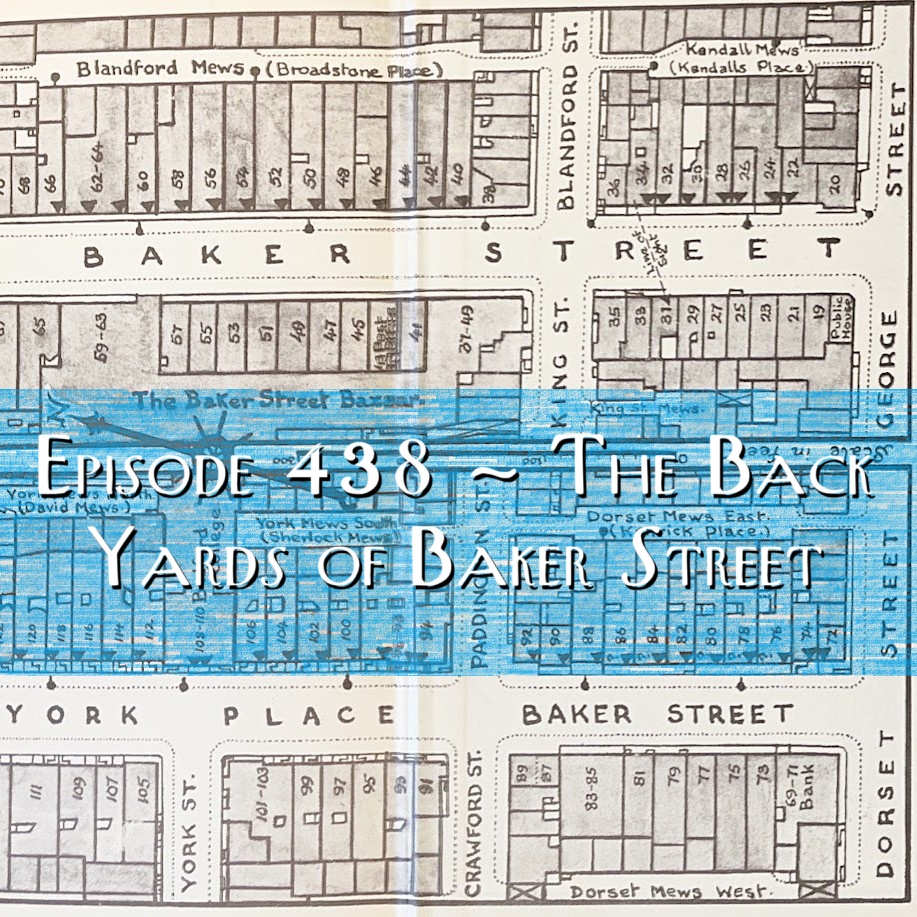
The Back Yards of Baker Street
"I went into the back yard" [BLUE] The third week of the month means we look at a piece of Sherlockian scholarship — particularly one that may not be as widely read or generally available to most Sherlock Holmes fans. This month, we're looking at Bernard Davies' "The Back Yards of Baker Street," which appeared in James Edward Holroyd's Seventeen Steps to 221B. Step with us through the alleyw
Capital Punishment
"You have done your best to get an innocent man hanged." [NORW] Capital punishment in the United Kingdom evolved over a period of time. From the mid-17th century through 1820, the Bloody Code tracked some 200 crimes punishable by death. In which Sherlock Holmes stories do we hear about capital punishment, and under England's laws of the late Victorian period, who would have been eligible for
The Solitary Man-Uscript
"so ardent a bicyclist must be full of energy" [SOLI] The latest installment in our review of Morley-Montgomery Award-winning articles is by Andrew Jay Peck, BSI ("Inspector Baynes"): "The Solitary Man-Uscript" from Vol. 22, No. 2 of The Baker Street Journal in 1972. Just who was the Solitary Cyclist? There are two cyclists in the story, and one is a young lady simply trying to get to her tr
An Aborted Avatar
"a strange, loud whiz" [EMPT] We came across a quite unusual observation — a Trifle, if you will — in an old issue of The Baker Street Journal. An article by Antony Boucher called "An Aborted Avatar." Boucher discovered a turn of the century play called The King of Gee-Whiz that involved Sherlock Holmes in a quite unusual setting. The play was co-written by L. Frank Baum, of The Wizard of Oz

Gypsies
"general resemblance to an itinerant" [VALL] A term we don't hear as frequently these days is "gypsy." Unless you're headed to see a Sondheim musical, which is about an entirely different Gypsy (and one with Sherlockian connections too). Anyway, our focus here is on stories in which gypsies are mentioned (there are two; can you name them?) and a bit of historical context of gypsies in the Vict

On Stage and Off
"before my biographer had come to glorify me" [GREE] Once again, we find ourselves in a "Mr. Sherlock Holmes the theorist"-themed episode, where we look at a piece of old scholarship. This time, we share a chapter from William S. Baring-Gould's groundbreaking biography of Sherlock Holmes. Chapter V "On Stage and Off in England and America: 1879–1881" finds us in the two years leading up to Hol

The Man with the Watches (The Apocrypha Part 2)
"I would read as easily as I do the apocrypha" [VALL] The second in our series on the Apocrypha of Sherlock Holmes — stories that are not in the original Canonical 60 but that have some relevant interest. In this case, we have a story written by Arthur Conan Doyle in 1898 and set in 1892 involving the mysterious death of a passenger on a train. The murderer is nowhere to be found and the man has

The Alleged Use of Cocaine by Mr. Sherlock Holmes
"you are mistaken about my alleged agents" [MAZA] Along with the calabash pipe, deerstalker cap, and Inverness cape, one of Sherlock Holmes's traits is the use of cocaine. But should it be? William H. Miller, M.D. F.A.C.P. won the Morley-Montgomery Award for his article in Vol. 19, No. 3 of The Baker Street Journal in which he asserted that we're mistaken in believing that Sherlock Holme

North American Businesses
"the great North American Continent" [STUD] Picking up where we left off in Episode 428 ("British Businesses"), we're moving to the other side of the pond and doing a survey of businesses in North America that were mentioned in the Sherlock Holmes stories. Since there are decidedly fewer scenes and stories that took place in North America, we have far fewer to choose from. But not so few a