How to Fix Democracy
Since its origins, democracy has been a work in progress. Today, many question its resilience. How to Fix Democracy, a collaboration of the Bertelsmann Foundation and Humanity in Action, explores practical solutions for how to address the increasing threats democracy faces. Host Andrew Keen interviews prominent international thinkers and practitioners of democracy.
Episodes

Eric Liu | How to Live Like a Citizen: Rebuilding Democracy from the Ground Up
What does it mean to be a citizen, not simply in a legal sense, but as an active member of the community? Andrew Keen speaks with Eric Liu, CEO of Citizen University and author of Live Like a Citizen, about what citizenship requires in an era of polarization and declining trust in democratic institutions. Liu argues that resilient democracy depends not only on politics and institutions, but on the

John Ralston Saul | Can "Boring" Save Democracy? Lessons from Canada
What can Canada teach us about building resilient democracies? In this episode of How to Fix Democracy , Andrew Keen speaks with Canadian award-winning essayist and novelist John Ralston Saul about the country's long democratic tradition, the role of dialogue and negotiation in managing differences, and the importance of embracing Canada's complexity. They also discuss Canada's evolving relationsh

R.T. Rybak | Standing Up for Democracy
What makes democracy resilient? Former Minneapolis mayor and current Minneapolis Foundation CEO R.T. Rybak argues that the answer starts at the local level. Drawing on decades of experience in public services, journalism and philantrophy, he explores how civic participation, local leadership, and strong communities can strengthen democracies in times of crisis. From responding to authoritarian pre

Marc Loustau | What Hungary Can Teach Us About Democracy's Resilience
After more than a decade of Viktor Orban's rule, Hungary has entered a new political chapter. In this episode, Andrew Keen speaks with cultural anthropologist Marc Loustau about how Orban built an illiberal state, why his political project ultimately faltered, and what Hungary's experience can teach democracies around the world about resisting authoritarianism. From the role of the European Union

John Kampfner | Democracy Needs Courage: Lessons from the World's Boldest Reformers
Can democracies become more resilient by being bolder? In this episode of How to Fix Democracy, Andrew Keen speaks with journalist, author and foreign affairs commentator John Kampfner about his new book Brave New World. Drawing on research from countries as diverse as Finland, Estonia, Taiwan, Morocco, Canada and Romania, Kampfner argues that democracy's greatest challenge is not a lack of ideas

James Traub | Democratic Resilience Starts in the Classroom
What role do schools play in strengthening democracy? In this episode, award-winning author James Traub argues that civic education remains one of the most important tools for building democratic resilience. From declining attention spans and digital distractions to respectful disagreement and civic engagement, Traub reflects on what he learned from classrooms across America and what it takes to p

Jeffrey Rosen | Hamilton, Jefferson, and the Future of American Democracy
What would the Founding Fathers make of America today? In this episode host Andrew Keen talks with constitutional historian Jeffrey Rosen about the centuries-old struggle between liberty and executive power. From Hamilton and Jefferson to Donald Trump and AI, Rosen traces how America's constitutional system has drifted from the Founders' orginal vision, and why restoring democratic resilience may

Soli Özel | Democratic Resilience or Illusion? Lessons from Turkey
In this episode of How to Fix Democracy, we turn to Turkey to explore what democratic resilience like over the long arc of history. Joined by the political scientist Soli Oezel, the conversation traces more than a century of "bouts of freedom" punctuated by military interventions, constitutional resets, and shifting balances between state authority and popular will. From the late Ottoman period to

Konstanty Gebert | From Solidarity to Uncertainty: Poland's Ongoing Fight for Democracy
Poland's story is often told as a triumph of democracy, but it's far from over. In this episode, author, activist and journalist, Konstanty Gebert reflects on a lifetime spent confronting authoritarianism, from underground activism in the 1970s to the rise of Solidarity and the fall of communism. But victory brought new challenges: how do you transition from unity against oppression to the comprom

Hélène Landemore | Who Owns Democracy? Citizens vs. Elites
As trust in political institutions fades, who really holds power in democracy? Helene Landemore argues that elite decision-making has left democracies less responsive and less resilient. In this episode she joins Andrew Keen to explore how citizen assemblies, broader participation, and new approaches to governance could reshape the future of democratic life.

Maury Giles: Courageous Citizenship — Practicing Resilience in an Age of Outrage
As How to Fix Democracy opens its seventh season on democratic resilience, host Andrew Keen welcomes Maury Giles, the new CEO of Braver Angels, for a candid conversation about whether American democracy can withstand what Giles calls the "industrial outrage complex." In a year marking the nation's 250th anniversary, Giles argues that resilience is not something institutions deliver from above, bu

Richard Edelman | From Polarization to Insularity: Can Trust be Rebuild
For 26 years, Richard Edelman has measured the world's trust levels through the Edelman Trust Barometer. In this final episode of our trust series, he joins Andrew Keen to diagnose a new and troubling phase: insularity. After years of polarization, grievance, and activism, societies are hardening into self-contained camps, "turtles in shells", as Edelman puts it, trusting only those who share thei

Rebuilding Trust: Can We Fix America's Social and Political Fractures? | Featuring Dr. Michael Neblo and Frederick J. Riley
In this episode of How to Fix Democracy, host Andrew Keen explores America's deepening crisis of trust, both social and political. Joined by Frederick Riley of Weave at the Aspen Institute and Dr, Michael Neblo of the Ohio State University, the conversation examines rising isolation, collapsing confidence in institutions, and the growing divide across communities. From neighborhood-level connectio
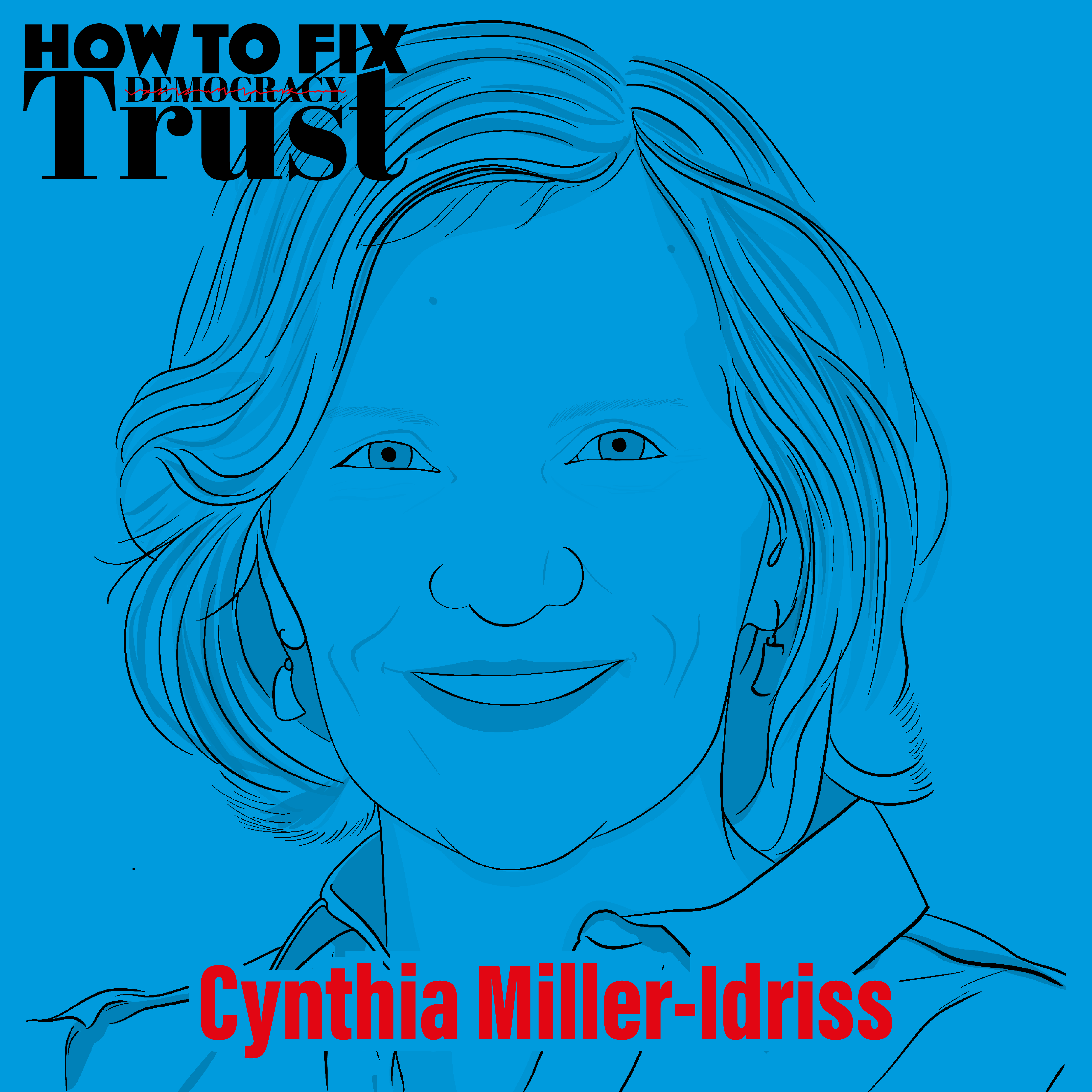
Cynthia Miller - Idriss | How Distrust Fuels Extremism
In this episode of How to Fix Democracy, host Andrew Keen sits down with Cynthia Miller-Idriss - scholar of extremism, founder of the Polarization and Extremism Research and Innovation Lab (PERIL), and author of Man Up: The New Misogyny and the Rise of Violent Extremism. Together they explore one of democracy's most fragile foundations: trust. From gender polarization and the rise of the "manosphe

From FDR to AI: Derek Leebaert on Trust and Democracy
In this episode of How to Fix Democracy, host Andrew Keen speaks with Derek Leebaert - historian, technologist and author of Unlikely Heroes - about the shifting foundations of trust in democracy. From Franklin D. Roosevelt's efforts to rebuild confidence in government during the New Deal era to today's rapid rise of articifical intelligence, Leebaert traces how accelerating technological change h
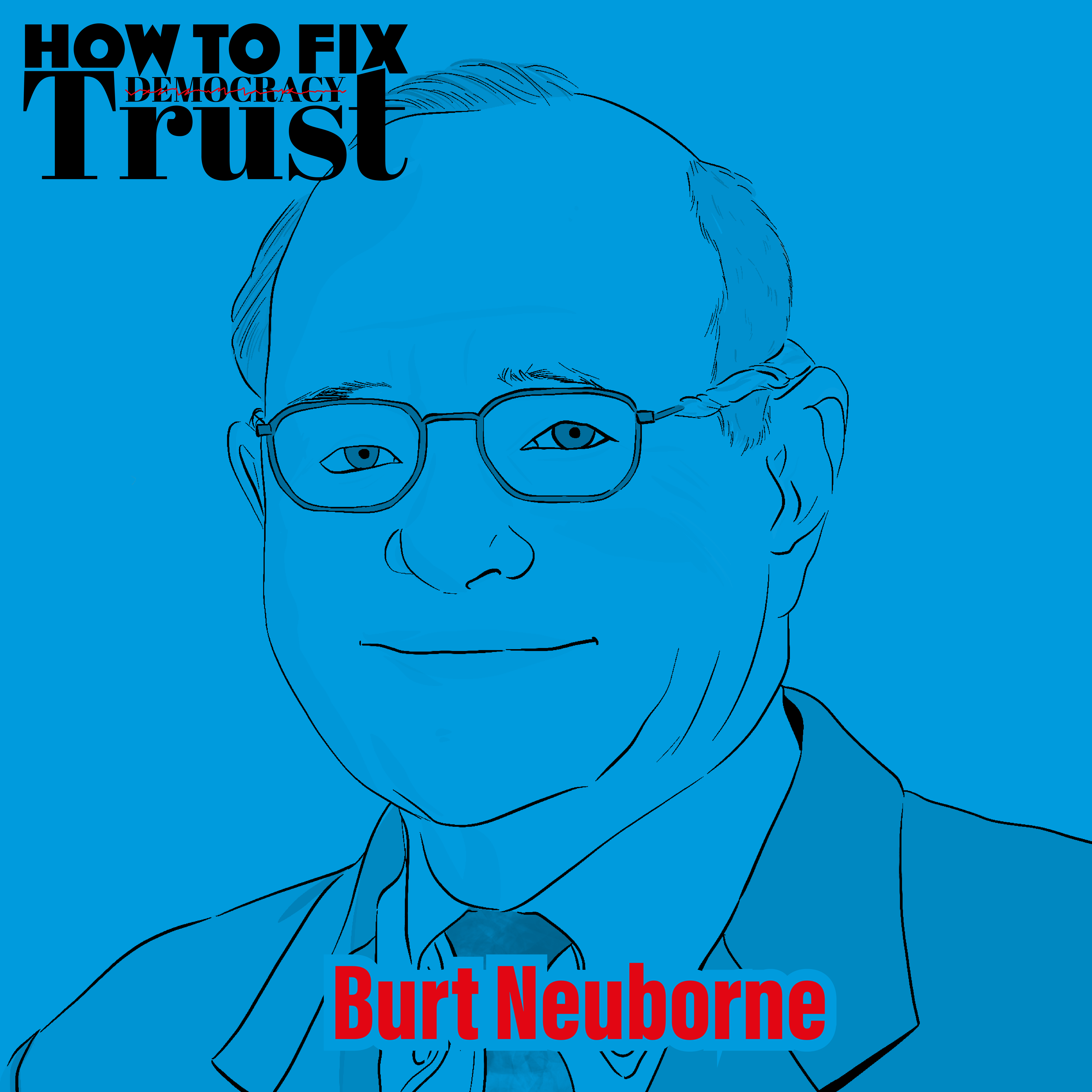
Burt Neuborne | Law, Trust, and the American Constitution
Can democracy survive without trust in the law? In this episode of How to Fix Democracy, host Andrew Keen speaks with Burt Neuborne, founding legal director of the Brennan Center for Justice and professor of law at NYU, about the complex relationship between law and trust in America. From Hobbes and Rousseau to Madison, Lincoln, and the U.S. Constitution itself, Neuborne explores how law can both
Richard Kreitner | Trust, Mistrust, and the Myth of American Unity
Is mistrust a defining feature and flaw in American democracy? Or is it a manifestation of basic opposition against long-term democratic and aspirational concepts such as "all men are created equally"? In this thought provoking conversation author and historian Richard Kreitner joins Andrew Keen to explore the deep mistrust in U.S. political life. Drawing on themes from his book Break it up: Seces

Joan Williams | Outclassed: Rebuilding Trust Between Political Elites and the Working Class
Legal scholar and author Joan Williams joins How to Fix Democracy to unpack the breakdown of trust between political elites and the American working class. Drawing from her new book Outclassed, Williams explores how class-blindness, cultural signaling, and economic inequality have shaped political divides - and what the left must do to win back working class voters. From language to long-term coal
Jonathan Rauch | High Tech and Low Trust - An American Quandary
In this episode Brookings's scholar Jonathan Rauch explores America's historically unprecedented position as a "high-tech, low trust society" - a dangerous combination where technological advancement coexists with collapsing social trust. Trust levels have plummeted since the 1970s warns Rauch, with America now ranking 52nd globally in believing strangers would return a lost wallet. He traces this
Sally Lehrman & The Trust Project
In this episode of How to Fix Democracy, host Andrew Keen, speaks with journalist Sally Lehrman, founder of the Trust Project - a global initiative aimed at restoring trust in journalism. They discuss the origins of the project, inspired in part by the 1947 Hutchins Commission report on media responsibility, and how today's digital landscape has blurred the lines between news and content. Lehrman

Francis Fukuyama on How to Fix Trust
In this episode, host Andrew Keen sits down with Francis Fukuyama to explore the concept of trust. Fukuyama defines it as a byproduct of virtuous behaviors like reliability, truthfulness, transparency, and keeping commitments. He describes trust as a crucial "lubricant" for social interactions and distinguishes between interpersonal and institutional trust, both of which are built through experien

American Democracy|A conversation with Dr. Carol Anderson
Days before the U.S. election, Professor Carol Anderson of Emory University spoke with the three producers of the How to Fix Series about the current state of American democracy. With references to previous interviews, the discussion focuses on the urgency of the times, the criticical issues at stake, the forces of deep conflict and expectations for the future of America's democracy.

Democracy as an Unfinished Project: A Conversation with Congressman Jamie Raskin
In conversation with Congressman Jamie Raskin, host Andrew Keen explores key elements of American democracy. Raskin highlights his deep commitment to public service, grounded in his believe that the rule of law is fundamental to America's greatness. He reflects on the influence of Presidents Reagan, Clinton, Bush, Obama and Trump on their political journeys and how their legacies relate to his vis

From Stability to Upheaval: Yuval Levin on the 1950s Prelude to America's 1960s Revolution | Featuring Yuval Levin
In a conversation with Andrew Keen, Yuval Levin, Director of Social, Cultural, and Constitutional Studies at the American Enterprise Institute, explores the critical transition from the 1950s- a decade often seen as a conservative period of economic prosperity- into the 1960s, a turbulant era marked by confrontations over race, gender, and shifts in the politcal landscape of the Republican and Dem

The Turning Point in American Conservatism | Featuring Matthew Continetti
In this episode, host Andrew Keen and historian Matthew Continetti explore the pivotal moments in the history of American conservatism, starting in 1964. Continetti elaborates on the ideological foundations of American conservatism, emphasizing its roots in the political traditions of the Declaration of Independence and the U.S. Constitution. The conversation delves into the marginalization of con

The Dualities of the American Immigrant Experience: A Reflection on Dreams, Acceptance, and Cultural Tensions from the 1950s to Today | Featuring Ray Suarez
Author and broadcast journalist, Ray Suarez, born into a Puerto Rican family newly settled in New York City in the 1950s, speaks with Andrew Keen about American immigrant experiences in the late 20th and 21st centuries. Extolled as a welcoming democracy built by immigrants, they were both hailed and despaired over - needed for labor and growth but feared for the different cultures they brought to
Democracy and Foreign Policy: Elites, Power, and Accountability in the Cold War Era |Featuring Elizabeth Saunders
Elizabeth Saunders, Professor of Political Science at Columbia University and author of The Insiders' Game: How Elites Make War and Peace, speaks with Andrew Keen about democracy and foreign policy. The conversation focuses on the tension between elites and democracy, power and accountability and domestic priorities and global responsibilities between the 1950s and 1970s. In the era between the Ko
Faith, Politics, and the Rise of Authoritarianism: A Journey Through American Conservatism | Featuring Peter Wehner
In this episode host Andrew Keen sits down with Peter Wehner to discuss the intersection of faith and politics and the rise of the Evangelical movement in the Republican Party. Pete reflects on his early caution of the dangerous intertwining on faith and politics, his concerns about the religious impact on the Republican Party, and the shift towards more authoritarian tendencies within the party.

The Republican Thread: Conservatism in the Twentieth Century | Featuring Jacob Heilbrunn
In conversation with Andrew Keen, the American historian Jacob Heilbrunn, outlines the continuous history of the close association of conservative views and the Republican Party in the early to Mid-Twentieth Century. He describes the party's support of strong anti-immigrant racial differences in the 1920s, hostility to the New Deal, support of the anti-Communist campaign of Senator McCarthy in the
Pursuing Gay Rights in America's Democracy | Featuring James Kirchick
For this episode, host Andrew Keen sits down with James Kirchick, journalist and author of the New York Times bestseller Secret City: the Hidden History of Gay Washington. They discuss the historical exclusion of gay individuals within American democracy, with a particular emphasis on the challenges - from legal persecution to professional exclusion, and social stigmatization, Kirchick and Keen ex

How the Constitution and the Law Can Save American Democracy | Featuring Jeffrey Rosen
In this episode we delve into Jeffrey Rosen's latest work The Pursuit of Happiness. As the President of the National Constitution Center and a Professor of Law at George Washington University, Rosen brings a unique perspective on America's democratic foundations. Through an exploration of classical writers and America's own philosophers and political founders, Rosen and Keen engage in a discussion

Testing American Liberalism in the Cold War Years | Featuring James Traub
Testing American Liberalism in the Cold War Years In this episode journalist and historian James Traub delves into the paradoxical nature of liberalism in the post war years. The continuation of New Deal social and economic reforms charactarized a society of consensus in fulfillment of democratic ideals in the Cold War years. However, the illusory impression was built on the continuiation of Jim C

Challenges to Democracy in the Cold War | Featuring Sarah Snyder
In conversation with Prof. Sarah Snyder, an historian of Cold War international relations, Andrew Keen examines the relationship of democratic goals with the realities of American foreign policy. As the world's great post-war democratic and capitalistic power, the U.S. opposed Russia and China through strategic foreign aid and international interventions - often with non-democratic regimes. Intern
The Democratic Divide in a Post World War II America | Featuring Dr. Carol Anderson
The democratic divide in post WWII: advance abroad, retreat at home. In this episode, Andrew Keen speaks with Dr. Carol Anderson, professor of African American Studies at Emory University. They discuss America in the post World War II years when America emerged as the world's leading democratic country. That claim was belied by the reality of a flawed and unfulfilled democracy at home. Black Amer

American Democracy Transformed | Featuring Kevin Baker
American Democracy Transformed: A Conversation with Kevin Baker on the Interwar Era's Cultural and Political Evolution In this episode, host Andrew Keen discusses with writer and editor, Kevin Baker, the multifaceted changes and growth of American democracy. Significant cultural innovations, technological advancements, and societal shifts occurred between the two World Wars. Baker emphasizes Ameri

Fighting for Equity: African-American struggles in the '20s and '30s | Featuring Jill Watts
Fighting for Equity: African-American struggles in the '20s and '30s. In this episode, host Andrew Keen talks to Jill Watts author of The Black Cabinet, about the untold story of African Americans and politics during the age of Franklin Delano Roosevelt. Jill Watts is an author and a Professor Emeritus of History at California State University San Marcos where she teaches United States social and
Women's Political Rights | Featuring Dr. Allida Black
Women's Political Rights | Dr. Allida Black Allida Black speaks with host Andrew Keen about the history of women in politics and the impact of their noteworthy political and social activism, which dates back a time well before the Women's Right to Vote. Dr. Allida Black is a historian, author, and editor of the Eleanor Roosevelt Papers.

The Hoover Presidency | Featuring Richard Norton Smith
In this episode of How to Fix Democracy, host Andrew Keen engages in a conversation with the author and historian Richard Norton Smith, delving into a discussion about the Hoover presidency and its profound relevance for the United States during a time of upheaval and economic depression. Author and historian Richard Norton Smith enjoys national recognition as an expert on the American presidency.

The Legacy of FDR | Featuring Paul Sparrow
The Legacy of FDR | Paul Sparrow, former Director of the Franklin D. Roosevelt Presidential Library and Museum, speaks with Andrew Keen about the immense challenges and legacies of FDR and his administration. Sparrow maintains that Roosevelt saved American democracy from an existential crisis caused by the Great Depression and the failure of previous administrations to provide for the welfare of t

FDR and the Great Depression | Featuring Derek Leebaert
FDR and the Great Depression | In this episode of How to Fix Democracy, author and historian Derek Leebaert provides a revisionist account of President Franklin Roosevelt and four members of his Cabinet. According to Leebaert, the 1920s were beset by economic distress and labor unrest that culminated in the Great Depression. Supported by Frances Perkins, Harold Ickes, Henry Wallace and Harry Hopki

American Isolationism and the Shifting World Order | Featuring Robert Kagan
American Isolationism and the Shifting World Order in the 1920s and 30s | In this 3rd episode of the season, host Andrew Keen talks to Robert Kagan, the distinguished Brookings Institute scholar of foreign policy, about America's dramatically changing place in the world during the Twenties and Thirties. According to Kagan, at the end of World War I Europe expected American democracy to lead a new

The Scopes Trial and the Fight for the Freedom to Teach | Featuring Edward Larson
The Scopes Trial and the Fight for the Freedom to Teach | In 1924, John Scopes, an instructor in a public school in Dayton, Tennessee, was indicted for violating the Tennessee Butler Act for teaching evolution in a publicly funded school. Strong personalities and strong beliefs clashed in the courthouse as they engrossed and even inflamed the country. Clarence Darrow, America's most famous litigat
American Democracy in the Aftermath of World War I | Featuring Adam Hochschild
American Democracy in the Aftermath of World War I | In the first episode of Season 5, How to Fix Democracy host Andrew Keen sits down with Adam Hochschild, historian, journalist, and award-winning author of "American Midnight: The Great War, a Violent Peace, and Democracy's Forgotten Crisis." Hochschild takes us on a journey to America in the aftermath of World War I – a country divided by labor

How Authoritarian Leaders Wield & Maintain Power | Featuring Moisés Naím
How Authoritarian Leaders Wield & Maintain Power | On October 20, 2022, Moisés Naím joined host Andrew Keen for a live episode of How to Fix Democracy in the Bertelsmann Foundation office in Washington, DC to discuss how authoritarian leaders wield and maintain power in contemporary politics. Author of "The End of Power" (2013) and "The Revenge of Power: How Autocrats are Reinventing Politics in t

The State of American Democracy in the Shadow of January 6th | Featuring Larry Diamond
The State of American Democracy in the Shadow of January 6th Nearly two years on, the January 6th insurrection is still lingering over Washington, DC like a dark cloud. The events leading up to the Capitol insurrection, as well as the attack itself, have signaled a major threat to American democracy. Will the United States be able to recover fully from these events, or is the damage irreparable?

Is Bipartisanship Possible in the United States | Featuring Michael Thorning
Is Bipartisanship Possible in the United States? | The 2020 Presidential Election clarified the need for a unified, authoritative understanding of elections and election systems in the United States. In recent weeks, Democratic legislators have been working to pass the Electoral Count Reform Act to update outdated systems and clarify the role of the Vice President in electoral proceedings. Simulta
The Transformation of the Republican Party | Featuring Dana Milbank
The Transformation of the Republican Party Throughout the last thirty years, the Republican Party in the United States has undergone a great change. How did the party come to adopt such a polarized platform in which white supremacy, conspiracy theories, and authoritarianism are no longer off limits? Washington Post columnist Dana Milbank traces this transformation from Newt Gingrich's Contract wit

Midterm Elections Special | Featuring Rebekah Caruthers
Midterm Elections Special Many Americans are preparing to head to the polls on November 8, 2022 for the US Midterm Elections. Following the elections of 2020, many are worried about the rise of election denial and the growing distrust of electoral systems. Rebekah Caruthers, the Vice President of the Fair Elections Center, advocates for election security, the safety of elections officials, and equ

American Ideologies and Trumpism | Featuring Darrell M. West
American Ideologies and Trumpism "Trumpism'' has emerged as a powerful force in American political ideology since the 2016 election. It is characterized by a philosophy that leans heavily on populism, ultra-nationalism, and religious fundamentalism – all part of the platform that bolstered Former President Donald Trump throughout his administration and beyond. However, if Donald Trump were to disa

The Legitimacy of the U.S. Supreme Court | Featuring Dahlia Lithwick
The legitimacy of the U.S. Supreme Court The popularity of the U.S. Supreme Court has been in sharp decline throughout the last two years. Since the overturning of Roe v. Wade in June of 2022, many Americans, feeling unheard and unseen by the court's decision, have been asking the question, "Why does the Supreme Court have so much power?" Dahlia Lithwick, lawyer and author of Lady Justice, explain

Religion and American Conservatism | Featuring Katherine Stewart
Religion and American Conservatism The American far-right has, in many ways, become inseparable from religious conservatism and fervor. Religious movements and organizations provide the foundation, funding, and voting base of the extreme right in American politics, explains our latest guest. Katherine Stewart, the author of The Power Worshippers: Inside the Dangerous Rise of Religious Nationalism,

The Health of American Democracy | Featuring Cynthia Miller-Idriss
The Health of American Democracy The erosion of democratic values in the United States has led many to refer to American democracy as "sick" and in need of healing. Extremism, disinformation, and civic illiteracy have fueled radical beliefs and led to grave polarization within American society. Cynthia Miller-Idriss, director of the Polarization and Extremism Research Innovation Lab (PERIL), and a

Racial Injustice & Voting Rights in the United States | Featuring Andrea Young
Racial Injustice & Voting Rights in the United States Andrea Young, the executive director of the ACLU in Georgia, is a lifelong advocate of voting and civil rights in the United States. Having participated in the Selma to Montgomery marches with her parents at nine years old, she has dedicated her life to ensuring the protection of civil liberties for marginalized groups in the United States. Geo

Bridging the Partisan Divide | Featuring Mónica Guzmán
Bridging the Partisan Divide What does it mean to engage with someone on the other side of the political aisle? Mónica Guzmán has made it her mission to answer this question and facilitate thoughtful, constructive dialogue between the political left and right in the United States. In her latest book, I Never Thought of It That Way, she explores the ways in which American citizens can move beyond

The Crisis of the American Right | Featuring Peter Wehner and Jonathan Rauch
The Crisis of the American Right Authors Peter Wehner and Jon Rauch recently published a New York Times Opinion piece entitled "What's Happening on the Left is No Excuse for What's Happening on the Right." As conservative researchers, they have a unique position to observe and analyze the recent shifts in the American political right. In the latest episode of How to Fix Democracy, Peter Wehner and

Tocqueville's Take on Democracy | Featuring Cheryl Welch and Arthur Goldhammer
Tocqueville's Take on Democracy Harvard University professors Cheryl Welch and Arthur Goldhammer are world-renowned experts and translators of the work of Alexis de Tocqueville. They kick off Season 4 of How To Fix Democracy by joining host Andrew Keen for a discussion of Tocqueville's famous observational text, "Democracy in America." Our fourth season of the podcast will focus on just that: demo

The Roles of Citizens | Featuring Jon Alexander
The Roles of Citizens Jon Alexander is the founder of The New Citizenship Project and speaks in this interview with host Andrew Keen about the conflict between our roles as citizens and consumers. From the psychology of marketing and the formation of the modern citizen to what a crowdfunded brewery can teach us about restructuring decision-making and profit-driven thinking, this interview helps i

Democracy in Pain | Featuring Patrick Radden Keefe
Democracy in Pain Patrick Radden Keefe is a writer and investigative journalist whose recent book, Empire of Pain, delves into the opioid crisis in the United States. In this interview, co-hosted by Andrew Keen and the John Adams Institute director Tracy Metz, Patrick explains some of the lessons from this story for repairing democracy in America. In many ways, the saga of the opioid crisis refle

Examining Elections | Featuring David van Reybrouck
Examining Elections David van Reybrouck is a Belgian author, historian, archaeologist, and the National Endowment for the Humanities / Hannah Arendt Center Fellow at Bard College in New York. He and Andrew Keen take a multifaceted approach to deliberative democracy and the structural challenges of democratic practices today. Are elections as we know them today indispensable to democracy? Are ther

Innovating Democracy | Featuring Claudia Chwalisz
Innovating Democracy Claudia Chwalisz is the Innovative Citizen Participation Lead at the OECD Directorate for Public Governance. In this interview, she talks with host Andrew Keen about the importance of innovation in democratic governance to shift away from structures that encourage short-term thinking. Deliberative democracy, Chwalisz argues, can help engage citizens in the decision making pro

The State of American Democracy | Featuring Darryl Pinckney
The State of American Democracy American novelist, playwright, and essayist Darryl Pinckney takes host Andrew Keen on a tour d'horizon of the state of American democracy, from the current political discourse to the impact of identity politics, cancel culture, social media, and the role of education in teaching the young generation what it means to be a citizen.

Democracy Delivering Results | Featuring Danilo Türk
Democracy Delivering Results On the occasion of the International Day of Democracy, host Andrew Keen sat down with Danilo Türk, former President of Slovenia and currently President of Club de Madrid for a review of the challenges facing democracies around the world today. The basis of liberal democracy, they discuss, must be reinvented, not just reinterpreted or revived. From electoral systems to

Fostering Collaboration | Featuring Hélène Landemore
Fostering Collaboration Hélène Landemore is Professor of Political Science at Yale University. In this interview, she talks with host Andrew Keen about a wide range of innovations and influences on democracy. They discuss how to engage citizens, from experiments like citizen assemblies to finding ways to increase more regular participation in politics. The answer, Landemore says, could be technol

Non-Western Democracies | Featuring David Stasavage
Non-Western Democracies David Stasavage is the Dean for Social Sciences at New York University, and the author of The Decline and Rise of Democracy. Stasavage and host Andrew Keen go over some non-western examples of early democracies, departing from the lineage of Athenian democracy. From elections, to bureaucracy and conceptions of meritocracy, they discuss the components of democratic governanc

A Political Wilderness? | Featuring DeLesslin "Roo" George-Warren
A Political Wilderness? DeLesslin "Roo" George-Warren is a queer artist, researcher, and organizer from Catawba Indian Nation and a Humanity in Action Landecker Fellow. He talks with host Andrew Keen about Catawba Nation views of property, democracy, and the environment in the search for an indigenous view of the meaning of citizenship. Just as arriving Europeans falsely viewed the North American

Citizenship and July 4th | Featuring Roya Hakakian
Citizenship and July 4th Roya Hakakian is a writer and poet and the author of A Beginner's Guide to America: For the Immigrant and the Curious. Talking just before July 4th, host Andrew Keen speaks with Roya Hakakian about her own experience coming to the U.S. from Iran, the meaning of America's Independence Day, and what we should think about during the holiday.
Voter Suppression | Featuring Dr. Carol Anderson
On June 1st, 2021, we hosted a live session of How to Fix Democracy with Dr. Carol Anderson, Charles Howard Candler Professor of African American Studies at Emory University, to discuss recent voter suppression measures in the United States and her new book, The Second: Race and Guns in a Fatally Unequal America.

Digital Democracy and Citizen Engagement | Featuring Wietse Van Ransbeeck
Digital Democracy and Citizen Engagement Wietse Van Ransbeeck is the Co-Founder and CEO of the Citizen Lab, a Brussels-based company that works with governments to enable public participation in decision-making. With host Andrew Keen, Van Ransbeeck discusses his goals to make citizenship easier by using new technology to help local democracy be more participatory. In many past How to Fix Democracy

Democracy Through the Camera Lens | Featuring Astra Taylor
Democracy Through the Camera Lens Astra Taylor is an author and filmmaker whose documentary What is Democracy? covers much of the same ground as our own series, but with a different essential question in mind. In this interview, Astra Taylor and host Andrew Keen reflect on what they drew from ancient Athenian democratic practices in their respective quests to understand democracy and predict what

Citizen Power | Featuring Eric Liu
Citizen Power Eric Liu is the co-founder and CEO of Citizen University and the Director of the Aspen Institute's Citizenship and American Identity Program. In this episode that delves into the meaning of citizenship and the nature of power in politics, Liu and host Andrew Keen discuss contemporary conceptions of power in the United States and responsibilities of citizens. There is a tension, espe

What is Global Citizenship | Featuring Nanjala Nyabola
What is Global Citizenship? | Nanjala Nyabola is a writer, political analyst, and activist based in Nairobi, Kenya. In this interview, she talks with host Andrew Keen about the meaning of citizenship especially in relation to global citizenship. If citizenship is related to rights and freedoms in a country, she says, global citizenship means enjoying similar rights and freedom around the world. In

Devil's Curse of Migration | Featuring Abdul-Rehman Malik
Devil's Curse of Migration Abdul-Rehman Malik is a journalist, community organizer, and Associate Research Scholar and Lecturer in Islamic Studies at Yale Divinity School. Malik and host Andrew Keen address the contradictions of belonging and inclusion. Migrants, they discuss, face these contradictions constantly, seeking belonging in their new homes, but not excluding their own multifaceted iden

Democracy, Citizenship, and Dystopian Fiction | Featuring Margaret Atwood
Democracy, Citizenship, and Dystopian Fiction Margaret Atwood is an award-winning author, who has written numerous best-sellers including the 1985 novel The Handmaid's Tale. In this episode, she discusses with Andrew Keen her impressions of citizenship and the importance of fiction writers in a democracy. Dystopias, Atwood says, show us the future if we do not correct the mistakes of the present,
Can America Lead Again? | Featuring Tom Malinowski
Can America Lead Again? Tom Malinowski is the U.S. representative for New Jersey's 7th congressional district and was formerly the Assistant Secretary of State for Democracy, Human Rights, and Labor in the Obama administration. He and host Andrew Keen discuss the stature of American democracy today in light of the Biden administration's proposed global Summit for Democracy. Representative Malinows

Smart Cities, Smart Citizens? | Featuring Bianca Wylie
Smart Cities, Smart Citizens? Bianca Wylie is co-founder of Digital Public, co-founder of Tech Reset Canada, and Senior Fellow at the Centre for International Governance Innovation. In this episode, she discusses with Andrew Keen the architecture and geography of citizenship from our countries and cities to cyberspace. She argues that digital technology has blurred the lines between public and pr

Active, Equal, and Collective | Featuring Richard Bellamy
Active, Equal, and Collective Richard Bellamy is Professor of Political Science at University College London and the author of Citizenship: A Very Short Introduction. For him, being a citizen today is being an "active and equal participant in sustaining cooperative and collective goods in your political community." However, the current idea of citizenship contains paradoxes, faces challenges, and

Citizenship and Belonging | Featuring Adrienne Clarkson
Citizenship and Belonging Adrienne Clarkson is the co-founder of the Institute for Canadian Citizenship and the former Governor General of Canada. Madame Clarkson tells host Andrew Keen her story of coming to Canada, learning what it was to be Canadian, and her journey to becoming Governor General of the country. Along the way, she formed important ideas of what citizenship and belonging means in

The Contradictions of Human Nature | Featuring Adam Hochschild
The Contradictions of Human Nature Adam Hochschild is an award-winning author, historian, and journalist. In this interview, hosted by Andrew Keen, he discusses the contradictions within the history of democracy in Europe and America. Hochschild points out that capability of democracies to wage war, torture, and enslave people abroad, while aspiring to uphold enlightened values at home. Beyond hi
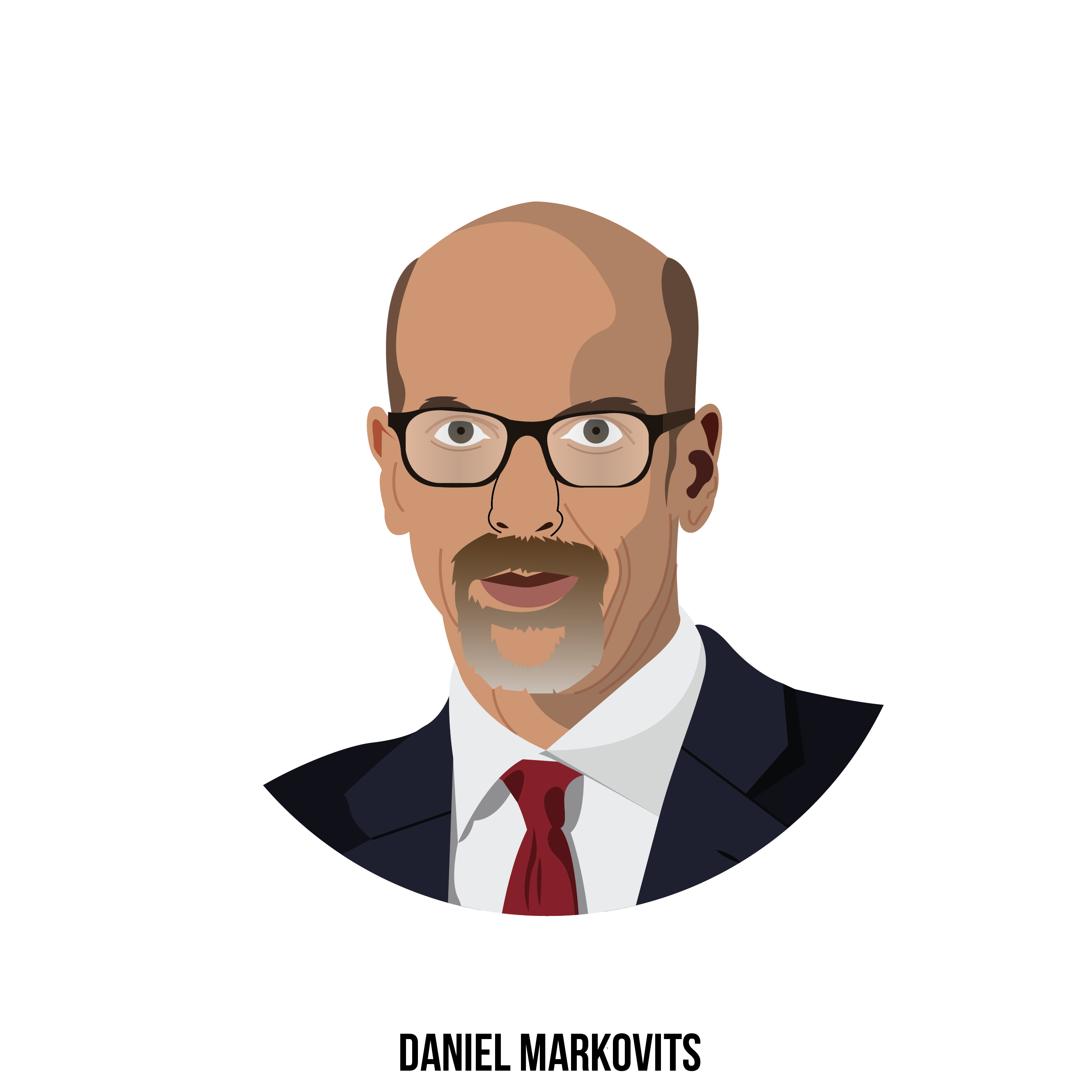
Human Capital-ism | Featuring Daniel Markovits
Human Capital-ism Daniel Markovits is Guido Calabresi Professor of Law at Yale Law School. In this interview with Andrew Keen, he explains how the accumulation of human capital--the skills and education that enable advanced economies--has been captured by the elites. But, he argues, because these skilled workers in fields like law and finance are also laborers, they find themselves alienated in th

No Nostalgia | Featuring Jan Sowa
No Nostalgia Jan Sowa is an Associate Professor at the Academy of Fine Arts in Warsaw, Poland. In this interview, he explains the Marxist view of capitalism as more than an economic system. The social and cultural aspects of a capitalist system are just as important and have shaped democracy in the modern era. In Sowa's view, democracy must continue to develop beyond its current structures and pr