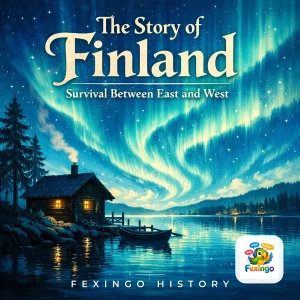
The Story of Finland: Survival Between East and West — Fexingo History
This podcast explores Finland's history as a small nation surviving between East and West, from Swedish rule and Russian Grand Duchy to the Winter War and post-war 'Finlandization.' Hosts Lucas and Luna guide listeners through key events like the Continuation War and the Lapland War, as well as cultural elements such as sauna, design, and language struggle. It highlights how Finland transformed from a poor region into a happy, technologically advanced nation.
Episodes

The Finnish Icebreakers: Surviving the Winter Sea
While previous episodes have covered Finland’s fierce military history and its cultural soul, we turn to a quieter but vital force: the icebreaker fleet. This episode explores how Finland transformed from a timber-dependent nation into a global leader in polar navigation technology. We examine the story of the SS Sisu, launched in 1939, which became the world’s most powerful icebreaker for decades
The Lapland War: Finland's Forgotten Betrayal
While the Winter War and Continuation War dominate popular memory, the final chapter of Finland’s involvement in World War II remains a shadowy, controversial footnote. In Episode 261, we explore the Lapland War (Lapin sota) of 1944–1945, a conflict where Finnish forces were ordered to expel their former German allies from northern soil. This episode examines the strategic necessity behind Preside
Finland's Great Famine of 1866-68 and the Rise of Nationalism
While we often think of Finland’s history as a series of wars, the true crisis that forged modern Finnish identity was not military, but ecological. In this episode, Lucas and Luna explore the Great Famine of 1866–1868, a disaster so severe it killed nearly ten percent of the population. We look at how the potato blight, combined with rigid Russian imperial policies and local harvest failures, cre
Finland's Iron Age Trade and the Rus Connection
This episode explores Finland’s deep ties to early medieval trade networks, focusing on the Salme ship burials in Estonia and the Viking-era connections across the Gulf of Finland. Lucas and Luna discuss how these archaeological finds reveal a shared maritime culture between Finland, Sweden, and the emerging Rus principalities. They examine the role of Tavastia and Karelia as crucial intermediarie
The Finnish Winter Palace: A Tsar’s Forgotten Summer Home
While Helsinki’s neoclassical grandeur often steals the spotlight, there was another imperial capital built for a different season. In this episode, we travel to Viipuri—Vyborg—to explore the Winter Palace of the Russian Tsars, a sprawling estate designed not for winter’s chill, but for the humid heat of summer retreats. We’ll meet the architects like Carl Ludwig Engel and later figures who shaped
Finland's Invisible Front: The Kivikari Incident
In the tense years following World War II, Finland navigated a precarious path between Soviet demands and Western sovereignty. While the Paasikivi-Kekkonen line is well known, fewer stories highlight the explosive moments that tested this diplomacy. This episode explores the 1948 Kivikari incident, where Finnish coast guard forces fired on Soviet naval vessels near the Åland Islands, nearly trigge
The Winter of Suffering: Finland's 1771-72 Famine
In this episode of The Story of Finland, we turn away from the wars and political independence to explore a quieter, more devastating crisis: the Great Famine of 1771. While earlier episodes covered the Great Hunger of 1867 and the Lapland War, this story focuses on the catastrophic crop failures that struck in the late 18th century, killing roughly one-fifth of the population. Lucas and Luna disc
The Silent War: Finland's Shadow Conflict
While the Winter War and Continuation War dominate historical memory, a quieter, more insidious struggle unfolded across Finnish soil during the early Cold War. This episode explores the phenomenon of 'Finlandization'—not as a surrender, but as a complex survival strategy employed by a small nation squeezed between Soviet hegemony and Western capitalism. We trace the origins of this policy to Pres
The Winter War's Forgotten Heroes: The Lotta Svärd
While the Winter War is often remembered for the bravery of soldiers at the Raate Road and the strategic genius of C.G.E. Mannerheim, a quiet revolution was happening in the rear. This episode explores the Lotta Svärd, a massive women’s auxiliary organization that became indispensable to Finland’s survival against the Soviet Union. We examine how these women managed logistics, communications, and
The Battle of Lemland: Finland's Last Stand
In Episode 253, we step away from the grand political maneuvering of Helsinki and the frozen forests of Karelia to look at a pivotal, often overlooked moment in 1918. As the Russian Empire collapsed, the Swedish island of Lemland stood as a microcosm of the civil war tearing Finland apart. We explore the short but intense conflict between the local pro-Swedish militia and the Finnish Whites, exami
Finland's Frozen Front: The Battle of Raate Road
In this episode, we travel back to the winter of 1939 to examine one of the Soviet Union's most disastrous military failures during the Winter War. While the world focused on the siege of Tali-Ihantala or the political maneuvering of the Paasikivi line, a different kind of war was being fought in the dense forests of eastern Finland. We explore the Battle of Raate Road, where the Finnish 64th Infa
Finland's Hidden Forest Wars: The Partisans Who Defied Stalin
While the world knows Finland for its Winter War and diplomatic tightrope during the Cold War, a darker, more desperate chapter unfolded in the forests of Finnish Lapland. This episode explores the Karjalan partaasiit, or Karelian partisans, who launched cross-border raids into Soviet territory between 1941 and 1944. These were not regular soldiers but displaced civilians and former fighters from
Finland's Great Fire of 1827 and the City Reborn
On September 4, 1827, a catastrophic fire consumed most of Helsinki, destroying thousands of homes and forcing a complete redesign of the capital. This episode explores how Governor-General Gustaf Mauritz Armfelt and architect Carl Ludvig Engel transformed this disaster into an opportunity to build a neoclassical city that still defines Finland today. We trace the immediate chaos of the flames, th
The Night of the Long Knives in Finland
While historians often focus on Finland’s diplomatic tightrope during the Cold War, this episode uncovers a darker, more intimate chapter: the 1975 Helsinki Summit and the internal political earthquake it triggered. We explore how President Urho Kekkonen’s careful orchestration of the Conference on Security and Co-operation in Europe (CSCE) was perceived not just as foreign policy, but as a profou
The Man Who Saved Helsinki from the Gulag
In 1950, Finnish President Juho Kusti Paasikivi faced an impossible ultimatum: extradite a group of former SS volunteers to the Soviet Union or risk total war. This episode explores the secret diplomatic maneuvering that saved these men, known as the Salpalinja fighters, from execution in Siberian labor camps. We trace how Paasikivi and his inner circle navigated the YYA treaty constraints, using
Aino and Jean: The Secret Life of Sibelius's Wife
While Jean Sibelius is globally celebrated as the voice of Finnish nationalism, his wife Aino Sibelius has long been overshadowed by her husband’s towering shadow. This episode explores the complex, often difficult partnership between two artistic giants in early 20th-century Finland. We look at how Aino managed the household, supported Jean’s creative process, and navigated the pressures of publi
Finland's Iron Age Trade Routes and Viking Connections
Long before the Winter War or the Paasikivi Line, Finland was a vital crossroads of Bronze and Iron Age trade. In this episode, we explore how the Gulf of Finland served as a bridge between the Baltic tribes and the Rus principalities to the east. We meet Salme, a young warrior buried in 600 CE whose sword reveals connections to Sweden, and examine the archaeological evidence of amber, silver, and
Sibelius Hall and the Birth of Finnish Modernism
Long before Helsinki became a global design capital, Finland was negotiating its cultural identity in the shadow of the Russian Empire. This episode explores the architectural revolution of the early twentieth century, focusing on Eliel Saarinen’s visionary entry for the Chicago Tribune competition and how that global fame helped cement Finland’s place in modernism. We trace the journey from the r
The Winter Queen: How Finland's First Female Prime Minister Survived
Episode 244 turns to the post-war era of the 1950s, focusing on a figure often overshadowed by Mannerheim and Paasikivi: Urho Kekkonen’s predecessor as Prime Minister, Gro Lili Lili Lehtinen. While most histories of Finlandization highlight the male-dominated corridors of power in Helsinki, this episode explores the political maneuvering of the first woman to hold the office in independent Finland
The 1906 Parliament: How Finland Gave Women the Vote First
While the world watched empires crumble in the early twentieth century, a quiet revolution was taking root in Helsinki that would reshape gender equality forever. This episode explores the pivotal year of 1906, when Finland’s Diet transformed from an estate-based assembly into the world’s first fully democratic parliament. We examine how Russian pressure and Finnish political strategy converged to
The Finnish Sauna: Ritual, History, and Identity
We often think of the sauna as a place for relaxation or health, but in Finland, it has been a site of profound historical significance, from birth and death rituals to political negotiations. This episode explores how the stove room became the heart of Finnish society, transcending class and gender boundaries that existed elsewhere in Europe. We look at the specific practices of the savusauna, th
Finland's Secret Winter War: The Battle of Tornio
While the world remembers the brutal clashes on the Mannerheim Line and the scorched-earth tactics of Lapland, a quieter but equally desperate struggle unfolded in northern Finland during the winter of 1944. This episode explores the Battle of Tornio, where Finnish forces fought to expel retreating German troops from the port city without triggering a full-scale invasion by the Soviet Union. We ex
Finland's Iron Age Trade Routes and Viking Connections
While much of Finland’s history is defined by the wars of the twentieth century, its story stretches back over a thousand years to the iron age and the early medieval period. This episode explores how Finnish communities were integrated into broader European networks long before modern borders existed. We look at the significance of the Salme ship burial in Estonia, which revealed warriors from th
Finland's Forest Economy: Post-War Timber Boom
While the Winter War and Continuation War dominate the narrative of Finnish survival, a quieter, equally vital struggle unfolded in the nation’s vast woodlands. After the devastation of Lapin sota and the heavy reparations demanded by the Moscow Armistice, Finland faced economic collapse. This episode explores how the country leveraged its natural resources to rebuild, focusing on the timber trade
Finland's Arctic Survival: The Lapland War
Most history books gloss over the final months of World War II in Northern Europe, but for Finland, the Lapin sota was a brutal and necessary severing of ties with Nazi Germany. In this episode, we explore the scorched-earth policy that turned Rovaniemi into ash and how Finnish soldiers, many of whom had previously fought alongside German forces against the Soviet Union, were ordered to drive thei
The Great Hunger of 1867: Finland's Silent Crisis
While we often trace Finland’s path through wars and treaties, the summer of 1867 was defined by a different kind of survival. This episode explores the Great Hunger that struck Southern Finland, a catastrophe born from three consecutive failed harvests in the late 1860s. We examine how the rigid Russian administrative structures struggled to respond to the crisis, leading to widespread famine and
Eino Leino: The Poet Who Woke Finnish Identity
We explore the turbulent life of Eino Leino, the poet whose work helped define modern Finnish culture during the late 19th and early 20th centuries. Moving beyond his famous verses in Kalevalan meter, we look at how he navigated the tension between Swedish-speaking elites and the rising Finnish language movement. You will hear about his radical political views, his controversial personal life, and
Eino Leino: The Poet Who Woke Finnish Identity
While Finland’s political independence was forged in the fires of the Winter War and secured through the Paasikivi-Kekkonen line, its soul was awakened decades earlier by a turbulent poet named Eino Leino. In this episode, we step away from the treaties and battlefields to explore the cultural awakening of the late 19th century, where literature became as potent as any weapon against Russian Imper
Finland's Cold War Tightrope: Survival Between East and West
While earlier episodes covered the bloodshed of the Winter War and the political maneuvering of the early republic, this episode explores the delicate art of neutrality that defined Finland from 1948 to 1955. We examine how President Juho Kusti Paasikivi and later Urho Kekkonen navigated the YYA Treaty with the Soviet Union, avoiding direct confrontation while maintaining democratic sovereignty. T
Aino Sibelius: The Woman Who Shaped Finland's Soul
While Jean Sibelius is a global icon of Finnish nationalism, his wife Aino Sibelius remains largely in the shadows. This episode explores how Aino was far more than a supportive spouse; she was a critical editor, a fierce business manager, and an intellectual partner who actively shaped the composer’s legacy. We look at her early life in Åbo, her marriage to Jean in 1897, and her crucial role in r
Finland's WWII Survival: The Paasikivi Line Explained
While the Winter War and Continuation War dominate popular memory, Finland’s true victory lay in the diplomatic quiet that followed. This episode explores the Paasikivi-Kekkonen line, a survival strategy forged by President Juho Kusti Paasikivi and later refined by Urho Kekkonen. After signing the 1948 YYA Treaty with the Soviet Union, Finland navigated the razor-thin path between East and West, a
The Finnish Winter War's Secret Rescue
While the world focused on the front lines of the 1939–1940 Winter War, a quiet, desperate humanitarian effort was unfolding in the snow-covered forests of Karelia. This episode explores the fate of the Jewish refugees who fled Soviet persecution only to find themselves trapped by the sudden outbreak of war between Finland and the USSR. We examine how Finnish authorities, caught between internatio
The Winter War's Secret Peace: Mannerheim's Silent Negotiations
We often think of the Winter War as a purely military story, but behind the frozen front lines of 1939 and 1940, a quiet diplomatic struggle was unfolding in Helsinki. This episode explores how President Risto Ryti and Marshal Carl Gustaf Emil Mannerheim navigated the impossible gap between Soviet demands for territory and Finland’s refusal to surrender its sovereignty. We look at the secret conta
Finland's Forest Economy: Post-War Timber Boom
This episode explores how Finland rebuilt its shattered economy after World War II through the massive timber industry. We look at the Paasikivi-Kekkonen line of diplomacy that secured peace, allowing Finnish loggers and sawmills to flourish in the post-war years. Lucas and Luna discuss the physical labor of forestry, the rise of companies like UPM and Stora Enso, and how wood exports funded natio
Finland's Post-War Forests: The Timber Trade That Built a Nation
After the devastation of the Continuation War and the Lapland War, Finland faced a stark reality: its industrial base was shattered, its territories lost, and its treasury empty. Yet, in the late 1940s and early 1950s, an unlikely engine of recovery emerged from the northern woods. This episode explores how Finland leveraged its vast forest resources to navigate the precarious geopolitical tightro
The Paasikivi Line: Finland's Survival Strategy
After surviving the Winter War and the Continuation War, Finland faced an impossible geopolitical tightrope in the late 1940s. This episode explores how President Juho Kusti Paasikivi crafted a foreign policy known as the Paasikivi-Kekkonen line to maintain independence between the Soviet Union and the West. We examine the 1948 YYA treaty, the delicate diplomacy of J.H. Kivimäki, and the internal
Finland's Frozen War: The Battle of Tornio
In this episode, we explore the final, brutal chapter of the Lapland War in late 1944. While much attention has been paid to the diplomatic tightrope of Finlandization, we focus on the military reality of Operation Birke and its aftermath. We examine how Finnish forces, under General Rainer, were ordered to expel retreating German troops from northern Finland. The narrative centers on the Siege of
Finland's Silent War: The Kivimäki Diplomacy
In the shadow of the Winter War and the Continuation War, Finland’s political elite navigated a treacherous path between Nazi Germany and the Soviet Union. This episode explores the controversial tenure of Risto Ryti and Juho Kusti Paasikivi, focusing on the secret diplomatic maneuvering that defined Finland’s survival strategy during World War II. We examine the concept of 'silent diplomacy' empl
The Lapland War: Finland's Forgotten Northern Front
While most histories focus on the brutal clashes with the Soviet Union, this episode explores a lesser-known chapter of World War II: the Lapland War. Between September 1944 and April 1945, Finnish forces fought against their former German allies in the harsh Arctic wilderness. We trace the strategic retreat known as Operation Birke and the subsequent scorched-earth policy that devastated northern
The Winter War's Forgotten Heroes: Lotta Svärd
Before the Mannerheim Line held back the Red Army, a different kind of defense was rising in Finland during the winter of 1939. This episode explores the Lotta Svärd organization, a massive volunteer network of women who stepped into roles previously reserved for men when the Soviet invasion shattered peace. We trace how these women managed logistics, cooked for thousands, and manned anti-aircraft
The Continuation War: Finland's Second Struggle for Survival
In this episode of The Story of Finland, Lucas and Luna explore the Continuation War (Jatkosota), the brutal conflict between Finland and the Soviet Union from 1941 to 1944. While previous episodes covered the initial Winter War and the subsequent peace treaty, this conversation dives into the complex alliance with Nazi Germany that allowed Finnish forces to retake lost territories in Karelia. We
The Winter Mannerheim Line: Finland's Concrete Defense
In 1939, as Soviet troops massed on the border, Finland didn't just hope for peace—it built a wall. This episode explores the Mannerheim Line, a series of reinforced concrete bunkers and anti-tank ditches stretching across the Karelian Isthmus. We examine the engineering behind these fortifications, designed by Marshal Carl Gustaf Emil Mannerheim to stop an inevitable invasion. But when the Winter
Finland's 1918 Election: The First Female MPs
In 1907, Finland became the first European nation to elect women to parliament, and the first in the world to see them take their seats. This episode unpacks the 1906 Diet reform that made it possible, and the 1907 election that followed. We follow the story of Miina Sillanpää, a former servant who rose to become one of the most influential voices for social justice, and we meet the other eighteen
The 1948 YYA Treaty: Finland's Tightrope Between East and West
In April 1948, Finland signed the Agreement of Friendship, Cooperation, and Mutual Assistance with the Soviet Union — a pact that would shape its Cold War neutrality for decades. This episode unpacks how a small Nordic nation, fresh from the trauma of war and the loss of Karelia, navigated the looming shadow of its giant neighbor. We trace the tense negotiations in Moscow, the roles of President J
Finland's 1940 Winter War Peace: The Moscow Treaty
In March 1940, Finland signed the Moscow Peace Treaty, ending the Winter War with the Soviet Union but ceding 11% of its territory, including Karelia and the naval base of Hanko. This episode unpacks the painful negotiations, the strategic choices facing Marshal Mannerheim and the Finnish government, and the human cost of the Karelian evacuees who left their homes permanently. We trace the diploma
The 1940 Hanko Lease: Finland's Painful Bargain for Peace
In the harsh winter of 1940, Finland emerged from the Winter War bruised but independent. Yet the price of that peace included a secret clause that handed the Soviet Union a naval base on Finnish soil — the Hanko Peninsula. This episode follows the lease from the Moscow negotiations to the brutal coastal defense battles of 1941, when Finnish troops finally retook the peninsula. We meet the men who
The 1919 Finnish Election: Women, Reds, and a Republic
In the spring of 1919, Finland held its first parliamentary election after the civil war—and the result reshaped the nation. This episode follows the campaign trail from Helsinki to the countryside, where women voted for the first time, the Social Democrats staged a comeback after their defeat in the war, and the new republic took its first breaths. We meet the key figures: K. J. Ståhlberg, the ca
Finland's 1918 Senate: Birth of a Nation
In the chaos of Finland's 1918 civil war, a new government was born. This episode follows the Senate's flight from Helsinki to Vaasa, the clashes between Reds and Whites, and the men who shaped Finland's future—Pehr Evind Svinhufvud, J.K. Paasikivi, and Mannerheim. We explore how the Senate operated under German pressure, the role of the Jägers, and the legacy of the 1918 constitution. From the dr
Finland's 1918 Civil War: The Red Guard and the White Army
In this episode, Lucas and Luna explore the bitter Finnish Civil War of 1918, a conflict that tore the nation apart just months after independence. They focus on the Red Guards, their leaders like Kullervo Manner, and the White Army under Carl Gustaf Emil Mannerheim. The conversation covers the key battles of Tampere and Viipuri, the role of German intervention, the tragic prison camps, and the de
The Sámi City by the Arctic: Finland's Inari Renaissance
In the far north of Finland, where the treeline thins and the midnight sun holds court, lies Inari — a small village on the shore of a vast lake that has become the beating heart of Sámi culture. This episode traces how Inari, once a meeting place for nomadic Sámi and a trading post for fur and fish, evolved into the political and spiritual capital of Sápmi in the 20th century. We follow the found
The Sampo: Finland's Epic of Creation and Greed
In this episode, Lucas and Luna dive into the Kalevala, Finland's national epic, and unpack the story of the Sampo — the mysterious artifact that grants prosperity to its possessor. They trace the origins of the epic from Elias Lönnrot's 19th-century compilation of oral poetry, the rune singers of Karelia, and the cultural movement it sparked. The conversation examines the Sampo's possible histori
The 1952 Kerttula Murder: Finnish Crime and the Death Penalty
In 1952, Finland was a nation rebuilding. The Helsinki Olympics had just showcased a country emerging from war, but a brutal murder in the small town of Kerttula would shock the nation and spark a debate about justice, capital punishment, and the very nature of Finnish society. When a young woman named Aili was found murdered on a summer evening, suspicion fell on her boyfriend, Reino Kerttula, a
Finland's 1906 Diet Reform: Birth of a Modern Parliament
In 1906, Finland stunned the world by granting full political rights to women, making it the first nation in Europe to do so. But this leap wasn't a sudden burst of altruism—it was a strategic chess move by an autonomy-hungry Grand Duchy facing a crumbling Russian Empire. This episode unpacks how the ancient four-estate Diet (valtiopäivät) was swept away and replaced with a unicameral Eduskunta, w
Finland's 1940 Winter War Peace: The Moscow Treaty
In this episode of The Story of Finland, Lucas and Luna explore the Moscow Peace Treaty of March 1940, the harsh agreement that ended the Winter War. They discuss the territorial losses—Karelia, Salla, and the Hanko naval base—and the massive evacuation of 400,000 Finns who left their homes. The episode delves into the tense negotiations with the Soviet Union, the leadership of Väinö Tanner and Ju
The 1940 Paper Bridge: Finland's Secret US Bank Loans
When the Winter War ended in March 1940, Finland faced a crushing indemnity and a devastated economy. But a lesser-known lifeline came from an unexpected direction: the United States, whose Export-Import Bank extended loans that kept Finland's trade alive while the country balanced precariously between Moscow and Berlin. In this episode, Lucas and Luna trace the story of Finnish-American banker Al
The Helsinki Olympic Games of 1952: A Nation Rebuilds
In this episode of The Story of Finland, Lucas and Luna explore the 1952 Helsinki Olympics as a pivotal moment of postwar reconstruction. With the capital still scarred by war and burdened by reparations to the Soviets, Finland pulled off a Games remembered for Emil Zátopek's triple gold and the first Soviet Olympic appearance. Lucas unpacks the political tightrope—how Finland balanced hosting a g
The 1961 Notte Storta: Finland's Midnight Crisis
In November 1961, Finland faced its gravest Cold War test yet. Soviet leader Nikita Khrushchev sent a note demanding military consultations, rattling the fragile balance President Urho Kekkonen had built between East and West. Known as the Notte Storta — the 'crooked night' — the crisis pushed Finland to the brink, only to be defused by a sudden summit in Siberia. This episode unpacks the 1961 Not
The Fate of Finland's Swedish Speakers: From Ruling Class to Minority
In this episode of The Story of Finland, Lucas and Luna explore the shifting fortunes of Finland's Swedish-speaking minority, from their centuries as the ruling elite under Swedish rule to their gradual transformation into a cultural minority in an independent Finland. The conversation traces key milestones: the 1863 language decree of Alexander II that began elevating Finnish, the language strife
Finland's Great Famine: The 1860s Hunger Years
In the 1860s, Finland suffered one of the worst famines in European history. When the rye failed and the potatoes rotted, nearly 8% of the population died. This episode follows the catastrophe from the first cold rains of 1861 to the ragged survivors of 1868, and looks at how the disaster cracked open Finnish society and pushed it toward modernity. We meet the bureaucrats who bungled relief, the d
Finland's 1922 Prohibition: The Law That Brewed a Nation
In 1922, Finland banned alcohol in a grand experiment to shape a new nation. But prohibition didn't dry out the country—it flooded it with moonshine, smuggling, and a black market that touched every corner of society. In this episode, Lucas and Luna trace the rise and fall of Finland's kieltolaki, from the temperance movement's moral crusade to the bootleggers of the Åland Islands, the rise of Hel
Finland's 1944 Evacuation of Lapland: A People Uprooted
In this episode, Lucas and Luna explore the harrowing 1944 evacuation of Finnish Lapland, a forced displacement of nearly 100,000 people as the Lapland War raged. They follow the journey of families like the Aikio reindeer herders from Pelkosenniemi, the trek to Tornio, and the uncertain refuge in Ostrobothnia. The conversation unpacks the politics of the Moscow Armistice, the scorched-earth tacti
The Sami Path: Finland's First Peoples and the 1973 Alta Conflict
In this episode, Lucas and Luna trace the long arc of the Sámi people in Finland, from the prehistoric spread of the Sámi languages to the fight for recognition that culminated in the 1973 Alta Dam protests. They explore how Sámi reindeer herding shaped the fells of Lapland, the arrival of Finnish settlers, the forced school system that suppressed the Sámi language, and the pivotal role of the 196
Finland's 1944 Break with Germany: The Lapland War
In this episode, Lucas and Luna explore the Lapland War of 1944–45, when Finland, having signed an armistice with the Soviet Union, turned against its former German ally. They discuss the background, the key figure of General Lothar Rendulic, the scorched-earth tactics that destroyed Rovaniemi, the battle of Tornio, and the bitter irony of Finns fighting Germans in their own north. The conversatio
Finland's 1918 Aid to the Russian Reds? The Murmansk Legion
In this episode of The Story of Finland, Lucas and Luna turn to a little-known chapter of the Finnish Civil War: the Murmansk Legion. After the Whites won in 1918, hundreds of Finnish Red refugees—many from the industrial town of Tampere—chose to fight on the side of the Allies and the Russian Bolsheviks in the far north. Why would Finnish socialists join forces with the very power that had just c
The Great Wrath 1713-1721: Finland's Russian Occupation
In this episode, Lucas and Luna dig into the Great Wrath — the brutal Russian occupation of Finland from 1713 to 1721, a period that scarred the national psyche and reshaped the land under Swedish rule. They follow the flight of Finnish refugees, the scorched-earth tactics of General Armfelt, and the guerrilla resistance led by figures like Matias Kivekäs. We walk through the streets of a starving
Finland's 1944 Break with Germany: The Lapland War
In September 1944, Finland signed an armistice with the Soviet Union, ending the Continuation War. But the peace came with a brutal condition: Finland had to drive its former ally, Nazi Germany, out of Finnish territory. The result was the Lapland War, a bitter campaign fought in the Arctic autumn and winter, where Finnish soldiers—many of them battle-weary veterans—found themselves fighting Germa
Finland's Bronze Age: The Lost Warriors of the Baltic
In this episode of The Story of Finland, Lucas and Luna step far back in time, before the Vikings, before the Crusades, to the Bronze Age — a period that shaped the very landscape of Finnish identity. They explore the Kiukainen culture, the mysterious 'warrior burials' of the Baltic, and the controversial interpretations of early Finnish ethnicity. From the bronze axes of Eura to the debated origi
Finland's Coastal Defense: The 1918 Battle of Suomenlinna
In the chaos of Finland's 1918 Civil War, the fortress island of Suomenlinna — a UNESCO World Heritage site today — became a stage for betrayal, siege, and a decisive Red defeat. In this episode, Lucas and Luna unpack the Battle of Suomenlinna: how a naval fortress founded by Sweden in the 18th century fell to the Whites after a daring coastal operation, why the Reds' surrender there foreshadowed
Finland's 1918 German Alliance: A King for a Nation
In October 1918, as the First World War ground toward its end, the newly independent Finland made a bold and risky choice: it elected a German prince, Friedrich Karl of Hesse, as its king. In this episode, Lucas and Luna explore the strange, short-lived episode of the Finnish monarchy — the diplomatic maneuvering, the role of the German military, the political factions that backed the plan, and th
Finland's Frozen Frontier: The 1940 Battle of Suomussalmi
In this episode, Lucas and Luna dig into one of the most astonishing episodes of the Winter War: the Battle of Suomussalmi, where a vastly outnumbered Finnish force destroyed two Soviet divisions in the deep snows of December 1939 and January 1940. They explore how the Finnish army, led by Colonel Hjalmar Siilasvuo, used motti tactics and ski troops to turn the tables on a Red Army unprepared for
Finland's 1858 Diocesan Synod: When the Church Spoke Finnish
In 1858, the Lutheran Church of Finland held a synod in Turku that quietly changed the course of the nation. For centuries, the church had spoken Swedish and Latin — but a new generation of clergy, inspired by the fennoman movement, pushed to make Finnish the language of worship, governance, and education. This episode follows the debates, the key figures like Johan Vilhelm Snellman and the archbi
The Icebreaker Sisu: Finland's 1969 Polar Rescue at the North Pole
In 1969, a Soviet icebreaker named Sibir was trapped in the Arctic ice north of Alaska, and the closest ship capable of reaching it was the Finnish icebreaker Sisu. This wasn't a military mission or a Cold War strategy — it was a single act of seamanship that would become a quiet legend in Finnish maritime history. Join Lucas and Luna as they trace the Sisu's perilous voyage through the polar nigh
Finland's 1809 Porvoo Diet: Losing Sweden, Finding a Nation
In 1809, as the Napoleonic Wars redrew Europe's map, Finland was wrested from Sweden and absorbed into the Russian Empire. The Diet of Porvoo — a single assembly of the Finnish estates — became the unlikely birthplace of Finnish statehood. Emperor Alexander I's promise to preserve Finland's laws and religion gave the Finns something Sweden never offered: a distinct political identity. This episode
Lotta Svärd: Finland's Women Who Fought From the Home Front
In 1918, a voluntary organization of Finnish women took its name from the wife of a fictional soldier. Within a quarter-century, Lotta Svärd would grow into one of the world's largest paramilitary women's organizations, and their service on the home front would prove as vital as the men in the trenches. In this episode of The Story of Finland, we follow the Lottas from their founding after the Civ
Tampere 1918: The Civil War Battle That Shaped Finland
In March-April 1918, the newly independent Finland tore itself apart in a brutal civil war. This episode zooms in on the decisive Battle of Tampere, the largest military engagement in Nordic history up to that time. We’ll follow the White forces under General Mannerheim as they besiege the Red-held industrial city, the bitter street fighting in Pispala and around Näsilinna, and the role of the Ger
Helsinki Accords 1975: Finland Hosts the Superpowers
In 1975, amid the Cold War, Helsinki became the stage for one of the 20th century's most pivotal diplomatic gatherings: the Conference on Security and Co-operation in Europe. This episode dives into how President Urho Kekkonen leveraged Finland's neutral status to bring together 35 nations—including the US, USSR, and all of Europe—to sign the Helsinki Accords. We explore the high-stakes negotiatio
Finland's 1906 Suffrage Reform: The Grand Duchy That Gave Women the Vote
In 1906, Finland—then an autonomous Grand Duchy under Tsarist Russia—enacted one of the most progressive parliamentary reforms of its time, granting universal suffrage to all men and women aged 24 and older, and establishing a unicameral parliament, the Eduskunta. This episode delves into the dramatic context: the 1905 general strike that paralyzed the empire, the weakening of autocracy after the
Finland's Treaty of Tartu 1920: Forging a Border with the Bear
In 1920, a young and scarred Finland sat down with Soviet Russia in the Estonian town of Tartu to draw a frontier that would shape the next century. This episode walks through the tense negotiations led by J.K. Paasikivi, the bitter compromises over Repola and Porajärvi, and the surprising prize of the ice-free Arctic port of Petsamo. We explore how the treaty ended the active hostilities of the F
The Greater Wrath: Finland Under Russian Occupation 1713-1721
Before the Winter War, before the autonomy, there was the Isoviha — the Great Wrath. For almost a decade, Russian forces occupied Finland, burning villages, deporting officials, and grinding down a population already exhausted by war. In this episode, Lucas and Luna explore the brutal occupation of 1713-1721, the guerrilla resistance led by farmers and clergy, and the lasting scars that shaped Fin
Mikael Agricola: The Father of Written Finnish
In this episode of The Story of Finland, Lucas and Luna explore the life and legacy of Mikael Agricola, the 16th-century bishop who single-handedly created the Finnish literary language. We trace his education under Martin Luther, his translation of the New Testament (finished in 1548), and his groundbreaking ABC book (Abckiria) that taught a nation to read. Along the way, we discuss the orthograp
Recommended

Learn English A2 with Daily News | Simple English Listening Practice

پلی لیست | PlayList
Conspiracy Files with Paige Carter

Bad Friends

Learn 50 English Phrases While You Sleep | Everyday English Phrases & Vocabulary

This Past Weekend w/ Theo Von

Dateline NBC

Back to the 80s Radio

Crime Stories with Nancy Grace

Bible Tea

این نقطه

TED Business
