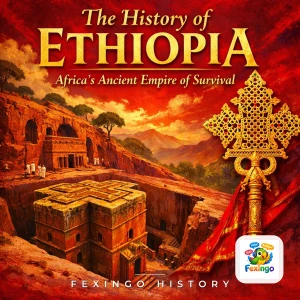
The History of Ethiopia: Africa's Ancient Empire of Survival — Fexingo History
This podcast explores the rich history of Ethiopia, from the ancient kingdom of D'mt to the modern era. Hosts Lucas and Luna cover major events like the Aksumite Empire, the construction of Lalibela's rock-hewn churches, and the Solomonic dynasty. They also discuss Ethiopia's resilience against colonization, including the Battle of Adwa, and modern challenges like the Derg regime and the 1984 famine. The show emphasizes Ethiopia's unique cultural and religious heritage.
Episodes

Haile Selassie and the Abyssinian Constitution of 1931
While Ethiopia is famous for defeating Italy at Adwa, its modern survival also relied on diplomatic brilliance. In this episode, we explore Emperor Haile Selassie’s landmark 1931 Constitution, the first in Africa’s history to establish a bicameral parliament. We examine how he balanced traditional imperial authority with emerging democratic ideals to secure Ethiopia’s seat at the League of Nations
Taytu Betul: Ethiopia's Warrior Empress
Long before the world knew of Menelik II, there was Taytu Betul, a woman whose political acumen and military strategy reshaped the Horn of Africa. While previous episodes have touched on the Treaty of Wuchale and the battles against Italy, this episode dives deep into the life of the Negus Tigabet herself. We explore her early years in Shewa, her pivotal role in negotiating with European powers, a
Ethiopia's Great Famine and the Fight for Survival
In 1984, while the world watched the Live Aid concert in London, a devastating famine was unfolding in Ethiopia’s Wollo province. This episode examines the complex political reality behind the crisis, exploring how the Derg regime under Mengistu Haile Mariam weaponized food distribution during the civil war. We look at the role of international NGOs, the controversial involvement of NASA satellite
Ethiopia's Great Famine and the Fight for Survival
In 1973, a devastating famine struck Wollo province in northern Ethiopia, yet the imperial government under Emperor Haile Selassie largely ignored it or suppressed news of it. This episode explores the tragic events leading up to the crisis, the role of local officials like Governor Mekonnen Endalkachew in concealing the suffering, and how a rare satellite image from NASA inadvertently exposed the
Ethiopia's Hidden Kingdom: The Oromo Gadaa Democracy
While much of Ethiopia’s history focuses on imperial dynasties and rock-hewn churches, a parallel tradition of governance thrived in the south through the Oromo people. This episode explores the Gadaa system, an intricate, age-grade democracy that regulated political power, justice, and social order for centuries. We trace its origins, examine how leadership rotated every eight years among four ge
The Gadaa System: Africa's Ancient Democracy
While European kings ruled by divine right, the Oromo people of Ethiopia developed a sophisticated democratic system called Gadaa. This episode explores how this multi-generational cycle of power-sharing, with strict term limits and checks on authority, functioned for centuries before European contact. We trace the origins of the Luba council, the election process through the Geeddo, and the philo
The Battle of Gura: Ethiopia Defeats Italy Again
Just six years after the stunning victory at Adwa, Ethiopia faced another Italian invasion from the north. In 1896, General Oreste Baratieri led a colonial force to Gura, hoping to exploit perceived weakness in the northern borders. Emperor Yohannes IV personally commanded the defense, facing not just British-supplied rifles but also internal betrayals and logistical nightmares. This episode explo
The Siege of Debre Damo: Ethiopia's Holy Mountain
While Lalibela’s rock-hewn churches capture the imagination, Debre Damo stands as a different kind of miracle—perched atop a sheer volcanic plug, accessible only by rope. This episode explores the history of this inaccessible monastery, founded in the seventh century during the reign of King Yekuno Amlak. We examine how the monks maintained their isolation, surviving centuries of political upheava
Ethiopia's Stone Carvers: The Mystery of Lalibela
In Episode 251, we explored the legend of King Lalibela and the Zagwe Dynasty. Now, let us look closer at the physical reality of Bete Giorgis and its twelve neighboring churches carved from volcanic tuff in the 13th century. We examine the engineering marvels of monolithic construction, where artisans hollowed out entire structures from single rock masses rather than building up with stone blocks
Ethiopia's Stone Carvers: The Mystery of Lalibela
While we have explored the political maneuvering of emperors like Menelik II and Yohannes IV, and the ancient trade networks of Aksum, this episode turns our gaze to a different kind of power: spiritual engineering. We examine the life of King Lalibela in the late 12th century, who commissioned the creation of eleven monolithic churches carved directly into the volcanic rock of his homeland. Unlik
Ethiopia's Ancient Water Laws: The Fetha Nagast
While previous episodes have touched upon Ethiopia’s legal codes, this episode dives deep into the Fetha Nagast, the 'Law of the Kings,' a foundational document that shaped Ethiopian jurisprudence for centuries. We explore how this compilation of Byzantine canon law, Roman civil law, and local customs was translated into Ge'ez during the Zagwe dynasty and later expanded under Emperor Amda Seyon I.
Ethiopia's Unwritten Laws: The Oromo Gadaa Democracy
While much of Ethiopian history focuses on emperors, stone churches, and military victories, there is another powerful tradition that has survived for centuries in the highlands and lowlands of East Africa. This episode explores the Gadaa system, a sophisticated indigenous democratic governance structure practiced by the Oromo people. We trace its origins back to ancient times and examine how it o
Ethiopia's Pre-Colonial Constitution and Legal Code
Long before European powers mapped the African continent, Ethiopia possessed a sophisticated legal framework that governed everything from water rights to criminal justice. In this episode, we explore the Fetha Nagast, or Law of the Kings, a compilation of Byzantine, Coptic, and Ethiopian laws that served as the backbone of imperial governance for centuries. We trace its origins through the Kebra
Ethiopia's Ancient Water Laws: The Fetha Nagast
This episode explores the Fetha Nagast, Ethiopia’s enduring legal code that blends Byzantine canon law with local customs. We trace its origins from the 13th-century Solomonic restoration under Emperor Yekuno Amlak and how it served as the constitutional backbone of the Ethiopian state for centuries. Lucas and Luna discuss how this text allowed Ethiopia to maintain a unified judicial system across
The Rise of Aksum: Trade, Coinage and Ancient Power
Long before the rock-hewn churches of Lalibela or the medieval forts of Gondar, the Kingdom of Aksum rose to dominate the Red Sea trade routes. This episode explores how a landlocked highland kingdom became one of the four great powers of the ancient world, alongside Rome, Persia, and India. We look at the reign of King Ezana, who adopted Christianity as the state religion in the fourth century, s
Ethiopia's Sacred Calendar and the 13 Months of Peace
While we’ve explored Ethiopia’s battles against Italy and its ancient rock-hewn churches, this episode turns to a different kind of survival: the rhythm of time itself. We examine the Ethiopian calendar, which lags behind the Gregorian system by seven or eight years, and the unique concept of thirteen months of twenty-eight days each. This structure isn't just a quirk; it’s deeply tied to the litu
Ethiopia's Ancient Water Laws: The Fetha Nagast
Long before modern constitutions, Ethiopia was governed by the Fetha Nagast, a medieval legal code translated from Latin into Ge'ez that shaped centuries of justice. This episode explores how this Byzantine-inspired text influenced Ethiopian courts, from the Solomonic restoration to the reign of Menelik II. We examine the unique blend of Roman law, canon law, and indigenous custom that defined Eth
Ethiopia’s Unbroken Chain: The Solomonic Restoration
In 1270, Yekuno Amlak overthrew the Zagwe dynasty to restore the Solomonic line, claiming descent from King Solomon and the Queen of Sheba. This episode explores how this political maneuver was cemented by the Kebra Nagast, a text that rewrote Ethiopian history to legitimize Christian rule. We examine the tension between Agaw heritage and Amhara dominance, the role of the Ge'ez language in unifyin
Ethiopia's Unconquered Soil: Coffee, Slavery and Survival
While we have explored the great battles of Adwa and the rock-hewn churches of Lalibela, Ethiopia’s survival also rested on its economic resilience and diplomatic agility. This episode examines how Emperor Menelik II navigated the Scramble for Africa not just with muskets, but with treaties, trade routes, and the global commodity of coffee. We look at the complex relationship between the Ethiopian
Ethiopia's Unbroken Chain: The Solomonic Restoration
While earlier episodes covered the Zagwe dynasty, the rock-hewn churches of Lalibela, and the modern battles of Adwa, Episode 241 turns to the pivotal moment when Emperor Yekuno Amlak ended centuries of Zagwe rule in 1270. This episode explores the complex restoration of the Solomonic line, not as a simple military coup, but as a carefully negotiated political settlement that redefined Ethiopian l
Gondar's Royal Enclosure and Imperial Ambitions
While previous episodes explored the ancient rock-hewn churches of Lalibela and the fierce battles of Adwa, this episode shifts focus to the seventeenth century and the rise of Gondar. We trace how Emperor Fasilides moved the capital from Debre Berhat to the northern highlands, establishing the Fasil Ghebbi, a fortified royal compound that would serve as Ethiopia’s seat of power for nearly two cen
Haile Selassie’s Exile: The Diplomatic War
While the Battle of Adwa secured Ethiopia’s independence in 1896, the mid-20th century presented a far more insidious threat: diplomatic encirclement by European powers. This episode explores the complex reign of Emperor Haile Selassie, focusing on his final, desperate stand at the League of Nations in Geneva in 1936. We examine how Italy, under Benito Mussolini, utilized propaganda and colonial r
The Battle of Adwa: Ethiopia’s Defeat of Italy
In 1896, the Italian army marched into Ethiopia expecting a swift colonial victory, but they walked into a meticulously prepared defense at Adwa. This episode traces the diplomatic unraveling between Menelik II and Italy, focusing on the disputed Treaty of Wuchale which contained conflicting Amharic and Italian texts regarding Ethiopian sovereignty. We explore how Emperor Menelik rallied a diverse
Ethiopia's Coffee Origins: Kaldi and the Global Trade of Buna
While previous episodes have explored Ethiopia’s political resilience from Aksum to Adwa, this episode traces a different kind of survival: the cultivation of coffee, or buna. We journey to the highlands of Kaffa to uncover the legend of Kaldi, the goatherd whose discovery sparked a global commodity. Lucas and Luna discuss how Ethiopian monasteries preserved ancient cultivation techniques while th
Haile Selassie and the League of Nations: A Diplomatic Crisis
In 1935, as Italy prepared to invade Ethiopia under Benito Mussolini, Emperor Haile Selassie traveled to Geneva to appeal directly to the League of Nations. This episode explores the dramatic diplomatic failure that followed, examining the speeches delivered in the assembly hall and the geopolitical calculations that led Western powers to ignore his plea for sovereignty. We look at the specific ev
Ethiopia's Unconquered Soil: Coffee, Slavery and Survival
We trace the global journey of coffee from the highlands of Ethiopia to the world stage, exploring how this single crop shaped the empire’s economy and internal politics. Lucas and Luna examine the legend of Kaldi the goatherd and the actual historical spread of qat and coffee through Oromo trade networks. We look at the complex relationship between Emperor Yohannes IV and the rising coffee trade
Yodit: Ethiopia's Warrior Queen of the Zagwe Dynasty
While Lalibela is remembered for carving churches from rock, his mother Yodit was remembered for wielding a sword. This episode explores the complex legacy of the Zagwe dynasty and the woman often labeled as a destroyer in later Solomonic propaganda. We examine the Battle of Campasa, where Empress Yodit defeated Emperor Gabra Maskal, and analyze how political rivals rewrote history to demonize her
The Siege of Maqdala: Britain's Punitive Expedition
In 1868, a British expeditionary force marched into the Ethiopian highlands to rescue hostages held by Emperor Tewodros II. This episode explores the Battle of Magdala, where modern British artillery smashed through ancient fortress walls. We examine the political tensions following the imprisonment of European envoys and the tragic aftermath of the assault on the mountain citadel. Lucas and Luna
Yohannes IV: The Emperor Who Defied Italy and Died Fighting
While Menelik II is often credited with the victory at Adwa, it was his predecessor, Emperor Yohannes IV, who first stood firm against Italian expansion in the Horn of Africa. This episode explores Yohannes’s complex reign as a warrior-emperor navigating the treacherous waters of post-Zemene Mesafint politics. We examine how he unified rival regional powers under the Solomonic banner while facing
Menelik II's Modernization and the Battle of Adwa
We trace the dramatic transformation of Ethiopia under Emperor Menelik II, focusing on his aggressive modernization campaigns that turned a medieval kingdom into a regional power. You will hear about his strategic acquisition of European weaponry, including Maxim guns and rifles from France and Russia, and how he used these tools to consolidate control over southern territories like Shewa, Wolayta
Ethiopia's Hidden Jewish Kingdom: Beta Israel History
While much of Ethiopian history focuses on the Solomonic dynasty and Christian kingdoms, a parallel narrative unfolds in the mountainous regions of Gondar and Lasta. This episode explores the Beta Israel community, often referred to as Falasha, who maintained distinct religious practices rooted in ancient Hebrew traditions for centuries. We examine the complex relationship between these communitie
Ethiopia's Lost Library: The Monastic Archives of Lake Tana
While Lalibela’s churches are carved into stone, Ethiopia’s most vital historical records were kept safe on the islands of Lake Tana. For centuries, monastic libraries here preserved thousands of manuscripts in Ge’ez, shielding them from invasion and decay. This episode explores how these fragile texts survived the Jesuit missions, the Mahdist wars, and modern conflicts. We meet Abba Gebre Medhin,
Ethiopia's Ancient Library of Heaven: Lalibela's Hidden Archives
While most visitors flock to the iconic rock-hewn churches of Lalibela to photograph Saint George, a quiet revolution in historical scholarship is revealing that these monuments were never just places of worship. They were sophisticated libraries and scriptoria designed to preserve Ethiopia’s unique intellectual heritage during centuries of isolation and conflict. In this episode, we explore how t
The Battle of Gorgora: Ethiopia's Naval Victory on Lake Tana
While we have covered the land battles that defined Ethiopia’s survival, this episode turns to the waters of Lake Tana. In 1543, as Ahmad Gran’s Adal forces swept through the highlands, the Ethiopian Empire faced annihilation. But Emperor Galawdewos did not just retreat; he adapted. By forging a fragile alliance with Portuguese musketeers and leveraging the unique geography of Lake Tana, he launch
The Battle of Adwa: Ethiopia's Victory Over Italy
While the Zagwe Dynasty built Lalibela’s churches and the Jesuit missions caused turmoil in Gondar, the true test of Ethiopian sovereignty came on March 1, 1896. This episode explores the Battle of Adwa, where Emperor Menelik II defeated Italian forces at a critical turning point in African history. We examine the Treaty of Wuchale, the role of Empress Taytu Betul, and the strategic brilliance tha
Tewodros II and the End of the Zemene Mesafint
This episode explores the turbulent Zemene Mesafint, or 'Era of Princes,' a period where Ethiopia’s central authority collapsed into regional warlordism. We focus on Kassa Hailu, a local governor who rose from obscurity to unite the fractured provinces under his banner as Emperor Tewodros II. The narrative details his military reforms, including the adoption of modern weaponry and standardized dri
The Jesuit Mission in Ethiopia: Faith, Fire, and Failure
In 1624, Emperor Susenyos I of Ethiopia made a decision that would tear the kingdom apart: he converted to Roman Catholicism. This episode explores the dramatic and often violent attempt by Portuguese Jesuit missionaries to align Ethiopia’s ancient Tewahedo Church with Rome during the reign of Susenyos and his successor Fasilides. We trace the political maneuvering behind this religious shift, the
Ethiopia's Ancient Libraries and the Survival of Texts
While Lalibela’s rock-hewn churches dominate popular imagination, Ethiopia’s true intellectual heritage lies in its monastic libraries. This episode explores how centuries-old manuscripts survived invasions, fires, and colonial neglect through a unique system of oral transmission and physical preservation. We trace the journey of texts like the Kebra Nagast and medical treatises from their creatio
Ethiopia's Hidden Christian Kingdoms: The Zagwe Legacy
Long before the Solomonic Restoration reasserted ancient dynasties, Ethiopia was ruled by the Zagwe dynasty, a kingdom centered in the remote mountains of Lasta. This episode explores how King Gebre Mesqel Lalibela transformed his realm into a 'New Jerusalem' by carving eleven monolithic churches directly out of volcanic rock at Lalibela. We examine the Agaw people’s unique theological contributio
Ethiopia's Medieval Spy Network and the Battle of Shimbra Kure
While Ethiopia’s military victories are well-documented, its intelligence apparatus was equally formidable. This episode explores how Emperor Dawit II and his generals used a network of spies and informants to counter the expanding Adal Sultanate in the mid-16th century. We examine the pivotal role of Queen Sabla Wangel, who didn’t just fight on the front lines but orchestrated complex diplomatic
The Real Queen of Sheba: Aksumite Roots of a Legend
Was the Queen of Sheba a real Aksumite ruler, or a legend woven from ancient trade, prophecy, and politics? In this episode, Lucas and Luna trace the story from the Kebra Nagast's Solomonic myth to the archaeological and textual evidence linking the queen to the Sabaean kingdoms of southern Arabia and the highlands of Ethiopia. They explore the spice trade that made the Red Sea a highway of empire
The Gondar Bridge That Took 100 Years to Cross
In the 17th century, Ethiopian emperors Fasilides and Iyasu I built a series of stone bridges across the Blue Nile, known locally as the Portuguese bridges. The most famous, the Sebara Dildiy, was famously incomplete for over a century. This episode follows the story of these engineering marvels: how they were built, who built them, and why their collapse and reconstruction became a symbol of Ethi
Lalibela's Church of Saint George: Carved from the Sky
In this episode of The History of Ethiopia, Lucas and Luna explore the most iconic of the eleven rock-hewn churches of Lalibela: Bete Giyorgis, the Church of Saint George. Carved from a single block of volcanic tuff in the late 12th or early 13th century, this cross-shaped monolith is a marvel of engineering and faith. They discuss how King Lalibela, of the Zagwe dynasty, commissioned the churches
Ethiopia's Blue Nile Fortress: The Battle of Dashen
In this episode of The History of Ethiopia, hosts Lucas and Luna explore the little-known Battle of Dashen, a 16th-century confrontation that reshaped the Ethiopian highlands. Set against the dramatic backdrop of the Blue Nile gorge, the battle pitted Emperor Sarsa Dengel's forces against the Ottoman-backed armies of Bahr Negash Yeshaq, a powerful regional ruler who had turned to foreign allies fo
The Battle of Ayshal: Gondar's Last Stand and the Rise of Tewodros II
Before Ethiopia's modern era, the Battle of Ayshal in 1855 sealed the fate of the Gondarine dynasty and crowned a self-made warlord as Emperor Tewodros II. This episode unpacks the decaying power of the Zemene Mesafint, the 'Era of the Princes,' when rival regional lords—the Begemder, the Yejju Oromo, the Shewan kings—fought for supremacy while the once-glorious capital of Gondar fell into neglect
The Gadaa System: Ethiopia's Oromo Democracy
Long before modern parliaments, the Oromo people of Ethiopia practiced a sophisticated system of generational democracy called the Gadaa system. In this episode, Lucas and Luna explore how this indigenous governance structure worked: its eight-year cycles, the five gadaa classes, and the elected leader known as the abbaa gadaa. They discuss the role of the 360-day Borana calendar, the significance
Gondar's Royal Enclosure: Ethiopia's Camelot
In the 17th century, Emperor Fasilides broke with tradition and built a new capital at Gondar, a city of stone castles and churches in the highlands of Ethiopia. This episode explores the Royal Enclosure, its iconic Fasil Ghebbi, and the rulers who shaped it — from Fasilides to Iyasu I, the Great. We look at the architectural wonders, including the famous Fasilides' Castle and the church of Debre
Queen Sabla Wangel: Ethiopia's Warrior Queen of the 16th Century
In this episode, Lucas and Luna explore the life of Queen Sabla Wangel, wife of Dawit II and mother of Galawdewos, during Ethiopia's war with Ahmad Gran. They discuss her military command at the Battle of Shimbra Kure, her personal losses, her role in negotiating with the Portuguese, and her little-known regency after her husband's death. The conversation also touches on the women of the Solomonic
Lalibela's Rock-Hewn Churches and the Zagwe Legacy
In this episode, Lucas and Luna explore the rock-hewn churches of Lalibela, carved in the 12th and 13th centuries under the Zagwe dynasty. They discuss the architectural wonders of Bete Giyorgis and Bete Medhane Alem, the legend of King Lalibela's divine vision, and the role of the churches in Ethiopian Orthodox Christianity. Along the way, they touch on the Agaw people, the end of Aksum, and the
The Battle of Debarki: Oromo Expansion and Ethiopia's Shifting South
In the early 1600s, as the Solomonic dynasty recovered from the wars with Ahmad Gran, a new force was reshaping Ethiopia's southern frontier: the Oromo migrations. This episode focuses on the Battle of Debarki (c. 1625), a pivotal clash between Emperor Susenyos I and an Oromo army led by the legendary warrior Sersa. We trace the origins of the Oromo expansion, their military innovations—like the d
The Battle of Adwa: Ethiopia's Victory Over Colonial Italy
In 1896, at the Battle of Adwa, Ethiopian forces under Emperor Menelik II and Empress Taytu Betul defeated Italian troops, securing Ethiopia's sovereignty and reshaping the colonial narrative in Africa. This episode explores the strategies, the treaty dispute, and the decisive clashes that led to the victory. We look at the roles of generals like Ras Makonnen and Ras Alula, the logistics of mobili
The Battle of Wayna Daga: Ahmad Gran's Last Stand
In this episode, we return to the dramatic final chapter of Ethiopia's 16th-century war with the Adal Sultanate. We follow the dying Emperor Dawit II, the arrival of Portuguese musketeers under Cristóvão da Gama, and the remarkable leadership of Empress Seble Wongel, who rallied resistance while her son Galawdewos was still a boy. The climax is the battle of Wayna Daga, where Imam Ahmad ibn Ibrahi
The Zagwe Dynasty: Ethiopia's Bridge Between Empires
In this episode, Lucas and Luna explore the often-overlooked Zagwe dynasty, the rulers who bridged the fall of Aksum and the rise of the Solomonic line. They discuss the dynasty's origins in the Agaw people, the legendary figure of Mara Takla Haymanot, and the shift of the capital to Roha. The conversation centers on the dynasty's remarkable architectural legacy, especially the rock-hewn churches
The Battle of Adwa Revisited: Ethiopia's Victory over Italy
In this episode, Lucas and Luna explore the Battle of Adwa in 1896, where Ethiopian forces under Emperor Menelik II and Empress Taytu Betul defeated the Italian army, securing Ethiopia's independence and becoming a symbol of African resistance to colonialism. They discuss the diplomatic maneuvering around the Treaty of Wuchale, the military strategies of Ras Makonnen and other commanders, the cruc
The Queen of Sheba: Legend or Real Ruler?
This episode of The History of Ethiopia explores the enduring mystery of the Queen of Sheba, the legendary monarch who, according to the Kebra Nagast, visited King Solomon in Jerusalem and bore him a son, Menelik I, the founder of the Solomonic dynasty. We trace her story from its earliest sources—the biblical account in 1 Kings, the Quranic narrative of Bilqis, and the Ethiopian national epic—to
Ezana's Aksum: The King Who Chose Christianity
Emperor Ezana of Aksum ruled in the 4th century, a time when the Red Sea trade made his kingdom one of the ancient world's great powers. He is remembered for a momentous decision: converting to Christianity, making Aksum one of the first Christian states. This episode explores what we know about Ezana from his own inscriptions and coins, how his conversion reshaped Ethiopian identity, and the fasc
The Solomonic Restoration: Yekuno Amlak's 1270 Coup
In 1270, a young prince named Yekuno Amlak overthrew the Zagwe dynasty and claimed the throne of Ethiopia, restoring the Solomonic line that would rule for centuries. This episode unpacks the story behind that coup: the legend of Queen Gudit's destruction of Aksum, the Zagwe kings who rebuilt Ethiopia from Lalibela's churches, and the political maneuvering that brought Yekuno Amlak to power. We ex
Aksum's End: The Rise of Queen Gudit
In the 10th century, the great Aksumite Empire—once a Red Sea powerhouse—faced a challenge from within. This episode explores the mysterious Queen Gudit (also known as Yodit), the warrior-queen who, according to tradition, sacked Aksum, burned its churches, and toppled the Zagwe dynasty centuries before Lalibela's rock-hewn marvels. Drawing on scant written records and rich oral tradition, we sepa
The Aksumite Obelisks: Giants of an Ancient Empire
In this episode, Lucas and Luna explore the towering granite obelisks of Aksum, the ancient Ethiopian capital. They trace how these monolithic monuments, some over a hundred feet tall, were quarried, carved, and erected without modern machinery, and how they served as royal markers for the kings of Aksum, from Sembrouthes to Ezana. The conversation covers the mysterious methods of transport and ra
The Aksumite Kings and the Ark of the Covenant
In this episode of The History of Ethiopia, Lucas and Luna explore the Aksumite Empire's most enduring mystery: the legend that the Ark of the Covenant rests in a chapel in Aksum. They trace the story from the Queen of Sheba's visit to Solomon, through the Kebra Nagast's medieval account, to the Ethiopian Orthodox Church's claim that the Ark has been guarded for centuries — including its alleged j
The Aksumite Navy: How Ethiopia Ruled the Red Sea
Episode 200 of The History of Ethiopia looks back at the empire's seafaring age, when Aksum commanded the Red Sea and its kings called themselves 'King of Kings of Aksum and of Himyar.' We trace the rise of Adulis as a gatewayport, the expeditions that carried Aksumite armies to Arabia, and the trade in ivory, frankincense, and gold that funded the stelae of Aksum. We meet the shadowy king Sembrou
The Battle of Shimbra Kure: When Ethiopia Faced the Imam
In 1529, Ahmad ibn Ibrahim al-Ghazi, known as Ahmad Gran, led his Adalite forces into the heart of the Ethiopian highlands. At Shimbra Kure, he faced Emperor Dawit II in a battle that would change the course of the region. This episode unpacks the military maneuverings, the role of matchlock muskets and Ottoman support, and the strategic blunders that led to Dawit's defeat. We explore the fragile
The Battle of Adwa and the Making of Modern Ethiopia
In this episode, Lucas and Luna revisit the Battle of Adwa, the decisive 1896 clash where Ethiopian forces under Emperor Menelik II and Empress Taytu Betul defeated the Italian army. They explore the diplomatic maneuvering, the strategic use of terrain, and the profound impact on African and global history. The conversation touches on the Treaty of Wuchale, the role of Ras Alula, and the significa
The Battle of Adwa and the Making of Modern Ethiopia
In this episode, we explore the Battle of Adwa in 1896, a turning point that reshaped not just Ethiopia but the entire colonial map of Africa. We talk about the lead-up: the Treaty of Wuchale and its famous Article 17, where the Italian and Amharic versions disagreed—one gave Italy a protectorate, the other didn't. That ambiguity set the stage for conflict. We look at Menelik II and Empress Taytu
The Battle of Wayna Daga: Ahmad Gran's Last Stand
In 1543, on the slopes of Wayna Daga, the Ethiopian empire faced its greatest crisis since the Muslim conquests began a decade earlier. Ahmad ibn Ibrahim al-Ghazi, the charismatic leader of the Adal Sultanate, had swept through the highlands, burning churches and forcing Emperor Dawit II into exile. But the balance of power shifted when a small Portuguese force under Cristóvão da Gama arrived with
Dawit II and Ahmad Gran: Ethiopia's 16th Century War
In 1529, Ahmad ibn Ibrahim al-Ghazi—known as Ahmad Gran, 'the Left-Handed'—led the armies of the Adal Sultanate out of the lowlands and shattered the highland armies of Emperor Dawit II at the Battle of Shimbra Kure. Over the next fourteen years, Gran's forces, armed with matchlocks and backed by Ottoman support, swept through the Ethiopian highlands, burning churches, looting monasteries, and for
The Battle of Zenta: Sabuktagin's Last Stand
In this episode, Lucas and Luna explore the Battle of Zenta, fought on September 11, 1697, between the Ottoman Empire and the Habsburgs. They discuss the military genius of Prince Eugene of Savoy, the Ottoman Grand Vizier Elmas Mehmed Pasha, and the strategic crossing of the Tisza River. The battle shattered Ottoman dominance in Hungary, leading to the Treaty of Karlowitz in 1699. This conversatio
Gondar's Royal Chronicles: Scribes of an African Empire
Step into the scriptorium of Ethiopia's 17th-century capital as Lucas and Luna trace how the royal chronicles of Gondar turned dynastic memory into a tool of survival. From Emperor Fasilides' founding of the city to the meticulous annalists who recorded every campaign, this episode explores the Ge'ez-language manuscripts that anchor Ethiopia's claim to an unbroken Solomonic lineage. Discover the r
The Medieval Ethiopian Church's Gondar-Century Gold
In this episode, Lucas and Luna step into the 17th-century Ethiopian Highlands, where the medieval kingdom of Abyssinia was quietly minting its own gold currency — the birr — centuries before the modern Ethiopian state. They trace how Emperor Fasilides, fresh off expelling the Jesuits and restoring the Tewahedo Church, revived a monetary tradition that had lain dormant since the Aksumite Empire. L
Lalibela's Living Stones: Ethiopia's Carved Churches
Deep in the Ethiopian highlands, eleven monolithic churches rise from the rock, carved top-down by hand in the twelfth century. This episode of Fexingo History explores how King Lalibela built a 'New Jerusalem' after Muslim conquests blocked Christian pilgrimages to the Holy Land. Hosts Lucas and Luna walk through the engineering, the faith, and the mystery of the Bete Giyorgis cross-shaped church
The Battle of Shimbra Kure: Ahmad Gran's Conquest of Ethiopia Begins
In 1529, the Ethiopian Empire faced a cataclysm at Shimbra Kure. Emperor Lebna Dengel, a young ruler from the Solomonic line, confronted the jihad of Ahmad ibn Ibrahim al-Ghazi, known as Ahmad Gran. The battle shattered Ethiopia's army, leading to the loss of sacred Axum and the near collapse of the Christian kingdom. This episode explores the opening phase of Gran's invasion, the desperation of L
The First Hijra: When an Ethiopian King Sheltered Islam's Early Refugees
In 615 AD, a small group of early Muslims fled persecution in Mecca and crossed the Red Sea to seek refuge in the Christian kingdom of Axum. Their protector was the Negus Ashama ibn Abjar, a ruler whose defiance of the Quraysh delegation and his decision to grant asylum shaped both Ethiopian and Islamic history. This episode explores the events of the first Hijra to Abyssinia, the diplomatic confr
Zara Yaqob: The Reformer Emperor of 15th Century Ethiopia
Emperor Zara Yaqob ruled Ethiopia from 1434 to 1468, a period of intense religious reform, administrative centralization, and cultural flowering. This episode explores how he consolidated the Solomonic dynasty, enforced Orthodox unity, suppressed pagan and Jewish practices, and fought wars against the Muslim Sultanate of Adal. We discuss his theological treatises—the Matshafa Berhan and Matshafa M
Beta Israel: Ethiopia's Ancient Jewish Community
Ethiopia is famous for its Christian heritage, but it is also home to one of the world's oldest Jewish communities: the Beta Israel. This episode traces their mysterious origins from the time of the Queen of Sheba to their 20th-century exodus to Israel. Learn about their unique religious practices preserved in isolation for centuries, their relationship with the Solomonic emperors, and the hardshi
The Fall of Haile Selassie and the Ethiopian Revolution of 1974
In 1974, Ethiopia's ancient monarchy collapsed after a series of student protests, a devastating famine, and a military coup that brought the Derg to power. This episode follows the final months of Haile Selassie's reign, the rise of Mengistu Haile Mariam, and the brutal Red Terror that followed. Lucas and Luna examine the roots of the revolution, the role of the 1973 Wollo famine, and how Ethiopi
The Battle of Adwa: Ethiopia’s 1896 Victory Over Italy
In 1896, at the Battle of Adwa, Ethiopian forces under Emperor Menelik II and Empress Taytu Betul decisively defeated the Italian army, ensuring Ethiopia remained the only African nation to successfully resist European colonization during the Scramble for Africa. This episode explores the diplomatic breakdown over the Treaty of Wuchale, Menelik’s military modernization, the controversial role of R
Ethiopia's 1935 War Against Fascist Italy: Gas, Betrayal, and Resistance
In 1935, Fascist Italy invaded Ethiopia, seeking revenge for the humiliating defeat at Adwa four decades earlier. This episode dives into the Second Italo-Ethiopian War, focusing on the brutal campaign that pitted Emperor Haile Selassie's modernizing army against Mussolini's mechanized forces equipped with poison gas. We walk through the Walwal incident that sparked the conflict, the failure of th
The Oromo Expansion: How a People Reshaped Ethiopia
In this episode, we explore the Oromo migrations that transformed Ethiopia's highlands from the 16th century onward. Unlike the dynastic narratives of emperors and battles, the Oromo story is one of a decentralized, democratic society—the gadaa system—that expanded through migration and integration rather than conquest. We discuss the origins of the Oromo in the southern lowlands, their age-grade
From Segale to Throne: Haile Selassie's Rise to Power
In the years after Menelik II's death, Ethiopia plunged into a succession crisis. The young, unpredictable Lij Iyasu took the throne, alienating the Orthodox establishment with his Muslim sympathies. When he was deposed in a 1916 coup, power shifted to Empress Zewditu and a little-known regent: Ras Tafari Makonnen. But Lij Iyasu wasn't finished—he raised an army, leading to the decisive Battle of
The Last King of Zagwe and the Birth of the Solomonic Dynasty
In this episode, we travel back to 13th-century Ethiopia to witness the twilight of the Zagwe dynasty and the rise of Yekuno Amlak, the founder of the Solomonic line. Lucas and Luna explore how Mara Takla Haymanot established the Zagwe dynasty from the Agaw people, the construction of the Lalibela churches under King Lalibela, and the growing discontent among the Christian clergy. They delve into
Recommended

Learn English A2 with Daily News | Simple English Listening Practice

پلی لیست | PlayList

Conspiracy Files with Paige Carter

Bad Friends

Learn 50 English Phrases While You Sleep | Everyday English Phrases & Vocabulary

This Past Weekend w/ Theo Von

Dateline NBC

Back to the 80s Radio

Crime Stories with Nancy Grace

Bible Tea

این نقطه

TED Business
