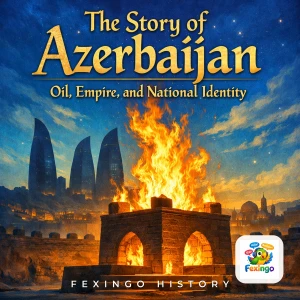
The Story of Azerbaijan: Oil, Empire, and National Identity — Fexingo History
A history podcast that traces Azerbaijan's national identity through millennia of foreign rule, from Persian and Turkic empires to Russian and Soviet domination. Hosts Lucas and Luna explore the ancient Zoroastrian fire temple of Ateshgah, Baku's oil boom, the brief Azerbaijan Democratic Republic, and the Nagorno-Karabakh conflict. The narrative covers Heydar Aliyev's authoritarian era, the modern oil-and-gas state, and cultural touchstones like mugham music and Nizami Ganjavi. It presents Azerbaijan as a nation caught between East and West, shaped by fire and fossil fuel.
Episodes

Nizami Ganjavi: The Poet Who Shaped Azerbaijani Soul
This episode explores the life and enduring legacy of Nizami Ganjavi, the thirteenth-century Persian poet whose works became foundational to Azerbaijani national identity. We trace his journey from Ganja to Shirvan, examining how his masterpiece Khosrow and Shirin and Layla and Majnun transcended religious and linguistic boundaries to unite the Caucasus. Lucas and Luna discuss the historical conte
Leyla Bnoy: The Woman Who Saved Azerbaijani Literature
In this episode, we uncover the remarkable story of Leyla Bnoy, a pioneering journalist and writer who navigated the treacherous waters of early Soviet Azerbaijan. While previous episodes focused on oil barons and political purges, we turn our attention to the cultural resistance embodied by Bnoy’s work in the 1920s and 30s. Lucas and Luna discuss how she used her platform at Azərbaycan qadını (Az
The Baku Stock Exchange and the Birth of Modern Finance
While the Nobel brothers industrialized Azerbaijan’s oil, a quieter revolution was transforming Baku into one of the world’s most dynamic financial hubs in the early twentieth century. This episode explores the rise of the Baku Stock Exchange, founded in 1904, which became a global center for trading petroleum futures and equities. We follow the story of Huseyn Zardabi, the newspaper publisher who
The Baku Uprising of 1920: A Forgotten Revolution
In the spring of 1920, the newly independent Azerbaijan Democratic Republic faced its most existential threat not from foreign armies alone, but from a coordinated insurrection within its own capital. This episode examines the Baku Uprising of April 1920, where local Bolshevik cells, supported by the Red Army and the Caspian Flotilla, attempted to overthrow the Musavat government just weeks before
Yevgeny Polivanov: The Linguist Who Saved Azerbaijani
In 1920s Baku, the Soviet Union launched a radical linguistic experiment that would reshape Azerbaijan's identity and ultimately destroy one of its greatest minds. This episode explores the work of Yevgeny Polivanov, a brilliant Russian linguist who helped replace the Arabic script with Latin, and later Cyrillic, for the Azerbaijani language. We examine how these changes were not merely administra
The Silk Road's Forgotten Gateway: Derbent and the Gates of Alexander
While Baku gets the spotlight for its oil wealth, the eastern Caucasus held a different kind of treasure: security. This episode explores Derbent, the ancient fortress city that guarded the narrowest point between the Greater Caucasus mountains and the Caspian Sea. For over two millennia, empires from Alexander the Great to the Sassanids and the Russians fought to control these Iron Gates. We trac
The Battle of Sardarapat: Saving Armenian Identity
In May 1918, as the Ottoman Empire advanced on the Transcaucasian border, a fragile new state called the Democratic Republic of Armenia faced annihilation. This episode examines the Battle of Sardarapat, a desperate last stand that not only halted the Turkish offensive but also preserved the cultural and political existence of modern Armenia. We explore how this military victory was inextricably l
The Caucasian Albanians: Lost Kingdom Revealed
For over a century, the history of the South Caucasus was written through the lens of its powerful neighbors—the Persians, the Armenians, and the Romans. But there was another power in the region that has largely vanished from our collective memory: the Kingdom of Caucasian Albania. In this episode, we uncover the story of an ancient state that stretched from the Greater Caucasus mountains down to
The Lost Kingdom of Caucasian Albania
For decades, history books treated the ancient civilization of Caucasian Albania as a mere footnote to Persia and Rome, or worse, erased it entirely under Soviet historiography. This episode uncovers the vibrant, independent kingdom that flourished in the southern Caucasus from the 4th century BCE until its absorption by the Sassanid Empire. We explore how Albanian kings navigated the immense pres
The Baku Commune: Lenin's Lost Experiment
While most history books remember the Azerbaijan Democratic Republic as the first secular democracy in the Muslim world, there was another Baku that existed for just three months in 1918. This episode explores the Bakı Kommunası, a radical Soviet experiment led by Stepan Shaumian that emerged from the chaos of World War I and the Russian Revolution. We trace how Bolshevik forces, supported by the
Azerbaijan's First Republic: The Lost Democracy
After decades of Soviet rule that erased much of Azerbaijan’s early 20th-century history, the story of the Azerbaijan Democratic Republic (ADR) remains a powerful testament to resilience and modernity. In this episode, Lucas and Luna explore the brief but groundbreaking existence of the ADR from 1918 to 1920. We examine how this fledgling nation became the first secular democratic republic in the
The Soviet Erasure of Azerbaijan's First Republic
We explore the brief but brilliant existence of the Azerbaijan Democratic Republic, established in May 1918. Unlike previous episodes focusing on oil wealth or communist uprisings, this conversation examines how this fledgling nation achieved one of the earliest and most progressive acts in global history: granting women full suffrage. We look at Mammad Amin Rasulzadeh’s leadership, the modernizat
The Baku Uprising of 1920: A Forgotten Revolution
In this episode, we move beyond the well-trodden paths of oil wealth and Soviet purges to explore the chaotic final days of the Azerbaijan Democratic Republic in April 1920. We examine the spontaneous uprising that erupted in Baku just before the Red Army's invasion, focusing on the role of ordinary citizens, sailors from the Caspian Flotilla, and the complex political landscape left by the collap
The Baku Oil Boom and the Nobel Brothers
While earlier episodes touched on the broader history of Azerbaijan’s oil industry, this episode zooms in on the specific figures who transformed the Absheron Peninsula into the world’s petroleum capital. We explore how Swedish entrepreneurs Immanuel and Robert Nobel arrived in Baku in the late nineteenth century, challenging the Russian monopoly held by the Rothschilds. You will hear about their
The Silk Road’s Hidden Caravans: Azerbaijan's Trade Legacy
While previous episodes have explored Baku’s oil boom and the political turbulence of the early twentieth century, this episode turns back the clock to examine the economic backbone of the Caucasus long before the first barrel was drilled. We focus on the intricate network of caravanserais that dotted the southern slopes of the Greater Caucasus and the Absheron Peninsula, serving as vital nodes on
Nakhchivan's Exclave: A Georgian Story
In this episode of The Story of Azerbaijan, we leave the oil fields and political upheavals behind to explore one of the most geographically peculiar corners of the Caucasus: the Nakhchivan Autonomous Republic. While earlier episodes covered Baku’s industrial boom and the fierce battles of the Red Summer, few have discussed how a small strip of land, separated from the main body of Azerbaijan by A
Azerbaijan's Silk Road Legacy: Caravans and Culture
While previous episodes have chronicled the blood-soaked politics of the Baku Commune, the oil barons of the Nobel era, and the poetic depths of Nizami Ganjavi, Episode 242 takes a step back to examine the centuries-long pulse of the Caucasus before the modern age. We explore Azerbaijan’s role as the critical northern artery of the Silk Road, where goods from China and India met Europe not just in
The Caspian Flotilla and Azerbaijan's Naval History
While Baku’s oil boom is well-documented, the maritime history of the Caspian Sea remains a hidden chapter in Azerbaijan’s story. This episode explores the formation of the Caspian Flotilla, a naval force that operated in one of the world’s most politically complex waterways during the early 20th century. We examine how local shipbuilders like Muhammad Javad Melikov utilized the Mantis Shipyard to
The Fire Temples of Atashgah and Zoroastrian Roots
While previous episodes have explored the oil wealth of Baku and the political struggles of the early twentieth century, this episode looks deeper into the spiritual landscape that predates both. We visit the Atəşgah, the Fire Temple in Surakhany, often mistakenly called a Zoroastrian site. In reality, it was a Hindu-Sikh pilgrimage center built by traders along the Silk Road who saw the natural g
Azerbaijan's Soviet Silence: The Purge of 1937
In this episode, we explore the dark heart of the Great Purge in Azerbaijan during 1937 and 1938, a period when the Soviet Union systematically dismantled its own national identity. We focus on the tragic fate of Mikayil Muradov, the first Azerbaijani pilot who flew into Berlin to celebrate Hitler’s rise, only to be executed by Stalin for the same act years later. We trace how the NKVD targeted no
Azerbaijan's Black Diamond: The Nobel Brothers and Baku's Oil Boom
In the late nineteenth century, Baku was the center of the global oil world, fueled by the industrial ambitions of the Nobel brothers. This episode explores how Alfred Nobel’s brother, Robert, and his son Immanuel transformed the chaotic, fire-prone fields of the Absheron Peninsula into a model of modern engineering and safety. We look at the Branobel company’s rise, their rivalry with the Rothsch
The Baku Commune and the Blood of July 1918
In July 1918, Baku became the epicenter of a violent struggle that defined the short-lived Azerbaijan Democratic Republic. This episode explores the final months of the Baku Commune, led by Stepan Shaumian and the Bolsheviks, as they held out against the combined forces of the Ottoman Qızıl Ordu under Nuri Pasha and the British Caspian Force commanded by General Thomson. We examine the political f
Nizami Ganjavi and the Myth of Alexander
This episode explores how the 12th-century poet Nizami Ganjavi shaped Azerbaijani national identity through his epic poem, Khosrow and Shirin. We examine how Nizavi blended Persian literary traditions with local Caucasian folklore to create a distinct cultural voice under Seljuk rule. The conversation details the historical context of Ganja as a center of learning and the political pressures faced
Nizami Ganjavi: The Poet Who Shaped Azerbaijan
This episode explores the life and enduring legacy of Nizami Ganjavi, the thirteenth-century Persian poet whose works defined the cultural soul of the Caucasus. We trace his journey from a humble background in Ganja to the literary courts of Shirvan and Georgia, examining how his masterpiece, Khosrow and Shirin, bridged Islamic, Christian, and Zoroastrian traditions. Lucas and Luna discuss the pol
The Baku Water War: How Oil Built a City
While previous episodes explored the political turbulence of the Azerbaijan Democratic Republic and the violent Red Summer of 1918, we now turn to the quiet, daily struggle that kept the oil industry alive during the chaos. In this episode, Lucas and Luna examine the critical infrastructure of early 20th-century Baku, focusing on the water crisis that threatened to halt production. We follow the e
The Caspian Flotilla: How Azerbaijan Built a Navy
While we have explored the oil wells, fire temples, and political struggles of Azerbaijan in previous episodes, this conversation turns to an often-overlooked pillar of its modern identity: the Caspian Flotilla. We trace how the Baku oil boom didn't just fuel lamps in London but built a naval force capable of challenging empires. Lucas and Luna discuss the strategic vision of figures like Muhammad
The Caucasus Camel: Azerbaijan's Silk Road Legacy
Long after the oil derricks rose over the Absheron peninsula and the Soviet tanks rolled into Baku, a different kind of empire was built on the backs of animals and the endurance of merchants. In this episode, we step away from the industrial boom and the political turbulence of the early twentieth century to explore the ancient economic spine of the region: the Silk Road trade routes that connect
The Red Terror in Baku: Shaumian’s Last Stand
In the summer of 1918, Baku was a cauldron of violence where the Bolshevik Baku Commune, led by Stepan Shaumian, held the city against a coalition of Ottoman forces and the Musavat-led Democratic Republic. This episode explores the final months of that desperate siege, focusing on the ideological fervor and brutal internal politics of the Communist regime as they faced imminent defeat. We examine
The Blood of the Caspian: Baku’s Red Summer
In July 1918, the city of Baku became the stage for one of the most brutal and chaotic episodes in Caucasus history. As the Ottoman army approached from the south and the White forces gathered to the north, a fragile coalition of Bolsheviks, Armenian Dashnaks, and British Imperial troops held the city together by sheer force of will—and fear. This episode explores the 'Red Summer' of 1918, focusin
Azerbaijan's Red Summer and the Baku Commune
While previous episodes explored the oil wealth of the Mansurovs and the political foundations of the Musavat Party, this episode turns to the violent summer of 1918 that reshaped the Caucasus. We examine the formation of the Baku Commune, a short-lived Soviet republic born from the ashes of the city’s ethnic cleansing. Lucas traces the journey of Stepan Shaumian, an Armenian Bolshevik who arrived
Azerbaijan's Forgotten Resistance: The 1920s Anti-Soviet Uprisings
While the fall of the Azerbaijan Democratic Republic in April 1920 is well-documented, the story of what happened next is often silenced. This episode explores the fierce, fragmented resistance that erupted across the Absheron peninsula and the Greater Caucasus immediately following the Red Army’s invasion. We look at the guerrilla warfare led by local leaders like Mirza Davud Huseynov and the spo
Azerbaijan's Oil Aristocracy and the First Muslim Parliament
While earlier episodes explored the technical boom of Baku’s oil fields, this episode turns to the political architecture built by that wealth. We examine how figures like Murtuza Mukhtarov and Haji Zeynalabdin Taghiyev didn’t just drill wells but financed a radical new experiment in governance: the Azerbaijan Democratic Republic. In 1918, for the first time in the Islamic world, this nascent stat
Azerbaijan's First Republic and the Women Who Fought
In this episode, we explore the Azerbaijan Democratic Republic, established in 1918 as the first secular democracy in the Muslim world. We move beyond the oil barons and Soviet invasions to examine how the Musavat Party led by Mammad Amin Rasulzadeh granted women full suffrage decades before many Western nations. Lucas traces the political maneuvering required to secure independence from collapsin
Haji Zeynalabdin Taghiyev: The Oil Baron Who Built Modern Baku
Before Branobel and the Rothschilds arrived, there was Haji Zeynalabdin Taghiyev, the self-made oil magnate who transformed Baku from a muddy port into a cosmopolitan metropolis. In this episode, we trace his extraordinary journey from a poor village boy in Shamakhi to one of the wealthiest men in the Russian Empire. We explore how he defied ethnic and religious prejudices to dominate the early Ca
Azerbaijan's First Democracy and the Musavat Party
After decades of imperial tug-of-war between Russia and Persia, Azerbaijan carved out a startling path in 1918 with the establishment of the Azerbaijan Democratic Republic. This episode explores how the Musavat Party, led by Mammad Amin Rasulzadeh, navigated the collapse of empires to create the first modern secular democracy in the Muslim world. We examine the fragile coalition that held Baku tog
Azerbaijan's Constitutional Revolution and the Siege of Tabriz
While previous episodes have explored the oil boom in Baku and the fall of the First Republic, this episode turns north to the heart of the Qajar Empire to tell the story of the Persian Constitutional Revolution. We focus on the siege of Tabriz, a pivotal moment where Azerbaijani identity intersected with Iranian modernity. The narrative centers on Sattar Khan, a blacksmith from Ganja who became t
Azerbaijan's Lost Republic and the First Muslim Democracy
We left off in 1920, watching the Red Army march into Baku and dismantle the Azerbaijan Democratic Republic. But what happened to the men who built it? In this episode, we follow Mammad Amin Rasulzadeh, the charismatic leader of the Musavat Party, as he flees not just the Bolsheviks, but a collapsing geopolitical order. We explore how this short-lived state became the first modern democratic repub
The 1920 Soviet Invasion and the Fall of Azerbaijan
In this episode, we trace the final days of the Azerbaijan Democratic Republic in April 1920. We explore how the Red Army crossed the border from Persia and Georgia, exploiting internal political fractures and economic hardship to install a provisional communist government. Lucas and Luna discuss the rapid collapse of President Mammad Amin Rasulzadeh’s administration, the role of Fatali Khan Khoys
The 1920 Red Army Invasion of Azerbaijan
In 1920, the First Republic of Azerbaijan, a pioneering secular democracy in the Muslim world, faced an existential threat from the advancing Red Army. This episode explores the final months of independence under President Mammad Amin Rasulzadeh and Prime Minister Fatali Khan Khoyski. We examine the diplomatic failures to secure British support from Moscow, the internal political fractures between
The Silk Road's Forgotten Merchant Princes
Long before the oil derricks of Baku defined Azerbaijan’s modern economy, a different kind of wealth flowed through the Caucasus: silk. In this episode, we trace the lives of the 'Merchant Princes' (Ticarət Şahları), specifically Haji Zeynalabdin Taghiyev and Murtuza Mukhtarov, who built their empires on trade routes centuries old. We explore how these figures navigated the complex politics of the
The Zoroastrian Fire of Baku and the Silk Road of Faith
In this episode, Lucas and Luna explore the Zoroastrian heritage of Baku and the Absheron Peninsula, focusing on the Ateshgah fire temple and the centuries of pilgrimage that shaped it. They trace the role of the Sasanian Empire, the arrival of Hindu and Sikh traders, and the temple's transformation under Russian rule in the 19th century. The conversation also touches on the wider Silk Road contex
The Ateshgah of Baku: Fire Temple, Hindu Pilgrims, and the Zoroastrian Legacy
In this episode, Lucas and Luna explore the Ateshgah of Baku, the ancient fire temple on the Absheron Peninsula. They trace its origins from Zoroastrian veneration of natural gas flames to its later role as a Hindu pilgrimage site in the 17th century, when traders from India's Sindh and Punjab built the complex we see today. Through inscriptions, traveler accounts, and archaeology, they untangle t
The Maiden Tower's Secrets: Baku's Ancient Mystery
In episode 216, Lucas and Luna unravel the enigma of Baku's Maiden Tower (Qız Qalası), a 12th-century monument that has puzzled historians for centuries. Was it a Zoroastrian fire temple, a defensive fortress, or an astronomical observatory? They explore the tower's possible connection to the goddess Anahita, its role in the city's ancient defenses, and the legend of the fiery maiden that still ca
The Shirvanshahs: Baku's Forgotten Persian Dynasty
Long before oil made Baku famous, the Shirvanshahs ruled the Caucasus from their capital at Shamakhi and later Baku. This episode of The Story of Azerbaijan traces the dynasty's rise under the Sasanians, its survival through Arab conquest and Mongol invasion, and its crowning architectural achievement: the Palace of the Shirvanshahs in Baku. We explore how a family of Persianized Arabs maintained
The Silk Road of Fire: How Baku's Oil Shaped the Persian Empire
In this episode, Lucas and Luna explore a lesser-known chapter of Azerbaijan's oil story: its role in the ancient Persian Empire. Long before the Nobel brothers or the Rothschilds, the Absheron peninsula's seeping petroleum and natural gas fires weren't just curiosities — they were woven into Zoroastrian worship, Sasanian statecraft, and the very idea of sacred fire. We trace how the Sasanians exp
The Baku Oil Boom’s Forgotten Architect: The Rothschilds' Pipeline
In the 1880s, Baku's oil gushed, but moving it to market was a nightmare. Enter the Rothschilds — a Paris banking dynasty that built a pipeline to the Black Sea and quietly transformed Azerbaijan's oil game. This episode traces how the Rothschilds' deal with Muhammad Javad Melikov and the Batum pipeline beat the Nobels at their own game, and why the 1905 revolution and the 1918 battle for Baku wer
The Baku Oil Barons and the Making of a Modern City
In this episode, Lucas and Luna explore how Baku's oil boom transformed a provincial Caspian port into a global industrial powerhouse. They trace the rise of the city's first oil barons—the Mansurov brothers, Haji Zeynalabdin Taghiyev, and Murtuza Mukhtarov—and the palaces, schools, and theaters they built. The conversation moves from the early refineries at Bibi-Heybat to the construction of the
The Rise of Baku's Muslim Oil Barons: A Forgotten Dynasty
Before the Nobels and Rothschilds carved up Baku's oil fields, a handful of Muslim entrepreneurs built the industry from the ground up. In this episode, Lucas and Luna trace the rise of figures like Haji Zeynalabdin Taghiyev and the Mansurov brothers, who turned a dusty Absheron Peninsula into a global energy hub. We follow the first wells at Bibi-Heybat, the boom that transformed a small port int
Baku's First Oil Baron: The Rise of Mirzoev
Long before the Nobels and Rothschilds, a Persian-Armenian merchant named Mirzoev saw the black gold bubbling beneath Baku's arid soil. In this episode, Lucas and Luna trace the astonishing career of Haji Zeynalabdin Taghiyev — the self-made oil magnate, textile pioneer, and philanthropist who transformed Baku from a dusty provincial port into the engine room of the Russian Empire. Discover how Ta
Nizami Ganjavi: The Poet Who Shaped the Caucasus
In this episode, Lucas and Luna explore the life and legacy of Nizami Ganjavi, the 12th-century Persian poet who was born in Ganja, in what is now Azerbaijan, and whose work influenced writers from Rumi to the Romantics. They discuss his masterpieces, including the Khamsa (Five Treasures), his famous lovers Layla and Majnun, and his epic Iskandarnameh, which reimagines Alexander the Great. They al
The 26 Baku Commissars: Execution, Memory, and Oil
In September 1918, as Ottoman forces closed in on Baku, a desperate evacuation by sea ended in betrayal, a trial, and twenty-six men shot in the desert outside Krasnovodsk. The 26 Baku Commissars — Bolsheviks, Left SRs, Dashnaks, and even an anarchist — became one of the Soviet Union's most potent martyrdoms. But the story is anything but simple: the commissars included both heroes and hardliners,
The 1918 Baku Land Commune: Oil, Land Hunger, and Ethnic Strife
In the chaos of 1918, Baku's Bolsheviks seized power and launched a radical land redistribution that inflamed ethnic tensions and helped spark the March Days. This episode explores the Baku Land Commune's decree, its roots in Absheron's oil-driven land scarcity, and how a well-intentioned reform became a catalyst for civil war. Lucas and Luna unpack the roles of Stepan Shaumian, the Armenian Revol
Sattar Khan and the Constitutional Revolution
In this episode, Lucas and Luna explore the constitutional movement in Iran and the Caucasus, and the role of Sattar Khan, the legendary fighter from Tabriz. They discuss the 1906 Persian Constitutional Revolution, the siege of Tabriz, and how the revolution connected with the broader Caucasus world, including Baku's oil workers and the Tangestan movement. They also examine the revolution's legacy
The 1918 Baku Massacre: Oil, Ethnicity, and Soviet Memory
In March 1918, Baku erupted in violence that killed thousands and left deep scars. This episode of The Story of Azerbaijan examines the March Days — the ethnic clashes between the Bolshevik-led Baku Soviet, Armenian Dashnaks, and Azerbaijani Muslims in the chaos of World War I's final year. We trace the tangled alliances, the role of Stepan Shaumian's Bolsheviks and Müsavat, the short-lived Baku C
The 1918 Battle of Baku: Oil, Chaos, and the Fall of the City
In the autumn of 1918, as the Ottoman army advanced on Baku, the city's brief Bolshevik experiment collapsed in chaos. This episode tells the story of the Battle of Baku — how a ragtag force of Armenian volunteers, British troops from Persia, and local Azerbaijani fighters clashed over the world's richest oil fields. We trace the desperate diplomacy, the brutal street fighting, and the moments tha
The Coup That Made Baku Bolshevik: 1917's Bloodless Revolution
In October 1917, before the Winter Palace fell, Baku's Bolsheviks quietly took power in a coup so smooth it barely registered. This episode unpacks how Stepan Shaumian and his comrades seized the city's Soviets, why the Azerbaijani nationalists of the Musavat party initially cooperated, and how the promise of a socialist utopia dissolved into the chaos of the Baku Commune within months. We trace t
Yanar Dag: Azerbaijan's Eternal Flame Through History
In this episode, Lucas and Luna explore the burning hillside of Yanar Dag, Azerbaijan's famous eternal flame, and the deeper history of fire in the Caucasus. They trace how natural gas seeps shaped Zoroastrian worship, drew medieval travelers like Marco Polo, and even influenced Soviet-era infrastructure. The conversation moves from ancient fire temples to modern tourism, asking what it means to c
Baku's First Oil Boom: The Mansurov Brothers
Before the Nobels and Rothschilds turned Baku into the world's oil capital, a handful of local families sparked the first rush. This episode follows the Mansurov brothers, Baku's pioneering oil magnates, who drilled some of the earliest wells in the Absheron peninsula in the 1860s and 70s. We trace how they secured leases from the imperial Russian government, dug wells by hand using primitive tool
The Baku Commune: 1918's Bold Experiment
In this episode, Lucas and Luna explore the brief but dramatic life of the Baku Commune of 1918, a revolutionary government that tried to reshape the Caucasus in the chaos of World War I and the Russian Revolution. They trace its rise under Stepan Shaumian, the 'Caucasian Lenin,' and the extraordinary ethnic mix of Bolsheviks, Armenians, and Azerbaijani workers who briefly united against a backdro
The Aras River: Azerbaijan's Natural Border and Symbol
In this episode of The Story of Azerbaijan, Lucas and Luna turn to the Aras River — the quiet constant threading through centuries of Azerbaijani history. From its source in the Armenian highlands to its confluence with the Kura, the Aras has been a frontier, a battlefield, and a symbol of national identity. They trace the river's role in the Treaty of Turkmenchay, which split Azerbaijan between R
The 1905 Revolution That Shook Baku
In 1905, Baku's oil fields exploded in flames — not from a strike, but from an explosion of ethnic violence that would reshape the Caucasus and the Russian Empire itself. This episode peels back the layers of the Armenian-Tatar clashes, the general strike that paralyzed the industry, and the unlikely figures who tried to stop the bloodshed. We meet the young Joseph Stalin, who staged a fake marria
The Baku Oil Boom and the Armenian Ties That Shaped It
Before the Rothschilds and Nobels, Armenian entrepreneurs were the backbone of Baku's first oil rush. This episode follows the Mansurovs, Mirzoevs, and Lianozovs — the dynasties who drilled the first wells, built the first refineries, and funded the city's grandest buildings. We trace how their capital and expertise made Baku a global energy hub, and how the same families navigated the ethnic tens
The Mud Volcanoes of Azerbaijan: Fire, Oil, and the Land of Flames
This episode, 'The Mud Volcanoes of Azerbaijan: Fire, Oil, and the Land of Flames,' dives into the explosive geology behind Azerbaijan's ancient nickname, the Land of Fire. Hosts Lucas and Luna explore how mud volcanoes, not just oil seeps, fueled Zoroastrian worship at the Ateshgah and shaped the region's mythology. They trace the science from the Absheron Peninsula to the Gobustan mud fields, di
The Fire Temple of Baku: Zoroastrianism and the Ateshgah
In this episode of The Story of Azerbaijan, Lucas and Luna explore the Ateshgah of Baku, the ancient fire temple on the Absheron Peninsula that has drawn Zoroastrian pilgrims, Hindu traders, and European travelers for centuries. They trace the temple's origins back to the Zoroastrian reverence for fire, its connection to the natural gas vents that made the region a place of 'eternal flames,' and i
The Ateshgah of Baku: Where Fire Worship Met Oil
In this episode of The Story of Azerbaijan, we turn to a site that has fascinated travelers for centuries: the Ateshgah of Surakhany on the Absheron Peninsula. Before the oil boom, before the Nobel brothers, before the Rothschild pipelines, there was fire. The Ateshgah—a temple complex built over natural gas vents—became a pilgrimage point for Zoroastrians, Hindus, and Sikhs, who left inscriptions
The Baku Bombing: World War II Oil Raids
In June 1941, weeks after the German invasion of the Soviet Union, the Luftwaffe struck Baku's oil fields in a series of raids that nearly crippled the Red Army's fuel supply. This episode follows the attacks, the desperate defenses, and the extraordinary story of how a fake Luftwaffe squadron—created by Soviet intelligence—saved the city from destruction. We trace the strategic importance of Baku
The Caucasian Albanian Church: Azerbaijan's Forgotten Christian Heritage
Before Islam, before the Turkic migrations, the land of Azerbaijan was home to a Christian church that once rivalled Byzantium. In this episode, Lucas and Luna explore the Caucasian Albanian Church — its ancient roots, its mysterious alphabet, and its centuries-long struggle for survival against Sassanian Persia, the Khazar Khaganate, and eventually the Seljuk and Mongol invasions. Discover how th
The Shirvanshahs: Azerbaijan's Forgotten Royal Dynasty
Long before Baku's oil boom and the rise of the Azerbaijani republic, a dynasty of Persianized Arab princes ruled the eastern Caucasus from their capital at Shamakhi. The Shirvanshahs — whose name comes from the region of Shirvan — held power for nearly a thousand years, surviving the Khazar Khaganate, Seljuk invasions, Mongol conquests, and Timur's campaigns. In this episode of The Story of Azerb
The Maiden Tower Mystery: Baku's Ancient Enigma
In this episode of The Story of Azerbaijan, Lucas and Luna climb into the legend and lore of Baku's most iconic landmark, the Maiden Tower. They trace its possible origins from a Zoroastrian fire temple to a Sasanian fortress, and explore the many tales that surround it—from the tragic princess who threw herself into the Caspian to the mysterious inscriptions that still puzzle scholars. Along the
Gobustan Rock Art: Azerbaijan's Ancient Storytellers
In this episode of The Story of Azerbaijan, Lucas and Luna step back from the oil derricks and Soviet metro to trace the very first Azerbaijani voices — the petroglyphs of Gobustan. Carved into the desert cliffs southwest of Baku, these six thousand images record the lives of people who hunted aurochs, danced in wild rituals, and sailed the Caspian in reed boats long before Zoroastrian fire temple
The Silk Road's Hidden Chapter: Silk, Sassanians, and the Caspian Road
Before oil, before empires, Azerbaijan was a crossroads of the ancient world. In this episode, Lucas and Luna trace the Silk Road's lesser-known branch through the Caucasus, following silk caravans from China to the Caspian Sea, then on to Rome and Byzantium. They uncover how the Sassanian Empire, the Khazar Khaganate, and local merchants along the Caspian Road shaped a trading network that linked
How the Nobel Brothers Transformed Baku's Oil Industry
Long before the Rothschilds or Standard Oil, a Swedish family turned Baku's crude seeps into a modern industrial empire. Robert Nobel came to buy wood for rifle stocks and left with an oil concession. Brother Ludvig engineered the first oil tanker, the first pipeline, and the first fully electrified oil field. By the 1880s, their company Branobel produced half of Russia's oil. This episode tells t
The Azerbaijan People's Government of 1945-46
In 1945, as World War II ended, a new crisis brewed in Iranian Azerbaijan. With Soviet backing, the Azerbaijan Democratic Party under Jafar Pishevari established an autonomous government in Tabriz, briefly reviving a sense of Azerbaijani national identity south of the Aras. This episode explores the rise and fall of the Azerbaijan People's Government, the role of oil concessions, the Cold War tens
Hasan Bey Zardabi and the First Azerbaijani Newspaper Akinchi
In 1875, a teacher named Hasan bey Zardabi launched Əkinçi (The Ploughman), the first newspaper ever published in the Azerbaijani language. Printed in Baku, it defied the Russian Empire's censorship and the indifference of a largely illiterate population. Zardabi used the paper to promote modern education, agricultural reform, and a sense of national identity among Turkic-speaking Muslims of the C
Heydar Aliyev and the Contract That Reshaped Azerbaijan
In this episode of The Story of Azerbaijan, Lucas and Luna explore the life and legacy of Heydar Aliyev, the former KGB officer turned Soviet leader who became the founding father of modern Azerbaijan. They zero in on the pivotal 'Contract of the Century' — the 1994 oil deal that transformed Azerbaijan's post-Soviet economy and cemented its independence. Along the way, they discuss Aliyev's rise t
Nariman Narimanov: The Doctor Who Revolutionized Azerbaijan
In this episode of The Story of Azerbaijan, Lucas and Luna delve into the life of Nariman Narimanov—a physician, playwright, and revolutionary who shaped early Soviet Azerbaijan. Born in Tiflis in 1870, Narimanov studied medicine in Odessa, wrote satirical plays like 'Shamdan Bey' that critiqued corruption and religious hypocrisy, and emerged as a key figure in the Baku Soviet after the 1905 Revol
The Treaty of Turkmenchay: How Russia and Persia Split Azerbaijan
In this episode of The Story of Azerbaijan, Lucas and Luna explore the Treaty of Turkmenchay of 1828, the peace agreement that permanently divided the Azerbaijani people between the Russian and Persian empires. They discuss the Russo-Persian Wars, the role of generals like Ivan Paskevich and Abbas Mirza, the terms of the treaty, and how the Aras River became a national boundary. The episode examin
Azerbaijan's Alphabet Revolution: From Arabic to Latin to Cyrillic
In this episode of The Story of Azerbaijan, Lucas and Luna explore the dramatic shifts in Azerbaijan's writing system as a reflection of its national identity and political turmoil. Starting with the Arabic script used during the Azerbaijan Democratic Republic, they trace the bold Latinization campaign of the 1920s—championed at the historic Baku Turkology Congress of 1926—and the subsequent force
The City on Stilts: Neft Daşları and the Birth of Offshore Oil
After World War II, the Soviet Union faced an oil crisis. Land reserves in Baku were drying up. So Stalin ordered engineers to do what had never been attempted: build an oil platform in the middle of the Caspian Sea. The result was Neft Daşları — a strange, sprawling city on stilts, with bridges, schools, and a park, all perched above the waves. This episode tells the story of how Azerbaijan pione
The Rothschild Pipeline: How Baku Oil Reached the West
In this episode of The Story of Azerbaijan, we explore how the Rothschild family—already famous for banking—became titans of the Baku oil industry and built one of the world's first long-distance pipelines. Completed in 1906, the Baku-Batumi pipeline stretched over 1,000 kilometers from the Caspian Sea to the Black Sea, slashing transport costs and flooding European markets with Azerbaijani crude.
Recommended

Stand In The Circle

SLOW ENGLISH PODCAST (A1-A2) With Subtitles | Daily Videos | English With Us Podcast

Learn English A2 with Daily News | Simple English Listening Practice

پلی لیست | PlayList

Conspiracy Files with Paige Carter

Bad Friends

Learn 50 English Phrases While You Sleep | Everyday English Phrases & Vocabulary

This Past Weekend w/ Theo Von

Dateline NBC

Back to the 80s Radio

Crime Stories with Nancy Grace

Bible Tea
