The Ancient Art of Modern Warfare
This podcast explores how the practice of war evolves while its fundamental nature and principles remain constant. Hosted by Colonel Chris Mayer, U.S. Army Retired, a former member of the Advanced Warfighting Working Group and the U.S. Government's expert on private military companies. Topics include military strategy, the revolution in military affairs, hybrid warfare, cyber warfare, mercenaries, private military and security companies, and the laws and customs of war. It offers an insider's perspective on the enduring and changing aspects of conflict.
Episodes

Is Just War Theory Obsolete? (E143)
Is Just War Theory still relevant to war and war fighting in the world today? Are the criteria of Just Cause, Right Intent, Legitimate Authority, and Proportionality, and Last Resort tools to restrain nations from going to war, or have these principles been twisted into excuses for going to war. This is part of the argument Pope Leo XIV makes in his recent Encyclical, Magnifica Humanitas, in which

Just War and Atom Bombs (E142)
Every August and September, the U.S. atomic bombing of Japan in 1945 seems to be a topic of discussion. This year, I decided to take that on and place it into the Just War framework, specifically jus in bello, or justice in the conduct of war. Just War Theory is a recurring topic in this podcast series. I believe that this framework is critical as a restraint on war and to establishing a just and

Is Hizballah a Mercenary Organization (E141)
The common definition of a mercenary is a soldier paid to fight in an armed conflict for a country that is not his or her own. The terrorist organization Hizballah operates in Lebanon, fighting against Israel, with financial, material and organizational support from Iran, and frequently under the direction of the Iranian Revolutionary Guard Corps. Under the common definition, could Hizballah be co

War Is Irrational (E140)
Is war rational? The great philosopher of war, Carl von Clausewitz, was a product of three schools of education: the classical tradition of Aristotle, the enlightenment philosophers such as Kant, and the practical experience of Napoleon. Each of these three challenged and opposed the other two. His work, On War expresses this tension and opposition. In his effort to develop a comprehensive theory

The Rational Actor Model (E139)
Since at least the 1940’s, policy and strategic thinking uses the so-called rational actor model in determining what competitors and partners may do, how to respond to them, and how they may react in return. Even considering variations to that model to explain less than optimal choices by these actors, there appears to be enough irrationality by state and non-state actors to call into question whe

Wars of Choice? (E138)
I haven’t posted for a few weeks mostly because the current armed conflict with Iran poses a lot of questions that I don’t have answers for. One thing I might have an answer for is the question about wars of choice. Recently, this term is used in a way that implies that this armed conflict is illegitimate or unethical. Like many terms used by any faction with intended political impact, the term is

Cyber-Mercenaries (E136)
Any quick net search for the term “cyber mercenary” will result in dozens, if not hundreds of entries. These concerns largely focus on the effect these persons or entities have on personal freedoms, economic activity, and the ability of hackers and States can work together to undermine human rights. What about cyber mercenaries and warfare? Can – or do – real mercenaries of the cyber domain of war

Ceasefire? (E136)
As I post this, the cease-fires in Lebanon and Iran are still holding, and much longer than I expected. We usually think of cease fires as a good thing, enabling humanitarian activity and at least pause the death and destruction. That is not, however, the purpose behind any suspension in fighting a war. In this episode I examine the real reasons for most truces or cease fires, explore probable mot

What is a War Crime? (E135)
Every time the United States or Israel use military force, there are immediate claims that those military forces are committing war crimes. I also note that such claims are never made about the opposing side, whether that is Hamas, Hizbollah, Houthis, Iran or any other state or non-state armed group opposing Western armed forces. It also seems that there are voices that insist than any military op

Winning and Losing (E134)
The United States is in yet another war. The usual pundits say that we cannot win while others say we have already won. The same people seem to say nearly the same things about Russia’s war in Ukraine. I doubt that pundits in either camp can coherently describe what winning or losing a war means or looks like. So, in this episode, I will once again lean heavily on Carl von Clausewitz to describe w

Beyond IHL: The Law of Neutrality
I am not sure, but I think that I mention the Laws and Customs of War in about half of my episodes. (Clausewitz, of course features in almost EVERY episode -- except this one.) There is one part of the Law of War that is infrequently discussed. So infrequent that the term International Humanitarian Law (IHL) doesn’t even include it. The International Committee of the Red Cross even says that it is

When the Law of War Fails (E132)
I believe that the Law of War remains valid in modern warfare and is essential to establishing peace after war. Despite that belief we see States such as Russia and Iran and non-state groups such as Hamas operate in a manner that looks like violating the most fundamental aspects of the law of war, including deliberate targeting of civilians, to be an objective rather than a restriction. In this ep

Operation Epic Fury vs. The Powell Doctrine (E131)
In podcast episode 128, posted just before Operation Epic Fury began, I outlined how I think that an attack on Iran could be just, necessary, and what I perceived as a path to achieve the goals expressed by the U.S. Government in the weeks leading to the start of the war. I did not expect this to be a blueprint for what would actually happen. What I really did not expect was for the conduct of the

Revisiting Just Cause (E130)
In the last episode, I said that I would compare we know about Operation Epic Fury against the Weinberger-Powell doctrine for the use of American military force. I need to push that off for a week. Current events – and some pushback from my previous episode – require me to revisit my assessment of Just Cause in our attacking Iran. I stand by my initial assessment in Episode 128, which I recorded
The Persian Problem in Practice
I keep on trying to podcast about other things and current events keep distracting me. In my previous episode in this series, “The Persian Problem, I described some conditions under which U.S. military action against Iran would meet the Jus Ad Bellum criteria of Just War Theory. That description was, at the time I posted it, theoretical. Now we have the reality of having initiated combat operation
The Persian Problem (E128)
By the time anyone reads or listens to this podcast, the situation with Iran may be completely different than when I write this. In keeping with the intent of this podcast series, however, I thought it might be worthwhile to explore the possibility of intervention in Iran in a way that is in line with the enduring principles of war. In doing this I am not advocating such an intervention. Neither d

The Morality of Strategic Bombing (E127)
Can strategic bombing of cities ever be justified? In the previous episode of this podcast series (E126), Col. Altieri said that the air force always considers itself revolutionary. Before I began recording, he cited strategic bombing in World War Two as both revolutionary and consistent with Clausewitz’s concept of making things so painful that the enemy will not continue to resist. I responded,

A Revolution in Military Affairs? (E126)
The philosopher of war, Carl von Clausewitz, described three legs that support the architecture of war: Primordial violence, the play of chance, and reason. Clausewitz aligned the element of chance the military. Every revolution brings unintended consequences -- the free play of chance. A revolution in military affairs, therefore, means exponential chance to affect the other legs of that trinity.

Predicting the future...has a rather bad track record (E125)
The inevitable never happens. It is the unexpected always.
-- J.M. Keynes 1938
Almost everyone plays with predicting the future. Persons who speak with presumed authority and say that some outlandish thing is inevitable often get a lot of media attention. The more media attention, the more people come to think that the outlandish thing really is inevitable. In warfare, I have lived through the i

Greenland (E124)
The idea that we would invade Greenland is about the stupidest idea I ever heard. I find it difficult to believe that anyone believed that implying the United States might use military force was anything other than a negotiating tactic. An ill-advised negotiating tactic, but still, nothing more than that. Putting aside the fear and anger generated from different sources there are concerns and ques

Disobedience to superior orders? (E123)
Recently, there has been controversy over public statements from some politicians about the responsibility of members of the armed forces to disobey unlawful orders. In theory, there should be nothing objectionable about that. Members of the armed forces, from the lowest enlisted to the highest general or admiral, receive regular instruction on the laws and customs of war and our responsibilities

That Ancient Art of Modern Terrorism Part 6: State Sponsored Terrorism (E122)
This series on Terrorism is wrapping up with the problem of state sponsored terrorism. This form of international terrorism is most clearly a method of warfare, with the state using terrorist organizations as deniable proxies in armed conflict. International law, however, does not recognize that form of terrorism as war, but as criminal acts subject only criminal jurisprudence. This situation does

Counter-terrorism In Practice (E121)
In the last few episodes, I explained that international terrorism can be considered a war form and how it has been practiced through history. I described that, according to international law, terrorism is a crime and should be addressed as such. I also described how criminal laws are frequently inadequate to deal with terrorism used as a form of warfare. This leads to the question of how states d

Combatting International Terrorism (E120),
If terrorism, unlawfully attacking civilian targets to achieve a political outcome, is a modern war form, a different manner of armed conflict. When terrorist attacks are planned, organized, and operate from a foreign country, or otherwise use that country as a safe haven, what are the options of the attacked State in using military force to fight this new form of armed conflict? This episode of

Terrorism and War (E119)
I decided to change the trajectory of this series. Rather than continue with the history of terrorism, I am jumping ahead to how terrorism fits within the overarching philosophy of war. The manifestation of terrorism as it has evolved in the past century is not inconsistent with our understanding of war. Understanding that will help us to understand the ways and means to defeat it.
The informati

Is Terrorism Ancient or a Modern Development? (E118)
This continues my description of terrorism and warfare. The previous episode defined terrorism. This episode traces terroristic attacks from the Bible to the First World War and how it differed from modern terrorism. World War One had profound impacts on almost every aspects of human civilization and this included the use of terror to achieve political ends.
The information in these podcasts is

The Ancient Art of Modern Terrorism (E117)
What is terrorism? Is it something as old as warfare or something that has changed the nature of war? Is fighting terrorism the same as counterinsurgency? Despite more than two decades of the so-called War on Terror, we seem no closer to ending terrorism that we were when the Black September group attacked the Olympic Village in 1972. Before we can propose solutions to a problem, we must start by

Can There be Peace in Gaza (E116)
I am reluctant to post much of anything about the current armed conflict in Gaza. As the saying goes, the first casualty in war is the truth, and the truth of this saying is manifest in Gaza. It is almost impossible to separate information from information operations by either side. The International Committee of the Red Cross cites allegations of grave beaches of the law of war by both sides. In

A Modest Proposal for Peace in Ukraine (E115)
It seems that the time has come in Putin’s war on Ukraine that both sides indicate a willingness to negotiate. But negotiate what? This episode moves on from what is necessary for a sustainable peace, what Putin’s real goals are in his war on Ukraine, and propose a possible path forward. I introduced this possible path in In Episode 104. This episode sets that idea in the context of the previous t

What does Putin want? (E114)
Although diplomacy should not end when fighting begins, there are two conditions in war where one or more parties will seek to negotiate peace. One is when victory looks improbable, the other is when it looks certain. Which of these conditions is emerging in Ukraine? More importantly, which of these two conditions does Putin perceive as operative? In either condition, is negotiation leading to a s

Pope Leo and Ending War
Recently, Pope Leo XIV used the anniversary of the atomic bombing that ended WW2 to call for the rejection of war as a means to resolve conflicts. In ending war, or keeping war from breaking out, we must remember that war is a tool for resolving pre-existing conflicts. Ending war requires identifying and resolving those conflicts so that they do not become the seeds for future wars.
Music: Liszt,

Putin's Sledgehammer (E112)
Putin’s Sledgehammer: The Wagner Group and Russia’s Collapse into Mercenary Chaos, by Professor Candace Rondeaux is a must read for anyone interested learning how Russia came to rely on mercenary-like organizations in its global strategy and how it has used them. This book is not just about Yevgeny Prigozhin and Wagner, not even about Russia's other quasi-mercenary actors. It is an excellent summa

Nations, States, and Countries (E111)
I am picking up my podcast series where I left off, addressing the challenges of peace. War is an act of violence among nations or states, affecting entire countries. These terms, nations, states, and countries are not synonymous. Confusing these terms leads to misunderstanding, misinterpretation, or can be used to create misperceptions. In this episode I try to clarify the difference among nation
Moving Forward with the Ancient Art of Modern Warfare (E110)
Now that I have laid the groundwork for what I think everyone needs to know about war, I can digress and address current topics of interest, placing them in the framework of the Ancient Art of Modern Warfare. In this podcast I build on the topic of peace in the last episode to address current developments regarding Ukraine. Russia is the aggressor. Putin cannot be rewarded for his violations of in
E109: Peace, Peace, When There Is No Peace
In my closing podcast summarizing the Ancient Art of Modern Warfare I review key points from Episodes 91-96 about peace, with an application to current events. When we are trying to figure out conflict termination the take-away should be that peace after war depends on:
Jus ad bellum and jus in bello. The material evils of war are only justified to correct an injustice so great that the continue

War is a Political Instrument
After taking a Christmas break, I am picking up on my summaries of the Ancient Art of Modern Warfare. In the previous episode, I described the nature of war as violence intended to compel an opponent to submit to your will. Although this idea is described by Carl von Clausewitz in his magnum opus, On War, the Prussian philosopher of war is best known for the aphorism that war is a continuation of
E107: The Unchanging Nature of War
In this second episode of my summary series, I address the Nature of War. That nature is violence directed at an opponent to coerce him to submit to your will. This violence has always been the nature of war and it will always be so. Further, this violence must be so painful to your opponent that he will prefer submitting to your will rather than continuing to resist. How you apply that violence a

E106: Summarizing the Ancient Art of Modern Warfare, Part 1
For a little more than five years and 105 episodes, I have been podcasting on what I believe everyone can and should know about war and sometimes more specifically the characteristics of the persistent conflict we see in the world around us. Almost every week, something develops that want to explain by placing it within the context of the enduring nature of war – and the pursuit of peace. That sai

E104 Plan B: Rejecting Peace
In a recent episode of my podcast series of “The Ancient Art of Modern Warfare” (E104) I described possibilities for an end to the fighting in Ukraine. Of course, any end to any armed conflict requires the agreement of both (or all) parties to the conflict. Russia’s invasion of Ukraine is no different. It is entirely possible, perhaps likely, that one party does not want an end to the fighting. Th
E105 Contractors on the Battlefield
Last week, I attended the annual “Summit” meeting of the International Stability Operations Association, or #ISOA. This association includes 200 private corporations that support U.S. and friendly government engagement across the spectrum of stability, conflict, and post conflict operations. Presentations included speakers from the US Departments of Defense, State, Justice, Commerce, and USAID. Ot
E104: The Potential for Peace
Is a negotiated peace possible, or even desirable between Russia and Ukraine? How can this be done without validating Russia’s invasion of Ukraine and encouragement of future aggression? These are critical questions to address as the incoming U.S. administration states that negotiating an end to that war and our involvement in it as one of its first priorities.
As usual, the opinions in these po
E103: Proportionality in Contemporary War
We often hear that this or that military attack caused disproportionate civilian casualties. Most often, these accusations are directed against Israel, when they are not directed against the United States. I will be generous and presume that most of these accusations are based on a misconception of what proportionality in armed conflict means, and how it is different from proportionate use of for
E102: Catching Up
What is the common theme to mercenaries, natural resources, hypersonic missiles, Gaza, and exploding pagers? I can think of several, but in a recent conversation with a colleague of mine, that common thread was challenges to the Law of War, or International Humanitarian Law. Can the notion of the law of war even survive in modern manifestations of armed conflict? I think it can, and it is just as
E101: Second Battle of Kursk, Part 2
The fighting in the Kursk Oblast is still ongoing, and it would be much to soon to derive any lessons to be learned from this event. This episode picks up from the previous episode, examining how this campaign might offer examples of concepts presented in previous podcasts of the Ancient Art of Modern Warfare. Ukraine continues maneuver warfare at the tactical level, although as of this writing, n
E100: The Second Battle of Kursk
The war in Ukraine has taken a very interesting, and I think, exciting turn of events. The advent of combined arms maneuver warfare reminiscent of armored offensives in that region eight decades ago. It is impossible to conduct an in-depth analysis at this time. There is too much going on and we really know little about order of battle or Ukrainian objectives. StilI, I felt the need to talk about
E99: Applying Friction and the Trinity for contemporary War and Peace
Clausewitz’s descriptions of friction, taken with the often antagonistic interplay among his trinity of passion, policy, and probability, keep war in theory separate from war in practice. How does this look in real war? In this episode, I make my best guess about how friction and chaotic trinity might affect Russia’s “special military operation” in Ukraine.
If you missed the previous two episodes,

The Paradoxical Trinity of War (and Peace)
Clausewitz wrote that there are three forces at work when a nation goes to war: “unbridled passion,” reason, and the play of chance and probability. Things only work well when each of these is held in equilibrium by the other two. The people, the government, and the military represent these forces and the government should, in theory, maintain that equilibrium. In practice, this never happens. Ins

E97: Friction in War
War is really very simple, but Clausewitz cautioned that by saying that in war, even the simplest thing is difficult, sometime insurmountable. This idea, which he called “Friction” he maintained was the one thing that made war in theory different from war in practice. The elements that create friction in war also apply to the effort to move from war to peace; and the primary source of friction? Hu

E96: What is Peace?
If the only acceptable outcome of war is a peace, and the only sustainable peace is a just peace, then it is essential to answer the question, “what is peace?” This is a simple question, but without a simple answer. It has been debated from Plato up until the present day. This lack of definition may be one reason why the transition from war to peace is so difficult.
Music:
Holst, G: The Planets, M

E95: Justum Pacem
The subject of Just War, or Justum Bellum, is a frequent topic in these podcasts. If, however, the only acceptable justification for any war is to establish a more just and lasting peace, shouldn’t there be a similar framework for Just Peace, or Justum Pacem? Just War theory goes back to Plato and Aristotle, but Just Peace thinking is a product of the last century. Despite a lack of concrete formu

E94: Fighting a War that leads to Peaace
In Chapter 17 of the Prince, Nicolo Machiavelli wrote that a prince ought to desire to be thought of as clement and not cruel. It is more important, he said, to generate a respectful fear which, in then end, is actually more merciful than those who pursue reputations of mercy. Under no circumstances, however, should the prince become hated. This concept also applies to war, moving from war to peac

E93 Starting on the Path to Peace
Just as it takes two parties to agree to fight a war, it takes both parties to agree to peace. Getting both warring parties to agree to peace sometimes requires a third party. This third party provides “good offices” to help both sides agree on what peace should look like. It also helps when each party understands the political objectives of the others – and the “disinterested” third party has its

E92 Deciding to End War
Ending a war begins when one side or the other believes that the cost of continuing to fight exceeds any expectations of success. This could be a simple cost benefit calculation, it could be that continuing to fight after a major defeat is unlikely to bring success, or that the war aims have already been achieved and any further violence is unjustified. In each case, one side or another has to mak
E91 From War to Peace
My podcasts on The Ancient Art of Modern Warfare presented the elements of war that I think every citizen should know in holding our elected representatives responsible for decisions about going to and prosecuting war. The time has come in this series to move from war to peace. The most important consideration in going to and in prosecuting war is that it is the only way to correct a grave injusti

Thucydudes and the Ancient Art of Modern Warfare
“The past is a foreign country; they do things differently there.” So begins L.P. Hartley’s book, The Go-Between. Although the way people do things changes over time, what they do remains largely the same. War and politics are human endeavors, and human nature is unchanging. It should be no surprise, therefore, that the nature of war and politics is also unchanging. That is the point of these podc

E89 Sun Who?
“Sun Tzu said: The art of war is of vital importance to the State. It is a matter of life and death, a road either to safety or to ruin. Hence it is a subject of inquiry which can on no account be neglected.” My purpose in my podcasts of the Ancient Art of Modern Warfare. But who is Sun Tzu, and how is what he said relevant to modern warfare?
Music:
Holst, G., The Planets: Mars, Bringer of War (In

E88: Who is thes Clausewitz Guy?
Who is this Clausewitz guy?
The Army War College studies many different theories and theorists of war, from Thucydides of ancient Athens, Sun Tzu of Wu Dynasty in China, to Machiavelli, Mitchell, and present day theorists. One name stands out among the others, the early 19th century enlightenment era military philosopher, the Prussian Major General and War College Director, Carl von Clausewitz.

E87: Identifying the End State
There are more than 110 armed conflicts in the world today.[1] Ending any one of them requires more than a simple cease fire, it requires knowing what each side intends to achieve by the conflict. This is even true when the participants may not fully understand the end state they are seeking. This includes the conflicts in Ukraine and the Middle East. Without addressing those desired end states an

E86: Is an End State Important?
If I initiate a war, it seems logical that I would know why I am starting that war and what I expect to achieve by it. It might also be helpful if I let my opponent know that, too, as it may help limit the intensity duration, and long-term effects of that war. Why that is and how that does or doesn’t reflect reality is the subject of this and following episodes of the Ancient Art of Modern Warfare

E85: Naming the Rose Part 5 -- Why don’t we take action?
The Wagner Group is only one of about two dozen Russian sponsored semi-private military companies conducting combat operations in Ukraine, Africa, and elsewhere. If the operations of the companies violate relevant national and international laws, why aren’t criminal charges being filed against Wagner, affiliated entities, and its operatives? I believe that the answer is more political than legal.

E84: Naming the Rose, Part 4 -- Tools for Accountability
If we can agree that Russian mercenary-like organizations do not meet the legal criteria of being mercenaries, nor are they legitimate members of the armed forces, then their participation in combat must be illegitimate and their actions criminal. The question remains how to hold those criminal combatants accountable under law. This episode explores the tools for such accountability.
Disclaimer: T

Naming the Rose Part 3
If the Wagner Group and two dozen or so similar Russian paramilitary forces are not mercenaries, not PMSCs, not militia or volunteer corps, then what are they? If the term terrorist to too vague and a criminal organization insufficient, then what can we call them that facilitates accountability for their criminal behavior? Maybe, jut calling them criminals is enough. In Part 3 I propose calling th

Naming the Rose, Part 2
If Wagner and similar Russian mercenary-like organizations do not meet the internationally accepted criteria for being mercenaries or Private Military and Security Companies, then what are they? This podcast explores the suitability of other terms, including militia, volunteer corps, terrorist, and criminal organizations. The challenge is to find a term that accurately describes what they are in a

E81: Naming the Rose
Whether the infamous Wagner continues to exist or not, the problem they created is only growing. There may be more than 30 Russian paramilitary organizations operating across the world, many of them fighting in Ukraine. At least one has a reputation from brutality and criminal conduct rivaling Wagner’s. But what do we call them? They do not fulfil the definition of mercenary in some international

E80: Rules for the Use of Force for Private Security Companies
The presence of Private Security Companies, or PSCs, in conditions of armed conflict continues to be an item of concern to the international community. PSCs seem to blur the distinction between combatants and civilians. They use force, but are not members of the armed forces. Rules for the Use of Force, appropriate to PSC tasks and restrictions under international and local national law, issued by

E79: Rules for the Use of Force
The mission of the US Army is to fight and win our nation’s wars. That, however, is not the only task we ask the Army to perform in potentially hostile environments. Missions such as military support to civil authority, humanitarian assistance missions, and disaster relief are not governed by the law of war, but by human rights law. In this context, military use of force is regulated by Rules for

E78: ROE and the Law of War
How do rules of engagement promote compliance with the laws of war when those fighting war seem to do so without any basic consideration of humanity? I think that to answer this question, we must revisit the laws and customs of war, sometimes called International Humanitarian Law. This includes understanding that not every act of violence in war is a war crime. Effective ROE is a control to manage

E77: Rules of Engagement
Rules of engagement, or ROE, often get a bad reputation. But what are rules of engagement and why do we need them? If well constructed, ROE focus military action, manage risk of unintended consequences, such as escalation of the conflict and violations of the law of war, and as an economy of force, by minimizing unproductive action. On the other hand, poorly constructed, complex, or difficult to

E76: Limited War with China
It is probable that Russia’s lack of success in Ukraine gives the People’s Republic of China cause for reconsidering any existing plans for an invasion of the Republic of China on Taiwan. Perhaps, using the PRC’s unrestricted war model, they might instead resort to pursuing limited aims that will set conditions for later strategic victory. In other words, limited war. But what is limited war and i

Wagner Decapitated?
Wagner is dead, or apparently so. At least the senior leadership of PMC Wagner, along with Wagner himself, Dmitri Utkin. What does this mean? Anyone who says they know is either deluding you or deluding themselves. Although the specifics may be in doubt, I believe that Wagner will continue in some form if not in that name. Prigozhin’s statement from Mali last week is correct. The services Wagner t

E74: Niger -- Military Coup as Hybrid Warfare?
Does the recent coup in Niger affect US security interests, or is it just one more coup on a coup plagued continent? Or is it something more than that? Could it be the next campaign in a Hybrid War? If so, who are the contestants?
Disclaimer: The information in these podcasts is my own opinion and does not represent that of the US Army War College, the Department of Defense, or any other organizat

E73 Triumph of the Will
Clausewitz wrote that war is an act of violence to force the enemy to do our will. But what is that “will?” A 2019 Rand Study found that there is no official or agreed definition of “will” in the context of warfighting. In this episode, I tackle the question of what will means, why it is important, and the dangers going to war without a national will for victory.
(Note: I am full aware of the ti

E72: Warfighting Capabilities
Strategy is the application of ways and means to achieve an end. But what are means? This podcast describes the need to look beyond the weapons and other warfighting platforms to, instead, identify the capabilities needed to fight wars. Weapons systems and other elements of national power are resources to enable those capabilities.
Disclaimer: The information in these podcasts is my own opinion
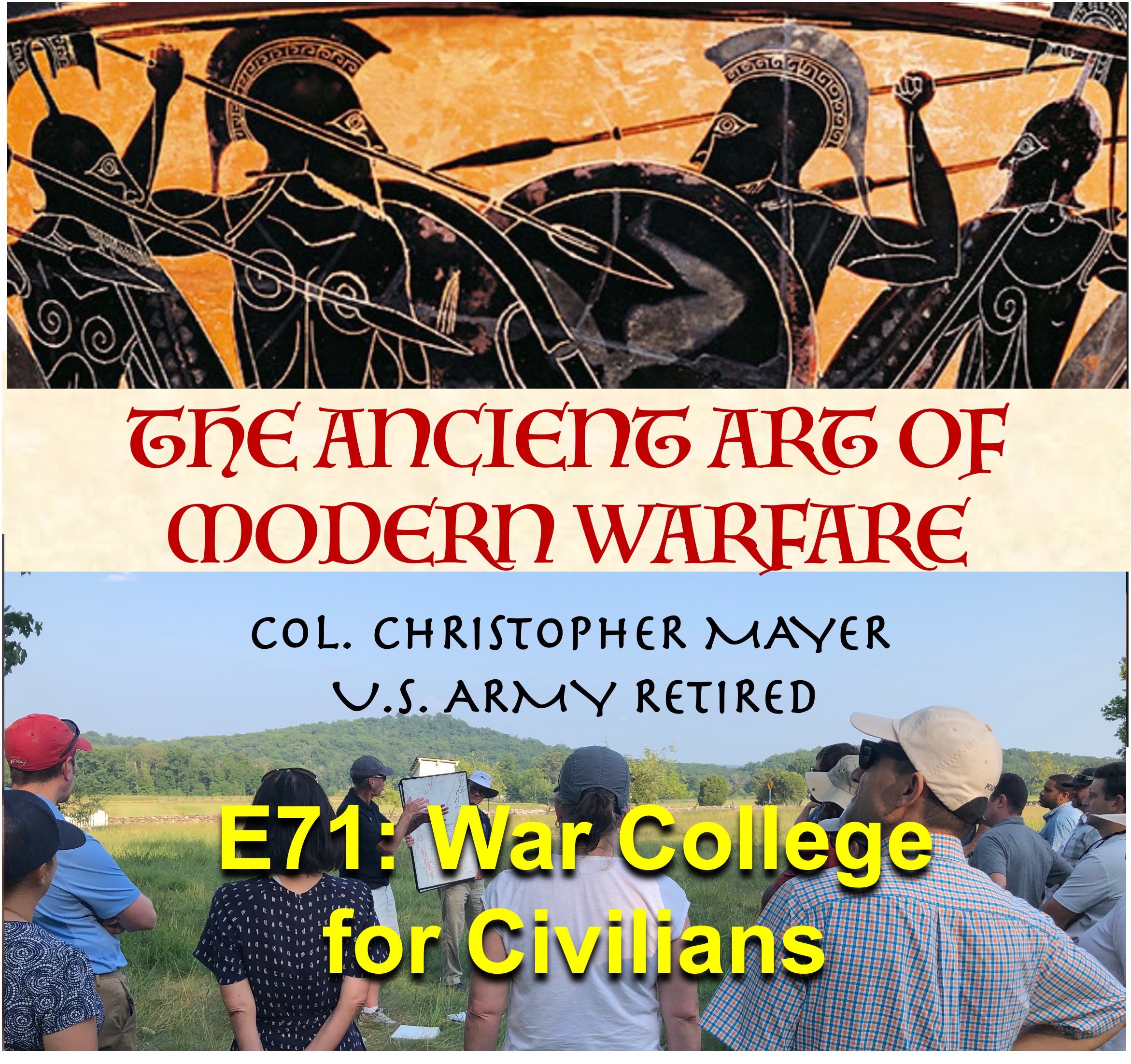
E71: War College for Civilians
What if I told you that civilians can attend the US Army War College? Not US Government employees, but civilians from all walks of life and professions? Two times each year, the Army War College offers that opportunity through its National Security Seminar and Commandant's National Security Program. In this podcast, I describe that program and interview faculty and guests during Battlefield Staff

E70: Why We Shouldn’t Help Ukraine
The decision whether to help Ukraine is not as black and white as it may appear. Episode 69 described reasons the United States and other nations should help Ukraine. In this episode, I address the other side, reasons why helping Ukraine is either wrong or dangerous. Choosing the right path forward requires us to understand both sides of the argument.
As is the case with all of these podcasts, the

E69: Ukraine -- Why Should We Care?
Why does Russia’s invasion of Ukraine affect us, or other nations? Isn’t that a matter between Russia and Ukraine? Isn’t our involvement only risking escalation and perhaps a global war? In short, why should we care? This episode of the Ancient Art of Modern Warfare address the first part, why we should care. The next episode will describe and evaluate reasons for staying out of it.

E68: Whither Wagner?
What is going on in Russia? Has Prigozhin lost his mind? Or is Wagner merely chess pieces being manipulated by a political chess master? I offer this special podcast in the Ancient Art of Modern Warfare to review points from previous podcasts on Wagner and military coups in light of breaking events in Russia. Even if this is all over by the time you see this, it may be worthwhile to look and see w

E67: Is Russia at War?
On February 23, 2022, the Russian Federation violated the territorial integrity of Ukraine – for the second time in a decade – calling it a “special military operation.” It certainly looks more like a war, but is it really a war? This podcast looks at the current Russian invasion in light of the definitions of war in Episode 7, which include war in theory, practice, and in international law.
The

E66: The Role of Citizens in Going to War
The United States of America is a republic founded on democratic principles. Not a democracy, but a republic. That means that, except in rare circumstances, the citizens do not vote on issues at the national level. Instead, we elect representatives of the people and of the component states of the United States to make those decisions. That does not, however, absolve those citizens for decisions ab

E65: The Battlefield Staff Ride
Why do we study old battles? Historic examples of strategy help us to understand enduring lessons about why nations win or don’t win wars. But historic battles and campaigns were fought using weapons, tactics, and other technology that have little relevance to modern warfare. What is the value in studying them and if we should, then how should we go about it? This episode describes one technique: