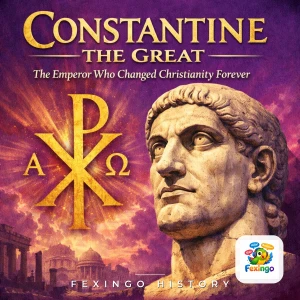
Constantine the Great: The Emperor Who Changed Christianity Forever — Fexingo History
This show follows Constantine the Great from the chaotic tetrarchy of Diocletian to his sole rule after the Battle of the Milvian Bridge, where he reportedly saw the Chi-Rho symbol. Lucas and Luna explore how he legalized Christianity with the Edict of Milan, convened the First Council of Nicaea to settle the Arian controversy, and built a new capital at Constantinople. They examine his military campaigns, monetary and bureaucratic reforms, and his complex dealings with the pagan aristocracy. The series also covers the Donatist schism, the Church of the Holy Sepulchre, and his deathbed baptism, unpacking the contradictions of a ruler who fused imperial power with Christian faith.
Episodes

Constantine's Lost General: The Battle of Tzirallum
While most histories focus on Constantine’s religious reforms or his clash with Maxentius at the Milvian Bridge, Episode 260 uncovers a critical eastern campaign often overlooked by modern audiences. In 348 AD, following Constantine’s death, the Roman Empire faced a devastating incursion by the Sassanid Persian king Shapur II. This episode explores the Battle of Tzirallum, where Roman forces under
Constantine's Lost Sister: The Tragedy of Constantia
While history fixates on Constantine the Great’s military conquests and his pivotal role in Christianizing the Roman Empire, a quieter, more personal tragedy unfolds in the imperial court. This episode explores the life of Flavia Maxima Constantia, Constantine’s full sister, whose marriage to Emperor Licinius was intended to cement peace between two halves of the Tetrarchy but instead became a fat
Constantine's Architect: The City That Outlived Rome
While previous episodes have explored Constantine’s military victories, religious conversions, and familial tragedies, this episode turns its gaze to his most enduring legacy: the physical creation of Nova Roma, later known as Constantinople. We trace the engineering marvels that turned a modest peninsula into the capital of the Eastern Empire, focusing on the innovative aqueduct systems, the stra
Constantine's Legal Revolution: The Code That Shaped Europe
We often think of Constantine the Great as the emperor who legalized Christianity, but his other legacy is arguably just as enduring: the legal framework that held the crumbling Roman Empire together. In this episode, we look past the religious controversies and the bloody family tragedies to examine Constantine’s legislative output. We explore how he moved away from the chaotic edicts of his pred
Constantine's Silk Road Trade and Economic Legacy
While historians often focus on Constantine’s religious reforms and military victories, his economic policies reshaped the Mediterranean world for centuries. This episode explores the introduction of the solidus, the gold coin that stabilized the Roman economy after decades of inflation, and how it became the standard currency for trade from Britain to Persia. We also examine Constantine’s strict
Constantine's Lost General: The Battle of Tzirallum
While Constantine the Great is remembered for his religious reforms and political consolidations, his military career included several brutal engagements against the Sassanian Empire that reshaped the eastern frontier. This episode explores the pivotal Battle of Tzirallum in 360 CE, though its roots lie in the diplomatic and military tensions established during Constantine’s reign. We examine how
Constantine's Forgotten General: The Battle of Tzirallum
While Constantine the Great is remembered for his faith and politics, his military genius was forged in the chaotic wars against Persia. This episode explores the brutal campaign of 348 AD, where Constantine faced a massive Sassanian invasion led by Shapur II. We dive into the pivotal Battle of Tzirallum, where the Roman Emperor, already fifty-five and far from Rome, personally commanded a despera
Constantine's Mother Helena and the Holy Sepulchre
In this episode, we shift focus from Constantine’s political maneuvers to the woman who shaped his spiritual identity: Saint Helena. While Constantine is often remembered for the Edict of Milan and the Council of Nicaea, it was his mother, Helena Augusta, who undertook the defining pilgrimage of late antiquity to Jerusalem around 326–328 CE. We explore how her search for the True Cross and the sit
Constantine's Lost Sister: The Tragedy of Constantia
While history fixates on Constantine’s military victories and his role in establishing Christianity, his sister Fausta’s daughter, Flavia Maxima Constantia, remains a shadowy figure defined by her marriages. This episode explores how Constantia was used as a political pawn to cement alliances within the Tetrarchy, first married to Licinius and later to Valerius Severus. We examine the delicate dip
Constantine's Last Days: Deathbed Confessions and Legacy
This episode explores the final, controversial days of Constantine the Great in 337 CE. While previous episodes covered his military reforms, religious policies, and family tragedies like the deaths of Crispus and Fausta, we focus on the circumstances of his own end. Lucas and Luna examine the conflicting accounts from Eusebius of Caesarea and Zosimus regarding Constantine’s baptism, his refusal t
Constantine's Daughter: The Tragic End of Fausta
In this episode, we uncover the harrowing final days of Flavia Maxima Fausta, Constantine’s wife and sister to his rival Licinius. While earlier episodes explored Constantine’s military reforms and religious policies, we turn to the private tragedy within the imperial family. We examine the political tensions between Fausta and her husband’s eldest son, Crispus, and how these domestic conflicts pl
Constantine's Banquet of the Princes
This episode examines the infamous banquet of 326 CE, a pivotal moment in Constantine’s reign that resulted in the executions of his son Crispus and wife Fausta. We explore the conflicting accounts from Zosimus and Eusebius, debating whether political conspiracy or familial tragedy drove these decisions. The narrative details the arrest at Poetovio, the isolation in Pula, and the subsequent purges
Constantine's Daughter: Fausta's Tragic End
This episode examines the complex and often overlooked relationship between Constantine the Great and his second wife, Fausta. While previous episodes have explored Constantine’s military reforms, religious policies, and architectural achievements, we turn our attention to the woman who bore him three sons and died under mysterious circumstances in a heated bathhouse in 326 AD. We trace her lineag
Constantine's Lost Sister: The Tragedy of Constantia
While historians have long focused on Constantine the Great’s military conquests, religious reforms, and architectural projects like Constantinople, his personal family dynamics offer a different lens into the instability of the Tetrarchy. This episode shifts focus to Flavia Maxima Constantia, Constantine’s younger sister, whose life was defined by political marriage rather than personal agency. W
Constantine's Forgotten Sister: The Tragedy of Constantia
While we have explored Constantine’s military reforms, his architectural projects, and his complex relationship with the early Church, Episode 246 turns to a figure often overshadowed by the Emperor himself: his younger sister, Flavia Maxima Constantia. Married to Licinius in an attempt to seal a political alliance between two halves of the Roman Empire, Constantia’s life became a tragic instrumen
Constantine and the Synod of Tyre
While we often focus on Constantine’s theological compromises at Nicaea or his architectural grandeur in Constantinople, this episode explores a different kind of imperial intervention: the Synod of Tyre in 335 CE. We trace how Constantine became embroiled in a bitter local dispute between two powerful bishops, Alexander of Alexandria and Arius, which spilled far beyond ecclesiastical boundaries.
Constantine's Letter to the Syriac Church
In this episode of the Fexingo History podcast network, we turn away from the grand imperial politics and theological squabbles of Nicaea to explore a quieter but profound moment in Constantine’s relationship with the Eastern church. The focus is on a specific letter sent in 325 AD to the Christians of Syria, preserved in the writings of Eusebius of Caesarea. Unlike his earlier edicts of toleratio
Constantine's Edict on Religious Toleration
While Constantine is often remembered for the Council of Nicaea and his architectural patronage, his early reign was defined by a pragmatic shift in imperial policy toward religious pluralism. This episode explores the Edict of Serdica in 311 AD, issued jointly with Licinius and Galerius, which formally ended the Diocletianic Persecution. We examine how this document granted Christians legal statu
Constantine's Jewish Policy: From Alliance to Exile
In this episode, we explore the complex and often contradictory relationship between Constantine the Great and the Jewish communities of the late Roman Empire. While earlier episodes covered his legal reforms and theological compromises, here we focus on a specific policy shift that alienated many Jews despite Constantine’s initial protection. We examine the controversy surrounding pilgrimage to J
Constantine's Jewish Policy: From Alliance to Exile
While earlier episodes covered Constantine’s Christian reforms and legal codes, this episode explores his complex, often contradictory relationship with the Jewish community. We examine how Constantine initially relied on Jewish support in his civil wars against Maxentius and Licinius, only to later enact harsh legislation that restricted Jewish rights, prohibited conversion, and barred Jews from
Constantine's Dream: The Vision Before the Battle
Before the Battle of the Milvian Bridge in 312 CE, Constantine reportedly experienced a vision that would alter the course of Western history. While later Christian historians like Lactantius and Eusebius framed this as a divine encounter with the God of Christianity, modern scholars look closer at the political and military realities of the Tetrarchy. This episode explores the primary sources reg
Constantine's Lost Sister: The Tragedy of Constantia
While her brother Constantine dominates the historical record as the first Christian emperor, his sister Constantia often fades into the shadows of dynastic politics. This episode explores her life not just as a political pawn, but as a crucial stabilizing force in the late Roman Empire. We examine how she was married twice to rival emperors—first Licinius, then Constans—in an attempt to forge pea
Constantine's Lost Sister: The Tragedy of Constantia
While we have spent many episodes examining Constantine the Great’s military campaigns, theological compromises, and legal reforms, history has largely obscured the life of his younger sister, Constantia. Born around 315 AD, she was not merely a passive figure in her brother’s shadow but a crucial diplomatic tool in the volatile politics of the Tetrarchy. This episode explores her marriage to Lici
Constantine's Mithraic Roots and the Chi-Rho Symbol
While previous episodes explored Constantine’s legal reforms, theological compromises at Nicaea, and the architectural grandeur of his new capital, this episode digs into the spiritual crucible that shaped his worldview: the syncretism of late Roman paganism and early Christianity. We examine how the cult of Sol Invictus, the Unconquered Sun, intertwined with emerging Christian symbolism to create
Constantine and the Battle of the Milvian Bridge
In this episode, we step away from the legal codes, theological debates, and architectural projects that have defined our previous look at Constantine’s reign. Instead, we focus on the single day that altered the trajectory of Western history: October 28, 312 AD. We examine the political landscape of the Tetrarchy, the rivalry between Constantine and Maxentius, and the strategic decisions that led
Constantine's Silk Road: Trade, Religion, and Power
While we often focus on Constantine’s legal reforms and military victories, his reign also transformed the Mediterranean into a bustling hub of global trade. This episode explores how Constantine leveraged the Silk Road to connect Rome with the Sassanian Empire and India, using commerce as a tool for diplomatic influence. We examine the role of Syriac-speaking merchants in spreading Christianity b
Constantine’s Military Reforms: The Scholae Palatinae
While Constantine the Great is famous for his religious edicts and the founding of Constantinople, his most enduring structural change was to the Roman military itself. In this episode, we explore how he dismantled the Praetorian Guard after their betrayal at the Milvian Bridge and replaced them with the Scholae Palatinae — elite palace troops loyal only to the emperor. Lucas and Luna trace the ev
Constantine's Golden Basilica and the Architecture of Power
This episode explores Constantine’s architectural legacy in Constantinople, focusing on the construction of the Golden Bema, the Great Palace, and the Church of the Holy Apostles. We examine how these structures were not just religious or political centers but deliberate statements of imperial divinity and urban planning. The conversation covers the engineering marvels of the time, the integration
Constantine's Mithraic Roots and the Chi-Rho Symbol
We often picture Constantine as a purely Christian emperor, but his path to power was paved with older, sun-worshipping traditions. In this episode, we explore the complex religious landscape of the early fourth century, focusing on the influence of Mithraism and the cult of Sol Invictus on Constantine’s personal beliefs. We examine how he navigated these competing spiritual forces before and afte
Constantine’s Imperial Portraits and the Art of Power
This episode explores how Constantine the Great used colossal marble statues, bronze busts, and architectural propaganda to reshape Roman imperial identity. We examine the Colossus of Constantine in Rome, its placement in the Basilica Nova, and how its scale communicated divine authority rather than human vulnerability. Lucas traces the evolution from Diocletian’s tetrarchic symmetry to Constantin
Constantine's Mithraic Roots and the Chi-Rho
While Constantine is remembered as the first Christian emperor, his early religious life was deeply entangled with Sol Invictus and the mystery cult of Mithras. This episode explores the complex spiritual landscape of the late Roman Empire, examining how Constantine’s father, Constantius Chlorus, navigated these pagan traditions before the Battle of Milvian Bridge in 312 AD. We look at the archaeo
Constantine's Baptism: The Mystery of His Final Faith
For decades, historians debated whether Constantine the Great was baptized before or after his death. While earlier episodes covered his Edict of Milan and the Council of Nicaea, this episode explores the mystery of his final days in Nicomedia. We examine the conflicting accounts from Eusebius of Caesarea and Zosimus regarding his baptism by Bishop Eusebius of Nicomedia. Was it a last-minute ritua
Constantine's Secret Army: The Scholae Palatinae
While we often focus on Constantine’s religious reforms or the founding of Constantinople, his most immediate source of power lay in a small, elite group of soldiers known as the scholae palatinae. Before this episode, you might know about the limitanei guarding the borders or the comitatenses field armies, but the imperial bodyguards were something entirely different. They were drawn from the fin
Constantine's Last Days and the Mystery of His Death
For over two decades, our show has traced Constantine the Great’s rise, his legal reforms, the Council of Nicaea, and the founding of Constantinople. But history often skips the final, bewildering chapter: the last forty days of his life in 337 AD. In this episode, we leave behind the polished edicts and theological compromises to examine the visceral reality of Constantine’s final illness. We exp
Constantine's Letter to Eusebius: The Text That Shaped Orthodoxy
In this episode, we look past the battles and the coins to examine a single document that fundamentally altered the trajectory of Western religion. We explore the letter Constantine sent to Eusebius of Caesarea in 326 AD, instructing him to produce fifty copies of the sacred scriptures. This commission was not merely an act of piety but a logistical masterpiece involving state resources, imperial
Constantine's Theological Compromise: The Council of Nicaea
In this episode, we explore the complex political and theological maneuvering behind the Council of Nicaea in 325 CE. While often remembered as the birthplace of the Nicene Creed, the council was less about simple doctrinal clarity and more about imperial consolidation. We examine how Constantine summoned bishops from across the Mediterranean to resolve the Arian controversy, a debate that threate
Constantine's Forgotten Mother Helena and the True Cross
While Constantine is rightly celebrated for his political maneuvers and military victories, his mother Helena Augusta played a pivotal role in shaping the religious landscape of the fourth century. This episode explores her journey to the Holy Land around 326 CE, a pilgrimage that was as much about imperial prestige as personal devotion. We examine the archaeological evidence behind the discovery
Constantine's Coinage: How Money Built the New Empire
We often think of Constantine’s legacy in terms of churches, laws, and battles, but his most enduring revolution might have been printed on gold. In this episode, we explore how Constantine reformed the Roman monetary system with the introduction of the solidus, a coin so stable it would circulate for nearly nine hundred years without debasement. We trace the economic pressures that led to this ch
Constantine's Christian Courts: Law, Faith, and Forgiveness
While we often remember Constantine for the Edict of Milan or his military campaigns, his most enduring legacy may lie in the courtroom. This episode explores how the first Christian emperor reshaped Roman jurisprudence, blending imperial authority with emerging theological concepts. We examine specific legal reforms that elevated the status of women, restricted cruel punishments, and introduced t
Constantine's Tax on Sin: The Empire's First Moral Code
We often think of Constantine the Great as the emperor who legalized Christianity, but his legal legacy is far more complex and contradictory. In this episode, we explore how Constantine’s laws simultaneously granted tolerance to Christian bishops while imposing severe criminal penalties on traditional Roman religious practices. We examine the specific statutes that banned divination, restricted a
Constantine's Shadow: The Execution of Crispus
In this episode, we look past the victories and the faith to examine the darkest hour of Constantine’s reign. We explore the tragic fall of his eldest son, Crispus, once hailed as Caesar and a brilliant military commander. Historians have long debated the reasons behind his sudden execution in 326 AD, uncovering a tangled web of imperial politics, jealousy, and family tragedy. We dive into the acc
Constantine's Greek East: The Language Shift That Built Byzantium
In 330 CE, Constantine dedicated his new capital on the Bosporus, but the real transformation wasn't just bricks and marble—it was language. Over the course of his reign, the emperor's public words shifted from Latin, the language of Roman law and army, to Greek, the tongue of Homer and the New Testament. This episode explores how that linguistic pivot reoriented the empire's center of gravity, re
Constantine's Lawgivers: Shaping a Christian Empire
In this episode of Fexingo History, Lucas and Luna examine Constantine's legal reforms and his efforts to shape a Christian empire. Drawing on the Theodosian Code, they explore Constantine's legislation on marriage, family, and religion, including his restrictions on Jewish conversion and his support for the Church. They also discuss the influence of his legal innovations on later emperors and the
Constantine's Law: The Edicts That Remade Rome
In this episode, Lucas and Luna explore the legal revolution that accompanied Constantine's conversion. From the Edict of Milan in 313 to the laws against crucifixion and gladiatorial games, Constantine used imperial legislation to reshape Roman society. They discuss the influence of Lactantius, the Council of Arles, the Donatist controversy, and the legal status of bishops as judges. They also ex
Constantine's Senate: A New Elite for a New Capital
When Constantine rebuilt Byzantium as Constantinople, he needed more than walls and churches—he needed a ruling class. This episode unpacks how the emperor engineered a brand-new senate in his eastern capital, a controversial move that bypassed Rome's ancient aristocracy. We explore the membership of these new senators, drawn from provincial elites and administrators, and the ranks they held—like
Constantine's Mother: Helena and the True Cross Discovery
In this episode, Lucas and Luna explore the remarkable life of Helena Augusta, mother of Constantine the Great. From her rise from humble origins to her pilgrimage to the Holy Land, Helena's journey reshaped Christian history. Discover how she uncovered the True Cross, commissioned the Church of the Nativity and the Church of the Holy Sepulchre, and influenced imperial policy. The episode also exa
Constantine's Wedding Gift: Crispus and the Blood of a Dynasty
In 317, Constantine married his daughter Constantia to his co-emperor Licinius, sealing an uneasy peace after the first civil war. But the marriage wasn't the end of the story — it was the beginning of a tangled web of ambition, intrigue, and bloodshed that would end with Constantine's own son Crispus dead and his wife Fausta dead, possibly killed by the man who had once been Rome's greatest champ
Constantine's Military Reforms: The Army He Built
Constantine the Great is remembered for his vision at the Milvian Bridge and his embrace of Christianity, but his impact on the Roman military was just as profound. In this episode, Lucas and Luna explore the emperor's sweeping reforms of the army: the creation of a mobile field army (comitatenses), the rise of frontier troops (limitanei), the strategic shift from heavy infantry to cavalry, the in
Constantine's New Rome: The Founding of Constantinople
In 324, Constantine stood on the shore of the Bosporus and decided to build a city that would outlast his empire. This episode traces the founding of Constantinople — from the ancient Greek settlement of Byzantium to the grand imperial capital that would stand for over a thousand years. We look at why Constantine chose this site, how he transformed it, the new administrative structures he created,
Constantine's Edict of Toleration: The Real Story of 313
When Constantine and Licinius met in Milan in 313, they issued a document that would reshape the Roman world. But the Edict of Milan wasn't a decree of universal religious freedom — it was a pragmatic agreement between two emperors locked in a power struggle. In this episode, Lucas and Luna untangle the text, the politics, and the myths behind the 'edict' that never actually mentioned Christianity
Constantine's Greek Letters: A Deeper Campaign
Emperor Constantine's conversion wasn't a single vision. It was also a war of words, fought with letters, laws, and carefully chosen Greek. In this episode, Lucas and Luna explore the surviving imperial correspondence to the eastern provinces—letters that reveal a ruler fine-tuning his message for different audiences. From the famous edict to the eastern provincials after Licinius's fall, to the s
Constantine's Edict of Milan: The Turning Point of Faith
In this episode, Lucas and Luna explore the Edict of Milan of 313 CE, the document that ended the persecution of Christians and set the stage for Christianity's rise in the Roman Empire. They dive into the political maneuvering behind the edict, the roles of Constantine and Licinius, and the difference between the edict's tolerance and later favoritism. The conversation touches on Lactantius, Euse
Constantine's Baptism: The Delayed Sacrament
In this episode, Lucas and Luna explore one of the most debated aspects of Constantine's life: his decision to postpone baptism until he was on his deathbed. Why did the first Christian emperor wait so long? What did baptism mean in the fourth century, and how did his choice shape Christian practice for centuries? The conversation traces Constantine's journey from his mother Helena's influence, th
Constantine's Last Victory: The Battle of the Hellespont
In 324, Constantine faced his final rival, Licinius, not on land but at sea. The Battle of the Hellespont saw a smaller, lighter Christian fleet defeat a larger pagan armada, thanks to a sudden storm and the tactical genius of Crispus, Constantine's eldest son. This episode unpacks the naval clash at the Dardanelles, the role of the Chi-Rho on Constantine's sails, and the political maneuvering tha
Constantine's Spolia: The Arch of Constantine and the Art of Reuse
Constantine's Arch of Constantine in Rome is famous for its recycled sculpture—spolia—taken from earlier emperors' monuments. But why did Constantine reuse Trajan's Dacian panels, Marcus Aurelius's battle scenes, and Hadrian's hunting tondi? Was it a sign of artistic decline, or a deliberate political statement? This episode unpacks the arch's layered messages, the Antonine and Trajanic reliefs, t
Constantine's Porphyry Column: Rome's New Heart
In 330 CE, Constantine dedicated a new capital on the Bosporus, and at its center he planted a column that would become the most sacred, mysterious object in Constantinople for a thousand years. The Porphyry Column, made of purple stone dragged from the desert of Upper Egypt, was topped by a statue of Constantine as Sol, Apollo, and Christ all at once — and beneath it, legend says, lay relics that
Constantine's Church of the Holy Sepulchre: The Shrine That Changed the World
In this episode of Fexingo History, Lucas and Luna take you to Jerusalem in the year 326, where Constantine's mother Helena arrives to identify the site of Christ's crucifixion and burial, and where the emperor commissions a church that will shape Christian pilgrimage for centuries. We explore the pagan temple that once stood there, the discovery of the True Cross as reported by Eusebius of Caesar
Constantine's Bridge Heads: Why Did He Build Them?
Constantine the Great is remembered for the Milvian Bridge, the Council of Nicaea, and the founding of Constantinople. But in 328, he ordered the construction of a massive stone bridge across the Danube at Oescus — and topped it with colossal bronze statues of himself and his sons, their heads turned toward the sky. In this episode, Lucas and Luna explore the mystery of Constantine's bridge heads:
Constantine's Sacred Geography: The Holy Land Project
In this episode, Lucas and Luna explore Constantine's ambitious building program in the Holy Land—the churches he commissioned at Bethlehem, the Mount of Olives, and Mamre, and how he reshaped Christian pilgrimage. They discuss the role of his mother Helena, the discovery of the True Cross, and the political and theological motives behind these sacred sites. From the Church of the Nativity to the
Constantine's Forgotten Rival: The Battle of Cibalae
Long before the Milvian Bridge, Constantine fought a brutal civil war against his brother-in-law Licinius. This episode explores the Battle of Cibalae in 316 AD, where Constantine's leadership and religious symbolism clashed with Licinius's pagan loyalty. We trace the campaign from the Danube frontier to the plains of Pannonia, examining the tactics, the stakes, and the aftermath that redrew the m
Constantine's Coinage: How Money Shaped an Empire
In this two-hundredth episode, Lucas and Luna explore the imperial economy through the lens of Constantine's coinage reform. From the debased denarius to the introduction of the gold solidus in 309, we trace how a new currency stabilized the Roman world and projected imperial power. Along the way, we meet the mints of Trier and Siscia, the enigmatic nummus, and the famous Chi-Rho coinage that foll
Constantine's Vision: The Real Story Behind the Chi-Rho
In this episode, Lucas and Luna dig into the most famous moment of Constantine's life — the vision before the Battle of the Milvian Bridge. They sort through the conflicting accounts of Lactantius and Eusebius, explore what the Chi-Rho actually looked like, and ask whether Constantine really saw a cross in the sky or whether it was a political calculation dressed as divine revelation. Along the wa
Constantine's Mausoleum: The Church of the Holy Apostles
In this episode of Fexingo History, Lucas and Luna explore Constantine's final architectural project: the Church of the Holy Apostles in Constantinople. Built as his imperial mausoleum, the church was designed to house his tomb surrounded by twelve cenotaphs representing the twelve apostles, casting Constantine as the thirteenth apostle. They discuss the building's cruciform layout, its circular t
Constantine's Panic Button: The Gold Solidus That Saved Rome
In 312 AD, Constantine the Great faced an economic meltdown. The Roman currency was in chaos, prices were soaring, and the empire's stability hung by a thread. His solution was audacious: a new gold coin so pure and so heavy it would define money for a thousand years. This is the story of the solidus—the coin that stabilized the Mediterranean world, funded Constantinople's rise, and became the bac
Constantine's Great Persecution: A Christian Emperor's Pagan Edict
In 324, Constantine issued an edict against sacrifices and the closing of temples — a shock from the emperor who built churches and legalized Christianity. But was this the beginning of Christian persecution of pagans, or a pragmatic gesture? Lucas and Luna uncover the edict's text in Eusebius's Life of Constantine, its enforcement by eastern officials, and the silence in the West. They explore th
Constantine's Victory Arch: The Battle That Made History
In 312 CE, Constantine faced Maxentius at the Milvian Bridge. The victory that followed didn't just decide who ruled Rome—it changed the course of Western history. This episode of Fexingo History dives deep into the Arch of Constantine, the monumental monument erected to commemorate that victory. We examine the arch's structure, its recycled sculptures from earlier emperors, and its strategic poli
Helena and the True Cross: Constantine's Mother
Constantine's mother Helena was no passive empress dowager. In her late seventies, she traveled to the eastern provinces on an imperial mission that blended pilgrimage, archaeology, and church politics. This episode follows her journey to Jerusalem, where tradition says she uncovered the True Cross — and explores how a relatively obscure Christian site became one of the holiest places on earth. We
Constantine's Helmet: The Chi-Rho and the Battle of Turin
In 312, Constantine faced Maxentius' cavalry at the Battle of Turin. This episode zooms in on that clash — the ambush formation, the imperial bodyguard, and the moment Constantine's helmet flashed the Chi-Rho. We look at the archaeological evidence from the Arch of Constantine and the ancient accounts of Lactantius and Eusebius, exploring how a personal religious symbol became a military standard.
Constantine's Bridge at Cologne: A Forgotten Legacy
In 310 AD, Constantine ordered a massive stone bridge across the Rhine at Cologne — Colonia Claudia Ara Agrippinensium — a project that both proclaimed his power and secured the frontier. This episode follows the bridge's construction, its role in Constantine's campaigns against the Franks and his rivalry with the Tetrarchy, and its afterlife through the Middle Ages. Lucas and Luna dig into the ar
Constantine's New Rome: The City That Shaped Christendom
In this episode, Lucas and Luna explore Constantine's foundation of Constantinople, the city he built as a Christian capital on the site of ancient Byzantium. They discuss the strategic choice of the Bosporus, the founding rituals that blended pagan and Christian elements, the construction of the Forum of Constantine with its porphyry column and relic of the True Cross, the creation of the Senate
Constantine's Pagan Roots: Sol Invictus and the Christian Shift
In this episode, Lucas and Luna explore how Constantine's religious transformation was more gradual and syncretic than often imagined. They discuss his early devotion to Sol Invictus, the appearance of the Chi-Rho in 312, the continuing use of pagan titles like Pontifex Maximus, the construction of Constantinople as a Christian city with pagan echoes, and the emperor's own religious self-understan
Constantine's Bronze Giant: The Colossus of Rome
In this episode, Lucas and Luna dig into the colossal bronze statue that once stood in the Basilica of Maxentius — a towering image of Constantine that blended sun-ray crown, spear, and globe, and may have held a piece of the True Cross. They piece together its fragments, its marble head and foot, and the controversy over whether it was a reused statue of the sun god or a new Christian statement.
The Edict of Milan Constantine and the Birth of Religious Toleration
In February 313, two Roman emperors—Constantine and Licinius—met in Milan and agreed to a policy that would change the course of history. The so-called Edict of Milan granted all people the freedom to worship as they chose, ended state persecution of Christians, and ordered the return of confiscated church property. This episode unpacks what the edict actually said, how it differed from the earlie
Constantine's Ban on Gladiators and Crucifixion
In this episode, Lucas and Luna delve into Constantine the Great's often-overlooked reforms: the outlawing of gladiatorial games and the abolition of crucifixion as a capital punishment. Drawing from the Codex Theodosianus and Eusebius of Caesarea, they explore how these edicts reflected Constantine's Christian convictions and altered the fabric of Roman society. The discussion covers the gradual
Constantine The Emperor as Bishop of Those Outside
Constantine the Great is famous for the Edict of Milan, the Council of Nicaea, and founding Constantinople. But few know his own vision of imperial Christianity: he called himself the 'bishop of those outside' (episkopos ton ektos). In this episode, Lucas and Luna explore how Constantine intervened in church disputes, wrote letters to bishops, presided at councils, and saw his rule as divinely ord
Constantine's Deathbed Baptism An Emperor's Final Controversy
In this episode, we explore the final days of Constantine the Great, focusing on his deathbed baptism in May 337. Surprisingly, the emperor who convened the Council of Nicaea and championed the homoousian creed chose to be baptized by Eusebius of Nicomedia, a leading Arian bishop. We delve into the reasons behind this decision, the theological and political fallout, and the irony of a ruler who sp
Constantinople: Constantine's Christian Capital
In this episode, Lucas and Luna explore Constantine the Great's most enduring legacy: the foundation of Constantinople, the 'New Rome' on the Bosporus. They discuss why Constantine chose the ancient Greek city of Byzantium, the grand dedication ceremony on May 11, 330 AD, and how the city was designed as a Christian capital with forums, a hippodrome, and defensive walls. The conversation also cove
Constantine's Sunday Law: Pagan Sun Day to Christian Sabbath
In 321 AD, Constantine issued an edict that made Sunday a day of rest for the Roman Empire. This episode unpacks the legal text from the Codex Theodosianus, examines whether it was a Christian or pagan measure (the dies Solis was already sacred to Sol Invictus), and traces how it shaped the Christianization of the week. We explore the practical impact on farmers, slaves, and soldiers; the reaction
The Battle of Chrysopolis — Constantine's Final Victory
In 324 AD, Constantine the Great faced his last rival: Licinius, co-emperor of the East. After years of uneasy alliance, war erupted. Constantine's son Crispus won a stunning naval battle at the Hellespont, while Constantine himself crushed Licinius at Adrianople. The final showdown came at Chrysopolis, modern Üsküdar, near the future site of Constantinople. This episode unpacks the battles, the r
Emperor Maxentius: Constantine's Great Rival
In this episode of Constantine the Great, Lucas and Luna explore the life and reign of Emperor Maxentius, Constantine's brother-in-law and rival for control of the Roman Empire. They trace Maxentius's rise after the collapse of the tetrarchy in 306, his consolidation of power in Rome through populist policies and restored monuments like the Temple of Peace, and his fateful confrontation with Const
Recommended

History of the Earthquake and Fire in San Francisco

Fox news

K-Drama Obsessed Mamas | Beyond “Just One More Episode!”

True Crime Classics

The Healer Revolution

Becoming: HER with Nikki Spoelstra

Booked, Blonde & Busy w/ Olivia Ponton

McKinsey on Consumer and Retail

megahired.com

Hard Knocks Podcast

Effective Weight Loss for Moms | High protein, Strength Training, Lose Weight, Meal Planning, Fat Loss, Healthy Habits

The Human-Animal Connection - Pet Life Radio Original
