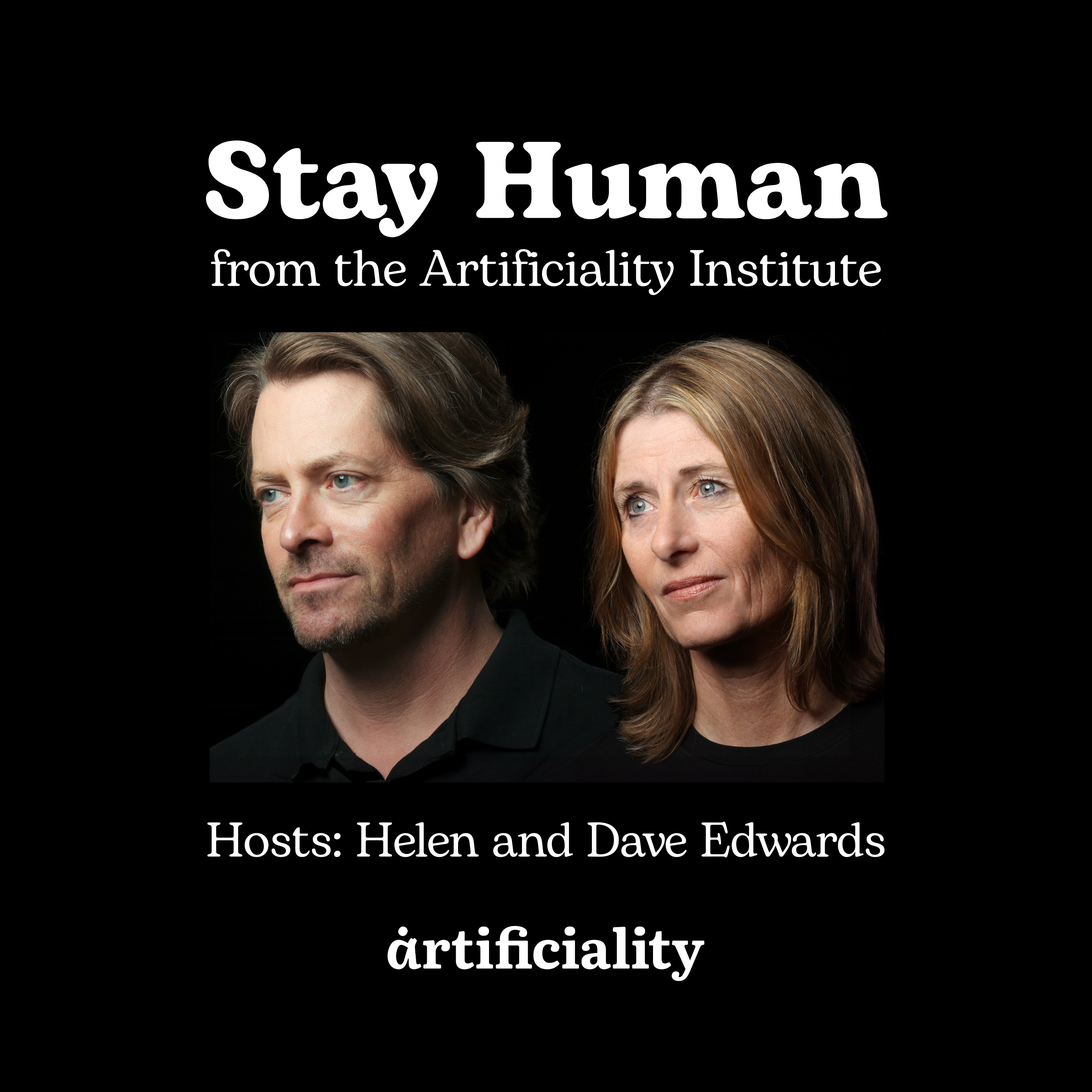
Stay Human, from the Artificiality Institute
Stay Human, from the Artificiality Institute explores how artificial intelligence transforms the way we think, who we become, and what it means to be human. The hosts believe AI should not merely be safe or efficient, but genuinely valuable to people. Through story-based research, education, and community, they help listeners choose the relationship they want with machines, so that people remain the authors of their own minds.
Episodes
Chris Summerfield: These Strange New Minds
In this conversation, we explore machine intelligence and human understanding with Christopher Summerfield, Professor of Cognitive Neuroscience at Oxford and author of "These Strange New Minds: How AI Learned to Talk and What It Means." Chris offers a "third way" of thinking about AI—neither irrational exuberance nor dismissive skepticism, but a view grounded in cognitive scien
Nina Beguš: Artificial Humanities
In this conversation, we explore the cultural foundations of artificial intelligence with Nina Beguš, Assistant Professor at UC Berkeley and author of "Artificial Humanities: A Fictional Perspective on Language in AI." Nina makes a compelling case for an entirely new field—one that brings humanistic insights into the very creation of technology rather than treating humanities as critical
Blaise Agüera y Arcas: What Is Intelligence?
In this conversation, we explore the nature of intelligence and life itself with Blaise Agüera y Arcas, VP and Fellow at Google and head of the Paradigms of Intelligence Lab. Blaise discusses his ambitious new book "What Is Intelligence?"—a work that bridges evolutionary biology, complexity science, artificial life, and AI to argue that intelligence fundamentally arises from computation,
Steven Sloman: The Cost of Conviction
In this conversation, we explore the psychology of conviction with Steve Sloman, Professor of Cognitive, Linguistic, and Psychological Sciences at Brown University and advisor to the Artificiality Institute. Returning to the podcast for a third time, Steve discusses his new book "The Cost of Conviction," which examines a fundamental tension in how humans make decisions—between carefully
Ellie Pavlick: The AI Paradigm Shift
In this conversation, we explore the foundations of artificial intelligence with Ellie Pavlick, Assistant Professor of Computer Science at Brown University, a Research Scientist at Google Deepmind, and Director of ARIA, an NSF-funded institute examining AI's role in mental health support. Ellie's trajectory—from undergraduate degrees in economics and saxophone performance to pioneering res
Helen & Dave Edwards: Becoming Synthetic
We enjoyed giving a virtual keynote for the Autonomous Summit on December 4, 2025, titled Becoming Synthetic: What AI Is Doing To Us, Not Just For Us. We talked about our research on how to maintain human agency & cognitive sovereignty, the philosophical question of what it means to be human, and our new(ish) approach to create better AI tools called unDesign. unDesign is not the absence of de
Tess Posner: AI, Creativity, and Education
In this conversation recorded on the 1,000th day since ChatGPT's launch, we explore education, creativity, and transformation with Tess Posner, founding CEO of AI4ALL. For nearly a decade—long before the current AI surge—Tess has led efforts to broaden access to AI education, starting from a 2016 summer camp at Stanford that demonstrated how exposure to hands-on AI projects could inspire high
Eric Schwitzgebel: The Weirdness of the World
In this conversation, we explore the philosophical art of embracing uncertainty with Eric Schwitzgebel, Professor of Philosophy at UC Riverside and author of "The Weirdness of the World." Eric's work celebrates what he calls "the philosophy of opening"—not rushing to close off possibilities, but instead revealing how many more viable alternatives exist than we typically rec
John Pasmore: Inclusive AI
In this conversation, we explore the challenges of building more inclusive AI systems with John Pasmore, founder and CEO of Latimer AI and advisor to the Artificiality Institute. Latimer represents a fundamentally different approach to large language models—one built from the ground up to address the systematic gaps in how AI systems represent Black and Brown cultures, histories, and perspectives
De Kai: Raising AI
In this conversation, we explore how humans can better navigate the AI era with De Kai, pioneering researcher who built the web's first machine translation systems and whose work spawned Google Translate. Drawing on four decades of AI research experience, De Kai offers a different framework for understanding our relationship with artificial intelligence—moving beyond outdated metaphors toward
Adam Cutler: AI, Design, and the Human Future
In this conversation, we sit down with Adam Cutler, Distinguished Designer at IBM and pioneer in human-centered AI design, to explore how generative AI is reshaping creativity, reliance, and human experience. Adam reflects on the parallels between today’s AI moment and past technology shifts—from the rise of Web 2.0 to the early days of the internet—and why we may be living through a “mini singula
Christine Rosen: The Extinction of Experience
In this conversation, we explore the shifts in human experience with Christine Rosen, senior fellow at the American Enterprise Institute and author of "The Extinction of Experience: Being Human in a Disembodied World." As a member of the "hybrid generation" of Gen X, Christine (like us) brings the perspective of having lived through the transition from an analog to a digital wo
Beth Rudden: AI, Trust, and Bast AI
Join Beth Rudden at the Artificiality Summit in Bend, Oregon—October 23-25, 2025—to imagine a meaningful life with synthetic intelligence for me, we and us. Learn more here: www.artificialityinstitute.org/summitIn this thought-provoking conversation, we explore the intersection of archaeological thinking and artificial intelligence with Beth Rudden, former IBM Distinguished Engineer and CEO of Bas
Steve Sloman: Information to Bits at the Artificiality Summit 2024
At the Artificiality Summit in October 2024, Steve Sloman, professor at Brown University and author of The Knowledge Illusion and The Cost of Conviction, catalyzed a conversation about how we perceive knowledge in ourselves, others, and now in machines. What happens when our collective knowledge includes a community of machines? Steve challenged us to think about the dynamics of knowledge and unde
Jamer Hunt on the Power of Scale
At the Artificiality Summit 2024, Jamer Hunt, professor at the Parsons School of Design and author of Not to Scale, catalyzed our opening discussion on the concept of scale. This session explored how different scales—whether individual, organizational, community, societal, or even temporal—shape our perspectives and influence the design of AI systems. By examining the impact of scale on context an
Avriel Epps: Teaching Kids About AI Bias
In this conversation, we explore AI bias, transformative justice, and the future of technology with Dr. Avriel Epps, computational social scientist, Civic Science Postdoctoral Fellow at Cornell University's CATLab, and co-founder of AI for Abolition.What makes this conversation unique is how it begins with Avriel's recently published children's book, A Kids Book About AI Bias (Penguin
Benjamin Bratton: The Platypus and the Planetary
In this wide-ranging conversation, we explore the implications of planetary-scale computation with Benjamin Bratton, Director of the Antikythera program at the Berggruen Institute and Professor at UC San Diego. Benjamin describes his interdisciplinary work as appearing like a "platypus" to others—an odd creature combining seemingly incompatible parts that somehow works as a coherent whol
David Wolpert: The Thermodynamics of Meaning
In this episode, we welcome David Wolpert, a Professor at the Santa Fe Institute renowned for his groundbreaking work across multiple disciplines—from physics and computer science to game theory and complexity. * Note: If you enjoy our podcast conversations, please join us for the Artificiality Summit on October 23-25 in Bend, Oregon for many more in person conversations like these! Learn more abo
Blaise Agüera y Arcas and Michael Levin: The Computational Foundations of Life and Intelligence
In this remarkable conversation, Michael Levin (Tufts University) and Blaise Agüera y Arcas (Google) examine what happens when biology and computation collide at their foundations. Their recent papers—arriving simultaneously yet from distinct intellectual traditions—illuminate how simple rules generate complex behaviors that challenge our understanding of life, intelligence, and agency.Michael’s &
Maggie Jackson: Embracing Uncertainty
In this episode, we welcome Maggie Jackson, whose latest book, Uncertain, has become essential reading for navigating today’s complex world. Known for her groundbreaking work on attention and distraction, Maggie now turns her focus to uncertainty—not as a problem to be solved, but as a skill to be cultivated. Note: Uncertain won an Artificiality Book Award in 2024—check out our review here: https:
Greg Epstein: Tech Agnostic
In this episode, we talk with Greg Epstein—humanist chaplain at Harvard and MIT, bestselling author, and a leading voice on the intersection of technology, ethics, and belief systems. Greg’s latest book, Tech Agnostic, offers a provocative argument: Silicon Valley isn’t just a powerful industry—it has become the dominant religion of our time. Note: Tech Agnostic won an Artificality Book Award in 2
Chris Messina: Reimagining AI
In this episode, we sit down with the ever-innovative Chris Messina—creator of the hashtag, top product hunter on Product Hunt, and trusted advisor to startups navigating product development and market strategy.Recording from Ciel Media’s new studio in Berkeley, we explore the evolving landscape of generative AI and the widening gap between its immense potential and real-world usability. Chris int
D. Graham Burnett: Attention and much more...
D. Graham Burnett will tell you his day job is as a professor of science history at Princeton University. He is also co-founder of the Strother School of Radical Attention and has been associated with the Friends of Attention since 2018. But none of those positions adequately describe Graham.His bio says that he “works at the intersection of historical inquiry and artistic practice.” He writes, he
Michael Levin—The Future of Intelligence: Synthbiosis
At the Artificiality Summit 2024, Michael Levin, distinguished professor of biology at Tufts University and associate at Harvard's Wyss Institute, gave a lecture about the emerging field of diverse intelligence and his frameworks for recognizing and communicating with the unconventional intelligence of cells, tissues, and biological robots. This work has led to new approaches to regenerative m
Artificiality Keynote at the Imagining Summit 2024
Our opening keynote from the Imagining Summit held in October 2024 in Bend, Oregon. Join us for the next Artificiality Summit on October 23-25, 2025!
Read about the 2024 Summit here: https://www.artificiality.world/the-imagining-summit-we-imagined-and-hoped-and-we-cant-wait-for-next-year-2/
And join us for the 2025 Summit here: https://www.artificiality.world/summit/
DeepSeek: What Happened, What Matters,
and Why It’s Interesting
First:
- Apologies for the audio! We had a production error…
What’s new:
- DeepSeek has created breakthroughs in both: How AI systems are trained (making it much more affordable) and how they run in real-world use (making them faster and more efficient)
Details
- FP8 Training: Working With Less Precise Numbers
- Traditional AI training requires extremely precise numbers
- DeepSeek found you ca
Hans Block & Moritz Riesewieck: Eternal You
We’re excited to welcome writers and directors Hans Block and Moritz Riesewieck to the podcast. Their debut film, ‘The Cleaners,’ about the shadow industry of digital censorship premiered at the Sundance Film Festival in 2018 and has since won numerous international awards and been screened at more than 70 international film festivals.
We invited Hans and Moritz to the podcast to talk about their
How AI Affects Critical Thinking and Cognitive Offloading
Briefing: How AI Affects Critical Thinking and Cognitive Offloading
What This Paper Highlights
- The study explores the growing reliance on AI tools and its effects on critical thinking, specifically through cognitive offloading—delegating mental tasks to AI systems.
- Key finding: Frequent AI tool use is strongly associated with reduced critical thinking abilities, especially among younger users,
J. Craig Wheeler: The Path to Singularity
We’re excited to welcome Craig Wheeler to the podcast. Craig is an astrophysicist and Professor at the University of Texas at Austin. Over his career, he has made significant contributions to our understanding of supernovae, black holes, and the nature of the universe itself.
Craig’s new book, The Path to Singularity: How Technology Will Challenge the Future of Humanity, offers an exploration of h
AI Agents & the Future of Human Experience + Always On AI Wearables + Artificiality Updates for 2025
Science Briefing: What AI Agents Tell Us About the Future of Human Experience
* What These Papers Highlight
- AI agents are improving but far from capable of replacing human tasks. Even the best models fail at simple things humans find intuitive, like handling social interactions or navigating pop-ups.
- One paper benchmarks agent performance in workplace-like tasks, showing just 24% success on e
Doyne Farmer: Making Sense of Chaos
We’re excited to welcome Doyne Farmer to the podcast. Doyne is a pioneering complexity scientist and a leading thinker on economic systems, technological change, and the future of society. Doyne is a Professor of Complex Systems at the University of Oxford, an external professor at the Santa Fe Institute, and Chief Scientist at Macrocosm.
Doyne’s work spans an extraordinary range of topics, from a
James Boyle: The Line—AI And the Future of Personhood
We're excited to welcome Jamie Boyle to the podcast. Jamie is a law professor and author of the thought-provoking book The Line: AI and the Future of Personhood.
In The Line, Jamie challenges our assumptions about personhood and humanity, arguing that these boundaries are more fluid than traditionally believed. He explores diverse contexts like animal rights, corporate personhood, and AI developme
Shannon Vallor: The AI Mirror
We're excited to welcome to the podcast Shannon Vallor, professor of ethics and technology at the University of Edinburgh, and the author of The AI Mirror.
In her book, Shannon invites us to rethink AI—not as a futuristic force propelling us forward, but as a reflection of our past, capturing both our human triumphs and flaws in ways that shape our present reality.
In The AI Mirror, Shannon uses t
Matt Beane: The Skill Code
We're excited to welcome to the podcast Matt Beane, Assistant Professor at UC Santa Barbara and the author of the book "The Skill Code: How to Save Human Ability in an Age of Intelligent Machines."
Matt’s research investigates how AI is changing the traditional apprenticeship model, creating a tension between short-term performance gains and long-term skill development. His work has particularly f
Emily M. Bender: AI, Linguistics, Parrots, and more!
We're excited to welcome to the podcast Emily M. Bender, professor of computational linguistics at the University of Washington.
As our listeners know, we enjoy tapping expertise in fields adjacent to the intersection of humans and AI. We find Emily’s expertise in linguistics to be particularly important when understanding the capabilities and limitations of large language models—and that’s why we
John Havens: Heartificial Intelligence
We're excited to welcome to the podcast John Havens, a multifaceted thinker at the intersection of technology, ethics, and sustainability. John's journey has taken him from professional acting to becoming a thought leader in AI ethics and human wellbeing.
In his 2016 book, "Heartificial Intelligence: Embracing Our Humanity to Maximize Machines," John presents a thought-provoking examination of hum
Leslie Valiant: Educability
We’re excited to welcome to the podcast Leslie Valiant, a pioneering computer scientist and Turing Award winner renowned for his groundbreaking work in machine learning and computational learning theory. In his seminal 1983 paper, Leslie introduced the concept of Probably Approximately Correct or PAC learning, kick-starting a new era of research into what machines can learn.
Now, in his latest boo
Jonathan Feinstein: The Context of Creativity
We’re excited to welcome to the podcast Jonathan Feinstein, professor at the Yale School of Management and author of Creativity in Large-Scale Contexts: Guiding Creative Engagement and Exploration.
Our interest in creativity is broader than the context of the creative professions like art, design, and music. We see creativity as the foundation of how we move ahead as a species including our cultur
Karaitiana Taiuru: Indigenous AI
We’re excited to welcome to the podcast Karaitiana Taiuru. Dr Taiuru is a leading authority and a highly accomplished visionary Māori technology ethicist specialising in Māori rights with AI, Māori Data Sovereignty and Governance with emerging digital technologies and biological sciences.
Karaitiana has been a champion for Māori cultural and intellectual property rights in the digital space since
Omri Allouche: Gong AI
We’re excited to welcome to the podcast Omri Allouche, the VP of Research at Gong, an AI-driven revenue intelligence platform for B2B sales teams. Omri has had a fascinating career journey with a PhD in computational ecology before moving into the world of AI startups. At Gong, Omri leads research into how AI and machine learning can transform the way sales teams operate.
In our conversation today
Susannah Fox: Rebel Health
We’re excited to welcome to the podcast Susannah Fox, a renowned researcher who has spent over 20 years studying how patients and caregivers use the internet to gather information and support each other. Susannah has collected countless stories from the frontlines of healthcare and has keen insights into how patients are stepping into their power to drive change.
Susannah recently published a book
Angel Acosta: Contemplation, Healing, and AI
We’re excited to welcome to the podcast Dr. Angel Acosta, an expert on healing-centered education and leadership. Angel runs the Acosta Institute which helps communities process trauma and build environments for people to thrive.
He also facilitates leadership programs at the Garrison Institute that support the next generation of contemplative leaders. With his background in social sciences, curri
Doug Belshaw: Serendipity Surface & AI
We're excited to welcome Doug Belshaw to the show today. Doug is a founding member of the We Are Open Co-op which helps organizations with sensemaking and digital transformation.
Doug coined the term "serendipity surface" to describe cultivating an attitude of curiosity and increasing the chance encounters we have by putting ourselves out there. We adopted the term quite some time ag
Richard Kerris of NVIDIA: AI, Creators, and Developers
We’re excited to welcome Richard Kerris, Vice President of Developer Relations and GM of Media & Entertainment at NVIDIA, to the show today. Richard has had an extensive career working with creators and developers across film, music, gaming, and more. He offers valuable insights into how AI and machine learning are transforming creative tools and workflows.
In particular, Richard shares his p
Tyler Marghetis: The Leaps of Human Imagination
We're excited to welcome Tyler Marghetis, Assistant Professor of Cognitive & Information Sciences at the University of California, Merced, to the show today. Tyler studies what he calls the "lulls and leaps" or "ruts and ruptures" of human imagination and experience.
He's fascinated by how we as humans can get stuck in certain patterns of thinking and acting, but t
James Evans: Scientific Progress
Why is scientific progress slowing down? That's a question that's been on the minds of many. But before we dive into that, let's ponder this—how do we even know that scientific progress is decelerating? And in an era where machines are capable of understanding complexities that sometimes surpass human cognition, how should we approach the future of knowledge?
Joining us in this explora
Ed Sim: AI Venture Capital
Few understand how to anticipate major technology shifts in the enterprise better than today's guest, Ed Sim. Ed is a pioneer in the world of venture capital, specifically focusing on enterprise software and infrastructure since 1996. He founded Boldstart in 2010 to invest at the earliest stages of enterprise software companies, growing the firm from $1M to around $375M today.
So where does an
Rodrigo Liang: SambaNova and Generative AI in the Enterprise
One of our research obsessions is Edge AI through which we study opportunities to build and deploy AI on a computing device at the edge of a network. The premise is that AI in the cloud benefits from scale but is challenged by cost and privacy and Edge AI solves many of these challenges by eliminating cloud computing costs and keeping data within secure environments.
Given this interest, we were e
Best of: Barbara Tversky & Spacial Cognition
One of our long-time subscribers recently said to us: “What I love about you is that you’re regularly talking about things three years ahead of everyone else.” That inspired us to look back through our catalog of conversations to see which ones we think are most relevant now.
Today, we're revisiting one of our most thought-provoking episodes, originally recorded in April 2022, featuring Barbar
Stephen Fleming: Consciousness and AI
In this episode, we speak with cognitive neuroscientist Stephen Fleming about theories of consciousness and how they relate to artificial intelligence. We discuss key concepts like global workspace theory, higher order theories, computational functionalism, and how neuroscience research on consciousness in humans can inform our understanding of whether machines may ever achieve consciousness. In p
Steven Sloman: LLMs and Deliberative Reasoning
If you’ve used a large language model, you’ve likely had one or more moments of amazement as the tool immediately responded with impressive content from its massive data cosmos training set. But you’ve likely also had moments of confusion or disillusionment as the tool responded with irrelevant or incorrect responses, displaying a lack of reasoning.
A recent research paper from Meta caught our eye

Julia Rhodes Davis: Advancing Racial Equity
In this episode, we speak with Julia Rhodes Davis, a Senior Advisor at Data & Society, about her recent report "Advancing Racial Equity Through Technology Policy" published by the AI Now Institute. This comprehensive report provides an in-depth examination of how the technology industry impacts racial inequity and concrete policy recommendations for reform. A critical insight from th

Alicia Juarrero: Context Changes Everything
Grounding her work in the problem of causation, Alicia Juarrero challenges previously held beliefs that only forceful impacts are causes. Constraints, she claims, bring about effects as well, and they enable the emergence of coherence.
Alicia is the author of multiple books, most recently Context Changes Everything: How Constraints Create Coherence. Helen says in this interview that it feels like

Jai Vipra: Computational Power and AI
Jai Vipra is a research fellow at the AI Now Institute where she focuses on competition issues in frontier AI models. She recently published the report Computational Power and AI which focuses on compute as a core dependency in building large-scale AI. We found this report to be an important addition to the work covering the generative AI industry because compute is incredibly important but not ve

Wendy Wong: We, the Data, and Human Rights
Wendy Wong is a professor of political science and principal’s research chair at the University of British Columbia where she researches and teaches about the governance of emerging technologies, human rights, and civil society/non-state actors.
In this interview, we talk with Wendy about her new book We, the Data: Human Rights in the Digital Age which is described as “a rallying call for extendin

Chris Summerfield: Natural General Intelligence
Chris Summerfield is a Professor of Cognitive Science at the University of Oxford. His work is concerned with understanding how humans learn and make decisions. He is interested in how humans acquire new concepts or patterns in data, and how they use this information to make decisions in novel settings. He's also a research scientist at Deepmind.
Earlier this year, Chris released a book calle

Michael Bungay Stanier: How to Work with (Almost) Anyone
Michael Bungay Stanier has an extraordinary talent for distilling the complexity of human relationships into easy to remember and follow frameworks—doing so with just the right amount of Australian humor and plenty of vulnerability. Despite his remarkable success with books like The Coaching Habit, The Advice Trap, and How to Begin, Michael never comes across as one of those gurus who thinks they

Synthesis & Generative AI
An exploration of how we might conceptualize the design of AGI within the context of human left and right brains.
The tension between AI and human functioning highlights unique cooperation. AI uses language, abstraction, and analysis, while humans rely on experience, empathy, and metaphor. AI manipulates static elements well but struggles in a changing world.
This leads to two distinct design app

Jonathan Coulton: Generative AI, songwriting, and creativity
If you’ve read our show notes, you’ll know that our music was written and performed by Jonathan Coulton. I’ve known Jonathan for more than 30 years, dating back to when we sang together in college. But that’s a story for another day, or perhaps never.
Jonathan spent his first decade post college as a software coder and then through a bit of happenstance and throwing care to the wind, he transition

Is it possible for AI to be meaningful?
An exploration of the intersection of AI, meaning, and human relationships.
In this episode, we dive deep into the role of AI in our lives and how it can influence our perception of meaning. We explore how AI, and specifically generative AI, is impacting our collective experiences and the ways we make authentic choices.
We discuss the idea of intimacy with AI and the future trajectory of human-A

Existential risk of AI
ChatGPT, Dall-e, Midjourney, Bard, and Bing are here. Many others are coming. At every dinner conversation, classroom lesson, and business meeting people are talking about AI. There are some big questions that now everyone is seeking answers for, not just the philosophers, ethicists, researchers, and venture folks. It’s noisy, complicated, technical and often agenda-driven.
In this episode, we tac

Values & Generative AI
As Silicon Valley lunges towards creating AI that is considered superior to humans (at times called Artificial General Intelligence or Super-intelligent AI), it does so with the premise that it is possible to encode values in AI so that the AI won’t harm us. But values are individual, elusive, and ever-changing. They resist being mathematized.
Join us as we discuss human values, how they form, ho

Culture & Generative AI
Culture plays a vital role in connecting individuals and communities, enabling us to leverage our unique talents, share knowledge, and solve problems together. However, the rise of an intelligentsia of machine soothsayers highlights the need to consciously design new coherence strategies for the age of machines. Why? Because generative AI is a cultural technology that produces different outcomes d

Mind for our Minds: Introduction
This episode is the first in our summer series based on our thesis for designing AI to be a Mind for our Minds. We recently presented this idea for the first time at our favorite event of the year hosted by The House of Beautiful Business. We are grateful for our long-term relationship with the House and its founders, Tim Leberecht and Till Grusche, and head of curation and community, Monika Jiang

C. Thi Nguyen: Metrification
AI is based on data. And data is frequently collected with the intent to be quantified, understood, and used across context. That’s why we have things like grade point averages that translate across subject matters and educational institutions. That’s why we perform cost-benefit analyses to normalize the forecasted value of projects—no matter the details. As we deploy more AI that is based on a me

Harpreet Sareen: Cyborg Botany
We are deeply interested in the intersection of the digital and material worlds, both living and not living. Most of our interviews are focused on the intersection of humans and machines—how does the digital world affect humans and how do humans affect the digital world. This interview, however, is about the intersection of plants and machines.
Harpreet Sareen works at the intersection of digital

Arvind Jain: Glean, Enterprise Search, and Generative AI
Anyone working in a large organization has likely asked this question: Why is it that I can seemingly find anything on the internet but I can’t seem to find anything inside my organization? It is counter-intuitive that it’s easier to organize the vast quantity of information on the public internet than it is to organize the smaller amount of information inside a single organization.
The reality is

Lukas Egger: Generative AI, a view from SAP
The world has been upended by the introduction of generative AI. We think this could be the largest advance in technology—ever. All of our clients are trying to figure out what to do, how to de-risk the introduction of these technologies, and how to design new, innovative solutions.
To get a perspective on these changes created by AI, we talked with Lukas Egger who leads the Innovation Office &
Katie Davis: Technology's Child
Is technology good or bad for children? How should parents think about technology in their children’s lives? Are there different answers depending on the age of the child and their stage of development? What can we apply from what we know about children’s play and activity in the analog world to the digital world? How should product designers think about designing technology to be good for kids? H

Andrew Blum: The Weather Machine
Weather forecasting is fascinating. It involves making predictions in the complex, natural world, using a global infrastructure for people who have varying needs and desires. Some just want to know if we should carry an umbrella today. Others want to know how to prepare for a week-long trip. And then there are those who use the weather forecast to make decisions that can have significant, even cri

Juan Noguera: Generative AI in Industrial Design
We’ve heard a lot about how generative AI may negatively impact careers in design. But we wonder how might generative AI have a positive impact on designers? How might generative AI be used as a tool that helps designers rather than as a replacement for designers? How might we use generative AI in design education? How do design educators and their students feel about generative AI? How else might

Don Norman: Design for a Better World
What role does design have in solving the world’s biggest problems? What can designers add? Some would say that designers played a role in getting us into our current mess. Can they also get us out of it? How can we design solutions for problems in complex systems that are evolving, emerging, and changing?
To answer these questions, we talked with Don Norman about his book, Design for a Better Wor

Jamer Hunt: Not to Scale
What are the cause and effect of my actions? How do I know the effect of the small acts in my life? How can I identify opportunities to have impact that is much larger than myself? How can we make problems that seem overwhelmingly complex feel more manageable and knowable? How might we use the scaling tools of designers to tackle some of the world’s largest and most complex problems?
To answer the

ChatGPT: Why does it matter, how special is it, and what might be ahead?
Why does ChatGPT matter?
* People always get excited about AI advances and this one is accessible in a way that others weren’t in the past.
* People can use natural language to prompt a natural language response.
* It’s seductive because it feels like synthesis.
* And it can feel serendipitous.
But…
* We need to remember that ChatGPT and all other generative AI are tools and they can fail us.
* Wh

David Krakauer: Complexity
We’re always looking for new ideas from science that we can use in our work. Over the past few years, we have been researching new ways to handle increasing complexity in the world and how to solve complex problems. Why do we seem to see emergent, adaptive, open, and networked problems more often? And why don’t they yield to traditional problem solving techniques?
Our research has centered on comp

Generative AI: ChatGPT, DALL-E, Stable Diffusion, and the rest
Everyone’s talking about it so we will too. Generative AI is taking the world by storm. But is it a good storm or a scary storm? How should individuals think about what’s possible? What about companies?
Our take: generative AI is hugely powerful but will always have flaws and potholes. As probabilistic systems, it will always produce errors—how will you plan for that? As systems that are trained

Kees Dorst: Frame Innovation
What can we learn from the practice of design? What might we learn if we had an insight into top designers’ minds? How might we apply the best practices of designers beyond the field of design itself? Most of our listeners are likely familiar with design thinking—what other practices should we learn about and understand?
To answer these questions, we talked with Kees Dorst about his books, Frame I

No-duhs and some surprises
The latest Big Ideas report from MIT Sloan and BCG makes for an interesting read but contains flaws, obvious conclusions, and raises more questions than it answers.We discuss this report and make some suggestions about how to think about AI based on the survey’s conclusions:* trust matters (no-duh). The data suggests if people trust AI they will use it twice as much.* ability to override the AI ma

Elon's error calculation at Twitter
Twitter as we knew is gone. Elon has fired half the full time employees and 80 percent of the contractors. It’s a brutal way to trim excess fat, reset the culture, and establish a loyal band. But is it a good decision? How could it go wrong?Elon is incredibly successful at running engineering companies. But if you look at his failures—the fixes he hasn’t been able to affect—they are all in the zon

Marina Nitze and Nick Sinai: Hack Your Bureaucracy
We all likely want to improve the organizations we work in. We might want to improve the employee experience, improve the customer experience, or be more efficient and effective. But we all likely have had the experience of feeling like our organizations are too difficult, too entrenched, and too complex to change. Any organization—large or small, public or private—can feel like a faceless bureauc