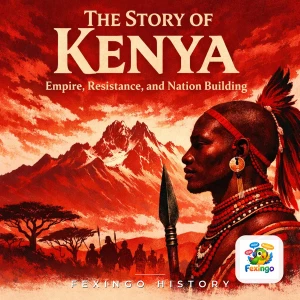
The Story of Kenya: Empire, Resistance, and Nation Building — Fexingo History
Kenya's story is a tapestry woven from ancient trade routes, colonial violence, and the fierce struggle for self-determination. From the coastal Swahili city-states like Mombasa and Lamu to the highlands where the Kikuyu, Maasai, Luo, and other communities built complex societies, this land has long been a crossroads. Lucas and Luna guide listeners through the arrival of the British East Africa Company, the construction of the Uganda Railway, and the brutal imposition of the 'White Highlands' system. The show delves into the Mau Mau Uprising, the complex figures of Jomo Kenyatta, Dedan Kimathi, and Tom Mboya, and the postcolonial nation-building project, covering ethnic balancing, assassinations, and authoritarian rule.
Episodes

The Kikuyu Witch-Finder and Kenya's Hidden Resistance
While most histories of Kenya focus on the Mau Mau uprising or political independence, this episode explores a lesser-known but vital thread of resistance: the spiritual and cultural defiance led by figures like Muthoni wa Kirima and the broader network of witch-finders who operated under colonial radar. We examine how traditional knowledge systems were weaponized against British authority long be
The Kamba Caravaneers: Kenya's Silent Trade Network
Long before the British established their colonial outposts along the East African coast, a vast network of trade routes crisscrossed the Kenyan landscape, connecting the Indian Ocean ports to the interior highlands. This episode explores the world of the Kamba caravaneers, the Wataita traders who moved goods like ivory, salt, and cloth across hundreds of miles with remarkable skill and resilience
The Kenya Air Force Coup of 1982
On August 1, 1982, a group of Kenyan air force officers stormed the National Assembly in Nairobi, attempting to overthrow President Daniel arap Moi. This episode explores the tense hours of that day, from the initial ambush on the aircraft carrier Mwanza to the chaotic negotiations at Uhuru Park and the subsequent brutal crackdown. We examine how Chris Okutoy and his fellow conspirators planned th
The 1956 Nyeri Massacre: Kenya’s Silent Tragedy
On October 21, 1956, colonial troops fired on a crowd of Kikuyu women in Nyeri, killing dozens. This episode explores the Nyeri Massacre, often overshadowed by the broader State of Emergency and the guerrilla war in the Aberdares. We examine how this event became a turning point in public opinion, exposing the brutality of British counter-insurgency tactics to the world. Through the lens of surviv
The Kamba Caravaneers: Kenya's Silent Trade Network
While history often focuses on the political upheavals of colonial Kenya, the economic backbone of the region was built by the Kamba people, master caravan leaders who connected the interior to the coast. This episode explores how the Kamba developed a unique socio-economic system based on trust, credit, and inter-ethnic cooperation long before British administrators arrived. We follow the routes
The Great Rift: Earth's Scars and Kenya's Hidden Depths
While we have covered the political struggles of Jomo Kenyatta, the land disputes of the Kikuyu, and the fierce resistance of the Mau Mau, there is a geological story beneath Kenya that shaped its very soul. This episode explores the East African Rift Valley, a tectonic fissure stretching thousands of miles from Lebanon to Mozambique. We visit Lake Turkana, known as the 'Jade Sea,' and examine how
The Nubian Regiment: Kenya's Forgotten Soldiers
This episode explores the complex legacy of the Nubian Regiment, a colonial military unit formed in East Africa with roots tracing back to Sudan. We examine how soldiers like those from the Nyabongo lineage and other Nilotic groups were recruited by the British Empire for their perceived martial prowess, often displacing them from their homes in Uganda and Kenya. The narrative focuses on the cultu
The Silent Resistance of Kenya's Coastal Traders
While the Mau Mau uprising in the central highlands dominated headlines and British military strategy, a quieter, more complex form of resistance was unfolding along Kenya’s Indian Ocean coast. This episode explores the role of the Swahili merchant class and the Islamic reformist movements that challenged both colonial authority and traditional hierarchical structures in the late nineteenth and ea
The Makueni Cushites: Kenya's Ancient Trade Network
While much of Kenya’s history is defined by the struggle against colonial borders and the rise of the Kikuyu or Luo, Episode 255 turns its gaze to a quieter, older world: the Makueni Cushites. This episode explores how communities in southeastern Kenya maintained distinct linguistic and cultural identities despite being surrounded by Bantu-speaking neighbors. We trace the ancient trade routes that
Tom Mboya's Kennedy Airlift: The Scholarship That Changed Kenya
In this episode, we explore the extraordinary story of Tom Mboya and the Kennedy Airlift, a diplomatic miracle that sent hundreds of Kenyan students to universities in the United States during the height of the Cold War. Set against the backdrop of 1959, as the Mau Mau emergency was winding down but political tensions remained high, Mboya recognized that independence required more than just soldie
Wangari Maathai and the Green Belt Movement
This episode explores the origins of the Green Belt Movement and Wangari Maathai’s journey from a rural Kenyan village to an international environmental icon. We trace her education at Mount Holyoke College, her return to Kenya in 1966, and the pivotal moment she connected women’s rights with environmental conservation. The conversation examines how planting trees became an act of political resist
The 1982 Air Force Coup: Kenya's Forgotten Battle
On October 1, 1982, a group of junior Kenya Air Force officers seized the National Assembly building in Nairobi, holding parliament hostage in a desperate bid to overthrow President Daniel arap Moi. This episode explores the dramatic hours of the failed coup, the internal fractures within the military that allowed such an event to occur, and the brutal aftermath that reshaped Kenyan politics for d
Tom Mboya's Kennedy Airlift: Cold War Diplomacy in Kenya
In this episode, we explore the ambitious Kennedy Airlift Scholarship Program, a pivotal moment in Kenyan history that sent hundreds of young Africans to universities in the United States during the height of the Cold War. Spearheaded by Tom Mboya, this initiative was not just about education; it was a strategic move to build a class of leaders equipped with modern administrative skills and democr
The Coast's Forgotten Uprising: The Mombasa Mutiny of 1947
While the Mau Mau rebellion dominates narratives of Kenyan resistance, a quieter but equally significant revolt occurred in Mombasa just five years before the state of emergency. This episode explores the King's African Rifles mutiny of March 1947, where soldiers refused orders to deploy to Burma and demanded better pay and conditions. We trace the roots of this discontent through the post-war eco
The Turkana: Kenya's Desert Warriors and Traders
While colonial history often focuses on the highlands and the coast, the arid north was home to fiercely independent communities like the Turkana. This episode explores how the Turkana people navigated centuries of isolation, mastering camel herding and trade routes long before British maps defined their borders. We look at their strategic resistance to early imperial incursions, their complex soc
Tom Mboya and the Cold War's Hidden Hand in Kenya
In this episode of The Story of Kenya, we uncover the extraordinary life of Tom Mboya, the Luo politician whose charisma and strategic brilliance helped shape modern Kenya. While Jomo Kenyatta provided the moral compass and Dedan Kimathi the military resistance, it was Mboya who built the political machinery for independence through the Kenya African Union and later KANU. We explore his pivotal ro
The Ghosts of Nairobi: Colonial Erasure
Nairobi began as a supply depot for the Uganda Railway in 1899, but its rapid growth came at the cost of indigenous communities. This episode explores how the British colonial administration systematically displaced the Kikuyu, Embu, and Meru people to create the 'White Highlands' and build the capital city. We look at the specific villages erased from the landscape, including Gikungu and Ngando,
The 1962 Kenya Constitution: A Fragile Peace
While we’ve covered the Mau Mau rebellion, the Nandi resistance, and the political awakening of Jomo Kenyatta, Episode 246 focuses on the tense, high-stakes negotiations that followed. We explore the Lancaster House conferences in London, where British colonial officials and Kenyan leaders like Ronald Ngala, Tom Mboya, and Bildad Kaggia drafted the constitution that would grant independence in 196
The 1975 Oil Shock and Kenya's Hidden Crisis
In 1975, a global oil embargo sent shockwaves through the Kenyan economy, exposing deep structural weaknesses beneath Jomo Kenyatta’s vision of national unity. This episode explores how the sudden spike in fuel prices triggered inflation, strained foreign reserves, and forced the government to make difficult choices about industrialization and agriculture. We look at the specific policies enacted
The Mijikenda Kaya Forts: Kenya's Ancient Stone Cities
Long before the British arrived or the Swahili coast flourished, nine distinct Bantu-speaking groups called the Mijikenda built fortified settlements known as Kayas along Kenya’s northern coastline. These stone-walled villages were not just defensive structures but sacred centers of governance, ancestor worship, and community life. In this episode, we explore how these ancient cities functioned as
The Kakamega Forest: Kenya's Last Rainforest
Deep in the mist-shrouded valleys of western Kenya lies a remnant of ancient biodiversity, the Kakamega Forest. This episode explores the lives of the Lurambi people and their enduring connection to this Guineo-Congolian pocket of wilderness. We examine how colonial land policies disrupted traditional livelihoods and how modern conservation efforts intersect with indigenous rights. Join us as we t
The Ghosts of Nairobi: How a Capital Was Built on Erased Villages
We trace the violent birth of modern Nairobi, focusing on how colonial planners systematically erased indigenous settlements to create a 'European City' in the wild. We explore the forced relocation of the Kikuyu from the Gikungu and Ngando villages, the role of Chief Njenga, and the architectural imposition that turned a railway depot into a capital. This episode examines the legal frameworks lik
The Ogiek Struggle: Kenya’s Indigenous Rainforest Guardians
Long before the colonial maps were drawn, the Ogiek people held sacred stewardship over the Mau Forest Complex, a vast stretch of green covering much of the Kenyan Rift. This episode explores their unique spiritual relationship with the land, centered on the Great Tree and the practice of beekeeping as both livelihood and ritual. We trace how the Land Apportionment Act of 1936 stripped them of the
The Kikuyu Land Question and the Roots of Independence
While earlier episodes have detailed the military campaigns of the Mau Mau and the political maneuvering of Jomo Kenyatta, this episode shifts focus to the foundational wound that made conflict inevitable: the dispossession of Kikuyu land. We trace the history from the pre-colonial githaka system through the coercive Land Apportionment Act of 1915, which carved out the White Highlands for European
Jaramogi Oginga: The Intellectual Father of Kenya's Left
Before Jomo Kenyatta solidified the post-colonial order, there was Jaramogi Oginga Odinga, the brilliant Luo scholar and politician who envisioned a different path for independent Kenya. This episode explores Odinga’s early life as a teacher in rural Nyanza, his rapid ascent into the Kenya African Union, and his fierce ideological clash with Kenyatta over land redistribution and socialism. We delv
The Kenya African Union: Jomo Kenyatta's Political Awakening
While previous episodes have explored the military resistance of the Mau Mau and the colonial policies that sparked them, this episode shifts focus to the political architecture that preceded the armed struggle. We examine the formation of the Kenya African Union (KAU) in 1944 and its role as the primary vehicle for nationalist sentiment in the immediate aftermath of World War II. The narrative ce
Kenya's Great Rift: The Kipsigis and the White Highlands
Episode 237 shifts focus from the high-profile rebellions of the Mau Mau to the quiet, calculated resistance of the Kipsigis people in the Rift Valley. While colonial narratives often painted African land loss as inevitable or chaotic, this episode examines how the Kipsigis navigated the Land Apportionment Act of 1930 through legal channels, diplomacy, and strategic adaptation. We explore the life
The Kipsigis: Kenya's Silent Guardians of the Rift
While the Mau Mau and the Nandi Resistance dominate the narrative of Kenyan anti-colonial struggle, the Kipsigis people of the White Highlands remained largely under the radar of major historical texts for decades. This episode explores how the British colonial administration specifically targeted the Kipsigis not just as laborers, but as a model for settler agriculture, turning their fertile land
The Kakamega Forest: Kenya's Last Rainforest
Deep in the western highlands of Kenya, a patch of Guineo-Congolian rainforest clings to existence, isolated from its African cousins by hundreds of miles of savanna. This episode explores how the Kakamega Forest became a biological anomaly and a cultural crossroads for the Lurambi, Ogiek, and Mijikenda peoples. We trace the history of the Lurambi Kingdom’s resistance against colonial surveyors wh
Mau Mau's Forest Guerrillas: The Aberdare War
While the State of Emergency was declared in October 1952, the true conflict had already begun in the mist-shrouded valleys of the Aberdare Range. This episode explores how Dedan Kimathi and General China transformed a rural protest movement into a disciplined guerrilla army that challenged the British Empire’s military might. We examine the tactical brilliance of the forest fighters, who used kno
The Kakamega Forest: Kenya's Last Rainforest
While much of Kenya’s history is told through the lens of colonial railways, urban centers like Nairobi, or the guerrilla warfare of the Mau Mau in the Aberdares, there is another landscape that holds deep historical significance: the Kakamega Forest. As Kenya’s only true tropical rainforest, this Guineo-Congolian remnant has served as a refuge for indigenous communities like the Ogiek and Lurambi
The Ogiek and the Sacred Forests of Kenya
Before the Maasai warrior profile became a symbol of East African resistance, there was another group whose deep connection to the land made them targets for both colonial dispossession and post-independence marginalization. In this episode, we explore the history of the Ogiek people, often described as the guardians of Mount Kenya’s forests. Unlike the Kikuyu or the Maasai, who have well-document
Mau Mau's Forgotten Guerrilla Tactics in the Aberdares
While Dedan Kimathi and the State of Emergency dominate Kenya’s decolonization narrative, the actual survival of the Mau Mau fighters relied on sophisticated, localized guerrilla warfare that defied British military doctrine. This episode explores how forest-dwelling Kikuyu, Embu, and Meru rebels utilized the dense cloud forests of the Aberdare Range to neutralize superior firepower. We examine th
The Mombasa Mutiny: Kenya's Forgotten Revolt
In Episode 230, we turn our gaze to the coastal city of Mombasa and the pivotal events of November 1947, known as the Mombasa Mutiny. While much attention is given to the inland Kikuyu resistance and the railway's construction, the sailors of the King’s African Rifles (KAR) played a crucial role in decolonization. This episode explores how World War II veterans, returning to a colonial system that
The Kakamega Forest: Kenya's Last Rainforest
Deep in western Kenya lies a botanical anomaly that defies the continent’s geography: the Kakamega Forest. While much of East Africa is defined by savanna and semi-arid plains, this remnant of the Guineo-Congolian rainforest survived the aridification of the last ten thousand years to become a vital ecological island. In this episode, we explore how this isolated ecosystem became a sanctuary for s
The Wanga Kingdom: Mumia's Colonial Bargain
In this episode, we explore the complex legacy of Nabongo Mumia, the paramount chief of the Wanga Kingdom in western Kenya. Unlike many leaders who fought colonial rule with armed resistance, Mumia chose a path of accommodation and strategic alliance with the Imperial British East Africa Company. We examine how he navigated the treacherous waters of colonial administration to expand his influence,
The Nandi Resistance: Koitalel Arap Samoei's Last Stand
Before the British fully subdued Kenya, the Nandi people mounted one of the most effective and prolonged military resistances against colonial expansion. This episode explores the rise of Koitalel Arap Samoei, the spiritual leader who unified the Nandi under a strict code of discipline and military innovation. We examine how his followers utilized modern rifles acquired through trade to repel mult
The Forgotten Women of the Mau Mau Rebellion
While history often centers on the male fighters in the forests, this episode explores the critical, often overlooked role of women during Kenya's War of Independence. We examine how figures like Muthoni wa Kirima and other female warriors challenged colonial gender norms, carrying messages, treating wounds, and sometimes taking up arms alongside Dedan Kimathi. Through their stories, we uncover a
Moi’s White Revolution: Kenya’s Dairy Empire
In this episode of The Story of Kenya, Lucas and Luna explore the economic transformation under President Daniel arap Moi, focusing on his ambitious agricultural policies known as the 'White Revolution.' We trace how Moi leveraged state-controlled cooperatives to boost dairy production, aiming for self-sufficiency in milk and butter. The conversation delves into the role of the National Cooperativ
The 1952 Emergency: Decolonization's Bloodiest Chapter
In Episode 224, Lucas and Luna explore the Kenya State of Emergency declared in October 1952, a pivotal moment that reshaped East Africa. While previous episodes covered the Mau Mau oaths and the railway’s labor legacy, this episode focuses on Operation Jock Scott and the mass detention camps that followed. We examine the British colonial strategy of collective punishment, the role of General Sir
The Thuku Rebellion: Harry Thuku and Kenya's First Protest
Before the Mau Mau and before the Kikuyu Central Association, there was Harry Thuku. In this episode, we trace the origins of modern Kenyan political resistance back to 1921 Nairobi. We explore how a young clerk turned his anger over forced labor and the hut tax into the first mass protest of the colonial era. You will hear about the formation of the Kikuyu Association, the brutal suppression by B
The Uganda Railway's Indian Laborers: Kenya's Forgotten Founders
Before Nairobi was a city, before the Mau Mau, before independence, there were the coolies — over 30,000 indentured laborers from Punjab and Gujarat who built the Uganda Railway, the 'Iron Snake' that carved Kenya's future. This episode follows their journey from recruitment in Lahore to the brutal construction camps of the Tsavo and the Rift Valley, where lions killed hundreds and malaria killed
The Wanga Kingdom's Fall and the Rise of Mumia's Colonial Compromise
In this episode of The Story of Kenya, Lucas and Luna revisit the Wanga Kingdom, one of the most powerful pre-colonial states in western Kenya, and trace its transformation under Nabongo Mumia. They explore how the Wanga, led by Mumia, navigated the arrival of the Imperial British East Africa Company, using diplomacy and strategic alliance to preserve their influence even as British rule expanded.
The Kaya Forests: Sacred Groves of the Mijikenda
In this episode, Lucas and Luna explore the sacred kaya forests of Kenya's Mijikenda people — ancient groves that served as fortified villages, spiritual sanctuaries, and cultural storehouses for centuries. They trace the kaya's origins to the Mijikenda's migration from Shungwaya, the role of the kaya elders and the kifudu dance, and the devastating impact of colonial land policies and logging. Th
The Giriama Rebellion: Mekatilili's War Against the Hut Tax
In this episode, Lucas and Luna explore the Giriama Rebellion of 1913-1914, one of Kenya's earliest mass revolts against colonial rule. Led by the prophetess Mekatilili wa Menza, the Giriama people of the coast defied British attempts to impose hut taxes, recruit labor, and extract timber from their sacred kaya forests. Lucas recounts how Mekatilili used the kifudu dance to rally thousands, was ex
The Kabaka's Crown: Buganda, Land, and the 1900 Agreement
In 1900, the Kingdom of Buganda signed an agreement with the British that would reshape Uganda's future. This episode explores the Uganda Agreement, its key figures—Apollo Kaggwa, the Katikkiro, and Sir Harry Johnston—and how the negotiation of land, taxes, and political power set the stage for colonial rule. We discuss the mailo land system, the Lukiiko (parliament), and the role of the Kabaka, a
The Kikuyu Forts: Gikuyu Castle and the Forest War
Before the Mau Mau fighters slipped into the Aberdares, they built a hidden world of stockades, trenches, and fortified villages. In this episode, Lucas and Luna explore the Kikuyu forts of the 1950s — the log-and-earth strongholds that British colonial forces called 'Gikuyu castles.' They trace the military logic behind these fortifications, from the timber palisades and firing slits to the under
The Kedong Massacre: When Kenya's Iron Snake Drew Blood
In 1895, the Imperial British East Africa Company was bleeding money and the Uganda Railway was still a glint in Whitehall's eye. But the Iron Snake needed its path cleared, and the company's ruthless caravan leader, Andrew Dick, thought he could force the Kikuyu of the Kedong valley to submit. The result was a massacre—and a reckoning that would shape Kenya's colonial future. In this episode, Luc
The Wanga Kingdom's Golden Throne: Mumia's Lost Empire
Before the British flag went up, western Kenya was ruled by the Wanga, a Luhya dynasty that traced its bloodline to a legendary queen. In this episode, Lucas and Luna explore how Nabongo Mumia turned his kingdom into the most powerful state in the Lake Victoria basin, signing treaties with the Imperial British East Africa Company that would hand him a golden throne—and cost him his empire. We walk
The Kenya-Uganda Railway: Iron Snake and the Birth of a Nation
Before Mau Mau, before the White Highlands, there was the 'Lunatic Line' — the Kenya-Uganda Railway that carved through East Africa in the late 1890s. In this episode, Lucas and Luna trace the railway's construction from Mombasa to Kisumu, the thousands of Indian laborers who laid the tracks, the lions of Tsavo that halted progress, and the profound demographic and political shifts it triggered. T
Nabongo Mumia and the Wanga Dynasty's Colonial Bargain
In Episode 213 of The Story of Kenya, Lucas and Luna explore the Wanga Kingdom, the most powerful state in western Kenya before colonialism. They trace the dynasty back to Nabongo Shiundu, whose nineteenth-century expansion brought the Wanga into contact with Swahili traders, Maasai raiders, and eventually British officers of the Imperial British East Africa Company. The story centers on Nabongo M
The Goldenberg Scandal: How Kenya Lost Billions
In the early 1990s, as Kenya's economy faltered under structural adjustment, a shadowy network of businessmen and politicians engineered one of the most brazen financial heists in African history. This episode unpacks the Goldenberg scandal, named for the gold and diamond export scheme that never shipped a single ounce of gold. We trace the origins of the scam, from the brainchild of businessman K
The Wanga Kingdom: Kenya's Forgotten Empire
Before the British arrived, the Wanga Kingdom dominated western Kenya. Its ruler, Nabongo Mumia, navigated a world of shifting alliances with the Luo, Luhya, and Maasai. When the Imperial British East Africa Company came seeking influence, Mumia chose collaboration, granting land and support in exchange for security. This choice would shape the region's future, making Mumia a polarizing figure — a
The Kikuyu Female Circumcision Crisis of 1929
In 1929, the Church of Scotland mission in Kenya burned down its own school in a protest that made global headlines. The Kikuyu people's practice of female circumcision, called irua, collided with missionary prohibition, sparking a crisis that would reshape Kenyan nationalism. At the centre was Harry Thuku's successor, the Kikuyu Central Association, and a young Jomo Kenyatta, then a London-based
Growing Coffee: The Kenyan Farmers Who Beat the System
In the 1930s, when colonial Kenya reserved coffee for white settlers, a group of Kikuyu farmers in the Fort Hall district dared to defy the law and plant their own. This episode tells the story of the Native Coffee Movement: the agitation by Kikuyu Central Association leaders like Harry Thuku and Joseph Kang'ethe, the growing of coffee on smallholdings, the appointment of colonial chiefs like A. H
Krapf and Rebmann: The Missionaries Who Found Kilimanjaro
Before Kenya was Kenya, two German missionaries walked inland from the Swahili coast and came back with stories that changed European maps forever. Johann Ludwig Krapf and Johannes Rebmann spent the 1840s crossing the Nyika, learning Swahili and Kamba, and opening the first mission stations at Rabai and Kibarani. They were the first Europeans to report snow on Mount Kilimanjaro and to glimpse the
The Kamba and the Kariakor: Nairobi's Labor Legacy
This episode of The Story of Kenya follows the little-known history of the Kamba people and their pivotal role in the colonial economy, from the Uganda Railway to the Kariakor market in Nairobi. Lucas and Luna explore how the Kamba, often overlooked in Kenyan resistance narratives, used labor migration and military service as a form of agency—while also facing the same dispossession as other commu
The Mombasa Mutiny: Kenya's Last Loyal Army Revolt
In January 1964, just weeks after independence, Kenyan troops at the Mombasa barracks mutinied over pay, Africanization, and lingering colonial hierarchies. The revolt spread to Nairobi and Lanet, forcing Prime Minister Jomo Kenyatta to call in British troops—Operation Grand Slam—to restore order. This episode explores the soldiers' grievances, the government's response, and how the mutiny shaped
The Kipsigis and the Orkoiyot: Buret's Last Stand
In this episode, Lucas and Luna turn to the southern highlands of Kenya, where the Kipsigis people resisted British colonial rule under the spiritual leadership of the orkoiyot. They trace the origins of the Kipsigis as part of the Kalenjin-speaking peoples, the role of the orkoiyot as prophet and war leader, and the brutal suppression of the Buret rebellion in 1905. The conversation explores the
The Mau Mau Oaths That Built an Army
In this episode of The Story of Kenya, Lucas and Luna dig into the secret oathing ceremonies that transformed the Mau Mau movement from scattered resistance into a disciplined army. They trace the evolution from the muma wa igongona, the first oath binding fighters to the land and to each other, to the muma wa batuni, the brutal batuni oath that initiated soldiers into the forest war. They explore
The Nandi Resistance and the Orkoiyot's Last Stand
In this episode, Lucas and Luna revisit the Nandi resistance against British colonial rule in Kenya, focusing on the spiritual and military leadership of the Orkoiyot, Koitalel arap Samoei. They explore the Nandi's sacred forests, the brutal suppression tactics of the British, including the controversial killing of Koitalel in 1905, and the lasting impact on the Nandi people and their land. The co
The East African Carrier Corps: Black Soldiers in WWI
During World War I, over a million African laborers were conscripted into the Carrier Corps to serve the British Empire in East Africa. This episode tells the story of the men who carried supplies, ammunition, and wounded soldiers through the bush, facing disease, hunger, and artillery fire. We follow the journey of a fictional but representative soldier, Kamau, from his village in Kikuyu country
The Nandi Resistance and Koitalel arap Samoei
Long before the Mau Mau uprising, the Nandi people of western Kenya fought one of the most sustained and ingenious resistance campaigns against British colonial rule. Led by their spiritual and military leader, Koitalel arap Samoei, the Nandi waged a decade-long guerrilla war that frustrated the British Empire, stalled the construction of the Uganda Railway, and forced the colonizers into a brutal
The Road to Lancaster House: Kenya's Fragile Path to Freedom
In this 200th episode, Lucas and Luna trace Kenya's journey from the Emergency years to independence, focusing on the Lancaster House Conferences of 1960 and 1962. They follow the key players — Jomo Kenyatta, Tom Mboya, Oginga Odinga, and the British colonial secretary Iain Macleod — as they negotiate a new constitution amid bitter divisions between Kikuyu, Luo, and the settler lobby. Along the wa
The Nandi's Sacred Forest and the Battle of Chemelil
In the early 1900s, the Nandi people of Kenya's Rift Valley fought a desperate war against British colonization, led by their spiritual leader, the Orkoiyot. This episode focuses on the Nandi's use of the sacred forest as a stronghold, the brutal counterinsurgency tactics of the British, and the pivotal Battle of Chemelil in 1905. We explore the role of the Orkoiyot, the impact of the Uganda Railw
The White Highlands: Kenya's Stolen Land and the Seeds of Mau Mau
In this episode, Lucas and Luna explore the creation of Kenya's White Highlands, the vast fertile region reserved for European settlers in the early 20th century. They trace how the Crown Lands Ordinance of 1902 and 1915 allowed the British to expropriate land from the Kikuyu, Maasai, and Nandi, often through outright seizure or dubious treaties. The conversation follows key figures like Lord Dela
Kenya's Last Mau Mau General: Mbaria Kaniu's Forest War
In this episode, Lucas and Luna step back from the famous names to trace the forest war through one of its most effective commanders: Mbaria Kaniu. A Kikuyu fighter who rose through the ranks of the Land and Freedom Army, Kaniu led the Mount Kenya and Aberdare forest forces in a guerilla campaign that kept British troops pinned down for years. We follow his tactical brilliance—how he used the Kiri
The Rift Valley's Ogiek: Kenya's Other Land Dispossession
For decades, the story of Kenya's land grievances has centered on the Kikuyu and Mau Mau. But in the forests of the Rift Valley, another dispossession was unfolding — quieter, but just as devastating. This episode turns to the Ogiek, an Indigenous hunter-gatherer people of the Mau Forest, whose ancestral lands were carved up by British settlers, then by post-independence governments. We follow the
The Lari Massacre: Mau Mau's Bloodiest Night
In March 1953, a coordinated Mau Mau attack on the loyalist village of Lari killed over a hundred men, women, and children. The British response was swift and brutal: mass arrests, collective punishment, and a series of trials that sent dozens to the gallows. This episode unpacks the night itself, the tangled politics of loyalty in the Emergency, and the contested memory of an atrocity that both s
Wangu wa Makeri: The Female Chief Who Defied Colonial Rule
In this episode of The Story of Kenya, we turn to the life of Wangu wa Makeri, one of the most powerful and controversial women in Kenya's colonial history. Born in the 1850s in Murang'a, Wangu rose to become a chief in the early 1900s — a position almost unheard of for a woman. She wielded authority over men, collected taxes, and led ceremonial dances that scandalized both colonizers and her own
Mary Nyanjiru: The Woman Who Shook Colonial Kenya
In March 1922, Nairobi's Native Tribunal was the scene of a protest that turned deadly when police fired into a crowd demanding the release of Harry Thuku. But the most famous moment belongs to a young Kikuyu woman named Mary Nyanjiru, who climbed onto a car bonnet and reportedly called on the women to strip naked — a curse in Kikuyu culture — before the shooting began. This episode tells her stor
Luo Resistance and the Mumbo Cult's Last Prophet
In this episode, Lucas and Luna explore the Luo resistance to British colonial rule in western Kenya, focusing on the Mumbo cult — a spirit-prophesied anti-colonial movement that swept through South Nyanza in the 1910s and 1920s. They trace the cult's origins with its first prophet, Onyango Dunde, its millenarian promises of a world without whites, and its spread among the Luo and Kisii. The conve
The Kapenguria Trial: Kenyatta's Arrest and Kenya's Path to Freedom
In October 1952, the British colonial government declared a State of Emergency and arrested Jomo Kenyatta, along with five other key nationalist leaders—Paul Ngei, Bildad Kaggia, Fred Kubai, Kungu Karumba, and Achieng Oneko. They were charged with managing an unlawful society (Mau Mau) and taken to a remote trial in Kapenguria, a dusty outpost in the Rift Valley. This episode delves into the polit
The Swynnerton Plan: How Land Policy Fueled Kenya's Mau Mau War
In this episode, Lucas and Luna examine the Swynnerton Plan of 1954 — a British land consolidation scheme that aimed to modernize Kikuyu agriculture but instead deepened grievances and fueled the Mau Mau uprising. They explore how the plan fragmented communal landholding, created a class of loyalist yeoman farmers, and displaced thousands, all under the guise of agrarian reform. Along the way, the
The 1957 African Elections That Shaped Kenya's Independence
In 1957, Kenya held its first elections allowing African representation in the Legislative Council. This episode zooms in on the eight men elected — including Tom Mboya, Oginga Odinga, and Daniel arap Moi — and how they used their limited positions to push for independence. We explore Mboya's trade union roots, the Mombasa dock strike of 1955, and the formation of the 'Elected Members' group that
Mekatilili wa Menza and the Giriama Uprising
In 1913, a Giriama prophetess named Mekatilili wa Menza launched a rebellion against British colonial rule along the Kenyan coast. This episode explores her life, her use of traditional oathing to unite the Mijikenda, the brutal British response, and her enduring legacy as a symbol of anti-colonial resistance. We discuss the causes of the uprising—land grabs, forced labor, and the hut tax—and the
Dedan Kimathi's Last Stand: The Capture That Ended the Forest War
In February 1957, Dedan Kimathi Waciuri was hanged at Kamiti Maximum Security Prison, but his body was buried in an unmarked grave to deny him a martyr's shrine. This episode follows the final two years of the Mau Mau war—from the 1955 British 'villagization' sweeps that drained the forest fighters of food and weapons, to the manhunt led by Special Branch officer Ian Henderson, who spoke fluent Gi
Operation Anvil: The 1954 British Crackdown in Nairobi
In April 1954, the British colonial government launched Operation Anvil, the largest military-style sweep in Kenyan history. Over 20,000 British troops and police cordoned off Nairobi's African locations—Eastlands, Punwani, Kariokor—and screened every African resident. Within days, more than 24,000 Kikuyu, Embu, and Meru were loaded onto lorries and sent to detention camps like Manyani and Langata
The Nairobi Massacre of 1922: Harry Thuku and the Women's Protest
In 1922, Nairobi witnessed a watershed moment in Kenya's colonial history: a mass protest led by women demanding the release of political activist Harry Thuku. When police opened fire on the crowd, twenty-one people were killed and many more wounded. This episode explores the rise of Harry Thuku, the grievances that drove thousands of Kikuyu women into the streets, and the brutal crackdown that fo
Mau Mau's Secret Oaths: Blood, Earth, and Resistance
Long before the Mau Mau fighters took to the forests of Mount Kenya, they were bound together by sacred oaths. In this episode, Lucas and Luna explore the elaborate oathing ceremonies that organized the Land and Freedom Army—from the first simple Muma wa Igongona to the unbreakable Muma wa Batuni. They unpack the symbolism of blood, soil, and the Bible; the crucial role of women as oath administra
Recommended

این نقطه

TED Business
Dark Night Tales with Brian King

Fantasy Flex

زن بودن

Medicine with Meaning

Yours Truly Johnny Dollar Collection

Take Back Your Health®

CBS Radio Mystery Theater | Old Time Radio

Solved Murders - True Crime Stories
紐約鳥|New York Aperture
The Swerve Podcast: Obscure Topics | Conspiracy Theories
