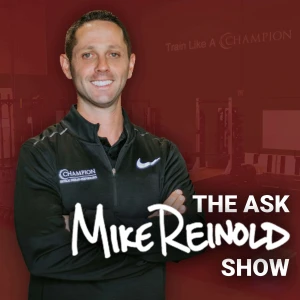
The Ask Mike Reinold Show
The Ask Mike Reinold Show answers listener questions about physical therapy, fitness, strength and conditioning, sports performance, and career advice. Host Mike Reinold is joined by colleagues from Champion Physical Therapy and Performance in Boston, MA. The show aims to help people feel better, move better, and perform better. Listeners can submit their questions on the show's website.
Episodes
Does In-Season Training with BFR Improve Strength or Performance? - #AMR397
Heavy lifting builds the strength behind every jump and sprint. But during a grinding competitive season, all that mechanical load piles onto athletes who are already worn down from games and practice, and at some point it stops helping and starts hurting. So what if you could keep training explosive power without the wear and tear?A new study out of the Journal of Sports Sciences put that questio
Drowning in Evidence: How to Read a Meta-Analysis Without Getting Fooled
We're taught to treat systematic reviews and meta-analyses as the gold standard. They sit at the top of the evidence pyramid, so when one lands in our inbox saying an intervention works, we tend to believe it and move on. But what if that instinct is exactly the problem?A new editorial from two of the most respected methodologists in sports medicine makes an uncomfortable argument: the explos
How to Progressively Load the Rotator Cuff - #AMR395
If you've ever programmed rotator cuff work, you've probably hit the same wall this week's listener did. You start with the classic light band or dumbbell external rotations, everything progresses nicely for a few weeks, and then it just stops. Add a couple pounds and the movement falls apart. So you assume you've maxed out what these little muscles can do and go back to mainte
Is Hamstring Tightness Correlated to Low Back Pain in Young Athletes? - #AMR394
If you treat young athletes, you have seen this note a hundred times. A 14-year-old gets referred for low back pain, and somewhere in the orthopedic report is the phrase "hamstring tightness," presented as if it settles the question. Tight hamstrings, tilted pelvis, cranky back. Case closed. Go stretch.It's a tidy story. It's also the kind of story that survives because it soun
Does PRP Actually Work for Hamstring Strains?
Hamstring strains are incredibly frustrating. You get an athlete feeling great, they go for a sprint, and the muscle grabs again. We have all been there. It is the most common time-loss injury we see in running and field sports.For years, sports medicine professionals have debated whether biologics actually speed up recovery. Some studies show great results. Other studies suggest they are a waste
Does Icing Your Shoulder Still Work for Baseball Pitchers? - #AMR392
Pitchers are constantly looking for the best way to recover after a long outing. Walk into any training room, and you will hear the hum of massage guns and see guys strapped to ice machines. We're seeing newer things too, like ESTIM machines and even BFR after an outing. We know pitching causes microtrauma and neuromuscular fatigue. The debate over how to properly manage that fatigue never se
Stop Treating the MRI and Start Treating the Athlete
Every sports physical therapist remembers the first time they handed a young, anxious athlete an MRI report filled with terms like "partial-thickness tear," "labral fraying," or "degenerative changes." It is a defining moment in a clinician's career. Instantly, the psychological landscape of the rehab process shifts. The athlete, who might only have mild, intermi
Physician Referrals vs. Online Presence: Which One Grows Your Sports PT Clinic Faster? - #AMR390
Building a sports physical therapy practice used to follow a predictable playbook. You opened your doors, printed some business cards, and spent your Friday afternoons dropping off food at local orthopedic clinics hoping to get on their referral list. For decades, doctor relationships were the lifeblood of private practice growth. But the modern healthcare consumer operates differently. Today, eve
The Truth About BPC 157 Peptide in Sports Medicine: What You Need to Know - #AMR389
If you’ve spent any time on social media or in many gyms lately, you’ve probably heard the buzz about BPC-157. Often called the "healing peptide," it’s being touted as a miracle cure for everything from chronic tendinopathy to acute muscle tears. Patients are showing up in our clinics asking where they can get it, and some "wellness clinics" are already handing out injections l
Outcomes and Return to Sport Testing After Bankart and Laterjet Shoulder Stabilization Surgery - #AMR388
We’ve all been there—you’re working with a high-level athlete after a Bankart repair or Laterjet, they’re at the 6-month mark, their ROM looks great, and they’re itching to get back on the field. The surgeon gives the green light, but you can’t help but wonder: Are they actually ready?In the world of ACL rehab, we have strict batteries of tests, symmetry indexes, and psychological readiness scales
Can the ACL Actually Heal Without Surgery? - #AMR387
Wouldn't it be amazing if an ACL tear can heal on its own without surgery?For sure, and there have been recent discussions about the Cross-Bracing Protocol and its impact on these injuries.But is this too good to be true?In this episode, we discuss the emerging cross-bracing protocol for non-operative ACL treatment, exploring its potential benefits and drawbacks. There is some skepticism abou
The New Tommy John: The Rise of the Internal Brace - #AMR386
Ten weeks to start throwing after UCL surgery sounds like a miracle timeline, until you’re the clinician staring at a stiff elbow, a deconditioned arm, and a protocol that assumes the athlete is further along than reality. We’re seeing more internal brace UCL repairs and fewer “classic” Tommy John reconstructions, and that shift is changing how baseball pitchers, gymnasts, and other overhead athle
Risk Factors of Arthrogenic Muscle Inhibition - #AMR385
We’ve all seen it: the acute ACL patient who drags their leg into the clinic, unable to squeeze their quad to save their life. We call it Arthrogenic Muscle Inhibition (AMI), and for years, we’ve treated it as a stubborn, long-term enemy. But a fascinating new study from the American Journal of Sports Medicine suggests we might be overcomplicating it.Researchers analyzed 300 acute ACL patients and
Ranking the Top Patellar Tendon Exercises by Tendon Load - #AMR384
We all have our favorite "go-to" exercises for patellar tendinopathy. For years, the single-leg decline squat has been the gold standard, often introduced early in rehabilitation to target the tendon. But what if I told you that this specific exercise actually places more load on the patellar tendon than running or double-leg jumping?A massive new study just analyzed 35 common rehabilita
Using ChatGPT and AI in Physical Therapy
The use of ChatGPT and other AI models has exploded in recent years, and you're starting to see this in most professions, including the medical profession.We've been using AI quite a bit at Champion for a variety of things and wanted to share our experiences. We go over some of the use cases as well as different models that we've tried with varying successWe do think you should be u
Should Adults Lift for Less than 5 Reps Per Set? - #AMR382
Mike Boyle had a great discussion on Instagram several weeks ago about adults lifting to failure and using low rep schemes.It sparked a lot of arguments among people about which approach is best and whether there's always an answer to this question.We discuss whether adults should lift to failure on low-rep schemes in this week's episode. We'll go over what we do at Champion, how we
ACLR + LET: Overkill or the New Gold Standard? - #AMR381
Surgeons are adding more lateral extra-articular procedures to ACL reconstructions, especially in young cutting and pivoting athletes. On paper, it sounds great—tighten up the anterolateral side, improve stability, protect the graft. But what does that actually mean for clinical outcomes and for how we manage rehab?A new Level 1 systematic review and meta-analysis just pulled together the randomiz
10 Year Anniversary Episode - #AMR380
Wow, I can't believe it's been 10 years!It truly is an honor to be able to host a live episode celebrating the 10-year anniversary of our podcast. Thank you so much for listening all these years!In this episode, we'll answer live questions from an audience of listeners, reflect on some of our favorite moments of the podcast, and give out some prizes and special discounts to all the
Should Every ACL Get E-Stim? What the New NMES Meta-Analysis Really Shows - #AMR379
Quadriceps shutdown after ACL reconstruction is one of the biggest barriers we see in the clinic. Even with modern surgical techniques and “aggressive” rehab, too many athletes struggle to get their quad strength back, and that deficit shows up later in gait, loading, and confidence on the field.A new systematic review and meta-analysis just took a fresh look at neuromuscular electrical stimulatio
Hamstring Exercises after PCL and Meniscus Surgery - #AMR379
There is substantial variability in rehabilitation protocols following PCL and meniscus repair surgery. There is often a conservative period where we minimize or avoid hamstring activity.Biomechanical studies show that hamstring activity can increase posterior translation of the tibiofemoral joint and potentially put stress on a healing meniscus repair.In this episode, we discuss the science behin
How Much Time Off Should You Take From Throwing After the Baseball Season - #AMR377
Baseball injuries continue to rise at an alarming rate. Over the years, we have seen the development of more advanced training velocity programs and pitchers that are focused on enhancing their performance during the offseason.This has led to a variety of development programs being performed over the offseason, which takes away from downtime and allows the body to heal after a long competitive sea
Using Blood Flow Restriction to Neuromodulate Pain During Exercise - #AMR376
Blood flow restriction training is gaining popularity, and new research continues to show benefits and potential new uses.We review a brand-new randomized trial examining a brief BFR session before exercise in patients with knee pain. The question: Can a quick change before you even start your main work meaningfully alter pain during the session that follows? The results nudged us to rethink how w
Practice Guidelines for Patellofemoral Pain - #AMR375
If you treat a lot of knee pain, this week’s episode is for you.We review a new best-practice guide for patellofemoral pain that pulls together research, patient voices, and expert reasoning into one playbook. But here’s the twist: when you blend the data with what patients actually want and what clinicians really do, one deceptively simple priority rises to the top - something many of us already
What to Do When an Athlete Passes Objective Testing But Not Psychological Readiness - #AMR374
Returning to sport after an injury is always a challenge. In the profession, a lot of attention has been given to objective testing to determine when and how to progress athletes. This has been a significant evolution that will definitely improve outcomes.But what do you do when an athlete passes objective testing but not psychological readiness testing?We talk about what we do in this week’s podc
How to Differentiate Between Hip and Low Back Pain - #AMR373
There is no doubt that back and hip pain are often linked and sometimes confusing to diagnose. But sometimes it's hard to differentiate the two, and what may be the underlying cause versus the symptoms.We discuss in this week’s podcast episode.To see full show notes and more, head to: https://mikereinold.com/how-to-differentiate-between-hip-and-low-back-pain/Learn our proven system for sports
Are the Outcomes Really the Same Between Nonoperative and Surgical Treatment of ACL Injuries? - #AMR372
A meta-analysis was recently published, suggesting that outcomes may be the same between nonoperative and surgical reconstruction after ACL injury. Clearly, social media has been buzzing. But are outcomes really the same? We discuss this in this episode.To see full show notes and more, head to: https://mikereinold.com/are-the-outcomes-really-the-same-between-nonoperative-and-surgical-treatment-of-
Periodization of Strength Training After ACL Reconstruction - #AMR371
One of the most essential parts of ACL rehabilitation is regaining strength in the leg. Traditionally, rehab specialists have been guilty of underloading people during the rehabilitation of these injuries.Ah, the old “3 sets of 10.”In this episode, we review a recent journal article that compares the outcomes of two different set and rep schemes during ACL rehabilitation.To see full show notes and
How to Progress Rehabilitation Following Hamstring Strains - #AMR370
Hamstring strains continue to rise in sports. As we continue to learn more, the evolution of our rehabilitation programs has also evolved.Here are our current thoughts on how fast to progress athletes back to sports after a hamstring strain.To see full show notes and more, head to: https://mikereinold.com/how-to-progress-rehabilitation-following-hamstring-strains/Learn our proven system for sport
When to Test Strength After a Rotator Cuff Repair - #AMR369
Objective strength testing is always important to document progress and ensure that patients are ready for the next phase of rehabilitation.But, when do you start testing strength with a hand-held dynamometer after rotator cuff repair surgery?We discuss on this episode of the podcast.To see full show notes and more, head to: https://mikereinold.com/when-to-test-strength-after-a-rotator-cuff-repair
Evaluation and Treatment of Low Back Pain in Weight Lifting Athletes - #AMR368
Low back pain injuries are common in athletes, and often present differently than the typical orthopedic disc-related neurogenic pain.In this episode, we discuss a recent review article on the diagnosis and management of low back pain in athletes.It was nice to see this topic applied to a specific athletic population and include recommendations on treatment as well as evidence-based lifting modifi
Management of Arthrogenic Muscle Inhibition - #AMR367
As we continue to learn more and more about arthrogenic muscle inhibition after ACL reconstruction surgery, we can continue to build better rehabilitation programs for our athletes.In this episode, the team discusses a recent review article on AMI and its impact on postoperative rehabilitation and return to sport decision-making.To see full show notes and more, head to: https://mikereinold.com/man
Does Strength Training Improve Running Performance? - #AMR366
In this podcast, we review a recent article on the effect of strength training on running economy and performance.Many people have been advocating for incorporating more strength training into the routine of runners for some time. It’s nice to see research emerging to continue supporting this.A simple strength training program can improve running performance.To see full show notes and more, head
How to Manage Persistent Swelling After ACL Reconstruction - #AMR365
Swelling and quadriceps muscle weakness are not uncommon after ACL reconstruction, and can even persist for several months.Athletes want to get back to running and eventually their sport as fast as they can. But sometimes using time-based criteria is not optimal.In this episode, we answer a question about whether an athlete should start running 5 months after an ACL reconstruction, even though the
Is 9 Months the Sweet Spot After ACL Reconstruction? - #AMR364
Over the last several years, the PT community has grown more convinced that athletes should not return to sport earlier than nine months.Research reports suggested that 9 months was a magic number. But what if your patient looks amazing at 8 months?In this episode, we review a recent article that showed that athletes returning earlier than 9 months were not at more risk if they met the proper obje
Does Stiffness Lead to Better Outcomes After Rotator Cuff Repair? - #AMR363
The debate over postoperative rehabilitation after rotator cuff repair continues to evolve.In this episode of the podcast, we review a recent article that looked at outcomes between two groups, one that was stiff and one that wasn’t.Here are our thoughts on the paper.To see full show notes and more, head to: https://mikereinold.com/does-stiffness-lead-to-better-outcomes-after-rotator-cuff-repair/
Do You Need Isokinetic Testing? - #AMR362
It's important to have objective test data to safely progress patients and return them to sport after injuries like ACL reconstruction.Isokinetic testing is still the gold standard. However, the machines are large and expensive, and they are used much less frequently.We don’t even have an isokinetic machine at Champion.Here’s what we do instead.To see full show notes and more, head to: https:
Knee MCL Repair with Internal Brace - #AMR361
Internal bracing is becoming a very popular procedure with orthopedic surgeons. Repairing ligaments and then augmenting the tissue with an internal brace has shown to be promising throughout the body, including the MCL of the knee.But, what do you do if there is prolonged stiffness?To see full show notes and more, head to: https://mikereinold.com/knee-mcl-repair-with-internal-brace/Learn our prove
Oblique Injuries in Baseball Players - #AMR360
Oblique injuries are common in baseball players, and not so common in other sports.With baseball players training so much more in the offseason with high volume and max intent, it’s no wonder these injuries are rising.Here’s how we approach these injuries and how to progress them back to hitting.To see full show notes and more, head to: https://mikereinold.com/oblique-injuries-in-baseball-players/
Restoring Range of Motion After Rotator Cuff Repair - #AMR359
Restoring range of motion after a rotator cuff repair is one of the most important factors in long-term patient satisfaction.Internal rotation is especially important, as a loss of IR can really limit their functional movements.There are many variables to consider when rehabbing a rotator cuff repair patient. Several factors will alter our speed of progression.Unfortunately, protocols vary greatly
Return to Running After ACL Surgery - #AMR358
Rehabilitation after ACL reconstruction is a long, sequential process.We look for specific criteria before progressing our athletes back to running.Here are the criteria we look for and the progression we follow for plyometrics, running, sprinting, and agility work to help athletes get back to competition after ACL surgery.To see full show notes and more, head to: https://mikereinold.com/return-to
Little League Elbow - #AMR357
Little League Elbow is a common injury in youth baseball players. Little League Elbow is a growth plate injury typically seen in baseball pitchers around the age of 13.At this age, the bone is typically the weak link, not the ligament. This is why we see more bony growth plate injuries than Tommy John injuries in youth athletes.These often take longer to heal than you think, so we don’t usually ru
Update on Sports PT Residencies - #AMR356
Over the last decade, the amount of sports physical therapy residency programs has skyrocketed. There are so many great programs now.Our students ask us all the time if they should do a residency.Our answer is always, “It depends.” They aren’t for everyone.Here are our current thoughts on sports PT residencies, who should consider them, and who shouldn’t.To see full show notes and more, head to: h
Evaluation and Treatment of Biceps Pain - #AMR355
Ah, the diagnosis of biceps tendonitis. We’ve all seen it so many times on script from doctors.Is all anterior shoulder pain coming from the biceps? How can you tell? How does this change your rehab?We’ll answer all this and more in this episode.To see full show notes and more, head to: https://mikereinold.com/evaluation-and-treatment-of-biceps-pain/Learn our proven system for sports PTs who want
What it Takes to Start a Cash Based PT Practice
It’s so awesome to see so many cash-based physical therapy businesses starting around the country.It’s really been an amazing experience for us at Champion to be out-of-network with health insurances for over 10 years.In this episode, we have some advice, pros, and cons for those looking to succeed with this model.To see full show notes and more, head to: https://mikereinold.com/what-it-takes-to-s
ACL Reconstruction with Lateral Extra-Articular Tenodesis (LET) - #AMR353
We’re starting to see more and more ACL reconstruction procedures with an LET, or lateral extra-articular tenodesis. Especially in revisions and younger female athletes.In this episode we talk about the technique, how it changes the rehab progression, and some tips on what to watch out for.To see full show notes and more, head to: https://mikereinold.com/acl-reconstruction-with-lateral-extra-artic
What Athletic Qualities Do We Test (and How)? - #AMR352
If you want to help your athletes maximize their potential, you need to have a system to assess athletic qualities.This is important to individualize programming and monitor progress.We follow a few steps in our system:1. Identify the athletic qualities needed in a sport2. Identify an assessment to measure this quality3. Determine the technology neededHere are the athletic qualities we value at Ch
Building Return to Sport Programs - #AMR351
One of the most common questions we tend to get over time is how to return athletes back to sport after an injury.This is one of the main topics in our online Champion Sports PT Mentorship, and probably the most popular portion of the program for past students (BTW, our next cohort starts in January… click here to learn more). In this episode, we talk about the criteria to start a return to sport
Is Limb Symmetry Index Our Goal? - #AMR350
Limb symmetry index is often used to measure performance and determine return to play.Makes sense, but what if the other side isn’t perfect?We prefer to look at more than just LSI, but there’s a bunch that goes into it. We discuss in this episode.To see full show notes and more, head to: https://mikereinold.com/is-limb-symmetry-index-our-goal/ Learn our proven system for sports PTs who want to mas
Rotator Cuff Repair Surgery in Younger Patients - #AMR349
Rotator cuff tears are becoming more common in younger active patients in their 40s and 50s.Typically, they are small tears at this time, but what should we do with them? Should we consider surgery? Should we avoid it at all costs?We talk about some of the things to consider in this episode.To see full show notes and more, head to: https://mikereinold.com/rotator-cuff-repair-surgery-in-younger-pat
Our Favorite Journals to Stay Current - #AMR348
There are a ton of scientific and medical journals these days. Seems like there are more and more each year.We’ve talked over the years about how there are actually some journals you want to avoid, and others that you want to follow.In this episode, we talk about our current favorites plus some other current thoughts on how to stay current.To see full show notes and more, head to: https://mikerein
BFR Update for 2025: How We’re Using Blood Flow Restriction Training - #AMR347
Blood flow restriction training has been such a great addition to what we do in physical therapy.Just like everything else, the more we use it, the more we refine what we are doing.Here are our latest thoughts on how we are using BFR at Champion.Check out the show notes below to see our latest recommendations on BFR cuffs.To see full show notes and more, head to: https://mikereinold.com/bfr-update
How to Treat Acute Lumbar Radiculopathy - #AMR346
We’ve all had the patient walk in the door with acute low back pain. It’s awful. They’re in a ton of pain and can’t function.In this episode, we discuss our strategies for working with people with acute lumbar radiculopathy to get them on the right path as soon as possible.To see full show notes and more, head to: https://mikereinold.com/how-to-treat-acute-lumbar-radiculopathy/ Learn our proven sy
How to Periodize a Rehabilitation Program - #AMR345
We all know it’s important to challenge our patients with load during the exercise progression of a rehabilitation plan.Many people like to poke fun at the concept of 3 sets of 10 repetitions, probably because some abuse it, but there is a time and place for everything.In this episode, we discuss set and rep schemes and how we periodize our exercises during physical therapy and even the gym.To see
Should You Delay Range of Motion after a Rotator Cuff Repair? - #AMR344
Rotator cuff repair surgery is one of the most common procedures in physical therapy, yet the recommended postoperative guidelines vary significantly.Different doctors worldwide disagree on what’s best. Some want to be conservative and delay range of motion and physical therapy to maximize the chance that the repair does not fail.But is that best? Are there negatives?In this episode, we discuss so
Update on SLAP Tears: Good SLAPs vs Bad SLAPs - #AMR343
Our understanding of SLAP tears, or superior labral tears of the shoulder, continues to evolve. In the past, we often rushed to surgical repair of a SLAP lesion, but now we understand that not all SLAP tears need to be repaired. In fact, repairing some types of SLAP tears in the wrong person could make them worse!In this episode we talk about the difference between a “good” SLAP tear and a “bad” S
Rate of Force Development in Rehabilitation - #AMR342
Rate of force development has become popular in the strength and conditioning world, but not so much in rehabilitation.After an injury, we often work on strength and power, but we must also work on producing force as quickly as possible to benefit athletes.In this episode, we discuss how to measure RFD and how to incorporate it into the rehabilitation process for an injured athlete.To see full sho
ACL Repair Using the BEAR Technique - #AMR341
The future of ACL reconstruction and repair is evolving. One of the newer techniques to try to repair the native ACL ligament rather than needing a graft is using a bridge enhancement. This is called the BEAR technique for Bridge-Enhanced ACL Repair.This procedure has specific indications, contraindications, and rehabilitation guidelines.In this episode, we discuss this procedure and the differenc
Return to Running After an Injury - #AMR340
One of the areas that physical therapists often report feeling a lack of confidence is building a return to running program after an injury or surgery.There are a few things to consider, such as the type of athlete and what their goals are in the long run. But in general, a slow and gradual progression is often best.Here are the factors we consider and how we build our return to running programs.T
When to Start Training in the Gym After Surgery - #AMR339
Many people value getting back to the gym after surgery. They may be athletes needing to prepare for their sport or people who enjoy the gym recreationally.We’re big advocates for getting back into the gym as soon as possible, but after surgery, there are some things to consider. Here are our thoughts on how to best manage this.To see full show notes and more, head to: https://mikereinold.com/when
Strategies for Cervical Spine Pain - #AMR338
Cervical spine pain is pretty common. Most of the time, it seems like we only see these patients when their symptoms progress to the point where they are having radiculopathy and loss of strength or sensation down their arm.But what do you do with the younger person who seems to have the beginning of cervical issues? Here are our thoughts.To see full show notes and more, head to: https://mikereino
The Most Important Thing You MUST Do to Accelerate Your Career - #AMR337
Finding a good mentor is hard. Many people don’t have access to someone who wants to help them accelerate their career.We often start our careers and have so many questions. We’ve all been there.In this week’s podcast, we talk about what we recommend you do when you aren’t in a spot where you have a great mentor.This is also why we started our new Champion Sports PT Mentorship online program. We k
How to Deal with Stubborn Elbow Loss of Motion - #AMR336
Loss of range of motion after elbow surgery is common. The elbow is a very congruent and unforgiving joint.It’s important to prevent loss of motion with early activities as much as possible. But what do you do when you have a loss of mobility in the elbow?Here are our treatment strategies.To see full show notes and more, head to: https://mikereinold.com/how-to-deal-with-stubborn-elbow-loss-of-moti
How to Specialize in a Niche Population - #AMR335
The riches are in the niches, or so they say. But in all seriousness, I agree. Most people I know who love their jobs specialize in a niche they enjoy.But how do you get started specializing in a niche? Here are some of our tips.To see full show notes and more, head to: https://mikereinold.com/how-to-specialize-in-a-niche-population/Learn our proven system for sports PTs who want to master ACL reh
Strategies for Acute Low Back Pain - #AMR334
We’ve all seen it before. Someone comes in saying that their “back locked up” on them!They are in a lot of pain, guarded with their movement, and not sure what to do.Here’s how we approach this and some pearls to help them get out of pain and spasm and back into their activities without setbacks.To see full show notes and more, head to: https://mikereinold.com/strategies-for-acute-low-back-pain/Le
How to Know When to Push or Back Off - #AMR333
One of the more common questions we get from students is knowing when to push someone or back off.As always, the answer will depend on the situation. But, there are some principles to guide you.We discuss what we do and how to avoid the ups and downs.To see full show notes and more, head to: https://mikereinold.com/how-to-know-when-to-push-or-back-off/Learn our proven system for sports PTs who wan
Should You Cue to Pinch Your Shoulder Blades Back? - #AMR332
A common debate in physical therapy is whether we should cue people to “pinch their scapulas” together during exercises.I don’t really think there should be a debate…Here’s why we don’t use that cue and what we do instead.To see full show notes and more, head to: https://mikereinold.com/should-you-cue-to-pinch-your-shoulder-blades-back/Learn our proven system for sports PTs who want to master ACL
How to Measure Strength in the Clinic - #AMR331
We all know that it’s super important to assess strength with our patients and clients. But is manual muscle testing enough?We don’t think so.Here’s why and what we use at Champion.To see full show notes and more, head to: https://mikereinold.com/how-to-measure-strength-in-the-clinic/Learn our proven system for sports PTs who want to master ACL rehab, confidently progress patients, and guide athle
Rehabilitation After UCL Repair with Internal Brace - #AMR330
Over the last several years, we have seen the growth of the new repair of the ulnar collateral ligament with an internal brace procedure. It’s been awesome to witness such great success with this new Tommy John procedure, and patients have been doing great.Here’s an update on our experience so far, some clinical pearls on rehabilitating these athletes, and the differences we sometimes see with tra
When is it Safe to Start Running After a Hamstring Strain? - AMR#329
Hamstring strains continue to be one of the most common injuries in sports. Returning these athletes to play can sometimes seem daunting.When is it safe to start running? Do you have to wait until they are pain-free?We answer these questions and more in this episode.To see full show notes and more, head to: https://mikereinold.com/when-is-it-safe-to-start-running-after-a-hamstring-strain/Learn our
How to Integrate Students into Clinical Care - #AMR328
As you probably know, we have a lot of clinical physical therapy students and strength and conditioning interns at Champion.Over the years we have found success in integrating them into working with our patients and clients.Here are some tips on how to do this while still being able to provide a great learning experience for the student and a great experience as the patient.To see full show notes
What Exercises Are Safe After Rotator Cuff Repair - #AMR327
Some of the most common questions we get in regard to rotator cuff repair rehabilitation are when can we start range of motion and strengthening exercises.It will depend on several factors, but there are ways to build an evidence-based rehabilitation progression.In this episode, we talk about how we progress rotator cuff repair patients and how we determine if an exercise is safe to perform.To see
Interviewing for a Job in Professional Sports - #AMR326
Many students and early career professionals want to get into professional sports.Here’s some of our advice on how to stand out when applying and interviewing for these high level jobs.To see full show notes and more, head to: https://mikereinold.com/interviewing-for-a-job-in-professional-sportsLearn our proven system for sports PTs who want to master ACL rehab, confidently progress patients, and
Using Force Plates to Show Progress - #AMR325
Force plates can be very valuable in quantifying certain metrics that can monitor progress over time. We’re using these for both our performance and rehabilitation athletes.Here’s what we have seen so far.To see full show notes and more, head to: https://mikereinold.com/using-force-plates-to-show-progress/Learn our proven system for sports PTs who want to master ACL rehab, confidently progress pat
Should ACL Allografts Go Slower with Their Rehabilitation - #AMR324
There are many options for graft sources when performing an ACL reconstruction. There are pros and cons to them all.One graft type, an allograft, probably deserves a different rehabilitation approach. We often go slower with this graft type.We talk about why in this episode.To see full show notes and more, head to: https://mikereinold.com/should-acl-allografts-go-slower-with-their-rehabilitation/L
How to Deal with Recurring Hamstring Strains - #AMR323
Hamstring strains are one of the most common injuries in sports. And as many of us know, it often can be recurring.In this podcast episode, we discuss why this may be the case and what you can do to minimize recurrence. To see full show notes and more, head to: https://mikereinold.com/how-to-deal-with-recurring-hamstring-strains/Learn our proven system for sports PTs who want to master ACL rehab,
Getting the Most Out of Your PT Clinical Affiliations - AMR322
It is important as physical therapists that we are exposed to a diverse range of the profession during school.Many students that want to get into sports or orthopedics feel like they don’t get as much out of the PT clinical affiliations outside of those areas.But, we think there’s a ton to learn in every environment that will help you with your future career.To see full show notes and more, head t
Building Load Capacity After Lower Extremity Injuries - #AMR321
As physical therapists, we often do a great job with the early phases of rehabilitation and helping people restore motion and strength.But many people, especially athletes, also need to develop their loading capacity to get back to advanced activities like running, cutting, and jumping.In this episode, we talk about how we progress people and build their loading capacity.To see full show notes and
Fitting Everything into a Physical Therapy Treatment Session - AMR#320
It’s unfortunate that many physical clinics have limits on the amount of time you can spend with a patient. We all want to spend a ton of time with our patients, especially in the later stages of rehab when there is so much to do.In this episode, we’re going to talk about some strategies on how to deal with these limitations.To see full show notes and more, head to: https://mikereinold.com/fitting
Baseball Pitchers with Limited External Rotation - #AMR319
We treat a lot of baseball players at Champion. And one thing is certain, throwing a baseball sure does make a lot of people lose shoulder mobility!We often see this correlated with medial elbow pain, so when someone is rehabbing an elbow injury like Tommy John, we often focus as much on the shoulder as the elbow.We talk about this concept and more in this episode.To see full show notes and more,
Improving Range of Motion After a Patellar Tendon Repair - #AMR318
Any surgery that involves repairing a torn tendon will have the potential to have complications. Most commonly, this involves a loss of motion.Depending on the activity, some discomfort is expected. But you also don’t want to overload the healing tissue.To see full show notes and more, head to: https://mikereinold.com/improving-range-of-motion-after-a-patellar-tendon-repair/Learn our proven system
Recommended

Deadline: White House
Crickets Corner

History of the Earthquake and Fire in San Francisco

Fox news

K-Drama Obsessed Mamas | Beyond “Just One More Episode!”

True Crime Classics

The Healer Revolution

Becoming: HER with Nikki Spoelstra

Booked, Blonde & Busy w/ Olivia Ponton

McKinsey on Consumer and Retail

megahired.com

Hard Knocks Podcast
