eMultipleSclerosis Review
eMultipleSclerosis Review is a journal club-style podcast that delivers up-to-date, practice-relevant information on multiple sclerosis. Each topic-focused episode features experts from Johns Hopkins University School of Medicine and other institutions who summarize and provide expert perspectives on the most relevant peer-reviewed articles. The show aims to keep clinicians current with the latest clinical data and research findings in the field. It is produced as an audio extension of a newsletter format, focusing on concise, expert-driven analysis.
Episodes

Barriers To Minority Participation in MS Clinical Trials
In the clinical trials of new MS medications and procedures, why has the participation of racial and ethnic minority individuals been so low? Is it a difficulty with outreach? Are the patient barriers to participation underrecognized and underaddressed? Does historical mistrust of the medical community remain a strong negative? What should clinicians and trial designers do to increase diversity to
Treating Sexual & Bladder Dysfunction in Patients with MS
The long-anticipated advances in therapeutic treatments to improve outcomes in both relapsing and progressive MS are coming closer to fruition. Although much of the evidence is still preclinical, the variety and scope of the ongoing research promises to provide new and novel options to manage this disease in the relatively near future.Take our post-test to claim CME credits (https://elit
Promising New Options in MS Care
The long-anticipated advances in therapeutic treatments to improve outcomes in both relapsing and progressive MS are coming closer to fruition. Although much of the evidence is still preclinical, the variety and scope of the ongoing research promises to provide new and novel options to manage this disease in the relatively near future.Take our post-test to claim CME credits (https://elit
MS and Family Planning: The Clinician’s Perspective
Giving birth and raising a family. For many people with MS, the path to achieving those goals contains more questions than answers. Questions about timing — which should come first, pregnancy or disease stability on a DMT? Questions about genetics — can MS be passed on to the baby? Questions about fertility — is in vitro fertilization safe and effective, and how much does it increase disease activ
Clinical Approaches to MS Fatigue
In this issue: Fatigue. It’s one of the most common complaints providers hear from their patients with MS. It interferes with virtually every aspect of a patient’s life. What can clinicians do to better identify MS fatigue? And what do they need to know to better provide management effectively tailored to each patient?Take our post-test to claim CME credits (https://elit.dkbmed.com/issue
POMS: A Clinical View
In this issue: POMS. Pediatric Onset Multiple Sclerosis: children and adolescents with symptoms indicating a diagnosis of multiple sclerosis. Are their presentations different from adult-onset MS? POMS is often associated with higher degrees of activity and inflammation early in the disease. How can clinicians most effectively confirm an early MS diagnosis in these young patients? What does the cu
Using the New Biomarkers in Clinical Practice
Hosted on Acast. See acast.com/privacy for more information.
Emerging MS Clinical Options
Has the place for BTK inhibitors in MS been determined? How well do extended interval or alternative B cell depletion dosing regimens work, and for which patients? Do the data support HSCT (hematopoietic stem cell transplant) over high-efficacy DMT — again, for which patients, and with what efficacy and safety?Join us, as guest host Dr. Cole Harrington from the Ohio State University explores these
Clinical and Radiologic Features of an MS Prodrome
What’s the evidence supporting the existence of an MS prodromal phase — where the biology of the disease has begun but the symptoms typical of MS have not yet appeared? Are there biomarkers to help identify it? Imaging abnormalities? And how can diagnosing a prodrome benefit patients?Join us as we discuss these questions with Dr. Naila Makhani from Yale School of Medicine, in this video podcast is
Mitigating MS DMT Infection Risk
Clinicians prescribing the increasingly higher efficacy B-cell depletion or S1P modulators therapies — how aware are they of the newer concerns about safety? Which of their patients may be in greater danger of acquiring PML and/or opportunistic infections? The vaccinations commonly recommended for the general population (eg, COVID-19) — do individuals with MS respond differently, and what should c
Overcoming Barriers to MS Care
Too many individuals with MS are not receiving access to the most effective care. Why? What’s behind these disparities? And what can individual clinicians do to help remove the barriers that prevent equitable care for all patients?Join us, as Dr. Dorlan Kimbrough, from the division of Neurology, Multiple Sclerosis, and Neuroimmunology at the Duke University School of Medicine, discusses these topi
Clinical Opinions: Managing Spasticity in Individuals with MS
How burdensome is spasticity for patients with MS? What’s the approach to treatment, and how effective is it? What do patients and clinicians need to know about cannabis-based therapies? These are the key questions Program Director Dr. Michael Kornberg from the Johns Hopkins School of Medicine discusses with guest MS spasticity experts in this second part of this eMultipleSclerosis
MS Risk Factors and Outcomes
In her Expert Commentary, Dr. Melanie Ward from West Virginia University’s Rockefeller Neuroscience Institute provided analysis of the newer data describing the modifiable and nonmodifiable risk factors for developing MS and/or increasing the rate of disease progression and disability.Join us for this podcast as Dr. Ward explains how these findings can affect clinical practice to improve over
Effects of Race/Ethnicity on MS Diagnosis and Treatment
How aware are clinicians that MS should no longer be considered a “White people only” disease? What roles have race and ethnicity been shown to play in MS disease severity and disability progression? What do health care professionals need to know to provide the most effective care for all their patients?Join Dr. Yujie Wang from the University of Washington and Dr. Kimystian Harrison, a post doctor
Clinical Considerations for In-Development MS Treatments
Where’s the newer MS research leading? How has our understanding of noninflammatory progressive MS changed? How might these findings affect what happens in the clinic? Join us as we discuss these and other questions with Dr. Michael Kornberg from the Johns Hopkins School of Medicine in this eMultipleSclerosis Review podcast. Take our post-test to claim CME credits.To read
Is that MS Diagnosis Accurate?
Is it true that a significant number of patients being treated for MS may not actually have the disease? What are the red flags — warnings that something about the patient’s condition does not meet the accepted MS diagnostic criteria — that need to be investigated? Join us in this eMultipleSclerosis Review podcast, as Neuroimmunologist Dr. Gabrielle Macaron from Saint Joseph
Nonpharmacologic Symptom Management
In this Issue: Fatigue. Urinary dysfunction. Constipation. Spasticity and gait problems. Providing relief from these common MS symptoms often requires clinicians to go beyond the prescription pad to recommend nonpharmacologic treatments. What works? What doesn’t? What does the evidence say? Join us as Dr. W. Oliver Tobin from the Mayo Clinic discusses these questions in this eMultipleSclerosi
Treatment Considerations for Aging Patients
As people with MS age, how does their response to their long-term DMT change? Is there a time when disease-modifying therapy can be safely discontinued? In which patients? At what age? What role do comorbidities play in making these decisions? Join us as we discuss these questions with Dr. Burcu Zeydan from the Mayo Clinic in this eMultipleSclerosis Review podcast. T
MS and the COVID-19 Vaccine: What Do We Know and What Should We Do About It?
COVID-19 vaccination. For many people with multiple sclerosis, it’s not a simple and straightforward process. The DMT they’re currently taking to control disease progression and moderate their symptoms — particularly if it’s a beta cell- depleting agent — may prevent the vaccine from working as it’s supposed to. What do clinicians need to know, and how should they explain it to thei
Shared Decision Making in MS: The Why and The How
Shared decision-making — what does it mean in multiple sclerosis? Can it really help providers more fully understand their patients’ concerns? Can it motivate patients to more readily and enthusiastically take ownership of their disease? And most important, how can it be developed in the clinic? Join us in this eMultipleSclerosis Review podcast, as we talk about the why and how
Clinical Approaches and DMT Choices
As the number of new MS therapies continues to grow, so does the uncertainty about which management approach — escalation or highly effective disease-modifying therapy — is best for each patient. What are the patient-specific factors that indicate the most appropriate DMT selection? What’s known about the potential longer-term risks associated with highly effective th
A Clinical Approach to Comprehensive MS Care
A “comprehensive MS center” — what is it? Which clinicians comprise a “multidisciplinary MS care team?” How does comprehensive MS care work in practice? How does it benefit patients?That’s the focus of this non-CME-accredited eMultipleSclerosis Review podcast, where we answer those questions and more, with our special guest, Dr. Jacqueline Nicholas, System Chief of Neuroimmunology and Mu
Clinical Challenges of Pediatric MS
Pediatric multiple sclerosis. How different is the disease from adult MS? Which disease-modifying therapies have been trialed and approved for use in children? How common is cognitive impairment in children with MS? How can it be successfully addressed? These are some of the important questions Drs. Zongqi Xia and Kavita Thakkar from the University of
Clinical Decisions: Selecting the Right Disease Modifying Therapy
Selecting the most appropriate Disease Modifying Therapy (DMT) is becoming more complicated for patients with MS and clinicians who treat them. Newer approaches and newer agents are altering the benefit/risk equation, and making the question of which treatment is most appropriate for which patient more difficult to answer. That’s the focus of
Clinic Insight — Managing Chronic MS Symptoms
Successful management of multiple sclerosis has gone beyond slowing disease progression and preventing relapses. Improving patients’ health-related quality of life by recognizing and addressing the pervasive chronic symptoms of the disease — spasticity, fatigue, depression, cognitive dysfunction — has become increasingly important. In this eMultipleSclerosis Review Podcast, Dr. Bard
Minimizing Pregnancy/Postpartum Relapses: A Clinical Perspective
Disease reactivation during and after pregnancy is a challenge facing many women with MS and their clinicians. How can relapses be prevented? What are the benefits of pregnancy planning? What are the risk factors for postpartum MS reactivation? How can they be modified? These are the questions Dr. Kristen Krysko from the University of California San Fra
Individualizing MS Treatment: Practical Applications
In this podcast, Drs. Daniel Ontaneda, Jenny Feng and Gabrielle Macaron from the Cleveland Clinic follow up on their recent eMS Newsletter Issue (V2; No.5) to discuss some of the practical applications of individualizing MS therapy. Take our post-test to claim CME credits. To read a companion newsletter click here. Hosted on Acast. See acast.com/privacy for more information.
Patients’ DMT Decision-Making
In this issue, Dr. Ellen Mowry, Associate Professor of Neurology and Epidemiology at the Johns Hopkins University School of Medicine, brings recent findings about patient decision-making and addressing common comorbidities into the MS clinic. Take our post-test to claim CME credits. To read a companion newsletter click here. Hosted on Acast. See acast.com/privacy for more informati
Clinical Markers for MS Diagnosis and Prognosis
The central vein sign. Optical coherence tomography. Serum neurofilament light chain. New research has identified these markers as valuable in discriminating MS from mimicking conditions, and in predicting future disability.In this Issue, Dr. Michael Kornberg and Dr. Elias Sotirchos from the Johns Hopkins University School of Medicine discuss how these advances can impact clinical decision-making
Incorporating MRI Results in Treatment Decision Making
Benjamin M. Greenberg, MD, MHS covers the important topic of Incorporating MRI Results in Treatment Decision Making in the format of case-study scenarios for the clinical practice.To read a companion newsletter click here. Hosted on Acast. See acast.com/privacy for more information.

New Insights into Lifestyle Modification
Ellen M. Mowry, MD, MCR covers the important topic of New Insights into Lifestyle Modification in the format of case-study scenarios for the clinical practice.To read a companion newsletter click here. Hosted on Acast. See acast.com/privacy for more information.
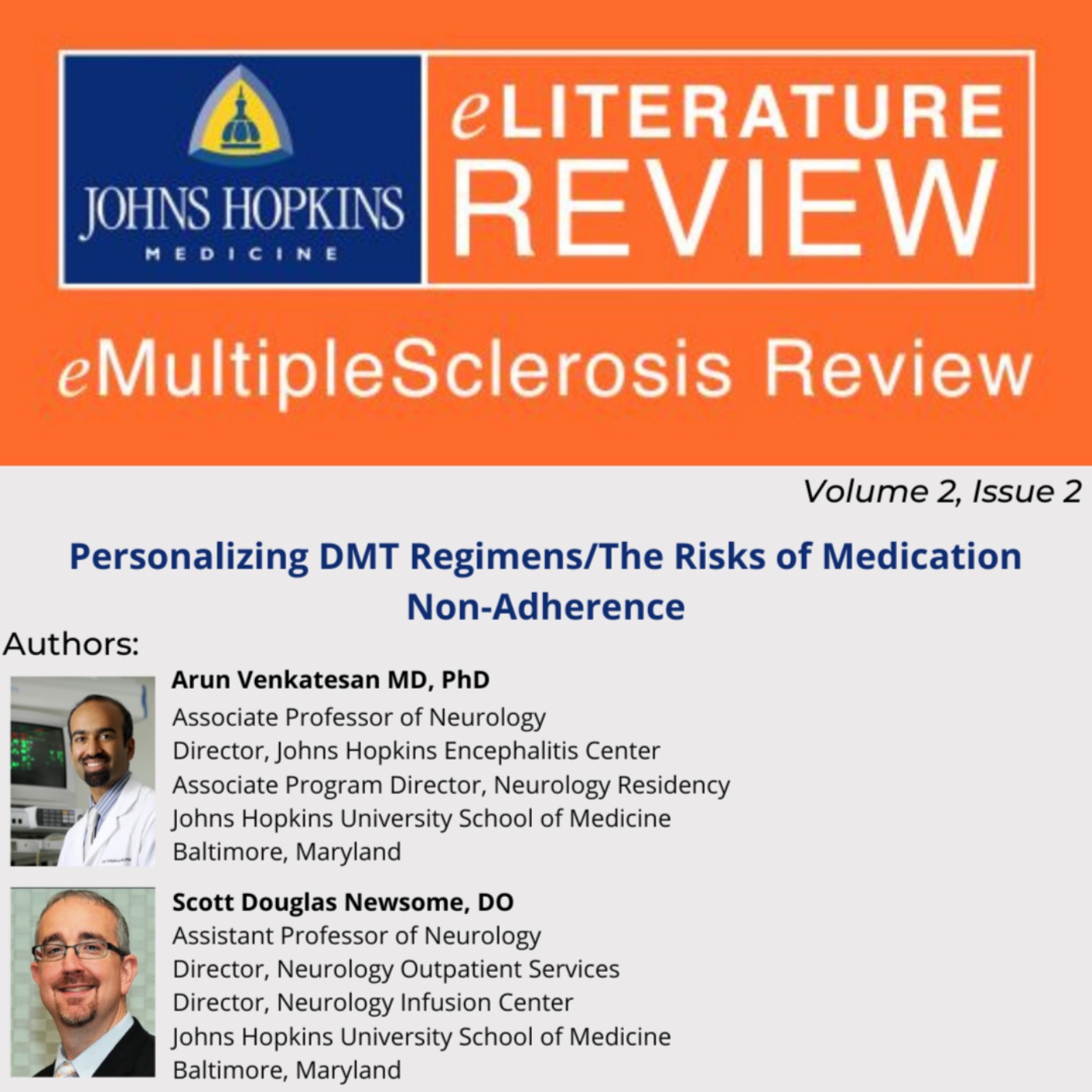
Personalizing DMT Regimens/The Risks of Medication Non-Adherence
Arun Venkatesan, MD, PhD and Scott Douglas Newsome, DO cover the important topics of personalizing DMT regimens and the risk of medication non-adherence in the format of case-study scenarios for the clinical practice.To read a companion newsletter click here. Hosted on Acast. See acast.com/privacy for more information.