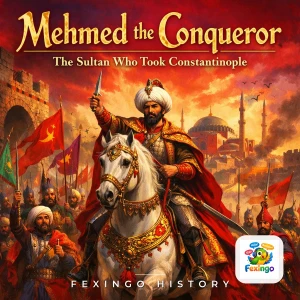
Mehmed the Conqueror: The Sultan Who Took Constantinople — Fexingo History
This podcast explores the life and legacy of Mehmed II, the Ottoman sultan who conquered Constantinople in 1453. Hosts Lucas and Luna examine his childhood, his obsession with Alexander the Great, and the famous siege involving massive cannons, a portable fleet, and underground mining. They also cover his post-conquest policies, including restoring the Ecumenical Patriarchate and commissioning the Topkapi Palace, as well as his campaigns against Vlad the Impaler and other rivals. The show delves into Mehmed's dual identity as a devout Muslim with an appreciation for Renaissance art and his legal and architectural achievements.
Episodes

Mehmed II and the Byzantine Legacy in Istanbul
While earlier episodes explored Mehmed II’s military campaigns, legal codes, and intellectual obsessions with Alexander the Great, this episode turns its gaze to the immediate aftermath of the conquest: the deliberate reconstruction of Constantinople as a living, breathing hybrid city. Lucas and Luna examine how the Sultan didn’t just occupy the Hagia Sophia but actively repopulated it, inviting d
Mehmed II's Lost Brother Cem Sultan and European Exile
This episode explores the dramatic life of Cem Sultan, Mehmed II’s younger brother whose bid for the throne led to a decade-long exile across Christian Europe. We trace his journey from the Battle of Otranto in 1480, where he fought against Ottoman forces sent by his own father, to his subsequent capture and handover to the Knights Hospitaller on Rhodes. The narrative follows his movement through
Mehmed II and the Janissary Revolt of 1476
By 1476, Mehmed II had conquered Constantinople, crushed Serbia, and terrified Europe, but his own army was turning against him. In this episode, we explore the dramatic Janissary Revolt of 1476, a rare moment when the Sultan’s elite troops forced his hand. We look at how the Devshirme system created a military class that could defy its master, and why Mehmed was compelled to reinstate Mahmud Pash
Mehmed II and the Rise of Janissary Power
We’ve talked about Mehmed’s sieges, his naval innovations, and his love for ancient texts, but we haven’t really looked at the engine that made it all possible: the Kapıkulu. This episode dives into the institutional heart of the Ottoman military—the Janissaries—and how their status evolved from loyal slaves of the Sultan to a powerful political faction. We explore the recruitment system, the reli
Mehmed II's Forbidden Library and the Picatrix
While Mehmed II is famous for capturing Constantinople in 1453, his true obsession was knowledge. This episode explores the Sultan’s secret library at Topkapi Palace, where he housed rare manuscripts from across the Islamic world and Byzantium. We examine his fascination with the Picatrix, a medieval grimoire on astrological magic, and how this controversial text influenced his court politics. Luc
Mehmed II's Intellectual Empire: Science, Law, and Legacy
While the fall of Constantinople in 1453 is legendary, Mehmed II’s true conquest was intellectual. This episode explores how the Sultan transformed his capital into a crossroads of Renaissance thought, inviting scholars from across the known world to his court. We examine the role of Gennadios Scholarios, the first Orthodox Patriarch under Ottoman rule, who navigated the delicate balance between s
Mehmed II's Ottoman Artisans and the Golden Horn Arsenal
While history remembers Mehmed II as the conqueror of Constantinople, his true legacy may lie in the workshops he built to sustain an empire. This episode explores the industrial might behind the Fatih Sultan Mehmed’s ambitions, focusing on the Tophane gun foundries and the shipyards that transformed the Golden Horn into a center of naval power. We dive into the lives of the craftsmen—gunners, car
Mehmed II's Obsession with Alexander the Great
While we have covered Mehmed’s military campaigns and legal codes, this episode explores his profound intellectual obsession with Alexander the Great. Lucas and Luna discuss how the Sultan adopted the title Kayser-i Rûm not just for political legitimacy, but to position himself as Alexander’s spiritual heir. We look at the portrait he kept in his chamber, the copies he commissioned across his empi
Mehmed II's Lost Brother: Cem Sultan's Exile
While Mehmed II is remembered as the Conqueror of Constantinople, his reign was shadowed by a bitter civil war with his younger brother, Cem Sultan. This episode explores the dramatic flight of Cem after the Battle of Otranto in 1473, where he fled not to safety, but into the hands of the Knights Hospitaller on Rhodes. From there, Cem became a pawn in European diplomacy, passed from castle to cast
Mehmed II's Persian Renaissance and the Birth of a Court Culture
While earlier episodes explored Mehmed’s military conquests and legal codes, this episode turns to his cultural ambitions. We examine how Mehmed II deliberately cultivated a court in Edirne and later Constantinople that rivaled Timurid Persia, inviting scholars like Akshamsaddin and poets like Fuzuli into his circle. The conversation traces his patronage of miniature painting, his translation proj
Mehmed II's Forbidden Books and the Picatrix
While previous episodes have explored Mehmed II’s military conquests and administrative reforms, this episode turns to his insatiable intellectual hunger. We examine how the Sultan built one of the most extensive private libraries in history, acquiring rare manuscripts from across the Islamic world and Europe. Lucas and Luna discuss the specific texts he sought, including the Picatrix, a complex g
Mehmed II's Legal Code and the Devshirme System
While earlier episodes have explored Mehmed II’s military conquests, intellectual pursuits, and naval innovations, this episode turns to the administrative machinery that held his empire together: the Kanunname. We examine how Mehmed codified Ottoman law beyond Sharia, creating a flexible legal framework that allowed for centralized control across diverse territories. The conversation delves into
Mehmed II and the Siege of Rhodes: A Naval Defeat
While Mehmed II is famous for taking Constantinople, his campaign against the Knights Hospitaller on the island of Rhodes in 1480 was a rare and costly failure. This episode explores the intense siege that tested the limits of Ottoman naval power and the fierce resistance led by Grand Master Pierre d'Aubusson. We look at how the Knights used Greek fire, fortified their walls with innovative design
Mehmed II and the Art of Psychological Warfare
Episode 248 shifts focus from the mechanics of siege to the psychology of conquest. We explore how Mehmed II weaponized fear, rumor, and spectacle before a single arrow was loosed. The episode details his use of psychological operations during the Balkan campaigns, particularly the calculated display of power in Shkodra and the strategic intimidation that preceded the fall of Constantinople. We ex
Mehmed II's Secret War: The Naval Shock at Constantinople
While most history books focus on the cannons that breached Constantinople’s walls, the true turning point of the 1453 siege happened in the dark hours before dawn, when Sultan Mehmed II ordered his fleet to be dragged overland. This episode explores the logistical miracle of transporting fifty ships through Galata and up the Golden Horn, bypassing the massive Byzantine chain that had protected th
Mehmed II's Naval Shock: Porting Ships Overland
In 1453, Mehmed II faced a seemingly impossible barrier: the Golden Horn chain. With no fleet large enough to break it and Byzantine galleys waiting inside, he ordered his engineers to build a road over the steep hill of Galata. In a single night, nearly one hundred ships were dragged on greased logs past the defensive chain and into the harbor. This episode explores the logistical nightmare, the
Mehmed II's Naval Shock: Porting Ships Overland
In 1453, Sultan Mehmed II faced a geographic impossibility to take Constantinople. The city was protected by massive chains stretching across the Golden Horn, blocking his fleet from reaching the vulnerable northern walls while Venetian and Genoese galleys held the harbor. Standard siege tactics failed against this naval barrier until an engineer named Mimar Ali proposed a radical solution: bypass
Mehmed II's Secret Naval Arsenal at Galata
While history remembers Mehmed II for his land armies and the famous overland transport of ships, this episode uncovers the hidden industrial engine that made Constantinople’s conquest possible: the Galata shipyards. We explore how Mehmed transformed a Genoese trading quarter into a militarized naval powerhouse before the siege even began. Lucas and Luna discuss the strategic importance of control
Mehmed II and the Golden Bull of Venice
Most histories focus on Mehmed II as the sword that shattered Constantinople, but his reign was equally defined by the pen that negotiated with Europe. This episode explores the complex diplomatic dance between the Ottoman Sultan and the Republic of Venice, specifically the series of capitulations known as the Golden Bulls. We examine how Mehmed used trade privileges not just for revenue, but as a
Mehmed II's Siege of Shkodra: Skanderbeg's Last Stand
While Mehmed the Conqueror is often defined by the fall of Constantinople, his military genius was equally forged in the rugged Balkans during the grueling siege of Shkodra. This episode explores the brutal winter campaign of 1478-1479, where the Ottoman army faced not just the formidable Albanian hero Gjergj Kastrioti Skanderbeg, but also the frozen terrain and Venetian naval support. We examine
Mehmed II's Balkan Campaigns and the Fall of Serbia
While Constantinople dominates the narrative of Mehmed II, his most brutal and enduring work was done in the Balkans. This episode explores the systematic dismantling of Serbian resistance after the Battle of Kosovo in 1459. We look at how Mehmed used military colonization to transform a rebellious province into an imperial asset. The story focuses on the strategic relocation of Christian populati
Mehmed II's Double-Headed Eagle: Byzantine Legacy
While previous episodes have explored Mehmed II’s legal codes, his harem, and the military mechanics of the siege, this episode focuses on the profound cultural and ideological transformation that followed the conquest. We examine how Mehmed II deliberately adopted the title Kayser-i Rûm, positioning himself not just as a conqueror but as the heir to Roman imperial tradition. The conversation trac
Mehmed II's War of Succession: Bayezid and the Prince Who Survived
While Mehmed II is remembered for conquering Constantinople, his early life was defined by a brutal struggle for survival against his own father, Murad II, and later his brother, Bayezid II. This episode explores the complex dynamics of Ottoman imperial succession, focusing on the 'Fratricide Law' that formalized killing siblings to secure the throne. We examine the political maneuvering behind th
Mehmed II and the Siege of Shkodra
After taking Constantinople, Mehmed II turned his gaze north to Shkodra, the last major Byzantine stronghold in Albania. This episode explores the brutal, eight-month siege that tested the Ottoman war machine against the Venetian garrison led by Skanderbeg’s cousin, Andrea Topia. We examine the tactical innovations of the siege, including the use of sappers and massive cannons, and how the city’s
Mehmed II's Failed Siege of Rhodes
In this episode, we explore the 1480 siege of Rhodes, a pivotal moment where Mehmed II’s Ottoman navy met its match against the Knights Hospitaller. While earlier episodes covered the fall of Constantinople and the Black Sea empire, this story focuses on Grand Master Pierre d'Aubusson and the city’s formidable fortifications. We examine how the Ottomans attempted to bypass the land walls by attack
Mehmed II's Failed Siege of Belgrade
In this episode, we look at the one major military failure that defined Mehmed II’s later reign: the siege of Belgrade in 1456. While earlier episodes covered his triumph in Constantinople and his administrative reforms, we focus on the brutal clash with John Hunyadi, the Hungarian regent who had spent years fortifying the Danube frontier. We explore the tactical mistakes Mehmed made underestimati
Mehmed II's Failed Siege of Belgrade
While history remembers Mehmed II as the Conqueror of Constantinople, his military record was not flawless. This episode explores the one major defeat that defined the limits of Ottoman expansion: the Siege of Belgrade in 1456. We examine how John Hunyadi, a Hungarian nobleman and military genius, turned back the Sultan’s army using innovative fortifications and guerrilla tactics. The conversation
Mehmed II and the First Modern Spy Network
While earlier episodes explored Mehmed II’s military might, legal codes, and cultural patronage, this episode turns to his intelligence apparatus. We examine how the Sultan built a sophisticated network of spies, diplomats, and informants across Europe and the Middle East long before modern espionage existed. Lucas and Luna discuss key figures like Gennadios Scholarios and Ali Qushji, who served a
Mehmed II's Double Eagle Legacy
While previous episodes have covered the cannons, the coinage, and the court intrigue surrounding Mehmed II, this episode explores a more subtle but enduring aspect of his reign: his deliberate adoption of Byzantine imperial symbolism to legitimize his rule over a Christian population. We examine how Mehmed styled himself as Kayser-i Rûm, or Caesar of Rome, and what that title truly meant in pract
Mehmed II's Secret Army of Child Soldiers
While earlier episodes explored Mehmed the Conqueror’s military might through cannons and diplomacy, this episode uncovers the human engine behind his empire: the devşirme system. We trace how Ottoman sultans collected Christian boys from the Balkans, converted them to Islam, and trained them into two distinct paths — the palace-educated Enderun scholars who became Grand Viziers, or the elite Jani
Mehmed II's Greek Renaissance: Saving Byzantine Knowledge
When Mehmed II stormed Constantinople in 1453, the world expected a cultural purge. Instead, he launched an unexpected intellectual revival. This episode explores how the Conqueror actively recruited Greek scholars, translated ancient texts, and preserved the legacy of Hellenistic philosophy within the Ottoman court. We trace his partnership with Gennadios Scholarios, the first Orthodox Patriarch
Mehmed II's Intellectual Legacy and Greek Renaissance
Episode 230 shifts focus from the cannons and courts of Mehmed II to the man behind the conquest: the scholar-sultan. We explore how Mehmed, known as Fatih, used his deep knowledge of history, philosophy, and languages to legitimize his rule over a conquered Christian capital. The episode details his patronage of Greek scholars like Gennadios Scholarios, his translation projects, and his self-styl
Mehmed II's Intellectual Empire: Art, Philosophy, and the Greek Legacy
While we have covered Mehmed II’s cannons, his harem, and his legal codes, this episode explores a different kind of conquest: the intellectual one. After taking Constantinople in 1453, Mehmed did not just occupy the city; he actively recruited its most brilliant minds to build a new cultural capital that rivaled Herat and Isfahan. We look at how Mehmed assembled a court of Greek philosophers, Per
Mehmed II and the Janissary Rebellion of 1482
We often think of Mehmed II as an absolute ruler, but his final years were marked by a dangerous fracture between the Sultan and the very military elite he built. This episode explores the 1482 Janissary revolt in Edirne, sparked by rumors that Bayezid II had been killed. We trace how the Kapıkulu corps, originally loyal servants of the state, began to assert political power through collective act
Mehmed II's Persian Renaissance: Art, Poetry, and Power
While we have explored the cannons that breached Constantinople’s walls and the legal codes that bound the empire together, Episode 227 turns inward to the cultural heart of Mehmed II’s court. We examine how the conqueror utilized art, poetry, and diplomacy to legitimize his rule as Kayser-i Rûm, the Roman Emperor. The episode details his patronage of the painter Bihzad in Herat, his complex relat
Mehmed II's Double-Headed Eagle: The Byzantine Legacy
When Mehmed II entered Constantinople in 1453, he didn't just destroy the Byzantine Empire; he inherited it. This episode explores how the Conqueror adopted the double-headed eagle of the Palaiologoi, positioning himself as Kayser-i Rûm, or Caesar of Rome, to legitimize his rule over Orthodox Christians and rival Muslim sultans. We examine the political calculus behind this symbolic theft, the com
Mehmed II's Harem: Power, Politics, and the Valide Sultan
While earlier episodes explored Mehmed II’s military campaigns, legal codes, and diplomatic spycraft, this episode turns its gaze inward to the Topkapı Palace’s most politically charged space: the Harem. We trace the evolution of the Sultan’s private quarters from a modest residence into a complex bureaucratic hierarchy led by the Valide Sultan. We examine how figures like Gulbahar Hatun navigated
Mehmed II's Legal Code: Building an Empire Through Law
While we often remember Mehmed II for his cannons and conquests, his true legacy lies in the meticulous legal framework he built to hold the Ottoman Empire together. In this episode, Lucas and Luna explore the Kanunname, the secular laws that governed land, taxation, and military service, working alongside Sharia to create a stable administrative state. We dive into the specific reforms of the Top
Mehmed II's Lost City: The Palace of Topkapi and Its Hidden Courts
We leave behind the cannons, the coinage, and the court chroniclers to explore the physical heart of Mehmed II’s new empire: the Topkapı Palace. While earlier episodes touched on its construction and its role as an administrative center, this episode dives into the intricate social architecture within those walls. We examine how the Harem functioned not just as a private residence but as a politic
Mehmed II's Diplomatic Spies and the Fall of Trebizond
While we’ve covered Mehmed II’s cannons, navy, and palace schools, this episode explores a different kind of siege weapon: espionage. In 1461, just before his final push on Constantinople had fully settled into Ottoman rule, Mehmed turned his gaze east to the Empire of Trebizond. This small Greek successor state clung to the Black Sea coast, protected by mountains and Byzantine tradition. But Sult
Mehmed II's Secret Library: The Sultan's Quest for Knowledge
In this episode, we explore a side of Mehmed the Conqueror rarely discussed: his passion for books and learning. Lucas and Luna discuss how the sultan, who took Constantinople in 1453, built a personal library that rivaled the great collections of the Renaissance. We hear about the Italian humanists who wrote to him, the Greek scholars he welcomed to his court, and the famous library of the Topkap
Mehmed II's Court Chronicler: The Pen Behind the Conqueror
In this episode, Lucas and Luna step away from the cannons and conquests to meet the man who shaped how we remember Mehmed II: Tursun Beg, the Ottoman court chronicler. Tursun Beg wasn't just a scribe — he was an eyewitness to the fall of Constantinople, a bureaucrat in the imperial chancery, and the author of the 'History of Mehmed the Conqueror' (Tarih-i Ebü'l-Feth), a work that framed the sulta
The Sultan's Shadow: Mehmed II and the Janissary Corps
In this episode of Fexingo History, Lucas and Luna step away from Mehmed II's conquests to examine the institution that made them possible: the Janissary Corps. From the devshirme levy that took Christian boys as a tax, to their transformation into the most disciplined infantry in Europe, the Janissaries were both the sultan's sword and his greatest threat. Lucas walks Luna through their origins u
Mehmed II's Salt Trade and the Black Sea Empire
In this episode of Fexingo History, Lucas and Luna explore Mehmed II's strategic control of the salt trade, a vital commodity that funded his conquests and solidified Ottoman dominance over the Black Sea. They discuss the Kaffa region, the Genoese merchants, and the pivotal 1475 campaign that brought the Crimean port under Ottoman rule, reshaping trade routes from the Mediterranean to the steppes.
Mehmed II and the Cannon That Broke Byzantium
In 1453, the fate of Constantinople rested on a gunpowder gamble. This episode digs into the story of Urban, the Hungarian engineer who built the great bombard for Mehmed II — the şahi cannon that battered the Theodosian Walls for weeks and helped topple an empire. We look at how Mehmed assembled his siege train at Edirne, the logistics of dragging tons of bronze and stone across Thrace, and the s
Mehmed II's Grand Vizier: Mahmud Pasha, the Conqueror's Right Hand
In this episode of Fexingo History, Lucas and Luna explore the remarkable career of Mahmud Pasha, the grand vizier who served as Mehmed II's chief minister, general, and diplomat during the most critical years of the Ottoman expansion. Born a Serbian despot's son, devşirme-recruited into Ottoman service, Mahmud Pasha rose to become the sultan's most trusted lieutenant. He led armies to victory in
The Salt of Empire: Mehmed II's Ottoman Coinage
In this episode of Mehmed the Conqueror: The Sultan Who Took Constantinople, Lucas and Luna dig into the forgotten engine of the Ottoman state: the sultan's coinage. From the silver akçe to the gold sultani, Mehmed II's monetary reforms were as transformative as his conquests. Lucas explains how the conquest of Constantinople was funded by a currency overhaul, how the sultan wrestled control of mi
Mehmed II's Poisoned Melon: The Sultan's Final Meal
In 1481, Mehmed the Conqueror died at just 49. The official story said a stomach ailment. But whispers of poison — and a suspicious melon — have haunted historians for centuries. In this episode, Lucas and Luna dig into the Sultan's last days: the campaign rumored to be aimed at Rhodes or even Rome, the Venetian physician Giacomo da Gaeta (known as Hekim Yakub) who attended him, and the political
Mehmed II's Forgotten Frontier: The Karamanid Campaigns
Before he took Constantinople, before he built an empire, Mehmed II had to win his own backyard. This episode of Fexingo History follows the young sultan's relentless campaigns against the Karamanid beylik — the Anatolian dynasty that kept testing Ottoman power. We trace the shifting alliances, the brutal sieges of Konya and Karaman, the chess moves against the Akkoyunlu ruler Uzun Hasan, and the
Mehmed's Secret Weapon: The Sultan's Poison Squad
Before the fall of Constantinople, Mehmed II faced a threat more insidious than any enemy army: assassination. In this episode, Lucas and Luna explore the shadowy world of Ottoman poisoners and the countermeasures the Conqueror deployed to protect himself. From the famous poisoned melon of 1479, which claimed the life of his son-in-law, to the role of the palace physician Hekim Yakub, who was both
Mehmed II's Naval Arsenal: The Tersane-i Amire
In the years after Constantinople fell, Sultan Mehmed II set out to build the Ottoman navy into a force that could challenge Venice and control the eastern Mediterranean. At the heart of this effort was the Tersane-i Amire, the imperial shipyard at Kasımpaşa on the Golden Horn, which grew from a small Byzantine dock into the largest naval construction site in the Mediterranean. This episode follow
Mehmed II's Secret Weapon: The Ottoman Cannon Foundries
In 1453, Mehmed II's army breached the walls of Constantinople with some of the largest cannons the world had ever seen. But where did those guns come from, and how did the Ottomans cast them? This episode follows the story of the foundries that made the conquest possible—from the master founder Urban, who first offered his services to the Byzantines, to the massive bronze bombard that fired a 1,2
The Sultan's Diet: Mehmed II and the Poisoned Melon
In this episode of Fexingo History, Lucas and Luna peel back the layers of a little-known but telling incident from the reign of Mehmed II: the sultan's fascination with a giant melon sent as a tribute gift — and the fear that it might be poisoned. The year is 1476, and the gift comes from the Karamanid ruler, İshak Bey, a vassal with a history of rebellion. Mehmed's court physicians, led by the J
Mehmed II's Grand Bazaar: The Conqueror's Economic Engine
In 1461, Mehmed the Conqueror ordered the construction of a covered market at the heart of his new capital. That market, the Grand Bazaar, would grow into one of the world's oldest and largest shopping centers. But it was more than commerce—it was statecraft. This episode explores how Mehmed II used the bazaar to rebuild Constantinople's economy, attract merchants, and bind his diverse empire toge
Mehmed II's Cem Sultan: The Sultan's Exiled Son
In Episode 207 of Mehmed the Conqueror, we follow the tragic story of Cem Sultan, the son who challenged his brother Bayezid II for the Ottoman throne after Mehmed's death in 1481. Caught between the glitter of Renaissance courts and the cold politics of Christendom, Cem spent thirteen years as a hostage, first with the Knights Hospitaller in Rhodes, then in France and Italy, his life a chess piec
Mehmed II and the Great Gunpowder Debate
In Episode 206 of our Mehmed the Conqueror series, we tackle a question that's fascinated historians for centuries: was the fall of Constantinople in 1453 really due to the mighty Ottoman bombard? Lucas and Luna dig into the evidence—from the famous bombard built by Urban, the Hungarian engineer, to the logistical nightmare of hauling it to the city walls. They explore how Mehmed II's use of gunpo
The Sultan's Faith: Mehmed II and the Church of the Apostles
In this episode, Lucas and Luna explore a lesser-known chapter of Mehmed the Conqueror's reign: his relationship with the Greek Orthodox Church after the fall of Constantinople. They discuss how Mehmed appointed Gennadios Scholarios as patriarch, granted the Church privileges, and even engaged in theological debates. The episode centers on the Church of the Holy Apostles, which Mehmed initially gr
Mehmed II's Palace School: The Making of an Ottoman Elite
In the decades after the conquest of Constantinople, Sultan Mehmed II built an institution that would shape the Ottoman Empire for centuries: the Enderun, the palace school. This episode explores how the Conqueror took the ancient practice of devshirme — the levy of Christian boys — and turned it into a rigorous academy for statesmen, generals, and administrators. We follow the journey of a boy fr
Mehmed II's Navy: The Admiral Who Built an Empire
In this episode, Lucas and Luna explore the naval side of Mehmed the Conqueror's reign, focusing on the transformation of the Ottoman fleet from a modest force into a dominant Mediterranean power. They discuss the crucial role of Baltaoğlu Süleyman Bey, the admiral who led the navy during the siege of Constantinople, and his controversial failure at the Chain of Galata. The conversation then shift
The Hidden Science: Mehmed II's Observatory and Astronomy
In Episode 202 of Fexingo History, Lucas and Luna explore a lesser-known facet of Mehmed the Conqueror: his passion for astronomy. From a young age, Mehmed was tutored by the greatest minds of his era, and as sultan, he patronized scholars and built an observatory in the heart of Constantinople. This episode uncovers the story of Ali Qushji, the Timurid astronomer who brought the Samarkand school
The Conquest of Trebizond: Mehmed's Last Byzantine Prize
In 1461, eight years after Constantinople fell, the last independent Byzantine Greek state vanished. Trebizond, a remote empire on the Black Sea coast, had survived for over two centuries thanks to its mountain defenses, its diplomacy, and the rivalry between Ottomans and their enemies. In this episode, Lucas and Luna explore how Mehmed II, the Conqueror, finally brought Trebizond into the fold. T
Mehmed II and the Ottoman Renaissance Man
In our 200th episode on Mehmed the Conqueror, we step away from the battlefield to explore his intellectual side. Forget the cannons and the siege for a moment — as the poet Avni, Mehmed wrote verses that still resonate. But his cultural ambition went deeper: he commissioned a portrait from the Venetian artist Gentile Bellini, invited scholars from across the world to his court, and built a palace
Mehmed II's Post-Conquest Islamization of Constantinople
In the years after 1453, Sultan Mehmed II transformed the conquered city of Constantinople into the Ottoman capital, Istanbul. This episode digs into the gritty mechanics of that transformation — the forced deportations (sürgün) that repopulated the empty streets, the conversion of churches into mosques, the establishment of Muslim quarters and the great medreses, and the delicate balancing act wi
The Sultan's New Language: Mehmed II and the Turkish Renaissance
In this episode of Fexingo History, Lucas and Luna explore a surprising chapter in the reign of Mehmed the Conqueror: his efforts to forge a new Ottoman literary language. After taking Constantinople in 1453, Mehmed II—himself a poet writing under the pen name Avni—set out to create a Turkish that could rival Persian and Arabic as a language of high culture. We look at how he gathered poets and sc
The Conqueror's Shadow: Mehmed II's Secret Police
Every empire needs eyes and ears. For Mehmed the Conqueror, that meant a shadowy network of informants, spies, and enforcers who reported directly to the sultan. In this episode, Lucas and Luna explore how the Fatih built his intelligence apparatus—from the çavuş, who carried the sultan's orders and watched his governors, to the oda, the sultan's inner chamber where loyalty was tested and secrets
The Janissary Revolt of 1446: Mehmed II's First Lesson
Before he conquered Constantinople, Mehmed II faced a humiliating setback: the Janissary revolt of 1446. This episode unpacks the intricate politics of the Ottoman court, where a child sultan, a powerful grand vizier, and a restless army collided. We trace the origins of the Janissary corps, the devşirme system that recruited them, and the economic crisis — triggered by a debased currency — that p
Mehmed II's New Rome: The Rebuilding of Constantinople
After the conquest of 1453, Mehmed II faced a ruined city. This episode explores how the Conqueror repopulated and rebuilt Constantinople, turning a desolate Byzantine ghost town into the bustling Ottoman capital. Lucas and Luna discuss the sürgün forced resettlement policy, tax incentives, the construction of the Grand Bazaar and Topkapı Palace, and Mehmed's vision of himself as Kayser-i Rûm, the
Mehmed II's Ottoman Reform: The Kanunname of 1478
In this episode, Lucas and Luna explore Mehmed II's legal reforms and the Kanunname of 1478, the first comprehensive Ottoman law code. They discuss the sultan's efforts to centralize authority, the role of the devşirme, the codification of taxes and criminal law, and the influence of Islamic jurisprudence. The episode also covers the creation of the imperial council (divan), the establishment of t
Mehmed II's Secret Topkapi Library and the Lost Codex
In this episode, Lucas and Luna explore a little-known corner of Mehmed the Conqueror's legacy: his secret library in Topkapi Palace, where the sultan amassed Greek, Latin, Persian, and Arabic manuscripts—including a mysterious codex that may have been a lost work of Ptolemy. We trace the library's creation, its chief librarian, the Italian humanist Gian Maria Angiolello, and the famous 'Trabzon G
The Sultan's Secret Weapon: Mehmed II's Bodyguard Corps
In the aftermath of Constantinople's fall, Mehmed II built more than a new capital—he built a new kind of ruler. This episode digs into the shadowy institution that made his power possible: the sultan's personal bodyguard corps, the peyk and solak. These were no ordinary guards. Recruited through the devşirme, trained in silence, and bound by an oath of utter loyalty, they were the sultan's shadow
Mehmed II's Venetian Spy: The Secret Diary of a Bailo
In 1463, Venice's new bailo to Constantinople, Giovanni Emo, walked into a city still scarred from the 1453 sack. His secret reports—decoded in the Venetian archives—give us a rare street-level view of Mehmed the Conqueror's capital: the bustle of the Grand Bazaar, Greek notables speaking Turkish, the sultan's obsession with the ancient cisterns, and the quiet dread of a war with Venice that would
The Fall of Çandarlı Halil: Mehmed II's First Political Execution
After taking Constantinople in 1453, Sultan Mehmed II didn't just conquer a city — he shattered the old Ottoman order. In this episode, Lucas and Luna trace the dramatic rise and fall of Çandarlı Halil Pasha, the grand vizier from a distinguished Turkish family who had served two sultans, opposed the great siege, and paid for it with his life. We explore the dynastic power plays, the role of devşi
Mehmed the Conqueror as Avni: The Sultan Who Wrote Poetry
When Mehmed II wasn't conquering empires, he was writing verses. Under the pen name Avni, the same hand that ordered the conquest of Constantinople also composed ghazals in Persian and Turkish. This episode dives into Mehmed's education under Molla Hüsrev and Ali Qushji, his patronage of poets like Ahmet Pasha, and the themes of his divan—power, love, mortality, and his vision of himself as a univ
Mehmed II vs Skanderbeg: The Albanian Eagle
In the decades after conquering Constantinople, Mehmed II turned his attention to a stubborn foe in the Albanian highlands: Gjergj Kastrioti, known as Skanderbeg. A former janissary who defected to lead a rebellion, Skanderbeg held off Ottoman armies for over two decades. This episode traces Mehmed's campaigns against the League of Lezhë, the key sieges of Krujë, and the guerrilla warfare that fru
The Siege of Rhodes 1480: Mehmed II's Great Defeat
In 1480, Sultan Mehmed II — fresh from conquering Constantinople and expanding Ottoman power across the Aegean — turned his sights on the island fortress of Rhodes, held by the Knights Hospitaller. This episode dives into the two-month-long siege, the massive Ottoman assault involving tens of thousands of troops and heavy artillery, and the surprisingly resilient defense led by Grand Master Pierre
Mehmed II and the Fall of Mystras: The Last Byzantine Despotate
In this episode of Fexingo History, Lucas and Luna explore Mehmed the Conqueror's campaigns against the Despotate of Morea, the final Byzantine stronghold in Greece. After the fall of Constantinople in 1453, the despotate was ruled by the feuding brothers Demetrios and Thomas Palaiologos. Mehmed exploited their divisions, first subjugating the region in 1458 and then completing the conquest in 146
Mehmed II vs Uzun Hasan: The Battle of Otlukbeli 1473
After conquering Constantinople and crushing the Karamanids, Sultan Mehmed II faced his most dangerous eastern rival: Uzun Hasan of the Akkoyunlu confederation. In 1473, Uzun Hasan allied with the Karamanids and Venice, threatening Ottoman control of Anatolia. Mehmed marched east with a massive army, including new field artillery and disciplined Janissaries. The two forces met at Otlukbeli, near E
Mehmed II's Otranto Campaign: The Unfinished Conquest
In 1480, eight years after his conquest of Constantinople, Sultan Mehmed II launched an audacious invasion of Italy. An Ottoman fleet under Gedik Ahmed Pasha crossed the Adriatic and besieged the city of Otranto in Apulia. The siege lasted two weeks, ending with a massacre that shocked Christendom and created martyrs venerated to this day. This episode explores Mehmed's grand ambition to capture R
Mehmed II and the Orthodox Patriarch: Birth of the Millet System
In 1454, just a year after the Fall of Constantinople, Sultan Mehmed II did something unexpected: he personally appointed a new Ecumenical Patriarch. The man he chose was Gennadius Scholarius, a fierce anti-unionist theologian who had openly preferred Ottoman rule to Catholic subjugation. This episode explores Mehmed's strategy of using the Orthodox Church as a tool of governance—a pragmatic move
Mehmed II's Naval War: The Siege of Negroponte (1470)
In 1470, Sultan Mehmed II launched the largest Ottoman naval expedition yet against the Venetian stronghold of Negroponte (modern Chalkis) on the island of Euboea. This episode chronicles the siege—the massive fleet of 200 ships, the artillery bombardment from sea and land, the desperate defence by Venetian captain Girolamo Loredan, and the final assault by Janissaries. We explore how Mehmed built
Recommended

Solved Murders - True Crime Stories

紐約鳥|New York Aperture

The Swerve Podcast: Obscure Topics | Conspiracy Theories

The Bread and Banter Podcast

The Church of What's Happening Now: The New Testament

Busted Open

Deadline: White House

Crickets Corner

History of the Earthquake and Fire in San Francisco

Fox news

K-Drama Obsessed Mamas | Beyond “Just One More Episode!”

True Crime Classics
